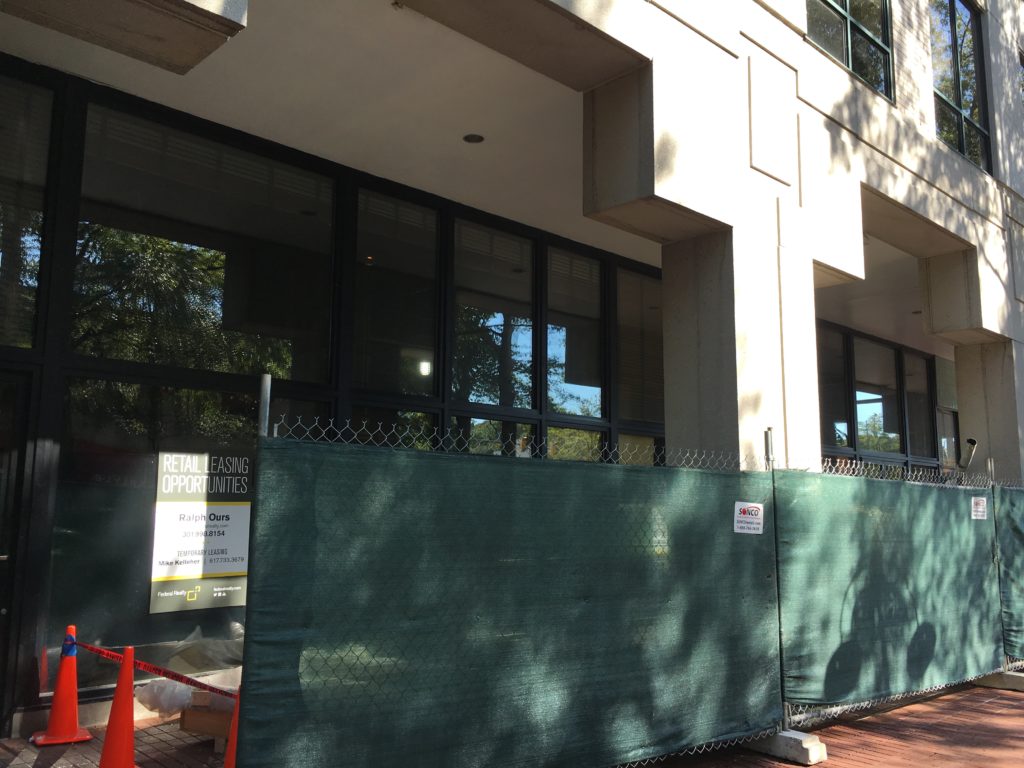
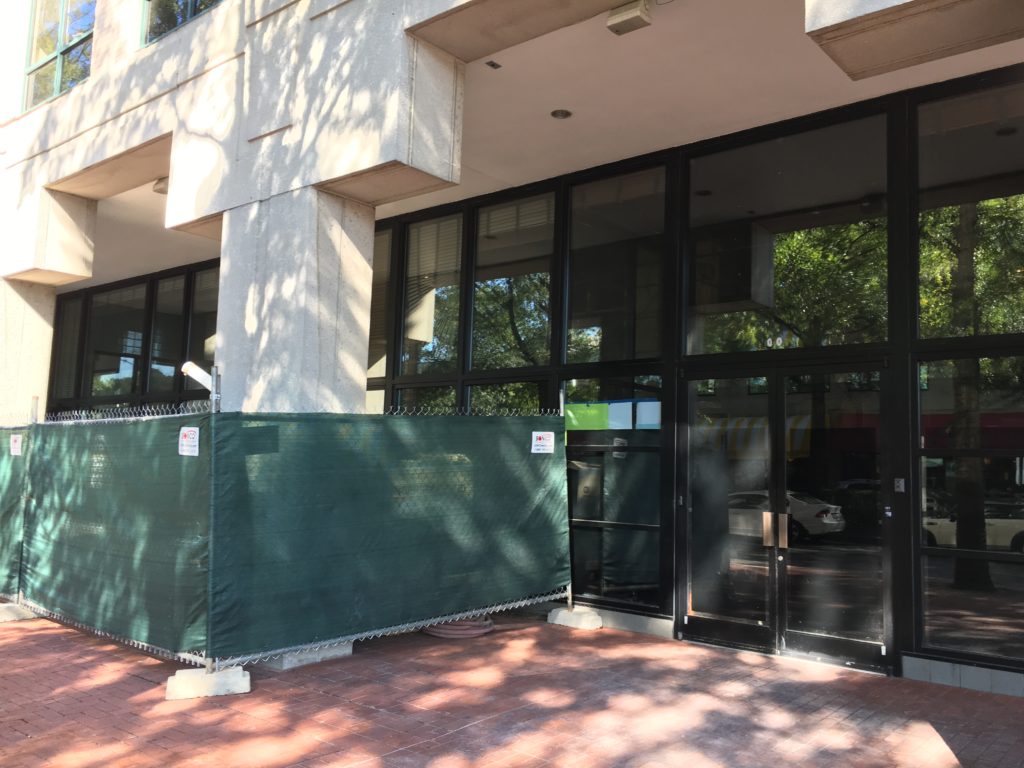
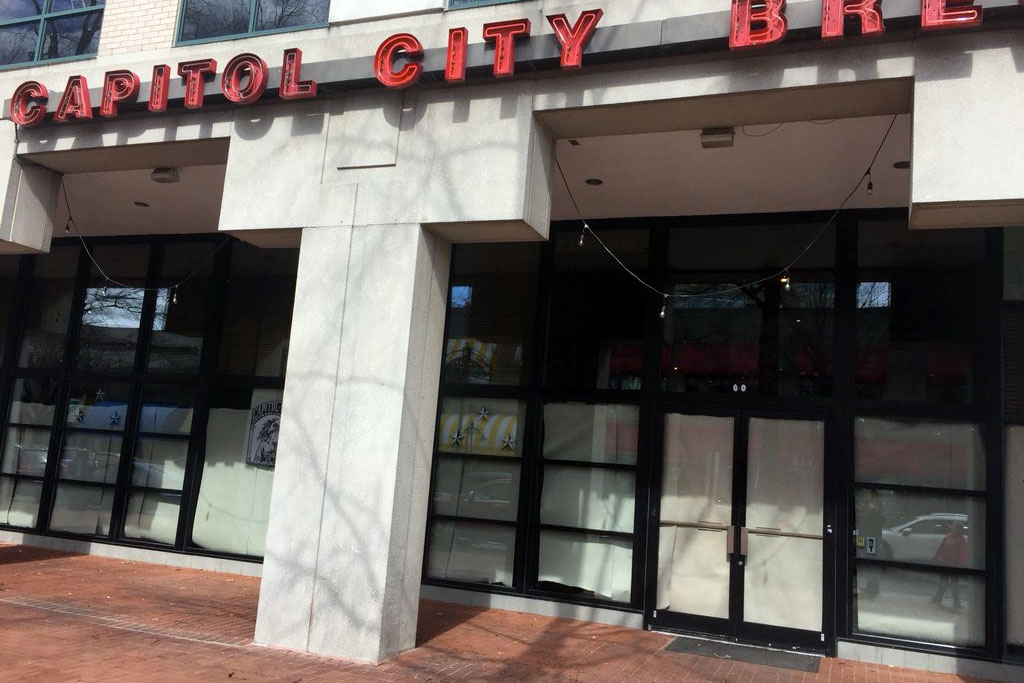
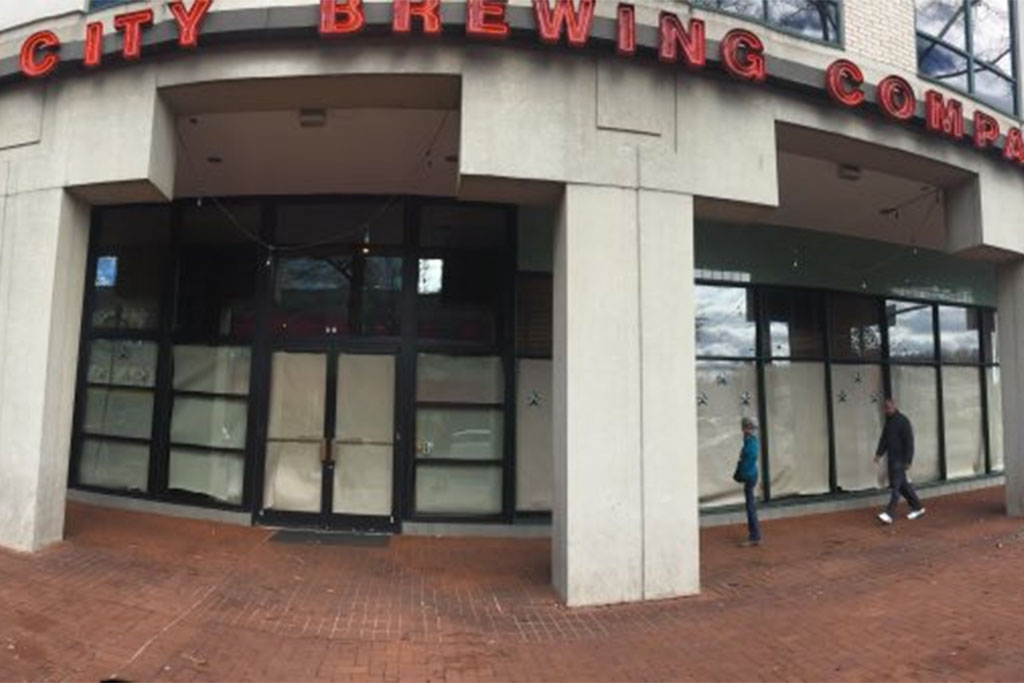
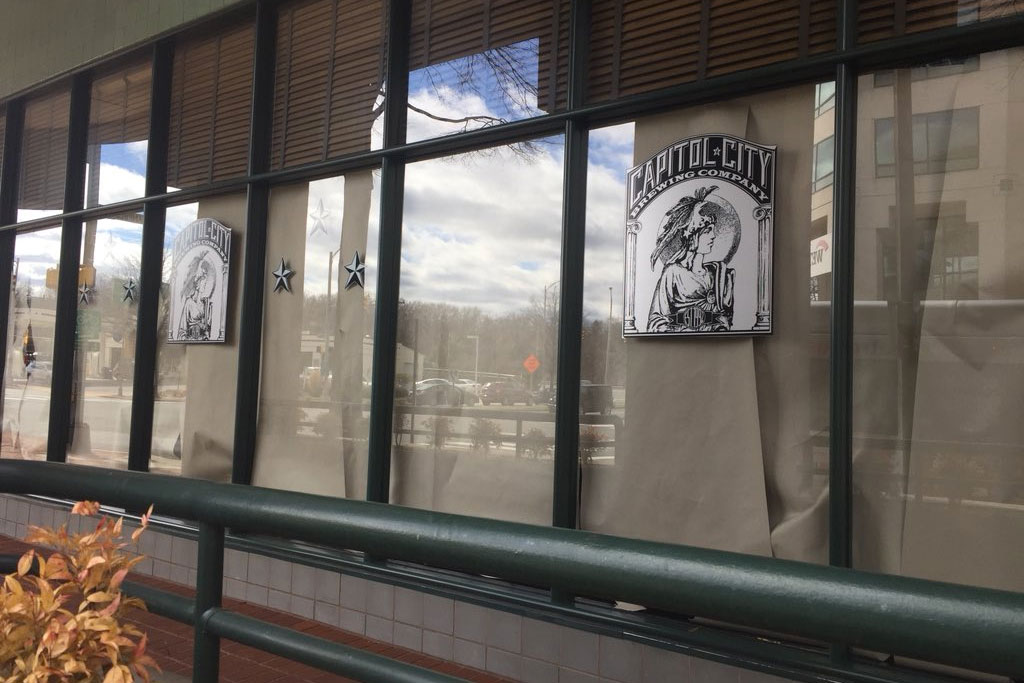
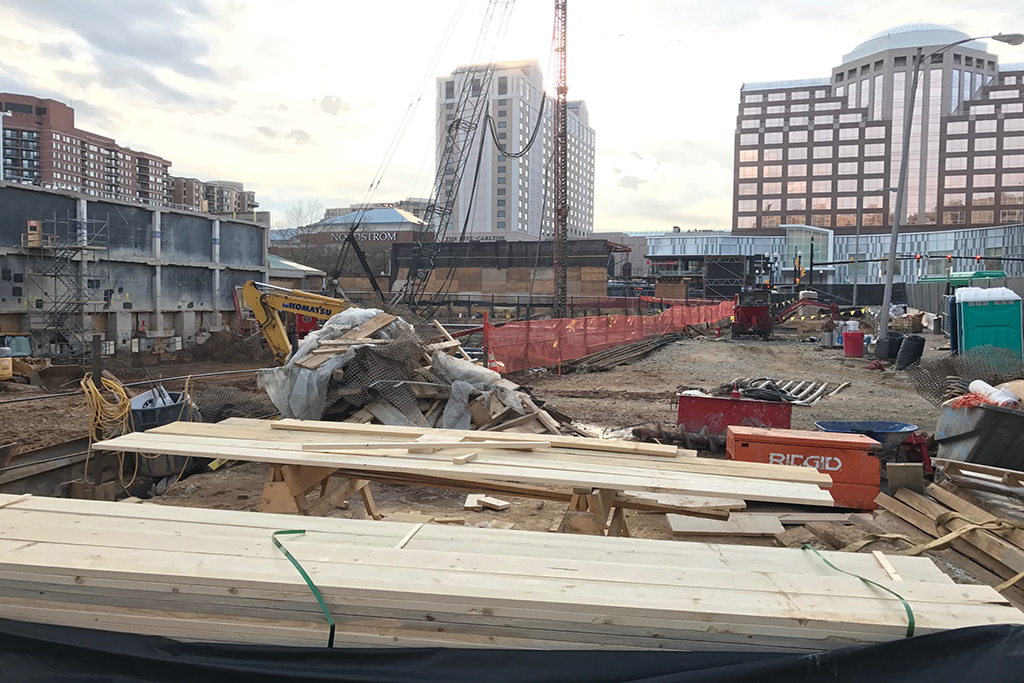
The former Capitol City Brewing space in the Village at Shirlington
The former Capitol City Brewing space in the Village at Shirlington
Capitol City Brewing closed in Shirlington (photo courtesy @007AgentPerry)
Capitol City Brewing closed in Shirlington (photo courtesy @007AgentPerry)
Capitol City Brewing closed in Shirlington (photo courtesy @007AgentPerry)
A new restaurant could soon be on the way for the space formerly occupied by Capitol City Brewing in Shirlington.
A tipster recently told ARLnow that workers in the area believe Lazy Dog Restaurant and Bar is eyeing the property at 2700 S. Quincy Street, part of the Village at Shirlington shopping center. The chain is primarily based in California, with locations in Colorado, Illinois, Nevada and Texas.
Barbara Caruso, a spokeswoman for Lazy Dog, confirmed that the restaurant is evaluating the location, which would be its first in the D.C. area.
“Lazy Dog is exploring a potential future location in the Arlington area but a lease has not yet been signed,” she said.
According to the restaurant’s website, the menu is centered around traditional American fare, with brunch options as well. Lazy Dog also boasts an extensive beer list.
Since Cap City closed up shop in March, ending its 22 years in business, the space has seen a flurry of construction activity, but otherwise remained empty. That work could be tied to plans from the shopping center’s owner, Federal Realty Investment Trust, to add new buildings to the area and refresh the development.
The property owner asked county officials for a special General Land Use Plan review of the area last December, which could ultimately clear the way for more density on the site. However, that request “has not been addressed due to the current county staff workload,” according to minutes from a Nov. 14 meeting of the Long Range Planning Committee.
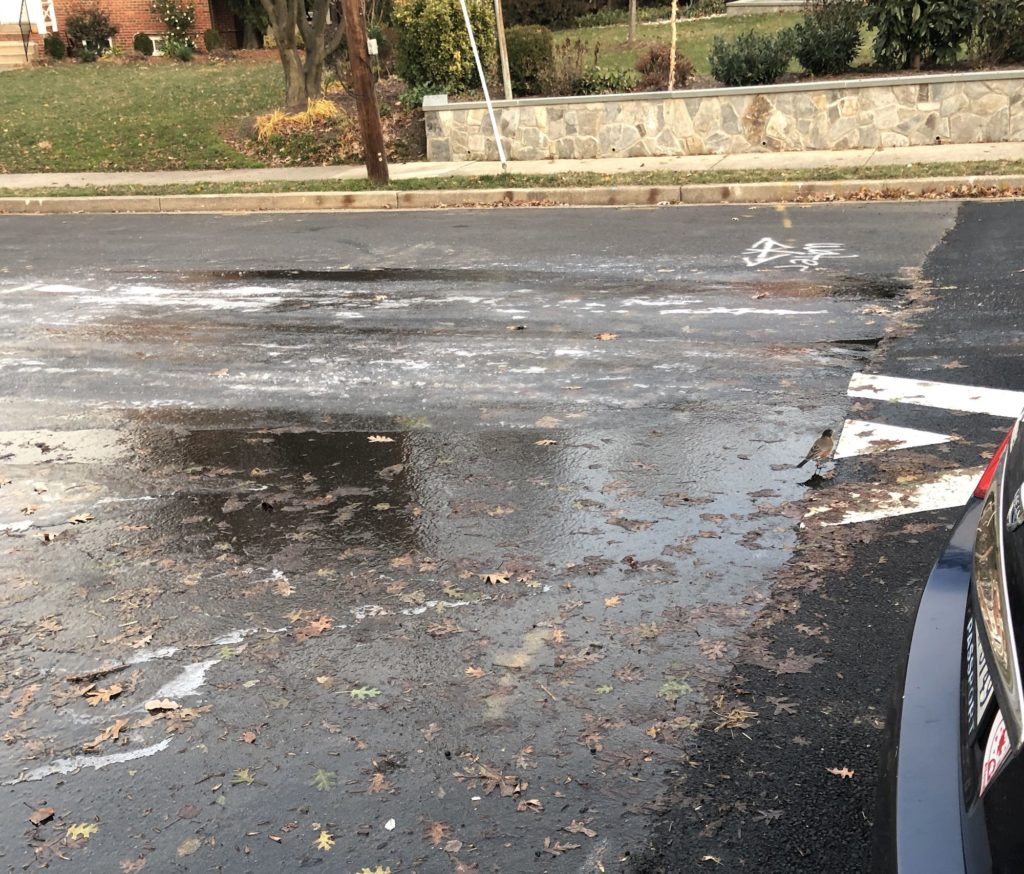
Some Yorktown residents say their neighborhood has become an icy mess at times over the last few weeks — and they believe a newly installed speed bump is to blame.
County officials still aren’t sure of the exact problem on the road, but they aren’t willing to blame the speed bump quite yet. Regardless of the exact source of the issue, people living along 26th Street N. as it runs between N. George Mason Drive and N. Glebe Road, say they’re desperate for a solution.
“We have had to have the county send salt trucks twice since [last] Friday to specifically address the road downhill from the speed bump,” David Miller, who lives along the 4900 block of 26th Street N., told ARLnow via email. “We expect this will be worse as we have more days below 32 degrees. We have not seen any accidents yet as a result of the ice/water, but have had our own cars slide while coming out of our driveway, so we fully expect it is only a matter of time.”
Miller says the road first started getting soaked with water about six months ago, the day after the county removed a speed bump from the area. Accordingly, neighbors can’t help but draw a connection between the two events.
However, he says the issue wasn’t serious until about six weeks ago, when the county installed a new speed bump and temperatures started to dip, leading residents to inform county officials about the problem. Everyone living in the area is convinced this is due to a leak of some kind, Miller said, but the county hasn’t come to a definitive conclusion just yet.
Katie O’Brien, a spokeswoman for the county’s Department of Environmental Services, says workers are indeed “actively investigating” what’s going on in the neighborhood. She says county staff “have been unable to identify a leak” thus far, making it possible that there are other factors at play in the area.
“Due to the record amount of rain we have received this year, there are a number of locations throughout the county that are supersaturated and the standing ground water may give off the appearance of a water main leak,” O’Brien wrote in an email. “We are also monitoring these locations as a precaution.”
Miller does give the county credit for its responsiveness to the issue, but remains frustrated that the problem is still unsolved all these weeks later. With temperatures continuing to plummet, he fears what will happen if the county still can’t find a fix in the coming months.
“Everyone on the street is concerned for the danger that the ice is creating,” he said.
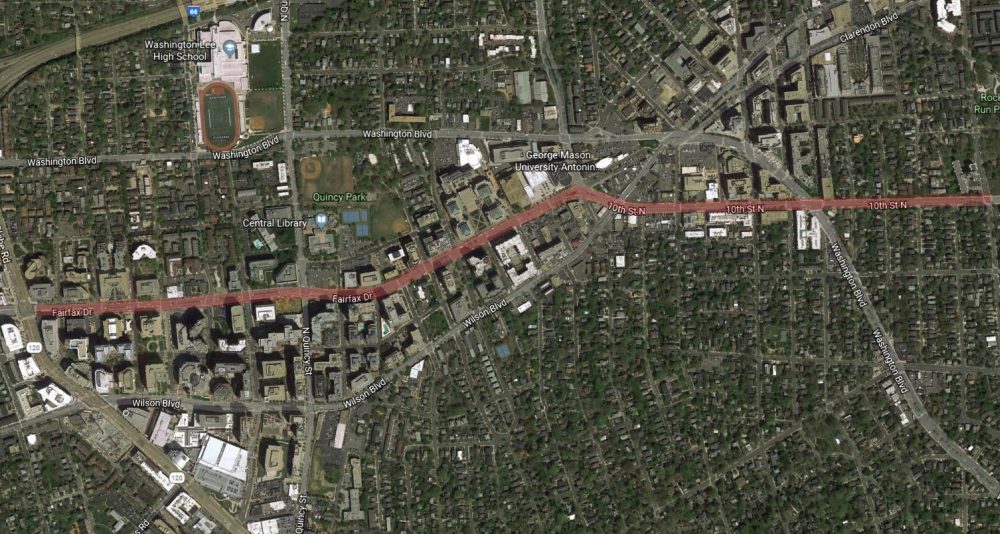
County officials are planning some improvements along Fairfax Drive and 10th Street N. as the roads run from Ballston to Clarendon, with a special focus on ways to make the corridor safer for drivers, pedestrians and cyclists alike.
Arlington transportation planners are circulating a survey seeking feedback on how the roads should change, as the county weighs a series of modest improvements over the next few months. In all, the study area stretches from Fairfax Drive’s intersection with N. Glebe Road in Ballston to 10th Street N.’s intersection with N. Barton Street in Lyon Park.
The county is envisioning changes along the 1.5-mile-long stretch of road as “short-term, quick-build projects to enhance safety and mobility on the corridor.” Officials hope to eventually commission more expansive changes, after it took over management of the roads from the state this summer, but the county’s budget crunch means that options are limited, for now.
But, in the near term, the county plans to examine “multimodal traffic volume data, curbspace use, crash data, and transit service data” in addition to the community’s feedback to chart out small-scale changes, according to a project webpage.
The advocates with the group Sustainable Mobility for Arlington County certainly have some suggestions for the corridor. The group sent an email to its members urging them to advocate for the transformation of Fairfax Drive into a “low-stress biking corridor, even if it requires re-purposing space from motor vehicles,” in addition to other cycling improvements.
“The existing Fairfax Drive bike lanes are narrow, frequently blocked, and fail to be low-stress due to fast-moving traffic,” the advocates wrote. “The existing, short two-way protected bike lane should be extended all the way from Glebe Road to Clarendon Circle.”
The group also argues that 10th Street N. and Fairfax Drive both lack safe road crossings, particularly as the corridor runs from N. Barton Street in Lyon Park to N. Monroe Street in Virginia Square.
“This makes the corridor a barrier,” they wrote. “Additional safe crossings should be provided and these crossings must be simple and easy to use for cyclists as well as pedestrians.”
The county survey on road improvements will be open for submissions through Dec. 16. Officials hope to have short-term recommendations ready by sometime early next year, then install those by the spring or summer of 2019.
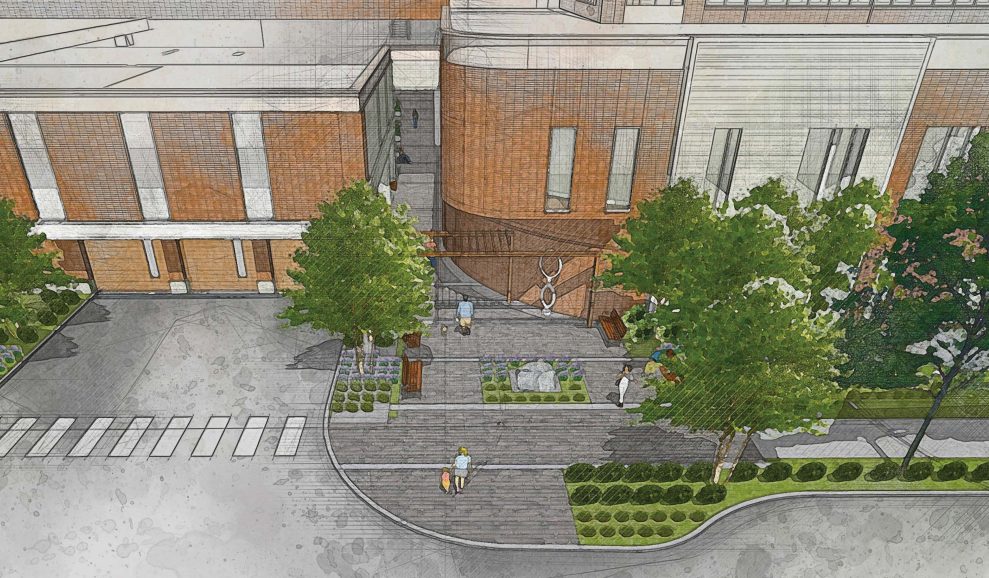
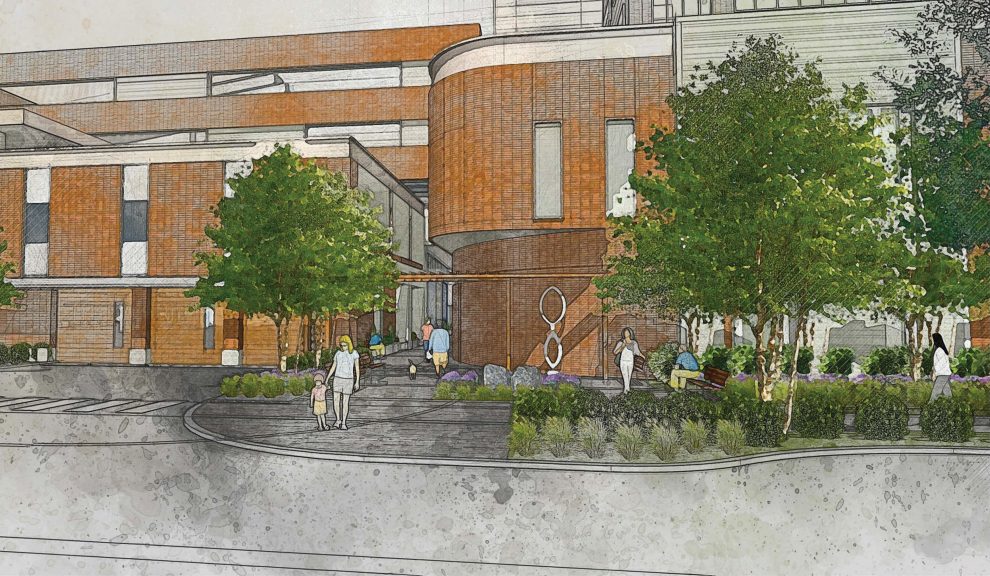
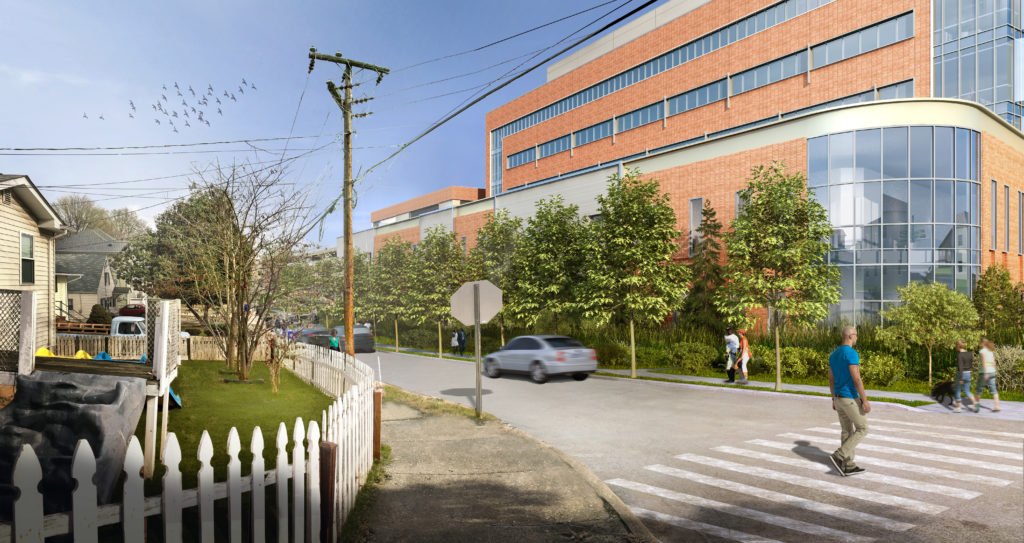
A new rendering of the Virginia Hospital Center expansion, as seen from 19th Street N. (via Arlington County)
A new rendering of the Virginia Hospital Center expansion, as seen from 19th Street N. (via Arlington County)
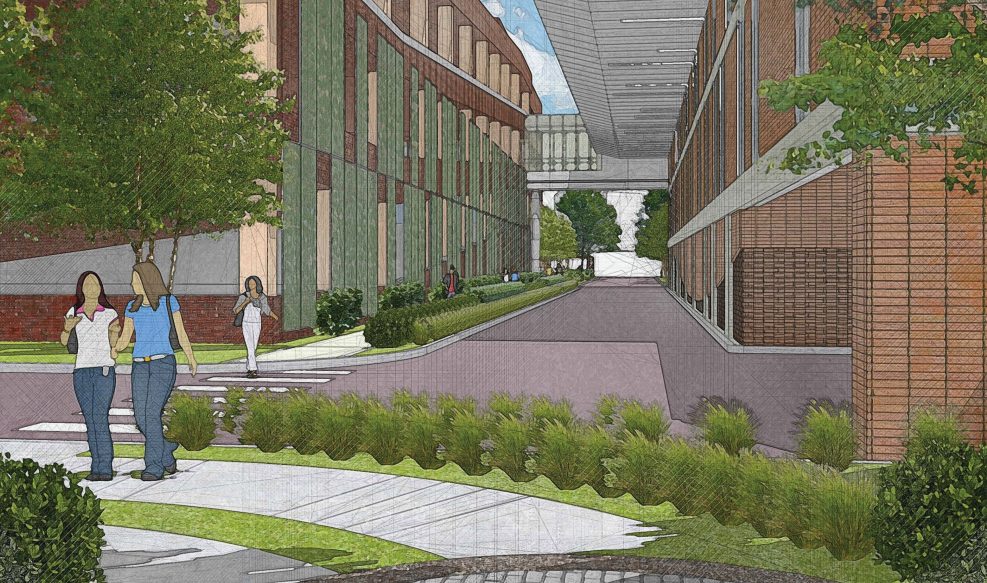
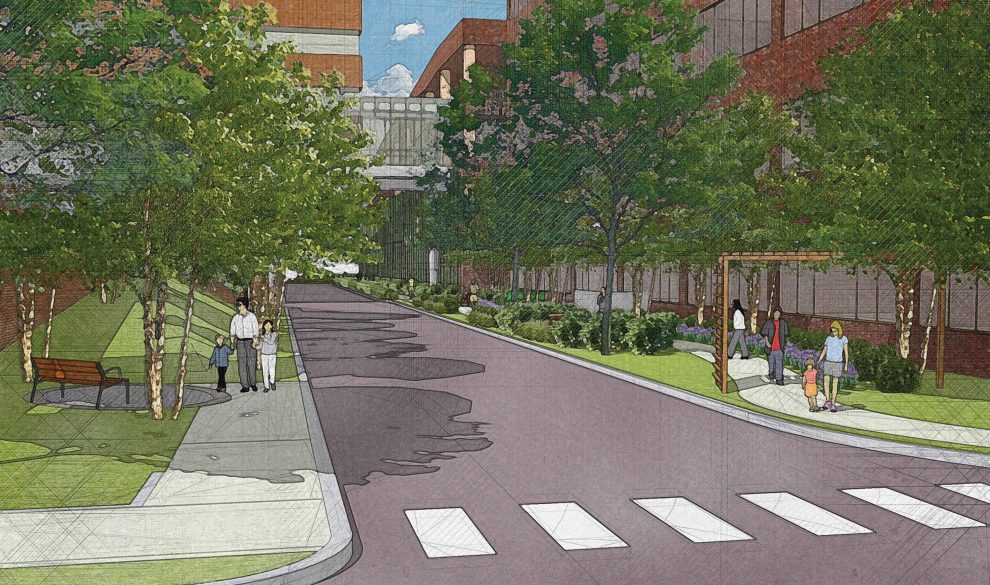
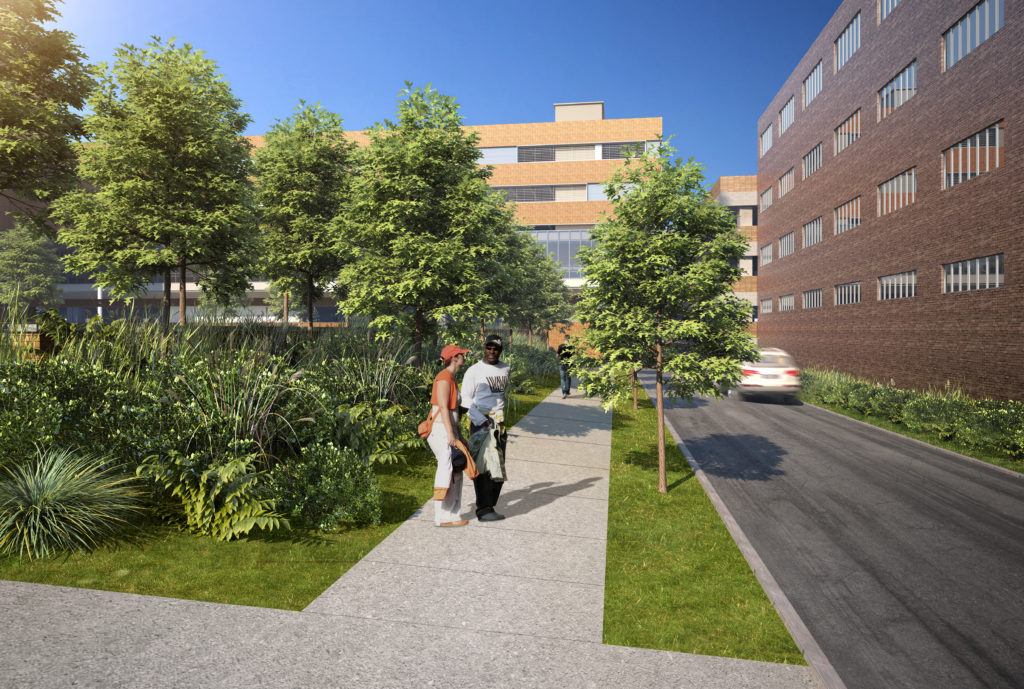
A new rendering of the Virginia Hospital Center expansion, as seen from a garden near N. George Mason Drive (via Arlington County)
A new rendering of the Virginia Hospital Center expansion, as seen from a garden near N. George Mason Drive (via Arlington County)
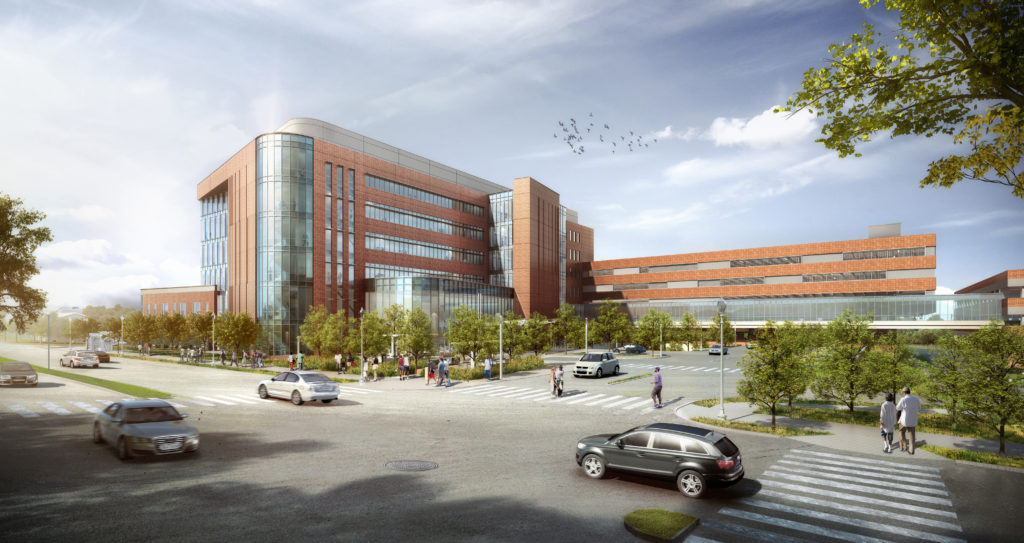
A rendering of the planned Virginia Hospital Center expansion (courtesy photo)
A rendering of the planned Virginia Hospital Center expansion (courtesy photo)
A rendering of the planned Virginia Hospital Center expansion (courtesy photo)
The Virginia Hospital Center might’ve finally won the county’s approval on designs for a hefty new expansion of its North Arlington campus, but officials have months of work left to do before neighbors will start seeing any construction in the area.
Years from now, the hospital will add a seven-story outpatient facility and a 10-story parking garage to its property at 1701 N. George Mason Drive, after the County Board narrowly approved plans for the $250 million project on Tuesday. The expansion will ultimately help the county’s lone hospital add 101 new beds, in a bid to match rising demand in the area.
But VHC officials say they won’t be able to put shovels in the ground just yet. First, they need to complete a land swap with the county to make the expansion possible.
Arlington officials and the VHC agreed last year that the county would send the hospital a property adjacent to its campus at 1800 N. Edison Street in exchange for one at 601 S. Carlin Springs Road. However, the swap was contingent on the Board signing off on the expansion plans in the first place.
Community concerns over the project’s design meant that the Board repeatedly delayed its consideration of the VHC proposal, but with that green light finally given, hospital executives will now turn to finalizing the terms of the land swap. Adrian Stanton, the hospital’s vice president for business development and community relations, says that process will wrap up around next “May or June” at the latest, teeing up construction to start soon afterward.
“It’s been a good three years we’ve been involved in this process, so absolutely it was a sigh of relief when we got the approval,” Stanton told ARLnow. “We wanted to be in front of the Board back in May because we need the beds today… and there a lot of specifics involved, and a lot left to happen.”
Some of the process of sorting out the details of the land swap agreement are fairly mundane, like basic site inspections. Others are a bit more fraught — for instance, the county and the hospital will have to agree on the Edison Road property’s value.
The terms of the agreement call for the hospital to pay either $12.56 million or the property’s appraised value to acquire the site — it all depends on which amount is larger. County records show the property was valued at about $8.9 million this year. By contrast, the S. Carlin Springs Road land the hospital will send to the county was valued at $38.8 million.
Stanton says that the process of hashing out the land swap could wrap up more quickly than they’re expecting, but the hospital is tentatively planning on kicking off construction by “somewhere around June or July 2019” in his most conservative estimate of the timeframe.
Once that happens, Stanton says the hospital will likely need another approval from state regulators before it can wrap up the construction. VHC previously earned a “Certificate of Public Need” from the Virginia Department of Health, certifying that enough demand exists in the area to add more beds to the facility.
The catch is that state officials only allowed VHC to add 44 beds, rather than the full 101 it’s planning. Stanton says that’s because the state only examines demand in five-year increments, while the hospital is projecting a need for 101 beds by looking at a 10-year timetable.
“We agreed to that smaller number with the acknowledgement that we will be back asking for more,” Stanton said. “Our intent is to be able to get the additional beds we feel we need, and do that before construction is complete.”
As for the construction timeline, Stanton says the hospital’s “guesstimate” is that the new garage will be open by the first few months of 2021. Then, he hopes the new outpatient facility will be ready by the second quarter of 2022.
Once that new “pavilion” is ready, the hospital will begin moving its existing outpatient equipment over to the new facility, opening up space for the 101 new beds. However, Stanton cautions that process will require some complicated renovation work, so it’s difficult to know when it will be ready.
“It shouldn’t take as long [as the new construction], but we’ll be doing construction in the existing patient tower,” Stanton said. “It’s not as easy a construction project because we’re working around our existing operations. So it’s by no means easy.”
Looking even further down the line, hospital leaders eventually hope that this expansion will lay the groundwork for the full redevelopment of the campus. However, Stanton’s “best guess” is that work on that process won’t start for at least 15 years or so.
Stanton hopes that hospital officials can use that time to rebuild trust with the surrounding community.
The expansion’s design process became an acrimonious one at times, with neighbors accusing the hospital of ignoring their concerns or even walling off the surrounding community with its new facilities. And Stanton admits to no small amount of frustration that the process turned so contentious.
He argues that the hospital’s initial outreach to the community was “largely positive,” before the county’s formal site plan review process got started. He believes that VHC officials managed to build plenty of consensus around the project, back when neighbors formed their own ad hoc committee to work with the hospital.
“I thought we had a very strong connection with those communities,” Stanton said. “It doesn’t mean were always in agreement, but we felt we, and the County Board, were getting positive reviews from the community about conversations with the hospital. But that seemed to change when we went through formal process with the county, which was really frustrating to me.”
Accordingly, Stanton is pledging “continual communication” between the hospital and its neighbors, to try and recapture the spirit of those early days of planning the expansion, leading to much more harmonious community conversations around any future redevelopment.
“I would only hope that relationship and communication can be just as good, if not better, than before we started this process,” Stanton said.
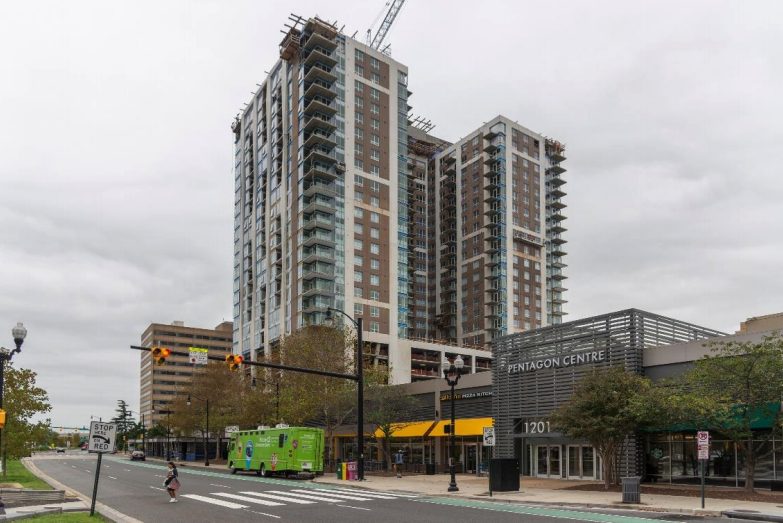
The Witmer, a new residential tower as part of the Pentagon Centre redevelopment (via Kimco Realty)
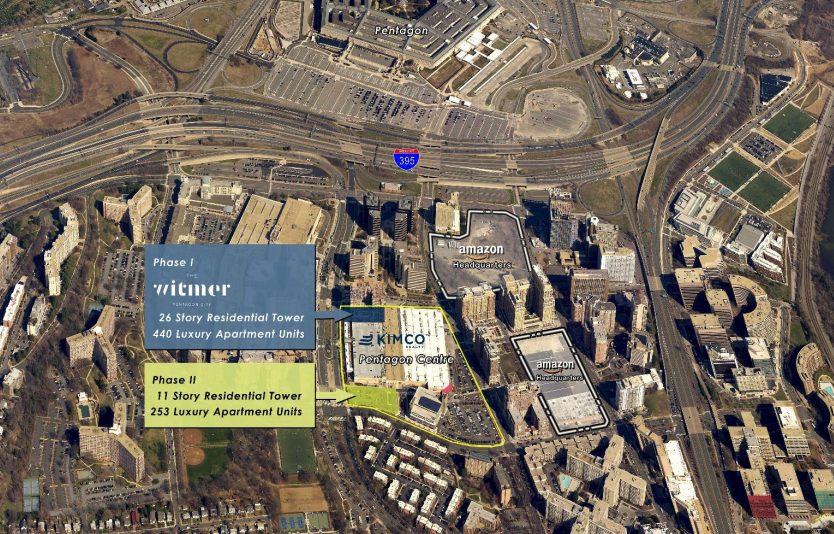
Plans for the redevelopment of Pentagon Centre (via Kimco Realty)
Attention now shifts to building the residential towers at Pentagon Centre
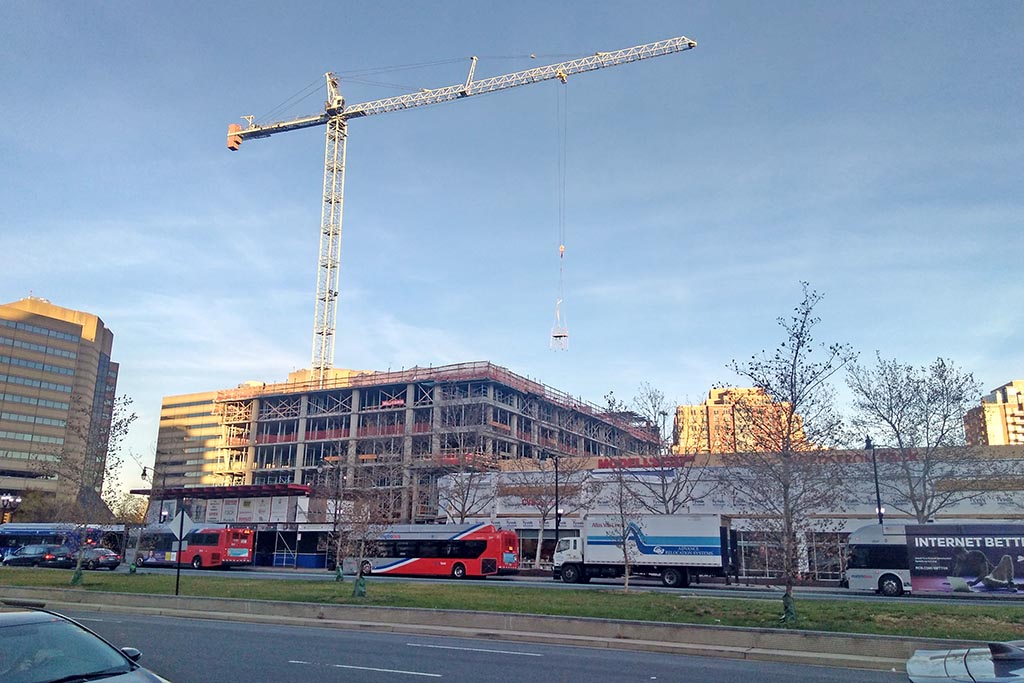
Pentagon Centre completed parking lot
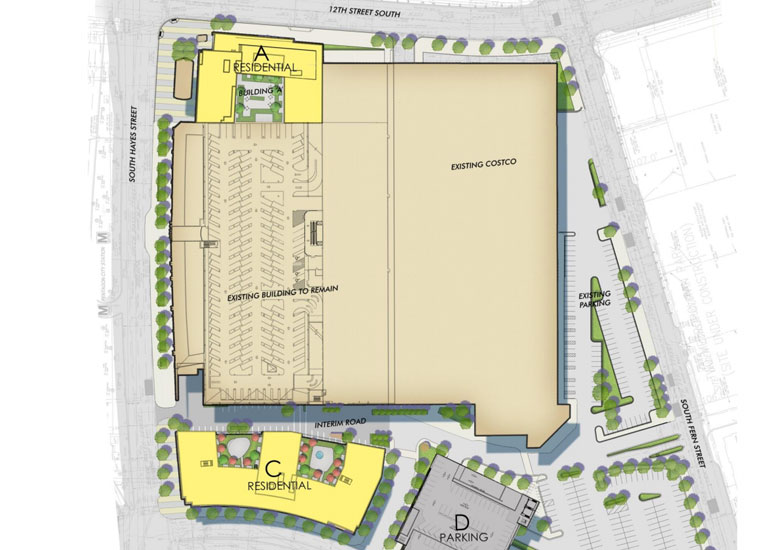
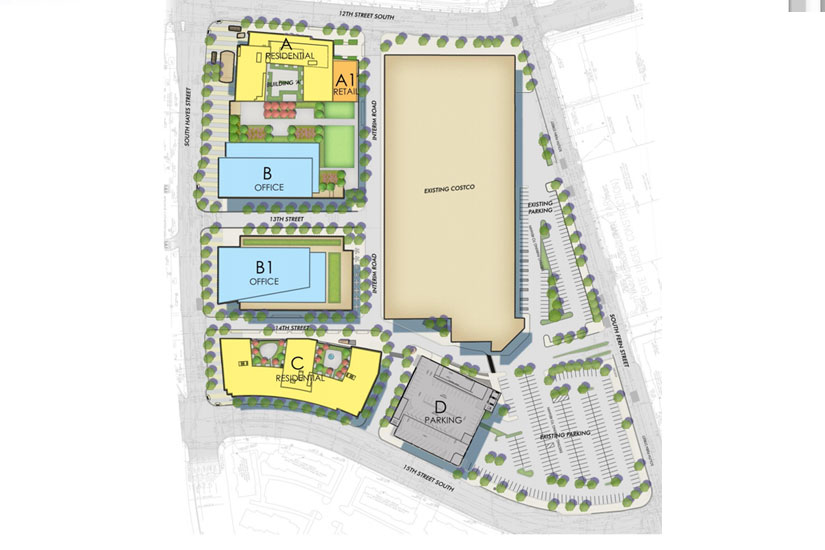
The planned construction and streetscape of Phase I of the Pentagon Centre redevelopment
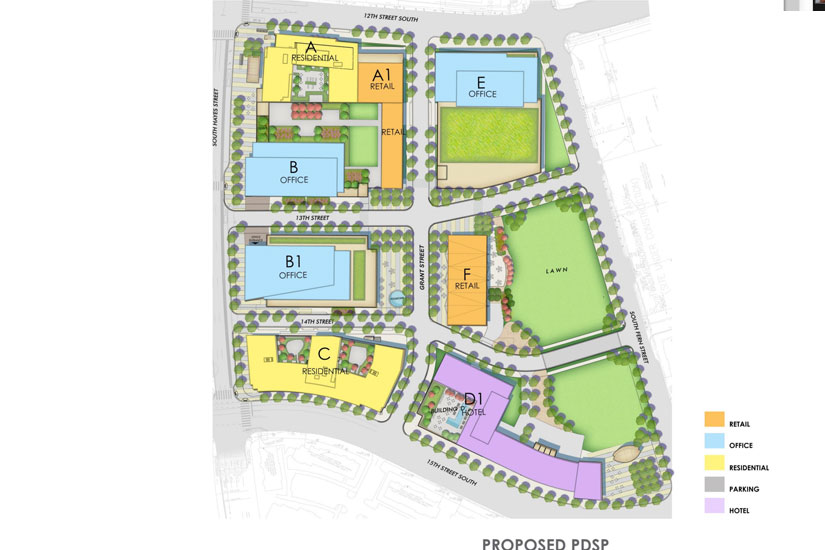
The complete layout and streetscape of the Pentagon Centre redevelopment
The construction and streetscape of Phase II of the proposed Pentagon Centre development
Update, Nov. 30 at 9 a.m.: After this story was published Kimco spokeswoman Jennifer Maisch contacted ARLnow to clarify that Glazer’s comments regarding the new parking garage were inaccurate. The garage will serve only retail customers, while each residential building will have its parking available on lower floors, she said.
A massive new mixed-development in Pentagon City is nearly ready to open — and its backers hope it’ll be perfectly positioned to serve the thousands of Amazon employees who will start arriving in the area in the next few months.
The first phase of the Pentagon Centre redevelopment project, backed by New York-based developer Kimco Realty, should start leasing apartments as soon as spring 2019, according to a news release.
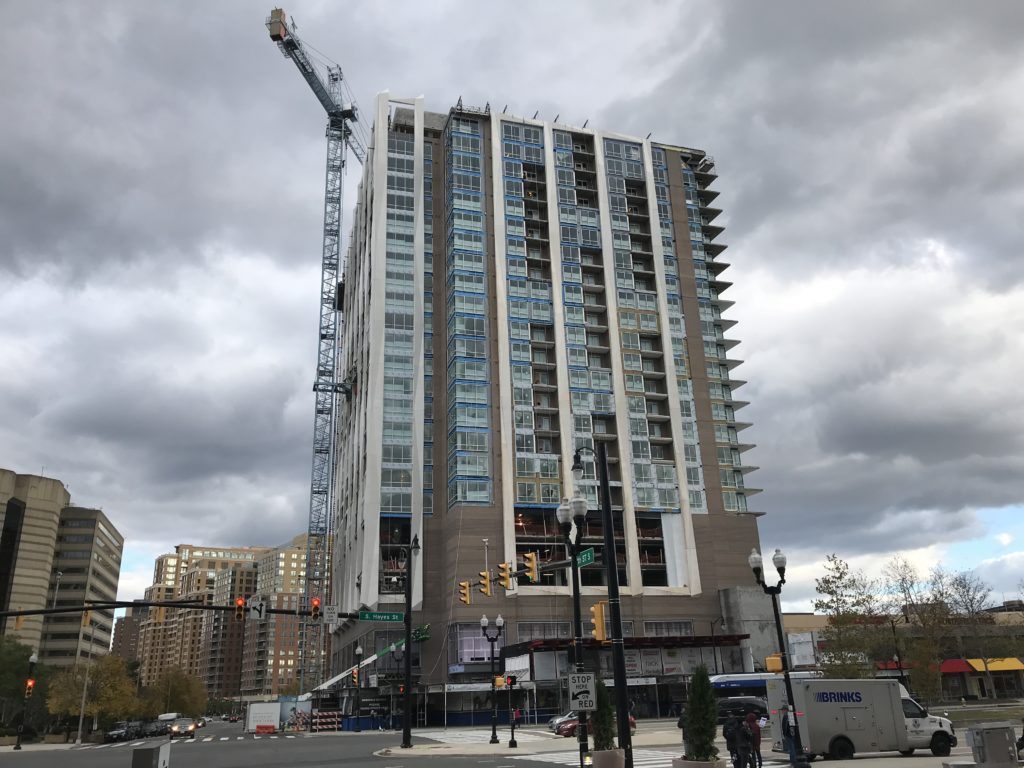
The company hopes to open “The Witmer,” a 26-story residential tower complete with 440 apartments and 7,000 square feet of ground-floor retail space, by the second half of the new year.
The new building will be the first of many new changes to come for the shopping center, located between S. Hayes and Fern Streets and 12th and 15th Streets S., as the developer embarks on a decades-long effort to redevelop the area. Kimco earned the county’s approval for the project back in 2015, but it’s taken on new significance now that Amazon plans to construct a pair of new buildings for its headquarters right next door — the company purchased the “PenPlace” and “Metropolitan Park” developments from JBG Smith as part of its move to the county.
“Our Pentagon Centre ‘Signature Series’ redevelopment is in excellent position to take advantage of the incredible growth Amazon’s National Landing headquarters will bring to the area,” Kimco CEO Conor Flynn wrote in a statement. “With ‘The Witmer’s’ location directly above the Metro Station and its stunning views of the Pentagon, Potomac River and Washington Mall, it will be at the heart of this new center of gravity.”
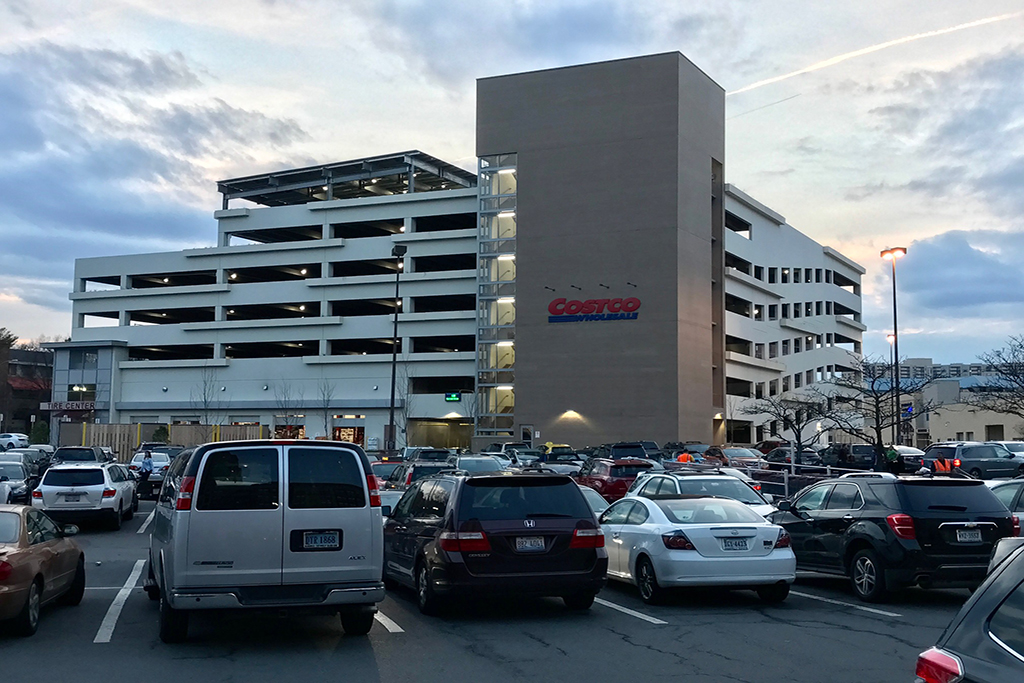
Geoff Glazer, Kimco’s senior vice president for national development, also told ARLnow that a seven-story parking garage along 15th Street S. is already “complete and operational” as well. The garage will serve residents of the new apartment building, as well as help replace parking lots for Costco customers to be occupied by the next phase of development in the area.
Kimco plans to build a 10-story residential tower, complete with 253 units and 15,541 square feet of ground-floor retail, once the first the building is ready. Glazer says the timeline for that project is a bit unclear just yet, however, calling it a “market-driven decision” with plans to “evaluate timing for the second tower in 2019.”
Real estate watchers expect that the market will demand plenty of new construction in the area as Amazon ramps up hiring, so the company may not need to wait long. Brad Dillman, the chief economist for national real estate developer Cortland, says that data suggest Crystal City and Pentagon City both have slightly higher residential vacancy rates than the D.C. metro area as a whole, but there will still be a huge demand for new development as Amazon’s 25,000 workers descend on the area.
“If you look across the whole market on the multifamily side, there were just under 9,000 new units delivered in the last year,” Dillman said. “It’s pretty clear that just Amazon alone is going to require some above and beyond new housing development.”
However, Kimco’s ambitions for the 17-acre property extend far beyond just residential buildings. Eventually, the company plans to demolish the mall building (the current home of retailers like Best Buy and Nordstrom Rack) and then tear down the Costco as well, replacing them with three new office buildings, 377,000 square feet of retail and commercial space and 180-room hotel.
Those plans are quite ways off yet, though, with Glazer estimating that they’re “many years down the road given our existing lease obligations.” The company’s initial estimates suggest that the first phase of demolitions wouldn’t start for another 20 years yet, with more to come another 20 years after that.
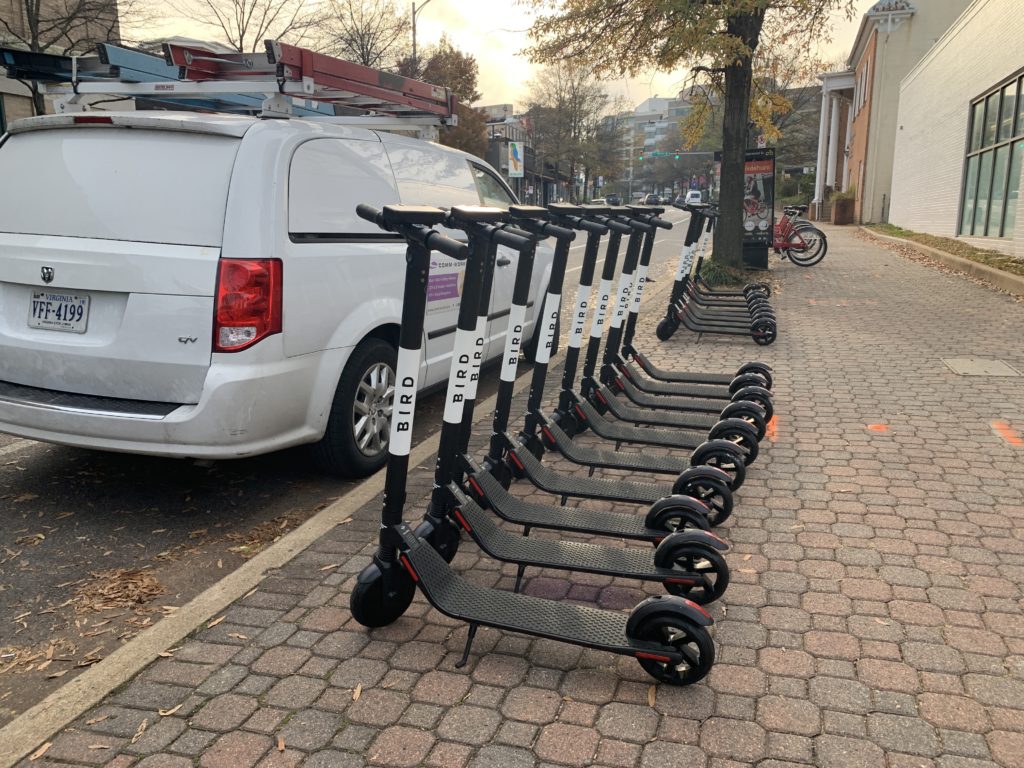
Arlington will soon see even more dockless electric scooters cropping up on its streets, but officials remain a bit vexed about the best way to keep underage riders off the vehicles.
While county transportation officials say they haven’t seen any major safety issues with the scooters beyond a handful of accidents, they also told the County Board Tuesday that the community response to the pilot program expanding the number of dockless vehicles in Arlington has been far from unanimously positive. In all, county commuter services bureau chief Jim Larsen told the Board that his department has received 550 scooter-related complaints from Oct. 1 through Nov. 19.
Most of those have centered around people riding scooters on county sidewalks or trails, a practice banned by the county’s pilot program, or teenagers riding scooters in violation of company rules. Both of the scooter companies currently operating in Arlington — Bird and Lime — ban anyone under the age of 18 from riding the vehicles, and require users to submit a photo of a driver’s license before riding.
Nevertheless, Larsen says the county isn’t quite sure how to tackle the latter issue, in particular.
The whole point of the pilot program, which is set to run through July, is to test out the best policies for the county to adopt surrounding the scooters. And nearly two months in, after the scooters recorded nearly 69,200 rides in the month of October alone, Larsen says there are still more questions than answers.
“Education is the key,” Larsen said. “But there are still challenges.”
Larsen noted that his staff is working with the dockless companies, county police, school officials and parents on educating kids that they should stay off scooters. Even still, he foresees it being a tough issue to fully resolve — he theorizes that parents are either unaware of the ban on young riders, and could be giving kids permission to use the scooters, or that teens have simply figured out ways to “hack the apps.”
“We fine people if they’re driving a car when they’re not supposed be,” said County Board member Libby Garvey. “Is there a way to fine somebody for this?”
But even when a police officer or teacher catches an underage rider on a scooter, Larsen noted that there’s not much they can do about it. After all, he points out that state law actually allows anyone 14 or over to ride a motorized scooter, though the definition of what constitutes a scooter has certainly changed drastically since the law was written.
“The commonwealth has a lot of work to do to bring their regulatory scheme forward a number of years,” said County Manager Mark Schwartz. “I won’t say what century it’s in.”
Yet, with so little of the pilot completed, county officials are hesitant to ask Arlington’s General Assembly delegation for too many changes just yet. They’re also wary of a repeat of the way the state chose to regulate ride-sharing companies, removing control from localities in favor of a light-touch regulatory scheme managed by state officials.
“Our goal is to craft common sense regulations coordinated across localities, but ones that preserve that ability to maintain that regulation on the local level,” said county transportation chief Dennis Leach.
Larsen would caution, however, that Bird and Lime have already both hired lobbyists in Richmond to make their case to lawmakers, so the county will need to have some answers by the time the legislature reconvenes in January. To that end, he suggested convening interested county staffers, including Arlington’s legislative liaisons, in a working group to focus on the issue.
There will certainly be plenty of pressure to act fast — Larsen says Lyft is nearly finished with the application process to offer its scooters in the county, and a dockless electric bike company could offer its wares on Arlington streets by January.
But policymakers do have one factor working in their favor as they work to craft solutions; it’s no longer the ideal temperature for scooter-riding.
“In winter months, as things get slow, we expect they won’t keep them all out there,” Larsen said. “Especially if we get bad weather, as we’re expecting.”
Arlington leaders are now planning on hosting at least two Amazon-focused town halls to let residents share their concerns about the tech giant ahead of a planned February vote on the deal to bring the company’s new headquarters to the county.
County Board Chair Katie Cristol announced at the Board’s meeting yesterday (Tuesday) that the county will hold a pair of “community listening sessions” to give people the chance to talk directly with Arlington staffers and Board members alike about Amazon. She says the county is targeting Dec. 17 at 7 p.m. and Jan. 12 at 9:30 a.m. for those sessions, but has yet to settle on locations for either one.
“There have been a lot of questions about opportunities to engage or ask questions directly to County Board members as well as to learn about this opportunity and its impacts on our Arlington community,” Cristol said. “We’ve heard that people are very interested in an in-person opportunity to share their feedback and county staff.”
Cristol added that any Board vote on the proposed deal, largely sketched out by state officials, would come no sooner than Feb. 23. In the likely scenario that the deal wins the Board’s approval, the company would then face a whole variety of Board hearings as it looks to build new facilities in Pentagon City and Crystal City.
The county has also scheduled an array of online Amazon question-and-answer sessions on Facebook.
Arlington’s already held a pair of those, and will hold three more next month: a Dec. 6 session focused on transportation, a Dec. 19 discussion on schools and education and a Jan. 16 session on housing.
Skeptics of the tech giant’s impact on the area have accused the Board in the past of allowing too little community discussion on the issue, with many skeptics flooding a Board meeting earlier this month to raise the matter. Progressive groups like Our Revolution Arlington have also specifically called for a series of such listening sessions by Board members.
Erin Wasiak, co-president of the Henry Parent-Teacher Association, speaks at a public hearing on elementary school boundaries.
A Nov. 27 version of Superintendent Patrick Murphy’s school boundary proposal, which contained an error (via Arlington Public Schools)
(Updated at 9:50 a.m.) Many parents of Patrick Henry Elementary School students have expected, for years, that their community would move as one to Alice West Fleet Elementary when it opens next fall.
They believe Arlington school officials have repeatedly promised them as much over the years, as deliberations have progressed over the best way to build a new South Arlington elementary school, then shift Drew Model School’s Montessori program to Henry’s old building. That’s why so many Henry parents are now furious that Superintendent Patrick Murphy’s proposal for a redrawing of school boundaries would send more than a fifth of current Henry students to schools other than Fleet.
School leaders, however, argue they’ve never made such promises about keeping the entirety of the Henry community together. The current boundary process is aimed at better spreading out students across eight different South Arlington elementary schools, and officials argue that it’s likely impossible they’ll be able to please every single parent as they look toward the greater good for the whole school system.
But some parents believe there’s a better way to achieve school officials’ stated goals for the boundary process, which simply involves a little bit of creative thinking. They’d much rather see the school system transform Drew into a science and technology-focused program that accepts transfers from across the county, as a way of simultaneously solving overcrowding issues in the area and avoiding a major breach of trust with the community.
“South Arlington has always been on the back end of receiving support for its schools,” Gary Belan, a parent of two current Henry students, told ARLnow. “But this whole process has not only been a disservice to the kids at Henry, but the folks at Drew. It does a minimal amount to set either up for success.”
After releasing a slightly revised version of Murphy’s map and holding a public hearing on the boundary proposals last night (Tuesday), the School Board won’t approve a final map until Dec. 6. Some early proposals would’ve moved all but a small section of the Henry community to Fleet, though some came at the cost of angering parents in Fairlington by moving students from Abingdon to Drew, and Board members stress that all of the draft maps remain on the table for debate.
Yet some parents who’ve spent years working on committees guiding Fleet’s opening have lost faith that the Board will listen to Henry’s concerns. For instance, Joe Everling, who worked on the Building Level Planning Committee for Fleet, believes the Board “wasted my time” and “co-opted me into this flawed process.”
“The ‘Arlington Way’ is often all about asking for feedback and then doing whatever you want anyway, and that’s what’s happening here,” said Everling, the parent of two kids currently at Henry and a third approaching school age. “They’re talking to us like we’re kindergarteners, telling us we didn’t hear what we heard… We’ve been working with them, not fighting with them. But then they reveal something that doesn’t even reflect what they’ve been promising.”
Yet Arlington Public Schools spokesman Frank Bellavia insists that moving Henry to Fleet was merely a “general plan” developed as the school system began planning for a new elementary school in 2013, and never an explicit promise.
“When APS began this boundary process, the School Board listed eight schools to be included in this process and none were to be exempt from possible boundary changes,” Bellavia said.
School Board Chair Reid Goldstein was even more emphatic during an Oct. 24 work session, arguing that parents were mistaken in assuming that Henry’s student body would move together to Fleet. He even conceded that some school officials, himself included, might have given parents the wrong impression about the matter, and should’ve expressed more uncertainty about the future.
Goldstein went on to explain that he’d requested a correction to an ARLnow article which reported on APS officials reassuring Henry parents that all students would move to Fleet, after several parents mentioned such assurances at an October School Board meeting. He argued that the article was “inaccurate” and “further inflamed” tensions over the matter.
“Staff has attempted to quell this rumor but, unfortunately, it still persists in some places,” Goldstein said. “I’m addressing it here to hopefully, finally, put it to bed.”
But Everling points to a number of school documents delivered to various committees over the years dubbing Fleet “a new school for Henry Elementary.” The Board’s April 2016 motion approving plans for Fleet even refers to it as such; a January 2018 presentation on the school’s design similarly notes that the Board “identified Patrick Henry Elementary as the school community that will occupy the new elementary school.”
And, in a May 2016 email to Douglas Park Civic Association leaders obtained by ARLnow, Goldstein himself looks to quell what he dubs “rumors” that the Henry community will be split up in the move to Fleet.
“To fill up the new building, we need to move all of the Henry students there,” Goldstein wrote. “Removing current Henry students from that new boundary zone is counter-productive to accomplishing this goal.”
A man is now facing a slew of charges after he allegedly drunkenly exposed himself in Clarendon, then scuffled with police as they tried to arrest him.
Arlington Police say they received a call around 4 a.m. on Monday (Nov. 26) after someone saw a man “with his pants down exposing himself while walking” in the vicinity of the 3000 block of Washington Blvd. The area is home to several apartment buildings, a 7-Eleven convenience store and other shops and restaurants.
Officers then spotted a man “appearing disheveled and intoxicated” and arrested him. They subsequently identified him as 54-year-old Michael Tomlin, of no fixed address.
“The suspect actively resisted officers while they placed him in handcuffs,” police said. “Once in custody and while in booking, the suspect continued to resist, attempting to remove his hands from the handcuffs, and ignored the instructions of officers.”
Tomlin was subsequently charged with obstruction of justice, indecent exposure and public drunkenness.
More details from a county crime report:
INDECENT EXPOSURE, 2018-11260035, 3000 block of Washington Boulevard. At approximately 3:55 a.m. on November 26, police were dispatched to the report of a male exposing himself. Upon arrival, it was determined that the victim observed the male suspect allegedly with his pants down exposing himself while walking in the area. A lookout was broadcast and arriving officers located an individual matching the suspect description in the lookout still in the area, appearing disheveled and intoxicated. The suspect actively resisted officers while they placed him in handcuffs. Once in custody and while in booking, the suspect continued to resist, attempting to remove his hands from the handcuffs, and ignored the instructions of officers. Michael Tomlin, 54, of No Fixed Address, was arrested and charged with Obstruction of Justice, Indecent Exposure and Drunk in Public.
And here are other highlights from the past week of crime reports:
BURGLARY, 2018-11270233, 1000 block of N. Quincy Street. At approximately 9:26 p.m. on November 27, police were dispatched to the report of a possible burglary. Upon arrival, it was determined that between 8:30 a.m. on November 18 and 8:20 p.m. on November 26, an unknown suspect(s) gained entry to the victim’s residence and stole items of value from the residence. There is no suspect description. The investigation is ongoing.
RECOVERED STOLEN VEHICLE, 2018-11240168, Army Navy Drive at S. Hayes Street. At approximately 7:13 p.m. on November 24, a lookout was broadcast for a potentially stolen vehicle, driven by subject wanted out of Prince William County. At approximately 7:20 p.m. an officer on routine patrol observed a vehicle driven by a subject matching the descriptions in the lookout travelling Northbound on I-395 and effected a traffic stop. The driver of the vehicle was confirmed to be wanted and taken into custody without incident. Brandon Williams, 25, of Spotsylvania, Va., was arrested, served with outstanding warrants out of Prince William County and held on no bond.
RECOVERED STOLEN VEHICLE, 2018-11210043, I-66 W.B. at N. Sycamore Street. At approximately 4:33 a.m. on November 21, officers on routine patrol were alerted to a License Plate Reader hit on a stolen vehicle. With the assistance of additional arriving officers, a traffic stop was conducted and the driver was taken into custody without incident. Terry Degeus, 33, of Fredericksburg, Va., was arrested and charged with Driving with a Suspended or Revoked License, and served with outstanding warrants out of Stafford County, Va.
BURGLARY, 2018-11250003, 2100 block of N. Quantico Street. At approximately 12:06 a.m. on November 25, police were dispatched to the report of a burglary just discovered. Upon arrival, it was determined that between November 23 at 9:30 a.m. and November 24 at 11:50 p.m., an unknown suspect(s) forced entry to a residence, causing damage, and stole items of value. There is no suspect(s) description. The investigation is ongoing.
ROBBERY, 2018-11200269, 700 block of S. Ode Street. At approximately 9:10 p.m. on November 20, police were dispatched to the report of a robbery just occurred. Upon arrival, it was determined that the victim met the known suspect to purchase goods for sale. The victim paid the suspect in cash for the goods, however, when the victim reached for the goods, the suspect pulled them away forcefully and fled in his vehicle with the goods and cash. The victim attempted to stop the vehicle, but was dragged a short distance, causing the victim to suffer minor injuries, which did not require medical treatment. The victim then returned to his vehicle, where he was approached by three individuals, allegedly known to the suspect, who attempted to climb on his car, before hearing a loud noise and fleeing on foot. The suspects are described as black males. The investigation is ongoing.
A new rendering of the Virginia Hospital Center expansion, as seen from 19th Street N. (via Arlington County)
A new rendering of the Virginia Hospital Center expansion, as seen from 19th Street N. (via Arlington County)
A new rendering of the Virginia Hospital Center expansion, as seen from a garden near N. George Mason Drive (via Arlington County)
A new rendering of the Virginia Hospital Center expansion, as seen from a garden near N. George Mason Drive (via Arlington County)
A rendering of the planned Virginia Hospital Center expansion (courtesy photo)
A rendering of the planned Virginia Hospital Center expansion (courtesy photo)
A rendering of the planned Virginia Hospital Center expansion (courtesy photo)
The Arlington County Board narrowly approved the Virginia Hospital Center’s expansion plans yesterday (Tuesday), clearing the way for the $250 million project to move ahead despite persistent concerns over its design and impact on the community.
In a rare 3-2 vote, the Board signed off on designs for the county’s lone hospital to add a seven-story outpatient facility and a 10-story parking garage adjacent to its existing campus at 1701 N. George Mason Drive.
The additions will help the hospital add another 101 beds to its existing building, a move that VHC officials argued was urgently necessary to meet rising demand in the area. The Board will now send the hospital a piece of county-owned land on N. Edison Street to power the expansion, and receive a some hospital property on S. Carlin Springs Road in exchange.
“We are grateful to have constructively worked with community members to reach a positive solution, and we are committed to remaining good neighbors in the Arlington community,” Adrian Stanton, the hospital’s vice president for business development and community relations, wrote in a statement. “For 75 years, Virginia Hospital Center’s mission has been to act in the best interest of our patients. We continue to be thankful for our Board, physicians, staff and auxiliary members who are ready to serve for the next 75 years.”
The Board was previously set to approve the expansion plans in September, but opted for a delay instead to give the hospital a chance to tweak its designs a bit. A narrow majority of the Board felt that VHC’s planners managed to meet those standards over the last two months, while Board members Erik Gutshall and John Vihstadt argued that the hospital failed to meet the specific requests the Board previously laid out for design changes.
Others on the Board expressed similar concerns, but none of the other three members were willing join Gutshall and Vihstadt in delaying the project once more.
“I certainly remain troubled to not be able to fully achieve what we envisioned a couple of months ago,” said Vice Chair Christian Dorsey. “It’s better today than it was two months ago… We’re at a much better place where this facility interacts with the neighborhood in a way that is going to be a lot more respectful and pleasing for people who will choose to live there for decades to come.”
The Board had also urged VHC executives to do more outreach in the community and ease concerns about everything from traffic to the size of the new facilities. The hospital held several community meetings with nearby civic associations and other neighbors since the Board’s last vote, but the Board still expressed plenty of concern that the hospital didn’t do enough to fully engage the community.
“I’m really feeling frustrated and undernourished here,” Vihstadt said. “Too often, it was a matter of ‘Here’s what we’re going to do, we invite your comments, we invite your critique,’ not, ‘Here’s option A, here’s option B, what do you think works best?'”
But some Board members had specific critiques of the design as well. Those primarily centered on a pedestrian walkway running from north-south through the site, starting at 19th Street N. and running toward 16th Street N., and the traffic pattern on N. George Mason Drive as it runs alongside the hospital.
The Board’s September motion specifically requested that the north-south walkway be at least 15 feet wide and two stories in height, in order to create a better flow of both pedestrians and light throughout the campus. Yet the revised design presented a path that wasn’t quite that wide, and had a pedestrian bridge running over top of it along one section to restrict the open air standard the Board laid out.
“It doesn’t seem to me that it really meets the gist and the intent of our motion,” Gutshall said.
Nan Walsh, an attorney for the hospital, argued that VHC’s architects did the best they could to meet the Board’s standards, but ran into a series of intractable problems.
Widening the pathway, for instance, could’ve forced the hospital to move its parking garage too close to neighboring homes, or forced the hospital to cut more than 200 spaces from the structure, Walsh said. The latter option was particularly unpalatable for VHC, as it had already removed hundreds of spaces to meet the concerns of transit advocates.
“We have sharpened our pencils for the last two weeks and we really feel we’ve gone about as far as we can go,” Walsh said.
County planner Matthew Ladd did reassure the Board that the walkway struck him as a “major improvement” over the hospital’s original design, and most members were inclined to agree.
“This is breaking up what felt like a superblock and creating a sense of flow of light and air between the two buildings,” said Board Chair Katie Cristol. “I know this leaves disappointment on the part of some of the neighbors… but I did not enter this phase with a lot of optimism that there will be peace in the land.”
Gutshall initially looked for a one-month deferral of the project, as the Board had originally planned to take up the new designs in December — the hospital, backed by its allies in the business community, pressed for the earlier consideration. Vihstadt was inclined to support him, dubbing the new plans “too much of a suburban campus, a suburban design.”
Yet Gutshall couldn’t find a third vote for the delay, and he relented. But he did warn the hospital that, as it considers the full redevelopment of its campus in the coming years now that this expansion has been approved, there may be more painful meetings in its future if it doesn’t change its approach.
“You continually throughout this process pushed the envelope every step of the way…but ultimately I think there’s a cost extracted for that,” Gutshall said. “And I’d strongly encourage you to look at what are the things that you can do to build a stronger relationship with the surrounding community to begin to lay the groundwork for the next time you come back for whatever the next phase of this is going to be.”
Crystal City’s bevy of aging office buildings have long been in need of a makeover, and Arlington officials hope Amazon’s arrival will spur some big development changes in the neighborhood.
The tech giant itself will be responsible for a major transformation of the newly christened “National Landing” all on its own, of course. Amazon will start off by leasing space from property owner JBG Smith in Crystal City, with plans to fully renovate those office buildings, and even construct its own facilities on various plots of land in Pentagon City.
And while the company could one day control as much as 8 million square feet of office space in the area, there are plenty of other buildings dotting Crystal City’s landscape that Amazon won’t touch. JBG alone controls another 6.2 million square feet of office space throughout the neighborhood, including a whole variety of buildings constructed decades ago, when Crystal City was primarily a home for the military and federal agencies.
It’s those structures that Arlington leaders are most anxious to see receive a refresh, in order to lure even more businesses to the area. While Amazon’s new headquarters will put a huge dent in the neighborhood’s office vacancy rate, officials say the county still has plenty of work left to do in that department.
“Many of these buildings were purpose-built for the federal government or overflow from the Pentagon,” Anthony Fusarelli, the assistant director of the county’s Department of Community Planning, Housing and Development, said during a question-and-answer session live-streamed on Facebook last night (Monday). “As the economy diversifies, the building stock needs to diversify with it.”
Sally Duran, the chair of the county’s Economic Development Commission, pointed out that business leaders have been strategizing ways to orchestrate such changes in Crystal City for years now, dating back to the immediate aftermath of the Pentagon’s Base Realignment and Closure process. But the county lacked any sort of driving factor to spur that change, she noted, making Amazon’s selection of the area quite welcome news indeed.
Fusarelli also observed that many Crystal City property owners, including JBG, were already nearing a critical decision point about how to handle the future of their buildings. Given the age of the structures, he said owners faced one of just a few options: sell their holdings, “reinvest and try to cary the building forward for 10 to 20 more years,” or simply “demolish and redevelop.”
With Amazon about to bring 25,000 jobs to the area, he expects to see plenty of developers choosing the third option.
“We may have these 40-, 50-year-old buildings come off the line and be replaced with residential buildings, or other uses,” Fusarelli said. “We may see the vacancy rate go down over time to the extent that additional activity in this area will lead to redevelopment and changing uses.”
Even before Amazon’s announcement, Fusarelli says the county was projecting an additional 20 million square feet of development in the area he dubbed “the Route 1 corridor,” rather than the controversial “National Landing” moniker, through 2025. Accordingly, he expects that the county will be ready to embrace all that new change, rather than be overwhelmed by it.
“Over the past 14 months, we’ve been evaluating the area and making sure it could manage that growth, and it could,” said Christina Winn, director of Arlington Economic Development’s Business Investment Group. “It was planned for that.”
But county officials remain adamant that the slow pace of the tech giant’s arrival, to be stretched out over the better part of 12 years or so, will help Arlington adjust to the changes gradually. The company plans to add only a few hundred workers in the near term, then bring on about 2,000 staffers a year through 2030.
Officials also stressed that the county will review every step of the assembly of the new headquarters. The County Board will vote no earlier than February on the outlines of the state’s proposed deal with Amazon; then, the company will submit individual applications for each new piece of construction it’s planning, most of which will require the Board’s scrutiny.
Fusarelli says the county doesn’t expect to see any applications from Amazon until early next year, projecting a first Board vote on new Amazon developments by mid-2019 at the earliest.
“We don’t expect a flood of Amazon-specific building proposals in the first quarter of next year,” Fusarelli said. “What we do expect is a gradual submission of projects over time that align well with their need to house workers.”