Sen. Tim Kaine (D-Va.) negotiated his fair share of economic development deals back in his days as Virginia’s governor, and he thinks Arlington has an awfully strong chance to land Amazon’s vaunted second headquarters.
The county has already emerged as a prime contender for “HQ2” and the 50,000 jobs that could come with it, with two possible sites for the massive new development pitched by state officials to the tech company: one split between Crystal City and Alexandria’s Potomac Yard, and another in the Rosslyn-Ballston corridor.
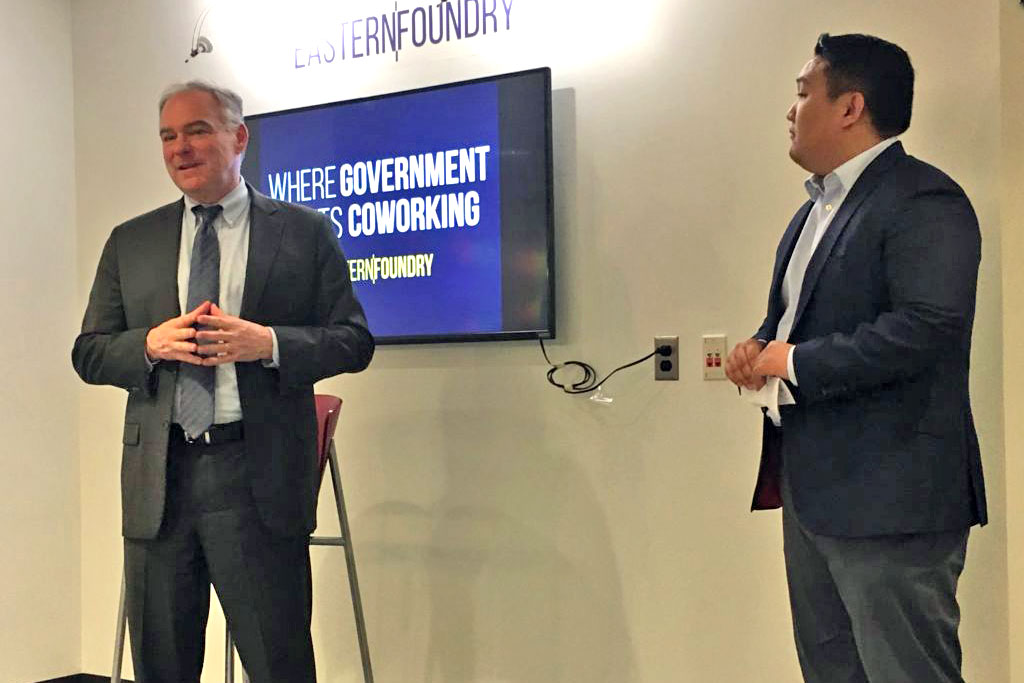
County officials have been wrestling with the question of what Amazon’s arrival would mean for Arlington’s schools and transportation systems. But, in an interview Monday at a campaign stop at Crystal City coworking space Eastern Foundry, Kaine says he sees winning the HQ2 project as a potentially “transformative” one for the county.
Arlington is vying with other Northern Virginia localities (and D.C. itself) to lure the online retail giant to the area, but Kaine believes the county’s highly educated workforce could very well prove to be the deciding factor for Amazon CEO Jeff Bezos.
“We tend to win competitions like this if the company is really looking at it as a long term thing,” Kaine told ARLnow. “If they’re looking at it as a short term deal, they may go with a better incentive package. If they’re looking at it as a long term thing, it’s about, ‘okay, where is the workforce going to be better?’ I would think this would be a long-term investment.”
Kaine admitted that Virginia and its localities might not be able to offer the same number of incentives as other places vying for HQ2 — for instance, Maryland lawmakers recently approved $8.5 billion in incentives for the company. But the senator believes Virginia economic development officials will be able to point to investments the state’s already made in its education system as an alternative to offering tax breaks or cash incentives.
“We’ve decided to try to spend resources on a really good higher ed system, really good K-12 schools,” Kaine said. “Other states put a lot of incentive money down, but they don’t have the same base. We might get outbid, but we’d say, ‘Oh, by the way, this is a long term decision. Look at our higher ed institutions, look at our schools.'”
For instance, Kaine noted that state lawmakers recently agreed to send roughly $25 million to Virginia Tech to manage a new cybersecurity training initiative in Northern Virginia.