Healthy Paws

Editor’s Note: Healthy Paws is a column sponsored and written by the owners of Clarendon Animal Care, a full-service, general practice veterinary clinic and winner of a 2017 Arlington Chamber of Commerce Best Business Award. The clinic is located 3000 10th Street N., Suite B. and can be reached at 703-997-9776.

We’ve discussed fleas previously, but since we’re just starting to see the first real fleas of the season figured it’s a good time to revisit these icky insects.

What exactly is a flea?

Fleas are small (~2-3mm), reddish-brown insects. They feed on the blood of mammals and birds. While they cannot fly, they have incredible jumping ability. According to the website fleascience.com, the average flea can jump about 5 inches high and 9 inches horizontally, though they can reach 8 inches high and nearly 20 inches horizontally.

What diseases can they carry?

Fleas can cause symptoms of mild itchiness to severe itching/scratching and significant secondary bacterial infections, depending both on the flea burden and the individual animal’s sensitivity to flea bites. Additionally, in young puppies and kittens, or severely infested animals, fleas can cause anemia due to blood loss.

Other parasites and diseases can also be carried or transmitted by fleas:

  • The most common form of tapeworms, Diplydium caninum, are carried by fleas. Tapeworms are rarely a significant health concern but can be uncomfortable to the pet and disturbing to the owner who discovers them.
  • Bartonella, the causative agent of Cat Scratch Disease, is also carried by fleas. Typical transmission is from the scratch of an infected cat (who got the disease from fleas), but there is some thought that infected fleas can transmit directly to humans via a bite.
  • Plague, caused by the bacteria Yersinia pestis, can also be transmitted by fleas.

What is the lifecycle of the flea? And why does it matter?

Adult female fleas feeding on an animal can start laying eggs within hours, laying up to 50 eggs per day. Eggs develop in the environment, preferring cool dark places (like under fallen leaves — which is why we tend to see an increase in cases of flea infestations in the fall) and indoors along baseboards, carpets and crevices of furniture or floors.

Larvae then develop into pupae, typically preferring the same places as the larval stages. Finally, adults emerge from the pupal stage and start looking for a host to feed on. This whole process can take as little as a few weeks in optimal conditions. However, the larval and pupal stages can also lie dormant for months, and hatch only once they sense the environmental factors are ideal (vibrations from movement, heat and CO2 can all trigger this).

Because of the prodigious egg-laying of the adult flea, it is possible for a single adult female to quickly lead to an infestation. The environment (which can be outdoors or indoors) quickly becomes contaminated with eggs, larvae and pupae.

How do I know if my pet has fleas?

Sometimes you will actually see the flea moving along the skin under the hair coat, or even jumping from the pet as you rub their belly. A more reliable way to detect them is to look for “flea dirt,” which is digested and excreted blood. The tail area and behind the ears are two common places to see this.

However, sometimes it’s not a simple diagnosis, especially early on. Some pets are very sensitive to flea bites, and will demonstrate intense itching with only a single bite — in these cases, it may be difficult to detect the fleas.

The classic signs of a pet with fleas are intense itching or chewing around the tail base (and in general). The itch associated with fleas is often more intense than we might see with other causes of itchiness (namely, allergies). (more…)



How is a wedding gown like a bomb suit? Why are shrimp more dangerous to sailors than sharks? Why is a zipper a problem for a sniper?

On Wednesday, September 27, join economist Tyler Cowen and the Mercatus Center at George Mason University for a conversation with “America’s funniest science writer,” Mary Roach. The conversation is part of the Mercatus Center’s Conversations with Tyler event series, and will be open to the public. A book signing will immediately follow the event.

Click here to register.

Roach’s latest book is Grunt: The Curious Science of Humans at War. Grunt examines the science behind keeping soldiers’ bodies and minds intact, alert, and sane in the extreme conditions that come with war.

Like Roach’s other books, Grunt combines fascinating science with the perfect amount of humor and accessibility to explore life’s most interesting peculiarities. Roach’s work isn’t afraid to “go there” as she explores taboo topics such as sex, the nitty gritty of life in space, dead bodies, and what happens to food after you eat it.

Roach’s perspective frequently comes from a first-hand experience as she offers up herself — and sometimes her husband — to participate in unconventional science experiments, including agreeing to wear ultrasound equipment during coitus.

In Conversations with Tyler, economist and George Mason University professor Tyler Cowen explores the world of ideas in one-on-one dialogues with today’s top thinkers. Past guests include Lawrence H. Summers, Malcolm Gladwell, Jhumpa Lahiri, and Atul Gawande.

Mary Roach’s skillful wit and creative approach to science makes her the perfect candidate for a conversation with Tyler. Come prepared to laugh, learn, and unlock some of life’s most interesting mysteries.

Register for the event here.


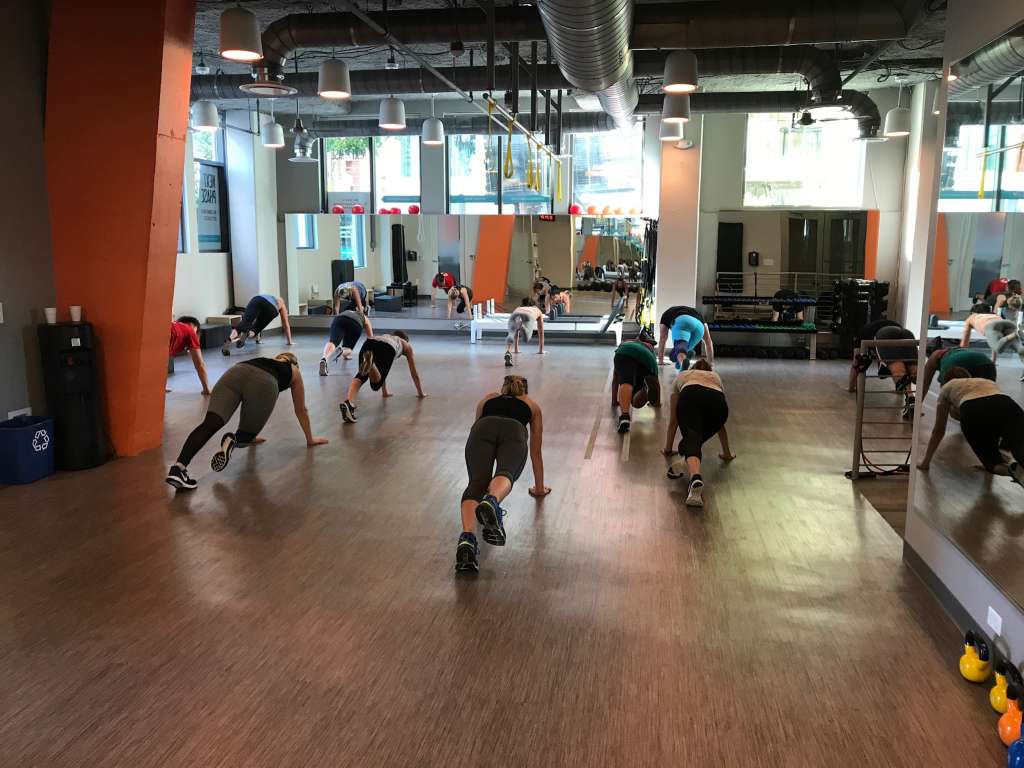
Walk in the door at Next Phase Arlington any time of day and you’ll be greeted with the kind of enthusiasm and energy that comes exclusively from people busy doing what they love. Creating a “Happy Place” for the Arlington community is Next Phase’s #1 priority — they just happen to be a kick-ass fitness studio, too.

Located in the Courthouse neighborhood, at 2009 14th Street N., Next Phase’s class schedule boasts a heart-thumping lineup of high intensity interval training (HIIT) classes including TRX, Tabata, Barre and something they like to call HIIT Pilates: Pilates reformer training partnered with high intensity intervals for a well-rounded, albeit sweaty, workout.

But sweaty group exercise classes (and smiles) are not all Next Phase brings to the Arlington scene. Offering in-house nutritionists and personal trainers, Next Phase also designs customized programs built to nurture optimum health and happiness on an individual level. Consultations are free, and the programs are intentionally developed to serve each individual’s needs.

Best of all, Next Phase offers all of these services without the commitment of a membership — no strings attached. Sure, you can subscribe to their monthly unlimited plan, but they’ll pause your account whenever you ask them to or cancel it with no questions asked or charging fees. Next Phase wants you to be happy and healthy — all the other stuff is flexible.

This boutique fitness studio offers more than impressive, innovative instructors and fitness class formats. The Next Phase community will elevate you, encourage you to keep moving when you think you can’t and then sit down and have a beer with you.

This is no joke – just yesterday Next Phase crushed their Tabata workout outside Courthaus Social and then headed to happy hour. They were also out on the town over the weekend, demoing their signature Super Circuit at Discover Arlington’s Wellness + Fitness Festival. But, if this is the first you’re hearing about Next Phase, it’s all good – you can stop by the studio any time of day, and you’re sure to be greeted like family.

Curious yet? Your first class is always free. Create an account to access your free class, and bring a friend.


Just Reduced banner

Each week, “Just Reduced” spotlights properties in Arlington County whose price have been cut over the previous week. The market summary is crafted by licensed broker Aaron Seekford of Arlington Realty, Inc. GET MORE out of your real estate investment with Aaron and his team by visiting www.arlingtonrealtyinc.com or calling 703-836-6116 today!

Please note: While Aaron Seekford provides this information for the community, he is not the listing agent of these homes. 

Today is September 20, which means that it’s National Pepperoni Pizza Day and Punch Day (the drink, not the action… so please don’t physically punch anyone).

We hope you make the most of it!

And on that note, what a perfect time to reflect on all of the wonderful dining, entertainment and shopping options we have here in Arlington. From the mom and pop shops that line 23rd Street S. here in Crystal City to the big-time retailers scattered throughout Clarendon, Arlington County truly does offer it all.

There are so many perks that come with living a stone’s throw from our nation’s capital and in the heart of a thriving market. And when you are ready to make the most of it and purchase a home of your very own, our team is here to help you GET MORE out of your transaction.

As of September 20 there are 244 detached homes, 71 townhouses and 298 condos for sale throughout Arlington County. In total, 63 homes experienced a price reduction in the past week.

Here is this week’s selection of Just Reduced properties:

Please note that this is solely a selection of Just Reduced properties available in Arlington County. For a complete list of properties within your target budget and specifications, contact Aaron Seekford.


No matter how fascinated we are by the beauty of a new language, it seems like there is always a critical period where we encounter many excuses that deter us from even starting the process!

We have all been there; one minute we are excited about the idea of learning a new language, and the next, we make all kinds of excuses and pause from the initial excitement.

Read about three popular language learning myths that we create in order to justify our procrastination when it comes to learning a new language.

1) Age

  • “I am too old for this; I will never learn.”

While there are some studies that support the idea that children have an easier time learning a second language, there is nothing to suggest there’s an age at which learning abilities disappear for good. So, put this myth to rest and start learning that language that you have been meaning to study for years.

Also, here is an extra incentive: Think about the advantages that your age gives you, you have been speaking your native language for quite some time, and your innate knowledge of its grammar and sounds will be helpful when trying to learn a new language from scratch. So what are you waiting for? Go try it now (Actually, hang on, let’s finish this article first!).

2) Time

  • “I’m too busy; I don’t have time to waste.”

Let’s start by making it clear that time spent learning a new language is not time wasted. There are many advantages to learning a new language. That’s an entirely different article in itself. It’s true that, as adults, we have a lot on our plates and often find it difficult to make time for learning. In this case, it helps if we change our perception of learning from being “a waste of time” to being “an investment” that will bring us personal, social and even economic benefits in the future.

Also, it is important to realize that learning is not exclusive to classrooms, nor does it need to be time-consuming. You can try to listen to language podcasts while walking to work, or when you’re working out, or you can also squeeze in a mini-lesson while waiting for an appointment. Remember to make it fun, and not see it as an obligation or as homework. Once you see your own progress, oftentimes that’s all you need to keep pushing forward.

3) Money

  • “Learning a new language is too expensive; I don’t have that kind of money.”

This excuse is probably the one that’s used most often, but it is also the easiest to solve. Just as learning a new language doesn’t have to be a boring burden, it doesn’t have to break the bank as well. Thanks to the Internet, we now have access to many affordable, helpful resources. Make use of these and take advantage of the many sites and applications designed to make learning easier for you.

(more…)


This regularly-scheduled sponsored Q&A column is written by Eli Tucker, Arlington-based Realtor and Rosslyn resident. Please submit your questions to him via email for response in future columns. Enjoy!

Where is it?

Douglas Park is a large neighborhood in South Arlington bordered by Columbia Pike to the north, S. Four Mile Run Drive to the west, S. Walter Reed Drive to the east, and ends at the intersection of each of those roads to the south.

It hosts multiple parks and Randolph Elementary School, although households in the southern portion of the neighborhood go to Hoffman-Boston Elementary and students in the northwestern corner are districted to Barcroft Elementary School. The majority of households are districted to Jefferson Middle School, but the Barcroft Elementary households in the northwest corner end up at Kenmore Middle School. Every household in Douglas Park ends up at Wakefield High School.

Douglas Park is a blended neighborhood of mostly residential housing, ranging from affordable multi-family buildings for rent or purchase along the northern and eastern borders, a few pockets of town homes built in the 1960s and again in the 2000s, but mostly single family homes build in the early/mid-1900s many of which are cape cods and bungalows that are popular targets for renovations and expansions.

About the interviewee:

Anne and her husband, Horacio, met in Colombia (the country) and moved to Shirlington in early 2015 before buying their home, where they’re raising two young children. They weren’t in a hurry to move, but found a home with potential on a street they loved, and bought their Douglas Park Cape Cod in late 2015.

They spent about three months renovating the kitchen, refinishing floors, and giving the house new life while trying to maintain the original charm as much as possible. Just after moving in, they dealt with some pipe issues that required them to tear up a lot of their front yard, but turned a bad situation into a positive by introducing some beautiful landscaping and hardscaping out front.

What do you love about Douglas Park?

We’re part of an incredible community here. Being a bi-lingual family, we love living in a bi-lingual neighborhood. An added plus that we hadn’t thought to be so important before experiencing it, is the cross-generational interaction. The young families who just moved in hang out with neighbors who have lived here for decades.

It’s also very front-yard focused, so in the evenings and weekends, you’ll see most of the neighborhood out front, spending time together, not tucked away privately in their backyards (note: this was highlighted in the Claremont Neighborhood Spotlight and a trend in many South Arlington neighborhoods). It’s a beautiful, engaged, diverse community.

We also have great access to public transportation, despite not being near a Metro station. Whenever I can, I take the bus to work in Courthouse. Also, despite not having sidewalks, the streets are wide enough for kids to safely ride bikes and walk without being in danger.

(more…)


The following bi-weekly column is written and sponsored by Bark + Boarding, which provides a heart-centered and safe environment for your pets. Conveniently located at 5818-C Seminary Road in Bailey’s Crossroads, Bark & Boarding offers doggy daycare, boarding, grooming, walking and training services, plus in-home pet care.

By Rae Patterson, Writer and Animal Enthusiast

Everyone knows that animals smell like animals and dogs smell like dogs. But does it seem like your dog has a special talent for smelling bad? There are ways to combat and reduce problem smells. Bark + Boarding is here to help you figure out the origin of the odor and what to do about it.

Dogs don’t drip sweat like people do, but their skin does perspire a small amount and it produces oil to keep the skin and coat healthy. This, combined with a dog’s anal glands that carry a personalized scent that tells other dogs about him or her, are responsible for the common doggy smell. And daily dog smell can build up, just like human smell does.

It’s important to bathe and groom your dog regularly; not only for the sake of your nose, but also for the health of your dog’s skin and coat. If your dog swims, lives outdoors, joins you for runs, or has a thick coat, these are all reasons to take your dog to a professional groomer often.

Grooming can make a big difference in how your dog smells by doing more than the average at-home bath to remove dandruff, dirt, and organisms matted in the fur. Bark + Boarding offers full grooming services or individual services for both dogs and cats. See the article How to Deal with Your Dog’s Summer Shedding to learn more about the benefits of grooming.

If your dog is particularly smelly, there may be another cause, besides your dog just being “dirty.” The source of the smell could be internal. Your dog may have dental or stomach issues causing bad breath or gas. Oral health is directly related to the overall health of your dog. Bad teeth can cause a myriad of other health issues, not to mention truly bad breath. For this reason, dogs need regular dental cleaning, the same as humans.

If tooth-brushing is traumatic for your dog or if you prefer to spread out the cost of dental care, you can try daily dental chews like Greenies or Whimzees, and try water additives that work like drinkable mouthwash. Take a look at your dog’s teeth to see if tartar buildup, a cracked tooth or rotting is the cause of your dog’s stench. If the dog’s teeth are in bad shape already, you’ll want to take him to the vet.

If your dog’s gas can clear a room, you can start by trying a different food that has a different protein source or is grain free. You could also try topping your dog’s food with probiotics to see if that helps. If the problem persists, you should see your vet to ensure there aren’t more serious gut issues going on.

One of the most common but least expected causes of overpowering doggy odor is an infection in your dog’s anal glands. It is possible for these glands to become irritated, and your dog may excessively lick or nip at this area if it is bothering him. If you suspect your dog’s unwanted scent is caused anal gland problems, it is always time for a vet visit!

One last possible cause of stink is your dog’s ears. Ear buildup, bacterial infections, or mites can create a strong smell. When checking your dog’s ears, look for excessive wax, moving spots in the ear canal, or any red or painful spots. Particularly if your dog has floppy ears or if your dog swims often, be sure to check your dog’s ears regularly.

Similarly, if your dog suffers from a food allergy he/she can develop a nasty yeast infection in the ears that stinks! If your pup is consistently getting ear infections you might want to speak with your vet about a possible food allergy. There are many ear wipes and fungus treatments available at your local pet store. If the problem is severe, schedule an appointment with your vet.

If you need any supplies or advice while de-scenting your dog, drop by Bark + Boarding where we have the experts and the tools you need!


This regularly-scheduled sponsored column is written by the Arlington Initiative to Rethink Energy team (AIRE). This county program helps you make smart energy decisions that save you money and leaves a lighter footprint on the environment. This post focuses on the Greater Arlington Solar Co-op, open for Arlington and other Northern Virginia residents interested in purchasing solar at a discount by the October 1 deadline. Got a question? Email us at [email protected]!

More and more Arlingtonians are considering solar power for their home. It’s a great way to slash your energy bill, your carbon footprint and your dependence on the electric grid.

But like any major purchase it’s hard to know if you’re getting a good price or what questions to ask.

If that sounds like your experience, we can help! You can go solar at up to a 20 percent discount with the Greater Arlington Solar Co-op.

To get started, visit the co-op website by the October 1 deadline for a no-obligation roof screening. You can also attend the final information session to learn more.

  • Final info session: Thursday, September 21, 6:30 p.m., Key Elementary, 2300 Key Blvd, Arlington. RSVP here.
  • Sign-up deadline: October 1

Over 80 Arlingtonians have already gone solar using co-ops like this, and solar has never been cheaper. Systems cost less than half of what they would have just five years ago and the federal tax credit offers a 30 percent discount in addition to the co-op discount.


Flying Colors column banner

Flying Colors is a sponsored column on the hobby of backyard bird feeding written by Michael Zuiker, owner of the Wild Birds Unlimited store at the Lee Harrison Shopping Center. Visit the store at 2437 N. Harrison Street or call 703-241-3988.

As Halloween approaches, many people are taking time to learn about one of the holiday’s well-known icons and one of nature’s most misunderstood creatures: bats.

A lot of people do not understand the useful role bats play in helping control insect populations. Most of the myths about bats have created such fear that the topic of bat conservation is rarely discussed.

They do not drive around in fancy cars and have really cool, destructive gadgets. They also don’t have super hero friends. Although humans if they change some of their bad habits, could be those superheroes.

They do not fly into your hair. More than likely they fly near you when you are outside because you are attracting flying insects- which they love. On average one bat can consume 600 to 1,000 insects an hour. Over the course of the night, that would equate to 6,000-8,000 flying insects including mosquitos. They also eat coach roaches, beetles and flies.

Bats have vision, but it is very limited. They navigate at night and find their prey through a process call “Echolocation.” Think of it as a sophisticated type of sonar. Echolocation uses sound waves to determine where objects are in space. Bats use this to navigate and find food in the dark.

To echolocate, bats send out sounds waves from their mouth or nose.   When these sound waves hit an object, such as an insect, they produce echoes. The bats follow those echoes for a tasty meal. Some species of insects have developed a false echo that when emitted, will misdirect the bat and allow the insect to escape.

Bats are the only flying mammal on the planet. Air Force-funded projects have been created to learn how the wing motion and structure work on these mammals in an effort to create better flying machines.

There are 16 different species of bats in Virginia. Three of these species of bats, Virginia Big-Eared, Gray and Indiana are federally endangered. The Rafinesque’s bat is state endangered. The Big Brown Bat, Evening Bat and Little Brown Bat are three common species you could see at night. These three are the most likely to take up residence in a building.

If a bat is found indoors with people, the VA Department of Health recommends capturing the bat and having it tested for rabies. While less than half of 1 percent of all bats actually carry rabies, this is a time of caution. If you must handle the bat in any way, heavy gloves should be worn. But it would be better to contact a professional to help with the safe removal of the bat.

In recent years, significant populations of several hibernating bat species have declined. The cause of death is connected to Geomyces destructans, a cold temperature-loving white fungus, commonly known as White-nose Syndrome (WNS). Little Brown and Northern Long-eared Bats appear to be the species hardest hit.

WNS has been reported in 19 states in the U.S. and four Canadian provinces. It is believed that infected bats are depleting their fat reserves more quickly during hibernation, awaking more often and/or for longer periods of time. The fungus spreads across the wings causing scarring and, in the worst case, complete holes.

Secondarily, the fungus agitates the bats during hibernation causing them to wake thus expending energy. With no food source to be had during the winter, bats must rely on their fat reserves to make it through. The smallest species are most at risk because they simply are not large enough to store enough fat to last the winter.

What can be done to help? The Organization for Bat Conservation (OBC) suggests building or buying a bat box to provide roosting sites. They also suggest planting moth-attracting wildflowers to give bats an additional food source. Also, leave up dead or dying trees, as long as it is safe, to provide bats with natural shelters.

The OBC, in conjunction with Wild Birds Unlimited, has developed a bat box that meets OBC specifications and provides the features that successfully attract bats. In addition, a portion of the sales from each OBC bat box goes to OBC for bat research, rescue and public education.

These are truly amazing and beneficial creatures. The more people know about bats, the less frightening they are. If you have questions about bats, bat conservation and/or attracting bats to your yard, visit Wild Birds Unlimited, in your area.


Just Listed banner

Just Listed highlights Arlington properties that just came on the market within the past week. This feature is written and sponsored by Team Cathell, “Your Orange Line Specialists.”

Hellooo inventory! Home buyers finally got the break they’ve wanted with 108 new listings this week. There’s now a lot to choose from, and the homes are going fast. Some 28 of the new listings sold within a week. In total, buyers ratified 70 contracts this week. The Fall market is now in full swing.

Interest rates nudged upward about 4 basis points this week to about 3.99% for a 30-yr fixed rate with no points. Arlington now has 631 homes actively for sale. At the current rate of absorption, that’s still only 2.3 months of inventory.

Homeowners have until the end of the year to take advantage of the HARP program and lower their monthly payments and save thousands annually. The Obama program was part of the economic stimulus plan. If your mortgage balance is under $625,000 you may qualify. Google HARP for more information and how to apply.

Click to see all the fresh new inventory in MRIS and call Team Cathell (703-975-2500) when you find a home you like.


This biweekly column is sponsored by the Arlington County Department of Public Safety Communications & Emergency Management.

Hurricanes are on everyone’s mind lately. The flooding caused by Hurricane Harvey has devastated the Houston area of Texas. Hurricane Irma has just come through and flooded many areas in Florida and caused catastrophic damage in Puerto Rico and the U.S Virgin Islands.

Harvey is already ranked as one of the costliest disasters and Irma is one of the most powerful hurricanes in history. There has been a lot of chatter: “What if that ever happens in this area?” The fact is, it’s already happened pretty close to home.

Last July, a flash flood wreaked havoc in Ellicott City, Maryland. Over six inches of rain fell within two hours. Three people lost their lives, 90 businesses were impacted and hundreds of cars were destroyed; almost 100 residents were displaced from their homes and many were left unemployed.

Since then, 93 percent of businesses have reopened and 72 percent of those displaced have been able to return to their homes.

Prepare Now!

The first step to being prepared is knowing the risks. This could happen in Arlington and it could happen at any time, with little to no warning. Almost 65 percent of families are not prepared for a disaster. It’s National Preparedness Month and there is no better time to get prepared.

Start today by making a plan & building a Kit. Taking these steps now is essential to being prepared for a disaster. You may not have time to pack a bag or call family members to coordinate when an event happens. If you know where to go and what to do before something happens, then you can just grab and go to safety.

Interested in knowing more?

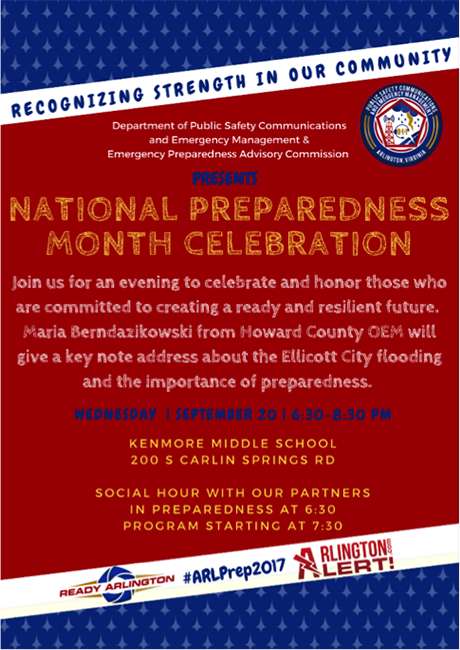
On September 20, we will be hosting our National Preparedness Month Celebration, to honor those in our community who have helped us be more prepared for a disaster.

We’ll be hosting a social hour with several of our partners in preparedness followed by a key note address from Maria Bernadzikowski, Howard County OEM. Maria will be discussing the Ellicott City flooding and how important it is to prepare before a disaster strikes.

Maria Bernadzikowski joined the Center for Health and Homeland Security as a Senior Policy Analyst in November 2016 and began working for the Howard County Office of Emergency Management on the Disaster Recovery Team (Ellicott City Flooding, July 2016.)

She transitioned as the Recovery Coordinator for the county’s efforts in March 2017 and has recently been tasked with creating their Outreach Program. Ms. Bernadzikowski is a graduate of St. John’s University (BA) and Tulane’s School of Public Health and Tropical Medicine, where she earned a Master of Public Health with a concentration in Disaster Management.

Ms. Bernadzikowski has worked on establishing community outreach programs, preparedness and recovery plans, exercise and training, and volunteer programs throughout Fairfax, Virginia, New Orleans, Louisiana and Léogâne, Haiti. She specializes in outreach to individuals with access and functional needs.

Come by Kenmore Middle School, 200 S. Carlin Springs Road, from 6:30-8:30 p.m. next week and learn more about how you can help us and yourself better prepare Arlington for a disaster.

Get connected!

As always, visit ReadyArlington.com or follow us on Facebook and Twitter for more information, and make sure to sign up for Arlington Alert.


View More Stories