
The Chew column banner

The following bi-weekly column is written and sponsored by Dog Paws n Cat Claws, which provides a heart-centered and safe environment for your pets. Conveniently located at 5818-C Seminary Road in Bailey’s Crossroads, DPnCC offers doggy daycare, boarding, grooming, walking and training services, plus in-home pet care.

We’ve all been there. We’ll see our dog eating something strange or even downright disgusting and ask ourselves, “Why is my dog eating that?” From grass to poop to the remote control, what are the reasons why some dogs have pretty strange appetites?

Grass. I refer to this as “having a salad” and it can mean a number of things. He may have an upset stomach and grass is a natural remedy for gassy upset tummies. Try a dog food higher in fiber or add fresh cooked veggies to his kibble. Grass eating can be as simple as liking the way it tastes or feels. It also can be a sign of boredom so keep your dog engaged with walks and outdoor activities. Keep in mind that although grass itself is not bad for dogs, the pesticides they pick up from treated lawns could be harmful.

Feces. The scientific name for eating feces is coprophagia and it’s not an uncommon behavior in dogs. It’s a mother dog’s natural instinct to clean herself and necessary to stimulate urination and defecation in her puppies. What about the dog that does this for apparently no reason? Research shows it could mean a dog is suffering from parasites, diets deficient in nutrients, conditions such as diabetes or as a side effect from drugs, such as steroids. Consult your vet to rule out any of these health issues. It also can be due to anxiety. Try adding a Vitamin B complex supplement to your dog’s diet and monitor his behavior for any further signs of anxiety.

The cats provide one of my dog’s favorite “treats” each time they use the litter box. He thinks they’re delicious, we think it’s gross! He probably acquired this unusual craving because of his love of cat food. He’ll do anything to get it and I’ve moved the food to a higher shelf. Cat poop will naturally taste of the cat food he craves but it can make him sick. Cat food is higher in fat and protein than dog food, which is hard on a dog’s liver and kidneys. Chemicals in the litter can cause blockages in the intestines, as well as transmitting parasites.

To solve this problem, go to the pet store and find a top entry litter box. I actually took an old Tupperware bin and cut a hole in the top. It’s deep enough so that even if his head enters the hole, he can’t reach the forbidden treats.

Chewing objects. Puppies have a bad habit of chewing on everything and anything as they explore their world and usually outgrow this behavior. However, when you are not home, a dog may find something that smells like you and immediately want to check it out. Objects like jewelry, cell phones, TV remotes, kitchen utensils and clothing — especially shoes — contain your scent and oils and commonly become chew toys for your dog. If your dog displays this tendency, make sure to keep these objects out of his reach.

Chewing is something dogs need to do to keep their teeth healthy as well as relieving boredom and tension. But it can also be due to lack of exercise so it’s important to make sure your dog gets at least 1-2 hours of exercise each day and mental stimulation through playtime and obedience training. Take her to doggy daycare to blow off some of that steam!

No dog is perfect and let’s be honest…we wouldn’t want them any other way!

Sara Schabach
In-Home Pet Care Manager / Writer Extraordinaire



Just Listed banner

Just Listed highlights Arlington properties that just came on the market within the past week. This feature is written and sponsored by Team Cathell, “Your Orange Line Specialists.”

Buyers continue to outpace sellers this week in Arlington which reduces total inventory and pushes us more into a seller’s market.

Only 52 new listings came on the market this week, while buyers ratified 64 contracts on homes. The shortage of inventory here reflects national trends that are pushing the value of homes upward. HUD reported this week that September brought the highest increase in property values in 10 years.

The housing market hit its peak in the 2nd quarter of 2006 with $13.5 trillion in equity across the U.S. Currently, the total equity in homes across the country stands at $12.7 trillion. At the current rate of appreciation, the U.S. housing market should reach its peak again in only two more years. But this time there should be very little risk of a bursting bubble.

Meanwhile, interest rates rose this week by about 6 basis points to 3.62% for a 30-year fixed rate.

Click to see all the fresh new inventory in MRIS and call Team Cathell (703-975-2500) when you find a home you like.


Ready Arlington banner

This biweekly column is written and sponsored by the Arlington Office of Emergency Management.

Nearly half of US adults had their personal information hacked in 2014 — not including the 500 million recently revealed hacked Yahoo accounts. 2015 saw an even higher rate of personal data breaches. That means that it’s likely either you’ve been a victim yourself, or know someone who has.

Communication is a critical infrastructure in today’s world. And just by using your phone or computer, you make yourself vulnerable. Just as you need to be aware and prepare for natural emergencies, you should take steps to improve your cyber preparedness. Join us during Cyber Security Awareness Month to enhance your awareness and preparedness!

Protect Your Personal Information

Your personal information includes your email; online banking, Pay-Pal and e-commerce accounts (like Amazon or I-Tunes); and accounts with sensitive information like your social security number, address, phone, etc. You’ll be surprised how many there are!

  • S=Secure in the HTTPS. A website without an “S” at the end of the HTTP may not be secure. Avoid shopping or sharing any sensitive information in sites unless it is an HTTPS.
  • Read the fine print. Know what data an app can access before you download it. Read the privacy policy before you download, and pass on apps that want to access personal information.

It’s all about the update

85% of security hacks could be prevented by updates, according to the US Computer Emergency Readiness Team (US CERT).

  • Always Update Your System. Update your security software, web browser and operating systems regularly. Updates include patches for security breaches. Without them, your systems are left vulnerable to hackers.
  • Back it up. Back up your information regularly. If your device is hacked, you will still have your information.

readyarl-pwEnhance Your Password Protection

You’ve heard it before, but a strong password is one of your best defenses for your personal information. Yet 123456 remains the most popular password in the US (followed by Password).

  • Mix it up. Use a combination of letters, numbers and characters. Try a phrase, like “Ih8sh$pping!” for increased protection.
  • Don’t be green. When it comes to cyber security, never reuse or recycle passwords, no matter how inconvenient it may be. If one account becomes compromised, then all of your accounts are vulnerable. Consider using a password manager to keep track of your passwords.

Be WiFi wise

Anything you do while online via public or insecure networks can be accessed. Use these networks carefully.

  • Nix the auto-connect. Turn off the WiFi auto-connect and Bluetooth on your devices, and only connect when you need to. This will save your battery as well.
  • Safe at home. Shop, access your bank accounts and email from your own device, and only on a network you trust.

readyarl-clickbateDon’t be click-bait

Nearly one million new malware threats are released every day, and attacks are quick. It takes 82 seconds from the time of release to the first victim, according to Verizon. Keep your home, contacts and business safe by clicking cautiously.

  • Stranger Danger. If an email is unexpected or you don’t recognize the sender, don’t open it before verifying.
  • MiSpelled.com. Check URLs before opening. Hackers will often slightly misspell the URL of a legit website. Verify any URLs you’re unfamiliar with before opening.
  • If it it’s too good to be true… It probably is. Avoid amazing, free or urgent deals. The more urgent, the higher chance of infection. Be wary of links with shocking or fake celebrity news.

While you’re reviewing your accounts to update passwords, don’t forget to review your www.ArlingtonAlert.com account to make sure you receive emergency, traffic and weather alerts from Arlington County!


Legacy Home Improvement Property Pros banner

This is a sponsored column by Jim Muldoon, a Northern Virginia native, Arlington resident and one of the real estate and remodeling experts at Legacy Home Improvement Consultants. Legacy HIC is your source for all real estate and home improvement needs. Please email with any questions or topics you would like covered.

One of the most common reasons for a bathroom remodel is converting a tub-shower combo to a walk-in shower. This small area has a lot of moving parts and requires a lot of decision making for the homeowner. Here is a guideline to simplify the process.

The standard dimensions for a tub-shower combo are 60 inches in length, 32 inches in width and 8 feet in height.

The Basics

Tile — Your tile selection has the biggest influence on the look of the shower. You will need 90-95 square feet of wall tile and 15-20 square feet of shower floor tile. Typically to finish off the edges, a bullnose tile or a Schluter strip is used. To account for the height of the wall tile, 20 linear feet will work.

Plumbing — For a center drain location, a 4 inch circular or square drain works. If you would like the drain in the front of the shower, I would recommend a 28 inch wide linear drain. I always recommend swapping out the diverter valve during a bathroom remodel. The rough plumbing stage is also the time to determine your shower head height. Switching to a rain shower head is becoming more common and could require raising the height of the water supply.

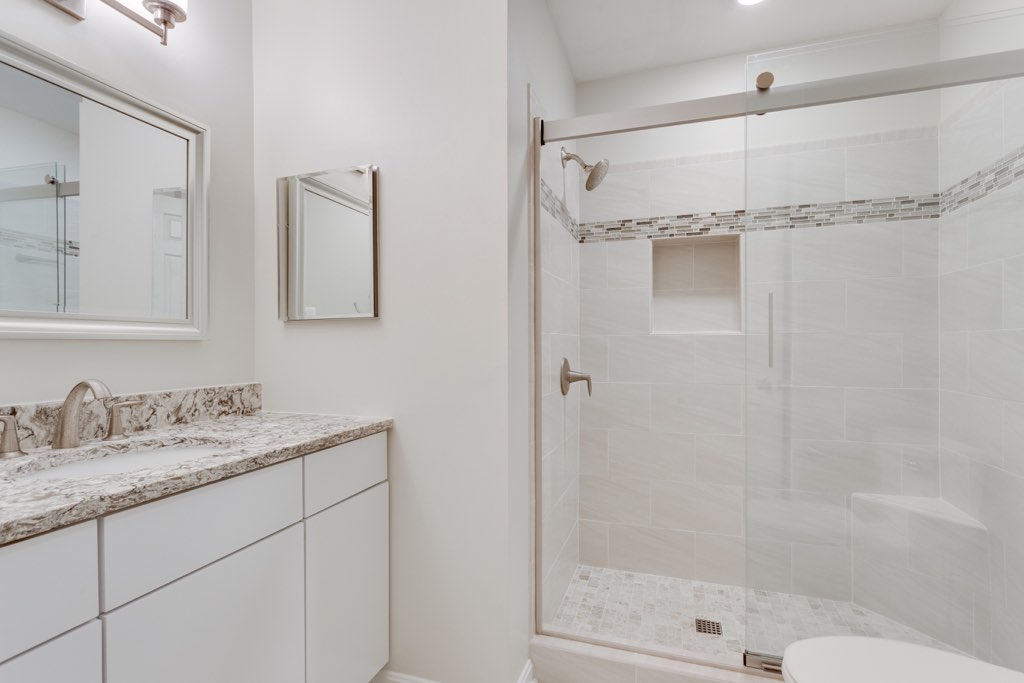
Shower Door — Frameless shower doors are the craze but check and make sure there is enough space for the clearance of a swinging door. If not, Semi-Frameless sliding doors are a great option that are affordable and still show off the tile work behind them.

leachbeforeandafter1-1024

The Upgrades

Niche — This is a recessed shelf in the wall of the shower. They have become a staple in new showers. Check out the height of your bathroom products to help figure out the dimensions you want them built out to. The added materials required will be 8 bullnose tiles to finish off the edges.

S Rolfe StStep or Seat — Shower seats are very popular but take up a lot of space in a tub to shower conversion. We build a lot more steps for this type of remodel. They look like a seat but smaller and are located in the corner of the shower. Bullnose will be required to finish off the edge as well.

Wall Accent — Installing a decoration strip around the shower walls adds a lot of pop. You can run mosaic tile flush to the tile or add pencil edging to each side to frame it in.

Grab Bars — This remodel is very common for adults wanting to age in place. Framing is required for grab bars, so let your contractor know about these items before the backer board is put in place.

Recess Light — There are recess lights made for the shower area. We like to run a separate switch so that you don’t have to waste energy when you are not in the shower.

Finishing Touches

sc4-1024Ledges — A fabricated piece of stone gives a nice high-end finish to the bottom of niches, the top of the shower curb and the top of the step.

Grout — Getting flexible grout admixture helps reduce grout cracking and maintain its proper color. If grout discoloration has been a problem in the past I would use power grout.

Silicon Caulk — You can match your grout color for the tile areas that require caulking . Clear silicon should be used around the fixtures.

Email me at [email protected] with any questions or topics you would like me to discuss. Be sure to follow us on Instagram @LegacyHomesDMV and like our Facebook page Legacy Home Improvements for project inspiration and breaking news.


Ask Eli banner

This regularly-scheduled sponsored Q&A column is written by Eli Tucker, Arlington-based Realtor and Rosslyn resident. Please submit your questions to him via email for response in future columns. Enjoy!

Question: Should I accept an offer on my home that is contingent on the buyer selling his home first?

Answer: While there are financing options and other strategies to help buyers avoid home sale contingencies, they’re oftentimes necessary to close a deal. Before you accept an offer that includes a home sale contingency, you should consider the following factors:

Which Home Sale Contingency?

1) Sale of Buyer’s Property with Kick-Out:

This is used when a buyer’s property does not have a pending contract and can be used even if the property isn’t yet listed for sale. It includes a deadline for the buyer to go under contract, terms of the listing (when it will be listed and for how much), and most importantly, it allows you to “kick-out” the buyer, with notice, to accept another offer or put the home back on the market as Active. This is a high-risk contingency for sellers.

2) Settlement of Buyer’s Property (no kick-out):

This is used when the buyer’s home is under contract and pending settlement. Depending on the terms of the contract on the buyer’s home, this can be a fairly low risk contingency for sellers.

Kick-Out Clause

If contingency #1 above is used, you have the ability to continue marketing your home for sale and accept back-up offers from other buyers. If you receive a better offer, you can “kick-out” the current buyer unless they can provide proof of a ratified contract on their home or proof they can purchase the home without first selling their home. You will negotiate the number of days the buyer has to meet one of these requirements, once you’ve given notice, so it’s in your best interest to keep the number as low as possible.

Review All Relevant Data

If contingency #1 above is used, you and your agent should conduct a full market analysis of the home the buyer is trying to sell to determine the likelihood that it sells in a timely manner at the price it’s being offer for. If you learn the home is in a market with average days on market of 100+ days and the buyer is offering it at a price above market value, you have a bad offer.

If contingency #2 above is used, you’ll want to review the terms of the ratified contract your buyer has to determine what contingencies still exist. If all contingencies have expired and a substantial Earnest Money Deposit has been made, you can proceed with confidence. However, I’ve seen offers made where the buyer’s ratified contract includes a home sale contingency itself for the buyer of that property, meaning my client had to rely on two homes to sell before his home could sell…bad offer.

Days On Market

You should also assess where you are in your sale cycle. If you’re in the first 30 days of your listing, you should hold out for strong offers and avoid a risky home sale contingency. Just like you wouldn’t normally accept a deep reduction from the asking price in the first 30 days, you should also push for strong supporting terms.

Other Terms

If you’re considering accepting an offer that includes a home sale contingency, work hard to negotiate favorable terms elsewhere, especially price. You deserve to be compensated for the additional risk a home sale contingency presents.

Before accepting an offer with a home sale contingency, you and your agent should work with the buyer and buyer’s agent to explore strategies that allow the buyer to qualify for the purchase without first selling their home. Often, it’s more feasible than buyers realize.

If you’d like a question answered in my weekly column, please send an email to [email protected]. To read any of my older posts, visit the blog section of my website at http://www.RealtyDCMetro.com.

Eli Tucker is a licensed Realtor in Virginia, Washington DC, and Maryland with Real Living At Home, 2420 Wilson Blvd #101 Arlington, VA 22201, (202) 518-8781.


Berry & Berry column banner

This is a sponsored column by attorneys John Berry and Kimberly Berry of Berry & Berry, PLLC, an employment and labor law firm located in Plaza America that specializes in federal employee, security clearance, retirement, and private sector employee matters.

By John V. Berry, Esq.

We often represent federal employees in federal agency misconduct investigations. The types of misconduct that a federal agency can investigate are too numerous to list here, but some of the most common types of misconduct involve:

  • Time card and attendance issues
  • Misuse of government computer and internet
  • Misuse of government credit card, vehicle or travel card
  • Allegations of discrimination or harassment
  • Alleged dishonesty or lack of candor
  • Allegations of off-duty criminal or traffic conduct
  • Inappropriate promotions and selections cases

The Investigation Process

The usual process for a federal employee misconduct investigation begins when a federal employee is notified that an investigator needs to speak with the employee. The alleged misconduct can be investigated by several types of investigators. The investigator can be a supervisor, someone from human resources, an agency investigator, an Inspector General agent, or another type of agency official or representative. There is usually short notice for the investigation and the investigator generally will want to conduct the interview fairly soon. Furthermore, the federal employee is usually never provided an explanation of his or her rights.

In many, if not most cases, the interviewer immediately starts asking questions and expects answers to his or her questions without providing a statement of rights. In some cases, the interviewer may ask that the federal employee sign a statement agreeing to be voluntarily interviewed (often referred to as a Garrity warning) and waiving all of the employee’s rights. In other cases, the federal employee may be asked to sign a Kalkines warning requiring that the employee acknowledge that he or she is being ordered to speak to investigators under penalty of disciplinary action.

While circumstances vary, it is usually preferable for a federal employee to be ordered to provide a statement as some protections may attach, versus providing a voluntary statement where there are no protections. Federal agencies generally prefer that voluntary statements be given. In cases where a federal employee is not ordered to provide a statement, but voluntarily provides one, no protections to the employee’s statement usually apply. As a result, it is important and wise for the federal employee involved in a misconduct investigation to have legal counsel to advise the employee prior to the interview.

The Investigation Format

Generally, the most common scenario for a federal employee misconduct investigation involves the federal employee being interviewed by one or, more often, two investigators. The duration of these types of investigations vary depending on the issues under review, but generally last between one and three hours. However, we have represented federal employees during longer interviews. Following the interview, many investigators summarize the employee statement and attempt to have the employee sign it for the record.

It is important to ensure that the investigator does not insert his or her own version or characterization of the employee’s verbal statement into a final and inaccurate written statement signed by the employee. All too often a federal employee makes a statement to an investigator that is taken out of context in the written summation, which is then signed by the employee.

How to Handle the Investigation

It is very important for federal employees to treat any misconduct investigation seriously. It is also important to seek advice early because doing so can help prevent or mitigate potential subsequent disciplinary action. Furthermore, it can often help when an investigator knows that you are represented by legal counsel. In our experience, investigators tend to follow the rules regarding investigations more closely when an individual is represented by legal counsel. Additionally, should the issues involved turn potentially criminal in nature it is important to be represented before making statements about conduct which can lead to criminal issues.

If you need assistance with an employment matter, please contact our office at (703) 668-0070 or at www.berrylegal.com to schedule a consultation. Please also visit and like us on Facebook at www.facebook.com/BerryBerryPllc.


This regularly-scheduled sponsored Q&A column is written by the Arlington Initiative to Rethink Energy team (AIRE). This county program helps you make smart energy decisions that save you money and leaves a lighter footprint on the environment. Got a question? Email us at [email protected]!

Sustainability through storytelling. That is what you can expect from Rethink Energy’s new podcast. Energy is invisible. But then again, it can be seen almost everywhere. Rethink Energy makes the invisible visible with stories from the people who take on some of our greatest energy challenges, right here in Arlington. 

These podcasts are packaged in 8-10 minute bits. Listen while riding the metro, bus, or while walking home from work.

Some highlights:

  • In episode 5, we learn why Arlington Public Schools went through the trouble of building a net-zero energy school. Take a behind-the-scenes tour of Discovery Elementary School. “Our electric bills are basically zero,” says APS construction manager, Steve Stricker.
  • In episode three, Patty Shields explains what a novelty she is being a woman in the home builder arena, “It is fairly unique. There are not a lot of women home builders. I can count them on one hand not using a lot of those fingers. I really only know two.” When asked if she was one of those two she replies, “I am. I want to beef up the numbers so that other women will get into it!” She opens up about her experiences building the first LEED Platinum house in Arlington, and the first Passive House.
  • Other episodes look into Arlington’s solar co-op, home insulation and air sealing, heating and cooling, and more!

Each podcast episode opens a door to new ideas, new jokes, and new ways of seeing Arlington. Take a few minutes to (binge) listen and check out the episodes from our first season:

Podcast Teaser – LINK

All episodes – LINK


Weekend Wine and Beer Guide logo

Editor’s Note: This biweekly column is sponsored by Dominion Wine and Beer (107 Rowell Court, Falls Church). It is written by Garrett Cruce, a Cicerone Program Certified Beer Server.

The harvest period for hops in the Pacific Northwest happens to coincide with the end of Summer and beginning of Fall. As rows and rows of bines — that’s what hops grow on, though they resemble vines — fill out with bright green leaves and hop cones, farmers reap what they sowed. Most hops are processed in a kiln to dry them and keep their valuable oils stable. A certain portion of hops are shipped directly to breweries so they can use them to make “fresh hop,” “wet hop” or “harvest” (though there can be confusion between a fresh hop “harvest” beer and a brown ale called a “harvest” beer) beers.

Fresh hop beers can only be made during and immediately following the hop harvest as the wet hops (they are literally wet with moisture and fresh hop oils) have a short life span if they are not dried. The oils risk spoiling and worse, the moisture can lead to rot. Before long all those lovely, fresh hops are garbage. That’s why fresh hop beers are so special. That’s also why Fall is truly the one seasonal period for craft beer that cannot be superseded by seasonal creep. A fresh hop beer cannot be made before its time.

Thomas Cizauskas gave me the idea in a comment on my last column. He inquired about whether I had any favorite fresh hop beers that are limited to Fall. Since that article was about my faves up to that column’s release, I couldn’t say. There just weren’t any fresh hop beers available to me.

As it is, I had to cross the Potomac to Dominion Wine & Beer’s sister store, Downtown Crown Wine & Beer to find two locally brewed fresh hop beers. These beers represent another aspect of the fresh hop category: the appeal to locavores. Both are made using only locally harvested hops, while one even uses locally sourced grain and honey.

Waredaca Brewing Company, Whetstone Session Pale Ale (4.4% ABV)

whetstoneLocated in Laytonsville, MD, Waredaca is designated as a farm brewery, which means that they include at least one ingredient grown on the farm. Established on the Waredaca farm, the brewery brews small batches of draft-only beer. Their Whetstone is a fresh hop beer that is made with Cascade and Chinook hops from their farm and a Maryland hop farm, Pleasant Valley. The result is a beer that smells of biscuit with an earthy overtone and a hint of pear. The sip is light-bodied with a subtle hop fruitiness that gives way to hints of pine. While there’s a bitterness in the finish, it’s very light. As it warms, the green grass that can be a hallmark of fresh hop beers begins to come out in the flavor. Subtle is THE word with this style and certainly this beer, too.

Oliver Brewing Company Harvest Ale (5.6% ABV)

harvest-ale Oliver Brewing Company started in 1993 with a focus on traditional English style beers. Since then, they have expanded from the basement of a brew pub to their current location and began to can their flagship beers. They still brew smaller batches of special beers, like Harvest, that are only available on draft. I had actually just sampled this fresh hop beer at the Ale House of Columbia days before grabbing my Crowler from Downtown Crown. Oliver’s fresh hop ale is more of an amber ale that gives off a delightful scent blending honeycomb, Nilla wafer and dark berries. Similar to the Whetstone, Harvest is light on the tongue. The flavor is more malt than hop flavor, though a hint of smoke appeared as my glass warmed. Oliver sourced its fresh hops from Black Locust Farms in Maryland, its grain from Copper Fox Distillery in Virginia and honey from Miller Bee Yards in Maryland.

These two beers aren’t merely entries in a brief annual release schedule, they are celebrations of local farming and economies. I set out to learn more and to share with you about a style that I knew existed, but hadn’t given much attention. I ended up finding a style that can be used to epitomize the concepts of #drinklocal and #shoplocal.

Check out Dominion Wine & Beer to see what fresh hop beers they have. These subtle beers are worth exploring now since the season for them will be gone before you know it. Cheers!


Healthy Paws

Editor’s Note: Healthy Paws is a column sponsored and written by the owners of Clarendon Animal Care, a full-service, general practice veterinary clinic. The clinic is located 3000 10th Street N., Suite B. and can be reached at 703-997-9776.

So you want to run with your dog?

Running with your dog can be great exercise for both of you, especially since most pets don’t get the opportunity to really stretch their legs as much as they like living in the more urban environment that we do. We’ve put together a few tips to keep your pup safe, happy and healthy while engaging in an running regimen:

AGE — The first thing to take into consideration when considering running with your pet is the age of your pet. Dogs should be near skeletal maturity before any sort of serious running routine is started (this can be 9-12 months in a smaller breed dog, but not until closer to 18-24 months in a large/giant breed dog). Short, relaxed runs are okay starting at around 9 months for most breeds.

TRAINING — It is important that your dog has basic leash and obedience manners in order for you to safely run with them. If he/she is pulling and barking uncontrollably at every dog or person you pass, this will not likely lead to a safe, fun or efficient work-out for you.

ENDURANCE — Just as we need to work up our endurance, so do our pets! As a very general rule, we recommend starting with 10 minutes of exercise, and working up in 5 minute increments over the course of each week until you reach your desired time/distance. There is no exact formula for how much a dog can do, so it is important to watch for your dog for signs of exhaustion — these may include lagging behind, stopping to catch their breath, prolonged panting post-exercise, lameness associated with exercise, or coughing or labored breathing.

WEATHER — Again, just as for us, the time of day/year is important to take into consideration. As a general rule of thumb, if it is a hot day outside, place your hand directly on the cement. If you cannot keep your hand on the cement for 5 full seconds, then it is too hot for a dog’s paws. It is also preferred to run early in the morning or later in the evening, when the sun has gone down when it is >75 degrees outside. Humidity also plays a huge role for dogs as they do not get rid of body heat in any significant fashion through sweating. Sweating is important for evaporative cooling — but since they really only sweat in their feet and most of their evaporative cooling is done through panting — they are working with a really small surface area to get rid of heat. When it is very humid out — that evaporative cooling mechanism doesn’t work well at all — which means heat transfer doesn’t work well. This is why in the DC summers, even in the air conditioning, dogs tend to act hot (panting, wanting to sit near fans, etc…). It’s cooler inside, but the humidity is still much higher than in the winter at similar temperatures and so they have a harder time staying cool.

INJURIES — The weekend warrior or rare/intermittent/poor training is, similar to us, one of the main causes of musculoskeletal injuries in our dogs. We can’t expect a dog with little training to up and run without minimally being sore afterward. Other injuries we can see from a lack of training and conditioning are cruciate injuries (i.e. ACL tears), meniscal injuries, as well as any number of muscle, ligament and tendon sprains and strains.

In addition to the musculoskeletal system — we can see dogs injure their foot pads from running on rough/abrasive surfaces; or even burn their pads from running on hot surfaces. These injuries tend to hurt the worst a few hours after the happen and can lead to significant pain as well as secondary infection.

Just like you or I, dogs also need to be kept hydrated. Dehydration and overheating are two of the most common non-orthopedic problems that we see dogs present for when they are not appropriately conditioned for their run, when they are pushed too hard or when they are run in high heat or humidity.

Individual health concerns to consider are health issues (such as heart disease, kidney disease and breed type). Dogs with underlying medical conditions often need to go at a slower pace and go shorter distances. Brachycephalic breeds (i.e. “smoosh-faced”) physically cannot get the same amount of oxygen through their nose/mouth and into their lungs as a dog with normal conformation and are at risk of overheating, fainting or developing significant respiratory problems if they are pushed too hard.

INDIVIDUAL TEMPERAMENT/DRIVE — this may seem a little silly because we’re talking about dogs, right? Don’t they all want to run? Well, actually…No. Some dogs just won’t ever be good running buddies, and that’s okay. Some dogs will be on the other side of the spectrum and will be so devoted to you and the run that they will end up pushing themselves to significant injury. Know your pet and their individual drive and respect that when training.


Rental Trends banner

This biweekly sponsored column is written by the experts at Gordon James Realty, a local property management firm that specializes in residential real estate, commercial real estate and home owner associations. Please submit any questions in the comments section or via email.

If you are moving and considering renting out your home rather than selling, there are a multitude of details to consider before renting out your home, such as should you hire a property manager or rent it out yourself? Regardless of your decision, here is a checklist to get your house ready to rent.

Start the process at least six weeks out.

Start even sooner if you’ll need to have some work done to make the rent ready. You’ll want the home to be at its best before you start showing it to tenants, and many tenants start looking for a home four to six weeks prior to their move date.

Spruce it up.

Spend some time and money to give your property a coat of fresh paint, plant some flowers, de-clutter and clean thoroughly. Quality tenants want a clean home that makes a great first impression. This guide offers more tips you get your property ready to rent.

Change your insurance.

Your homeowner’s policy isn’t enough to cover you when you become a landlord. Before you sign a lease, be sure to consult with your insurance agent and get a landlord’s policy, also known as a dwelling policy. Find out more about landlord’s policies.

Get Legal.

Research the laws in your area and obtain any required licenses and inspections. In most jurisdictions, being a landlord is considered a business that requires a license, even for a single property or basement unit. Some cities (like Washington, D.C.) require inspections and a certificate of occupancy before you can legally rent out your home. Learn the requirements for becoming a landlord in Northern Virginia.

Decide if you’ll accept pets.

You’ll have a larger pool of tenants if you’ll consider furry companions, but make sure you have strong tenant and pet policies in place to prevent costly damage, noise and other pet-related problems. Determine whether to charge pet rent or pet fees. You’ll find information to help you decide and develop good pet policies in this article.

Figure out how much rent to charge.

Research the market for homes or units similar to yours in size, location, amenities and condition. See how much those comparable homes are charging and whether they rent quickly.

Create a marketing plan.

Think about your likely renters and decide where to post your listing to attract the largest pool of qualified tenants. Write an ad highlighting your property’s best or most in-demand features and take high quality pictures that show it in the best light. Learn more about how to market your rental property.

Develop a comprehensive tenant screening process.

Thorough screening is the key to making sure you get a great, qualified tenant instead of a nightmare. Screening should include pulling a credit report, criminal history, and eviction history as well as verifying employment and checking references. In addition, having a systematic process that you use for every applicant will help you avoid potential discrimination charges.

Have an iron-clad lease.

A lease outlines rights, rules and responsibilities for you and your tenant. In case of a disagreement or problem, a well-written lease will help protect you. To make sure you are adequately protected and that your lease follows all applicable laws, you may wish to consult an attorney. Get more information on leases and rental agreements.

Consider hiring a property management company.

A management company can help with or take care of all of the tasks above. And they’ll be there to handle anything that comes up after the tenants move in, too. Moving is stressful enough without worrying about starting a new business as a landlord at the same time. The value of professional property management is even greater if you’re going to live far from your rental property. Download our free guide to Working with A Property Management Company.


Stitch — a 3-year-old, neutered, 6-pound Chihuahua — doesn’t know why his people gave him up at an animal shelter last spring, but he does know that he’s ready to weave himself into the heart and life of the right new owner.

Stitch is hoping for someone who is retired, works from home or is a homebody.

This handsome boy has the classic Chihuahua look (adorable), personality (charming) and bladder (tiny!). He’s lovable and devoted, courageous and comical. Stitch is the lap dog you’ve always wanted and will make sure you’re never alone at home, shadowing you from room to room and sleeping sweetly in your lap, perhaps after his favorite activity: the daily walk!

Stitch is all dog, and all terrier (tenacious and bold!) He wants to make sure you know he’s not a doll and he’s not a child — in fact, he would like to be the #1 little dude, and the only pet, in a child-free home. He’d really love it if you took him to class to learn more manners and maybe some tricks, too.

Stitch is a very healthy boy, current on vaccines, monthly heartworm and flea/tick preventatives. He even had a full dental cleaning in August. His foster mom has had him long enough to give you all the details about handsome Stitch — no surprises and lots of great dog-owner tips.

Contact her at [email protected] or view his profile at http://lostdogrescue.org/stitch-3/.

The preceding was was sponsored post.


View More Stories