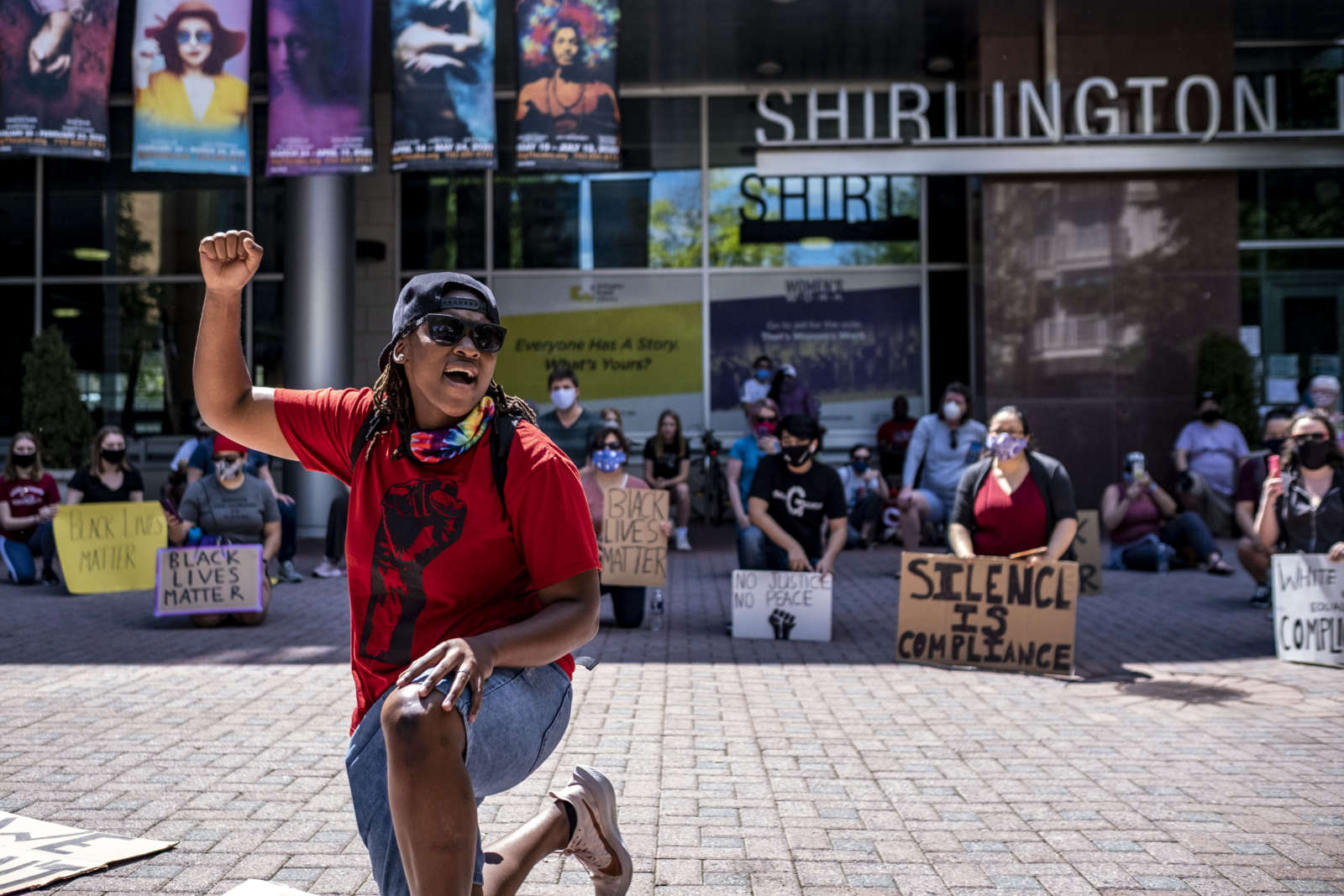
(Updated at 10:30 a.m. on 12/02/20) Arlington is seeking diverse voices in its Dialogues on Race and Equity, but so far the biggest group of respondents have been middle-aged white women who are relatively affluent.

Arlington County Chief Race and Equity Officer Samia Byrd and Challenging Racism Director Alicia Jones McLeod, who are promoting a new questionnaire on the topic of race, see this as a sign to keep pushing for broader participation.

“It has been interesting… we are seeing predominantly white women, middle aged, homeowners completing the assessment,” Byrd told the County Board last week. “So we really, really want to encourage everyone — so we can hear all of the voices that we typically do not hear — to complete the assessment.”

So far, 69% of respondents were white, but not of Hispanic origin. Hispanic people accounted for 7%, and Black or African American people accounted for 9%. Asian or Pacific Islander representation rests at 4.5% and American Indian or Alaska Native rests at 2.2%. Another 4.5% marked “other.”

Women represent 60% of respondents, and men 31%, with 8% preferring not to answer, and less than 1% marking gender non-conforming or not listed.

“We want to understand the full Arlington experience, or Arlington as experienced by everyone, so that we can continue to move forward,” Byrd added, in a conversation with ARLnow yesterday.

On Monday, the assessment was released in Mongolian and Arabic. It is being pushed via social media, email and the distribution of hard copies. The assessment closes on Dec. 31 and results will be presented to the County Board in the new year.

About 1,200 assessments have been completed since the survey went online on Oct. 12, as part of a broader initiative from Arlington County and Challenging Racism to engage community members in dialogues on race and equity, in the wake of the police killing of George Floyd and the protests that followed.

More than 200 people have participated in a second component of this initiative — a series of six conversations — the last of which is set for Dec. 9.

The preliminary under-representation of people of color, immigrants and non-English speakers mirrors the feelings that participants have expressed about the Arlington Way, housing and Arlington Public Schools. Participants have frequently mentioned barriers that lead to under-representation in government processes, home-owning and APS gifted programs.

Byrd said the assessments and discussions will lay the foundation for her work with county officials and the community to dismantle systemic racism, where it exists, in Arlington County.

That work involves undoing the lasting effects from when unequal treatment was codified in law, Byrd said. While those historic policies no longer exist, they erected barriers that keep Arlingtonians from accessing housing, education, health and wealth to this day, she said.

“None of us here created the system, but we’re all a part of it, regardless,” she said. “Race is the center of it.”

In the assessments and conversations, many Arlingtonians identified the Arlington Way — a catch-all phrase for citizen engagement in local government — as an area where the means of participation disadvantage people of color, those who rent and those who do not have the luxury of time to participate in lengthy, iterative decision processes.

“The Arlington Way means different things to different people, but generally it is about engagement: how people interact with, and who has access to, decision-making, decision-makers and resources; who is at the table when those policy decisions are being made; who can weigh in when policy decisions are being made that affect everyone,” Byrd said.

The sentiment is not new: For years, there have been suggestions to retool, reform or scrap the process entirely, in favor of a different system of gathering community input.

The pandemic has, at least temporarily, resulted in one notable change to the Arlington Way: more public meetings are being conducted online, rather than in person, thus making it more feasible for some to watch or participate. Before, participation in in-person meetings might have required some combination of booking a babysitter, requesting to work a different shift, waiting for public transit, and sitting in a crowded room for hours on end.

(more…)


The Rosslyn Business Improvement District is hosting its annual holiday clothing drive to benefit those experiencing homelessness from Monday (Nov. 30) through Dec. 15.

Accepted donations include winter coats, sweaters, sweatshirts, hats and gloves, which will be given to A-SPAN, an organization dedicated to ending homelessness in Arlington, which has distributed the donated items since 2011.

“While 2020 has been a difficult year for everyone, we’re glad we can continue the Rosslyn BID’s partnership with A-SPAN to give back to our community this holiday season,” Rosslyn BID President Mary-Claire Burick said in a statement.

Those who want to make donations are encouraged to put their items in plastic bags and drop them off in gift-wrapped donation boxes at participating buildings in Rosslyn.

Last year, 205 bags of clothing were collected, and in 2018, 269 bags were collected.

The clothing drive coincides with A-SPAN’s hypothermia season, which started on Nov. 9. To prepare for the influx of people needing care through March, it added 35 beds to its Homeless Services Center, and will be providing three meals a day both at its services center and hypothermia shelter.

“Despite COVID-19, we provide 24/7 care which includes a 24/7 shelter, 24/7 nursing and medical respite services, and a commercial kitchen at the Center,” CEO Betsy Frantz said in a statement.

The increase in people needing assistance comes as coronavirus cases in Arlington are rising. The organization has implemented isolation and quarantine protocols, she said.

“Emergency protocols are overseen by our full-time onsite nurse practitioner,” Frantz said. “All clients are being rapid tested and all staff and clients have daily temperature checks.”

The participating Rosslyn residential buildings are:

  • 1800 Oak Apts. (1800 Oak)
  • Bennett Park (1601 Clarendon Blvd)
  • Homewood Suites (1900 N Quinn St)
  • River Place North (1121 Arlington Blvd)
  • River Place East (1021 Arlington Blvd)
  • River Place South (1011 Arlington Blvd)
  • River Place West (1111 Arlington Blvd)
  • Turnberry Tower (1881 N Nash)
  • Waterview (1111 19th St)

For those who do not live in these buildings, there will be a collection box outside the Rosslyn BID office at 1911 N. Fort Myer Drive. The office will be open for donations Monday through Friday, from 9 a.m.-5 p.m.


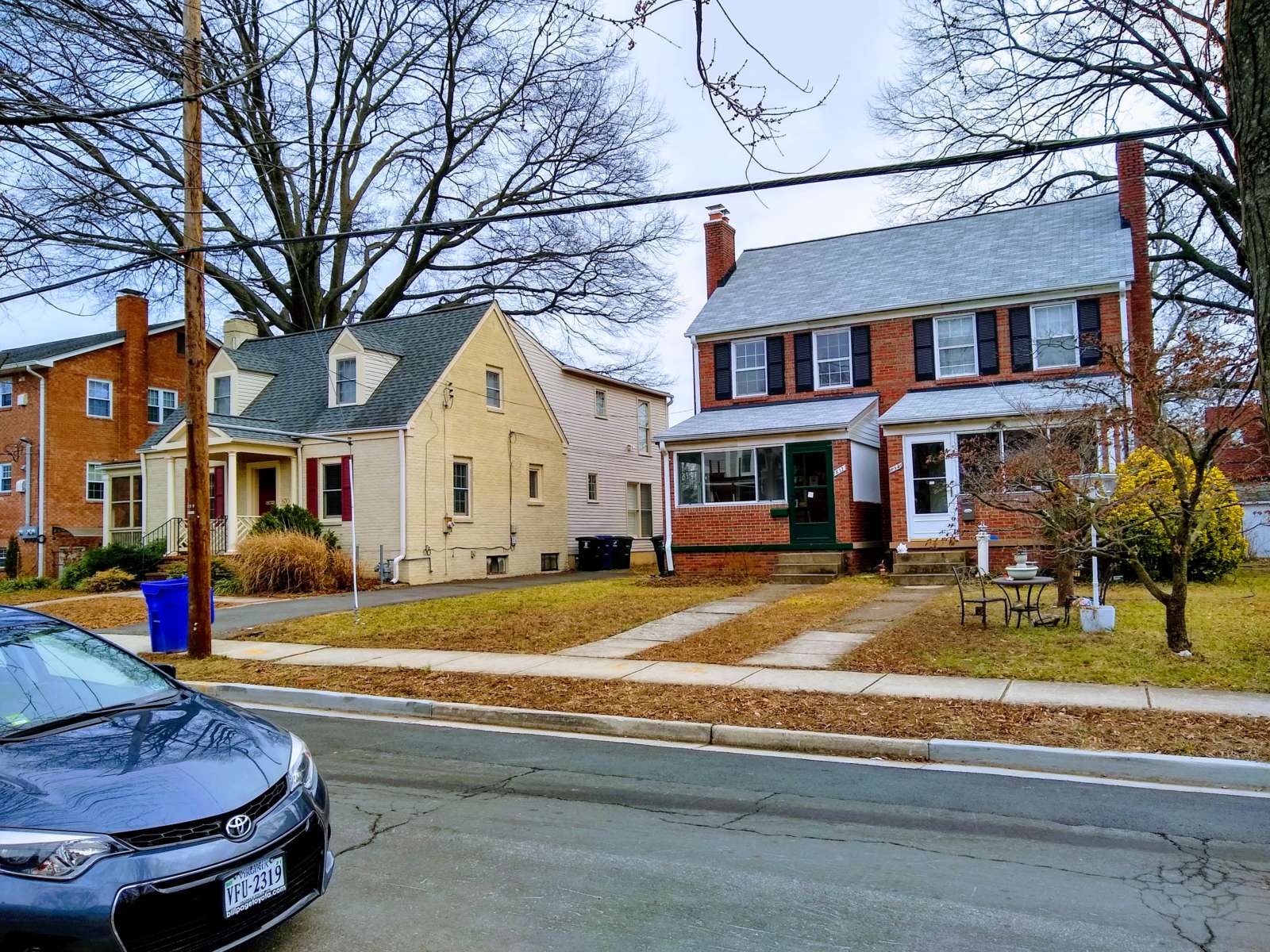
(Updated at 4 p.m.) When walking from a Metro station, pedestrians often pass large apartment buildings that transition quickly to detached, single-family homes on sizable lots.

That contrast reveals two problems in Arlington County’s housing supply, says Emily Hamilton, a housing expert and advocate, and the Director of the Urbanity Project at the Mercatus Center at George Mason University.

Arlington needs to allow for more expansive urban villages around Metro stations, as well as additional housing options in between apartment buildings and detached, single-family homes, she said.

Her remarks come one month after Arlington County kicked off its “Missing Middle Housing Study,” which is examining whether the county should introduce housing types that have been typically prohibited from many neighborhoods.

Hamilton commended Arlington as a national model for transit-oriented development, since it allows dense, multi-family apartment buildings within one-quarter mile of the Metro stations on the Rosslyn-Ballston corridor. But the County never changed the zoning ordinances to fully bring the plan to fruition, and she said it needs to.

“Ahead of Metro’s arrival in Arlington, county policymakers adopted the well-known ‘bulls eye approach’ to planning, which calls for dense development surrounding the Rosslyn-Ballston corridor Metro stations,” she wrote on the website Market Urbanism earlier this month. “Unfortunately, this plan has never been realized in the zoning ordinance.”

“The County maintains single-family or townhouse zoning within one-quarter mile of four stations on this corridor and a relatively low-density multifamily zone within one-quarter mile of the Rosslyn station,” she continued. “The County needs more townhouses and low-rise multifamily housing, but it also needs more high-rise multifamily housing as the bulls eye plan recognized. Given the high and rising land values and house prices along this corridor, it’s past time to realize this decades-old planning objective.”

“People are willing to walk a quarter-mile to a half-mile for transit generally, and farther for heavy-rail stations like the Metro,” Hamilton told ARLnow in a subsequent interview. At least an extra block or two could be converted into denser housing around the stations in Ballston, Virginia Square, Clarendon, Courthouse and Rosslyn, she said.

One such opportunity is in the Lyon Village neighborhood near Clarendon.

“North of the Clarendon Metro station is the largest chunk of that quarter-mile circle where there is low-density housing, and of course, that is where the single family homes are extraordinarily expensive,” said Hamilton. “It’s certainly a spot where denser development would make economic sense.”

Another example of low-density development around Metro is at East Falls Church, where there are single-family homes across the street from the station. A development plan for the area approved in 2011 but fizzled out, after facing strong opposition from local residents.

“There is a big opportunity” to build multi-family housing in the East Falls Church area, Hamilton said. New development would encourage more people to take Metro to work, and would have a positive overall environmental impact by cutting down on driving, she said.

While transit-oriented development has many positives, the relative lack of a middle ground between big apartment and condo buildings and single-family homes is “extremely stark,” Hamilton said.

“There is a missing price point in Arlington both because of the county’s high-income and the region’s unwillingness — compared to other coastal regions — to permit multi-family housing,” she said.

Recent calls to rezone some neighborhoods to allow smaller-scale multi-family homes would not outlaw single-family homes, Hamilton said. Rather, owners would be allowed to replace or convert houses into duplexes and townhouses, if they so choose. Still, the prospect of rezoning has already prompted opposition, making any changes an uphill battle politically.

(more…)


Sponsored by Monday Properties and written by ARLnow, Startup Monday is a weekly column that profiles Arlington-based startups, founders, and other local technology news. Monday Properties is proudly featuring Shirlington Gateway. The new 2800 Shirlington recently delivered a brand-new lobby and upgraded fitness center, and is adding spec suites with bright open plans and modern finishes. Experience a prime location and enjoy being steps from Shirlington Village. 

A new startup in Clarendon is riding the wave of workers who took the freelancing plunge this year due to the pandemic.

CareerGig (3100 Clarendon Blvd), which officially started operating in July, provides to freelancers the health and retirement benefits that a full-time employee might enjoy, and triple-verifies the qualifications of freelancers for companies that lack the time and resources to do deep dives themselves.

And CareerGig founder Greg Kihlström recently received confirmation that his idea could be profitable.

Last week, CareerGig participated in the Newchip Accelerator’s Online Demo Week, a three-day global online event that allows invited startups to present their companies to potential investors. Being recognized by Newchip will make it easier for CareerGig to raise money, he said.

Like platforms such as UpWork, CareerGig helps freelancers find work, but primarily the company provides independent contractors with health, life and disability insurance, vision and dental coverage, retirement plans and paid time off.

“I’ve been freelancing since the late ’90s,” Kihlström said. “What we saw lacking was how do independents take care of the rest of their lives.”

Additionally, from a company’s perspective, the way freelancers are verified is broken in many ways, he said.

“LinkedIn is great, but there are a lot of inaccuracies, because you only include the things that make you attractive,” he said.

CareerGig verifies potential workers by confirming a potential hire’s claims through a third party, such as a reference, as well as through independent, objective means, including skills assessments. That is where CareerGig excels, Kihlström said.

The founder predicts more people will be making the decision to work remotely, and possibly freelance, after getting a taste of work-from-home life during the coronavirus shutdowns.

Before the pandemic, research from Upwork predicted that 50% of workers in the United States would be freelancing by 2027, up from 36% in 2017. This past year, more than 2 million people started freelancing, according to a new Upwork study.

“We’ve been doing remote work long enough to form habits,” Kihlström said. “If this had gone on for 3 weeks, world would have returned to normal, but we’ve been doing this for nine months, and we’ve established habits.”

Although his team is spread throughout the country, Kihlström lives in Arlington and the company is headquartered here. He said he has a longstanding relationship with Arlington Economic Development.

“I’ve found Arlington to be very supportive of startups,” he said. “It’s a good place to be located.”

The team of 12 (plus contractors) will be growing over the next couple of months, Kihlström said.


As the November chill setting in, Arlington County restaurants are taking steps to keep guests cozy as they eat at impromptu patios.

Outdoor dining continues to be an option for restaurants that want to seat more customers while keeping indoor occupancy low. But some Arlington restaurant owners are facing hurdles outfitting their space with heaters and extra seating while meeting local and state laws.

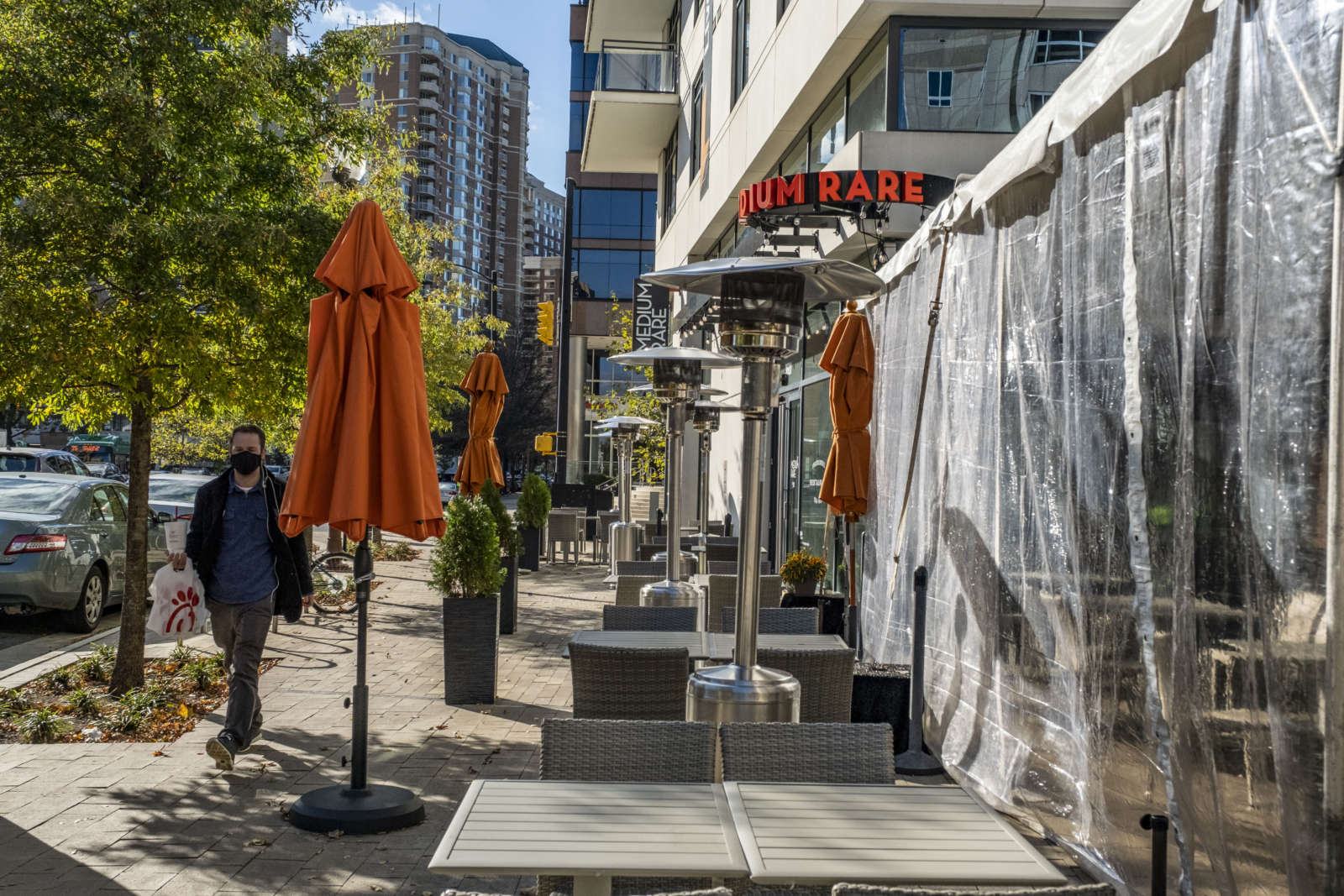
So far, the County has approved 21 requests for propane heaters. But some restaurants, including Medium Rare in Virginia Square, do not have enough outdoor space to keep their guests warm while meeting state fire codes.

Medium Rare’s owner, Mark Bucher, said he and other Arlington restaurant owners are being forced to choose among three bad options: close the outdoor seating space, spend thousands of dollars on electric heating, or break the law and put up propane heaters anyway.

Bucher, who has been organizing large-scale free meal deliveries during the pandemic, has started asking the County to cut the red tape that he says is making it harder to expand patio seating and subsequently, set up heaters.

“Arlington, which is normally the most business-friendly jurisdiction in the area, has been the worst on this,” said Bucher, who also operates in Bethesda and D.C. “There has been no proactive outreach.”

Arlington County spokeswoman Erika Moore said the County is taking steps to help businesses transition to winter.

“The Arlington County Fire Prevention Office is working hard to ensure businesses can remain open and operating as we move to colder weather,” she said in an email.

Part of the space issue stems back to the summer, when some Arlingtonians wanted to see streets closed so tables and chairs could spill into the street. But this never happened, due to a lack of resources and manpower, county officials said in October. A number of temporary outdoor seating areas were approved, and in some cases street parking spaces were used to help accommodate them, but bolder action was not taken.

Neighboring Fairfax County, meanwhile voted last month to relax regulations around tents and heaters.

With winter near, restaurant owners in Arlington do not just need space for outdoor seating, Bucher said, they need space to install heaters according to code. Propane heaters, for example, have to be five feet from buildings and exits, and cannot be under tents or canopies.

There’s a permit process that must be followed, which involves submitting a permit for heaters and possibly re-submitting a permit to change a restaurant’s set-up for outdoor seating. That all takes time, and restaurants are running out of time.

Out of desperation, in areas where seating is limited to sidewalks, some restaurants are putting up heaters anyway.

“People are doing it, but technically, you’re not allowed to have one,” Bucher said.

He said he tried to install a silent, diesel-powered, zero-emission heater at the Arlington Medium Rare, but was informed that also did not meet code.

Bucher said the problem is “an old fire code that is antiquated,” as well as overzealous enforcement.

“No one has said, ‘We’re going to hold off on this so that restaurants can have seating,'” he said.

Moore said Arlington County has helped create more seating for restaurant, approving 92 temporary outdoor seating areas that added more than 900 temporary outdoor tables countywide.

“Some of these have involved temporarily repurposing portions of public rights of way to increase space for restaurant seating, including in the Shirlington and Clarendon neighborhoods,” she said.

The County also has published a guide for transitioning to winter that addresses the commercial use of tents and heaters and recommends blankets, hand-warmers, cozy food and drinks and prix fixe menus. But even the warmest of drinks is unlikely to do much to boost business during the coldest of winter nights.

Bucher said Arlington should look to D.C. and Montgomery County, which are issuing grants specifically for restaurants to winterize, and have taken steps to close parts of streets for extra seating.

In D.C., 428 restaurants have received $2.6 million in funds to winterize, DCist reports, and the government still has $1.4 million to distribute. Restaurants in Montgomery County can apply for grants worth up to $10,000.

This summer, the County did award $2.8 million to nearly 400 small businesses through the Small Business Emergency GRANT Program, which “helped small businesses, including restaurants, transition as needed to operate during COVID,” Moore said.

To create more space D.C. shut down metered parking to create “streateries” in some areas, Bucher said. In Arlington, the process to expand patio seating is still beset with applications and fees, despite the extraordinary times, he added.

“I have to pay fees in a pandemic?” he asked.


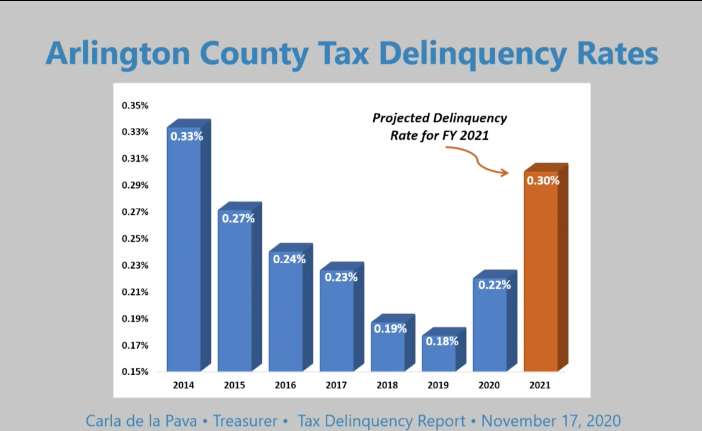
In March, Arlington County was on-track to set a new record low for tax delinquency rates.

Then, the coronavirus hit.

“As the pandemic unfolded, we got further and further from our goal, which was to be expected,” Treasurer Carla de la Pava told the County Board during its recessed meeting on Tuesday.

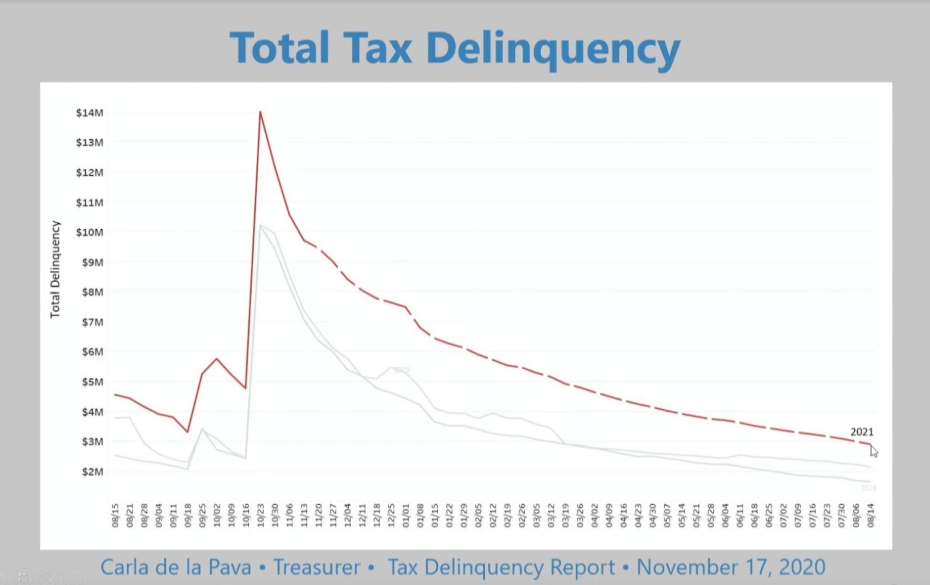
Delinquency rates had decreased by almost half since 2014, but COVID-19 erased two years of record-setting lows. The County is currently out nearly $10 million in uncollected tax revenue, de la Pava said.

For every 10,000 tax-paying residents and business, de la Pava had aimed to have only 17 fall behind, but when the collection year ended on Aug. 14, that proportion increased to 22. She told the County Board that next year, she predicts it will be “difficult, but achievable” to keep the rate under 30 delinquent residents and businesses per 10,000.

“We have our work cut out for us,” she said. “We started this collection year with the highest rate of delinquencies since I became treasurer,” or about $14 million.

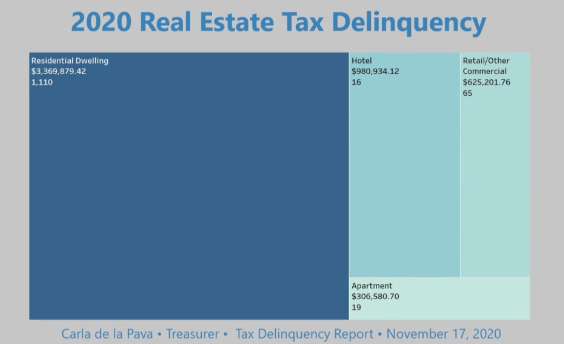
The “elephant in the room” that contributed the most to the spike is delinquent real-estate taxes, which have never been higher in the County’s history, de la Pava said. Overall, the County is missing more than $5 million in property taxes for homes, apartments, hotels and businesses.

The highest percentage of households that have not paid their property taxes are clustered in the 22207 zip code: the northernmost part of North Arlington that includes the Cherrydale, Country Club Hills and Yorktown neighborhoods.

The highest percentage of businesses that have not paid their property taxes are centered in the 22202 zip code (the Crystal City, Pentagon City and Arlington Ridge neighborhoods) and 22206 (the Shirlington, Fairlington and Long Branch Creek neighborhoods).

Taxes on property used for business are also up dramatically, with number of delinquencies concentrated in the 22202 zip code. The amount owed along the Rosslyn-Ballston corridor, however, exceeds all other zip codes combined, de la Pava said.

This June, the treasurer’s office put a number of hotels and big businesses on Taxpayer Assistance Program loans so they could pay their taxes over 10 months, from August 2020 to May 2021. This came after her office offered a two-month deferral this spring that mostly benefited hard-hit restaurants and hotels.

John Marshall Bank, which partners with the county on the short-term loans, lowered its rates to make these repayment plans more affordable, she said.

“We prevented almost $1 million in going delinquent through TAP loans from John Marshall Bank,” de la Pava said.

To encourage safe and timely payments this year, de la Pava said her office added a temporary location this September and encouraged people to pay online, resulting in an 11% increase in online profiles.

The County Treasurer said she found another bright spot in vehicle taxes, which reached the second-lowest delinquency rate in Arlington’s history this year. Outreach, payment plans and automatic billing contributed to the lower delinquency, she said.

The Columbia Pike corridor, or the 22204 zip code, has the highest concentration of vehicle delinquencies, amounting to $1.1 million.

The treasurer’s office drafted 400 payment plans for vehicle taxes, saving $600,000 from going delinquent, de la Pava said.

Images via Arlington County


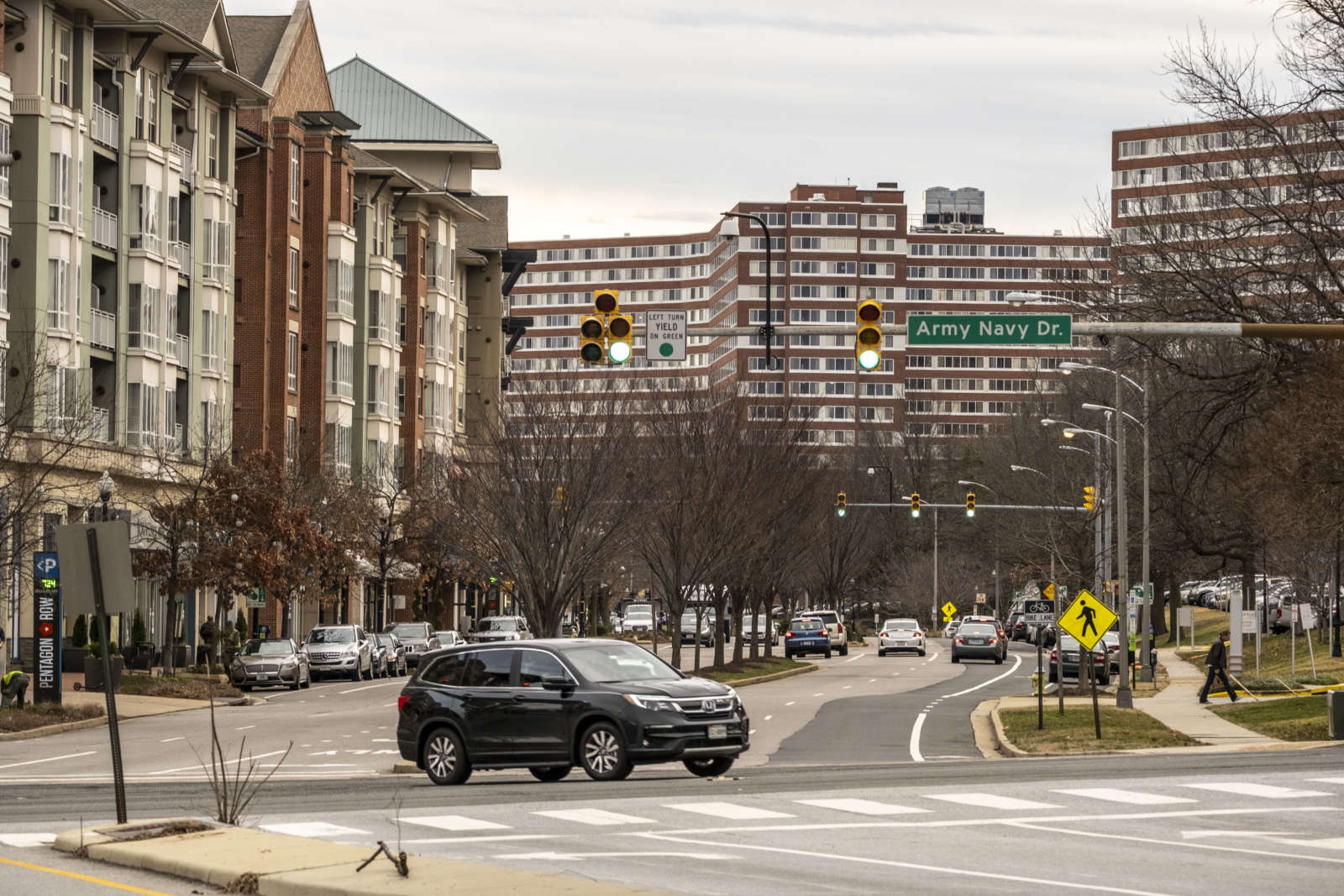
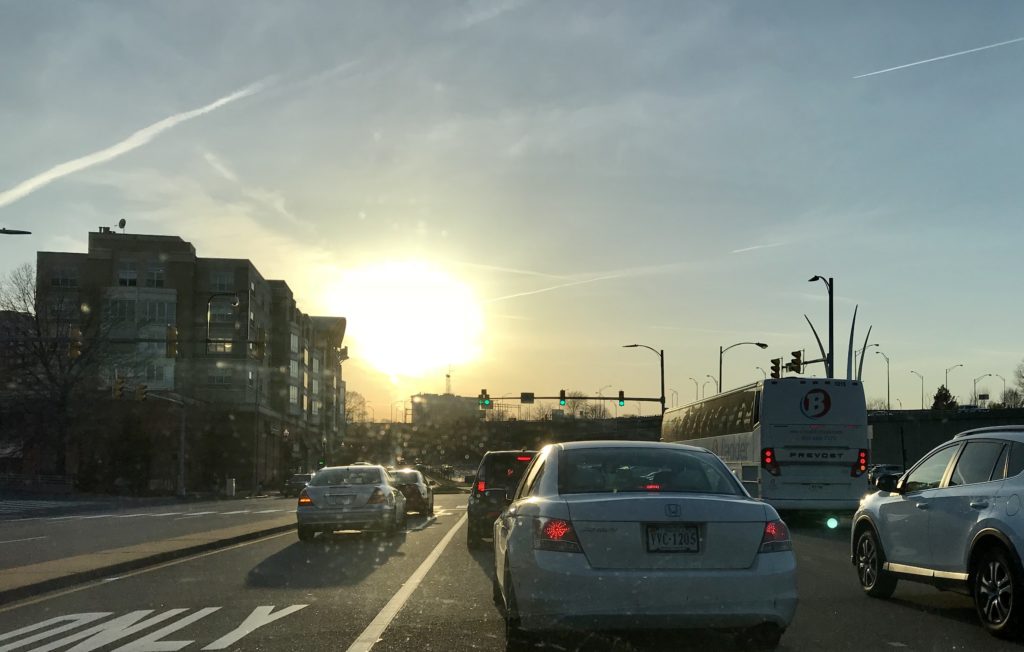
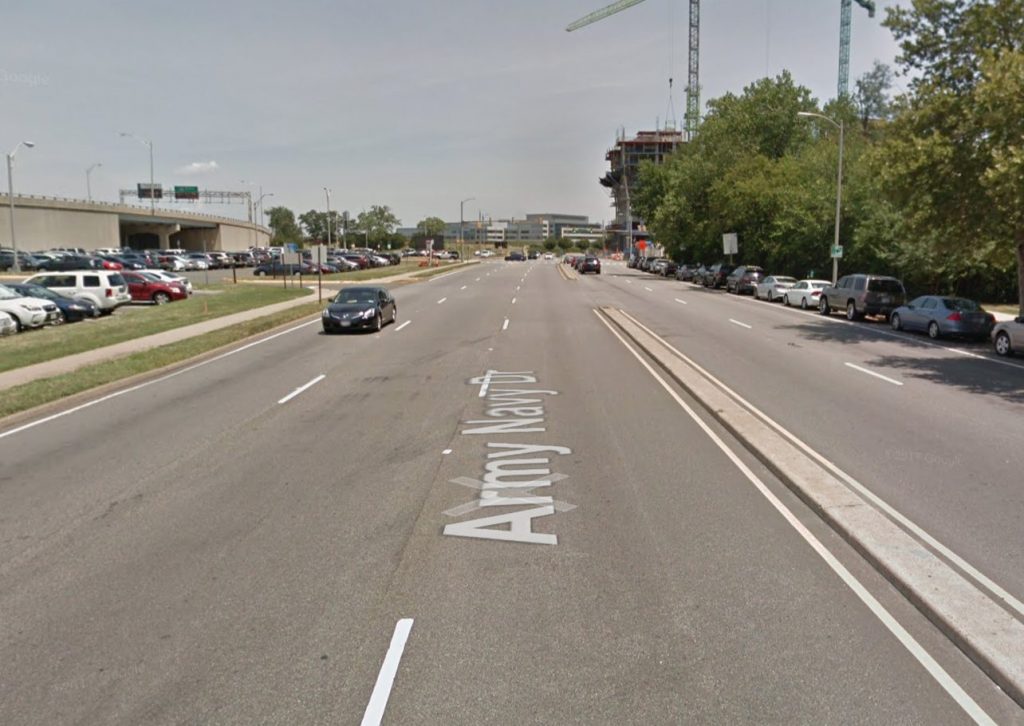
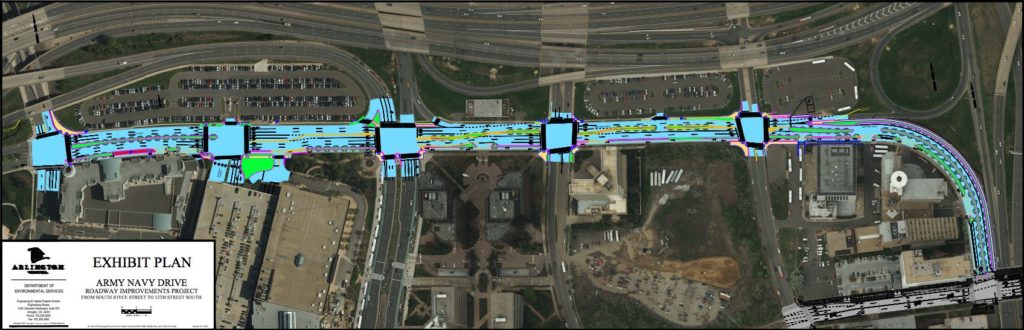
After five years, Arlington County is putting finishing touches on its Complete Street plan to improve walking, biking and driving conditions along a stretch of Army Navy Drive in the Pentagon City area.

The updated plans — which are 90% complete — were presented in a virtual public hearing on Wednesday. County staff are taking public comments via email on this version until Dec. 4, and the final plans will be submitted next summer. Construction on the section of road from S. Joyce Street to S. Eads Street is slated to begin in 2022.

The $16.87-million project aims to reduce conflicts among cars, buses, bikes and pedestrians with narrower lanes, stretches of bus-only lanes, protected left turns and signalized right turns, clearer sidewalks and shorter crosswalks. The south side of Army Navy Drive will have two-way bike lane protected by a line of trees.

“A lot of the signalizations will improve safety, prevent fatalities, reduce collisions, things like that,” Jon Lawler, the project manager, said during the meeting.

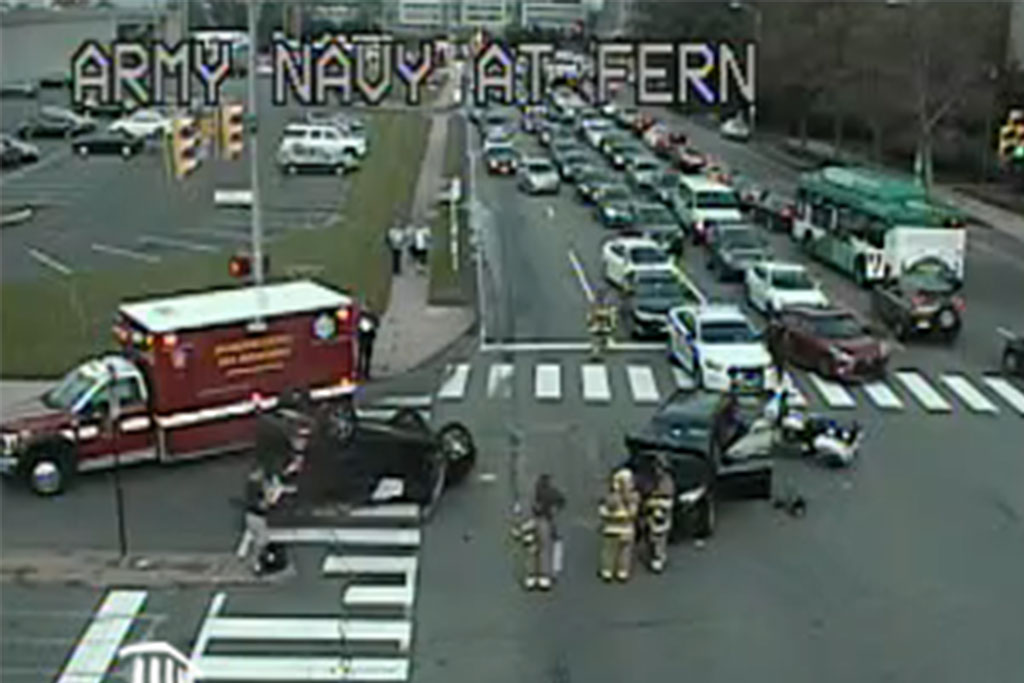
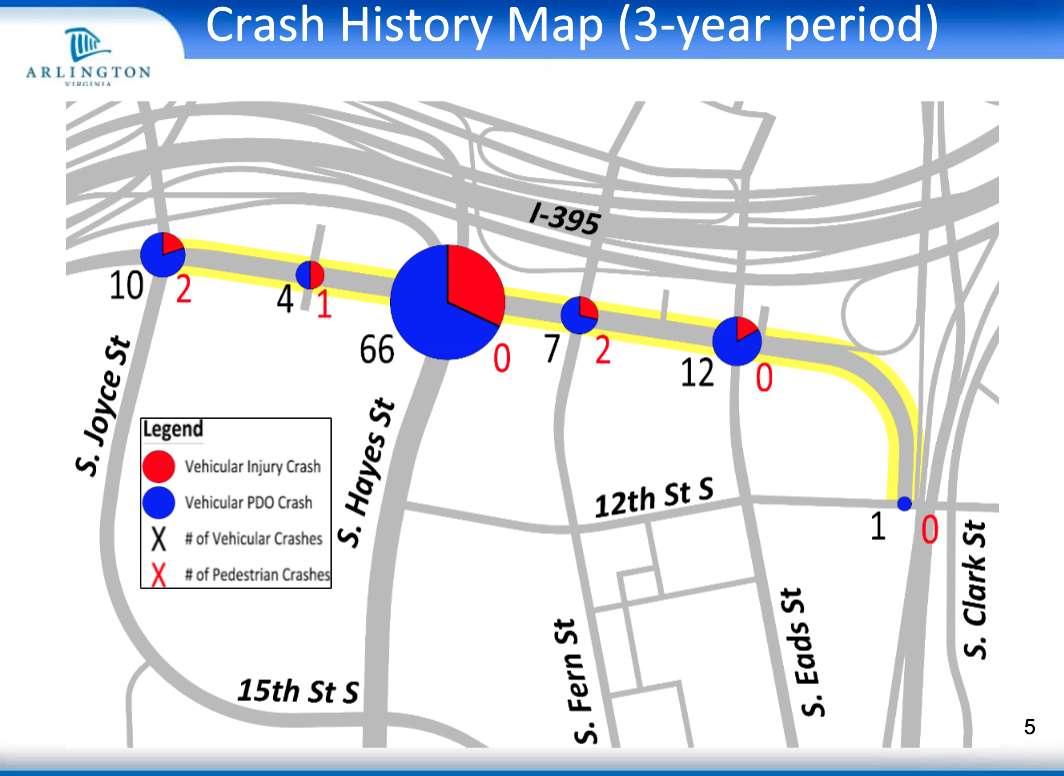
Crashes happen frequently in its intersections: Staff said the S. Hayes St/I-395 off-ramp intersection had the second-most collisions of any Arlington intersection in 2016.

The measures mean the new Army Navy Drive will be reduced to two through lanes in each direction, narrowing to one lane east of S. Eads Street.

“This segment has much lower traffic volumes than the other four blocks of the project corridor,” Lawler said in an email.

Reducing a lane of traffic to accommodate a bus lane between S. Joyce Street and S. Hayes Street will actually improve flow because buses will not block traffic while loading passengers, he said.

Traffic lanes will be narrowed to slow down cars, but staff are not planning to propose a lower speed limit, which is 35 miles per hour, Lawler said during the meeting.

Construction is still a ways off. Staff expect construction to begin in the spring of 2022. With work scheduled block by block to minimize disruptions, it could last until the fall of 2024. Original plans had construction starting in 2020 and ending in 2022.

Lawler attributed the delays to the additional tasks needed for a project receiving federal aid.

“For this project, it took much longer to receive our National Environmental Policy Act document approval than we had envisioned,” he said in an email.

Staff skipped the 60% design phase to make up for lost time, he said.

After the medians are removed, work will start on the south side of Army Navy Drive, beginning with the area where Amazon HQ2 will be, along S. Eads Street, and moving west. Once the medians are replaced, the road will be repainted and striped, concluding the project.

Lawler said in the meeting that “we won’t have any conflict” with Amazon construction.

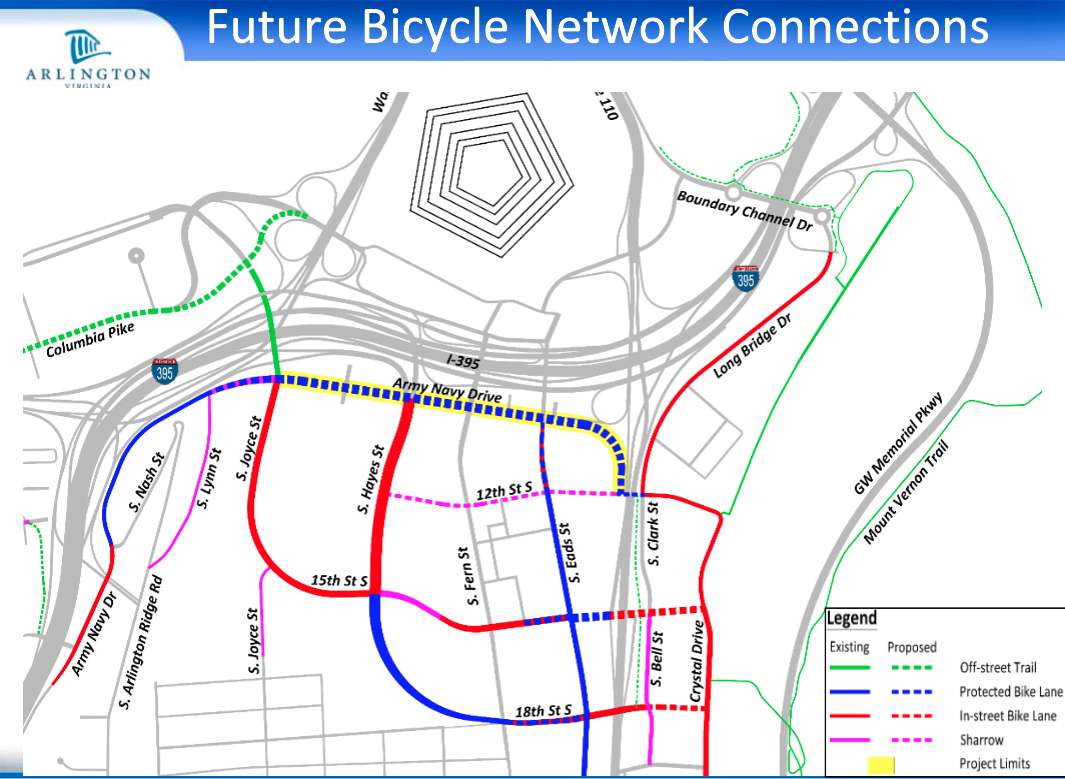
Community feedback led to two major changes, he said. First, another block of protected bike lane was added to connect the bike lane west of S. Lynn Street with the planned protected bike lane starting at S. Joyce Street.

“This way we don’t have a missing link in the system,” Lawler said in the meeting.

Staff could not insert this change into this project, as it is receiving federal funding, so they created a separate capital improvement project to address it, he said.

From S. Lynn Street — near Prospect Hill Park — to S. Eads Street, Army Navy Drive is “pretty uncomfortable to use scooters and bikes on,” Lawler told ARLnow after the meeting. “The changes will provide them a safer route for them to use.”

With the changes, bicyclists on Army Navy Drive will be able to use the major east-west link more easily to connect with the Mount Vernon Trail and get to Washington, D.C., he said.

Another change was to align the bumpy pedestrian ramps with the crosswalk. Initially, the ramps were perpendicular to the crosswalk, which advocates said directs vision-impaired pedestrians into harm’s way.


Wakefield High School has opened its doors to a handful of students in search of better internet connectivity, a quiet place to study or a trip out of the house.

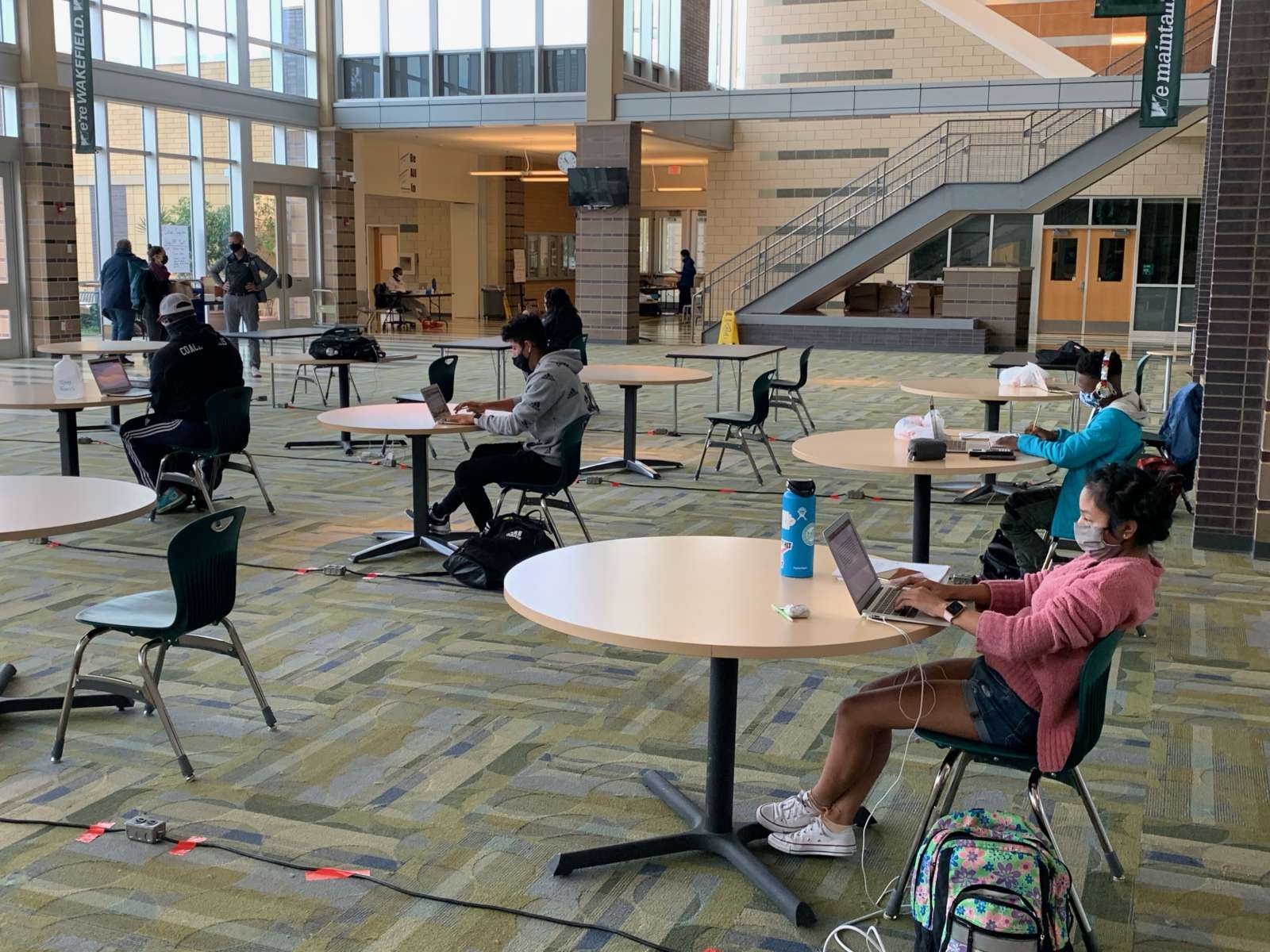
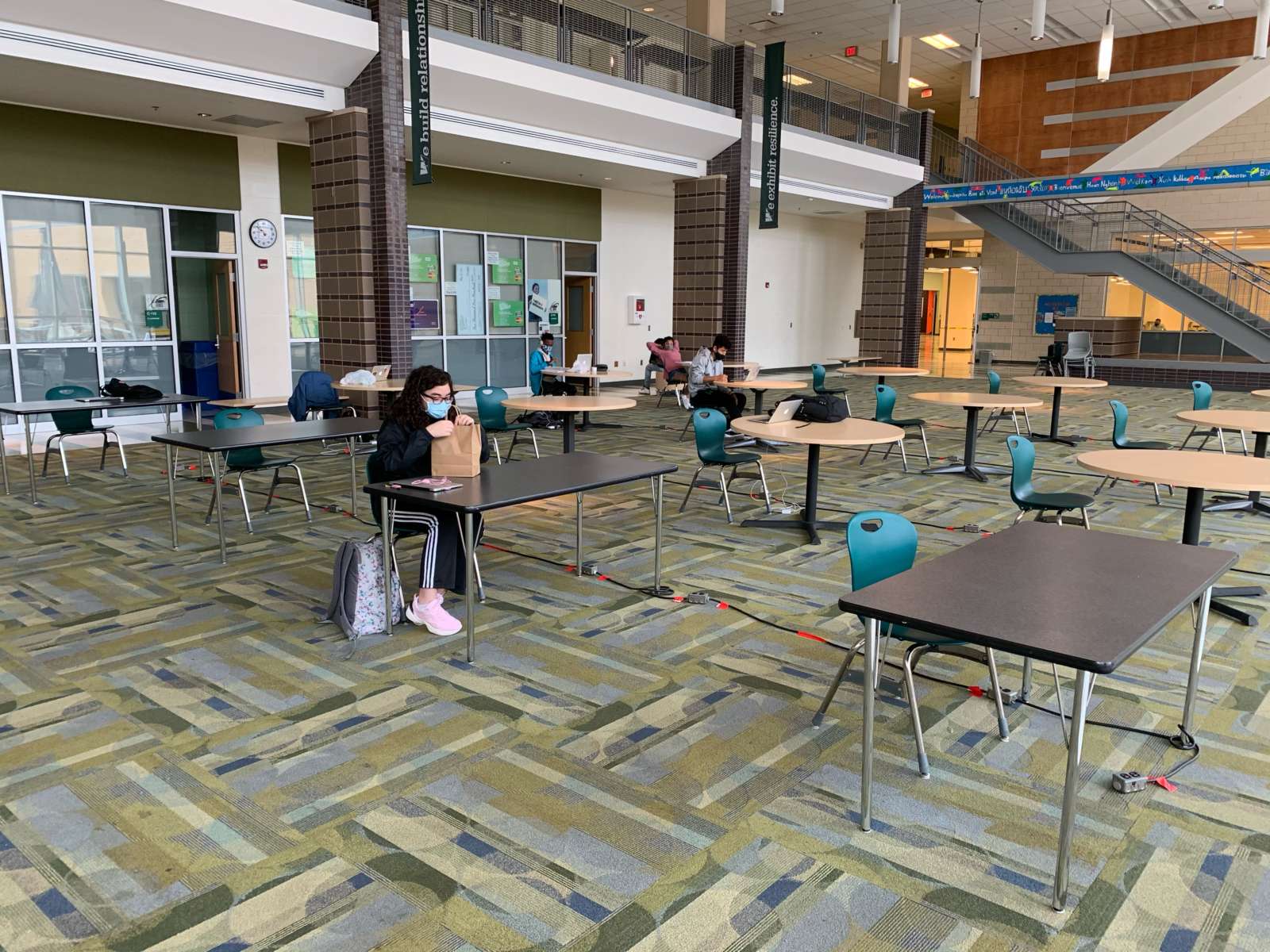
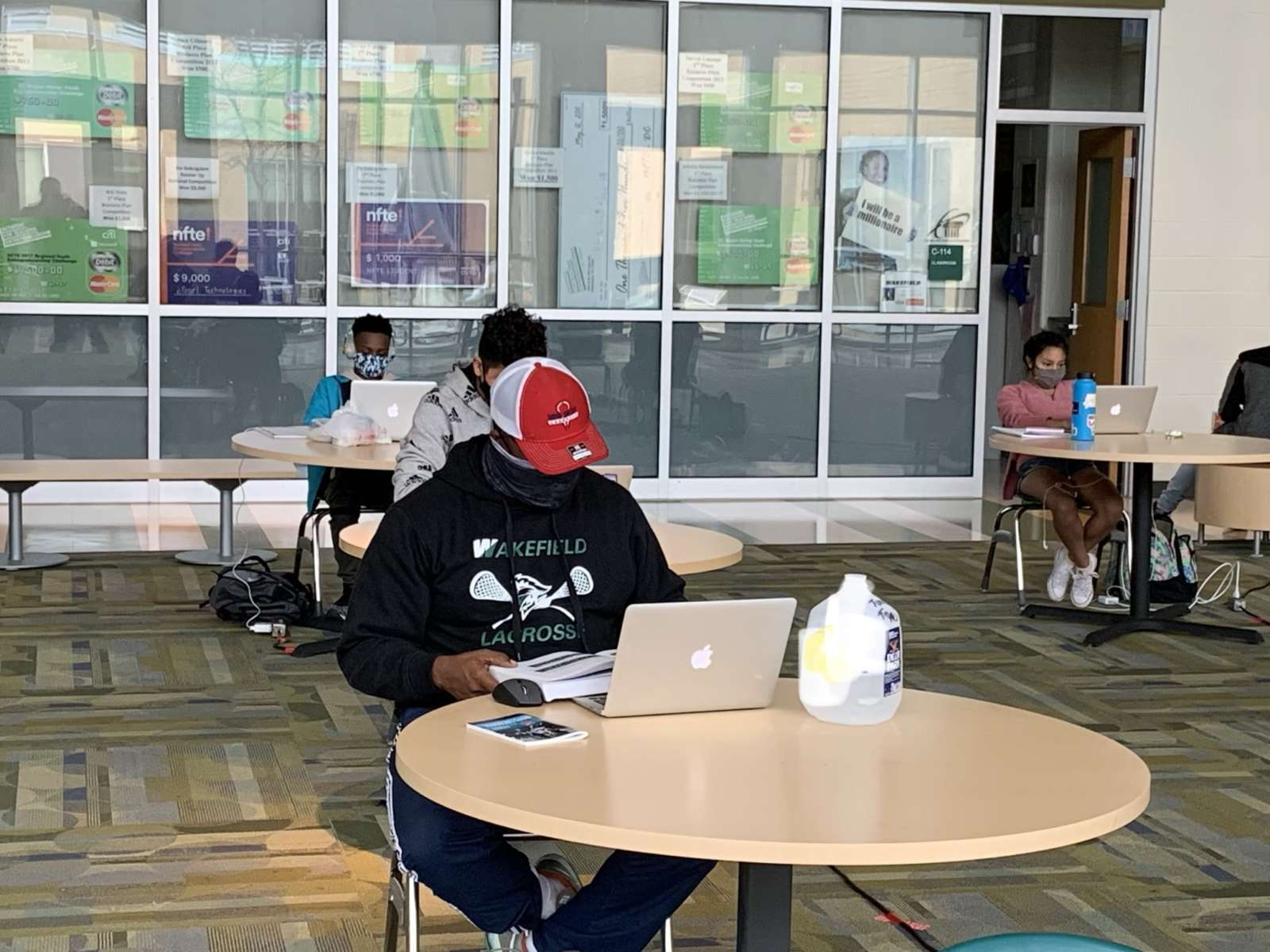
From 8 a.m.-3 p.m., up to 30 students can study at socially distanced work stations in the school’s vaulted atrium, featuring a glass wall that overlooks a courtyard. In the space, students can study without the distractions or demands of family life and they have access to technicians if their computers break.

It’s comparable to a co-working office, but for high school students.

“If you’re having WiFi issues, if you need a quiet study place, or if you simply are going stir-crazy and you need to get out and find a place to study, you’re welcome to come,” Principal Christian Willmore said.

Students seem to enjoy the space, with up to seven coming on average, he said. A few are regulars, while the rest come as needed.

“Honestly, it’s not to the degree that I had hoped, but we’re still trying to get the word out of what it is and what it looks like,” Willmore said. “I’m hoping more students access it, if they need it.”

Wakefield debuted its program on Nov. 5, one day after students with disabilities became the first to return to school. Wakefield had 12 students return for in-person learning, and 20 staff assigned to them, Willmore said.

The pilot is distinct from Arlington Public Schools’ return-to-school plan, which opened school buildings for students with disabilities in its first phase, also called “level one.” Future levels have had their return delayed until 2021, but APS did identify and start providing supports to an additional 150 four to 11 year olds this week.

Other principals are working with Willmore to eventually bring the program to their buildings.

“We want to see how it works at Wakefield first because we’ve been working out the detailed procedures,” Willmore said. “We’ve been able to refine practices and procedures, documents, processes so that people aren’t reinventing the wheel.”

Kids are screened and monitored by staff at the front door and to limit exposure, they cannot leave and come back later. To prevent them from roaming the building, only one bathroom and one drinking fountain are open and running. Students sign up one day in advance on Canvas, APS’ learning management software, affirming they have not been recently exposed to or sickened by the coronavirus.

The day-long study option also allows school staff to connect with students who do not log in for full periods or have fallen behind on work.

“Those conversations are hard to have, so it was nice to have them in person,” Willmore said.

Photos courtesy Frank Bellavia/Arlington Public Schools


Arlington County is looking at ways to make composting easier for residents.

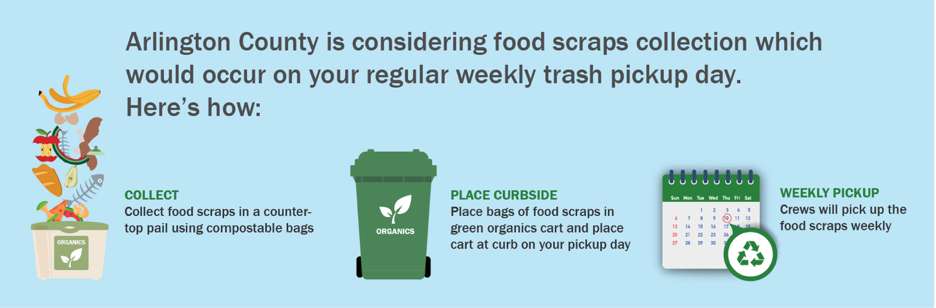
County staff are considering a collection service that would allow residents to mix their food scraps with their yard trimmings for collection. They are asking residents to share their thoughts in a survey available through Friday, Dec. 4.

Quarterly trash audits reveal that food scraps make up more than 20% of the residential waste stream. Staff said collecting food scraps would support the County’s goal of diverting up to 90% of waste from incineration by 2038.

According to the County’s website, the weekly service would cost less than $12 annually, far less than the City of Falls Church, which charges $66, and the rates of private haulers, which charge up to $360.

“Many communities have successfully implemented food scraps collection programs in the manner proposed by the County,” the website said. “By implementing a food scrap collection program, residents would increase the County’s recycling rate, reduce the amount of County trash incinerated, create soil amendments and depending on individual actions, save money, reduce food waste, and reduce greenhouse gas emissions.”

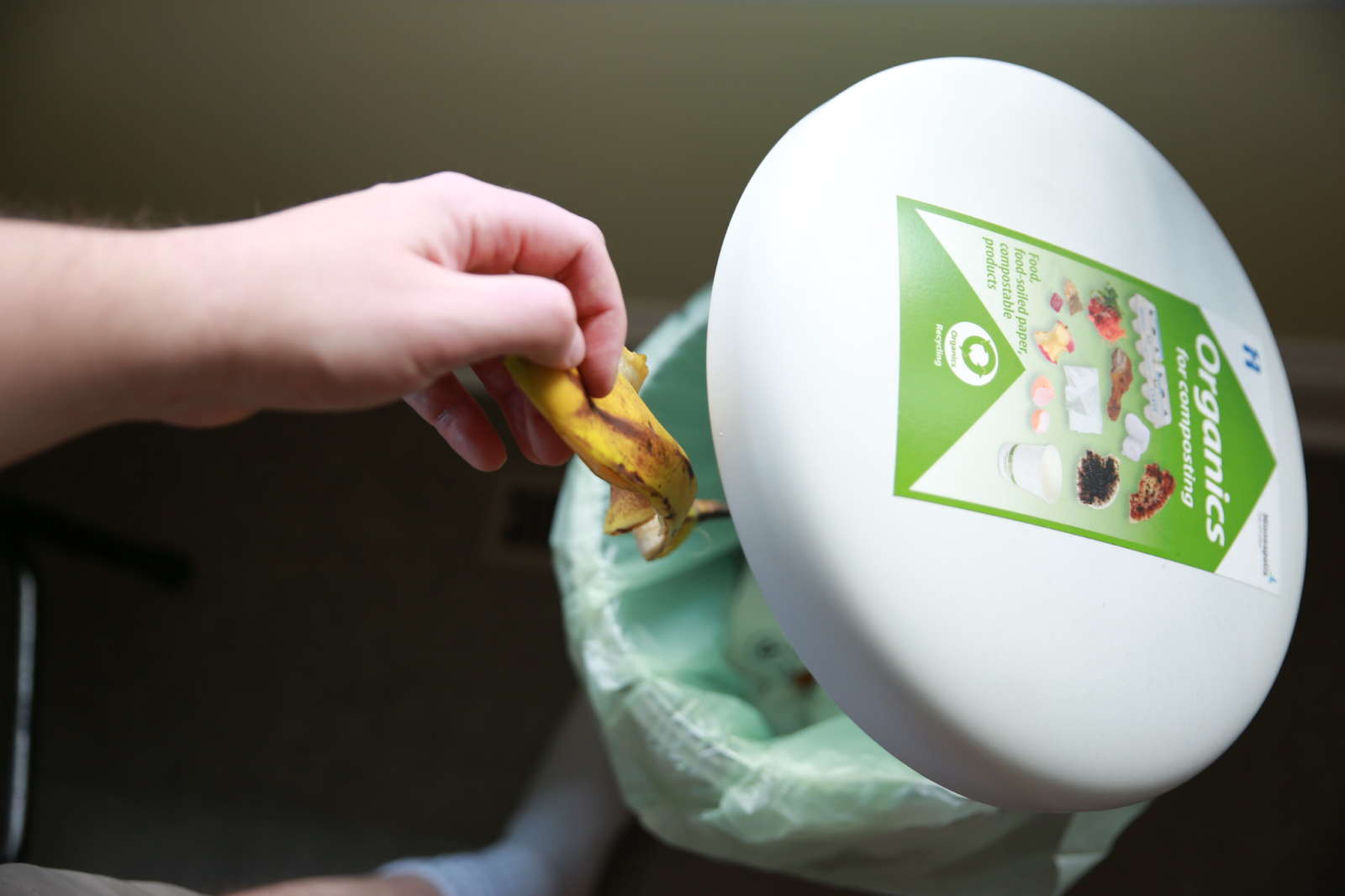
During the week, residents would collect their fruits, vegetables, meats and dairy in a countertop pail. Once the pail fills up, residents would place the scraps — bagged in paper or compostable bags — in their green organics cart and take it to the curb on trash pickup day.

To limit odors, staff recommend lining the pail with a bag, emptying it regularly and rinsing it occasionally. Freezing the scraps also reduces odors. Like the yard trimmings, food scraps will be brought to a ” Virginia-permitted composting facility certified by the U.S. Composting Council.”

The County has collected grass clippings, cut flowers, brush, hedge trimmings and leaves year-round since 2016.

(The service is available to those who receive residential waste collection from the county — mostly those in single-family homes. Apartment and condo residents are typically served by private waste collection haulers.)

“The year-round program has been very successful — so much so that the County is now considering the addition of leftover food scraps including fruits, vegetables, meats and dairy,” the county said.

Currently, all Arlingtonians can bring scraps to the Earth Recycling Yard at the Arlington County Trades Center from 7 a.m. to 3:30 p.m., Monday through Saturday. Some farmers markets also recycle food scraps.

The County sees a food scrap collection service as a chance to educate people about reducing food waste and improving the environment.

In addition to saving households money, the County website on food scrap collection said there are other benefits to preventing food waste, including “learning to make better use of leftovers, minimizing spoilage by storing refrigerated and perishable items properly, and most importantly, that each of us has a direct role in reducing food waste both inside and outside the home.”

It listed several environmental benefits: reducing methane emissions from landfills, conserving energy, and reducing pollution.

Compost pail photo by The Minnesota Pollution Control Agency


The kitchen of Palette 22 (4053 Campbell Avenue) in Shirlington is working double-duty as an outpost for Mia’s Italian Kitchen, which has a dine-in location in Old Town Alexandria.

Alexandria Restaurant Partners, which owns Mia’s and Palette 22, announced on Monday that those in and around Shirlington can now get pizza, giant meatballs and classic dishes delivered via UberEats and GrubHub from Mia’s “ghost” location, in the kitchen of Palette 22.

“We’ve had tremendous success with Mia’s to-go in Old Town, and thought, ‘This has legs,'” said Dave Nicholas, a founding partner of ARP. “So we decided to help people in Arlington who can’t reach us all the way in Old Town.”

The expansion of Mia’s, which also has a dine-in location in Orlando, follows a nationwide trend.

These delivery-only spaces with no dine-in options began sprouting up as food delivery businesses such as UberEats and GrubHub took hold in the economy, but really took off during the pandemic. The coronavirus accelerated their growth as more Americans use delivery, RestaurantDive reports.

In addition to operating from the back of bricks-and-mortar restaurants, ghost kitchens also can operate from mobile trailers, like the one that currently set up in a Clarendon parking lot.

Nicholas defines a ghost kitchen as one where customers do not know where the food is made, but they recognize the brand. ARP had mulled over the idea for years, but the pandemic and government-imposed restrictions sped up its development.

ARP operated its first ghost kitchen around Easter, when 150 full-family meals were made in Mia’s Old Town Kitchen for another ARP restaurant, The Majestic, while it was still closed.

The company opened a second ghost kitchen in Alexandria, Touchdown Wings & Burgers, in the kitchen of Theismann’s Restaurant and Bar.

“We’re a couple of weeks into it, and the response is awesome and sales are growing every week,” Nicholas said. “We’re not even doing pick-up: It is a true ghost kitchen.”

He predicts ghost kitchens will be a long-term necessity for the industry, and could help restaurants make up for lost time and money when dine-in returns to full capacity.

“People believe in our brands and know what we do, so it doesn’t matter where the delivery driver picks it up from or if you pick it up,” Nicholas said.

Delivery-only menu items offered by Mia’s include:

  • Giant meatball ($14)
  • Chicken Parmigiana ($19)
  • Roasted Mushroom Lasagna ($19)
  • Rigatoni à la Bolognese ($20)
  • Bucatini Cacio e Pepe ($18)
  • Five different pizzas, including Margherita, pepperoni, and sausage and peppers ($7.5-$8)

Hours of operation are:

  • Monday and Tuesday: 12-9 p.m.
  • Wednesday to Friday: 12-10 p.m.
  • Saturday: 3-10 p.m.
  • Sunday: 3-9 p.m.

Photos via Mia’s Italian Kitchen


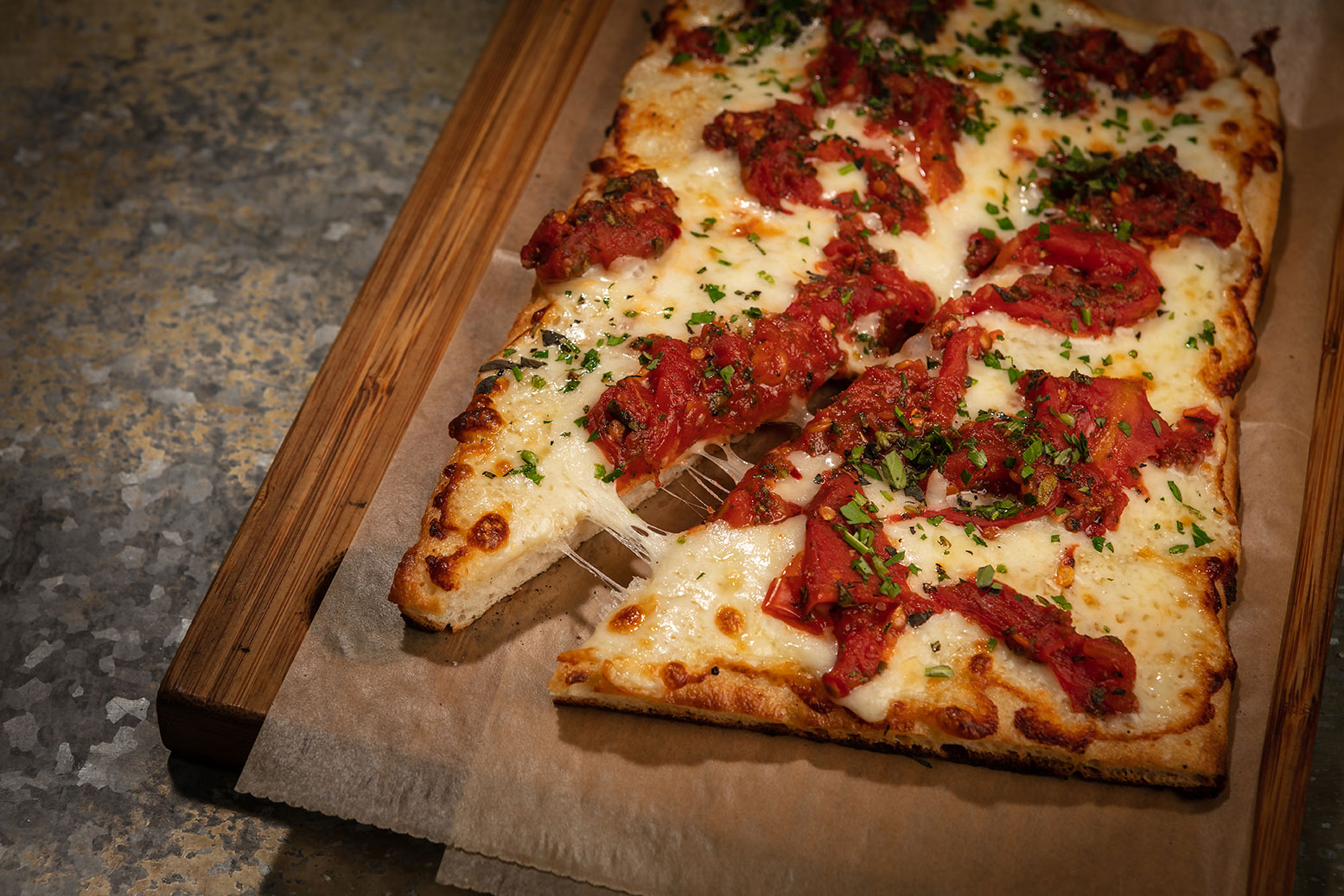
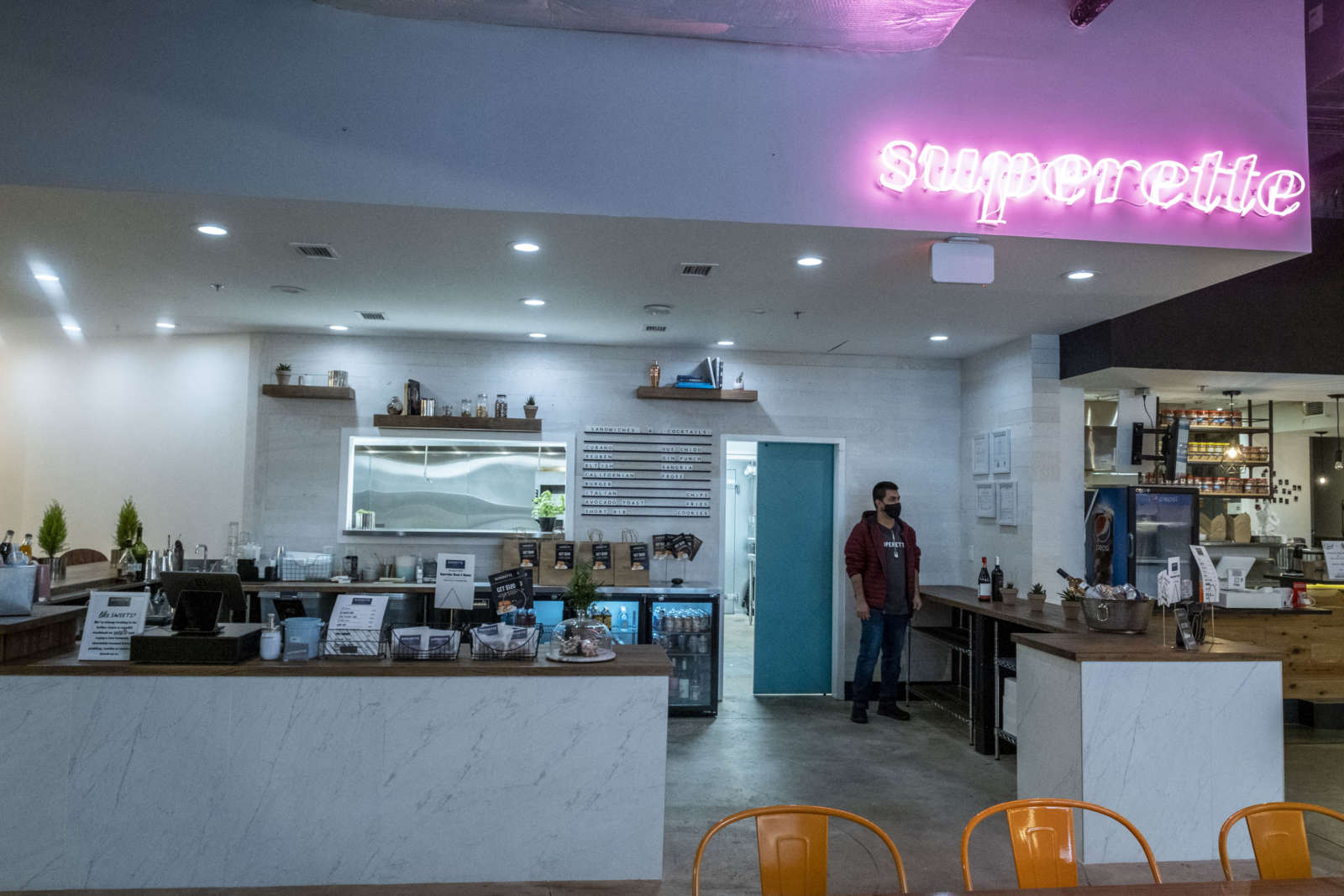
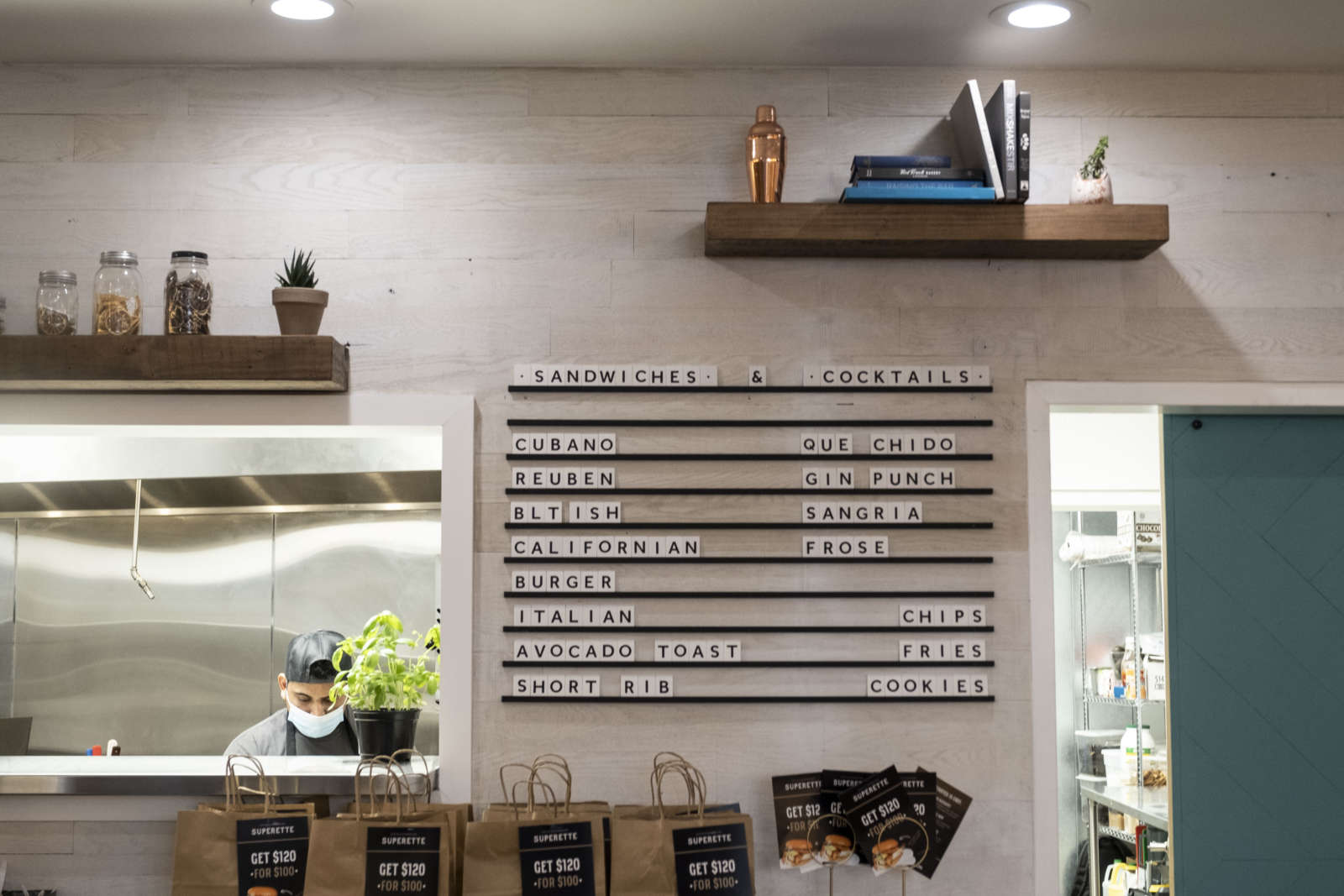
After opening in September, Arris Noble and his six-person team at Ballston’s newest sandwich shop, Superette, have gotten their sea legs.

The name, Noble explains, takes customers back in time to the corner store with hot food and a limited selection of grocery items. It was the kind of place that parents sent their kids to, list and basket in hand, for apples and milk. The cashier would gather and ring up the items and send the kids home.

“It’s an old-world concept that was forgotten, and shouldn’t have been,” said Noble.

The sandwich joint and grocery is in the lower level of the food hall at Ballston Quarter (4238 Wilson Blvd). Noble ultimately chose the neighborhood because he saw a gap in sandwich places that prioritize love and quality over speed and volume.

Noble said he is happy to own a business in Arlington, and Ballston in particular, adding that he “really likes the people.”

As for the food, while the sandwich is practical, Noble does not want his diners to sacrifice taste in order to gain convenience.

“If you’re going to dine and come to Superette, I want to give you that ‘Wow’ factor,” he said. “We just want them to know how much care we put into everything.”

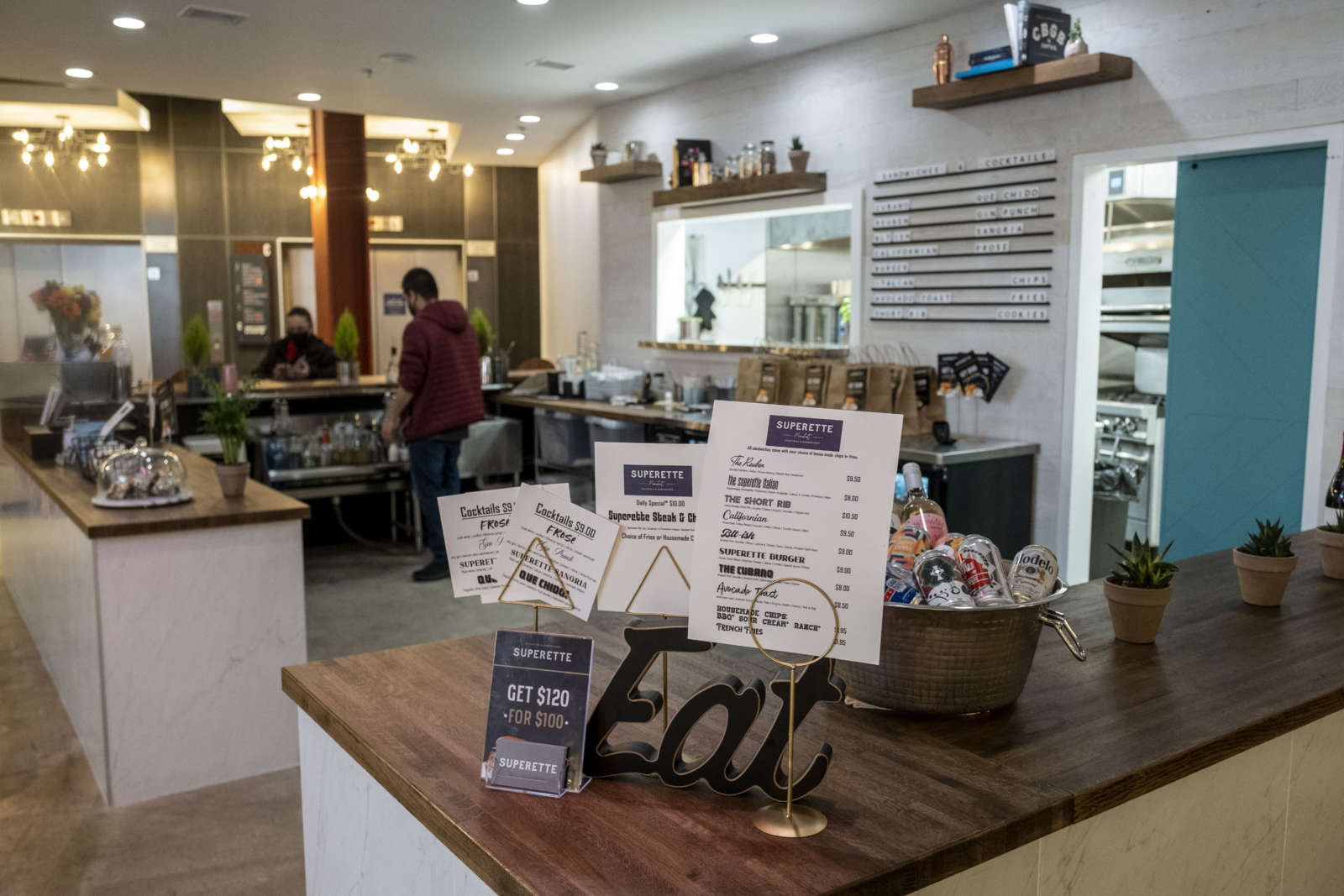
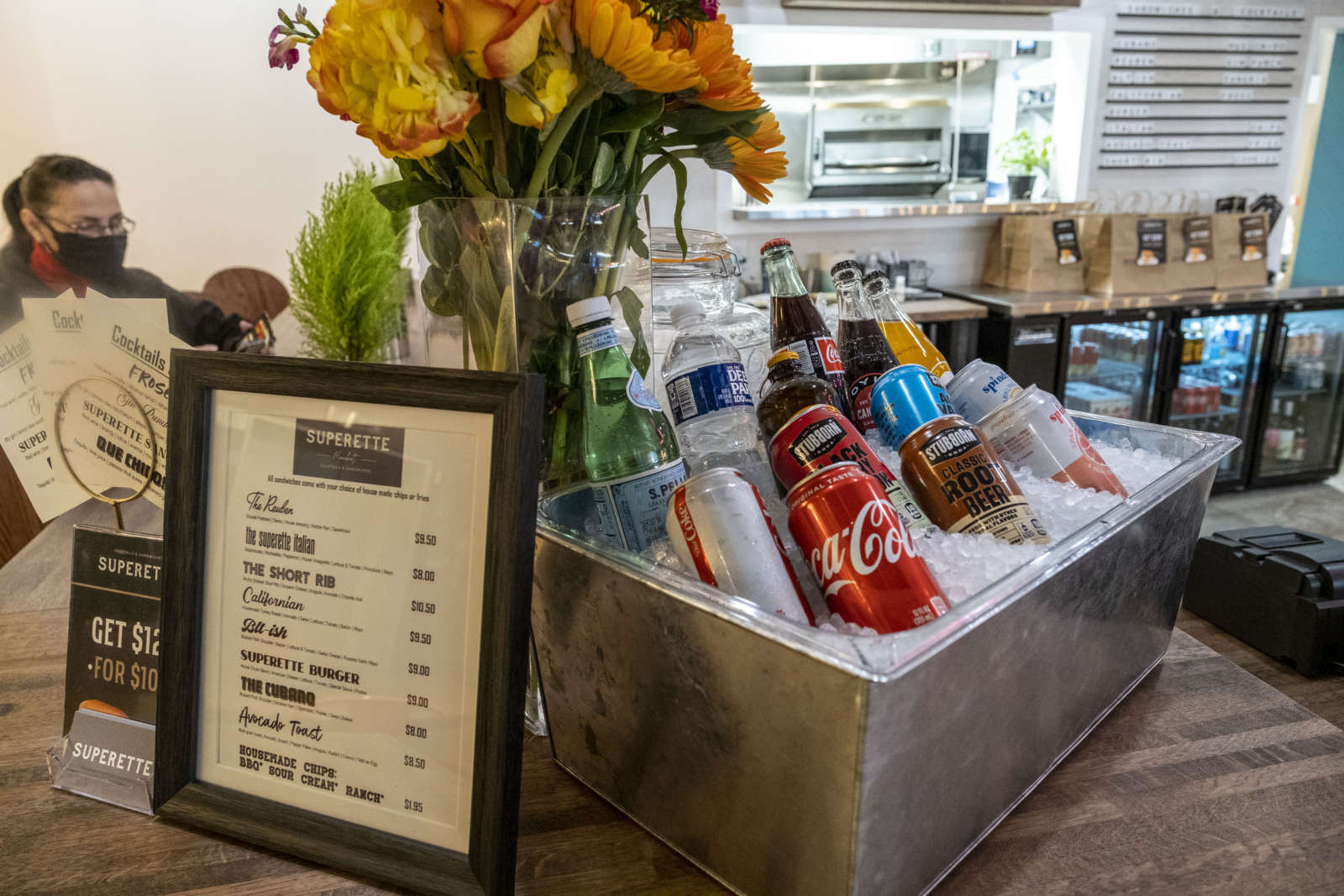
When new customers walk in, Noble said he loves seeing “the surprised look” on their faces when they see not only the food but the beer, wine and cocktail menu.

Noble, who paid his way through school at the University of Maryland by bartending, geeks out describing his signature cocktails.

His winter whisky sour combines rye whisky and a simple syrup infused with allspice, star anise, clove, cinnamon and black pepper, with the classic foam rim made from emulsified lemon juice and egg white.

Guests enjoy his gin punch, made with oleo saccharum (or oil of sugar). Muddled sugar and citrus peel steeps in spices and hot water, creating a syrup that is “easy to make, with a ton of flavor.” For the punch, he adds gin, lemon juice and stone fruit tea.

He personally developed the menu, to which his growing waistline can attest.

“I gained 35 pounds,” he said. “The one that has done the most damage is the BLT-ish.”

The classic bacon-lettuce-tomato sandwich does not do much for Noble. So he added cheese, braised pork shoulder and a sesame seed bun slathered with garlic aioli. The shoulder is the centerpiece: It marinates for a day before it is braised for seven hours with aromatics and chicken stock.

“That sandwich has a following,” he said. “I got a guy who comes here three days a week and gets it.”

Noble, who spent the last 18 years of his life in the restaurant business, said the challenge of managing a restaurant during the Great Recession more than a decade ago “does not hold a candle to the challenges restaurants are experiencing now.”

From idea to execution, Superette took 14 months, with the pandemic causing delays in deliveries and permitting. The price for a case of gloves increased by 300% times and third-party delivery apps charge double what they used to, but restaurants use them to keep the lights on and employees paid, he said.

“This environment is completely different because the virus creates government restrictions,” he said. “During the recession, you could have a holiday party — you may just have to take a discount — but people were still gathering.” 


View More Stories