Sally DuranProgressive Voice is a weekly opinion column. The views and opinions expressed in this column are those of the individual author and do not necessarily reflect the views of the author’s organization or of ARLnow.com.

Economic development is the art of attracting the right business to make a prosperous and vibrant community for residents, businesses and visitors to enjoy. Arlington is a unique place where business and residents have together created Arlington’s success and economic prosperity.

We’ve achieved an enviable and unique position in having a 50 percent/50 percent split in the residential/commercial share of property taxes. In some of our neighboring jurisdictions, for example, there’s a 70/30 split in the share of property taxes. That 50/50 split means commercial property taxes reduce the tax burden on residents; help fund schools, parks and infrastructure; and allow Arlington to maintain its triple-A bond rating.

What’s more, those commercial property owners and businesses pay business taxes and contribute into special funds for affordable housing, arts, sidewalks, landscaping, street lights and more.

Economic development is a topic that is not without its share of controversy in Arlington. As many of you know, our County is facing an unprecedented office vacancy rate that exceeds 20 percent. The team at Arlington Economic Development is diligently working to reduce that rate.

Two years ago, Arlington’s Economic Development Commission (EDC) established a competitiveness task force to look at Arlington’s position in the marketplace. That task force determined that Arlington’s public investment in Metro over the past three decades created distinct competitive advantages for Arlington’s economy and transformed Arlington into one of the most successful and “intelligent” communities in the country.

In the past, our location next to Washington, DC, lower business tax rates, public transportation and infrastructure made Arlington the low cost alternative and a key location for federal agencies, federal contractors and businesses. However, it’s a new time. Moving forward, those federal agencies are just one driver of Arlington’s economy, and we have more competition for those office rents.

In response, Arlington is in the process of diversifying its businesses so our residents can continue to enjoy the benefits that come from that 50/50 split in residential/commercial property taxes. We are investing in smart “mixed-use” planning and transportation for our urban villages and revitalizing shopping areas. We made changes at the County level too – with innovation-friendly, less costly processes and faster response times to attract and retain businesses.

Arlington has always been an early adapter, and the EDC recognized the need to focus on an “Innovation Economy” for the future. We recently completed a study on the Future of the Arlington Office Market, and as a result, we’re exploring creative and flexible approaches to using commercial spaces that will make Arlington’s commercial space more attractive and affordable to small businesses, start-ups and emerging new economy businesses.

We’re also fostering partnerships between business, government and universities to make Arlington a desirable destination for collaboration. And, we’re providing needed incentives and technology infrastructure improvements to support “mom and pop” storefronts, high-tech startups and solo entrepreneurs — all measures that are helping Arlington stay competitive in this rapidly changing marketplace.

Arlington values being an unique community that combines small town charm of walkable streets,  great schools, restaurants and shopping with the big city amenities, such as Metro, world-class hotels, universities and arts.

Right now, we’re in the midst of a transition – one that requires us to compete in the business marketplace and global economy of the future. It’s not an easy process, nor is it a short-term one. It will take everyone, including businesses and residents working together with the county, to find fair solutions that will improve the efficiency of Arlington’s development processes and meet these new challenges while still maintaining our shared community values.

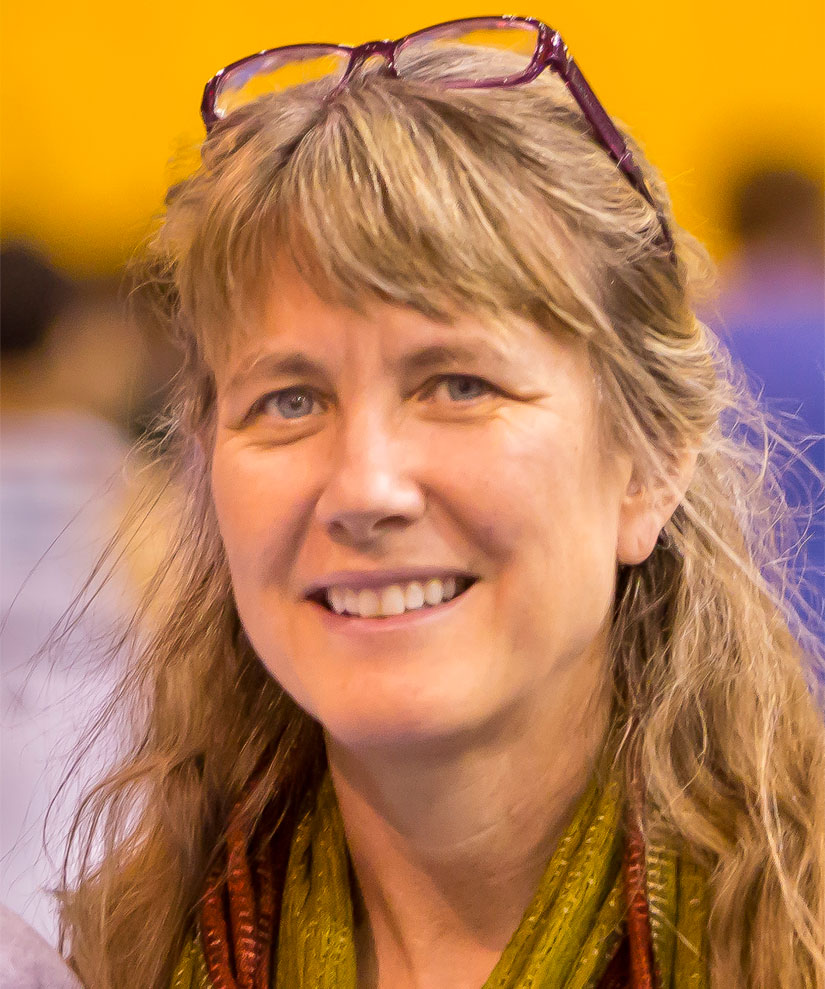
Sally Duran is Chair of the Arlington Economic Development Commission. She is a health insurance policy consultant with SJD Associates.
Progressive Voice is a weekly opinion column. The views and opinions expressed in this column are those of the individual author and do not necessarily reflect the views of the author’s organization or of ARLnow.com.

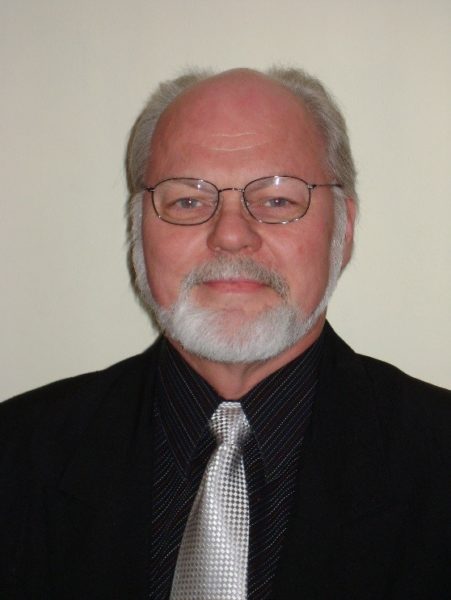
Frederico CuraWith Arlington’s school population growth, the need for expanded classroom space has become an important priority.

Throughout the 1990s, Democratic General Assembly candidates ran on a platform of making state funds available to lessen the heavy financial burden of localities facing growing demand for classroom space.

Unfortunately for Arlington, the General Assembly remained under Republican control and state funding for school construction has been kept off the table. Virginia’s Department of Education website reflects this short-sighted policy: “Counties and cities in Virginia are independent political entities of the state (so are school boards that own and maintain their facilities). Therefore public school construction projects are financed through local funds.”

State funding for local school construction makes sense given the significant state educational mandates. But General Assembly Republicans have refused to supplement local classroom construction funding.

As we see now, it is difficult for localities to cut spending, raise taxes, promote economic development, or create debt capacity quickly enough to meet high growth in student population. Availability of the state’s significantly greater resources in times of unusually rapid student population growth would promote high-quality education.

What did the Republican legislators do instead of providing school construction funds?

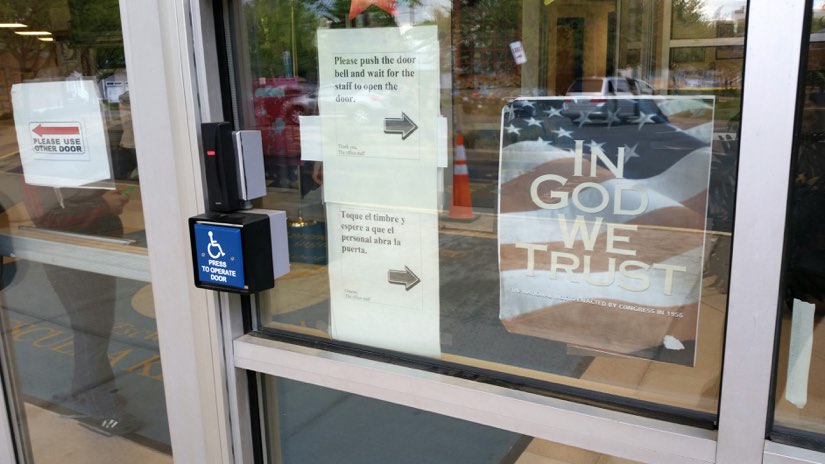
In God We Trust sign in front of Key Elementary (photo courtesy Frederico Cura)They mandated pushing on the state’s children — of diverse backgrounds and religious beliefs — state-sponsored religion in taxpayer-funded, government-run public schools.

I discovered this when I went to my kids’ elementary school in Arlington and noticed a large prominent sign next to the front door with “In God We Trust” superimposed on an American flag. It felt like a throwback to Cold War efforts to set ourselves apart from the communist Soviet Union.

After some inquiries, I learned that the General Assembly mandated that all public schools in Arlington, and across Virginia, put up that sign. (The words are based on the advice in Proverbs 3:5 — “Trust in the Lord with all your heart.”)

Some may think this isn’t a big issue. Kids may not pay much attention to symbols and tend to adapt to just about anything. But imagine for a moment being a 10 year-old raised Unitarian or Buddhist, or having atheist or agnostic parents, and you see that powerful, patriotic symbol every day when you come to school just before you recite the Pledge of Allegiance. How welcome would that sign make you feel?

We know what most kids want more than anything – to fit in. We want our professional learning communities to be welcoming places where ALL children can maximize their talents and become productive members of society.

(more…)


Progressive Voice is a weekly opinion column. The views and opinions expressed in this column are those of the individual author and do not necessarily reflect the views of their organization or ARLnow.com. This week’s column is written by Dr. Marie Price.

Marie PriceIn our nation’s history, we have achieved great success because we have encouraged educational achievement and because of the determination, grit, innovation, and entrepreneurship of our immigrants. Those who have come to our country from elsewhere, and their daughters and sons, have been strong contributors to our economic, national security and cultural preeminence.

Through the Dream Project, which matches educational success and immigrant youth who aspire to the achievements of earlier immigrants, Arlington is making a significant contribution to our community and our nation’s future.

The Dream Project began five years ago in Arlington as a community-based non-profit organization bringing together undocumented families, their high school and college-aged children, educators, and donors. It began with parents who could not bear to see their children’s academic achievements undermined by barriers of being undocumented. Today, the Project directly supports 70 promising immigrant youth through a mentoring program for high school seniors, offering scholarships, and promoting advocacy.

Dream Scholars from our program have nurtured student-led DREAMer groups at various Virginia colleges including the Mason Dreamers at George Mason University. By becoming part of a supportive community and sharing their stories of struggle, the Dreamers have become powerful voices for change in Virginia. As one Dream Scholar describes, “I got involved with the Dream Project and realized there are more Dreamers in Virginia. Then I got more involved with advocacy and I went to California and realized that this is a national issue.”

It is estimated that up to 25,000 Virginians may be eligible for DACA (Deferred Action for Childhood Arrivals), which the Obama Administration initiated in June 2012. The game changer in Virginia was Attorney General Mark Herring’s ruling verifying the legality of in-state tuition for DACA holders resident in Virginia. By September 2014, over 80 percent of our 48 scholarship recipients were eligible for in-state tuition, reducing their college costs by two-thirds.

DACA is not legal permanent residence and must be renewed every two years at the cost of $465. Students with DACA are able to work, obtain a driver’s license, open a bank account and receive in-state tuition.

A distinguishing feature of the Dream Project is its mentoring and collaboration with students and families. Creating a network that feels family-like has been shown to be especially effective for undocumented college students. Through mentoring and the renewable Dream Project scholarships, the success rate of our Dream Scholars is excellent. More than 90 percent of our students are currently enrolled in university classes and our first students will graduate in May 2015.

Dream Project students come from 15 different Northern Virginia high schools and are currently attending 16 different colleges and universities. Although 90 percent of the current Dream Scholars are from Latin America (especially Bolivia, El Salvador, Peru, and Colombia), Dream Project students also come from South Korea, Mongolia, Ethiopia, and the Philippines, reflecting Northern Virginia’s diversity.

Critical to the Dream Project’s success has been its ability to partner with key institutions such as public schools, community colleges, state universities, and religious organizations. From the beginning, Arlington Public Schools opened its doors by signing a strategic partnership with the Dream Project to provide in-kind support in the form of meeting space for after-school activities.

(more…)


Progressive Voice is a weekly opinion column. The views and opinions expressed in this column are those of the individual author and do not necessarily reflect the views of their organization or ARLnow.com. This week’s author is Gerry Collins.

Gerry CollinsOne of Arlington’s core values has been its support for public education — where all children can learn and a premium is placed on the quality of classroom instruction. The success of our school system is part of what makes Arlington an attractive place to live and that success has led to a growing school population.

That growth has led to budget challenges given that the county’s economic growth has not kept pace with school population growth. That is why it has been fascinating to observe the course of events that have brought us to the brink of a final, balanced budget for Arlington Public Schools.

Only four months ago in early December, the projected budget deficit for the Arlington Public Schools was $25.3 million. As adopted on April 10, the School Board’s proposed FY 2016 budget requests an additional $6.2 million from the County Board when that Board adopts the county’s overall budget.

It is interesting to reflect on the process that has brought that additional funding request down to the current $6.2 million. The process has consumed many hours on the part of many players, including the superintendent, the APS staff in Finance and Management Services, and the School Board, as well as allied groups including the Budget Advisory Committee, the Schools Committee of the Arlington County Civic Federation, several employee groups, and a host of parents and citizens who have weighed in on various components of the proposed budget.

The effort to reduce the projected budget deficit was led initially by Superintendent Patrick Murphy who, with the support of the APS finance staff, used revised expenditure calculations as well as savings from the December close-out report to present a proposed budget in February that had lowered the budget gap to $13.6 million.

To close that gap, the superintendent’s proposed budget identified additional reductions organized into three levels, or tiers. Tier 1, the first to be reduced if needed, included $4.8 million in central office efficiencies as well as payments from “one-time” money — that is, funds that cannot be used for ongoing expenses.

Tier 2, the next line of reductions if needed, included $5.1 million through reduced funding for two of the remaining four elementary schools that have a shortened instructional day on Wednesdays, as well as savings derived from increasing the planning factor for K-12 class size by one student per classroom. Tier 3, including funding for the other two schools and a 33 percent cut in the projected salary increase, amounted to $3.7 million in potential budget savings.

Some good news came from Richmond at the conclusion of the General Assembly in March, with the notice of increases in state funding amounting to $1.7 million. This came mainly from a statewide contribution to salary increases for teachers and a reduction in the Virginia Retirement System rate of 0.44 percent. This reduced the budget gap from $13.6 million to $11.9 million.

Additionally, the County Board’s decision to take a more deliberate approach with regard to the decision whether to construct a new elementary school on the Thomas Jefferson Middle School site — pushing back the CIP timeline for that school — provided a little silver lining in the form of $1.4 million in savings on debt service since the spring bond sale would be reduced by $28 million. This lowered the projected budget deficit to $10.5 million.

(more…)


Progressive Voice is a weekly opinion column. The views and opinions expressed in this column are those of the individual author and do not necessarily reflect the views of their organization or ARLnow.com. The following column was written by Paul Friedman.

Paul FriedmanLast week, Indiana Gov. Mike Pence signed the “The Religious Freedom Restoration Act” into law. The resulting outrage forced him to go on Sunday’s ABC News show “This Week” and attempt to clarify the law’s meaning and dispel the belief that it was discriminatory. He was unsuccessful.

As The Indianapolois Star reported, “Stephanopoulos asked Pence six times whether the new law would allow a business to discriminate against gay couples, and Pence ducked the question six times.” When asked about supporting a law banning discrimination against gays and lesbians, Pence said “that was not on [his] agenda.”

Within days of the law’s passage, companies and groups began cancelling Indiana events. Singer Audra McDonald announced she would devote the proceeds from her upcoming concert to a gay advocacy group. Angie’s List put an expensive expansion on hold. The band Wilco cancelled concert dates. A major technology conference announced that it would relocate to another state. Indianapolis’ Republican mayor called for repeal of the legislation.

Companies from Marriott, Apple, Levi’s and Yelp to sports organizations such as the NCAA, NBA, and NASCAR voiced opposition to the law and emphasized their commitment to diversity and inclusion.

Fortunately, Arlington County has had diversity and inclusion as core values for many years, and those values will help Arlington in its efforts to attract the businesses that will be at the heart of the 21st century economy.

While Virginia had previously passed a state constitutional amendment banning gay marriage and kept Arlington from expanding LGBT rights and establishing benefits for same-sex couples, the Commonwealth’s current leaders have recognized the importance of non-discrimination to the success of the state’s economy.

Since January 2014, when Gov. Terry McAuliffe, Lt. Gov. Ralph Northam, and Attorney General Mark Herring were sworn into office, Virginia has turned a corner on human rights. All supported marriage equality in their campaigns.

Almost immediately after taking office, Attorney General Herring determined, based on federal Constitutional principles, that his office could no longer defend the Commonwealth’s position opposing marriage equality. Instead, his office argued successfully in court that Virginia’s same-sex marriage ban violated the U.S. Constitution.

When the U.S. Supreme Court decided not to review the 4th Circuit’s decision to that effect, marriage equality became the law of the land in Virginia. Governor McAuliffe moved quickly to implement the court ruling by Executive Order. In doing so, the governor emphasized the importance of marriage equality to the growth of Virginia’s economy.

“The highest priority of state government should be to guarantee every person’s right to live, learn, work, and do business, regardless of their race, gender, creed or sexual orientation … Same-sex marriage is now legal in Virginia,” McAuliffe said. “This is a historic and long overdue moment for our Commonwealth and our country … An open and welcoming environment is imperative to grow as a Commonwealth, and to build a new Virginia economy that will attract vital businesses, innovative entrepreneurs, and thriving families.

This week, Governor McAuliffe put out the welcome mat for those who felt that Indiana’s new law was bad for business.  (more…)