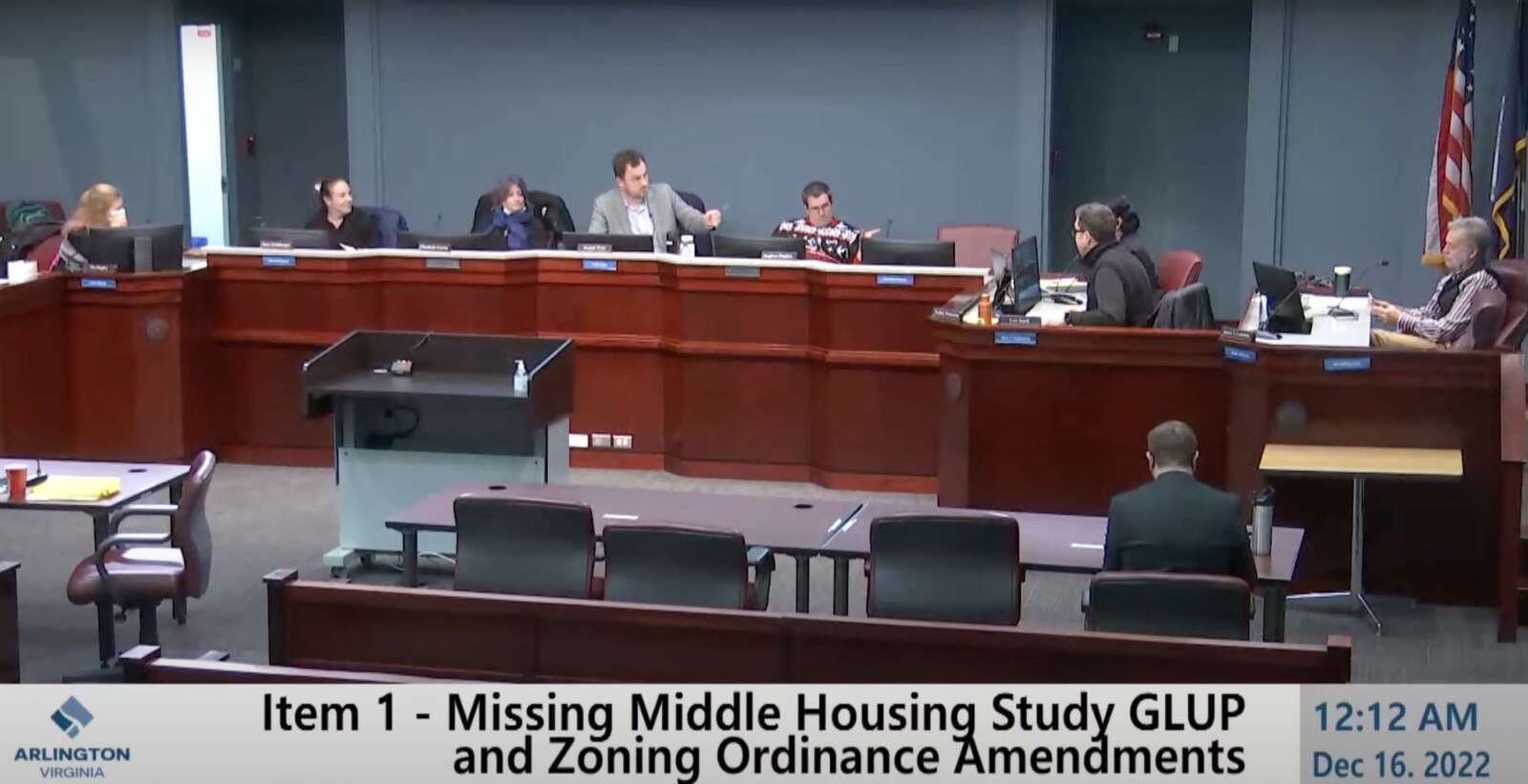
A proposal to allow by-right development of “Missing Middle” housing in single-family-home neighborhoods will now head to the Arlington County Board for a first look.
A little after midnight yesterday (Thursday), the Planning Commission voted 7-2 to recommend the County Board advertise hearings on a series of proposed changes to the county’s zoning code, which would allow 2-8-unit buildings in Arlington’s lowest-density neighborhoods.
This is the next step in a years-long process to draft and potentially approve the fiercely debated plan. The County Board is expected to deliberate the request to advertise hearings as early as its meeting on Jan. 21, meaning the proposal could return to the Planning Commission and the County Board for a final vote in March.
Some who voted “nay” last night said they support this effort while others who voted “aye” indicated they may not be voting the same way in March.
“I strongly support what staff are doing and what the County Board is doing,” said Commissioner Leonardo Sarli, who voted against the advertising request. “We just need a little more time to understand what we’re signing up for and what the outcomes are going to be… I find that there’s quite a bit that’s still lacking and missing. There’s a lot left up to chance in the hope of good luck.”
Commissioner Sara Steinberger, who voted for the advertising request, said what happened last night does not necessarily reflect how she might vote in March. Commissioner Denyse “Nia” Bagley, who voted to advertise, said “I personally still am not sure that what we have in front of us now… that we’re there yet.”
Outgoing Chair Daniel Weir, who voted for the request, said he is “so thrilled to give the community the opportunity to continue this conversation.”
“I am mindful of the number of people who spoke to us on Monday, pleading with us to give them hope that they have a future in our community,” he said.
During the five-hour meeting, members of the planning body bounced around a number of recommended changes to the draft. One failed suggestion was a 4-unit cap on Missing Middle-type buildings, which the draft zoning text now calls Expanded Housing Option (EHO) dwellings.
“Notwithstanding the enormous housing crisis we face locally, regionally and nationally, I’m still uncomfortable going all the way up to six or eight units,” said Commissioner Elizabeth Gearin, who voted against the advertising request. “That’s such a dramatic change to a single-family neighborhood. Two seems very reasonable, but even our peer jurisdictions don’t know what that’s going to look like in the long term. Six to eight almost seems like a bridge too far.”
Many of these recommended changes that passed dovetailed from concerns raised by the public during Monday’s Planning Commission meeting. They are intended to promote homeowner-led development and prevent gentrification, locate 5-8-unit buildings closer to Metro, eliminate parking minimums and encourage more tree preservation.
“The many motions we’ve gone through as a group this evening are a reflection of what we heard from the community, in thinking in terms of the appropriate number of EHO dwellings could be, what we can do to protect tree canopy and other resource allocation concerns we heard from the community,” said Steinberger.