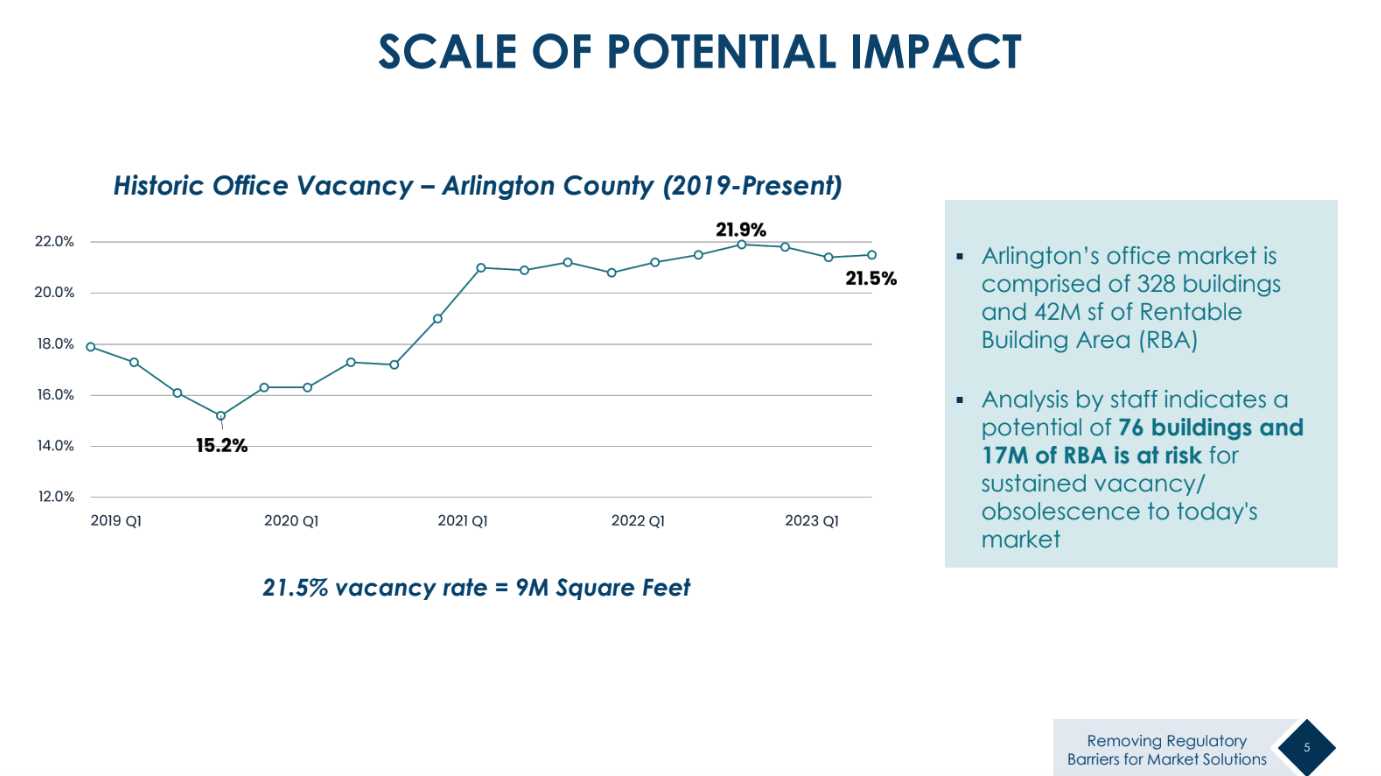
(Updated at 12 p.m. on 10/19/23) County leaders say Arlington is facing a grim future due to its rising office vacancy rate, which now stands at 21.5%.
Arlington is leading the region with its vacancy rate, which works out to 9 million square feet of empty space, according to Arlington Economic Development Director Ryan Touhill. He predicts the vacancy rate will continue climbing, as AED has determined about one-quarter of office buildings are at risk of sustained vacancies.
Compounding the vacancy issues, many leased buildings have space available for sublease and significantly lower rates of people going into the office, according to Arlington Economic Development Commission.
These conditions are set to have serious impacts on Arlington County’s future budgets, with County Board members and County Manager Mark Schwartz already predicting belt-tightening this budget cycle.
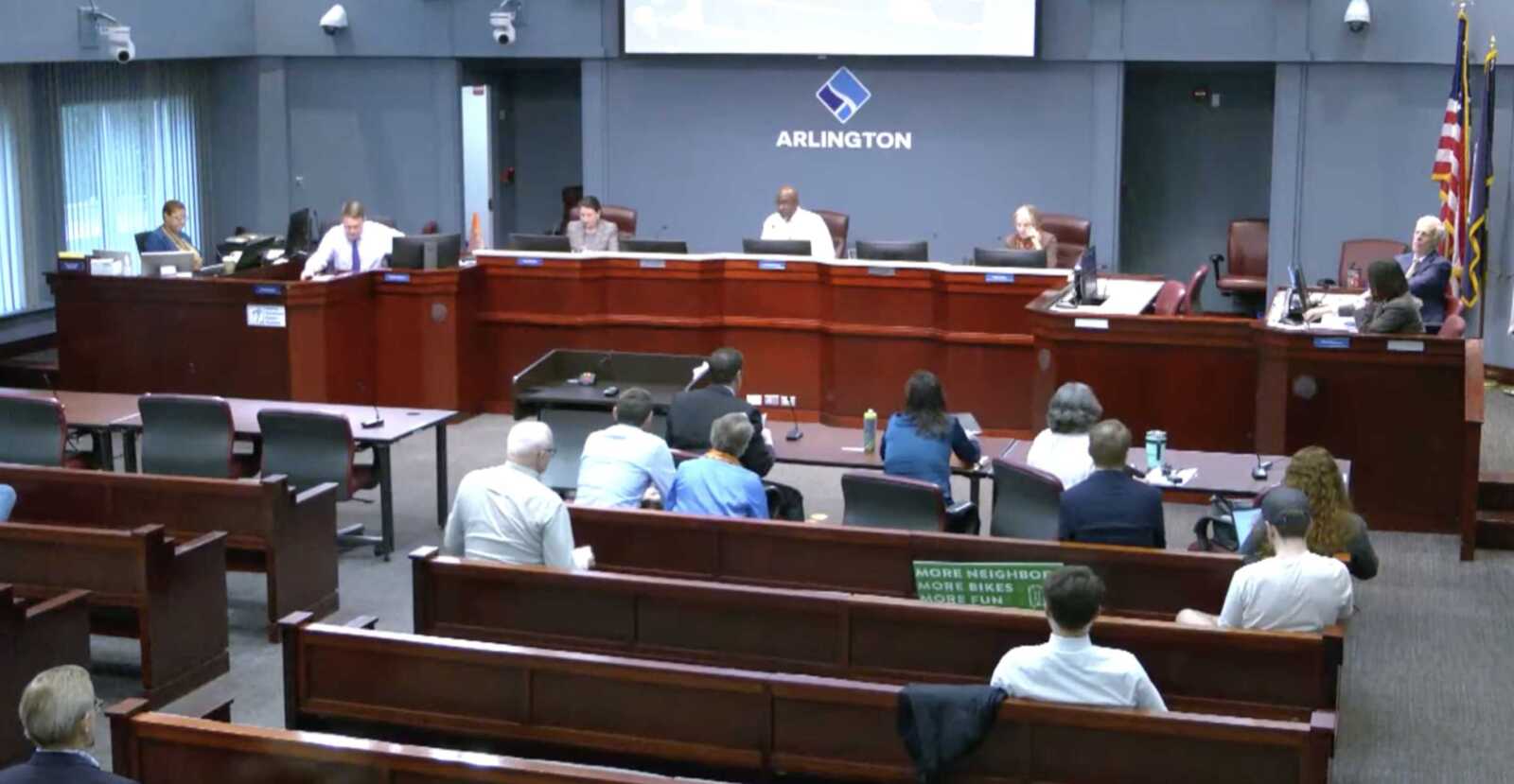
Last week, staff told the Arlington County Board about new strategies and policies they are considering to further combat this issue as part of the ongoing Commercial Market Resiliency Initiative. Yesterday (Tuesday), the county’s Economic Development Commission discussed its own recommendations for dealing with these vacancy rates.
That follows several zoning changes made in the last 12 months — on a compressed community engagement timeline — to get emerging businesses into older office buildings by allowing them to operate without seeking special permissions. This includes micro-fulfillment centers, urban farms, breweries, dog boarding facilities, pickleball courts and podcast studios.
Board Chair Christian Dorsey said Arlington is facing a different challenge than it has before.
“This is a little bit different than some of the elevated rates of vacancy that we’ve experienced in the past,” Dorsey said last week.
During the Base Realignment and Closure process, for instance, the office vacancy rate peaked at 20.1% in 2015 after major Department of Defense offices decamped from the county, per the Economic Development Commission.
Arlington managed to bounce back by landing deals with Nestle, Boeing and RTX — formerly Raytheon — Amazon and Microsoft, Dorsey said.
“But this is a little bit different because this is in the midst of a paradigm shift in the commercial market,” he said, pointing to the impacts of remote work. “And then, of course, there’s a market which is in turmoil, with incredibly low valuations and commercial space, which impacts lending and trading.”
With a potentially protracted dip in tax revenue from commercial properties in Arlington, residents will have to pay more for essential services, Touhill said.
“Historically, we’ve had that 50-50 split between our commercial and residential tax base,” he said. “But in recent years, we’ve seen that increase to more of a 55-45 split. And this means that our residents are carrying more of the burden to fund our essential services.”
To weather this storm, the economic development commission, AED and the Dept. of Community Planning, Housing and Development (CPHD) intend to streamline onerous county processes and tackle restrictive ordinances.
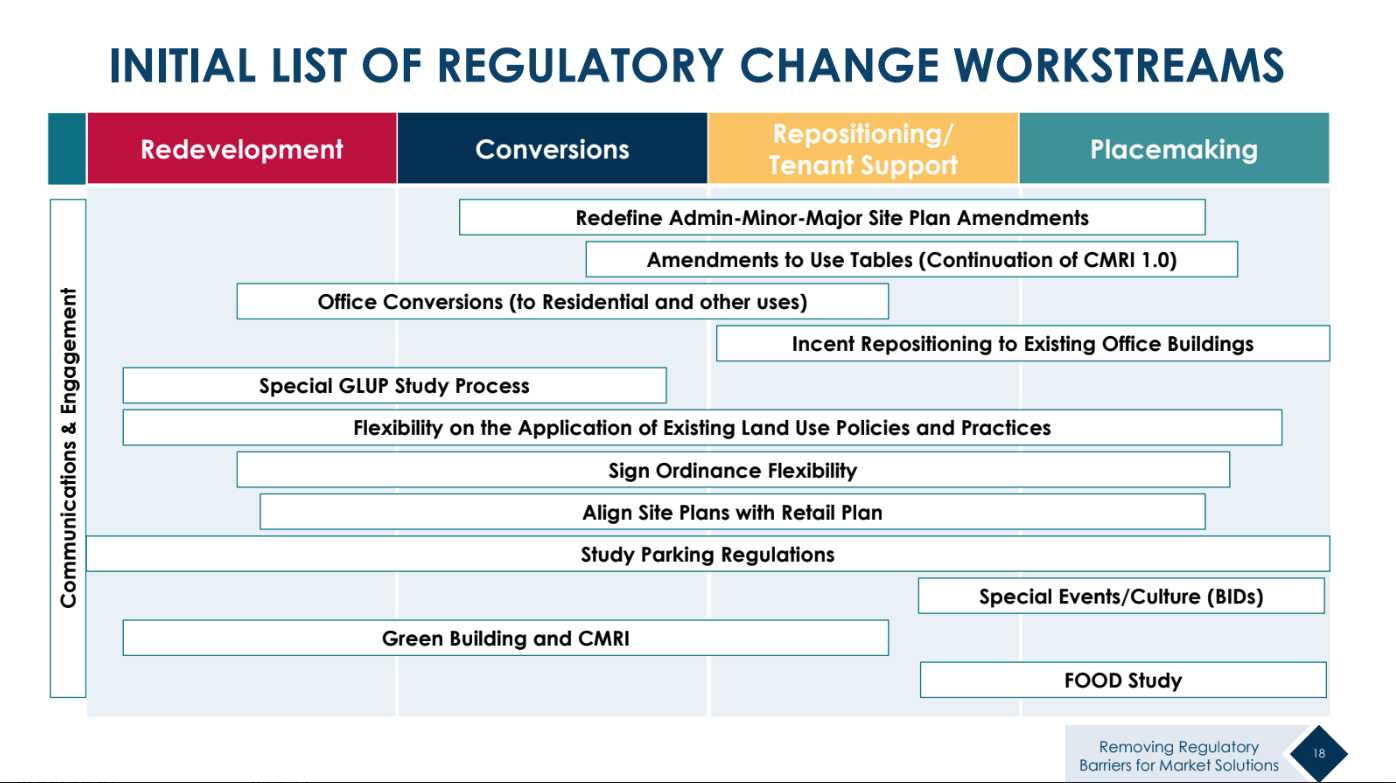
One under scrutiny will be the major and minor site plan amendment process, which developers and property owners go through to repurpose or renovate large, existing development projects.
“The site plan process’s length and variability are amongst the biggest impediments to redevelopment,” says the commission, which calls for an expedited process for these types of projects. “As these buildings already exist, all that will change is the building’s use.”