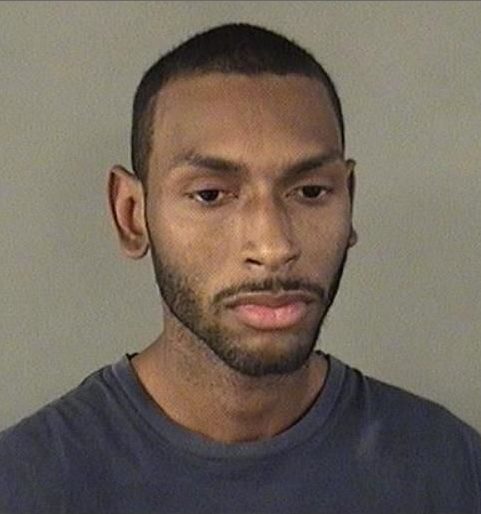
A Maryland man is now facing a slew of charges after police say he tried to lock himself in his car, then threw an officer to the ground during a traffic stop.

Arlington County Police say that 32-year-old Michael Terrance McClanahan of Clinton, Maryland first attracted the attention of officers when he made an illegal U-turn while driving near the intersection of Crystal Drive and 20th Street S. around 2 a.m. Monday (Oct. 8).

Police pulled McClanahan over and discovered he was driving on a suspended license. When officers told him to leave his car, McClanahan “refused to exit the vehicle, attempted to lock himself inside and did not comply with the lawful commands of the officers,” police said.

Once officers were able to get him out of his car, they found he was carrying a concealed weapon and decided to arrest him. As they tried to take him in to custody, McClanahan managed to lock legs with one officer, “causing both to fall,” according to police.

He’s now charged with assault and battery on a police officer, carrying a concealed weapon, obstruction of justice and driving without a license, with a hearing set for Nov. 5 in Arlington General District Court.

McClanahan is currently being held without bond in the county jail.

Full details from a county crime report:

ASSAULT AND BATTERY ON POLICE, 2018-10080019, Crystal Drive at 20th Street S. At approximately 2:14 a.m. on October 8, officers on routine patrol observed a vehicle make an illegal U-turn and attempted a traffic stop. One of the officers had previously cited the driver for operating without a valid license and his license remained suspended at the time of this incident. During the investigation, the suspect allegedly refused to exit the vehicle, attempted to lock himself inside and did not comply with the lawful commands of the officers. Officers removed the suspect from the vehicle and placed him under arrest. A search incident to arrest located a concealed weapon on the suspect’s person. While being transported to booking, the suspect affected a leg lock on an officer causing both to fall. Michael McClanahan, 32, of Clinton, Md., was arrested and charged with Assault and Battery on Police, Carrying a Concealed Weapon, Obstruction of Justice and No Operator’s License. He was held without bond.

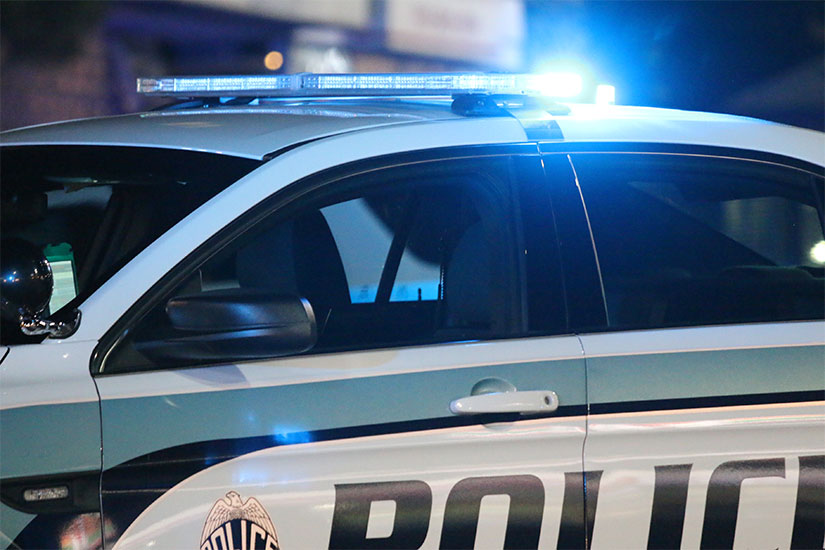
Photo courtesy of Arlington County Police Department
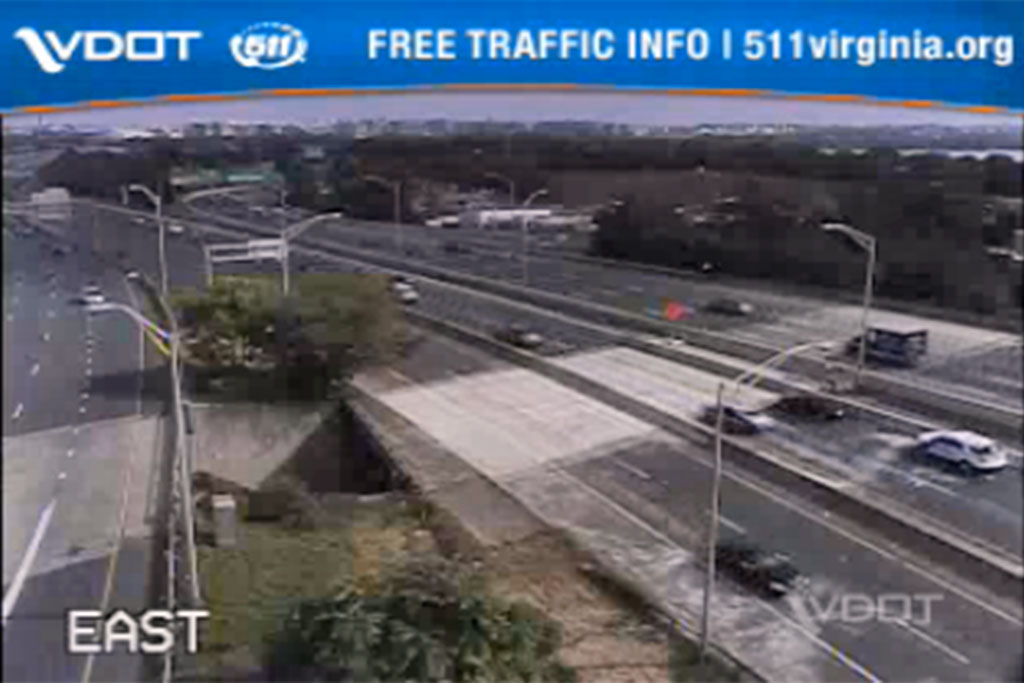

(Updated at 8:50 p.m.) A man wanted for a series of credit card and vehicle thefts has finally been taken into custody after a high-speed chase that zoomed through Arlington.

Alton Thodos, who escaped from a Fairfax County motel two weeks ago while surrounded by police, drove a reportedly stolen SUV northbound on the HOV lanes of I-395 this morning, pursued by Fairfax County police. Arlington County officers and the Fairfax County police helicopter assisted pursuing officers as the chase continued northbound toward the 14th Street Bridge.

Before the chase crossed the bridge, an Arlington officer attempted but to use a “spike strip” to flatten the tires of the SUV, but Thodos managed to maneuver around it, according to scanner traffic. (The image above shows the chase just before it crossed the river.)

Officers lost sight of the SUV after crossing into the District, but the search continued and the pursuit later continued in D.C. and Maryland. Thodos, 32, was later arrested after a crash in District Heights, Md.

More via Twitter:


Plans to make Rosslyn a bit easier to navigate for pedestrians and bicyclists are coming together, though county officials are concerned that some of the proposed changes might further snarl traffic in the area.

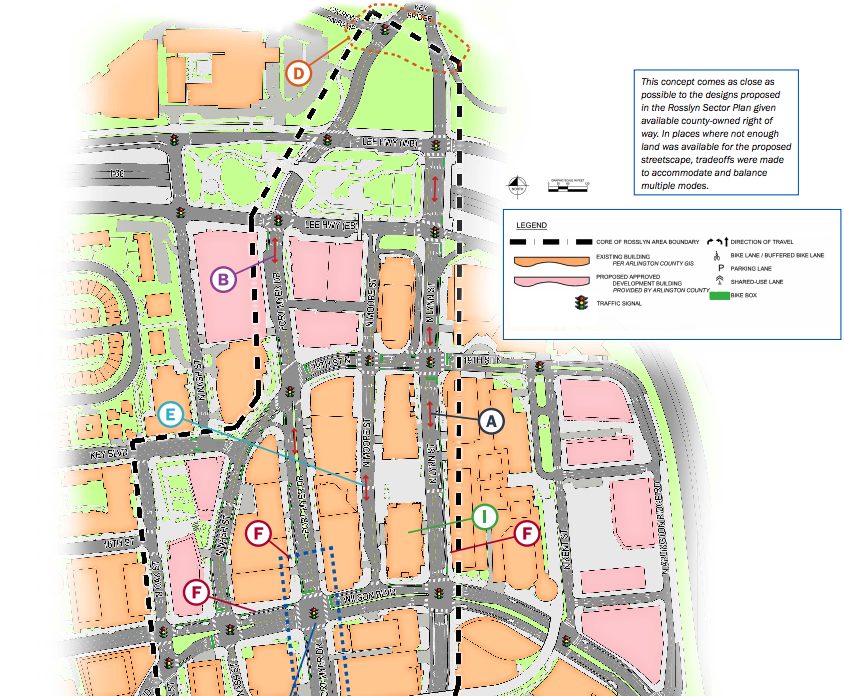
The county unveiled its latest designs for future of the “Core of Rosslyn” at a public meeting last Tuesday (Oct. 2), which includes plans to convert several streets around the Rosslyn Metro station into two-way roads, remove the Fort Myer Drive tunnel under Wilson Blvd and add a host of new connections for cyclists and walkers.

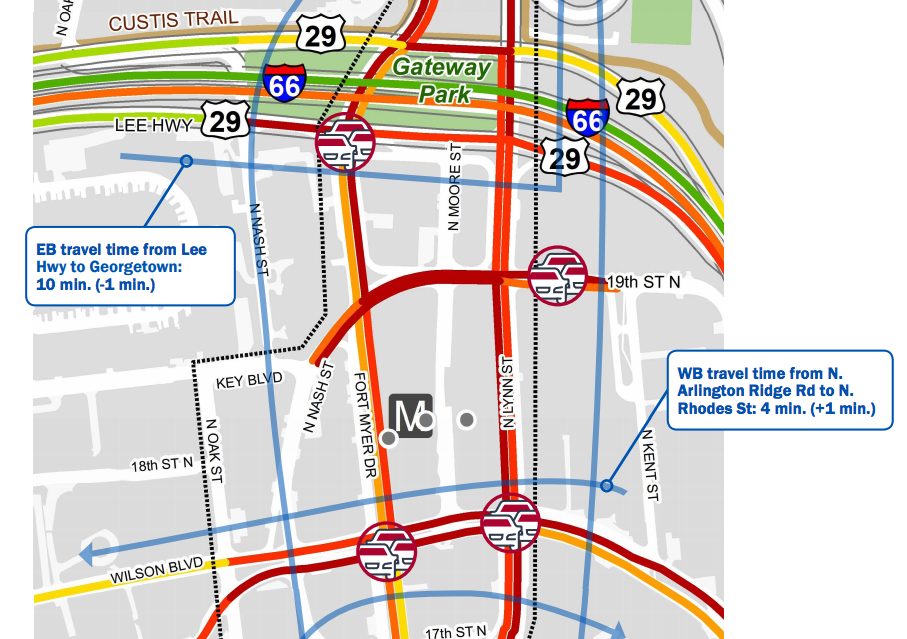
However, transportation planners worry that these alterations will produce “significant increases in gridlock” over the next decade or so, according to meeting documents.

In all, they’re projecting that the proposals will increase wait times at intersections in the neighborhood by a total of 19 minutes during the morning rush hour (with especially acute problems at the already jammed intersection of the Key Bridge, G.W. Parkway and Lee Highway) and a total of six minutes during the evening rush. They’re hoping to refine these designs in the coming months to address those issues, while maintaining the positive parts of the plan.

Certainly, planners expect the changes will result in substantial improvements in Rosslyn’s offerings for people who aren’t relying on cars to get around. The designs included 14 new or improved crosswalks for pedestrians, and more than 1.3 miles of new protected bike lanes included in the design. The lanes, largely set to run along Fort Myer Drive, N. Moore Street and N. Nash Street, are designed to ease bike connections to the Key Bridge and Mt. Vernon and Custis Trails.

The plans also keep alive the county’s long-considered possibility of building a car-free, “pedestrian corridor” running from 18th Street N.’s intersection with N. Oak Street to N. Kent Street, a change that would replace the Rosslyn skywalk system to make the Metro station more accessible.

Yet the county expects that this design would create some new challenges for walkers and cyclists as well. In particular, allowing two-way access on roads like N. Fort Myer Drive, N. Lynn Street and N. Kent Street will create a host of new “conflict points,” where cars are turning across crosswalks, prompting further delays for all involved.

That’s why Arlington officials are still accepting feedback on tweaks to the design.

Among the questions they want answered is whether people actually want to see the Fort Myer Drive tunnel filled in and transformed into a regular, signalized intersection with Wilson Blvd. The change would prompt additional delays at the intersections, and would involve “extensive construction costs and [a] long timeframe,” but could make it substantially easier for people to access the Rosslyn Metro station.

Similarly, planners want to know if making N. Lynn Street a two-way road is worth the extra traffic headaches it might entail. The county projects that the change “reduces confusion and allows for more direct routing” if it’s put in place, but it would also force officials to find new access points to the G.W. Parkway, I-66 and the Key Bridge.

The county plans to finish collecting feedback by Friday (Oct. 12), then unveil revised designs in the coming months. Officials hope to have final study recommendations for the area ready by sometime this winter.


Arlington Losing Big Office Tenant — “BAE Systems Inc. is moving its headquarters to Falls Church as part of a consolidation of its Northern Virginia office space… The move will also further ding Arlington County’s office vacancy rate, which at the end of 2017 was 20.6 percent.” [Washington Business Journal]

Hazmat Situation at Kaiser Permanente — Arlington County firefighters responded to a hazardous materials incident at Kaiser Permanente in Falls Church yesterday. Five people were evaluated by medics and, of them, two were transported to the hospital. [WJLA, Twitter, Twitter]

Red Top Development Groundbreaking Nears — “The Shooshan Co. has teamed up with Trammell Crow Residential on the first phase of its planned Red Top Cab site redevelopment in Clarendon, with groundbreaking slated for early next year. The partners closed Sept. 29 on their acquisition from The Red Top Cab Co. founder Neal Nichols of several parcels along Irving and Hudson streets for a listed consideration amount of nearly $28.2 million, according to Arlington County’s Recorder of Deeds.” [Washington Business Journal]

RIP Lance Newman and Tim Wise — Two notable Arlingtonians have died: “Tim Wise, the longtime president of the Arlington County Taxpayers Association, died Friday in Fredericksburg after a 10-month battle with cancer and heart trouble… Lance Newman, one of four black students who in February 1959 began attending a previously all-white middle school in Arlington… had died after a short illness.” [InsideNova]

ACSO Launches Breast Cancer Awareness Campaign — “Breast cancer hits close to home for the Arlington County Sheriff’s Office, which has launched a campaign to raise awareness about early detection and preventative care. Over the last six years, two employees at the county’s sheriff’s office have been diagnosed with breast cancer.” [WUSA 9]

Forum Planned to Discuss Accessory Dwellings — “A forum looking at current regulations related to accessory-dwelling units in Arlington will be held on Monday, Oct. 15 at 7 p.m. at Central Library. Speakers will discuss how changes made to the county’s housing ordinances in 2017 impact the regulatory process, and will look at whether further changes are needed.” [InsideNova]


(Updated at 6 p.m.) Striking new research reveals that where children are born in Arlington can have a decades-long ripple effect on their futures, with kids in the county’s more ethnically diverse neighborhoods growing up to make less money and end up in jail at higher rates than their counterparts.

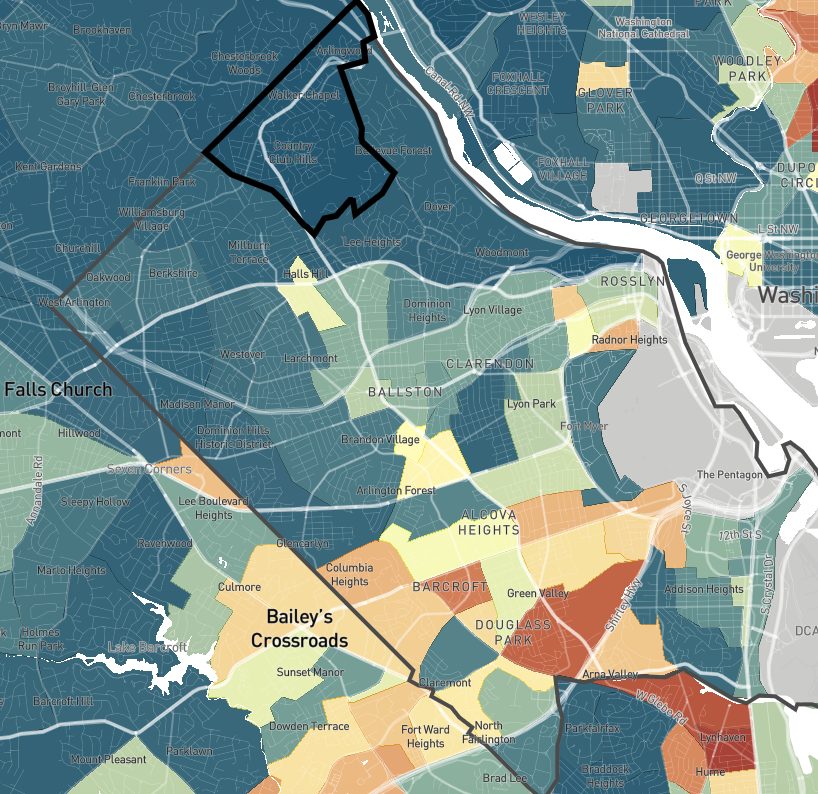
The analysis, compiled by the Census bureau and a team of academic researchers, shows that children born to a family in a wealthy, predominantly white North Arlington neighborhood earn tens of thousands of dollars more, on average, than kids from a more diverse, lower income South Arlington neighborhood. Incarceration rates generally follow the opposite pattern.

These effects largely persist regardless of a child’s race, or the income level of their parents, mirroring results researchers found around the country in creating this new “Opportunity Atlas.” The interactive map combines anonymized data on 20 million people born 30 years ago with granular Census tracts, in order to provide a glimpse of the gaps in opportunity across different neighborhoods nationwide.

Researchers are still sorting out the exact reasons behind these disparities — everything from the quality of local schools to an area’s employment rate could help explain the variations. But officials and public policy analysts increasingly view this data as a key way to guide where government intervention might be most needed to lift people out of poverty, particularly when evaluating which neighborhoods have borne the brunt of decades of racially discriminatory policies.

In Arlington, the atlas helps provide concrete examples of how the split in income levels and diversity between the northern and southern halves of the county affect residents of each neighborhood.

For instance, kids born in the Douglas Park Census tract, an area just off Columbia Pike with the largest share of non-white residents in the county as recorded in the 2010 Census, grew up to record an average household income of $36,000, regardless of their race or income level. That figure is the second lowest in the entire county.

Low-income children, defined as those born to families making $27,000 a year or less, in the area grew up to make $33,000 a year. High-income kids, who were born to families making $94,000 a year, grew up to make about $51,000.

In Nauck, a historically black community, children grew up to earn $34,000 a year, the lowest salary in the county.

Children born to low-income families made $30,000 a year, the lowest figure among that cohort in the county. Kids in high-income families there grew up to make $42,000 a year, again the lowest for the income bracket in Arlington.

People in Nauck are also incarcerated at the highest rate in the county — 4.8 percent of the people studied in the area are currently in jail. That includes 6.9 percent of children born to low-income parents and 1.6 percent of those born to high-income families, rates that are both among the highest in the county.

The results are also striking in the High View Park Census tract, which encompasses the historically black Halls Hill neighborhood, which was literally walled off from its white neighbors for decades in the Jim Crow era.

Kids growing up in the area, of all income levels, went on to make about $44,000 a year, roughly the median for the county. Low-income children, however, recorded the third lowest salary among that group in Arlington, at $29,000 per year. High-income kids went on to make about $57,000 per year, much more towards the county’s median. The neighborhood has the second-highest share of incarcerated residents in the county, with 9.2 percent behind bars.

By contrast, children born in the county’s whitest areas tend to grow up to become considerably wealthier, regardless of their family’s income level.

In the county’s Census tract with the lowest share of non-white residents (an area including neighborhoods like Bellevue Forest, Dover Crystal and Woodmont), children grew up to make an average of $68,000, tied for the second highest salary in the county. Low-income kids recorded that same $68,000 average, as did high-income kids.

Similarly, the county’s second whitest Census tract — an area in Northwest Arlington containing neighborhoods like Country Club Hills and Arlingwood — kids grew up to make $80,000, the highest salary in the whole county. Low-income kids eventually made an average of $51,000 per year, while high-income children made it to $70,000 a year.

And, in the vast majority of the county’s whitest areas, incarceration rates were below 1 percent.

Graphic via Opportunity Atlas


Local Investment Firm CEO Arrested — Todd Hitt, the founder of Falls Church-based Kiddar Capital, was arrested by the FBI and charged with securities fraud last week. Hitt was developing a new company headquarters in Falls Church. He made headlines as a young housing developer in the 1990s for clashing with Arlington neighbors while building what residents dubbed “McMansions.” [Tysons Reporter]

More White Nationalist Posters Spotted — A reader says he saw more white nationalists posters around Clarendon over the weekend. The reader, who wished to remain anonymous, says he removed the posters after photographing them. [Twitter]

New 1100 Wilson Blvd Rooftop — “Monday Properties hosted a VIP event for real estate brokers Wednesday evening to showcase the 6,200-square-foot indoor-outdoor space atop the 31-story building, part of the two-building The Towers. It is being unveiled as landlords in Rosslyn and across Greater Washington seek to up their communal spaces to appeal to tenants who increasingly want more than just office space to attract and hang onto employees.” [Washington Business Journal]

Bamboo Removal This Week — “Arlington County contractors will be removing bamboo in Benjamin Banneker Park during the week of Oct. 8. Depending on weather conditions, treatment is expected to conclude by Friday, Oct. 12.” [Twitter]

Maryjane Arrested for Car Theft, Weed — “Police caught a woman named Maryjane in Ballston who they say stole a car in Fairfax County — and they also hit her with a marijuana charge.” [Patch]

Windfall for Ballston Company — “Arlington-based AvalonBay Communities Inc. expects to clear north of $450 million from the sale of a majority stake in five Manhattan apartment communities.” [Washington Business Journal]

2000th Morning Notes Post — This is Morning Notes post No. 2000. ARLnow.com launched in January 2010.


A store in Courthouse was the scene of an armed robbery early Thursday morning.

According to a police report, a man walked into a business on the 2000 block of Clarendon Blvd around 1 a.m. and flashed a gun at a store clerk. He then ran off “with an undisclosed amount of cash and merchandise.”

The only business on that block open at 1 a.m. is a 7-Eleven store.

More from Arlington County Police:

ROBBERY, 2018-10040006, 2000 block of Clarendon Boulevard. At approximately 1:05 a.m. on October 4, police were dispatched to the report of an armed robbery just occurred. Upon arrival, it was determined that an unknown suspect entered a business, approached the front counter and requested to purchase merchandise. As the employee retrieved merchandise from behind the counter and presented it to the suspect, the suspect lifted his shirt, displaying a firearm, and demanded the employee give him cash. The suspect then fled on foot with an undisclosed amount of cash and merchandise. The victim was not injured. The suspect is described as a black male with a medium skin tone, approximately 6’0″-6’3″, with a medium build, wearing a red shirt on top of his head, a black rag covering his hair, a black short-sleeved t-shirt, black pants, and basketball shoes. The investigation is ongoing.


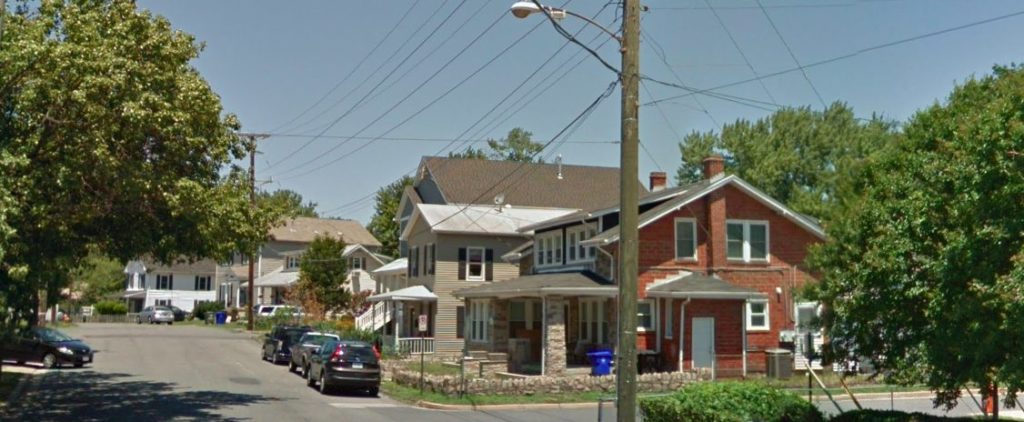
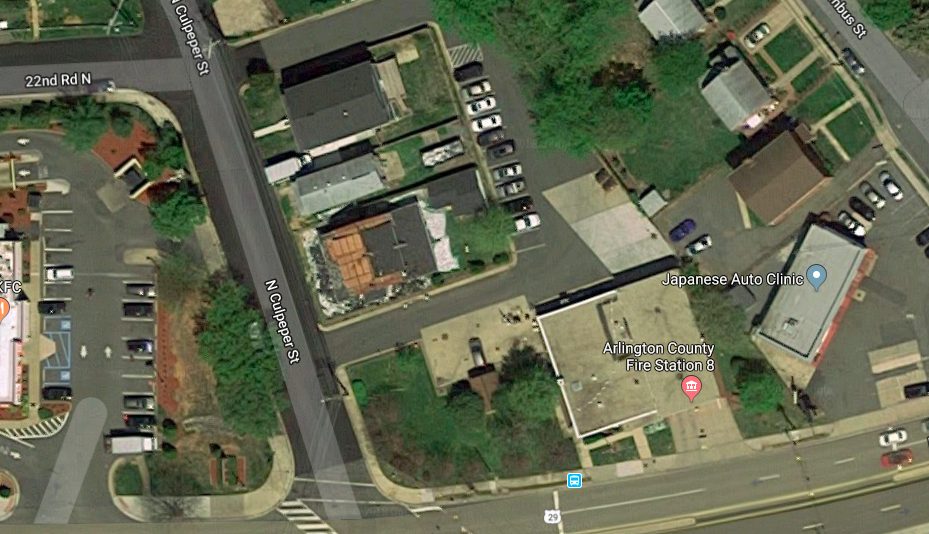
The demolition for Fire Station 8 is still a long ways away, but two homes behind the building are being prepared for demolition to eventually make way for a temporary station.

According to Peter Golkin, a spokesman with the Arlington Department of Environmental Services, the homes at 2211 and 2215 N. Culpeper Street will be demolished at the beginning of next week.

Currently, contractors at the site are putting up sediment and erosion control barriers around the buildings.

The buildings were purchased by Arlington County in December 2016 for $1.6 million.

According to Ben O’Bryant, spokesman for the Arlington Fire Department, demolition of Fire Station 8 is still at least a year away. O’Bryant says the Fire Department wants to have the temporary station built and running before they start to tear down the existing station.

Photos via Google Maps


WhyHotel Coming to Columbia Pike — “WhyHotel has just signed a deal for its second project in Arlington.  WhyHotel signed on with Orr Partners to operate temporary hotel rooms in 150 of the 366 units in the Centro Arlington development… [which] is replacing the former Food Star grocery store at the intersection of Columbia Pike and S. George Mason Drive.” [Bisnow]

New Scalia Statue at GMU Law School — “As debate raged on Capitol Hill over a Supreme Court nomination that could shape the court’s future for decades, five justices gathered Thursday at a law school just across the Potomac River for the unveiling of a statue honoring an icon from its recent past — the late justice Antonin Scalia.” [Washington Post]

Arlington Living Wage Calculator — According to the Massachusetts Institute of Technology living wage calculator, the income required to raise three kids in a household with two working adults in Arlington County is $92,480. [MIT]

Arlington Flyover Today — There is a flyover scheduled around 1:15 p.m. today in support of a funeral at Arlington National Cemetery. [Twitter]

Where to Find Singing WBJ Staffers — The Continental Beer Garden in Rosslyn and Westover Beer Garden in Westover are among the 15 best beer gardens in the D.C. area, according to the Washington Business Journal. The former is “a popular happy hour spot for WBJ staffers, who are known to sing along to the tunes playing on the outdoor speakers and share an order of pretzels and beer cheese dip.” [Washington Business Journal]

Arlington Pet Adoptions Up — “In 2017, we did a record number of adoptions for [the Animal Welfare League of Arlington], with 1,366 pets adopted. So far this year, we have already beaten that number, with 1,450 pets adopted.” [Twitter]

Halloween Stores Now Open — If you’re looking for a Halloween costume, there are three Spirit Halloween stores now open in the area, although none are in Arlington. For something closer to home, Total Fright in the Crystal City Shops (known as Total Party other times of the year) is also selling costumes and decorations. Meanwhile, a Christmas store is now open in Tysons. [Tysons Reporter]


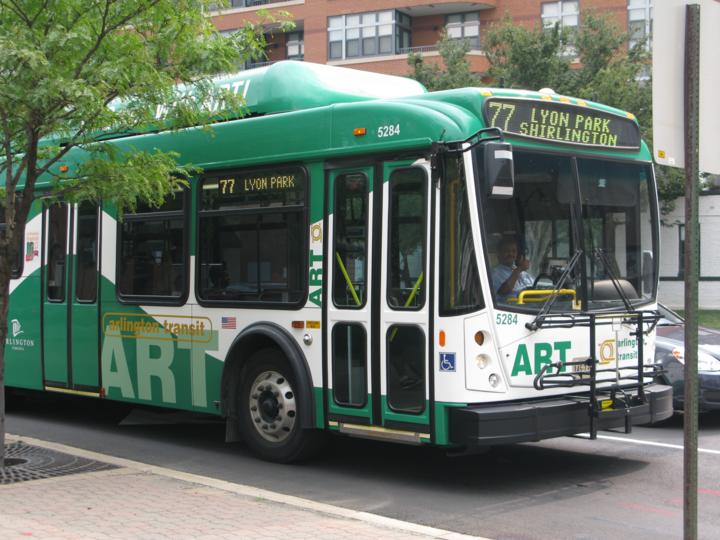
Arlington Transit could soon add a new bus route to better connect Ballston to Shirlington, as part of a host of route and schedule changes on tap for this winter.

The county’s bus service is currently collecting community feedback on the service tweaks, with plans to finalize any changes by mid-December.

The most substantial of the proposed options would be the creation of a new ART route 72, running from N. Glebe Road’s intersection with Old Dominion Drive in Rock Spring to the intersection of S. Quincy Street and S. Randolph Street near the Village at Shirlington.

The route would run through the Ballston Metro station, via both directions of George Mason Drive, and offer buses once every 20 minutes during peak hours. ART hopes that the new route would work in conjunction with Metrobus’ 22A/C routes to “bring more frequent service between Ballston and Shirlington.”

The 72 route require the creation of eight new bus stops along N. Glebe Road, at the following intersections:

Proposed Northbound Bus Stops

Stop 1 – N. Glebe Road and in front of the Marymount Admissions Building
Stop 2 – N. Glebe Road and 32nd Street N.
Stop 3 – N. Glebe Road and N. Albermarle Street
Stop 4 – N. Glebe Road and N. Abingdon Street

Proposed Southbound Bus Stops

Stop 5 – N. Glebe Road and 35th Road N.
Stop 6 – N. Glebe Road and 33rd Road N.
Stop 7 – N. Glebe Road and Rock Spring Road
Stop 8 – N. Glebe Road and Old Dominion Drive

Other proposed service tweaks include running buses more frequently along the 45 route during peak hours, and reducing some service on the 52, 55 and 77 lines. ART would also tweak the schedules of 74, 84, and 87 routes to create better spacing between various buses and endure buses run on time more frequently.

The county is currently collecting feedback via an online survey, and will also hold a pair of public meetings on the subject this month.

One is set for this coming Tuesday, Oct. 9, at the Arlington Mill Community Center (909 S. Dinwiddie Street), while the other is scheduled for the Langston Brown Community Center (2121 N. Culpeper Street) on Oct. 11. Both will run from 6:30-8 p.m.

File photo


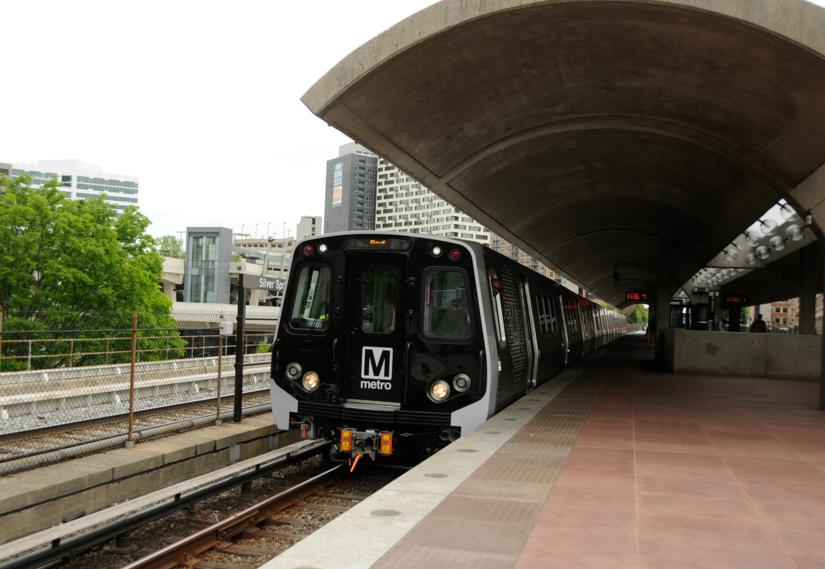
As Metro’s leaders wrestle anew with the question of how to bring riders back to the troubled transit service, Northern Virginia officials are offering their own suggestions: focus on reliability, and create new fare card plans to entice riders.

In a new report to Gov. Ralph Northam and the General Assembly set to be considered tonight (Thursday), the Northern Virginia Transportation Commission plans to urge Metro to use those strategies to boost ridership, and put WMATA on sounder financial footing in the process.

The document is the first such set of recommendations delivered to state lawmakers from the regional transportation planners at the NVTC, as part of the new oversight powers the group won through legislation to provide Metro with dedicated state funding.

Notably, however, it does not include any recommendation that Metro increase service to bring back riders. The push for service boosts, long backed by transit advocates, has become a particularly hot topic in recent days, after the Washington Post uncovered an internal Metro report insisting that service changes are the surest way for reversing WMATA’s declining ridership.

Members of Metro’s Board of Directors, including Arlington County Board Vice Chair Christian Dorsey, expressed no such certainty on a path forward when questioned by the Post, and said they had no knowledge of the internal report on service increases. But the NVTC report represents a chance for regional leaders — including NVTC commissioners like Dorsey, County Board Chair Katie Cristol and Board member Libby Garvey — to offer some of their own thoughts on the matter to Metro and its overseers.

The group’s “2018 Report on the Performance and Condition of Metro” notes that just 79 percent of trains arrived at stations “at or close” to their scheduled times in fiscal year 2017, underscoring the NVTC’s recommendation that improving reliability should be WMATA’s prime long-term focus in bringing riders back to the service. To do so, NVTC expects the system will need to devote plenty of cash to capital projects.

The report deems the $500 million in annual dedicated funding that Metro will now receive from D.C., Maryland and Virginia “an invaluable tool” in achieving its maintenance goals. Even still, the group notes that Metro reported an “unconstrained capital need” of $25 billion in projects in 2016, and will need to focus on the area for years to come to catch up on many years worth of work.

In the short term, however, the NVTC recommends developing “new fare-pass products” to “ease the transit riding experience.”

Examples could include the expansion of passes designed for college students, or new partnerships with hotels and conventions “to provide fare products directly to visitors as a part of hotel and/or convention registration.” Metro’s internal report also cites the importance of developing new fare pass options, recommending strategies like offering shorter term passes and making all passes useable on both Metro trains and buses, but those options are listed firmly below the priority of increasing service.

Yet the NVTC expects that exploring those fare pass strategies would also improve fare collection and boost Metro’s coffers, another key point of emphasis of the NVTC report. The document suggests that Metro “develop the next generation of fare collection technology” in the long term, and test methods for “off-vehicle fare collection” on Metrobus routes to juice revenues.

The report also includes recommendations on how Metro can control costs, with a special focus on labor costs. With a new Government Accountability Office analysis of WMATA’s pension liabilities igniting new debates on Metro’s relationship with its unions, the NVTC is urging Metro’s board to consider private contracting in select situations and other collective bargaining tactics to keep labor costs down.

Metro only recently cooled tensions with its largest union, which briefly threatened a strike this summer.

Photo courtesy of Metro


View More Stories