
The Right Note is a weekly opinion column. The views and opinions expressed in the column are those of the author and do not necessarily reflect the views of ARLnow.com.

On Tuesday night, the County Board room was packed with people asking for budget dollars.

Granted, a large number of police officers and firefighters were in attendance to make the case for higher pay, a cause certainly worthy of consideration. However, it is not an uncommon occurrence for the Board to hear about multiple ways to spend more taxpayer dollars.

With the tax rate question settled — unless the Board wants to lower it, which would be fine with many of us — the Board has a relatively big, but finite universe of spending to do this year. I have already made the case that the auditor’s office needs additional resources to truly be effective.

If we want to help relieve future budget constraints, let’s speed up the process of reviewing how the County spends our money.

The County Board should also constrain the closeout process now, as part of the budget. Calls in this column for the closeout funds to be used to lower tax rates have amounted to nothing. But what about an approach that takes our expenditures, tax rates and debt into account?

Total debt for FY 2019 is projected to reach nearly $1.2 billion by the end of the fiscal year. That is $5,193 for every Arlingtonian. Debt service is projected to cost taxpayers about $126 million in FY 2019 between the schools and the county government.

That is 9% of the county budget, which is close to the 10% threshold credit rating agencies look at when evaluating whether we maintain our high bond rating. And with upward pressure on interest rates, the days of uber-cheap financing may be coming to an end.

Here is a suggested constraint on the County Board’s year-end actions for the next five years:

25% of closeout funds, for unforeseen needs in the county or school system.

25% of closeout funds set aside in a reserve fund and earmarked to pay cash for some or all of a future school building.

25% of closeout funds set aside in a reserve fund and earmarked to pay cash for some or all of a major project in the Capital Improvement Plan.

25% of closeout funds given back to homeowners as a tax rebate.

Meeting unforeseen needs, saving to pay cash for purchases instead of putting them on the “credit card,” and giving money back to the people paying the bills sound like a pretty reasonable allocation of excess resources.


Progressive Voice is a weekly opinion column. The views and opinions expressed in the column are those of the individual authors and do not necessarily reflect the views of their organizations or ARLnow.com.

By Sally J. Duran

Arlington is a dynamic place and a lot of economic development happens within our small borders.

Our economy is fortunate to be powered by technology and innovation companies, federal government agencies, higher education institutions, small businesses like neighborhood coffee shops and big newcomers like Nestle.

However, maintaining a robust and diversified local economy doesn’t just happen; it requires a progressive development strategy that holistically considers many aspects of our community. How does Arlington stay resilient and attractive through all kinds of challenges? How do we ensure both large and small businesses stay competitive – and viable – for the future? What does it truly mean to have “progressive development” in a local economy?

It’s something Arlington has faced many times over the years, and it’s something we at the Economic Development Commission (EDC), a citizen advisory commission set up to monitor Arlington’s economy and make policy recommendations to the County Board, often consider when planning for the future.

Arlington has a growing technology sector and diversified corporate community along with the federal government, commercial business, non-profit and international communities. It’s no surprise that Arlington has access to one of the most educated and sought after workforces in the nation.

Our balanced and stable fiscal base allows for highly competitive tax rates that in turn provide world-class services and amenities to Arlington residents, businesses and visitors. The high incomes and low unemployment rates of our residents enable us to attract quality cultural events, excellent restaurants and varied retail establishments.

We have a long tradition of welcoming those from around the globe, and Arlington is supportive of varied lifestyles.

Our attractive economic landscape hasn’t just happened; it’s the result of careful planning, community engagement and aggressively addressing challenges such as those that arose in the past decade.

In 2008, the EDC created an economic development strategic plan to address the significant impact to the county’s commercial vacancy rate that resulted from the federal government’s decision to relocate federal tenants out of leased space in Arlington.

What we didn’t realize at the time was that subsequent federal government budget reductions would further erode the federal presence in Arlington. Equally significant changes were happening in the private sector. New ways of working — teleworking, 3rd spaces, hoteling, etc. — would shrink the per worker footprint in our office buildings across all markets and transform the definition of “workplace.” Clearly, we faced challenges that were neither fully anticipated nor understood a decade ago.

Nonetheless, Arlington’s economic development strategy has evolved thoughtfully in response to these changing dynamics. As a result of careful planning, we’ve maintained Arlington’s triple-AAA bond rating and balanced fiscal base with an approximate 50/50 commercial/residential split in property taxes — which is what’s key to Arlington’s economic prosperity.

(more…)


Peter’s Take is a weekly opinion column. The views and opinions expressed in this column are those of the author and do not necessarily reflect the views of ARLnow.com.

In last week’s column, I discussed a helpful new report on APS Future Facilities Needs prepared by the Advisory Council on School Facilities and Capital Programs.

The new report makes a compelling case that APS must pivot to a new way of thinking and decision making about capital projects. One commenter offered the following observation, “Yes of course but what is the ‘new way’? Some specifics would be nice.”

Today’s column offers some specifics.

Fiscal responsibility & long-range planning

Every future facilities decision should be made with fiscal responsibility and long-range planning as primary factors. The County and APS should collaborate to develop financial projections out to 2035 for both capital and operating budget spending, utilizing at least three assumptions: most likely case, optimistic case(s), pessimistic case(s).

The results of those projections, together with the major assumptions underlying them, should be published and shared for discussion with the community.

County & APS collaboration on site selection

The County needs to work with APS to find some sites for some new schools, starting with the next elementary in the new 2018 APS Capital Improvement Plan (CIP).

The County should adopt a land acquisition program to acquire acreage for school sites many years before the new schools would need to open. The County & APS should appoint a new task force, comprised of qualified, independent real estate professionals, to assist APS in negotiating for school space in vacant office space.

County-wide focus on locating new seats

Every decision on where to locate new seats should be made with a full understanding of the impacts of that decision on all of Arlington — not just the impacts on the immediately-proximate neighborhood.

Every community needs to be prepared to deal with some more intensified use of current buildings and sites. Congestion will grow inside and outside our schools. Every community will need to shoulder part of the burden, although the details will look different in each case.

APS & County resident-engagement

We must cut down on the average time it takes (currently up to 5 years) to get a new school on line. We also must introduce cost considerations into every stage of our engagement processes.

We need reformed civic engagement processes in which the public can weigh in early enough concerning a manageable number of budget-driving alternative options. We cannot continue with processes in which residents or staff are enabled to add one feature after another, never being told what the costs of doing so are nor that APS can afford X or Y but not both.

New CIP must include plans for enrollment growth beyond 2028

Last week’s column discussed the compelling evidence for future enrollment growth well beyond 2028. We won’t have enough capital funds or land (or money for land) to build up to 8 more schools beyond 2028 and service the debt in our operating budget. We need different (non-building) solutions to accommodate such further growth.

(more…)


We hope you get to enjoy the weekend’s sunny, mild weather, which should be a nice backdrop for the beginning of Passover tonight and Easter on Sunday.

Before the outdoor activities begin and the Easter baskets are filled, let’s take a look back at ARLnow’s biggest stories over the past week.

  1. Want to Live Comfortably in Arlington? Here’s What It Will Cost You
  2. Alt’s Vegetarian Restaurant to Open Soon in Lyon Park
  3. Crowdfunding Campaign Launched for Ballston Homicide Victim
  4. La Tasca Has Closed in Clarendon
  5. Ballston’s Lebanese Fast Casual Restaurant Badaro Now Open
  6. Arlington Bar Owners Cheer Chef Geoff’s Happy Hour Advertising Lawsuit

Feel free to discuss these topics, your weekend plans or anything else that’s happening locally in the comments below. Have a great rest of your weekend!


The Right Note is a weekly opinion column. The views and opinions expressed in the column are those of the author and do not necessarily reflect the views of ARLnow.com.

Last week, County Manager Mark Schwartz put out a new “Six-Step Public Engagement Guide for Capital Projects.” The county press release called it a “major milestone.”

County staff will find no objection to a more clearly defined path to consider large scale infrastructure projects. And the process will certainly provide a good path for projects that everyone will generally agree on the need for, but maybe need just need a little tweaking that comes from public input.

But as Mike Tyson once said about boxing, “everyone has a plan until they get punched in the mouth.” In other words, the true test of the guide is what happens when a project turns out to be controversial.

In the case of a controversial project, how will county staff address negative feedback that present major obstacles to move through the six steps?

If, at the end of the engagement process, the staff and elected officials are unable to address concerns in a way that the community feels good about, will county staff just step up the public relations effort to tell Arlingtonians why the project is a good thing? And under what circumstances will the County Board move forward with the project anyway?

What about putting a policy in place to bring the biggest projects to a straight up or down vote with the public? A standalone vote at a threshold borrowing amount of $25 million for a single project does not seem too much to ask. If a majority of the voting public feels the project is worthy, they will approve it.

Finally, what accountability is there for a project that doesn’t live up to its promises? For example, what if the county subsidy for a new aquatics center doubles, or triples over estimates? This is the type of thing that happened when it came to the Artisphere.

Over the years, we have heard a lot about how the government will listen to the public and be held accountable to the public. Every time a member takes over the gavel to chair the County Board, the subject is incorporated into their speech.

Two years ago, the County Board unceremoniously terminated a proposed “Blue Ribbon Panel” that would have provided independent citizen input into county priorities up front. The county auditor has not been given adequate resources to embark on a scope of work that would result in real accountability.

The true test for the County Board moving forward is how they take into account advice, input and accountability that is truly independent of the county manager, not whether there is an avenue to offer it.


Progressive Voice is a weekly opinion column. The views and opinions expressed in the column are those of the individual authors and do not necessarily reflect the views of their organizations or ARLnow.com.

By Laura Saul Edwards

Arlingtonians used to say that rising enrollment in our public schools was “a good problem to have.”

The catchphrase emphasizes the drawing power of the high quality instruction and student achievement at APS.

But these days, unprecedented enrollment growth, a shortage of seats and limited land for new school construction pose major challenges.

Fresh thinking and problem solving are needed as we face a space squeeze for schools — and for play space and other recreational needs. Building up — not out — is one solution. And building usable green space on rooftops has emerged as another promising option.

On the plus side, green roofs provide space for recreation and athletics when there is little to no available space for these activities at ground level. Just as important, they provide students with the chance to look at trees, plants and other natural amenities instead of industrial rooftops sprouting air conditioning units.

In this way, green roofs serve an environmental purpose while providing students with landscaped areas that can be used as a teaching tool, recreational areas for athletics and fitness and space for special events and programming.

For instance, in Rosslyn on a cramped urban site, construction is progressing rapidly on the new home of the H-B Woodlawn and Stratford programs, opening in September 2019. With seven floors, this facility will be Arlington Public Schools’ tallest building to date.

These massive rooftop terraces on four levels include one large enough to accommodate the equivalent of three basketball courts. These terraces create more functioning space on this small site with its compressed ground-level athletic field than would otherwise be possible if the new school were simply a multi-story box.

The rooftop terraces on top of the fanning bars of this modern building (picture a spread deck of playing cards) are a radical departure from the large, grassy suburban campus. Currently the programs are located with a traditional school building, full growth trees and acres of space for Ultimate Frisbee games.

But most people involved in reviewing the unique fanning bars design with its innovative rooftop terraces agreed that it made moving to the urban location more palatable. And the move also made space possible for a sorely needed middle school on H-B Woodlawn’s old site.

As green rooftops take hold in design nationwide, architects are learning how to lower the cost while addressing concerns with maintenance and drainage. Green rooftops can’t be the answer everywhere because each project and site is different.

Yet, given Arlington’s scrunch for space, even the most unlikely sites are being snapped up and creatively re-envisioned, often bringing a plus for the environment.

Imagine the old Alpine restaurant on Lee Highway – vacant for eight years – torn down and replaced by a three-story glass-paneled contemporary building for The Children’s School, a non-profit pre-school.

Imagine two secure rooftop green decks, where kids can safely run and play. A tree buffer to the residential area to the south. Open air, sunshine and a revitalized stretch of land.

(more…)


Peter’s Take is a weekly opinion column. The views and opinions expressed in this column are those of the author and do not necessarily reflect the views of ARLnow.com.

A helpful new Future Facilities Needs Report (“Future Facilities report”) from the APS Advisory Council on School Facilities and Capital Programs (“FAC”) makes a compelling case for new approaches to school facilities planning.

This new report was first presented to the School Board at its March 22 meeting.

Better seamless collaboration between APS and the Arlington County government is critical.

Longer-term school facilities planning, 2029-2035

As explained further in the new report, the best population and enrollment estimates available to APS and Arlington County demonstrate that APS will have significant needs for additional new seats and new schools beyond the conclusion of the planning horizon of APS’ new Capital Improvement Plan (CIP), i.e., from 2029-2035.

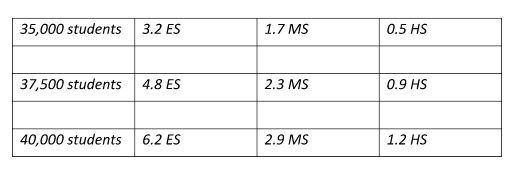
If APS student enrollment reaches any of these levels, these are the number of additional new schools that may be required (over and above current and planned capacity):

As of today, there are no plans regarding where these students will attend school.

We must engage now in longer-term planning to answer that question. The pressures of growing enrollment, budget restraints, limited land, space and bonding capacity mean it is no longer responsible to make these decisions in isolation from other decisions on where to locate county facilities.

APS Capital Improvement Plan, 2019-2028

The new CIP that APS now is preparing is intended to guide investments in new school facilities over the next ten years. Every decision APS makes on capital projects must examine both short-term needs and long-term implications. APS must address the needs for new seats in a way that provides the additional capacity on time and on budget.

On March 22, FAC Chair Stacy Snyder summarized the FAC’s views regarding the new CIP:

The projections, timing and seat needs we have identified are as follows:

  • 725 new elementary school seats in 2025 or 2026
  • A need for additional middle school capacity in 2022, 2023 or 2024
  • 500-600 high school seats in 2021 and an additional 700-800 in 2023, 2024 or 2025

We have not recently been in an environment in Arlington in which we haven’t been able to afford to build new schools exactly how we want them or to find a place for them. But, that is the situation in which we find ourselves today.

We should seize this opportunity to develop positive, new and innovative solutions so that before we reach a certain population size we are prepared, and have positive, cost conscious and forward thinking solutions in place.

Every decision must be made transparently in the context of understanding the impacts on APS’ overall seat needs, and how that decision fits within APS’ overall budget. It’s critical for APS to “show your work,” and make it clear to the community what APS’ financial and physical constraints are. Cost must be an important consideration at every stage.

Conclusion

APS must pivot to a new way of thinking and decision making about capital projects.

APS and the County Board must collaborate to develop a comprehensive and strategic long-range plan for land use and capital projects across the county.

Residents and taxpayers must participate in decisions that explicitly recognize the trade-offs and the impacts of APS’ proposals on the entire Arlington community.


Before all the rest of the snow melts — as did most of this formerly plump snowman — let’s take a look back at ARLnow’s biggest stories over the past week.

  1. Police Investigating Ballston Death as Homicide
  2. Attempted Armed Robbery of Starbucks Foiled By Audacious Customer
  3. Hit and Run Suspect Arrested During Police Raid in Fairlington
  4. Buckingham Church Listed For Sale
  5. Trump Impeachment Town Hall Series Coming to Arlington Tomorrow

For posterity, here is a photo taken during the snowstorm from one of the foremost photographic chroniclers of life in Arlington.

Feel free to discuss these topics, your weekend plans or anything else that’s happening locally in the comments below. Have a great rest of your weekend!


The Right Note is a weekly opinion column. The views and opinions expressed in the column are those of the author and do not necessarily reflect the views of ARLnow.com.

The Washington Post, referred to by one commenter as the “Amazon Post,” failed to get any answers about the offer made to attract the new Amazon HQ to Arlington. The County denied the FOIA request and said the requested information was not subject to disclosure.

With the latest back and forth, there are two questions that come to mind for me:

  1. Is Arlington’s commitment to transparency and accountability good enough?

Arlington does have a robust website where you can find a good deal of information about the county. We have an independent auditor now who reports to the County Board. A study of overtime at our emergency communications center was just released and is valuable information.

However, the auditor’s agenda is far less than robust with no real financial resources on the way to make it better. According to the proposed budget offered by the County Manager, there will be no new personnel to expand the scope of work in this office.

With $1 million dog parks and bus stops in our recent past, the $11,000 proposed increase demonstrates there is no commitment to making this office effective in more quickly evaluating how our $1.3 billion annual budget is spent.

  1. Why does it cost so much to make a FOIA request?

According to those asking for more information about the Amazon deal, the FOIA request would have cost anywhere from $319.50 to over $1,000.

First, the county should explain this cost quote discrepancy. Certainly county policy is not to discourage a regular Arlington resident from filing a FOIA request by quoting a higher potential cost than it would to a member of the media?

A few years ago, the County attempted to charge residents $2,858 for a FOIA request on the Columbia Pike streetcar project. The quote did not appear to be in line with what was allowable under Virginia law because county staff was attempting to charge for work done by consultants.

Whether it’s $300 or almost $3,000, it seems to be a lot of money to receive information that already exists. This is particularly true since so much of the information is already available in electronic form and could be produced with a few mouse clicks on a computer.

Gone are the days where you would have to pay a staff member to stand at a copy machine or scanner in order to reproduce information. The County Board should explore whether Virginia law allows it to direct county staff to lower the cost barrier for FOIA requests.


Progressive Voice is a weekly opinion column. The views and opinions expressed in the column are those of the individual authors and do not necessarily reflect the views of their organizations or ARLnow.com.

By Anne O’Brien

Child care in Arlington costs more than college–and not all families are lucky enough to find a spot.

Fortunately, the county is beginning to address the issue, with a Child Care Initiative that aims to increase the accessibility, availability and quality of child care in Arlington.

The average cost of infant care at a child care center in Arlington is $24,390 per year, according to a comprehensive analysis of child care in the county. That’s more than a year of in-state tuition, fees and room and board at Virginia Tech.

While home-based infant care is cheaper, averaging $16,929 per year, and the cost drops a bit as kids get older, child care remains a huge expense for Arlington families. That’s true for middle-class families (the median income of a family of four here is $108,600) but painfully true for our most vulnerable populations.

And child care expenses compete with money needed for transportation, food and a mortgage or rent.

In addition, there is a significant shortage of child care slots in Arlington. Nearly 70% of Arlington’s children under five live in a household where all parents work — but the county only has enough licensed full-time spots for about 33% of them. In some households, parents work nontraditional hours, or there is a language barrier or child with special needs — all of which can make it harder to find a quality child care option.

Enter nannies, au pairs, arrangements between friends and family, and hard decisions to leave small children with people who don’t have a license or other tangible child care qualification.

Also, enter withdrawal from the workforce. For some parents, there is not a choice–the high cost of quality child care or the inability to access it means that parents must give up jobs they love, impacting their earnings potential, future employability, retirement planning and mental health. It also means that valuable employees leave the companies that rely on them.

Consider the approximately 1,400 young Arlington children who live at or below the federal poverty level. Some of these children live in two-parent homes making the tough choices mentioned above. Others live in single-parent homes where no child care means no job.

What about child care subsidies for lower-income parents? State subsidies do exist, offering parents access to child care while working and gaining skills that can ultimately lead to higher income, allowing families to move off public assistance. Some families in Arlington use such subsidies, but others who qualify do not.

There is regularly a waitlist due to insufficient funds. Plus, few of Arlington’s providers accept subsidies, in part because a subsidy doesn’t cover the market rate for child care and state payments are sometimes delayed. There is also the “chicken and egg” issue: to qualify for a subsidy, you must have a job; to have a job, you must have child care.

So what needs to happen to make child care more affordable in Arlington?

(more…)


Peter’s Take is a weekly opinion column. The views and opinions expressed in this column are those of the author and do not necessarily reflect the views of ARLnow.com.

APS began its one-to-one student device program five years ago. Since then, substantial new research has been released documenting the harmful effects of prolonged exposure to such devices, particularly in early childhood.

Device exposure is especially harmful in early childhood

By beginning the current one-to-one program in second grade rather than first grade, APS tacitly has acknowledged the risks of excessive exposure to these devices at too young an age. Young children are hard-wired to respond to facial cues and learn from watching other human beings, not digital screens. Young children are more susceptible to screen addiction.

APS should start to phase out the one-to-one program beginning with the second-grade class in 2018, followed by the third-grade class in school year 2019-2020. Further phase outs should be considered in subsequent years.

Device usage policies need revision

After five years, APS is still struggling to develop policies regarding how these devices should be used. APS cannot prove how these devices improve educational outcomes. Too much responsibility is allocated to children and not enough to APS staff.

Parents are provided no opportunity to opt out, even if their child is falling behind due to overuse or misuse of technology in the classroom. There must be more accountability. Additional limits should be placed on when and how much teachers can use technology.

Decouple one-to-one program from “personalized learning” in new strategic plan

APS is developing a new strategic plan.

In the current strategic plan at APS, one of the worthy goals is “Development of the Whole Child.” Part of APS’ current approach to this goal is what APS calls “personalized learning,” and the one-to-one device program plays a central role in that goal.

In APS’ new strategic plan, the one-to-one program should no longer be an integral part of personalized learning. A June 2017 comprehensive history of the development of personalized learning provides a withering critique of the risks of making personal digital learning devices a central part of personalized learning. The article describes at least four other approaches to personalized learning that do not entail such heavy reliance on personal digital learning devices.

Other relevant sources also criticizing such heavy reliance are available here, here and here.

The one-to-one program actually is a form of depersonalized learning.

The current linkage between personal digital learning devices and personalized learning at APS schools should be severed. It should be replaced with an alternative approach centered on human interactions (not involving digital learning devices) between APS students and APS instructional staff.

Conclusion

To address appropriate concerns about the digital divide and the benefits that access to devices provide for many children with special needs, APS should convert the current one-to-one program in second and third grades into a new program that provides APS devices to students based upon the application of economic criteria like those in the free and reduced meals (FARM) program. This new program should be based on a shared-device model.

APS devices should include tracking and monitoring apps so that non-educational use and overall screen time (combining in-school and outside-school use) can be objectively measured by both APS and parents.

APS should be completely transparent about total costs and per-pupil costs associated with these devices, including insurance, maintenance and administrative costs. This information is critical to enable Arlington taxpayers to evaluate costs vs benefits.


View More Stories