
Peter’s Take is a weekly opinion column. The views and opinions expressed in this column are those of the author and do not necessarily reflect the views of ARLnow.com.

Peter Rousselotnew report by the Schools Committee of the Arlington Civic Federation challenges APS’ enrollment growth plans. The report demonstrates that APS has failed to take into account adequately the possibility that current enrollment forecasts are significantly understated.

Our capital improvement program (CIP) must do a much better job taking into account the possibility that enrollment, and therefore the cost of additional seats, will be significantly higher than now estimated.

Hundreds of millions of our tax dollars are involved.

Enrollment Forecast Issues

The vast preponderance of data points to significantly higher enrollment growth than now forecast by APS:

  • APS enrollment grew 5.2% from 2013 to 2014,
  • From 2015 through 2021, APS forecasts no increase in kindergarten enrollment, despite a 4.5% compound annual growth rate over the past 7 years. The last 6 kindergarten classes have been at least 25% larger than the classes over the prior six years,
  • The APS forecast removes up to 11.1% of students in its forecast between 5th and 6th grade when the recent average loss is only 1.3%, and other factors may understate middle school projections by as many as 700 students in 2024,
  • Sudden changes in medium term projections of cohort progressions are not justified. This disappearance of rising 5th graders masks the need for far more high school capacity to be completed by 2024,
  • APS grew 5.2% last year and averaged 3.7% growth for 4 years, but overall growth rates in the current forecast drop significantly year over year, creating future risk.

Major Implications

Among the major implications of significantly underestimating enrollment growth are these:

  • Building too small, too late is the most costly and disruptive way to expand,
  • We must lower the cost per seat,
  • The CIP must plan much better for higher enrollment growth and attendant costs within financial and space constraints:
    • We need designs that can expand or scale back cost effectively with shorter or longer wings, fewer or additional floors, and gyms and cafeterias on outside walls that can be expanded,
    • We must do the basic math regarding on how many sites APS can build, and the maximum size of cost-effective school additions, before sizing schools and then realizing we need to add 10-20% to the capacity of every school because there is no place left for new schools.

CONCLUSION

The vast majority of enrollment drivers point towards significantly higher enrollment growth and related capital expenditures than currently forecast. APS must make revisions now to take this into account. The County Board must begin now seriously to discuss options such as:

  • developer contributions (proffers),
  • deferral of County capital projects, and/or
  • providing APS with a higher share of overall debt service limits.

Peter Rousselot is a former member of the Central Committee of the Democratic Party of Virginia and former chair of the Arlington County Democratic Committee.
Progressive Voice is a weekly opinion column. The views and opinions expressed in this column are those of the individual author and do not necessarily reflect the views of the author’s organization or of ARLnow.com.

Gillian BurgessEvery May, millions of Americans take to the streets, trails and paths on two wheels to enjoy the feeling of the wind in their hair, the sun on their helmets and the pedals under their feet in celebration of bike month.

This May has been a wonderful time to bike here in Arlington. In addition to the mostly beautiful weather, we have had some very successful events, which show the growing popularity of cycling in Arlington.

Bike and Walk to School Day, which was on Wednesday, May 6th this year, was a record-setting success for Arlington Public Schools. Arlington was fourth among U.S. cities with registered events at 33 schools, including diverse participation from neighborhood and county-wide schools. Students arriving on bike or foot were treated to VIP entrances and rallies, a special obstacle course for cyclists, and lots of goodies.

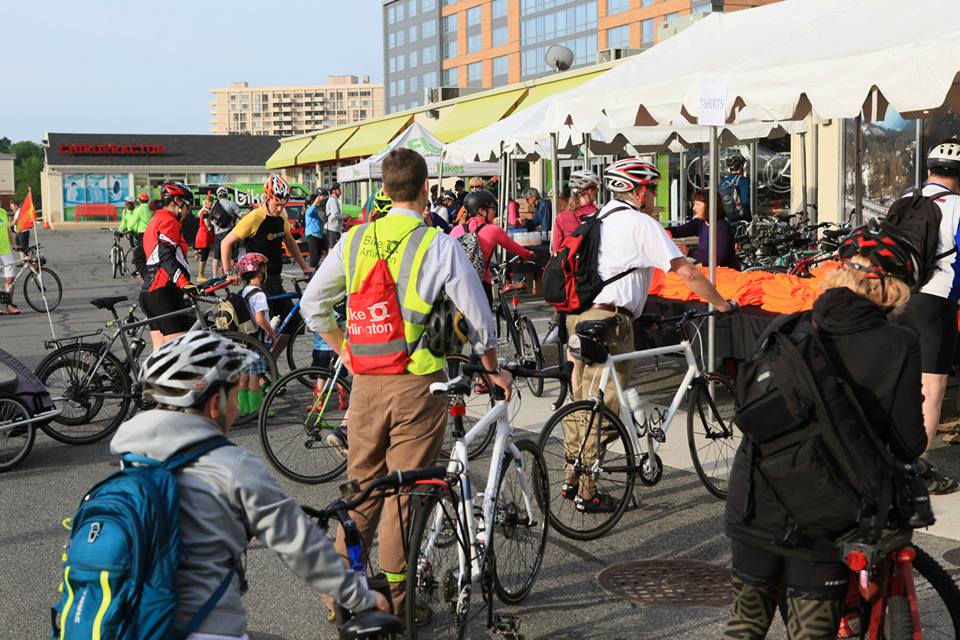
Bike to Work Day 2015 (photo via Bike Arlington/Facebook)Many APS staff biked to work, including at least one principal, and were rewarded with gift cards. A huge thanks to Tom Norton, the APS Safe Routes to School Coordinator, and to all APS and Arlington County staff and partners who had a role in this great day. Pictures can be found online using the hashtag #BWTSD15.

For adults (and kids who were towed along), Bike to Work Day was Friday, May 15th. It was also hugely successful. Arlington hosted six pit stops, including a new stop along Columbia Pike in Penrose, where cyclists could stop on their way to work and be treated to coffee, treats, swag, and lots of excited cheering from superheroes, unicyclists and elected officials.

In all 2,596 people registered for the Arlington pit stops and almost 17,500 registered for pit stops across the region. Both were a 4% increase over 2014. Over 1,000 of Arlington registrants were first timers! BikeArlington, WABA and their partners deserve thanks for hosting this great day. Pictures can be found online on the BikeArlington website and using the hashtag #BTWDDC.

With so many new riders, the growth in Bike to Work Day was no surprise. More impressive is the general growth of cycling in Arlington and the region. Anecdotally, we’ve all noticed more cyclists on the roads and on the trails, and that we’re seeing a more diverse group of people on bikes.

Bike racks at local schools and offices are filling up on “normal” weekdays. My family’s preschool has multiple families biking with their toddlers. Bike parking along the Rosslyn-Ballston corridor fills up at night and on the weekends. It’s great to see more women, more people of color, and more families cycling on streets and trails.

Data backs up our experience. Many of Arlington’s automated counters of bicycle and pedestrian trips along some trails and bike lanes have shown significant increases in bike traffic. Some – like the counter on the Mount Vernon Trail south of DCA – have shown a greater than 20% increase from May 2014 to May 2015. Clearly, Arlingtonians are hopping on bikes more often.

(more…)


The weekend is finally here, which means three days of grilling, relaxing, being active outdoors, grumbling about motorcycle noise, spending time with friends and family, watching sports and, most importantly, remembering those who gave their lives in the service of our country.

We’ll think not only of the recent veterans of Iraq and Afghanistan but, with Rolling Thunder in town, of veterans of earlier foreign wars like the Vietnam War. Thinking about the Vietnam War and how it’s remembered in Arlington, the hallowed grounds of Arlington National Cemetery might first come to mind. But one can also think of Clarendon.

The county-produced video above covers the May 9 “Echoes of Little Saigon” history program, which explored the 1970s and 1980s in Clarendon, when the neighborhood was home to many Vietnamese refugees and the businesses they started, following the fall of Saigon.

Most of those businesses have since been displaced due to ever-rising rents, but their creators and customers who fled the war in Vietnam have largely gone on to raise families and successfully integrate themselves into American society. One could consider it a happy legacy of the war and a tribute to the cause of freedom and democracy that American service members fight for.

With that, feel free to use the comments section to discuss any local topics of interest this weekend. We’ll be back on Tuesday with more local news and notes.


The Right Note is a weekly opinion column. The views and opinions expressed in the column are those of the author and do not necessarily reflect the views of ARLnow.com.

Mark KellyThumbs Up to the County Board for delaying consideration of the proposal to extend parking meter hours from 6pm to 8pm. After watching ground floor retail space sit empty, hopefully the Board will scrap this idea altogether when they reconsider it this fall.

Thumbs Up to Board Members Vihstadt and Garvey for refusing to vote for the Washington Redskins resolution.

There is no shortage of strong opinions as to whether the Washington Redskins should change their name. But when it comes to Members of the Arlington County Board, their personal opinions on the matter have nothing to do with their responsibilities to take care of the needs of Arlington County. Our fortunes will not rise or fall on the name of Washington’s professional football team whose stadium is in Maryland.

The resolution did support the team’s move to Virginia, provided it had a new name. Of course, when FedEx Field was constructed Arlington’s elected leaders ultimately opposed a site in the County and would almost certainly do so again.

Thumbs Down to meaningless resolutions from our County Board.

Telling a football team what to do with its name is not the first time the Board has taken up this type of resolution. In 2012, for example, the Board called on Congress and the American people to pass a Constitutional Amendment limiting the ability of corporations to enjoy the protections of the First Amendment and make political contributions. That resolution essentially called the Citizens United Supreme Court case a threat to our democracy. Though to my knowledge, no County Board Member who voted for that resolution ever refused to accept corporate contributions to their own campaigns as allowed by Virginia law.

Thumbs Down to the Board for unanimously adopting a plan to build an inadequate ART bus facility. As the County’s press release noted, “The new ART bus facility will not be large enough to meet all the County’s projected needs for ART facilities. It can house neither the entire existing ART fleet, nor accommodate all of the buses that will expand the fleet over the next decade.”

The total cost of the ART facility and surrounding street improvements will cost at least $17.6 million, but will only save the taxpayers $57,000 per year.

Mark Kelly is a former Arlington GOP Chairman and two-time Republican candidate for Arlington County Board.


Peter’s Take is a weekly opinion column. The views and opinions expressed in this column are those of the author and do not necessarily reflect the views of ARLnow.com.

Peter Rousselot

Virginia Governor Terry McAuliffe continues to display effective leadership by tirelessly promoting economic development. McAuliffe is:

1. Working to end Virginia’s over-reliance on federal defense spending, and
2. Seeking to diversify Virginia’s economy to take up the slack.

McAuliffe was here in Arlington two weeks ago highlighting cybersecurity and biotechnology as two areas particularly poised for growth.

According to the Center for Regional Analysis at George Mason University, the decline in federal spending has contributed to a region-wide shift from higher-paying jobs — government contractor and subcontractor — to lower paying jobs:

The shift has helped drive down the region’s gross regional product, an indicator of an economy’s health, by nearly $243 million since last year. Fewer highly paid workers, in turn, has led to … higher office vacancy rates and–year after year–reductions in the projected flow of tax dollars that help pay for schools, roads and other government services.

Stephen Fuller, the Director of the Center for Regional Analysis, underscored the problem:

“We’ve just had it easy for so long that we’ve never had to work at this.” Steady increases in federal spending, which reached a peak of $80.7 billion in 2010, kept the Washington region relatively stable during the recession. But it also fostered a false sense of security. “The message is clear: We need to rebrand ourselves and promote our assets.”

Fuller’s message is exactly the gospel that McAuliffe relentlessly continues to preach:

We have to build our own new economy, less reliant on the federal government, bring in new businesses, new interests. That’s what [my] focus has been since taking office in 2014. In slightly more than a year as governor, there have been 350 economic development projects and $6.3 billion in economic activity.

McAuliffe has stressed the importance of workforce development, credentialing, and apprenticeships: “Virginia needs to keep pace with employers’ needs if it wants to retain large companies. [We] need to cater to the large veteran population in Virginia by offering certifications for skills learned in the military.”

He is working closely with Senators Kaine and Warner to block the next round of federal automatic across-the-board sequestration cuts. Those cuts currently are scheduled to take effect on October 1, 2015. In a nutshell, McAuliffe’s message on sequestration is: “there have to be smarter ways to cut the federal budget.”

Conclusion

The Arlington County government cannot rely on the federal government gravy train the way Arlington has in the past. We need to spend every one of our tax dollars wisely. Kudos to Governor McAuliffe for:

  • candidly explaining the situation, and
  • highlighting what all Virginia leaders must do to adjust to our new economic realities.

Peter Rousselot is a former member of the Central Committee of the Democratic Party of Virginia and former chair of the Arlington County Democratic Committee.

Progressive Voice is a weekly opinion column. The views and opinions expressed in this column are those of the individual author and do not necessarily reflect the views of the author’s organization or of ARLnow.com.

Frederico CuraWith Arlington’s school population growth, the need for expanded classroom space has become an important priority.

Throughout the 1990s, Democratic General Assembly candidates ran on a platform of making state funds available to lessen the heavy financial burden of localities facing growing demand for classroom space.

Unfortunately for Arlington, the General Assembly remained under Republican control and state funding for school construction has been kept off the table. Virginia’s Department of Education website reflects this short-sighted policy: “Counties and cities in Virginia are independent political entities of the state (so are school boards that own and maintain their facilities). Therefore public school construction projects are financed through local funds.”

State funding for local school construction makes sense given the significant state educational mandates. But General Assembly Republicans have refused to supplement local classroom construction funding.

As we see now, it is difficult for localities to cut spending, raise taxes, promote economic development, or create debt capacity quickly enough to meet high growth in student population. Availability of the state’s significantly greater resources in times of unusually rapid student population growth would promote high-quality education.

What did the Republican legislators do instead of providing school construction funds?

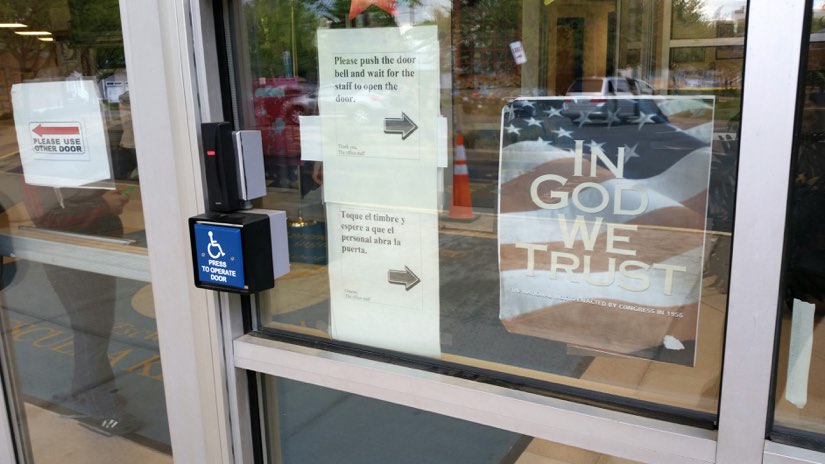
In God We Trust sign in front of Key Elementary (photo courtesy Frederico Cura)They mandated pushing on the state’s children — of diverse backgrounds and religious beliefs — state-sponsored religion in taxpayer-funded, government-run public schools.

I discovered this when I went to my kids’ elementary school in Arlington and noticed a large prominent sign next to the front door with “In God We Trust” superimposed on an American flag. It felt like a throwback to Cold War efforts to set ourselves apart from the communist Soviet Union.

After some inquiries, I learned that the General Assembly mandated that all public schools in Arlington, and across Virginia, put up that sign. (The words are based on the advice in Proverbs 3:5 — “Trust in the Lord with all your heart.”)

Some may think this isn’t a big issue. Kids may not pay much attention to symbols and tend to adapt to just about anything. But imagine for a moment being a 10 year-old raised Unitarian or Buddhist, or having atheist or agnostic parents, and you see that powerful, patriotic symbol every day when you come to school just before you recite the Pledge of Allegiance. How welcome would that sign make you feel?

We know what most kids want more than anything – to fit in. We want our professional learning communities to be welcoming places where ALL children can maximize their talents and become productive members of society.

(more…)


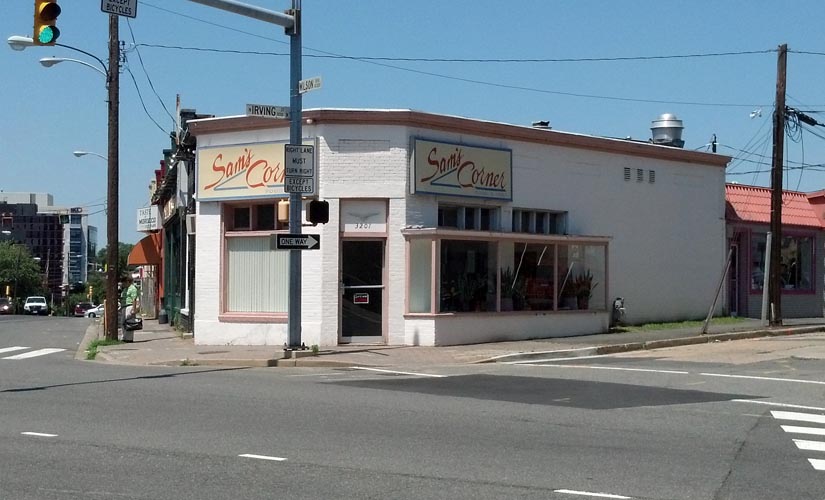
Sam's Corner in ClarendonThe weekend is here, which for many Arlington residents will mean a trip to Taste of Arlington in Ballston.

The event will take place from noon to 6:00 p.m. on Sunday, on Wilson Blvd, in front of Ballston Common Mall. Several road closures are planned in conjunction with the event.

A number of road closures in the Ballston area are also planned for the Girls on the Run 5K, which will take place Sunday morning, before Taste of Arlington.

If you wanted a taste of Arlington in 2010, the year of our launch, one place to get it was at the idiosyncratic eatery called Sam’s Corner, in Clarendon. This past week was the fifth anniversary of an incident very loyal ARLnow readers may recall.

Here’s how we described it in a comment a year after it happened, in response to readers wanting us to “research” the rarely-open restaurant:

An ARLnow.com writer walked into Sam’s Corner with the intention of doing a totally innocuous profile of what seems like a unique, older local business. For reasons unknown, the owner started asking strange questions of the writer, then rudely kicked the writer out and threatened to sue if anything was written about him or the restaurant. It was bizarre enough that we reported it to the police. Police told us that no crime had been committed. Seeing as how we don’t have the power or desire to “investigate” a private business, that episode and this comment will be the first and last time we devote any sort of time to Sam’s Corner — save the occasional wayfinding reference, as seen in this article.

Breaking our promise, we said goodbye to Sam’s Corner in 2012.

Today, it is with great regret that we are saying goodbye to Ethan Rothstein, our primary ARLnow reporter since July 1, 2013. Ethan will be joining the team at Bisnow, where he will report on commercial real estate and development. The ARLnow team wishes him well.

We plan to introduce our new ARLnow reporter to you just after Memorial Day.

With that, feel free to discuss any local topics of interest in the comment section.


Progressive Voice is a weekly opinion column. The views and opinions expressed in this column are those of the individual author and do not necessarily reflect the views of their organization or ARLnow.com.

Harrison GodfreyGrowing up in Arlington, my friends’ parents were entrepreneurs, artists, public servants, homemakers, lawyers, and service workers. In the past 30 years, I have seen Arlington change, largely for the better.

But as property values rise I wonder: “If I could buy in Arlington (that’s a big if) and raise a family here, will my children grow up in an economically diverse and largely middle class community?”

Continuing on our present course, I fear not.

Over the past several months I’ve written here and elsewhere about millennials and housing affordability in Arlington. How do we make home ownership attainable for young people? Our answer will affect Arlington’s prosperity and culture for decades to come.

Some millennials will earn well above the area median income (AMI) and have ample choices in Arlington. Others will earn well below AMI. For them, ownership here may be out of reach. To its credit, Arlington works hard to provide affordable rental housing.

The challenge is what to do for the majority of millennials who fall in between.

When my mother settled here, artists, budding entrepreneurs, and public servants could afford Arlington. With the median sale price of a “home” (detached dwellings, townhouses, and condos) now above $550,000, many find Arlington out of reach.

If ownership is unattainable to this group, they will move to more affordable urban centers. We will lose civic and artistic contributors and a significant share of a creative class that is critical to growing and diversifying our economy. Left behind will be a stratified county increasingly reliant on federal largesse.

In July 2012, Arlington initiated an Affordable Housing study. The resulting March 2015 draft plan found ownership housing affordable to families earning below 120 percent AMI “will continue to be undersupplied without public policies to stimulate and incentivize the production of lower cost ownership housing.”

In response, planners have suggested increasing the supply of affordable housing, raising density, and studying options to “enable greater flexibility in housing type.” This is promising. But to more quickly match today’s demand with existing supply, the County should also look to innovative financing options.

Upfront costs are a significant barrier to homeownership. Having graduated into a sluggish economy and saddled with student debt, few millennials have $110,000 in cash (20 percent of a median-price home).

That’s why “shared-equity” programs show significant promise.

In a shared-equity program, first-time homebuyers can get a deferred-payment, no-interest loan to partially cover down payment and closing costs. The buyer can defer payments until they sell. They then repay the original loan plus a proportionate share of the home’s net appreciation. This turns renters into buyers, helping them to build equity while putting down roots in the community. The fund is self-sustaining, refreshed with repayments and appreciation.

Arlington already has a similar program: the Moderate Income Purchase Assistance Program (MIPAP). But in FY 2014, just 14 MIPAP loans were made, up from three in the prior two years.

That’s partly because the maximum purchase price of an eligible home is $362,790, far less than the Arlington median, although the maximum allowed loan — $90,000 — and the minimum contribution required of the buyer — 1 percent — are quite helpful.

To improve MIPAP, we need to increase funding for homeownership programs. Funds to support MIPAP shouldn’t come out of support for low-income families, but rather reflect a strong commitment to both affordable housing and housing affordability.

(more…)


The Right Note is a weekly opinion column. The views and opinions expressed in the column are those of the author and do not necessarily reflect the views of ARLnow.com.

Mark KellyThis Saturday’s Arlington County Board Agenda will take more money from your pockets, raise your debt unnecessarily, and spend irresponsibly.

Parking is About to Get More Expensive

If the County Manager’s proposal on parking meters is adopted, Arlington hopes to add over $1.6 million annually to its coffers. The rates have not been changed since 2011, so it is not unreasonable to give them another look.

The more troubling part of the proposal is the effort to extend the hours from 6:00 p.m. to 8:00 p.m. The extended hours certainly do not create a welcoming environment for evening patrons to our retail and dining establishments.

Yes, people will ultimately feed the meters after 6:00 p.m., but is the extra $675,000 per year really necessary in a county already flush with cash?

Bonds to be Issued

There is a strong argument to be made that many of the items the County Board issues bonds for should be funded out of the regular budget. Parks and facilities maintenance, HVAC and roof repairs for our schools, and non-construction improvements to the Water Pollution Control plant should not be funded in the same way as infrastructure like school construction or replacing aging sewer lines.

Maintenance should be treated as regular and ongoing operating costs that the county and School Boards should budget for each year rather than borrowing money to pay for it. If you build a school or put a park in service, you should expect to have to pay to maintain it rather than adding to our already hefty debt service burden.

The county noted the bonds will not be issued until we get our annual bond ratings check-up that reaffirms our highest possible debt rating. Yes, that is in order to get us the lowest possible interest rates — a good thing when borrowing money.

But, the county often touts this rating like it is a measure of fiscal discipline. It’s not. It is a measure of the County’s ability to raise taxes on us to pay off the debt.

New ART Bus Facility

According to the County’s press release, building our own bus facility will save Arlington $57,000 per year. It will cost $14.2 million to build it.

In other words, in about 250 years this bus facility will have paid for itself. That’s one very generous definition of “long range planning.”

No one should argue with a straight face that this is some sort of cost saving measure. Sure, the funds to pay for the facility are not all at the expense of local taxpayers as Virginia is kicking in state funding. However, Arlington taxpayers are paying for that, too.

Mark Kelly is a former Arlington GOP Chairman and two-time Republican candidate for Arlington County Board.


Peter’s Take is a weekly opinion column. The views and opinions expressed in this column are those of the author and do not necessarily reflect the views of ARLnow.com.

Peter RousselotWill some Arlington students get their entire Arlington Public Schools education in trailer-based classrooms?

It’s a startling prospect for our “world class” community. But, that possibility became clearer in the latest plan proposed by APS Superintendent Patrick Murphy:

Murphy’s plan… calls for 27 new relocatables for elementary schools in South Arlington by fall 2020. By fall 2019, Murphy plans for middle schools around the county to add 44 new trailers. In five years, that would bring the total number of trailers for middle schools and South Arlington elementary schools to 120.

It’s been evident for some time that without financially feasible new plans to build new school facilities on specific sites, APS will ramp up its reliance on “relocatable classrooms” (aka trailers) in perpetuity. The numerous students for whom there are no classrooms already occupy 124 trailers.

It’s highly unlikely that the completion of the Community Facilities Study magically will eliminate the need for many dozens of trailers. Arlington probably won’t be able to retain its AAA/AAA bond rating over the next 10 years if it tries to finance the construction of all the new school facilities needed to provide enough seats — and ditch the trailers.

That still will be true even if APS does the right thing by substantially revising its Architectural Digest philosophy of new school design and construction. Furthermore, it remains to be seen if repurposing county-owned properties for schools will relieve enough congestion at an affordable price.

The County Board stubbornly has refused to take the steps needed to require developers like Vornado to pay their fair share of the cost of the new school facilities needed because of new development. And our highly educated community is unlikely to put up with a massive increase in class size as a means of trailer elimination.

Stop pretending trailers are temporary

APS needs to stop pretending that these “learning cottages” are temporary. Instead, APS must candidly admit that trailers are permanent.

Studies have shown that trailers can raise serious environmental and health concerns. These concerns are serious enough when trailers are temporary, but are greater when they are permanent. Health and environmental risks are magnified when trailers are used on the same site at which new school facilities or renovations are being constructed.

Launch a search for new models

APS should switch to new, more environmentally friendly and energy-efficient trailers. One possible model is the one used by the Waldorf School in Charlottesville. Many other examples are available here.

CONCLUSION

APS should:

  • admit that its relocatable classrooms are a permanent feature, and
  • appoint a joint citizen-APS task force to identify new models to fill APS’ growing capacity gaps.

Peter Rousselot is a former member of the Central Committee of the Democratic Party of Virginia and former chair of the Arlington County Democratic Committee.

Peter’s Take is a weekly opinion column. The views and opinions expressed in this column are those of the author and do not necessarily reflect the views of ARLnow.com.

Peter RousselotHow can Arlington improve its business environment?

In a recent column, I highlighted steps the Arlington County government should take to encourage a civic minded business community. That column explained why Arlington needs to improve its business environment in order to meet its public facilities challenges.

This column continues that discussion. It is based on input from a business owner who moved a business from Arlington to Fairfax. Among this owner’s key observations are these:

  • How does a business benefit from locating in Arlington, or remaining in Arlington? My checks were quickly cashed, but I never received a message of appreciation for remaining in Arlington nor congratulations for growing a business year-after-year. What can the County offer businesses? Perhaps appreciation is the most affordable thing. How about a pleasant phone call from time to time, an email that connects them with a county business liaison if they have questions, an offer to discuss business futures with them, or inviting them to seminars and gatherings?  It’s a conversation worth having.
  • The County knows how much in gross receipts taxes and BPOL taxes every firm pays. They can easily tell which ones are increasingly paying more in taxes. They could then connect and engage. Applications for occupancy permits for new office space could provide yet another opportunity to make meaningful contact with businesses that are growing and staying in the County.
  • When I called the Arlington Economic Development office to ask for help finding new office space for my growing company, I was told to contact a local commercial real estate agent. When I left a year later, no one ever called me about the motivations for my decision. So market retention is at least equally important to economic development because you don’t have to fill empty office space if the business stays in Arlington. The County needs to implement changes based on what they’ve learned from exit surveys — if they actually do them systematically (or even retroactively).
  • If more than 50 percent of all new businesses in Virginia are woman-owned, perhaps understanding the psychology of women business owners would make a difference in how the county does business with them. This is an opportunity for the county to offer customized help to small, woman and minority owned businesses.
  • It’s widely acknowledged that small businesses are the backbone of the economy, and yet in Arlington it seems that only large businesses and federal leases get the attention.  While we’ve listened to the sad story and witnessed the very real impacts of BRAC relocations, small businesses are being ignored.  Small businesses pay their share of taxes, too.  Why don’t they get meaningful attention or assistance?

Arlington: are you listening?

Peter Rousselot is a former member of the Central Committee of the Democratic Party of Virginia and former chair of the Arlington County Democratic Committee.

View More Stories