The Right Note is a weekly opinion column. The views and opinions expressed in the column are those of the author and do not necessarily reflect the views of ARLnow.com.
Mark KellyJohn Vihstadt spoke regularly about hiring an independent auditor in the county government during his campaigns and throughout his brief tenure on the Board. The credit for originally identifying the need goes to the Arlington Civic Federation. The Civic Federation raised the idea back in 2011, calling for an independent “Inspector General.”

While candidates from the Republican and Green parties raised the issue in previous election cycles, the idea did not really seem to take hold until the infamous $1 million bus stop made national news. Along with the ongoing Artisphere subsidies, a $1 million dog park and an aquatics center price tag that seemed to be spiraling out of control, the need became apparent to the voters as well.

Enter Del. Patrick Hope. Delegate Hope’s bill would remove any doubt as to whether the County Board could hire a truly independent auditor who will not report to the county manager, but directly to the Board itself.

With its unanimous passage in the House of Delegates, it seems on track to become law. Delegate Hope deserves kudos for pushing the bill towards passage.

With this in mind, the Board should be building this office into its FY 2016 budget with the anticipation it will be approved. The Board should ensure the office is adequately staffed and has broad enough authority to examine county spending in a truly independent fashion.

It seems as though the Board or the county manager had been dragging their feet on hiring an internal auditor under the current staffing structure as approved last year. The position is still vacant. So, the Board should set a self-imposed deadline to have an independent auditor in place of not later than July 1.

The Board should also grant the office authority to examine how county staff estimates revenues. While the White House chronically over-estimates revenue growth to make projected federal deficits look smaller, the staff at Courthouse seem to chronically underestimate revenue growth to drive tax rates higher.

The Board and county manager like to say they are budgeting conservatively, but there is nothing conservative about creating “revenue shortfalls” on paper as an excuse to drive up taxes and spending.

Providing transparency and accountability from outside the normal chain of command in Arlington is a good idea with broad support from across the partisan spectrum. Provided the Hope bill passes the General Assembly, the Board should follow through on it promptly.

Mark Kelly is a former Arlington GOP Chairman and two-time Republican candidate for Arlington County Board.



Progressive Voice is a weekly opinion column. The views and opinions expressed in this column are those of the individual author and do not necessarily reflect the views of ARLnow.com.

Mike LiebermanArlington occupies only 26.5 square miles — a geographic fact that looms larger and larger as we confront the challenges of a growing community on the doorstep of Washington.

Our school population is growing — projected to exceed 30,000 students in five years. More than 20 percent of our business office space is vacant, hit hard by sequestration, BRAC, GSA cutbacks, and other government spending cuts. And development has exploded and property values have increased, creating unprecedented challenges to affordable housing and the neighborhood feel of Arlington.

That’s why I believe that it is so important now that the County Board and School Board have formed a Community Facilities Study Committee — which meets for the first time this week — to analyze our current financial resources and physical assets, discuss our infrastructure challenges, and make recommendations for our community to move forward.

In some ways, the premise of the committee is unimpeachable — of course there is value in knowing what assets we have and planning for where we are going. But there are aspects of the committee that I believe make it particularly well-suited to the task at hand.

For one, it represents a collaborative effort between the County Board and School Board. All too often, the County Board and School Board have felt siloed. To be sure, there have been cooperative efforts among board members and initiatives that have broken through these walls, but in general, the School Board has focused on schools, and the County Board has tended to focus on other community needs.  The Community Facilities Study Committee will bring both boards into the same conversation.

Similarly, the committee is structured to bring all community groups to the table. County interests are represented by current members and veterans of several county advisory bodies. School interests are represented by members of school advisory councils and PTAs. And neighborhood interests are represented by members of civic associations from across Arlington. This diversity of views will help ensure that all interests have voice as the committee divides limited land and budget resources.

Finally, the committee represents a bipartisan effort premised on community engagement — the so-called “Arlington Way.” This will begin with monthly “resident forums,” and it will continue as the diverse views of committee members are heard and factored over the course of a year of discussion.

In 1975, the county plans that served as the foundation of our vibrant Rosslyn-Ballston corridor were the product of extensive community discussion and engagement. The Community Facilities Study Committee rightfully recognizes that that same model is needed for Arlington’s next chapter.

To be sure, even with the right structure, the committee faces no easy task. There is no shortage of strong viewpoints in Arlington, and no shortage of constituents willing to voice them. (more…)


Peter’s Take is a weekly opinion column. The views and opinions expressed in this column are those of the author and do not necessarily reflect the views of ARLnow.com.

Peter RousselotLast September, Gov. Terry McAuliffe relaunched an effort to enact effective ethics reform. He appointed a bipartisan commission charged with making recommendations.

As we enter the last weeks of the 2015 legislative session, some progress has been made. But, one key reform — the establishment of a truly independent ethics commission with teeth — appears to be dead. That’s a shame.

Virginia’s very weak ethics laws have led to a culture of corruption in Richmond — including the recent McDonnell and Puckett scandals. The corruption has tainted both Republicans and Democrats.

Some improvements — now in the legislative pipeline — would cap gifts to legislators and their immediate family members at $100 (rather than the current $250). These pending bills also would close the notorious loophole allowing unlimited “intangible gifts” like vacations and event tickets.

But, one of the critical recommendations that came from McAuliffe’s bipartisan commission was the recommendation to create a new, independent Ethics Review Commission with teeth, including subpoena and enforcement power. Setting up a permanent ethics commission with power to interpret and enforce ethics and anti-corruption laws is critical.

Virginia needs such a new commission with the:

  • resources to conduct investigations,
  • power to assess fines for violations, and
  • authority to make referrals to the attorney general or other prosecutors.

Regrettably, significant disagreement about the need for this type of strong ethics commission has led to the omission of such a provision from legislation adopted by both the Virginia Senate and the House of Delegates. They appear to have been swayed by statements like this one from Del. C. Todd Gilbert (R-Shenandoah):

“I think that’s a terrible idea, and I don’t think that either party wants to set up a framework where people can start and stop political vendettas through that process.”

In light of the persistent ethical problems in Richmond, the truly terrible idea is to omit this provision from the legislation.

A large majority of other states, including Massachusetts, South Carolina, and Pennsylvania have permanent ethics commissions. In Massachusetts, for example, the Ethics Commission can impose the following penalties:

  • a civil penalty of up to $10,000 for each violation of the conflict of interest law or the financial disclosure law, and
  • a maximum civil penalty of $25,000 for bribery.

By carefully studying the different ethics commission models established in these and other states, Virginia legislators ought to be able to find a model that combines effective enforcement power with safeguards against partisan abuse.

It’s a big mistake for legislators to leave Richmond this year without passing a comprehensive ethics reform package that includes a strong ethics commission.

Peter Rousselot is a former member of the Central Committee of the Democratic Party of Virginia and former chair of the Arlington County Democratic Committee.


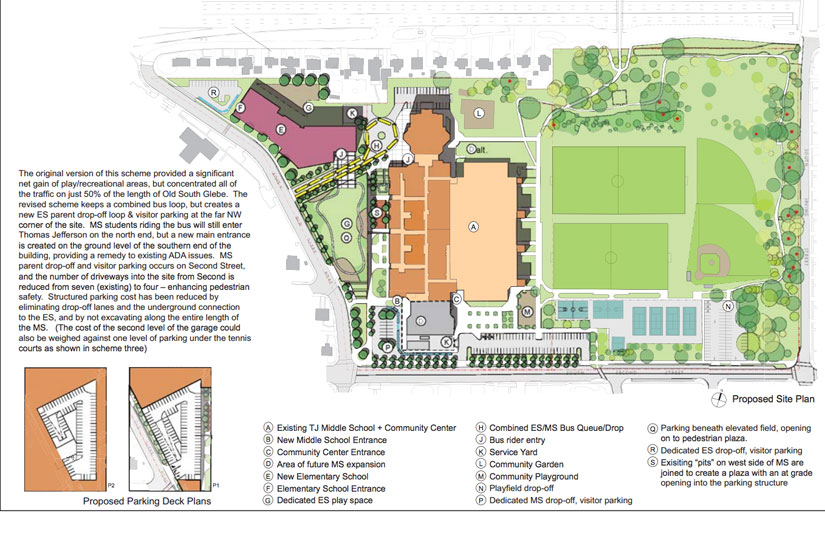
The proposed Thomas Jefferson elementary school site, put on hold by the Arlington County Board
Two weeks ago, the Arlington County Board said “not now” to a planned elementary school next to Thomas Jefferson Middle School.

Opponents of the plan cheered the County Board’s action, saying that plans to build on the TJ site would eliminate land that could later be used as parkland. Arlington Public Schools will now go back and conduct more studies and community engagement in order to figure out how to deal with its capacity crisis in south Arlington.

Supporters of the school plan said delaying the construction of urgently needed school capacity could result in 45 new trailer classrooms next to south Arlington schools by 2018.

While the “Save TJ Park” group that opposed APS’ proposed placement of the school was the most vocal during the lead up to the County Board vote, those who supported the school are now making their voices better heard.

In a letter to the Sun Gazette, Arlington resident Nathan Zee writes that the County Board decision shows that there is “an unquestionable divide” between north and south Arlington.

“The County Board’s direction to APS to keep working with the community until consensus is reached is nothing short of a total absolution of leadership and decision-making responsibility,” Zee writes. “There could always be more planning, but the time to act was now.”

In order to find out (unscientifically) how the community as a whole feels, we’re putting it to a poll: do you support the County Board’s decision?


Peter’s Take is a weekly opinion column. The views and opinions expressed in this column are those of the author and do not necessarily reflect the views of ARLnow.com.

Peter RousselotThe County Board recently decided not to approve “for now” an APS plan to build a new elementary school at the Thomas Jefferson site.

Several critical lessons must guide our way forward to meet the APS goal of adding a minimum of 725 new elementary seats in South Arlington by 2018.

Three of those lessons are discussed below.

1. APS Can’t Choose The Best Option Unless It Knows What All The Options Are

The county and APS must share with each other — and with the public — an inventory of all site options that they know about. This inventory must include both County-owned sites and private sites (like vacant commercial office space).

2. APS Must Be Completely Transparent In Discussing All Options

After APS has all the information about potential options, APS must conduct an open and transparent process to share options with the community, explaining:

  • what APS’ preferred options are, and
  • why other options were not chosen.

This transparent process cannot be limited solely to sites. The process also must include programs. For example, APS must disclose whether it intends to use a new facility as a neighborhood school or a choice school or a combination.

New, updated forecasts for enrollment growth — jointly prepared with the county — must be part of the conversation. The public must have confidence that all of our new school facilities will be located in the areas in which both the county and APS agree that the greatest school enrollment growth is likely to occur.

New, less elaborate and lower-cost design options for new school facilities everywhere in the county must be part of the conversation. The public needs assurances that all APS designs are as frugal as possible.

3. Developers Must Be Part Of the Solution

The county must get developers to pay for part of the cost of new school seats. Financing new learning facilities will require more than bond financing.

For starters, Arlington must emulate other jurisdictions, like Fairfax and Loudoun, that require a separate school impact analysis and developer contributions as a condition of approval of development projects.

If the County Attorney believes that Arlington lacks the authority to emulate Fairfax and Loudoun, then he must spell that out now so that we can ask our legislators to seek necessary changes in state law.

Of course, we cannot expect developers to pay for everything. But they must foot the bill for their fair share of the cost of the public infrastructure needed to serve the increasing population their new projects attract.

CONCLUSION

Arlington leaders must:

  • consider all available sites,
  • share publicly all proposed options,
  • make developers pay their fair share.

Peter Rousselot is a former member of the Central Committee of the Democratic Party of Virginia and former chair of the Arlington County Democratic Committee.


The Right Note is a weekly opinion column. The views and opinions expressed in the column are those of the author and do not necessarily reflect the views of ARLnow.com.

Mark KellyAcross America, there is a move to encourage states to call for a Constitutional Convention. That debate has moved to our General Assembly in Richmond.

Article V of the U.S. Constitution states in part:

The Congress, whenever two-thirds of both houses shall deem it necessary, shall propose amendments to this Constitution, or, on the application of the legislatures of two thirds of the several states, shall call a convention for proposing amendments, . . .

This means a minimum of 34 states would be required to petition Congress to set a date and venue for new Constitutional Convention. Any proposed amendments would then need to be ratified by 38 states.

Much of the beauty of our Constitution is in its simplicity, both in length and wording. Its 4,000 plus words have rarely been amended since it was drafted in 1787. By comparison, the European Constitution contains over 156,000 words, the King James Bible contains over 780,000 words, and the tax code and regulations are over 4 million words and counting. Nothing about the tax code or regulations can be argued to be simple or straightforward.

Amending the Constitution is serious business, which is why our Founding Fathers had the wisdom to make it difficult. In fact, our Constitution has never been amended as a result of a Constitutional Convention subsequent to its ratification.

Proponents, who tend to be on the conservative side of the political spectrum, are pushing for a balanced budget amendment and limitations on executive power, among other things. Their fiercest opposition also seems to be among conservatives who do not want to open up the Constitution to mischief by states that would send liberal contingents to a convention. And if my email inbox is any indication, both the proponents and critics are extremely passionate about their positions.

Whatever your view, there really seems to be no path to finding 34 states to petition for an Article V convention — at least not in the near future.

At the same time, a public debate about how, when and why to amend the Constitution is a healthy thing. If nothing else, maybe it has caused Virginia, birthplace of its primary author, to take a second look at the Constitution and to think about what it would mean to amend it. Hopefully more than a few teachers viewed it as an opportunity to use current events to study one of the best foundational documents ever written.

Mark Kelly is a former Arlington GOP Chairman and two-time Republican candidate for Arlington County Board.


Progressive Voice is a weekly opinion column. The views and opinions expressed in this column are those of the individual author and do not necessarily reflect the views of ARLnow.com.

Krysta JonesOur community and our society are becoming more aware of and educated about the issue of sexual assaults. This is, in part, due to high-profile cases that have drawn increasing press attention, including national media stories involving the military, college campuses and the National Football League. This issue is a difficult one, with many facets. But it is one that we must address fully and fairly.

According to whitehouse.gov, “Young women… face the highest rates of dating violence and sexual assault. In the last year, one in 10 teens have reported being physically hurt on purpose by a boyfriend or girlfriend. One in five young women have been sexually assaulted while they’re in college. While men compromise a smaller number of survivors, male survivors are no less important.”

Locally, Arlington data shows there were 201 sexually related offenses with reported victims in 2011. As is generally true, victims of sexual offenses in Arlington have been predominantly female.

As a single woman living in Arlington, it is something I think about a lot. A few years ago there were disturbing incidents on Arlington’s recreation trails, one by my home. I made the difficult decision to alter my exercise routine, but was pleased with how the county and citizen groups came together to respond to the incidents and address the broader safety issue.

As many of these crimes are not reported, it is hard to know for sure whether there has been an increase or decrease in assaults from year to year. Yet one thing is clear: in 2015, it is imperative that Arlington’s progressive values guide our work in preventing, raising awareness, and addressing sexual assault.

Fortunately, Arlington County has a history of addressing difficult community concerns, and it is responding to the issue of all-too-frequent instances of sexual assault. For example, during my term (2011-2014) on the Arlington Commission on the Status of Women, one of our top priorities was addressing sexual assault and rape.

One priority was establishing a local hotline for sexual assault incidents. Before now, the county’s only hotline for sexual assault incidents was the Virginia Domestic and Sexual Violence Action Alliance in Richmond. Although answered 24/7, the hotline’s location prevented those in urgent need of an immediate response from being connected with a County Violence Intervention staff person for assistance.

In Arlington’s FY 2015 budget, funding was included for a hotline in Arlington. As chair of the Commission on the Status of Women, I was proud to join organizations like Project Peace in supporting an Arlington-based hotline.

According to the county website, Arlington’s Violence Intervention Program (VIP) provides survivor services including safety planning, hospital accompaniment, or support when contacting law enforcement. The VIP program is also committed to preventing abuse from occurring by providing programs to a broad range of adults and adolescents. The VIP also offers consultation and training to allied professionals on the issue. (more…)


Progressive Voice is a weekly opinion column. The views and opinions expressed in this column are those of the individual author and do not necessarily reflect the views of ARLnow.com.

Karen DarnerArlington lost a pillar of progressive strength on Jan. 8 when Charles Washington Rinker Jr. passed away.

Fortunately, before his passing, Charlie and his wife Lora (co-founder and longtime Executive Director of the Arlington Street People’s Assistance Network or A-SPAN) were honored at a reception hosted by AHC “for their leadership and devotion to the Arlington community and their contributions to affordable housing and community development.”

At the reception, state Sen. Barbara Favola presented resolutions from the Virginia General Assembly honoring the life’s work of Charlie and Lora.

Charlie’s legacy was captured in the following remarks delivered by Karen Darner, former Virginia House of Delegates, at the Celebration of the Life of Charlie Rinker held at Rock Spring Congregational UCC on Jan. 18.

Remembering Charlie

Fifty years ago Charlie and I attended a quadrennial conference of the Methodist Student Movement in Lincoln, Nebraska. I only realized that when I re-read my notes from the conference 20 years later and told Charlie. Small world!

The Rev. Martin Luther King Jr., was the keynote speaker and Charlie was to introduce him. Another Movement officer wanted to have that honor, so Charlie deferred to her — sounds like him, doesn’t it?

So he may have deferred to another that day, but we all know that when it came to civil rights and social and economic justice here in Arlington, Charlie never gave up until the job was done. Advocacy was his middle name.

Charlie was involved in a number of activities in Arlington, and even ran for the County Board. I think Mary Margaret Whipple said it best — “We may have lost the election, but we won the campaign.” Yes, Arlington began to learn more about this gentle man who brought people together to find real life practical solutions to problems the county would face.

The immediate problem became housing.

Arlington’s “location, location, location” made it ripe for extraordinary redevelopment and our apartment stock quickly began disappearing from the rental category. The community that prided itself on living and working in Arlington was losing the “living” component because of rising rents and decreasing units. It happened to tenants everywhere and tenants were afforded very little respect. Charlie, by contrast, exuded respect for everyone. Moreover, the diversity Arlington championed as a treasure was slipping away. That was unacceptable.

The easiest way to summarize what Charlie and others instigated is to look at the organizations that have been requested as beneficiaries in lieu of flowers. If an organization has the word “housing” in it, Charlie’s fingerprints are all over it.

I like to think of all of them as the Home Team. Their names say it all…

The Arlington Housing Corporation — now AHC — produces, preserves, manages and finances affordable rental and owner-occupied housing. It offers educational services to strengthen residents’ economic and social stability. The latter helps to ensure people can continue to live in their new housing.

Arlington Home Ownership Made Easier — or A-Home — seeks to increase the number of low and moderate income and minority households that are able to purchase homes here.

Buyers and Renters Arlington Voice — or BRAVO — has a significant mission of empowering renters: giving them a voice, and often in several languages.  (more…)


Peter’s Take is a weekly opinion column. The views and opinions expressed in this column are those of the author and do not necessarily reflect the views of ARLnow.com.

Peter RousselotSeveral months ago, I wrote a column in which I concluded that Arlington Public Schools has failed to meet its burden to prove that it is ready to implement a plan to put a tablet in the hands of every student.

APS still has not met that burden.

For this plan to succeed, APS must demonstrate that it has credible YES answers to ALL of these questions:

  • Does APS have a long-term instructional vision for what this plan is intended to accomplish?
  • Does APS have a long-term budget to train staff to implement its long-term instructional vision?
  • Does APS have a long-term budget to replace the devices?
  • Given all the other priorities APS must weigh, has this 1:1 plan been assigned a high enough priority to receive the funding it requires to be successful?
  • Has APS obtained transparent feedback from all stakeholders with respect to its long-term instructional vision, its long-term budget to implement it, and the priority the 1:1 plan has been assigned?

In a helpful article, Alan November — an educational technology consultant — framed the challenge APS faces as follows:

[W]hile one-to-one computing might work as a marketing slogan…, it is a simplistic and short-sighted phrase… Adding a digital device to the classroom without a fundamental change in the culture of teaching and learning will not lead to significant improvement. …[I]t’s essential to craft a vision that giving every student a digital device must lead to achievements beyond what we can accomplish with paper. Otherwise, let’s just stick with the original one-to-one program: one No. 2 pencil per student.

Has APS addressed adequately the challenge Alan November posed?

This is what the APS website currently has to say:

Every school in the system is conducting a pilot which is focused on identifying instructional best practices which leverage personalization. These best practices will be woven into teacher professional development and the full project implementation over the upcoming years.

An accompanying paper on digital learning makes certain promises (pages 8-10) regarding these subjects. These include promises that a Digital Learning Steering Committee will develop a plan that will:

  • Provide instructional support
  • Provide and implement a short and long range professional development strategy
  • Provide guidance on technology and curriculum integration
  • Provide guidance to develop policy related to personalized digital learning

Conclusion

This plan needs to be:

  • created,
  • vetted and reviewed by all APS stakeholders,
  • transparently shared with the public, and receive strong public support.

Until all of the above steps are completed, we don’t know whether this plan will succeed.

Peter Rousselot is a former member of the Central Committee of the Democratic Party of Virginia and former chair of the Arlington County Democratic Committee.


The Right Note is a weekly opinion column. The views and opinions expressed in the column are those of the author and do not necessarily reflect the views of ARLnow.com.

Mark KellyWe may never know the content of the conversation between Jay Fisette and Mary Hynes that caused them to ultimately arrive at their votes to cancel the Columbia Pike trolley. However, it looks like the Board may still be split 3-2.

By all accounts, Democrat Libby Garvey should be up for Board Chair or Vice Chair. She was elected in a 2012 special election when Mary Hynes last chaired the Board. Hynes was followed in the middle seat by Tejada, then Fisette. Yet, Garvey was passed over this year to give those spots to Hynes and Tejada.

With Tejada’s announcement yesterday that he would not seek re-election, it is possible the move was a final nod to his service from his colleagues. It certainly explains why he remained defiant over his trolley vote. But, it is worth watching whether Democrats will ever accept Garvey back into the fold.

It is also worth noting that the father of the trolley, Chris Zimmerman, has remained strangely silent on its demise. Maybe Zimmerman saw the writing on the wall before he left the Board a year ago. He certainly was astute enough to jump off the Metro Board before it began a series of drastic rate hikes and service reductions.

Speaking of considering your political future, next week’s meeting of Arlington Democrats may see Hynes announce her electoral intentions for 2015. Her reversal on the trolley points to another run, particularly since Tejada’s pending departure opens up a seat for ambitious Democrats looking to run.

One Republican relayed to me recently that he thought it would be tough for a non-Democrat to win another race in Arlington without the trolley and the aquatics center to run against. My response: three of the same people who thought those projects were a good idea are still there — at least for the rest of this year. So, the penchant for putting the taxpayers on the hook for vanity projects still holds a majority on the Board. Voters were satisfied with the Vihstadt test run on the Board and elected him to a full term. They may be ready for another independent voice.

The County Board agreed to a revenue sharing agreement with the School Board. It reads like a lot of common sense, but it is not groundbreaking. Schools, public safety, roads and other basic infrastructure needs are the key spending priorities for any local budget. At around $22,000 per child, when you don’t “exclude” certain spending, maybe we ought to focus more time talking about how the schools are spending the dollars they already receive.

And finally, if you live near Reagan National Airport, you watched the County narrow a portion of S. Eads Street from two lanes in each direction to one. If the Board’s goal was to create more traffic congestion during rush hour and cause drivers to consider making use of neighborhood streets instead of a more major thoroughfare, then congratulations are in order.

Mark Kelly is a former Arlington GOP Chairman and two-time Republican candidate for Arlington County Board.

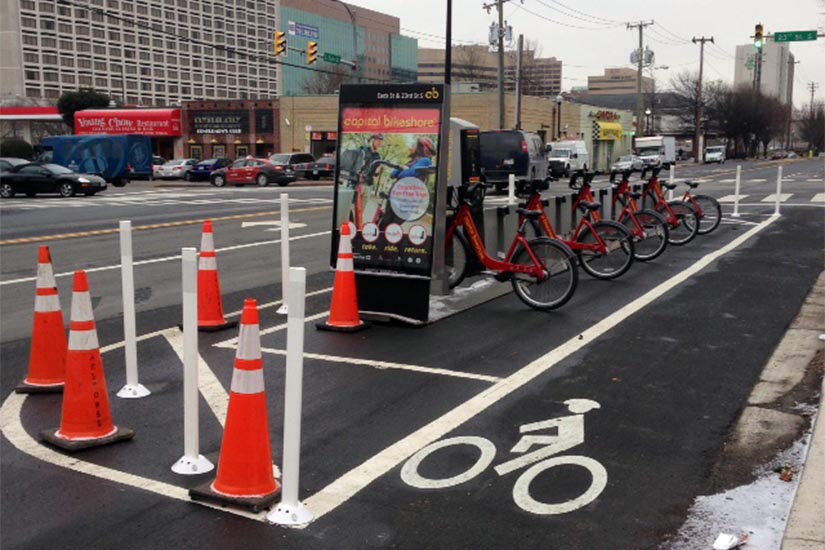
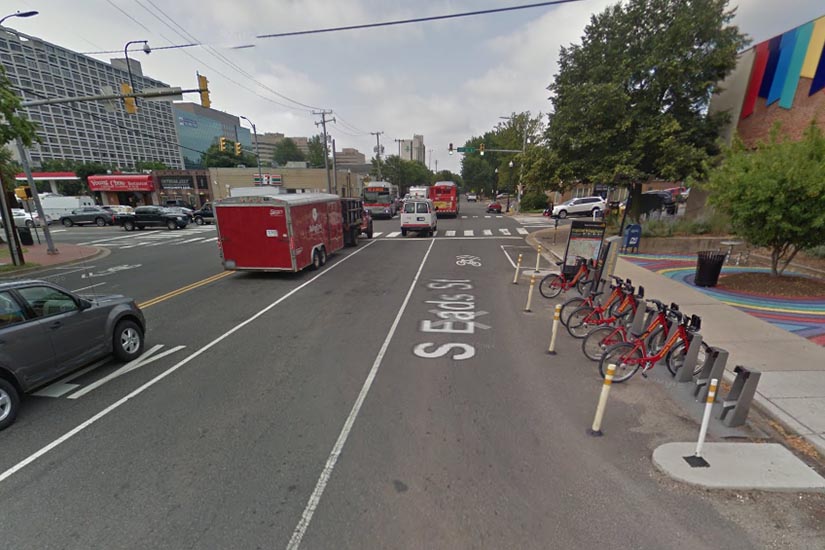
Capital Bikeshare station at S. Eads Street and 23rd Street S. (Flickr photo by Euan Fisk) Previous configuration at S. Eads Street and 23rd Street S. (photo via Google Maps)

Over on Greater Greater Washington, a mini debate is raging in the comments section about whether this Capital Bikeshare station (pictured, left) in Crystal City is a good idea.

It’s located on S. Eads Street at 23rd Street S, in what was previously a shared bike lane and vehicle travel lane (albeit one with a CaBi station on the side of the road). Now, the lane consists only of a protected bike lane and an in-street Capital Bikeshare station.

In support of the station, some say it has improved safety for cyclists while keeping the station off of the sidewalk. Also, it prevents conflict among drivers when two cars heading straight have to abruptly merge into one lane at the end of the intersection.

Those arguing against the station say it reduces lines of sight, making it harder for drivers to see cyclists and pedestrians crossing the intersection. It also is vulnerable to an errant driver and eliminates a lane used by cars turning onto 23rd Street. Finally, those returning and checking out bikes at the station may come into conflict with those using the bike lane.

Do you like or dislike the placement of the station?

Flickr photo (left) by Euan Fisk. Photo (right) via Google Maps.


View More Stories