Peter’s Take is a weekly opinion column. The views and opinions expressed in this column are those of the author and do not necessarily reflect the views of ARLnow.com.

Peter RousselotArlington County Board Chair Jay Fisette sent the wrong message last month about highly popular ride sharing services like Uber:

In the end, Fisette said Arlington would participate in a state study into the Uber issue, but didn’t say what kind of perspective the county would bring to the table. “As a locality, we don’t really have a point of view except that we have to enforce the law,” he said.

As I have explained, Arlington lacks the authority unilaterally to change the law under which ride sharing services like Uber operate. Under Virginia’s “Dillon Rule”, changing the law has to be done at the state level. But, Arlington certainly could have a “point of view” — if it chose to have one. Arlington could bring its perspective to the table.

Arlington knows how to develop a point of view about issues over which it lacks authority to change the law. Look no further than the point of view the County Board (including Fisette) unanimously adopted four years ago on the subject of enforcement of federal law regarding undocumented immigrants.

In a September 2010 press release announcing its decision to direct the County Manager to look for ways in which to withdraw from enforcement of the federal “Secure Communities” program, the Board stated:

[T]he “Secure Communities Initiative will create divisions in our community and promote a culture of fear and distrust of law enforcement that threatens public safety and makes communities less safe,”

[…]

[I]t is not the role or the desire of the Arlington County Police Department to take on the responsibility of enforcing federal immigration laws. [The Board] reaffirmed its support for existing County policies and procedures that prohibit racial profiling and protect crime victims and witnesses.

The Board concluded by explicitly calling on the U.S. Congress to adopt comprehensive immigration reform.  Even though it ended in failure, I applaud Jay Fisette and the County Board for the stand they took in 2010. They sent the right message to large numbers of Arlington residents who felt threatened by the federal program in question.

Today, vast numbers of Arlington residents say that ride sharing services like Uber are wildly popular for many good reasons. Jay Fisette ought to be demonstrating the same degree of empathy for these residents that he demonstrated four years ago for undocumented immigrants.

This is the message Jay Fisette should send on ride sharing services like Uber:

I am enthusiastic about the many benefits to Arlington customers that ride sharing services like Uber offer. I am committed to doing everything I can to enable these services to thrive.

Peter Rousselot is a former member of the Central Committee of the Democratic Party of Virginia and former chair of the Arlington County Democratic Committee.
Progressive Voice is a weekly opinion column. The views and opinions expressed in this column are those of the author and do not necessarily reflect the views of ARLnow.com.

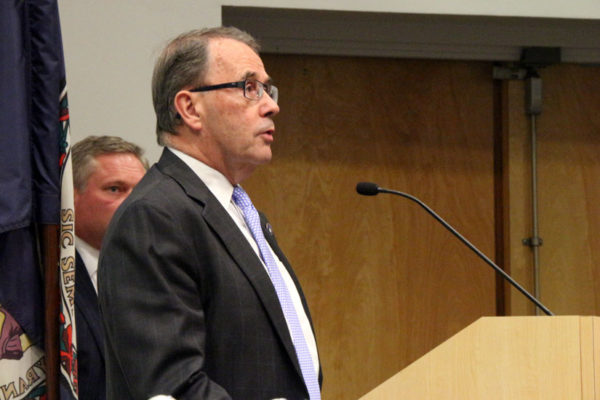
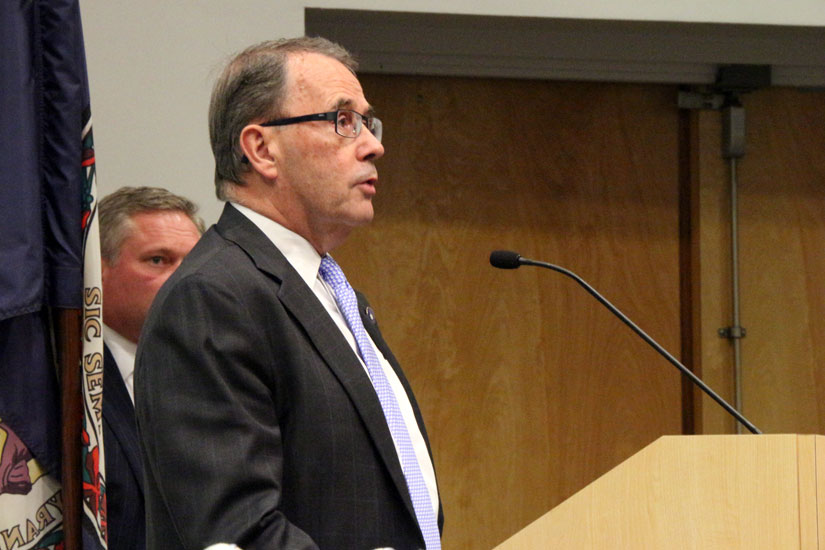
Del. Bob Brink (D-48)This week, I stepped down after 17 years as the 48th District’s Delegate in Richmond. This milestone gave me a chance to reflect on how I arrived at this point, what lies ahead — and how much this unique community means to me.

Unlike some people who have adopted a coiled snake as their mascot, I believe in government and the important and sometimes essential role it plays in improving people’s lives. From that belief came an interest from an early age in politics as a means of ensuring that like-minded people would serve in government. (The fact that I grew up in Chicago, where politics is in the water system, may have had something to do with it as well.)

The politics/government connection drew me to this area and to Arlington some 40 years ago. Here we were absorbed into the Arlington Democratic family: some became surrogate grandparents; our kids grew up together; and I developed lifelong friendships with people who would become colleagues and co-workers in Arlington’s positive, person-to-person brand of politics. Then in 1997, when Judy Connally (whose first campaign I had managed) decided to retire as Delegate, my personal and professional circumstances made it possible for me to run to succeed her.

My 17 years in Richmond have reinforced how fortunate we are to be part of this community. We know the statistics: we’re well-educated; we’re affluent; we continue to have a dynamic, vibrant economy (our unemployment rate is consistently Virginia’s lowest).

We champion efforts that don’t necessarily benefit us directly. A prime example is K-12 funding. If there’s anything like a litmus test in Arlington, it’s support for our public schools. Yet, due to Virginia’s K-12 funding formula, Arlington receives relatively little state money for its world-class public schools — by and large, we pay for them through our local taxes.

But Arlington’s delegation in Richmond is united in defending K-12 funding in the state budget — it’s the right thing to do and makes us a better and stronger Commonwealth. (A tragic irony in the debate over Medicaid expansion is that some downstate members most vociferous in their opposition to expansion represent areas with disproportionate numbers of low-income uninsured people who desperately need access to health care.)

Unlike many other delegations in Richmond, we work well together — within the delegation and with our local elected officials.

We’re generally of the same political party and share the same political goals. But that’s not the complete answer: there are other one-party delegations that fight like cats and dogs, both among themselves and with their local officials. Rather, it’s based on mutual trust and respect within the General Assembly delegation and with our hometown boards and constitutional officers.

That’s paid off for Arlington. When the Defense Advanced Research Projects Agency (DARPA) was in danger of moving out of Arlington, we worked together at the federal, state and local levels to keep DARPA headquarters here. Through strong working relationships developed over time in Washington, Richmond, and Arlington, we were able to achieve that goal.

DARPA is an example of how government investments in research and development as well as infrastructure pay enormous dividends in terms of national security, private sector growth and productivity — most famously as the place where the Internet got its start. DARPA’s continued presence is vital to Arlington’s economy and reputation for innovation.

A good share of my time in Richmond has been spent on “Arlington issues.” It’s a duty I’ve taken on gladly, and it’s one my successor must be prepared to assume.

This Arlington unity will become even more important. In a Dillon Rule state, Arlington’s delegation in Richmond must defend programs and policies in transportation, human rights, and other areas that reflect Arlington’s values and priorities developed through the community-centered process we call the “Arlington Way.”

A few weeks ago a Washington Post columnist noted that officials from surrounding jurisdictions sometimes refer to us as “Perfect Arlington” because sometimes we seem to view ourselves that way. While we have every reason to be proud of our accomplishments as a forward-looking, inclusive community, we need to be vigilant that satisfaction doesn’t become smugness and self-righteousness. I’ve found that a bit of humor doesn’t hurt either.

This is not a farewell address. While I’m moving on to new challenges, Arlington will always be my home. I’ll always be grateful to people who gave me the opportunity to be their voice and champion their values in Richmond. You’ll forever be in my thoughts.

Bob Brink is the Deputy Commissioner for Aging Services in the Virginia Department for Aging and Rehabilitative Services. He represented Arlington in the Virginia House of Delegates from January 1998 to June 30, 2014.


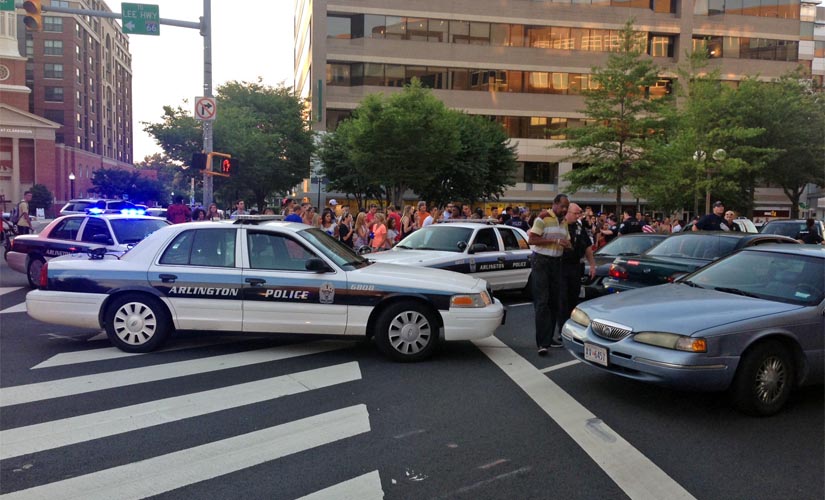
Police cars at the corner of Wilson Blvd and N. Highland Street after a car chase ended in a crash (photo courtesy Keith Hall)Over the weekend, during the All American Bar Crawl in Clarendon, an intoxicated Alexandria man in his early 20s stripped naked and led police on a chase that ended in a crash on Wilson Blvd.

It’s the latest high-profile police incident involving a bar crawl attendee in Arlington. In March a Reston woman allegedly showed up naked at the Arlington Magistrate’s Office and demanded that she be allowed to visit her husband, who was arrested earlier that day. Both had attended the St. Patrick’s Day-themed Shamrock Crawl, according to police.

The drunken antics of bar crawl attendees continue to irk residents of the neighborhoods around Clarendon. Some are calling for additional restrictions, or even an outright ban, on bar crawls. On the other hand, supporters say bar crawls are fun events that provide a social outlet for younger residents and a big boost for local businesses.

What, in your opinion, should Arlington policymakers do about bar crawls, if anything? (Assume that reducing the frequency of bar crawls is inclusive of any changes in police staffing you might support.)


Peter OwenProgressive Voice is a weekly opinion column. The views and opinions expressed in this column are those of the author and do not necessarily reflect the views of ARLnow.com.

Meeting the diverse interests of Arlington residents about how best to make use of available open space is not an easy challenge. The recent renovations at Rocky Run Park meet that challenge and are a tremendous success. Walk by any summer afternoon or evening and you will see Arlington’s residents out enjoying this newly updated park.

The park reopened in early April and the joy felt by park users is nearly palpable. Improvements to the 2.4 acre site include:

  • Playgrounds for both tots and school-age children
  • A new picnic shelter for birthday parties and social events
  • Two lighted hard-surface courts; one can be used for both basketball and volleyball
  • A lighted multi-use synthetic turf field for pick-up games
  • Exercise stations, benches and chess tables
  • Substantially improved ADA accessibility
  • Extensive landscaping, including additional planting near the adjacent substation

In addition, the county relocated the labyrinth previously located at Arlington’s Whitman Walker Clinic to provide a quiet and contemplative green space within the Rosslyn-Ballston Corridor.

How did these renovations occur? I credit the successful collaboration between the community and county government.

The Clarendon-Courthouse Civic Association’s Neighborhood Conservation Advisory Committee (NCAC) Plan adopted in 2007 pointed to the park and its oversubscribed and outdated equipment as an opportunity for improvement. Kristine Wood, our hardworking NCAC representative, brought neighbors together to request action. Responding to her leadership, county staff initiated a conversation with the CCCA to scope the redevelopment of Rocky Run as an NCAC project.

Following months of dialogue, NCAC citizen volunteers recommended the project to the County Board for funding, which was accomplished through a combination of pay as you go and park bond funding.

With the funding plan in place, Department of Parks and Recreation staff met with a CCCA work group comprised of active and interested members of varying ages. Neighborhood children were directly consulted on playground and other aspects of the park. Feedback was sought from elderly neighbors about making the park attractive and accessible.

By the spring of 2011, a collaborative, conceptual design for the park was in place. After our Civic Association unanimously approved the concepts, county staff worked with project engineers to refine and finalize a construction design that earned support from the county’s Park and Recreation Commission and Environment and Energy Conservation Commission.

When the plans were widely publicized on ARLnow.com, most residents were pleased, but some neighbors expressed concerns about certain parts of the plans and their understandable expectation for more direct notice than that provided mainly by civic association volunteers. (Since then, I have seen the county make improvements in how it provides similar notices.)

Even at this stage in the community planning process, County Board members and staff met with nearby neighbors in the summer of 2012, heard their concerns, and ultimately made additional refinements to the park design. In November 2012, the County Board unanimously approved a $2.95 million contract to fund the first stage of park improvements.

What do we have to show for this investment of time and resources? Living a block away from the park and walking by it daily, I see how popular the park is with Arlington’s parents, children, amateur ballplayers and other residents. (more…)


The Right Note is a weekly opinion column. The views and opinions expressed in the column are those of the author and do not necessarily reflect the views of ARLnow.com.

Mark KellyChairman Jay Fisette delivered a state of the county address at the annual Arlington Chamber of Commerce event this week. Job No. 1 for the chairman — tell everyone how great the Columbia Pike trolley will be.

Knowing words from the three supporters still on the County Board may not be enough to turn public opinion, so the Board will also ramp up a $650,000 ad campaign for the unpopular project. Any number of other projects in the County could be paid for with that money, as well as with the remainder of the $7-8 million contract. Or, they could have cut taxes and left that money in the local economy.

In his speech, Fisette claimed that running a trolley line down existing lanes of the Pike will not contribute to traffic congestion or accidents more than a bus or another car. He also pivoted to creating new affordable housing stock as an important rationale for the trolley.

A few years back, the Board made redeveloping Columbia Pike a priority. They made a part of that plan the form based code. Under the form based code, developers can essentially build without negotiating with the county on a site plan, provided they stay within the bounds of the code.

But, the Columbia Pike corridor is home to a high percentage of the most market-rate affordable housing in the county. This Board-driven redevelopment, happening now without the trolley in place, will gradually drive that market-rate affordable housing out of the county.

So, now the Board believes they must make replacing that housing stock a priority. The trolley, Fisette claims, will incentivize developers to work outside the form based code for additional density in exchange for creating affordable housing. Imagine Clarendon on the Pike. Of course, many disagree with Fisette’s assessment that additional density will make a substantial difference in attracting developers who will opt to pursue it.

Regardless of the disagreements over the merits of the Fisette plan, if implemented, we will have come full circle. The Board adds to the affordable housing shortage. Then the Board commits to spending taxpayer dollars to fix said crisis. And, in so doing, the Board sticks Arlingtonians with a long-term commitment to subsidizing the operations of a trolley line, over and above the additional construction costs. And worse, it will not substantially improve the ability to move people over improved bus service, which can be done at a fraction of the cost.

Fisette clearly disagrees on the efficacy of the improved bus service. “No possible bus system can handle that ridership growth,” he said. At the same time, the trolley system cannot handle the increased ridership on its own either. Buses will continue to run up and down the Pike with the trolleys. The half-billion price tag does not replace buses along the Pike, it would merely supplement them.

The bottom line — the trolley does not have an image problem that can be corrected with some slick advertising campaign or speeches by the chairman.

Mark Kelly is a former Arlington GOP Chairman and two-time Republican candidate for Arlington County Board.


Peter’s Take is a weekly opinion column. The views and opinions expressed in this column are those of the author and do not necessarily reflect the views of ARLnow.com.

Peter RousselotAs I have periodically, today I’m profiling a nonprofit that offers valuable services to the Arlington community: the Animal Welfare League of Arlington (AWLA).

AWLA provides animal adoption and community programs to the northern Virginia and D.C. metropolitan area, as well as animal rescue and control services within Arlington County. AWLA is committed to its mission to improve the lives of animals through sheltering, community services and humane education.

More than 3,000 companion animals benefit each year, with 92 percent of sheltered animals in 2013 either being adopted into loving homes, reunited with their owner, or transferred to one of many of AWLA’s network of rescue and rehabilitation partners.

Many of you already may be familiar with AWLA’s basic services, but AWLA also offers some innovative programs about which you may not be as familiar. These include baby ready pets, safekeeping (companions in crisis), and the veterinary assistance program.

Baby Ready Pets

Baby-Ready Pets is a free, two-hour workshop to help expectant families in northern Virginia prepare their home and their pets for the arrival of the new baby. This workshop:

  • Provides tips and strategies for making the home a safe and (relatively) stress-free experience for all, and
  • Has been endorsed by the ASPCA.

After the workshop, participants may call or email follow-up questions if they need additional support.

Safekeeping (Companions in Crisis)

If you are an Arlington County or Falls Church City resident, and you are experiencing a health or housing crisis (i.e. unexpected hospitalization, house fire), AWLA can shelter your pet on a short-term basis, through the Safekeeping program, giving you time to make other arrangements.

Pets are permitted to stay for up to two weeks, and there is no restriction on the number of times people can use the service. The pet’s owner is required to contact AWLA on a weekly basis during the safekeeping period to check on the wellbeing of their pet, and is permitted to visit their pet during the League’s regular visiting hours.

Veterinary Assistance Program

Through the Ross-Roberts Emergency Veterinary Assistance fund, the League makes small, no-interest loans to low-income pet owners who need emergency veterinary care for their pets but cannot afford the costs up-front. AWLA doesn’t cover expenses for basic pet care (shots, check-ups, teeth-cleaning) or chronic, life-long conditions (i.e. diabetes, heart condition, allergies). The owner agrees to pay back the loan in monthly installments and to have their pet spayed or neutered if it is not already.

Arlington is fortunate to have AWLA offering these services in our community. For more information about these programs, visit www.awla.org

Peter Rousselot is a former member of the Central Committee of the Democratic Party of Virginia and former chair of the Arlington County Democratic Committee.


The following letter to the editor was submitted by Henry Weiss, a rising junior at Washington-Lee High School who “chose to research Arlington’s affordable/subsidized housing crisis” as a class project this past school year.

Arlington’s subsidized housing stock is rapidly disappearing, and with it, its diversity.

This is an indisputable fact. Whether that is cause for concern is debatable, but I am of the opinion, as is the County Board, that it is. While I cannot speak for the members of the board, I believe this because I think that it is the responsibility of all prosperous jurisdictions to ensure that everyone has the opportunity to benefit from and contribute to that prosperity, no matter their background.

The County Board has already taken a few steps in the direction of preserving and recreating that subsidized housing stock, and I applaud them for that. But the county could still be doing much more.

First, Arlington and the Arlington Partnership for Affordable Housing should stop negotiating with developers to include subsidized housing in individual projects, and simply institute inclusionary zoning ordinances, requiring new developers to set aside a certain percent of their units for low income individuals.

Because the location of most of the larger residential development in the county overlaps with the locations of Arlington’s newest subsidized housing projects (in Rosslyn, Courthouse, Ballston and on Columbia Pike), creating inclusionary zoning laws will simply codify and institute on a larger scale what has already been the policy of the county while eliminating the costs of that policy for taxpayers. Inclusionary zoning laws in Arlington would also be a relatively quick way to recreate subsidized housing in the areas of the county that have lost the most of it in recent years.

The second step Arlington should take is to encourage the integration of its residential neighborhoods, probably through the encouragement of the construction of low rise apartments. Many of Arlington’s middle class neighborhoods, such as Penrose, Waverly Hills, Columbia Forest and Westover among others have managed to preserve their beauty and safe environments while maintaining subsidized and affordable housing, and these communities should be a model for others in the county.

Most of the adverse effects of subsidized and affordable housing occur when that housing is concentrated in one area and its residents are cut off from economic and educational opportunities. But in a county like Arlington, where the economy and schools are thriving, proper placement of subsidized housing in middle class neighborhoods will prevent these effects from being felt.

To help residents of less integrated neighborhoods feel more comfortable with this plan, Arlington should allow the civic associations of those less diverse neighborhoods to submit plans to bring more subsidized units to their communities in the relatively near future. The county should give civic associations plenty of chances to submit satisfactory plans before taking charge of planning for the diversification of that neighborhood.

In my opinion, this would be the best way to preserve and grow the fast disappearing pool of subsidized housing and diversity in Arlington. I am sure that many people will find faults in this plan, and others may draw up alternative plans. But one thing is certain: the County Board needs to come up with a comprehensive plan to preserve and recreate the subsidized housing they claim to support, and they need to do it quickly.

To submit a letter to the editor, please email it to [email protected]. Letters to the editor may be edited for content and brevity.


Peter’s Take is a weekly opinion column. The views and opinions expressed in this column are those of the author and do not necessarily reflect the views of ARLnow.com.

Peter RousselotIn a January column, I urged Virginia state legislators to find bi-partisan common ground to expand Medicaid coverage. So far, they have failed to find it.

In that earlier column, I quoted with approval from a Virginian-Pilot editorial warning that the cost of resisting Medicaid expansion would be ruinous:

Virginia lawmakers can preserve the financial health of hospitals across the commonwealth, save state tax dollars, strengthen local and state economies, extend managed health-care to nearly 400,000 people, many of them working poor, and recoup nearly $10 billion in federal taxes paid by Virginians over the next five years.

Or they can continue the reckless political theater destined to grow more costly with every passing year, a play that will cause a financial crisis at hospitals all across Virginia.

After spending six months, and engaging in thousands of hours of bitter partisan conflict, we now have arrived at the ruinous situation about which the Virginian-Pilot warned. Every Republican in the Virginia legislature voted last week against Medicaid expansion.

Most Republican legislative leaders who fought expansion argued it was the wrong policy solution. That surely CANNOT be because opposition to Medicaid expansion is some kind of core Republican Party value. Republican Governors in eight states (Arizona, Iowa, Michigan, Nevada, New Jersey, New Mexico, North Dakota, and Ohio) have either signed or supported legislation expanding Medicaid. Republican Governors in two other states (Indiana and Pennsylvania) have led alternative efforts to provide healthcare for the poor.

In Pennsylvania, a Republican Governor has made a health care reform proposal that would improve access to Medicaid for hundreds of thousands of residents through a premium assistance model. Up to 520,000 eligible low-income residents would receive federal subsidies to purchase private coverage through Pennsylvania’s federally run insurance exchange. Federal Medicaid expansion funds would be used to help eligible residents purchase commercial insurance.

Republicans in these other states have demonstrated greater leadership than Virginia Republicans in successfully addressing an enormous public policy problem. By carefully studying the Republican solutions in these other states, Virginia Republican legislative leaders should be able to find the right solution for Virginia.

While a few Virginia Republican legislators have expressed interest in providing a better healthcare solution for Virginia’s poor, most Republican and some Democratic legislators still seem focused on “reckless political theatre”.

Our failure to act may be better than some of the proposed solutions, but it surely is not better than the status quo.

If Republicans and Democrats in eight other states could act under Republican governors, then Virginia should be able to act under a Democratic Governor.

Peter Rousselot is a former member of the Central Committee of the Democratic Party of Virginia and former chair of the Arlington County Democratic Committee.

Progressive Voice is a weekly opinion column. The views and opinions expressed in this column are those of the individual author and do not necessarily reflect the views of ARLnow.com.

Nancy IacominiThe season to consider infrastructure and built amenities in Arlington is underway.

In May, the County Manager presented her draft Capital Improvement Plan (CIP). Neighborhood groups, organizations and individual residents have been weighing in on infrastructure projects cited in the CIP. This dialogue includes addressing the merits of projects that affect their visions of what Arlington County should be.

The CIP helps identify priorities based on funding projections that are necessarily estimates — we may see costs, revenues, and funding sources change over time. But the County Board does its best to fit residents’ priorities within the resources the County believes will be available.

We have already seen how the CIP process can sharpen thinking about our priorities and our investments. For example, the County found ways to redesign and dramatically lower the cost of transit stations. The County has put on hold a new aquatic center when bids came in well above budget projections.

This year’s CIP includes the streetcar system that will run from Skyline (yes, Fairfax County is a partner), along Columbia Pike to the Pentagon, and connect with a line through Crystal City and into Potomac Yard.

By looping together the Pike, Pentagon City, Crystal City, and Potomac Yard, the system will bring together the places where many live and work — single family areas, mid-rise residential and commercial areas, high rise buildings, grocery stores, community centers, libraries, coffee shops and much more.

It is a transportation system that will serve many thousands of people. It provides infrastructure that is not ephemeral. It will be tangible and fixed.

For a homeowner it means efficient and predictable public transportation will be a few blocks down the street come rain or shine and not be subject to a bus route changes. It tells commercial building owners there will be transportation for high rise office and residential tenants they attract to occupy revitalized structures in Crystal City. It also will provide one-ride transportation for employees who might work in Crystal City but live along the Pike.

The streetcar extends Arlington’s history as an excellent place to live and work because of intelligent and sustained investments in fixed public transportation infrastructure.

The CIP process has already helped sharpen the County’s focus on the streetcar investment. County Board members have committed themselves to finding ways to finance the system without any homeowner-financed general obligation bonds. The County has also hired a project management firm with a proven record of performance that has been tasked with finding ways to reduce system costs, speed up delivery, and minimize construction disruptions.

The CIP process has also brought into focus that the County cannot address the growing needs of schools and other core services without increasing economic growth in underdeveloped urban corridors like Columbia Pike and Crystal City. The recent streetcar return on investment study shows what has been demonstrated by other systems across the country — its creation will grow our economy far faster than any alternative system and will produce far more tax revenues to fund school expansion and the other key services that Arlingtonians want and expect.

Our willingness in Arlington to find ways to expand our commercial tax base fosters a thriving County that is an attractive place to live and work. Our County’s forward thinking earns confidence from financial experts and wins praise from planning and transportation experts.

Through fiscal responsibility, sound financial practices, and conservative financing policies, Arlington has maintained the highly coveted Triple-AAA bond rating for many years. The use of the CIP has been a key component of these good practices.

The CIP process is an appropriate place to consider our streetcar investment. The process allows us to bring in public input while respecting all of the planning that has already taken place as well as our long-term commitment to progressive policies in land use and transportation.

Because of my confidence in the CIP process, I support the decisions by County Board members Fisette, Hynes and Tejada to evaluate the streetcar within that process. The Chairman’s statement makes the case more eloquently that I can.

A referendum would be an ineffective way to evaluate a complex project. And, as far as I know, an advisory referendum would be contrary to law. Finally, there is no reason for a bond referendum where no general obligation bonds will be needed.

The current CIP process continues into July — all ideas are welcome and input encouraged as we work together to keep Arlington a great place.

Nancy Iacomini has resided in Arlington since 1980 and is currently a member of Arlington County’s Planning Commission. She is also a past member and chairman of WMATA’s Riders’ Advisory Council.


The Right Note is a weekly opinion column. The views and opinions expressed in the column are those of the author and do not necessarily reflect the views of ARLnow.com.

Mark KellyIn completely unsurprising news, Board Members Fisette, Tejada and Hynes have rejected calls for a referendum on the Columbia Pike trolley. What does that mean?

They would almost certainly lose the vote. Outside of a Presidential election turnout year, there is virtually no way the Board could win this vote — even if they could still get the endorsement on the Democrat’s sample ballot. The three trolley supporters may not care what the public thinks, but someone over in the County Manager’s office has certainly figured it out.

It makes you wonder whether Tejada or Hynes plan to run for re-election next year. Maybe they are taking advice and counsel on this project inside of their own political bubble, but their unwavering support of the project seems to leave them vulnerable in 2015.

Thus ends Alan Howze’s political stunt of calling for a referendum. Howze supports the trolley, and his wish to take it off the table by punting it to a public vote has been denied by the three Board members who endorsed him in the special election.

Chairman Fisette pledged not to use homeowner-financed general obligation bonds. That is an empty promise since the Board would have to take a request for those bonds to the voters. It has always been the Board’s plan to use other funding mechanisms. Federal dollars, the commercial property tax surcharge, tax increment financing, or public-private partnerships have been the options on the table since the start, almost certainly in no small part to avoid a public vote.

Walter Tejada said there are “other ways to address public concerns” on the trolley. This also rings hollow from someone who has repeatedly made clear statements that the Board has already taken into account all the public input it needs on the trolley before moving the project forward.

The trolley trio has no intention of turning back now. Chalk this announcement up to another tone deaf move that only further hardens the opposition.

In other news, the Arlington Police Department announced they would enforce the Virginia DMV’s decision to outlaw Uber and Lyft. From a law enforcement perspective, APD really had no choice here. But, this does open up some questions.

Where do our County Board members stand on the ban? And, where does Alan Howze stand?

Who ultimately made the decision in Richmond to prohibit Uber and Lyft from operating in Virginia? What is Arlington’s General Assembly delegation doing to rectify the issue with Governor McAuliffe?

Legislators could ask for emails from the DMV and Governor’s office to investigate the decision-making process, but it would be a shame to see any hard drives get the Lois Lerner/IRS treatment.

Mark Kelly is a former Arlington GOP Chairman and two-time Republican candidate for Arlington County Board.


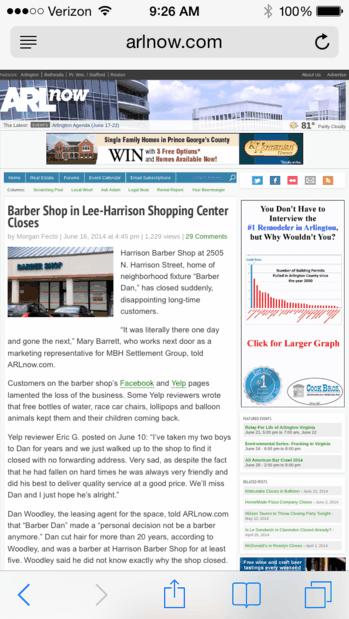
ARLnow.com as displayed on a smartphoneARLnow.com is about to embark on a minor redesign of our website and we would like your opinion on one aspect of this process.

Currently, our site is not optimized for smartphone readers. Instead, those who visit us on iPhones, Droids and other mobile phones simply see our desktop website rendered by their smartphone’s browser.

Many news websites, however, are designed to display in a more “native” fashion on smartphone screens — in a way that doesn’t require the user to zoom in to read text. One criticism of such mobile-optimized sites is that they can sometimes hide certain features and make navigation more difficult.

ARLnow.com is considering three approaches to our redesign:

  1. Develop a mobile-optimized site, from scratch, for smartphone users
  2. Optimize the existing site to simply display with larger text for smartphone users, to make articles more readable
  3. Don’t make any changes for smartphone users

Which would you prefer?


View More Stories