
The Right Note is a weekly opinion column published on Thursdays. The views and opinions expressed in the column are those of the author and do not necessarily reflect the views of ARLnow.com.

Mark KellyWhen the Arlington County Board convenes this Saturday, one person will be conspicuous in his absence. By all accounts, Robert Atkins has been at every County Board meeting, save one, since 1995.

By my rough, back of the envelope estimate, Atkins made over 1,000 speeches before the Board. That is far and away more speaking time during County Board meetings over that span than anyone else who was not elected to serve on the Board.

The tradition began, so the story goes, after a disagreement Atkins had over an issue in his neighborhood. Upon getting an unsatisfactory answer from new Board Member Chris Zimmerman, Atkins pledged to be at every County Board meeting in the future — and he was.

While Atkins did not live long enough to see Zimmerman’s farewell speech, he did get to see Zimmerman announce he was stepping down. The pair’s nearly two-decades-long journey of monthly meetups in the County Board hearing room was drawing to a close; though I suspect Bob had no plans to stop attending in Zimmerman’s absence.

If you ever heard Atkins speak during the public comment period or on agenda items, it was almost always the most unique speech of the day. Atkins made Board Members smile, cringe, scowl, and sometimes get up and leave the room altogether.

As the “board watcher-in-chief” for Arlington County for the past two decades, there was virtually no issue for which Bob did not know the history. If you needed background information, Bob knew it because he had read the staff report as well as listened to, and participated in, the debate. And, he would probably be able to recite for you the zinger from the speech he gave that day, usually with a wry smile.

One saying goes, in life, half the battle is showing up. While many Arlingtonians long ago gave up on influencing County Board decisions, Bob did not. He showed up every month to do his part to hold the Board accountable to Arlingtonians.

Atkins did not just show up at County Board meetings. Bob was active in the Arlington Civic Federation. He worked as a volunteer for many years at the county fair to increase voter registration in Arlington. He was a regular attendee or member of various political organizations, like the Arlington GOP, Log Cabin Republicans, the Arlington Gay and Lesbian Alliance and even attended Green Party events from time to time.

While Bob did not always agree with the GOP or its candidates on every issue, he was loyal to the party. Bob served as treasurer for the Arlington GOP for 12 years, including both times I served as Chairman. He donated to Republican candidates generously from his own personal funds. He also went out and knocked on doors on behalf of Republican candidates. And, every Election Day, you could find him at his polling place distributing Republican sample ballots.

In all of his civic and political activism, Bob Atkins certainly was one of a kind. He will be missed.

Mark Kelly is a former Arlington GOP Chairman and two-time Republican candidate for Arlington County Board.

Peter’s Take is a weekly opinion column. The views and opinions expressed in this column are those of the author and do not necessarily reflect the views of ARLnow.com.

Peter RousselotEnough is enough.

The Aquatics Center hasn’t been built yet, and it shouldn’t be built. The County Board should scrap its Olympian pretensions and its desire to build King’s Dominion North at the expense of Arlington taxpayers. The board should explain its decision as follows: “We have made a mistake, and we are going to fix it. We have new information, and we are going to act on it.”

The board immediately should direct the County Manager to halt all further work on the Aquatics Center. The board should notify the manager that the board no longer wishes to build this facility. The board should direct the manager to develop a new, cost-effective design for a sensible recreation center at Long Bridge Park (including a swimming pool).

The latest chapter in this problem-plagued project began when the Sun Gazette posted a story stating that “what had been an expected annual operating deficit of $1 million to $1.3 million has now ballooned to more than $4 million.” It’s not clear at the moment whether the ballooning deficit is due to lower than projected revenues or higher than projected expenses or a combination of both.

More than 80 percent of respondents to a recent ARLnow.com poll said that the Aquatics Center should not be built if this latest $4 million annual operating deficit projection turns out to be accurate. As I have written previously, this is just the latest in a string of warnings about the countless flaws in this project.

Commenting on the ARLnow.com Aquatics Center story that accompanied the latest poll, James Breiling nailed it:

“Office building occupancy has dived,” he writes. “The county is close to the set limit on bond borrowing. Taxpayers are rightly concerned about tax increases. So, funds are constrained. Accordingly, I suggest that THE question is the relative priority of the aquatics center via other things, in particular, providing facilities and staff needed to educate the surge in ACPS enrollment.”

That is, indeed, THE question.

THE answer: the Aquatics Center has far too low a priority and should be cancelled.

Peter Rousselot is a former member of the Central Committee of the Democratic Party of Virginia and former chair of the Arlington County Democratic Committee.


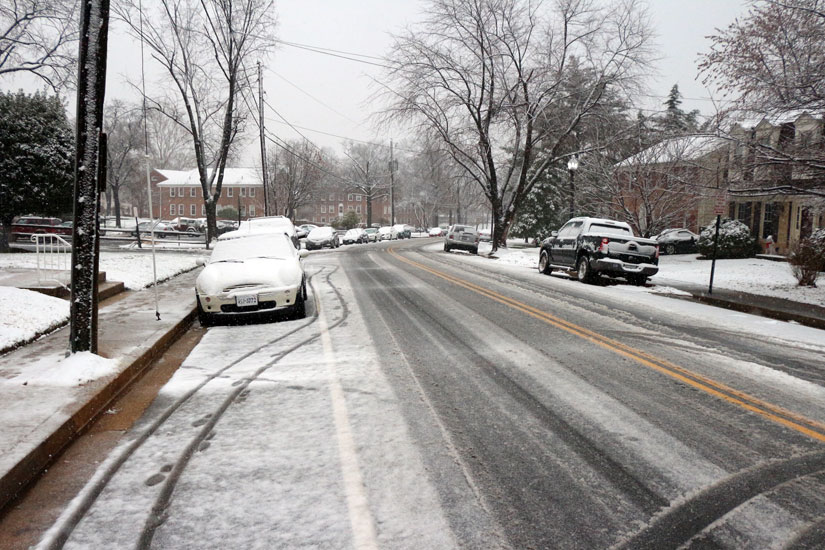
Snow Falling in BuckinghamAnother day, another underwhelming winter storm.

Arlington snow lovers have been disappointed yet again by a hyped-up storm that ultimately fizzled out. It’s enough for a weather-watcher to shed frozen tears — if only the temperature was cold enough for those tears to freeze.

Clearly, forecasting winter weather in the D.C. area is a challenge, given the area’s propensity for hovering just above the freezing mark when winter precipitation threatens. In fact, meteorologists are being challenged by yet another possible “mixed precipitation” storm, heading toward the Washington region this weekend.

It would be easy at this point to let the chicken little effect set in, dismissing all future snow forecasts, at least for inside the Beltway. But then you run the risk of winding up stranded on a highway when a real snow storm hits.

When the next significant snowfall is forecast, will you trust the prediction?


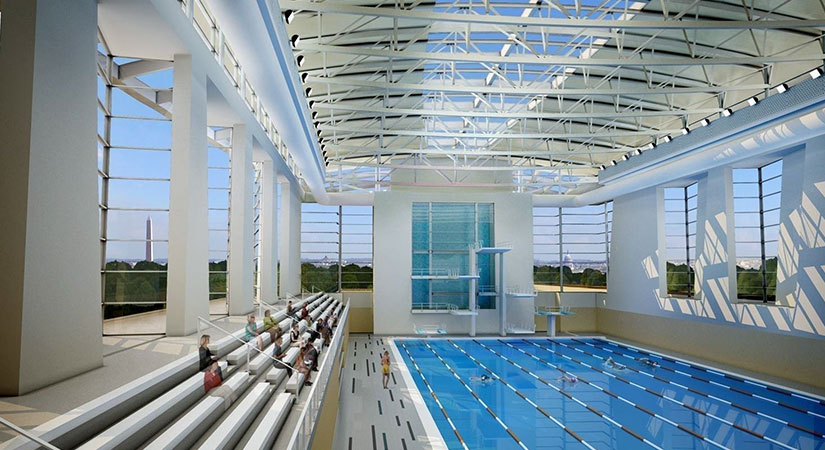
Renderings of the future Long Bridge Park Aquatics, Health & Fitness FacilityLast year, voters approved a bond to help build the new Long Bridge Park Aquatics and Fitness Center by a vote of 61 to 39 percent.

Now, however, the ongoing costs of the center are projected to be even higher than anticipated.

“What had been an expected annual operating deficit of $1 million to $1.3 million has now ballooned to more than $4 million, according to projections included in County Manager Barbara Donnellan’s updated budget forecast,” the Sun Gazette reported on Monday.

This news comes at a time when the county is facing a potential $24 million budget gap. Local fiscal watchdog Wayne Kubicki, who previously declared that the aquatics center could turn out to be “Artisphere on steroids,” said that the county would be better served to use its funds for other priorities.

Still, the aquatics center has its supporters, like the group Friends of Long Bridge Park, which has said it’s needed because “the large demand for aquatic activities can’t be met by… high school pools, which have limited public hours and space, and were designed for instruction, not a wide range of community needs.”

The Friends of Long Bridge Park also argue that other aquatics centers can cover most of their operating costs through memberships and rentals. The county itself, meanwhile, cautions that the latest projects are preliminary in nature.

If Donnellan’s projections prove correct, and the aquatics center will not be as self-sustaining as originally believed, do you still think it should be built?


Peter’s Take is a weekly opinion column. The views and opinions expressed in this column are those of the author and do not necessarily reflect the views of ARLnow.com.

Peter RousselotThe Arlington County Board’s budget guidance for FY 2015 fails to provide appropriate guidance on important issues. The guidance was adopted after a flawed process. The guidance reflects a status quo mindset in an era crying out for a new direction.

Process

The County Board needs a completely different, more open and more transparent process for adopting its annual budget guidance. Here is an example of a better process:

  • publish a draft set of guidelines 60 days prior to the target date for final adoption;
  • invite all citizens and citizens advisory groups and committees, like the Fiscal Affairs Advisory Commission, to comment in writing within 30 days of publication of the draft guidelines;
  • post all such public comments on the County website;
  • hold a public hearing on the draft guidelines and all written comments, then
  • adopt final guidelines.

Substance

In significant part because of the flawed process the County Board followed, this year’s budget guidelines fail to provide appropriate guidance on important issues.

Here are some examples of important issues that are not adequately addressed, or not addressed at all, in this year’s guidelines:

  • the seriousness and long-term nature of Arlington’s escalating office vacancy rate;
  • the impact on Arlington’s residential tax payers of the long-term stagnation in the valuation of Arlington’s commercial tax base;
  • the long-term declining share of Arlington’s operating budget dedicated to Arlington Public Schools even before enrollment increases are taken into account;
  • the need to devote a higher share of Arlington’s operating budget to APS (even higher than historic levels) to account for surging enrollment;
  • the need to introduce rigorous, unbiased cost/benefit tests to evaluate major capital projects like the Aquatics Center;
  • the impact on the operating budget, and Arlington’s AAA/AAA credit rating, of the rising debt payments needed to finance the escalating cost of Arlington’s capital projects;
  • the failure to impose adequate cost controls or caps on Arlington’s long-term commitment to affordable housing;
  • the adverse impact of all of the foregoing trends on Arlington’s ability to fund basic social safety net services, and
  • why all of the foregoing trends lead to the conclusion that Arlington needs to re-focus its budget to ensure that core government services are given priority for funding.

Conclusion

The County Board is treading water at a time when it needs to swim vigorously and resolutely in a better direction.

Peter Rousselot is a former member of the Central Committee of the Democratic Party of Virginia and former chair of the Arlington County Democratic Committee.


The Right Note is a weekly opinion column published on Thursdays. The views and opinions expressed in the column are those of the author and do not necessarily reflect the views of ARLnow.com.

Mark KellyBack in January, I wrote about Chairman Tejada’s call for a Columbia Pike Tax Increment Financing district, or TIF. Some have suggested privately that a dedicated stream of funding for affordable housing was a “condition” for Tejada’s trolley support. Regardless of the TIF’s genesis, the Board will hear public comments on it next Saturday.

First, a reminder of how a TIF works. Essentially, Arlington County freezes the tax base of a defined area and dedicates tax revenue from that base to the general fund. The additional future revenue, or a percentage of it, is then earmarked to spend solely in that area, presumably with a pet project in mind. The general fund, on the other hand, is used to pay for the ongoing county services we all use: schools, transportation, police, fire, parks, and other services.

In this case, the Board is proposing a set-aside of 25 percent in the TIF to put toward the construction of affordable housing projects in the Columbia Pike corridor for the next 30 years. Regardless of what you think about the need to fund additional affordable housing in Arlington, the TIF automatically removes 25 percent of the additional real estate tax revenue along the corridor in the future from the general fund. There is nothing to prevent this percentage from going higher in the future to pay for more affordable housing needs or another project in the area.

This is the second TIF proposed in the county, both begun in large part to help get the Columbia Pike trolley project built. The first was put in place for Crystal City — presumably to help finance bonds for that portion of the trolley line. Those bonds would allow financing without a requiring vote by Arlingtonians.

The Board’s willingness to move toward financing projects with TIFs seems to be setting us on a path toward multiple TIFs throughout Arlington. In effect, the new board policy is that they are willing to create long-term earmarks for pet projects. While we will almost certainly never reach Chicago-style TIF levels, with more than 100, what I wrote nearly 11 months ago still holds true today:

The use of special interest TIFs to avoid future public debate, scrutiny, and up or down votes on such projects is a bad idea, plain and simple. It will not only avoid additional public input, but it will inevitably lead to higher tax rates for all of us. When schools, roads, public safety and other services face a squeeze in future budgets, the Board will tell voters they simply have to raise taxes to pay for it.

The County Board should not lock Arlingtonians into this fiscally irresponsible path.

If you are concerned about the long-term earmarks that TIFs will create, you should consider attending the hearing on Dec. 14 to voice your concerns.

Mark Kelly is a former Arlington GOP Chairman and two-time Republican candidate for Arlington County Board.


Money (file photo)Will a new round of Metro fare hikes convince more commuters to drive?

Metro General Manager Richard Sarles’ budget calls for bus fares to increase by 15 cents, Metrorail fares to increase by 10 cents, and parking fees to increase by 25 cents. Will that lead to significantly more commuters hitting the road in cars? Probably not, says AAA Mid-Antic.”

“Even with a three percent average increase, area commuters will still save by using public transit after doing the math,” said John B. Townsend II, AAA Mid-Atlantic’s Manager of Public and Government Affairs. “After adding up the costs of driving and parking, commuters will often find that public transit is a more economical way to get to work and stick with Metro.”

For instance, AAA says a commuter who drives to work in downtown D.C. from Alexandria pays about $500 per month in vehicle costs, gas and parking. Someone who parks and rides from the Huntington Metro station will pay about $330 per month after the fare hike.

Will the new Metro fare hikes convince you to drive rather than taking public transportation?


Christmas treeWhether real or artificial, an evergreen tree helps enhance the spirit of the season around the home.

One of the county’s best-known Christmas tree sellers, the Optimist Club of Arlington, is expecting a record number of sales this year, according to the Sun Gazette. The club has ordered 1,200 trees from forests in North Carolina — 100 more than last year, when all trees were gone by Dec. 18.

The Optimist Club sells its trees from the parking lot of the Wells Fargo bank at Glebe Road and Lee Highway. Other Christmas tree sellers around town include the Boy Scouts (6000 Wilson Blvd), the Lions Club (Columbia Pike and George Mason Drive), and the Knights of Columbus (830 23rd Street S.), according to a recent forum thread.

Of course, not everybody opts for the real deal. Freshly-cut trees require water, care and some sort of vehicular transportation, in addition to an annual investment. Artificial trees, on the other hand, can be purchased once, stashed in a closet and set up year after year with nary the risk of getting tree sap all over one’s hands.

Regardless of your choice, when are you planning on buying or putting up a Christmas tree at home?


People walking in BallstonAccording the real estate information firm RealtyTrac, Arlington’s 22203 ZIP code is the 7th-most “hipster-friendly” area in the United States.

A hipster ZIP code is generally defined by RealtyTrac as an area where residents are young and lots of people rent and take public transportation. The 22203 ZIP code, the second-highest ranking ZIP in the D.C. area next to Alexandria’s 22304 ZIP code, includes the neighborhoods of Ballston, Virginia Square, Bluemont and Buckingham.

Arlington’s 22201 ZIP code, meanwhile, ranked 23rd on the list. That ZIP code includes Courthouse, Clarendon, Lyon Village, Lyon Park, and parts of Ballston and Virginia Square.

No ZIP codes in the District of Columbia made the rankings.

RealtyTrac’s methodology seems questionable at best, ignoring the more nuanced cultural factors that define a “hipster.” That said, which Arlington locale would you consider to be the biggest hipster hotbed?


The Right Note is a weekly opinion column published on Thursdays. The views and opinions expressed in the column are those of the author and do not necessarily reflect the views of ARLnow.com.

Mark KellyOn Tuesday, the County Board approved the FY 2013 closeout and re-appropriation measure.

According to the report accompanying the County Board’s agenda, tax revenue once again came in well ahead of predictions, by $27.9 million. The largest contributor to the surplus was real estate revenues, to the tune of $15.3 million. In percentage terms, real estate tax revenues ran 2.6% ahead of budgeted amounts.

In April, the County Board passed a 3.6 percent real estate tax increase. To justify it, the County Manager and the County Board cited a FY 2014 budget “shortfall.”

As it turns out for the 2013 fiscal year, and virtually every fiscal year in recent memory, the county underestimated the revenues that would be generated by the tax rate. Even if you agree with all of the spending priorities passed by the County Board in its annual budget, the surplus suggests your real estate taxes alone could have been 2 percent lower. And just as in previous years, the $27.9 million underestimation of all revenues was enough to actually lower your real estate tax rate even further.

The board also spends millions each year reclaimed from budget savings — adopting the federal government approach of “use it or lose it.” For FY 2013, the budget over-estimated the costs of government activities for the year by $25.3 million, but the money was still spent on other items. Among those items was $1.7 million in additional subsidies to the Artisphere, which was supposed to become self-sufficient by now.

In so doing, the board can say that they spent all that was budgeted in the prior fiscal year. This keeps the baseline of spending on an upward trajectory in order to help create another budget “shortfall” for FY 2015. You can find more information for next year’s budget in this report. County Manager Barbara Donnellan preliminarily estimates the “shortfall” will be $7.7 million. However, if you used this year’s actual surplus of excess revenues plus savings for comparison, that “shortfall” could actually become a $45.5 million surplus.

Granted, the county manager’s report also notes the schools could have up to $16 million in additional costs caused by higher enrollment. However, based on the consistent underestimation of revenue and over-estimation of costs, we can safely assume the FY 2015 revenues will more than cover school needs. And, it will still leave us with room to spare without necessitating another tax increase.

The board did give its budget guidance on Tuesday as well, and did not recommend a tax rate increase for next year. At the same time, your tax bill will still rise with your assessment by an average of $300 per homeowner. And, the Board regularly ignores its initial guidance.

Chairman Tejada’s comments that tax increases were still on the table in the budget process means the chances anyone on the board will propose the real estate rate cut the county could afford are somewhere south of slim-to-none. But, it is important to understand these numbers if the board comes to you in the spring and asks for another tax rate increase.

Mark Kelly is a former Arlington GOP Chairman and two-time Republican candidate for Arlington County Board.


Peter’s Take is a weekly opinion column. The views and opinions expressed in this column are those of the author and do not necessarily reflect the views of ARLnow.com.

Peter RousselotAt the Nov. 16 County Board meeting, the board voted 4-to-1 to hold a public hearing on Dec. 14 to “consider establishment of a tax increment financing area and fund to help finance affordable housing initiatives in support of the Columbia Pike Neighborhoods Area Plan.”

The board should vote NO on this proposal in December.

Why is there such a tiff about this TIF?

As a county staff report explains, TIF is a financing mechanism that captures “the projected increase in property tax revenues created by… development… It redirects and segregates the increased property tax revenues that would normally flow to the General Fund so that they can be used for a specific purpose.”

The Board Should Defer A Final Vote Until After It Approves A General Policy on TIF

The same county staff report acknowledges that “the County Manager will be proposing a County-wide TIF policy as part of a comprehensive review of the County’s financial and debt management policies, last updated in 2009.” But, staff recommends that the board go ahead and approve the Columbia Pike TIF now because staff cannot imagine that the County-wide review will change staff’s mind about this TIF.

The staff has the cart before the horse.

TIF is a deservedly controversial form of financing because every time it is used it takes tax revenues away from the county’s general operating budget. TIF curtails the board’s flexibility to adapt to changing economic conditions. Given the new normal of Arlington’s budget situation, no further uses of TIF should be approved until after the comprehensive review is complete and the public is heard.

This TIF Is Highly Problematic

County staff is straining mightily to find a way to pay for an unrealistic goal that the County Board adopted last year: to preserve every single one of the 6,200 market rate affordable housing units defined in the Columbia Pike Neighborhoods Area Plan.

It was a big mistake for the County Board to adopt this goal before having a robust budget discussion with the Arlington community about:

  • the priority of this goal compared to all other community priorities
  • the benefits of this goal compared to its costs

This goal should not be shielded from the competition with other goals that takes place as part of Arlington’s annual operating budget review.

Peter Rousselot is a former member of the Central Committee of the Democratic Party of Virginia and former chair of the Arlington County Democratic Committee.


View More Stories