

Peter’s Take is a weekly opinion column. The views and opinions expressed in this column are those of the author and do not necessarily reflect the views of ARLnow.com.
Peter RousselotAs also has been true in this year’s election for Lieutenant Governor, the race for Virginia Attorney General has been overshadowed by the scandals engulfing current Governor Bob McDonnell and current Attorney General Ken Cuccinelli.

In the AG race, the contrasts also are stark. The Democratic candidate, Mark Herring, is a moderate Democrat.

Herring lives in Loudoun County where he has a private law practice, working in several legal specialties, including land use and zoning, civil litigation, and municipal law. In 1999, he was elected to the Loudoun County Board of Supervisors. He served as Chairman of the Land Use Committee, and was a strong advocate for economic development and transportation improvements.

First elected to the Virginia State Senate in 2006, Herring has worked to bring technology-based economic development to the Northern Virginia region, and has been a leader in making both state and local governments more accountable.  He has led efforts to keep dangerous new synthetic drugs out of circulation.  He has advocated for legislation to target those who attempt to commit financial scams against seniors. He has sponsored and passed legislation to strengthen penalties for acts of domestic violence.

Herring’s sensible platform as our next Attorney General includes initiatives to keep Virginia’s families safe, defend civil rights, protect consumers, and safeguard our natural resources.

By contrast to Herring’s mainstream record and goals for the Attorney General’s office, his opponent, Mark Obenshain, has a far-right-wing, extreme record:

Obenshain sponsored a bill in 2009 that would have made it a crime to fail to report a miscarriage to the police. [SB962]

Along with Cuccinelli, Obenshain co-sponsored so-called personhood legislation. The Associated Press explained that under this legislation, “by giving embryos the constitutional protection of personhood from the instant of fertilization, abortions of all types would become illegal.” [Associated Press, 2/6/2007] The legislation Obenshain and Cuccinelli co-sponsored also would have banned some forms of birth control.

Obenshain voted against workplace protections against discrimination for gay and lesbian Virginians in 2013, 2011, and 2010. [SB701, SB747, SB66]

Electing Mark Obenshain as Attorney General is equivalent to giving Ken Cuccinelli a second term in that office.

The choice is clear: Mark Herring for Attorney General.

Peter Rousselot is a former member of the Central Committee of the Democratic Party of Virginia and former chair of the Arlington County Democratic Committee.
The Right Note is a weekly opinion column published on Thursdays. The views and opinions expressed in the column are those of the author and do not necessarily reflect the views of ARLnow.com.

Mark KellyAs we countdown to Election Day Nov. 5, we are reminded that in politics, facts and figures are thrown around quite often. One thing is certain: the numbers a politician uses will be the ones most likely to make their point.

One of my favorites is when Arlington’s elected officials extol the virtues of Arlington’s “low” tax rate. Chris Zimmerman was quoted in one article earlier this year saying Arlington is “eating everyone else’s lunch” on tax rates. Zimmerman credited “smart growth” for bringing in commercial projects and keeping taxes “low.”

While it’s true Arlington has a relatively low tax rate, it is our prime location that is responsible for bringing in relatively high commercial property tax revenue compared to our neighbors. Thanks to the Pentagon, Reagan National Airport, the U.S. Capitol, and federal agencies situated just over the river, no jurisdiction in Northern Virginia or Maryland is more well positioned geographically than Arlington.

What our board never talks about is the average out-of-pocket cost of Arlingtonians relative to our neighbors’. The median home value in Arlington is around $524,700. The new tax rate for the year is $1.006 for every $100 in assessed value. So, the average tax bill for Arlingtonians is $5278.48. In Fairfax, the average tax bill is $5052.98. In Alexandria, the average bill is even lower at $4885.48. So, the average Arlingtonian is paying more out of pocket, not less.

I had the opportunity to run against Chris Zimmerman in 2010 for County Board. On the campaign trail he liked to say that you pay more in taxes for the same house in other jurisdictions. But, I think we all know that, with the exception of Alexandria, a $500,000 house in most neighboring Virginia jurisdictions is substantially larger than one in Arlington. How many people do you know that moved out of Arlington to get “more house for the money”?

Over time, I guess elected officials just start believing their own spin. Between School Board and County Board terms, County Board members have been thinking of ways to spend other people’s money for over 15 years on average. This long-term penchant for driving up taxes lead to an astonishingly high cash on hand surplus — news our Board tried to quickly brush aside.

We should keep this in mind as our Board starts talking about spending so-called “closeout,” also known as surplus tax, dollars from the fiscal year that just ended, rather than returning them to us in the form of lower taxes next year. Or, you can just plan on eating lunch out a little less to pay your low tax rate.

Mark Kelly is a former Arlington GOP Chairman and two-time Republican candidate for Arlington County Board.


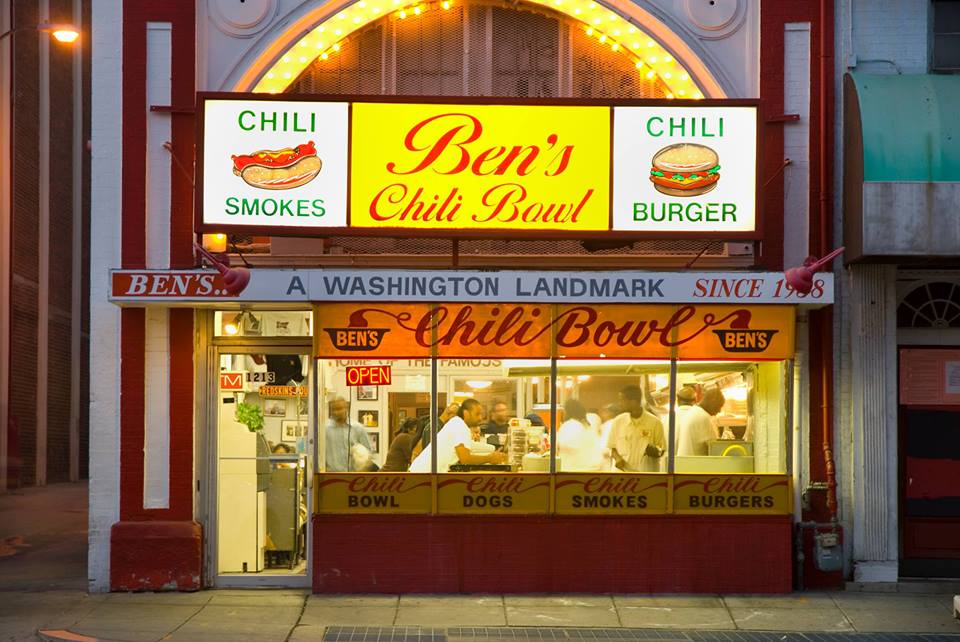
Ben's Chili Bowl (photo via Facebook)Washington Business Journal has today’s scoop that Ben’s Chili Bowl will be opening a new location in Rosslyn.

The new Ben’s will be located in at 1725 Wilson Blvd, in the former Ray’s Hell Burger space, WBJ reported.

But will the idea of scarfing down a chili half smoke closer to home be enough to drive Arlington residents to the new restaurant? Or is part of Ben’s allure tied to the original U Street NW location — whether it be the location’s history or proximity to popular bars?

After it opens — early next year, according to WBJ’s Rebecca Cooper — which Ben’s Chili Bowl will you be more likely to go to?
 

Photo via Facebook


The Right Note is a weekly opinion column published on Thursdays. The views and opinions expressed in the column are those of the author and do not necessarily reflect the views of ARLnow.com.

Mark KellyWithout using Google, can you name a candidate for statewide office November 5th not named Cuccinelli or McAuliffe?

With all of the attention given to the top of the ticket race for Governor in Virginia, the two down ballot races are a lot like Rodney Dangerfield — they get no respect. You can use Google if the name Rodney Dangerfield doesn’t ring a bell.

State Sen. Mark Obenshain is running as the Republican nominee for Attorney General. During his 25-year legal career, Obenshain managed one of Virginia’s 50 largest law firms. Then, he started his own firm which now has over 50 total employees.

As a Senator, Obenshain was the author of the Constitutional amendment to protect private property rights in Virginia that passed last November — receiving 57 percent of the vote here in Arlington. He also authored several pieces of legislation to toughen penalties on child predators.

Now, Obenshain wants to put his experience and proven track record to work in the Attorney General’s office and has offered a clear set of priorities for his service as AG. He will continue his work to protect our children from predators. He will defend Virginia’s right-to-work laws. He has offered a plan to protect seniors from abuse and neglect. And, he will stand up for Virginia when the federal government overreaches.

On ethics, Obenshain has come out in support of a $100 gift cap and has said he will institute stronger ethics standards in the Attorney General’s office even if the legislature does not take up this issue. He has also proposed the adoption of a Transparency in Private Attorney Contracts act to ensure complete openness in the process of retaining outside counsel for specialized legislation.

Senator Obenshain continues to put forward detailed policy proposals for the Attorney General’s office instead of the simple platitudes usually offered by his opponent.

Most recently, Obenshain unveiled his comprehensive plan to go after human traffickers in Virginia. The plan includes pushing for legislation making human trafficking a stand-alone felony offense, adding those engaging in commercial sex with a minor to the sex offender registry, extending asset forfeiture laws to human trafficking, ensuring victim compensation, and establishing a Human Trafficking Task Force to assist prosecutors. Ten days later, Obenshain’s opponent followed his lead and released a similar plan.

Virginia needs a leader like Mark Obenshain in the Attorney General’s office.

Mark Kelly is a former Arlington GOP Chairman and two-time Republican candidate for Arlington County Board.


Peter’s Take is a weekly opinion column. The views and opinions expressed in this column are those of the author and do not necessarily reflect the views of ARLnow.com.

Peter Rousselot

While the high-profile political publicity this year has focused on the scandal-plagued situations of Virginia Governor Bob McDonnell and Governor wannabe Ken Cuccinelli, far less attention has been devoted to the race for Virginia Lieutenant Governor.

In the LG race, the contrasts are breathtakingly stark.  The Democratic nominee is Virginia state Sen. Ralph Northam — a moderate Democrat.

Northam, from Norfolk, Virginia, is a practicing pediatric neurologist. He also serves as Assistant Professor of Neurology at Eastern Virginia Medical School, and volunteers as the Medical Director for a children’s hospice in Portsmouth.

First elected to the Virginia Senate in 2007, Northam has played a leadership role on several major issues, including the prohibition on smoking in restaurants, enhancing the protection of student athletes from concussions, and improving the health of the Chesapeake Bay.  He has also been a strong advocate for women’s health, public education, and long-term transportation solutions.

With an even split between Democrats and Republicans in the Virginia Senate, the lieutenant governor may be called upon to cast the tie-breaking vote on legislation. Northam has developed key relationships with Senators from both major political parties. These relationships will enable him to discharge his Senate responsibilities effectively.

In a contrast that could not be more striking, the Republican nominee for Lieutenant Governor is E.W. Jackson — one of the most extreme right-wing politicians ever nominated for statewide office in any state.

A brief sampling of Mr. Jackson’s views include these:
“Homosexuality is a horrible sin, it poisons culture, it destroys families, it destroys societies, their minds are perverted, they are frankly very sick people psychologically and mentally and emotionally”

“The Ku Klux Klan did not do nearly as much to destroy black life as Planned Parenthood has done.”

“Liberalism and their ideas have done more to kill black folks who they claim so much to love than the Ku Klux Klan and lynchings and slavery and Jim Crow ever did, now that’s a fact.”

“I don’t think that the federal government has much of a role at all constitutionally, at all [in disaster relief].”

With views like these, E.W. Jackson deserves no further consideration.

The choice is clear: Ralph Northam for Lieutenant Governor.

Peter Rousselot is a former member of the Central Committee of the Democratic Party of Virginia and former chair of the Arlington County Democratic Committee.


Deputy County Manager Mark SchwartzTwo weeks ago, opinion columnist Peter Rousselot wrote that Arlington County should explain its relatively large cash surplus.

Arlington Deputy County Manager Mark Schwartz has now responded.

In an op-ed, printed below, Schwartz says there are several reasons why the county government has nearly $300 million cash on hand. Chief among them: to provide a fiscal cushion that helps maintain the county’s high bond rating.

In his August 22, 2013 opinion piece “Peter’s Take,” Peter Rousselot asks, “Is Arlington’s cash surplus too large?” A fair question.

The short answer is “no.”

Residents should know that our balances are higher now than they were 10 years ago for three important reasons:

1.      We have increased our reserves. At the urging of the rating agencies that review our finances, we increased our reserves from 2% to 5% of the General Fund balance. This fiscally prudent step provides us a bigger cushion (but still at the low end of what our neighbors do) in case of emergency and shows our commitment to smart budget planning. It also ensures that we maintain our AAA rating from the three national rating agencies. Arlington is one of only 39 counties out of over 3,000 that enjoy this prestigious rating, attesting to our sensible practices.

2.      We have many more capital projects and needs in the community.  A review of the County’s most recently adopted Capital Improvement Plan (CIP) for FY 2013 – 2022 includes considerable investments in building new schools, transportation, water and sewer projects, recreation, fleet, and government services. Each of these investments will maintain and improve the quality of our residential neighborhoods and urban corridors. Prudent budgeting calls for us to build up balances to fund these important projects from pay-as-you go capital (in combination with the sale of bonds).  Capital projects require large investments for projects that will last many years and it is typical for cash balances to grow prior to execution of the projects.

3.      There are several sources of funds that simply didn’t exist 10 years ago. These are:

a.      Transportation Capital Fund (12.5-cents of our tax rate paid by commercial property owners) dedicated to invest in our streets, sidewalks, Metro, streetcar, and busses.

b.      Stormwater Fund (1.3-cents of our tax rate paid by all taxpayers) dedicated to revitalize our aging infrastructure and to help improve the Chesapeake Bay.

c.      Dedicated Development Fund (fees paid by developers and residents who improve their homes) to speed up permit processing and construction services.

d.      Business Improvement Districts (BIDs) – in Rosslyn, Crystal City, and Ballston, commercial property owners pay a dedicated tax and the cash is set aside to meet work plans to enhance services in each of these areas.

The Transportation Capital Fund, much of the Development Fund, and BID programs are all commitments made by our business community and not paid for by our residential taxpayers.

A close reading of the details (as posted on the County’s website) shows that the maintenance of operating reserves and a strong liquidity position is critical to the County’s strong bond ratings. Every penny of our cash balances is accounted for, and reviewed annually – not only by our audit staff in the Department of Management and Finance, but also independently assessed by outside auditors.

The statements in our annual review of finances – Comprehensive Annual Financial Report (CAFR) – and countless other documents including Official Statements accompanying bond offers, our annual operating budget and our CIP provide a detailed map to where the money is. These documents are there for all to see, and, as always, we appreciate residents’ interest in County financials and operations.  These funds are collected and maintained to support the programs adopted each year in our annual operating budgets, and over the longer term in our CIP.

Mark Schwartz
Deputy County Manager


Peter’s Take is a weekly opinion column. The views and opinions expressed in this column are those of the author and do not necessarily reflect the views of ARLnow.com.

Peter RousselotLast Saturday, there was a commemoration of the 50th anniversary of the March on Washington for Jobs and Freedom. I participated in that march on August 28, 1963.

Here are a few personal reflections about what it felt like to march 50 years ago and what the march means today.

In the summer of 1963, I was an intern at the Pentagon in Arlington, drafting issue papers on foreign policy. I felt lucky to have gotten that internship. I read the publicity about the march, and instinctively wanted to join it. I understood only vaguely what the goals of the march were.

The media were filled with warnings about the possibility of riots by the marchers. I didn’t really understand why. I had no experience enabling me to measure the risk—so I just disregarded the warnings.

On the Mall, the size and racial diversity of the crowd were overwhelming. Everything was black and white: the people, the signs, the speakers, the messages. With the “wisdom” of a 21-year old intern, I saw no grays anywhere.

Everyone seemed to be getting along very well with everyone else. If this huge, diverse crowd of people could get along so well, there had to be hope for our country.

From a 2013 perspective, what things did the march help to inspire?

In Virginia:

  • “massive resistance” to school desegregation has ended
  • interracial marriage is no longer illegal
  • public accommodations are open to all regardless of race
  • the Democratic Party’s “Byrd machine” suffered a slow, well-deserved death

The tremendous progress in all of these areas deserves to be celebrated.

And yet,

  • unemployment rates in the black community remain significantly higher than for whites
  • educational achievement by black students on many performance measures remains significantly below educational achievement by white students
  • new laws have been enacted making it disproportionately harder for members of poor and minority communities to vote
  • disparities in personal income are much higher now than in 1963

After 50 years, I see more shades of gray.

But, I’m proud that I still see some issues as black or white.

Peter Rousselot is a former member of the Central Committee of the Democratic Party of Virginia and former chair of the Arlington County Democratic Committee.

The Right Note is a weekly opinion column published on Thursdays. The views and opinions expressed in the column are those of the author and do not necessarily reflect the views of ARLnow.com.

Mark KellyYesterday, our nation commemorated the 50th anniversary of the March on Washington. The March, of course, was 100 years after President Lincoln freed the slaves with the Emancipation Proclamation. Today, I wanted to call attention to an important part of our history here in Arlington that took place in 1863.

On May 5, 1863, Lieutenant Colonel Elias M. Greene, chief quartermaster of the Department of Washington, and Danforth B. Nichols of the American Missionary Association officially selected the Arlington Estate, or Custis-Lee plantation, as the site for Freedmen’s Village. The site would later become a part of Arlington National Cemetery.

The Village was formally dedicated on December 4, 1863, and the site was intended to be a model community for freed persons. Originally, 100 former slaves settled on the site – eventually growing to over 1,000 residents. There were over 10 frame houses, 50 two-story duplex houses, two chapels, a school with five teachers, a meeting hall, a hospital, and a home for the elderly and infirm.

While the Freedmen’s Village was eventually closed around the turn of the 20th century, many Arlingtonians still trace ancestors back to it. Residents from the Village helped found the communities of Penrose, Hall’s Hill and Nauck.

Penrose, for example, was originally known as the Butler-Holmes subdivision. It was named after William Butler and Henry Holmes – two leaders in the Freedmen’s Village who held public office before developing land for housing. The Butler-Holmes subdivision was turned from a few parcels of farmland into multiple free standing dwellings.

The Penrose neighborhood was home to Dr. Charles Drew. He was the first African American to receive a Doctor of Science in Medicine, and he became Head of the Surgery Department at Howard University. He gained international acclaim for his scientific advances in the field of blood plasma transfusion research. The Drew Model Elementary School and Community Center in Arlington bears his name as a tribute to him – as do several other institutions of learning across the country.

Of course, the stories could go on and on, and I am only able to barely scratch the surface in this column. If you have a few minutes today, I encourage you to read through this “walking tour” brochure from the Black Heritage Museum of Arlington to learn a little bit more.

We truly have a rich history here in Arlington. I hope from time to time we all take a moment to understand, appreciate and learn from it.

Mark Kelly is a former Arlington GOP Chairman and two-time Republican candidate for Arlington County Board.


In Arlington, roadway panhandlers “have upped the ante and no longer are content to just stand in medians, but of late have been found walking in between lanes of traffic while vehicles are stopped.”

That’s according to the Sun Gazette, in the its weekly Highs and Lows column. The paper gave Arlington County a “thumbs down” for not dealing with the issue.

“What next?” the Sun Gazette asked. “Will we have people with squeegies demanding cash in exchange for washing windows?”

Do you think that Arlington County police should be more aggressive in dealing with those asking for cash on the side (or the middle) of the road?


The Right Note is a weekly opinion column published on Thursdays. The views and opinions expressed in the column are those of the author and do not necessarily reflect the views of ARLnow.com.

Mark KellyYou may remember three years ago when there was an effort to put the question of changing from a County Manager Plan to a County Board form of government to the voters. The effort started late and ended in a giant mess of fraudulent signature gathering.

One practical effect of the change in government would have been to require our County Board to be elected differently. The county would have been divided into four districts – each electing its own representative to the Board. A fifth member would be elected at-large or county wide. All of these elections would happen every four years.

Under this method of election, four of the Board Members would be more accountable to a smaller constituency. New York City Council Members represent fewer people than each of our at-large County Board Members do. Not only does this lower the level of constituent service from a part-time board, but it creates an additional barrier to entry for those outside the Democratic Party establishment.

So, the chances that a Republican or Independent could win one of the seats would likely have increased, even if the current board was able to draw the district lines. Diversity of opinion would be a breath of fresh air to one-party rule.

South Arlington would most certainly be guaranteed at least one Member of the County Board – two if the Board drew the lines with “compactness” in mind. There is a long-standing feeling that those who live South of Route 50 get the short end of the stick when it comes to Board decisions.

The change would have put more power in the hands of the board and less in the hands of the County Administrator (no County Manager in the proposed plan). The goal was to end the ability of the board to pass the buck to county staff whenever convenient.

However, the proposed plan was by no means perfect. It would not change the fact that the chairman would not be directly elected by the voters. We would not have ended the insider process of passing it around annually between board members. The change also would have seen our School Board move back to appointed positions by the County Board. And, the biggest loss of power for the County would have been in the number of authorized agencies the Board may create.

You can compare all of the differences between the County Board and County Manager Plan here.

Love or hate the idea of changing our form of government, it is a shame that this question never made it to the people of Arlington for a vote. It represented an important debate for our community to have about how our government currently operates. Ultimately, consideration of the merits was lost in the drama surrounding the signature gathering process.

Mark Kelly is a former Arlington GOP Chairman and two-time Republican candidate for Arlington County Board.


Peter’s Take is a weekly opinion column. The views and opinions expressed in this column are those of the author and do not necessarily reflect the views of ARLnow.com.

Peter RousselotIs Arlington’s cash surplus too large?

It’s a $200 million question in search of persuasive answers.

In an important letter published in the Arlington Sun Gazette last week, Arlington civic activist David North explained why he believes that Arlington’s cash surplus is way too large. David makes a good case that in a relatively prosperous county like ours, a cash surplus, general contingency fund in the range of no more than $100 million is about right. $100 million represents about 10 percent of Arlington’s current total operating budget.

However, in the earlier Sun Gazette story that prompted David’s letter, it was revealed that Arlington’s actual cash surplus is about $300 million.

A decade ago, Arlington’s then-$70 million cash surplus was in line with David’s rule of thumb. That $70 million cash surplus represented about 10% of Arlington’s FY 2004 total operating budget.

But today, Arlington’s $300 million cash surplus is about 30 percent of Arlington’s FY 2014 total operating budget.

Are there persuasive reasons that Arlington’s cash surplus needs to be $200 million more than the $100 million general contingency fund that David North recommends? Maybe, but Arlington County has not provided such reasons.

Theoretically, Arlington might be able to justify laying aside the extra $200 million if it could explain persuasively that none of the extra $200 million is part of a general contingency fund at all. Instead, Arlington theoretically might be able to convince reasonable people that:

  • all of the extra $200 million is earmarked for specific worthwhile projects or other uses that the Board has approved, and
  • it is necessary to accumulate in advance all or part of what it is going to cost to pay for those projects or uses.

But, if Arlington cannot provide a persuasive explanation for the need to retain the extra $200 million in cash, it ought to proceed to redirect these funds into alternative uses. Finally, Arlington needs to reassure the public that at least $100 million of the $300 million actually is set aside in a general contingency fund.

What Arlington is doing fairly could be described as unilateral layaway financing. Desi Arnaz, a 1950s comedian, would have known what to say in this situation, “Arlington, you’ve got some ‘splainin’ to do.”

Peter Rousselot is a former member of the Central Committee of the Democratic Party of Virginia and former chair of the Arlington County Democratic Committee.


View More Stories