Ed Talk is a biweekly opinion column. The views expressed are solely the author’s.

Arlington Public Schools (APS), like many school divisions, has had a substantial decline in enrollment since the pandemic began. But APS has not yet factored this into its estimates of future enrollment.

Enrollment projections are used for the APS budget, its Capital Improvement Plan (CIP), and boundary decisions. Because overestimating enrollment has significant financial implications, APS should base its next enrollment projections in part on actual enrollment for this year and last year.

The APS FY 2021 budget, adopted in the spring of 2020 after schools were closed due to the pandemic, projected enrollment for the 2020-21 school year at 29,142 students. Actual enrollment was 26,895 students — 2,247 fewer students than estimated.

The FY 2022 budget, adopted in the spring of 2021, projected enrollment for this school year at 29,108 students. Actual enrollment is 26,911 — 2,197 fewer students than estimated and 1,109 fewer students than the 28,020 students who were enrolled in September 2019.

A January 2021 APS report projecting enrollment for the following three years relied on September 2019 enrollment, explaining its methodology as follows:

  • Fall 2020 pupil counts are artificially lower than is reasonable, it is assumed that this is due to families’ decision making around the Covid-19 pandemic
  • This drop in enrollment does not represent a long-term trend.

Estimating enrollment is not easy. But pre-pandemic estimates of enrollment have been much closer to actual enrollment, with overestimates of 490 students in FY 2020, 580 in FY 2019, 335 in FY2018, and 262 in FY 2017.

Budget Implications

The APS budget uses planning factors to determine how many teachers, staff, equipment, and supplies will be needed for the following school year — all based on projected student enrollment.

When the adopted budget is based on a significant overestimate of student enrollment, the budget is larger than needed.

What happens to the money that is not spent? During the annual close-out process, usually in December, the School Board reallocates unspent funds from the prior fiscal year.

For this year’s close-out, the County Manager has reported that APS expenditure savings are $58.7 million. A substantial portion of this likely is due to lower staff costs during the pandemic because actual enrollment was less than projected enrollment.

Capital Planning Implications

At its Oct. 28 meeting, the School Board adopted CIP direction that adds seats to the Career Center at a cost of $153 million to $170 million based on pre-pandemic estimates that APS will have deficit of 603 high school seats by the 2029-30 school year.

But given the significant drop in enrollment since the pandemic began, particularly in the elementary school grades, will that many additional high school seats be needed when the new Career Center is planned to open in 2025?

Boundary Implications

While declining enrollment has not yet been considered in the APS budget and CIP, it is being discussed in the current school boundary process, which aims to reduce current and projected crowding at certain schools. A Nov. 3 staff presentation to the School Board characterized the current enrollment projections — used to determine crowding —  as having “limitations due to the impact of the COVID-19 pandemic.”

As a result, Superintendent Francisco Durán recommended that the Board not move forward this year with changing any elementary school boundaries.

Enrollment Projections Must Reflect Declining Enrollment

After two years of enrollment estimates missing the mark by about 2,200 students — the size of Wakefield High School — APS must recognize that many students who have left APS are not returning and adjust its enrollment projections accordingly.

The next APS budget and CIP should align with these new enrollment projections.

Abby Raphael served on the Arlington School Board from 2008-2015, including two terms as Chair. She also led the Washington Area Boards of Education for two years. Currently she co-chairs the Destination 2027 Steering Committee, is a member of the Board of the Arlington YMCA, and works with Project Peace, the Community Progress Network, and Second Chance. 

Making Room is a biweekly opinion column. The views expressed are solely the author’s.

The worst thing about working from home is being subjected to the near-daily onslaught of gas-powered leaf blowers.

The region is waking up to these noxious machines. The Arlington County Board took an important step on Tuesday, Nov. 16, when it appropriated funds from the American Rescue Plan Act to replace gas-powered landscape equipment with other options.

Leaf blowers are a drain on quality of life. Their piercing noise shatters concentration or the enjoyment of the outdoors. They spew noxious gas into the air. They can destroy insect habitats. But as a collective, we have come to expect leaf-free surfaces wherever we go. The pressure to maintain this appearance means that leaf blowers are ubiquitous.

But a movement against it is underway. I was visiting the Courthouse farmers market a few weeks ago and saw a table from Quiet Clean NOVA, a group petitioning the Virginia legislature for the local authority to regulate gas-powered yard equipment.

The person staffing the booth shared my hatred of leaf blowers. But he was surprised to hear that I live in an apartment building. He assumed that the scourge of leaf blowers only affected people who lived near homes with yards. But leaf blowers are a plight inflicted on just about anyone with a window facing outside. They are a quality-of-life concern that our leaders and property owners should take more seriously.

In my current unit, which faces a mostly landscaped and hardscaped courtyard, staff come almost every day to blow leaves from the sidewalks. In my previous building, which faced a public street and a private greenspace, crews from different landscape companies, hired by different property owners, would spend an hour or more blowing leaves and other debris from one end to the other.

Quiet Clean NOVA is hoping to change these practices, through law if necessary. They would like Arlington to join D.C., California, and other jurisdictions to ban the two-stroke engines that are the loudest and most polluting of the lawn care machinery. Because of the Dillon Rule, Arlington would need state approval to regulate or ban these devices.

We shouldn’t wait until elected officials act. We have other options to remove leaves without inflicting damage on our ears or our lungs. Electric options are quieter and fume-free. When clearing leaves from sidewalks and other hard surfaces, a sturdy push-broom can be just as effective. And in many cases, you can just let the leaves stay where they land.

Arlington is sending a clear signal by replacing gas-powered landscaping equipment. By investing in battery-operated tools, our government can showcase that we have other options. I hope that once we hear the difference as we walk through our parks, we won’t go back. The County should also make sure that the owners and managers of the buildings it occupies, such as the Bozman building, which is owned by JBG Smith, switch to other methods of clearing leaves from sidewalks. Ideally, these changes will encourage more private landscape companies to make the transition, without waiting for a ban.

We need to start speaking out about the negative impact of leaf blowers, and ask for quieter, cleaner options. You can sign Quiet Clean NOVA’s petition. You can talk to your elected representatives in Richmond. You can also talk to your building management to see if they will switch from gas-powered to alternatives. One person might not inspire change, but if enough residents ask, we can change the default in landscaping. If you use lawn equipment or employ people who do, you have the power to stop gas-powered leaf blowers from running your neighborhood.

Some nuisances of urban life are unavoidable. Leaf blowers are a menace we have the power to end with minimal drawbacks. Let’s start now.

Jane Fiegen Green, an Arlington resident since 2015, proudly rents an apartment in Pentagon City with her family. By day, she is the Membership Director for Food and Water Watch, and by night she tries to navigate the Arlington Way. Opinions here are her own.


A cool and cloudy weekend is on tap after a brief reprise of early-autumn-like warmth on Thursday.

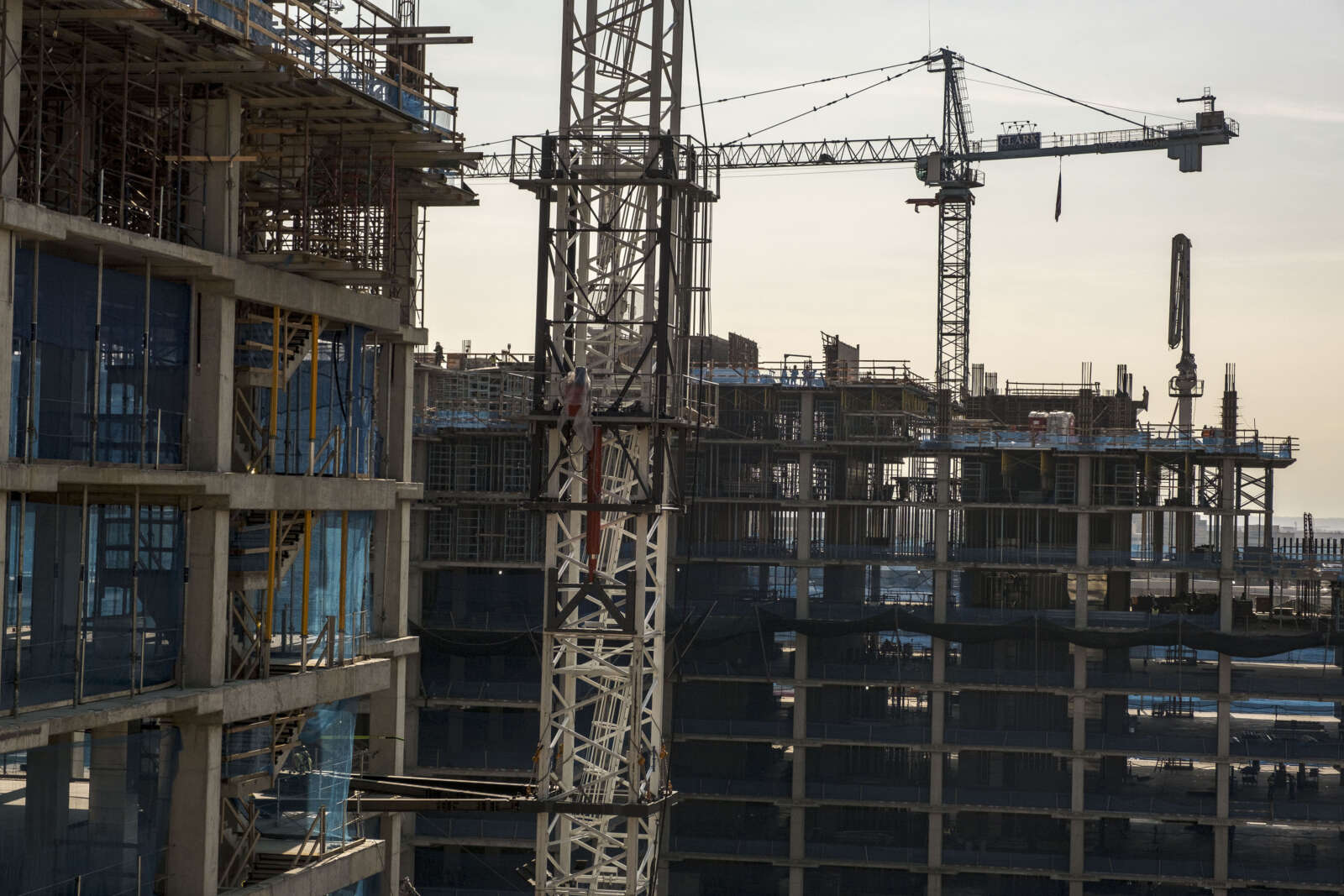
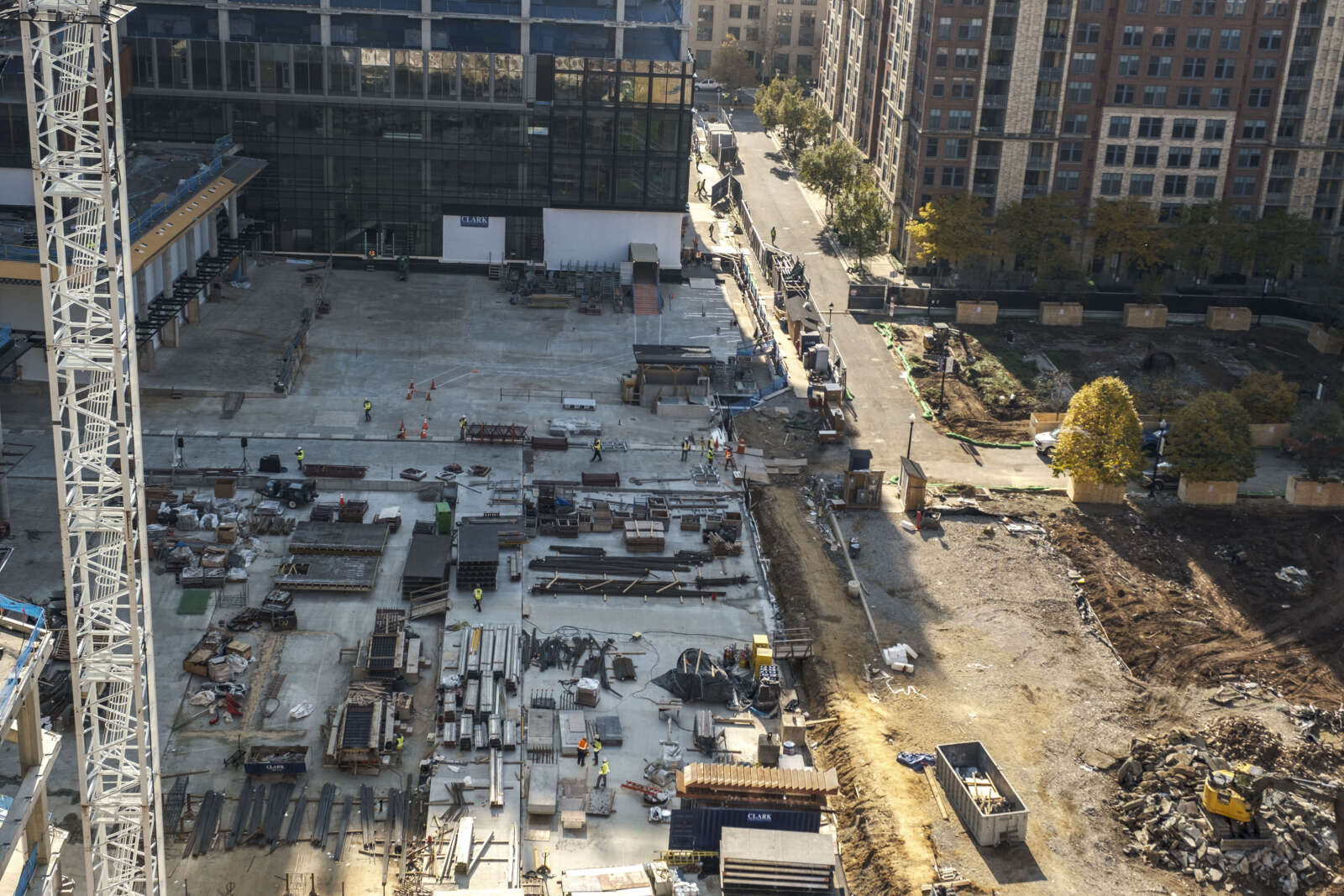
This was a busy news week, with everything from County Board meetings to a tour of the under-construction Amazon HQ2. The most-read stories of the past week are as follows.

  1. Toddler struck by driver, seriously injured in Westover
  2. Arlington police turn to state troopers for help with nightlife detail
  3. Deterioration forces additional closures on Arlington-Alexandria bridge
  4. New restaurant and flower shop Poppyseed Rye to open this week in Ballston
  5. Pines of Florence is coming back, opening in Cherrydale as soon as this weekend
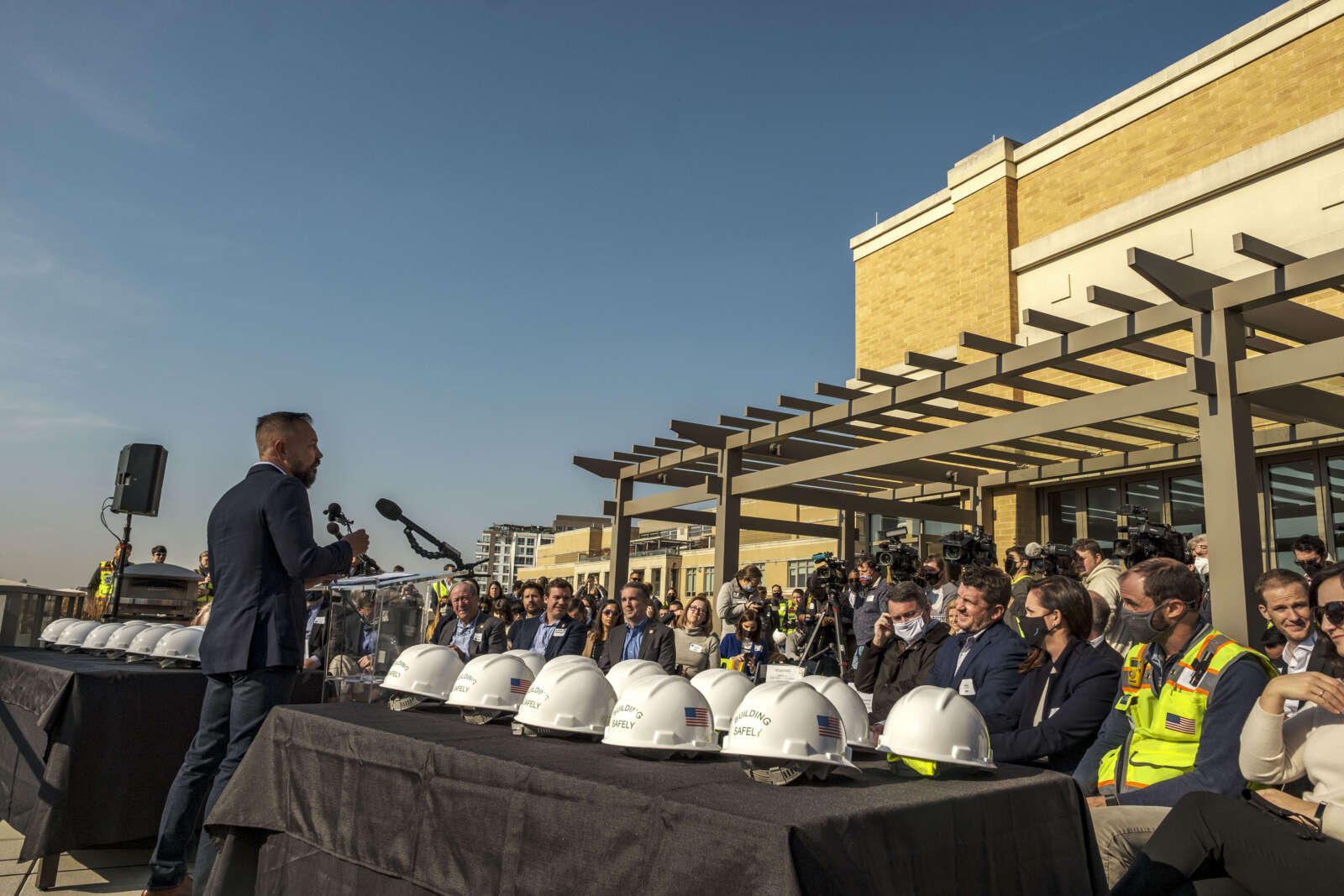
  6. Amazon touts HQ2 construction progress as Bezos makes big donation to local nonprofit
  7. Police investigating more than a dozen car break-ins along two blocks
  8. Thaiphoon in Pentagon City expected to close this weekend
  9. New study says at-grade Route 1 could cause pedestrian dangers, traffic headaches
  10. Death knell tolls for Victorian home in East Falls Church

Feel free to discuss those articles or anything else of local interest in the comments. Have a nice weekend!


What’s Next with Nicole is a biweekly opinion column. The views expressed are solely the author’s.

Homeownership is one of the fundamental pillars of building wealth in the American economy.

In Arlington about 60% of our housing stock is renter occupied and new housing stock is almost all in rental housing development, with almost no new development of ownership housing stock.

The Missing Middle housing initiative has the opportunity to provide expanded home ownership stock. The current Missing Middle draft lacks intentionality around homeownership and even pushes back against the concept. My hope is that this changes in future drafts.

Arlington has the highest median home sale price in the D.C. metro region from 2020:

  1. Arlington: $670,000
  2. D.C.: $630,000
  3. Alexandria: $600,000
  4. Fairfax: $575,000
  5. Montgomery County: $483,000
  6. Prince George’s County: $345,000

When the topic of homeownership was requested during multiple public meetings, it was largely shutdown as illegal based on “discrimination by tenure.” This is a term I have been unable to find in any fair housing laws and contrary to the fact that Arlington County is currently discussing dedicated home ownership exclusive units on Columbia Pike right now.

Homeownership is important for millennials, people aged 25-40, who are in their prime home-buying years and dominate the U.S. workforce. Millennials hold just 4.6% of U.S. wealth and have 56 million in the workforce, whereas Boomers are 10 times wealthier and hold 53% of U.S. wealth and have 41 million in the workforce.

When Boomers were in the current age-range for millennials, they held 21% of U.S. wealth or four times what millennials hold today. Since homeownership is a key to wealth building, this gap in purchasing opportunities is fundamental for the economic outlook of future generations.

We know that Missing Middle-type housing, when available for purchase, is lower-cost than single-family homes, while this rental type is not necessarily more affordable. For example, in 2021 average assessed value of homes were:

  1. Single-family detached: $1,000,300
  2. Attached townhouse: $846,800
  3. Condo townhouse: $686,800
  4. Multi-unit condos: $447,700
  5. Cooperatives: $158,400

Additionally, if we are planning to reduce ownership housing stock in single-family houses, we should have a plan to replace it with ownership housing. We have plans to produce thousands of additional rental units throughout the county and no plan for additional ownership opportunities, and the Missing Middle Housing initiative should be exactly where we seek to do so.

Nicole Merlene is an Arlington native and former candidate for Virginia State Senate. She has served as a leader in the community on the boards of the Arlington County Civic Federation and North Rosslyn Civic Association, as an Arlington Economic Development commissioner, in neighborhood transportation planning groups, and as a civic liaison to the Rosslyn Business Improvement District.


Peter’s Take is a biweekly opinion column. The views expressed are solely the author’s.

This month, Virginia announced that school divisions can apply for “Onward Upward Virginia” grants to support literacy and math, “with targeted support for learners most impacted by pandemic disruptions, including students with disabilities, English learners, students who are economically disadvantaged, early learners, and those who are underperforming.”

The announcement of this grant shows that the State of Virginia continues to acknowledge the scope and magnitude of the effect of school closures:

“Virginia’s 2020-2021 SOL test scores tell us what we already knew–students need to be in the classroom without disruption to learn effectively. The connections, structures, and supports our school communities provide are irreplaceable, and many students did not have access to in person instruction for the full academic year. We must now focus on unfinished learning and acceleration to mitigate the impact the pandemic has had on student results.”

APS lacks a system-wide, resourced plan to address learning losses

To date, APS has barely acknowledged the directive from Virginia to “focus on unfinished learning and acceleration,” nor is there a system-wide, resourced plan to address learning losses. Superintendent Francisco Durán recently shared via School Talk that interventions will rely heavily on iPad apps Dreambox and Lexia along with targeted small group instruction (a tall order for overworked teachers who are already leading larger classes than in recent years). More is needed.

VDOE data reveal the pressing nature of the problem and how it falls disproportionately on certain schools. In particular, across APS neighborhood elementary schools that are over 50% economically disadvantaged, math scores dropped by an average of 42 points and 60% or more of students failed the math SOL. Science scores fell by an average of 55 points, and reading scores by an average of 20 points (apples to oranges, as Virginia lowered the minimum reading pass rate last year).

These schools already reported generally lower scores than non-economically disadvantaged schools. With the impact of the pandemic, these student scores are a crisis.

Learning loss recovery should be front and center, and should feature such evidence-based interventions as intensified tutoring and comprehensive after-school and extended school year programs. Will APS apply for an Onward Upward grant? If so, what will it ask for?

Why and whither virtual?

Amidst these grim results of virtual learning, APS continues to signal a possible permanent place for virtual school. In March, APS officials suggested that a permanent virtual learning program be located on one floor of the Ed Center. Last month, the widespread problems with VLP were referred to as “growing pains” that APS was “working diligently” to avoid repeating.

The best way to avoid repetition is to strictly limit participation, if APS offers virtual learning at all. Even before the experience of this past year, researchers were skeptical about the effectiveness of virtual education. Permanent virtual learning also lacks scale; this year’s VLP hired teachers for every grade level, even though many grades have very few students. For example, at the high school level, of the 90 classes taught by 25 APS teachers, they are on average only 35% full, with an average class size of only 9 students. This is a misallocation of resources when brick and mortar schools have had to increase class sizes due to budget constraints. In Virginia, virtual programming duplicates something that already exists at the state level.

(more…)


The Right Note is a biweekly opinion column. The views expressed are solely the author’s.

Virginia voters shook up the national political landscape two weeks ago by electing a Republican statewide ticket just one year after giving Joe Biden a 10% victory.

No doubt, the race was influenced by the current national political environment, including soaring prices of just about everything. But what can Independents and Republican here in Arlington learn from these results?

1. Contrary to some Democrat claims, turnout was not the reason Democrats lost. 2021 saw the most voters ever go to the polls in a gubernatorial election. Across Virginia 54.9% of voters went to the polls this year, up from 47.6% in 2017 and 43% in 2013. Terry McAuliffe received nearly 200,000 more raw votes than Ralph Northam did and still lost by more than 60,000 votes.

2. The Republican statewide ticket made gains in virtually every jurisdiction, including right here in Arlington versus 2020. Governor-Elect Youngkin’s increase of 5.5% of the vote versus President Trump in Arlington nearly equaled his statewide increase of 6.5%. Youngkin did it by communicating on kitchen table issues across Virginia.

3. This election demonstrated a rural rejection of, and suburban reaction to, the Virginia, and in some ways national, Democrats’ leftward policy march. Democrats in Northern Virginia seem to believe they simply have a communication problem, and not a policy problem, when it comes to the disconnect with rural voters. That gap will widen if Democrats insist on telling rural, and even some suburban, voters they are wrong on the issues.

4. For example, parents do not want to be told they have no role in their child’s education. In what was one of the most tone-deaf statements ever, Terry McAuliffe effectively told parents — who were rightly concerned about everything from learning loss, to curriculum, to mandates, to school safety — to sit down and shut up. McAuliffe continued to double down on the sentiment through his closing campaign rally when he invited the national leader of teachers’ unions to be a featured speaker. And McAuliffe was not helped by the Biden Justice Department announcement that they would be using the FBI to investigate parents at school board meetings.

5. Here in Arlington, the Democrat sample ballot remains extremely difficult to beat. From the school bond to the Governor’s race, there was little doubt about how election day would go here in our 26 square miles. Only John Vihstadt has overcome the Democrats sample ballot endorsement in recent memory.

6. However, despite overwhelming support for the Democrat statewide ticket, Arlington voters have not moved very far when it comes to local issues. When I ran for County Board in 2010, Democrat Chris Zimmerman received 58% of the vote versus my 38% (Audrey Clement received the remainder). Zimmerman ran just 5% behind the “top of the ticket,” which that year was Congressman Jim Moran. This year Takis Karantonis received just 60% of the vote compared to nearly 77% for Terry McAuliffe. Running nearly 17% behind the top of the ticket is hardly an overwhelming vote of confidence in how things are going.

Moving forward, we may not yet be able to see a path on the horizon for a Republican to win Arlington in a statewide contest. However, there is still a coalition available of Republicans, Independents and concerned Democrats who would vote for local County Board and School Board candidates who campaign on the right set of issues.

Mark Kelly is a long-time Arlington resident, former Arlington GOP Chairman and two-time Republican candidate for Arlington County Board.


Progressive Voice is a biweekly opinion column. The views expressed are solely the author’s.

By William Mark Habeeb

The new Arlington County logo seems to announce that we are nothing but an appendage of D.C. Is that a sad admission of the truth, or the declaration of a rather uninspiring ambition? Either way, it’s a gross underestimation of what our county of nearly 240,000 could be.

Arlington enjoys a solid tax base, a geographic and population size conducive to the creation of community, and a diverse, well-educated — and generally liberal-minded — population. So, why are we so timid in exploring ways to use these assets to create a model progressive community, a place where new ideas are tested and refined, where we do more than wring our hands over problems like systemic inequality? In short, why aren’t we more bold?

Arlington has been bold in the past: Over 50 years ago, Arlington’s elected leaders insisted that the Metro be built underground, not above ground as originally planned. While this decision cost billions more, it allowed Arlington’s Rosslyn – Ballston corridor to develop as a compact urban community; the increased tax base must certainly have more than made up for the higher construction costs.

Contrast that decision with the issue of mass transit along Columbia Pike. The best solution would be bus rapid transit (BRT). But to be truly rapid, BRT needs dedicated bus-only lanes. That, however, would require removing street parking along Columbia Pike, which some would oppose. But being bold sometimes requires making decisions that meet resistance. Being bold requires a vision — in this case, the vision of a community dedicated to the reduction of vehicular traffic.

Addressing the “missing middle” housing crisis also requires boldness. Revised zoning laws to allow more small multi-family buildings and duplexes would make it possible for more people and families to live in Arlington’s neighborhoods while maintaining a neighborhood feel. Cities like Somerville, Massachusetts, maintain a neighborhood feel even though much of the housing stock is multi-family. Would this make everyone happy? Of course not. Being bold seldom makes everyone happy, especially when the bold actions are aimed at addressing inequalities or better sharing a community’s resources.

Bold ideas can be borrowed. For example, a way to provide lower-income Arlingtonians with more educational opportunities could be based on the “Birmingham Promise,” a public-private partnership in Birmingham, Alabama — which has a far lower tax-base than Arlington — that provides tuition assistance for graduates of Birmingham City Schools who attend public colleges in Alabama, and offers an internship and apprenticeship program where high school seniors gain work experience while earning money and academic credit.

Other ideas — such as community land trusts (CLTs) and participatory budgeting — have been successfully implemented in a number of communities. CLTs are publicly funded non-profits that purchase and hold property in trust in order to guarantee affordable rental rates. Participatory budgeting (PB), an idea that originated in Porto Alegre, Brazil — allows community members to decide how to spend a designated portion of the public budget. PB goes beyond Arlington’s Neighborhood Conservation Program by allowing community members to identify a wide range of community needs and allocating public budget funds to address them.

Not all bold ideas are realistic or cost-effective. But to find the ones that turn out to be real gems, we must be nimble-minded and willing to take a few calculated chances. If Arlington’s leaders — both elected officials and unelected community leaders — become so risk-averse, so afraid to arouse opposition, so scared of pushing the idea envelope, then we will be in danger of becoming what our new logo portrays: The missing corner of DC, a metro-area afterthought living in our just-good-enough community.

I would like to see Arlington become an urban “beta community,” where we test bold ideas even if they’re in the start-up phase.  Let’s take advantage of our citizens’ innovative ideas and other resources — to see how successful we can become in creating a model 21st century urban community.

William Mark Habeeb first moved to Arlington in 1977 as a graduate student, and he and his wife bought their Arlington home in 1991. Their son attended Arlington Public Schools. Mark teaches in Georgetown University’s School of Foreign Service.


All told, it was a pretty great week weather-wise. Alas, another cool stretch is arriving just in time for the weekend, before mid-week warm-up.

The good news is that if you ignore the chilly temperatures, peak fall foliage is finally here in the D.C. area.

Enjoy it while it lasts. Meteorological winter is a mere 2.5 weeks away and by then most of those leaves will be brown or on the ground.

Here are the most-read stories of the past week on ARLnow:

  1. Motorcyclist killed in school bus crash in front of Drew Elementary
  2. Advanced Towing ordered to pay only $750 in Attorney General’s lawsuit
  3. Green Valley residents express concerns about updated arts plan
  4. Unruly parents, coaches cause ref shortage in local youth hockey league
  5. Dispute outside Columbia Pike 7-Eleven ends in gunfire
  6. Popular La Tingeria food truck leaving Arlington for now
  7. Morning Poll: Is Arlington on the right track or the wrong track?
  8. Soccer-centric restaurant Copa has closed in Ballston
  9. Arlington police continuing to investigate flag burnings
  10. County to throw lifeline to struggling Subway on ground floor of jail
  11. CHIKO, popular Chinese and Korean eatery, opening in Shirlington this week
  12. Site of fatal crash last week is part of a new street safety improvement project

Feel free to discuss those articles or anything else of local interest in the comments. Have a nice Veterans Day weekend!


(Updated at 10 a.m.) We’re one year and nine months into the pandemic and it’s probably safe to say that most people just want things to be largely back to normal.

And, aside from wearing masks and working remotely, in many ways it is.

Most people are vaccinated. Covid-related hospitalizations, at least in Arlington, are relatively low. You can eat inside at restaurants, attend sporting events, go to school — basically do anything you used to be able to do, with only minor modifications.

There’s also good news on the return-to-normality front: a forthcoming Pfizer anti-viral drug holds the promise of further reducing severe illness and death from Covid, while an antibody cocktail appears effective in combating Covid among the immunocompromised, for whom vaccine effectiveness is limited.

Plus, there’s talk the the pandemic phase of the Covid era may be coming to an end soon.

On the other hand, it seems unlikely that we’ll return to pre-pandemic work habits, at least among those office dwellers. Two-thirds of white collar workers are still working remotely at least part time, and 91% of workers hope remote work is here to stay, according to a recent Gallup poll.

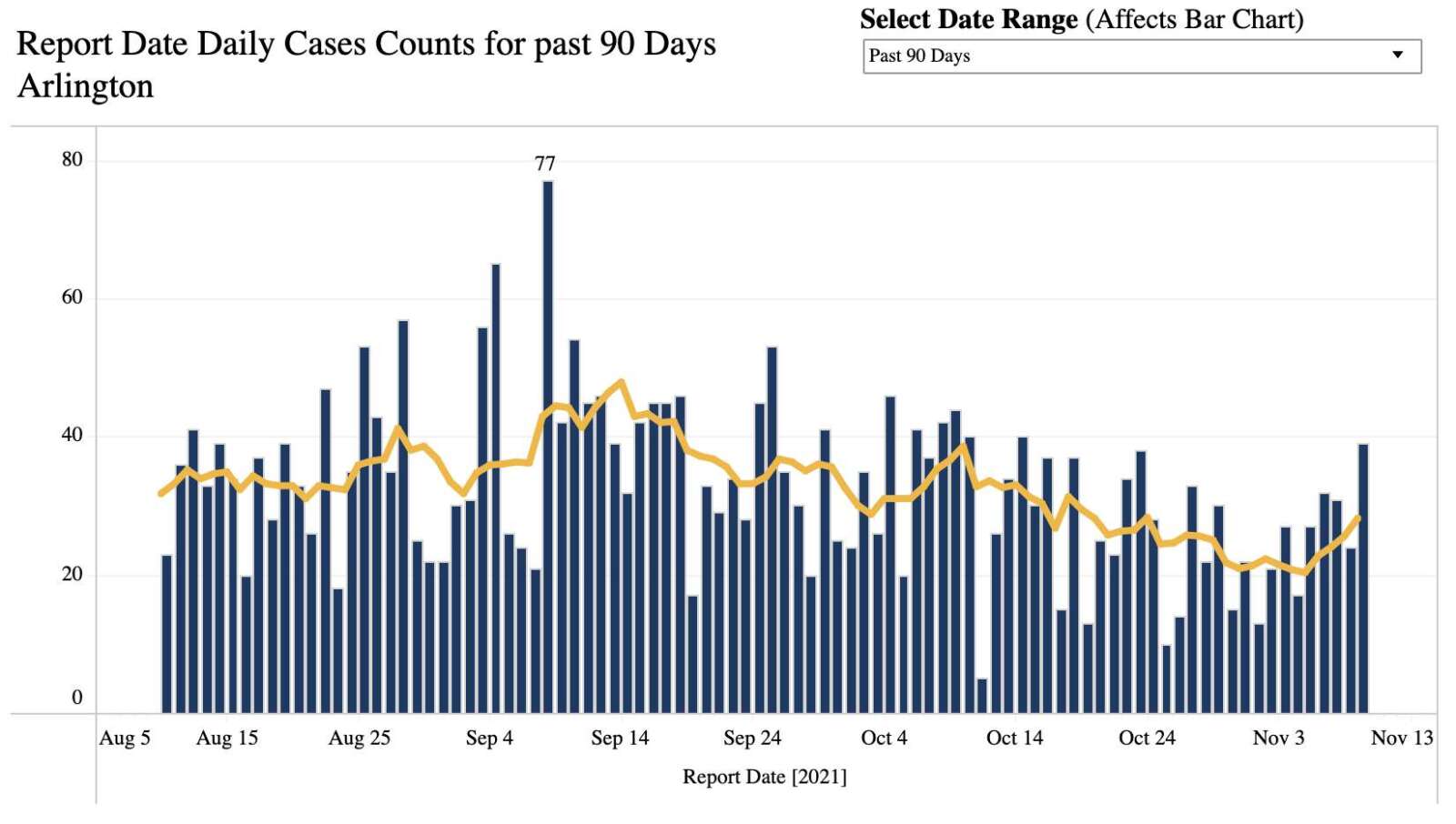
And for those with health conditions that make them vulnerable to Covid — or who have members of their household with such conditions — the threat is still here. In Arlington, the seven-day moving average of new cases has actually risen in each of the past four days, reaching 28 daily cases today after bottoming out around 20, according to Virginia Dept. of Health data.

Covid cases in Arlington as of 11/9/21 (via Virginia Dept. of Health)

Given all of the above, if you had to arbitrarily assign a percentage to it, to what degree is your life back to a pre-pandemic normal?


The Rosslyn skyline, as seen from the Tidal Basin (Flickr pool photo by Erinn Shirley)

Despite the Republican sweep of statewide offices in Virginia, last week Arlington remained deep blue.

All of the Democratic or Democrat-endorsed candidates for local office and the state legislature won their races by comfortable margins. That includes County Board member Takis Karantonis, who was reelected with 60.1% of the vote.

Of Karantonis’ three independent opponents, Audrey Clement had the highest vote total: 18.4%.

Karantonis slightly underperformed his predecessor, the late Erik Gutshall, who in 2017 received 62.8% of the vote. But there was also one fewer challenger in Gutshall’s race.

By the November election results alone, it would seem that people in Arlington are quite pleased with the way things are going here. Despite some economic headwinds and concerns about crime, Arlington remains a relatively safe place with the one of the lowest unemployment rates in the state — and that’s well before Amazon’s HQ2 is fully built out.

But that doesn’t necessarily paint the full picture of how people in Arlington feel about the direction of the county. So today we’re asking: how do you feel about the way things are headed here?

Flickr pool photo by Erinn Shirley


View More Stories