The Arlies continue today with a two new categories, but first, the results of last week’s voting.

Your favorite preschool/daycare is Trinity School of Early Learning on Columbia Pike, followed by Overlee Preschool on Military Road and Maria Teresa’s Babies Early Enrichment Center on 23rd Street S.

Now, let’s vote on this week’s categories.

Is there a real estate agent you’d recommend to sellers or a favorite real estate agent you’ve worked with when selling? Do you have a favorite home renovation company that turned your unfinished basement into a movie theater?

Let us know below or by clicking this link. Voting is open until next Tuesday, when we announce the winners and vote on a new category.

Photo by Francesca Tosolini on Unsplash


Progressive Voice is a biweekly opinion column. The views expressed are solely the authors’.

By Anne deLeon and Mary Byrne

Last year, Americans were inundated with millions of political calls. Texting technologies added to the deluge: 2.72 billion political text messages were sent in September 2020 alone. Voters like long-time Arlington resident Donna Bierlein were drained by the onslaught, “It’s annoying to get called over and over again.”

Yet, the Arlington Democrats’ effort to get out the vote has been successful because it relies not just on calls to solicit support, but on building genuine connections with voters. Last year, our volunteers found a new way to be of service.

The Rides to the Polls team has provided transportation assistance to voters since 2008. Our group expected the emergence of Covid-19 and the intensities of the presidential election would impact our operation in 2020. Voting became more complicated, leaving seniors unsure about their voting options.

Seeking to correct our state’s reputation for being a difficult place to vote, the Virginia General Assembly passed bills to make it easier. Drop boxes for collecting absentee ballots were approved, funding for postage for mail-in ballots was provided and rules for becoming a permanent absentee voter were eased. Because of Covid-19, the witness requirement for absentee ballots was waived.

To help voters absorb the changes, our team decided to reach as many people as possible in advance of the election. Volunteers made thousands of calls, answering questions about voting rules, providing assistance with online ballot applications and offering rides.

As coronavirus vaccines became available in January 2021, we saw a similar need among seniors. Why not turn our Rides to the Polls operation into a Rides to Vaccines program?

More than 90 volunteers joined up — twice the number who usually volunteer for the Rides to the Polls effort. Our newcomers ranged from college students to 80-year-olds and included Democrats as well as Republicans.

For five months our tireless volunteers called more than 4,000 seniors, regardless of political party, helping with online vaccine registration as well as scheduling and driving to appointments. By the time our program wrapped up in June, our outreach expanded to non-English speakers. Victoria Virasingh reached out to Spanish-speaking neighbors, organizing information drops at homes and setting up registration tables at markets. Another volunteer organized and paid for rides for those needing disability-adapted transportation. Mesky Bhrane helped Amharic speakers, collecting multiple blessings along the way.

Seniors were reassured by our safety protocols, which included mask requirements for drivers and passengers, surface-cleaning between rides and open windows during travel. Our volunteers built trust, checking in before and after appointments and offering their personal phone numbers for follow-up calls. Colleen Boles had multiple conversations with more than one vaccine-hesitant resident, providing the information and support they needed to become comfortable making an appointment.

Our project succeeded because it was rooted in connection and concern. We concentrated on those who “fell between the cracks,” helping those who lacked computer access, were confused about conflicting information provided by the media or needed safe transportation. Some seniors expressed surprise to know a neighbor cared enough to find and call them. Turney Tse said, had we not called, her 100-year-old mother would not have been vaccinated.

Retired California Congressman Vic Fazio, who now lives in Arlington, also appreciated the call. “I thought it was a great effort showing empathy, interest and concern.” Fazio suggested the impact of efforts like ours might have lasting impact. People learn “there’s more to a political party than platform and issues,” when people feel “recognized, noticed, cared for.”

If pivoting a small but effective effort like the Arlington Democrats’ Rides to the Polls program toward non-political community service can build goodwill in times of crisis, why not apply the model more broadly in normal times? “In a period when cynicism reigns and people are mistrustful,” DeFazio says, outreach rooted in common interest, concern for the individual and care for community can be key to engaging people one by one, neighbor to neighbor.

Long-time Arlington residents Anne deLeon and Mary Byrne are both former Capitol Hill staffers. They lead the Arlington, Va. Democrats’ Rides to the Polls team, which has provided transportation assistance to voters since 2008.  


The capacity crunch at Arlington Public Schools is not as dire as it once was, particularly after the pandemic, but there is still a need for more school seats in certain areas.

One place where a school might be needed: the National Landing area, where hundreds of new apartments are planned and where the nearest elementary school — Oakridge, in the Arlington Ridge neighborhood — is getting increasingly overcrowded, according to APS projections.

There’s not much contiguous land on which to plop down a full elementary school with fields and a playground in the Crystal City or Pentagon City neighborhoods, but one thing both have in abundance is office space — particularly older, harder-to-lease office space.

The Washington Business Journal reported last week that the City of Alexandria is purchasing an office building on N. Beauregard Street for $18 million, with plans to eventually convert it into a 600-student elementary or secondary school. Might that be an example for Arlington Public Schools to follow?

https://twitter.com/CarFreeHQ2/status/1415147596755181574

If not purchase an entire building, APS could potentially lease part of an office building for school use. Of course, some parents and students might not love the idea of having to take an elevator to class, or not having the grassy fields and other amenities of a typical suburban school.

What do you think?


Ed Talk is a biweekly opinion column. The views expressed are solely the author’s.

Schools should be teaching the truth. Truth, as fact and reality, is not theory. The attack on truth is percolating in Arlington.

At the June 24 School Board Meeting (at the 19:56 mark), a former APS parent implored the board to reject not only Critical Race Theory (CRT) — which APS doesn’t even teach — but specifically to reject anything rooted in equity, social justice, anti-racism and culturally responsive teaching.

You read that right. I was alarmed, but since there was only one such speaker and our Board meeting didn’t devolve into the melee that occurred just two days earlier at the Loudoun County School Board meeting, I convinced myself that this was an isolated effort in Arlington by a lone wolf, and I thought to myself, “thank God I don’t live in Loudoun.” I couldn’t have been more misguided.

Parents Defending Education (PDE), a seemingly innocuous group by its name and mission statement, deceptively masquerades itself as a “grassroots” nonprofit organization. Their website — plastered with stock photos of Black and Brown students in staged “diverse” school settings, fooling no one — misleadingly purports that: “Parents Defending Education is a national grassroots organization working to reclaim our schools from activists promoting harmful agendas. Through network and coalition building, investigative reporting, litigation, and engagement on local, state, and national policies, we are fighting indoctrination in the classroom — and for the restoration of a healthy, non-political education for our kids.”

In fact, PDE is a national movement funded largely by political right wing moguls like the Koch brothers and the Walton family. By their own standards, PDE is a case study in hypocrisy. They exist to accomplish the very ends they are purporting to subvert.

PDE is engaging in political activism. PDE is promoting the harmful agenda of whitewashed history. PDE is indoctrinating its members to believe that CRT is being taught in APS and is about teaching students to hate. This is hypocritical race theory. It’s an attack on the truth.

On June 9, PDE’s Director of Advocacy filed a FOIA request with APS seeking documentation about the procurement and distribution of the book Stamped: Racism, Antiracism, and You: A Remix of the National Book Award-winning Stamped from the Beginning and speaker fees paid to co-author Jason Reynolds.

Armed with that data, PDE lambasted APS and Amazon for the $16,000 it spent on the books and speaker engagement fees “instead of donating hot spots for remote learning.” Now, there are a plethora of legitimate reasons to be critical of Amazon and APS, but this one isn’t credible. It’s laughable. Perhaps if the PDE leadership lived here and paid taxes to Arlington, they would have known about the $500,000 grant APS received to provide MiFis to low-income families. They will not stop at this though. We need to be paying attention.

Quite frankly, I am growing tired of the political bastardization of CRT, how it is being efficiently misused as both boogeyman and straw man to distract and disarm us in a disguised quest to destroy truth and score political points. This kind of gaslighting is the mortar that has cemented white supremacy for over 400 years. We cannot afford to ignore this fake controversy or take it lightly. We must fight back. We must defend and protect our teachers and administrators who are teaching the truth.

(more…)


Modern Mobility is a biweekly opinion column. The views expressed are solely the author’s.

The 20′ Clear Width rule of the VA Fire Code has removed on-street parking that had existed safely for decades, prevented the installation of protected bike lanes and made new sidewalk installations politically infeasible — and you’ve probably never heard of it. This rule can save lives by speeding fire response or cost lives by preventing safer street designs. Is Arlington finding the right balance?

What is the 20′ Clear Width Rule?

The 20′ Clear Width rule is codified in section 503.2.1 of the VA Statewide Fire Prevention Code: “Fire apparatus access roads shall have an unobstructed width of not less than 20 feet.”

A fire apparatus access road is, essentially, every road, street and driveway that a fire truck might need to drive on to get from the fire station to a structure that is on fire.

What makes an area obstructed? The Arlington Fire Department says that this area “does not have to be completely flat,” but past projects seem to indicate that curbs or medians within this area are not allowed.

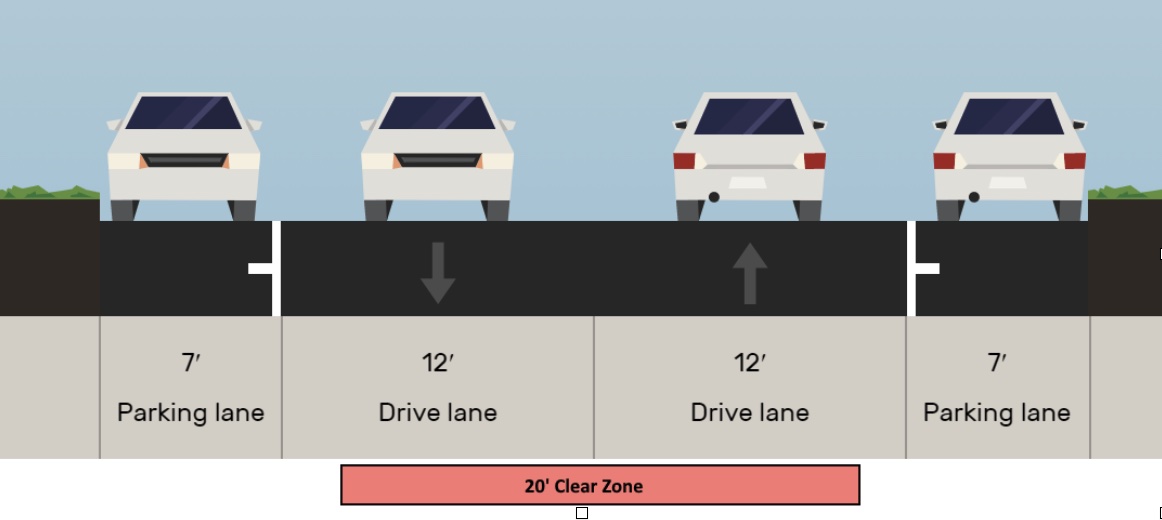
Here is an example Arlington residential street that more than meets the 20′ clear width rule because of its two adjacent, wide travel lanes:

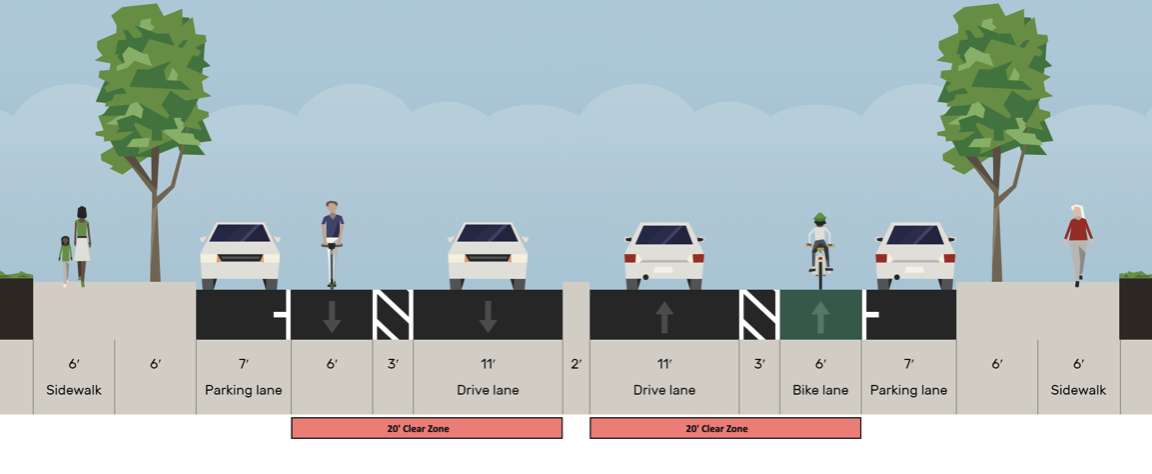
And here is an example arterial street with buffered bike lanes that meets the 20′ clear width rule because of the combination of the travel lane, buffer and bike lane, despite the car lanes being separated by a raised median:

What is it supposed to accomplish?

The Arlington Fire Department helpfully explains that the 20′ clear width rule is designed to make sure there is “continuous and unobstructed access to buildings and facilities” and to provide a “safe operational area around the fire apparatus to access compartments and equipment.”

The clear width isn’t so much to speed the truck’s arrival at the scene, fire trucks generally fit fine in normal lanes and factors like good grid connectivity are much more influential on response time than street widths. The clear width is to ensure that when the truck gets to the fire, there is space to park, extend outriggers (if necessary) and safely and easily access the equipment stored in and around the truck needed to fight the fire.

To the extent to which having 20′ of clear space at the scene of a fire speeds up response time by helping them quickly get set up and working, this portion of the fire code should help save lives in an emergency where every second counts.

(more…)


Community Matters is a biweekly opinion column. The views expressed are solely the author’s.

I was recently asked for my thoughts on influence. I have always been intrigued by influence – how it works, what makes some more influential than others and exactly how one can consistently influence others for greater impact.

When I think about the people and institutions in Arlington who have the potential for the most impact, in addition to elected officials, business leaders, etc., our organizational and civic leaders at all levels top the list. As we push for Arlington to evolve, I think it is critical that each of us truly understand influence.

It seems easy enough, we all influence our children, our partners and our colleagues in different ways. Sometimes it’s through commands, other times it’s through flattery, but most of us have been able to influence others in our lives.

I am often asked for recommendations on recruiting more minorities to organizations or initiatives, in particular. I have written about other advice and thoughts about authenticity, expanding your network, and simply asking – which are all essential.

When I am considering a new endeavor, something has to stand out about the ask and the work that I am being asked to do. As you consider recruiting people who are different from the majority of your current membership, consider using authentic influence. While there are a lot of people who likely fit your criteria, there are a limited number you have access to (until you ramp up your outreach). In my conversations I have noticed that many of the people who fit the commonly sought after criteria, are in high demand and recruited by several organizations at once.

Yet, there are differentiators for the people and organizations who are able to attract this talent, and I believe some of that lies in their ability to influence. We must remember that there are often concerns about trust, and leeriness that the person will be used as a token. Additionally, as with most of us, there are concerns about a limited ability to commit the time needed.

Empowerment. I have written before about providing training and preparation for those who you might want to recruit, but may not possess everything you need for the role. Whether you offer community training with the goal of recruiting, additional leadership/members, or specifically target the people you want to recruit, generally empowering them (without pandering) may be beneficial. Make a connection between the role you would like them to serve in and the work they do now. Have conversations with them and encourage them to see where they are now and where they could be by serving in that role.

Individualization. This may seem like it goes without saying, but be clear about why you want this person to serve in a role, and not just “any woman” or any “Asian American,” etc. Those of us who have been on the other end of recruiting efforts can generally tell when the person or organization knows little about what we can bring to the table.

Connect with their emotions. Within reason, I would consider really connecting with people. With so much going on in everyone’s lives, someone who takes the time to find out what is happening in my life and how I am feeling, would probably resonate more with me. I believe that those personal connections are what keep us coming back to the roles we currently have.

It can be easy to think about the new policies we are implementing in Arlington on a systemic level, but we can’t forget each other’s humanity. As we move forward with true community change, we should remember the power of authentic personal influence.

Krysta Jones has lived in Arlington since 2004 and is active in local politics and civic life. This column is in no way associated with or represents any person, government, organization or body — except Krysta herself.


If you thought “favorite dentist” was a boring Arlies category, you apparently thought wrong.

We received more votes this past week than for any other individual Arlies category so far. It turns out there are a lot of dentists in Arlington — and also a lot of people who like their dentist enough to vote for them.

Well, without further ado, your favorite dentist (for adults) is Dr. Richard Gruntz in Crystal City, followed by Dr. Tamara Garrett of Arlington Dental Solutions in Virginia Square and Roca Dental in Clarendon.

Now, let’s vote on this week’s category. Do you have a favorite preschool or daycare you take your children to? Let us know below or by clicking this link.

Voting is open until next Tuesday, when we announce the winners and vote on a new category.

Photo by BBC Creative on Unsplash


Making Room is a biweekly opinion column. The views expressed are solely the author’s. 

The following was written by guest columnist Thomas Bingham.

Virginia recently just decriminalized personal use of marijuana and passed reforms on use of police force. These are defining a step in the right direction and in the coming year, Virginia voters can hold candidates accountable and demand even more action on criminal justice reform.

Continued progress includes reducing sentences for crimes, improving policing, and expanding the legalization of recreational drugs. Below are policies that Arlington’s elected leaders should pursue to make the next steps toward criminal justice reform.

1. Ending mandatory minimums during the 2022 legislative cycle

Mandatory minimums of these laws have been passed during the tough on crime era. The intent of these laws was to reduce crime and take dangerous people off the streets. The result has led to minorities and low-income individuals being disproportionately targeted by the harsh drug laws. The harsh drug laws with mandatory minimums are why the U.S. has one of the biggest prison systems in the world.

The Virginia State Senate took the advice of the Virginia Crime Commission and passed a bill eliminating mandatory minimum sentences for most crimes. The bill failed in the House of Delegates. Arlington’s delegation could champion a more limited version of the bill that could pass in the next legislative session. At the very least, Virginia should end mandatory minimums for drug related charges and focus on better solutions to address drug addiction.

2. Democrats should abandon the “defund the police” movement and focus on reforms

News of car jackings and armed robberies have proliferated in recent months. Cutting funding for public safety does not help assure anxious residents and could be politically damaging to moderate Democrats seeking reelection this year.

This doesn’t mean that our elected representatives should abandon police reform. Law enforcement should narrow their focus on preventing violent crimes and use more discretion on victimless crimes, particularly crimes that have been used to target people of color for arbitrary arrest. The state legislature should focus on improving training, hiring more law enforcement personnel, giving law enforcement more tools to de-escalate hostile situations and changing tactics to protect citizens.

Along with these reforms, we should pressure our Senate and House representatives to end qualified immunity. Widely denounced in the wake of Derek Chauvin’s murder of George Floyd in 2020, qualified immunity shields public officials from being personally liable from violating individual rights. This effort failed the Virginia House last year but there is a chance it could be revisited in the next legislative cycle.

Civil Asset Forfeiture, a practice that allows police departments to take money or property based on a suspicion of crime, should be banned much like Maine did recently. The easy fix would be to require a criminal conviction before taking someone’s property.

3. Adapt similar policies to Oregon to decriminalize most personal use of drugs

The War on Drugs, which has increased the surveillance and arrest of people of color for over 50 years, is at the root of our unjust and inequitable criminal justice system. The sanest route, even if it is the most controversial, would be to decriminalize the personal possession of most drugs. This radical experiment has proven to be effective in Portugal by reducing drug abuse and limiting the spread of HIV. Oregon is the first state in the US to pursue this approach.

Arlington doesn’t currently have the progressive leadership that would champion such a dramatic change from the status quo. The best route would be to build grassroots support and bring a referendum to the voters. We should start laying the groundwork now.

Conclusion

Virginia has made some important first steps in undoing its harsh drug laws and reforming its broken criminal justice system. There is a lot more work to do with police reform, reducing crime and ending the war on drugs.

Thomas Bingham is a California native and lives in Arlington. He has worked in the public policy field for over ten years defending liberty and advocating for limited government. In his personal time, he enjoys the outdoors and riding motorcycles.


It was a busy week here at ARLnow as we finally unveiled the ARLnow Press Club.

Thank you to all who have signed up already, most of whom appear to be choosing the yearly option rather than the monthly. We greatly appreciate your support and trust in us.

It’s a major undertaking for our staff, which grew by one journalist in order to be able to launch the service. For those who have joined or will be joining, we look finding more ways to save you time, provide useful information, and generally make local living better.

Beyond the members-only newsletters, podcast and happy hour guide, the Press Club will allow us to expand our local news coverage on the website, which remains — and will forever remain — open to all.

Speaking of coverage, the top dozen most-read articles on the site this week are listed below.

  1. Arlington Woman Killed in Route 50 Crash
  2. Woman Robbed by Man With Gun Along Lee Highway
  3. Arlington Named ‘Fittest City’ in U.S., Again
  4. After Quiet June, Coronavirus Cases Starting to Rise in Arlington
  5. Construction Underway in Ballston to Turn Vacant Restaurant Into Spa
  6. Arlington PTA Leaders Consider Ways to Distribute Funding More Equitably
  7. Police Investigating Man’s Death Outside H-B Woodlawn
  8. County Daycare Facility to Close in August Ahead of Renovations
  9. Dittmar Looks to Use Furnished Apartments as Hotel Rooms
  10. ACPD Investigating More Break-ins at Arlington Forest Shopping Center
  11. Police Investigating Another Series of Gunshots in Green Valley
  12. Dominion Hills Swim, Dive Teams to Retire ‘Warriors’ Name

Feel free to discuss those stories or anything else of local interest, in the comments. Have a nice weekend!


Peter’s Take is a biweekly opinion column. The views expressed are solely the author’s.

One in five adults in the United States experiences a mental illness or mental health crisis every year. Suicide is the second leading cause of death among people ages ten to thirty-four.

Arlington is not exempt. Virginia’s Department of Behavioral Health and Developmental Services estimates any as one in twenty Arlington County adults have a serious mental illness in which their symptoms seriously impair adult functioning.

Treatment works — if you can get it — but too often mental health care is in short supply or inadequate.

Psychiatric bed supply

There is a shortage of available beds in Virginia’s state hospitals and the psychiatric units of other hospitals statewide. The bed shortage in state hospitals is documented here. The state hospitals’ mandated role is to provide a bed of last resort in times of crisis when no beds are available in private hospitals. State hospitals currently are unable to fulfill their mandated role.

A less known fact is the shortage of psychiatric beds in private hospitals, such as Virginia Hospital Center (VHC). This in turn exacerbates the shortage of beds in state psychiatric hospitals. For many Arlingtonians in crisis — particularly those with suicidal tendencies, VHC is the first place to look for help, and too often there is simply no bed available.

This critical supply problem is finally being addressed as part of VHC’s current $250 million expansion. Public outcry following VHC’s initial decision not to seek additional beds for its psychiatric unit has developed into a landmark partnership.

In 2018, an agreement was reached among a group including VHC, Arlington County government leaders, mental health advocates, and the Arlington Community Services Board. The agreement gave VHC access to a county-owned land parcel adjacent to VHC. In the agreement, VHC committed to specific improvements in its psychiatric services and to regular planning meetings.

So far, this process has worked effectively.

The first concrete step forward came this June. An analysis based on the number of people who did not get a VHC psychiatric bed provided a conservative estimate of the total number of beds needed. The group notified the County Manager that VHC will apply to the state for 16 new beds to add to the current 18 bed unit.

This substantial increase in the number of beds is critical to meet the mental health needs of Arlington County’s growing population and to meet VHC’s goal of increased single beds. The increase will reduce the number of patients in mental health crisis desperate for care who must go out of the region, far away from their supportive network of family and friends.

(more…)


View More Stories