
Progressive Voice is a bi-weekly opinion column. The views expressed are solely the author’s. 

By Wesley Joe

I ran [for governor] to get off the school board. That’s the worst job I ever had.”

–Former U.S. Senator Dale Bumpers (D-Arkansas)

A remarkable feature of this year’s Arlington School Board election was the last-minute drive to recruit candidates for the Arlington County Democratic Committee (ACDC) endorsement.

More troubling was the absence of more candidacies among our best prepared Arlingtonians — those who have led in unglamorous roles on the school advisory groups, such as Advisory Council on Teaching and Learning, Budget Advisory Council, County Council of PTAs, and Joint Facilities Advisory Commission.

Arlington Public Schools (APS) needs knowledgeable, experienced decision-making and oversight. APS is a complex $670 million per year system that helps to shape the lives of our 28,000, highly varied children. Its services range from preschool to career training to mental health and more. It is one of the county’s largest employers and maintains dozens of substantial physical plants. The leadership problem is even more urgent now, as Arlington seeks to recover learning losses sustained during the pandemic.

Can we do anything to encourage more of our best prepared leaders to join the School Board? To answer this, I asked several people who have served in the roles I identified above.

Some barriers, such as work and family commitments, are well known. As one long-time leader said:

[Beyond regular meetings and work sessions], the work…also includes attending events at their assigned schools, participating in the work of school board citizen committees…[and] thousands of hours informally meeting with and talking to parents and community members. It is more than a full-time job.

Another was more blunt:

“The job has crappy pay, long hours, and huge responsibility.”

We ought to enable Board members to serve full time and pay accordingly.

Nearly all of the long-term community leaders I talked with cited public incivility as a reason — often their top reason — for not running. This predates COVID-19, but the pandemic has only intensified this deterrent. Here, “incivility” means what one person referred to as “a lot of caustic, coarse, uninformed, nasty behavior” and personal attacks on School Board members’ values and character. The public should observe workplace norms with board members.

Another frequently cited concern is the ACDC endorsement’s influence over the general election outcome. ACDC’s endorsement provides a valuable information shortcut to the many general election voters who aren’t involved with the schools. In an overwhelmingly Democratic jurisdiction, the endorsement usually determines who wins the seat. That reality discourages some experienced Arlingtonians from running. ACDC has sound reasons for exercising its right to endorse a candidate. But as a lifelong Democrat, I think Arlington would be better off if independent candidates had a realistic chance of winning local elections.

(more…)


Thanks for providing feedback about the ARLnow Press Club.

Is there anything else you’d like to see the club or our emails offer? Let us know in the comments.


It wasn’t the busiest of weeks for local news in Arlington, but this evening’s windstorm was a chaotic coda.

As this post publishes (late) there are about 600 Dominion customers still without power, down from a peak of more than 6,000. Trees and tree branches were reported down throughout Arlington after the storm

Aside from the wind, the big story of this week was about the finalists for the new Arlington County logo.

Here are the most-read ARLnow articles of the past five days:

  1. County Reveals Five Finalists for New Arlington Logo
  2. Here Are Some of the Rejected Arlington Logo Designs
  3. The Crossing Clarendon Has a New Name and May Be Getting a New Pedestrian Plaza
  4. Arlington Man Dies After Early Morning Crash Along Washington Blvd
  5. Morning Poll: Which Proposed County Logo Do You Like the Best?
  6. Sketches Show Proposed New YMCA Facility and Apartments in Va. Square
  7. East Fall Church Metro Station’s Nearly Empty Bike Facility Seen as COVID-19 Symptom
  8. Trees, Power Lines Down After Line of Strong Winds

Feel free to discuss those or any other local story of interest in the comments. Have a nice weekend!


Ed Talk is a biweekly opinion column. The views expressed are solely the author’s.

On April 12, the Arlington School Board presented its nearly $700 million proposed FY 2022 budget to the Arlington County Board. The proposed budget includes a deficit of $14.9 million.

During the meeting, County Board member Christian Dorsey asked if this deficit is a result of a structural problem with the Arlington Public Schools (APS) budget.

The answer is yes.

For years, it was the practice of the School Board to direct the Superintendent to propose a balanced budget, with expenditures equal to revenues. However, this year’s budget direction lacks that requirement, which was last included in the FY 2017 budget cycle.

APS Superintendents began proposing budgets to the School Board that included significant deficits beginning in FY 2020, with a proposed deficit of nearly $9 million. For FY 2021 the deficit was more than $27 million and for FY 2022 it was more than $42.5 million.

After receiving the Superintendent’s proposed budget and holding numerous budget hearings, the School Board adopts a proposed budget. Typically, that proposed budget is a balanced one — but not this year.

Compare this process with that of the County Board, which includes in its budget guidance to the County Manager a requirement that his proposed budget is balanced.

A structural problem with the School Board’s budget process is that it delays the hard choices that must be made to cut expenditures to produce a balanced budget, which ultimately the School Board adopts each year. It also leads the School Board to ask the County for more money than is provided by the informal revenue sharing agreement between the boards. This year, the School Board asked the County Board for $2.8 million more than the $527.1 million in ongoing funds that the County Manager recommended.

To address this problem, the School Board should amend its policies on budget direction and budget development to require that the Superintendent propose a balanced budget and that the School Board adopt a proposed budget that is balanced. This would allow more time, and citizen input, for consideration of reducing expenditures. In addition, if APS believes that it is underfunded by the County, it should propose changes to the revenue sharing agreement.

With the School Board’s final vote on its budget scheduled for May 6, little time remains to determine how to balance this year’s budget. The $42.5 million deficit proposed by the Superintendent has shrunk because of nearly $19 million in federal emergency relief funds, as well as higher than initially estimated County and state revenue. In addition, the County Board agreed to provide the additional $2.8 million that the School Board requested, reducing the deficit to just more than $12 million.

That deficit could be cut in half if APS adjusts its enrollment projections for next year. The Superintendent’s proposed budget projects an enrollment next school year of 29,653. This is 3,154 students more than the 26,499 students enrolled in APS in March of this year, and 1,503 more than the 28,150 students who were enrolled in March 2020 when APS closed its school buildings.

If the projected enrollment for next year were reduced to a more realistic number of 28,500 students, the budget savings would be $5.9 million. The School Board’s Budget Advisory Committee (BAC) recommends that the enrollment estimate be revised downward, along with other cost-saving measures.

The School Board’s proposed budget includes a projected deficit for FY 2023 of $64.7 million in FY 2023, $91.4 million in FY 2024, and $111.1 million in FY 2025. This is untenable. The School Board needs to address the structural problems with its budget.

Abby Raphael served on the Arlington School Board from 2008-2015, including two terms as Chair. She also led the Washington Area Boards of Education for two years. Currently she co-chairs the Destination 2027 Steering Committee, is a member of the Board of the Arlington YMCA, and works with Project Peace, the Community Progress Network, and Second Chance


Get ready: the massive, every-seventeen-year generation of cicadas known as Brood X is about to emerge from the soil in Arlington and the D.C. area.

According to the Capital Weather Gang, the emergence is expected to kick into high gear over the next two weeks.

We’ve analyzed soil temperatures and the weather projections and, in our first-ever cicada forecast, predict a noticeable emergence of cicadas next week, starting as soon as between May 3 and 6. Then they should arrive in large numbers by the beginning of the following week, between May 10 and 12.

The swarm and the attendant cacophony of buzzy mating calls is expected to stretch into June.

Though the real action is predicted to start next week, there are already reports of cicadas sightings around the area.

https://twitter.com/MrErrett/status/1387398489697628161

Soon enough, cicada encounters will be unavoidable. But today we’re wondering how many readers have spotted the early birds.

Photo courtesy Fred Cochard


Modern Mobility is a biweekly opinion column. The views expressed are solely the author’s.

Arlington has grown and thrived as a result of transit-oriented development, but is it time for a new TOD in Arlington: trail-oriented development?

In many places, including the DC area, developers are seeing trails as desirable places to be and creating buildings that embrace the trail as an amenity to be cherished, rather than turning their back on the trail as so many existing buildings do.

Many of these buildings are primarily residential. They provide easy, direct connections to the trail for their residents, as well as amenities like wider hallways for wheeling bikes directly back to your unit, bike repair areas, etc. Having more people living where they can safely, easily and enjoyable bike and walk is great for our climate goals.

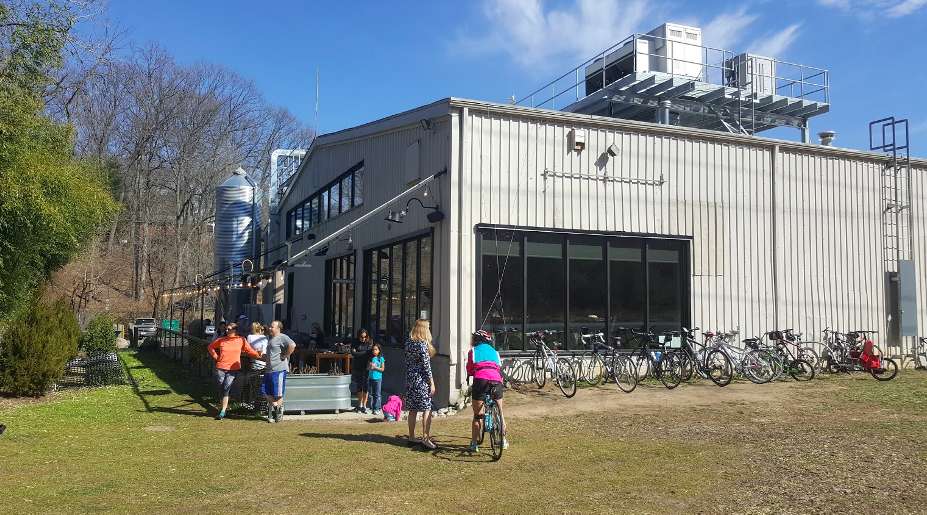
A more interesting pattern, in my opinion, are when retail spaces embrace the trail. One example of this is Caboose Brewing out in Vienna. While it has a standard drive up and park your car entrance, it also has a direct entrance from the W&OD Trail with bike racks. As you can see from this photo, many folks take advantage of this option.

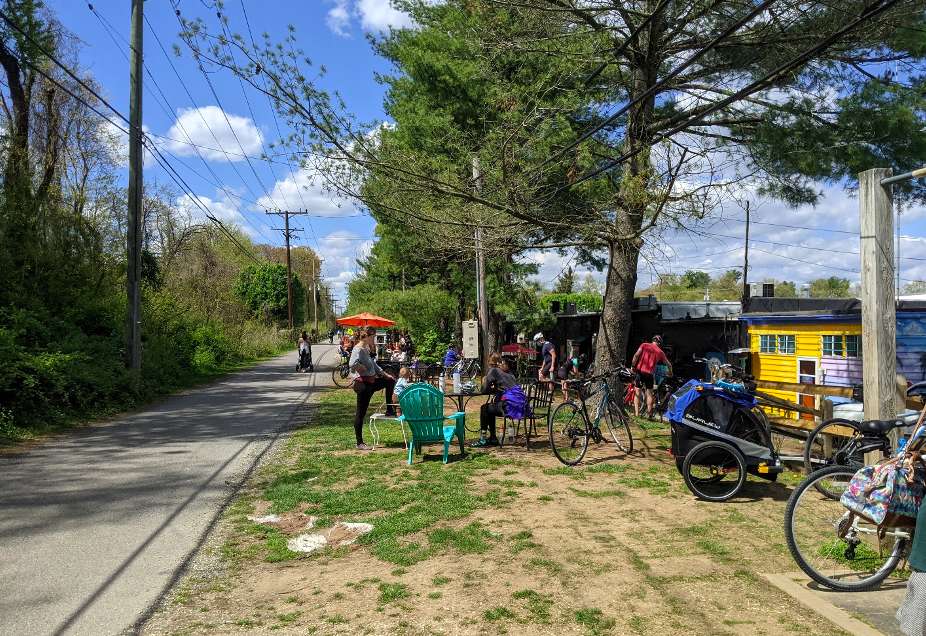
I saw an even more active and varied example of this recently on the Baltimore & Annapolis Trail. Nearly every business in this trail-adjacent strip mall had a usable back-entrance & there was a shared seating area along the trail adjacent to them. The coffee shop even had a little walk-up window where you could order from the trail side without setting foot inside the shop.

The seating area is pictured here along the trail, the retail shops are in the far right of the photo.

This area was clearly a gathering place for the community. It was busy every time I biked by over the weekend.

Where could we create these kinds of places in Arlington?

One possible option is the Arlington Boulevard Trail. The Days Inn site, at the corner of Pershing Drive is expected to redevelop in the near future and could be a fantastic spot to create this sort of trail/retail synergy. Currently the design guidance for the Days Inn site doesn’t call for such a thing, but that design guidance is open for comment now if you care to provide that sort of feedback to staff.

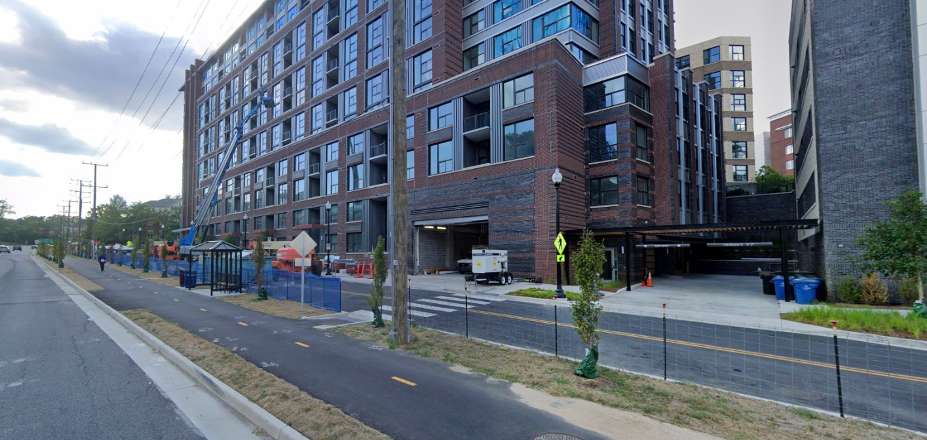
There are additional opportunities on the Arlington Boulevard Trail further east. While the development picture below kept the trail sandwiched between Fairfax Drive and Arlington Boulevard, the trail will likely need to cross Fairfax Drive somewhere before it reaches Rosslyn, putting the trail directly adjacent to the higher density buildings on the north side of Arlington Boulevard. This could be another opportunity for trail-oriented retail spaces.

Really, this is an opportunity to set a different character for the Arlington Boulevard Trail. Given its placement, it will never be the quiet leafy oasis that some of our other trails try to be. Instead, it could be the bustling community gathering trail with nodes of lively commercial activity.

While potential spots along the Custis, Bluemont Junction or W&OD are rare, they do exist. Any redevelopment in the Lyon Village Shopping Center could embrace the Custis in a big way and there are some commercial buildings in the vicinity of Pupatella in Bluemont that back up to the Bluemont Junction Trail offering some opportunities as-is.

Trails are good for business; they are a desired amenity that people want to live near, and people walking and biking tend to buy more locally. Having more activity adjacent to the trail creates more “eyes on the trail,” improving safety. Trail-oriented Development is an underutilized tool in the County’s planning toolbelt and we should use it more.

Chris Slatt is the current Chair of the Arlington County Transportation Commission, founder of Sustainable Mobility for Arlington County and a former civic association president. He is a software developer, co-owner of Perfect Pointe Dance Studio, and a father of two.


It’s safe for those who are fully vaccinated to skip wearing masks outside in most situations.

That’s according to new federal guidance from the Centers for Disease Control and Prevention. President Biden announced the new guidelines Tuesday, as vaccinations continue at a quickening clip locally but are slowing nationally.

Walking down the street, running, laying on the beach, and dining or hanging out with small groups of people you know — all can now be maskless for the fully vaccinated. The only exception: you should still wear masks when among large outdoor crowds.

“Starting today, if you’re fully vaccinated and you’re outdoors… and not in a big crowd, you no longer need to wear a mask,” Biden said.

The new CDC guidance will not immediately change Covid restrictions in Virginia. Gov. Ralph Northam (D) and his administration are reportedly considering relaxing the state’s mask mandate, which requires wearing masks outdoors if you cannot maintain social distancing. The mandate generally exempts outdoor exercise.

In Ballston yesterday evening, plenty of people could still be seen walking down the sidewalk with masks on. While mask wearing in such a setting doesn’t hurt, it’s probably unnecessary if you’re fully vaccinated at this point, according to the new guidance.

When walking outdoors in a populated but uncrowded public setting, when will you feel comfortable going maskless?


Community Matters is a biweekly opinion column. The views expressed are solely the author’s.

As a long time Arlington resident, I have seen citizen engagement from several angles.

I remember my first interactions with Arlingtonians upon moving here, and I definitely felt there was a reluctance to accept me immediately. Compared with my experiences with meeting new people in Alexandria, it felt like our Alexandria neighbors were more open to facilitate engagement and new perspectives with new members of their community.

One of my goals is to seek out community members who may not be engaged and encourage them to find their niche in Arlington. I also try to help organizations find ways to engage more residents at a systemic level.

One of the hallmarks of an inclusive community which fosters belonging is how we accept new ideas. As we emerge post COVID, after reflecting on what worked and what did not work in the “before times,” we should consider how we can encourage even more innovative ways to make our community stronger.

The origin of our ideas. We are often encouraged to funnel ideas through the Civic Federation and the County Board. While these can be effective, we should analyze whether there are other recommendations which come through other channels which do not make it to these bodies. We should be very clear to all residents about how to recommend new ideas.

Comfort in recommending new ideas. We should analyze how people feel about their opportunities to engage when they arrive in Arlington, and determine how those who have been here longer can connect with our new residents to make them feel welcome and involved. We should look at what methods work, and which do not. While I refer people to our existing institutions, I would like to have more confidence that they will be encouraged to stay active and engaged after joining, and that their ideas are heard.

Build on our current work. I have heard rave reviews of the Neighborhood College program. According to the Arlington County website, “Neighborhood College is a free civic leadership development program for Arlingtonians that helps participants become more effective community activists and leaders. Since its inception in 2000, nearly 400 Arlingtonians have graduated from the program, and many have gone on to become neighborhood leaders, members of advisory groups and commissions, officers in their civic associations, County Board members, volunteers at nonprofit organizations, local activists, and more.” We should continue to develop this program to encourage and grow the pipeline of engaged residents.

Provide training for community organizations. Arlington County has a great track record with diversity outreach. I was on the Diversity Dialogues Task Force several years ago, and we have made a concerted effort to engage organizations and individuals with Dialogues on Race and Equity. I would posit that there is an opportunity to provide similar general organizational outreach training. If the County government does not take the lead, we should provide a forum for organizations to share best practices on recruiting new ideas.

It is easy to say that information is accessible on a webpage, or that those who really want to be involved will find a way. This is not the best way to ensure that we have a consistent flow of new ideas and the structures to support them. We never know where the next big idea will come from that will revolutionize Arlington. When we push ourselves to constantly innovate and support new ideas, we become a better community.

Krysta Jones has lived in Arlington since 2004 and is active in local politics and civic life. This column is in no way associated with or represents any person, government, organization or body — except Krysta herself.


Making Room is a biweekly opinion column. The views expressed are solely the author’s. 

The following was written by guest columnist Kaydee Myers.

Over the next two years, the Arlington County Board and the Arlington School Board have the opportunity to create a more integrated community through four concurrent planning efforts.

Arlington County started its Missing Middle Housing Study and Affordable Housing Master Plan Review, while also drafting a plan for (the soon to-be-renamed) Lee Highway. Meanwhile, the School Board will adopt comprehensive elementary school boundaries in Fall 2022.

If the Boards coordinate these efforts, they could institute multi-family zoning in a portion of the area assigned to each neighborhood elementary school, leading to more mixed-income housing in neighborhoods currently lacking these options.

As in most public school districts in the nation, Arlington operates neighborhood schools, where most kids go to school based on where they live. Similarly, like most urban areas, Arlington County housing patterns reflect ingrained racial, ethnic, and economic segregation after years of discriminatory government policies and coordinated racist real estate practices. Our schools reflect this housing framework.

Past efforts, such as busing for integration, have fallen out of favor with parents, elected officials, and the courts. Other efforts, like option schools, are models for integration, but are not widespread enough to change the system. Plus, APS reports that Arlington parents voice a strong preference for walkable neighborhood elementary schools, and there are valid economic, environmental, and health benefits for promoting this walkability.

With this backdrop, APS is unlikely to challenge the status quo. However, APS can increase integration with intensive joint planning with the County Board to address school segregation where it starts — its neighborhoods. Many community members, including School Board member Reid Goldstein have called for this joint planning. But, despite being one of the 10 people in the County able to implement this collaboration, Mr. Goldstein didn’t elaborate on how to get started.

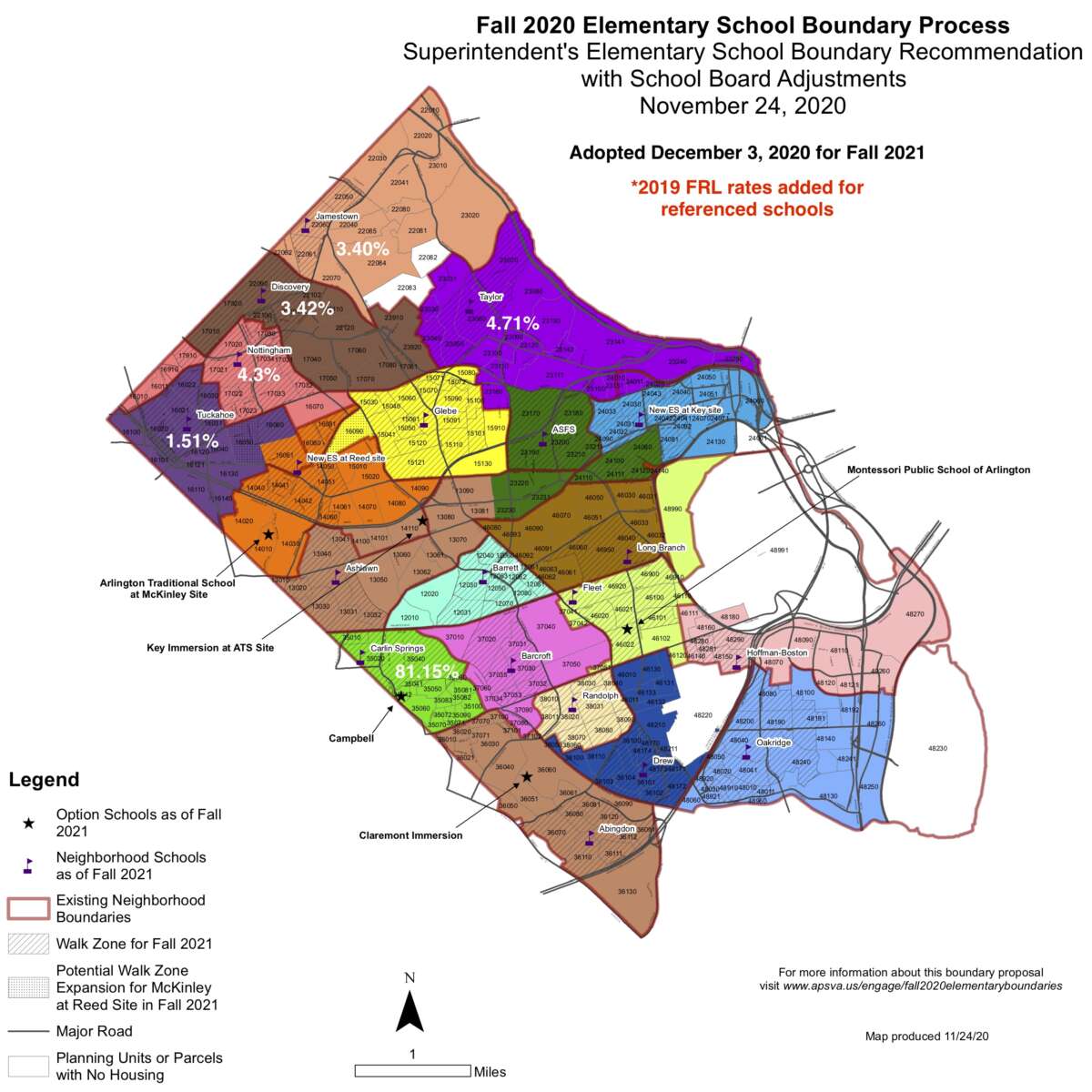
The most promising opportunity to improve integration within APS is the County’s Plan Lee Highway initiative. By reimagining Lee Highway as a walkable urban boulevard, a rezoning effort could add mixed-income housing in the northernmost quarter of Arlington — neighborhoods with the highest median incomes, which flow to elementary schools with the lowest poverty rates in the County.

(more…)


Last week, the Arlington County Board approved a new budget that holds the current real estate tax rate steady.

In some ways, that’s a win given the fears of a pandemic-caused budget crunch. Tax revenue ended up coming in above estimates and federal funding freed up million in local funds. Instead of making significant budget cuts, as originally feared, the Board was able to add in numerous initiatives, paid for with one-time funding.

The budget maintains the current base real estate tax rate at $1.013 per $100 in assessed property value, a de facto tax hike for most homeowners given that residential property assessments up are 5.6%. Assessments on commercial property, including office buildings, slumped 1.4% this year.

Some called for the Board to lower the property tax rate, as Loudoun County is doing and Fairfax County is considering, “to provide relief to homeowners hit by rising assessments.” In the end, the Board decided to do more rather than less, keeping the tax rate where it is and adding funding for things like housing, hunger, fiscal reserves, and raises for county employees.

Perhaps there is a calculation here, that an expected strong economy will further buoy tax revenue and property assessments over the next year, and that the next (FY 2023) budget is the time to trim the tax rate a bit, rather than now when many are still suffering as a result of the pandemic.

What do you think of the Board’s decision?

Photo by Pepi Stojanovski on Unsplash


We know what you’re thinking: why do we even bother writing any copy for the weekend discussion post?

Each week we scratch our heads and try to come up with something original, but it usually ends up being some generic musings on the weather and the fact that it was a busy week.

Is anybody actually reading the first 2-3 paragraphs of the weekend discussion? Or are you just scrolling down to the most-read stories and the comments?

In any event, the most-read Arlington stories of the past week are below.

  1. Here Are the Top 40 Highest-Rated Restaurants in Arlington
  2. Two COVID-19 Outbreaks Are Being Investigated In Arlington Schools
  3. Residents Prevail in Discussion of Grocery Store at Pentagon Row
  4. High Rise Plans Take Shape for Vacant Wendy’s Lot in Courthouse
  5. Mountain Bikers Continue Seeking Access to Arlington’s Dirt Trails
  6. New Japanese Restaurant Coming to Rosslyn
  7. County Board Kills Historic Designation Process After Failure to Save Febrey-Lothrop Estate
  8. New Crystal City Eatery ‘The Freshman’ Opens This Week
  9. Coronavirus Cases Slow in Arlington As Vaccinations Quicken
  10. After Being Cancelled Last Year, Ballston’s Quarterfest Crawl is Back On
  11. Arlington Restaurants Featured on Michelin Bib Gourmand List (Kind Of)
  12. Arlingtonian Launches Shimo, a Gardening Kit for City Dwellers

Feel free to discuss those stories, or anything else of local interest, in the comments. Have a nice weekend!

Flickr pool photo by Joanna Hiatt Kim


View More Stories