Making Room is a biweekly opinion column. The views expressed are solely the author’s.

I grew up in a predominantly white suburb in Minnesota. My family didn’t talk about race, but we had plenty of ways to indicate that black people were not our neighbors. I remember my parents warning me not to cross the river into Minneapolis. Once, after taking the wrong exit into a black neighborhood of Northern Minneapolis, my dad told me to lock the doors as we drove through.

This prejudice didn’t disappear when I moved to deep blue, progressive Arlington. But now I am more aware of the coded language white people use to mark black people as outsiders. I read Nextdoor complaints about people from outside the neighborhood playing basketball in Virginia Highlands Park. I’ve seen posts on DC Urban Moms decrying the school busses that pull up in front of Arlington’s affordable housing buildings. Without ever mentioning race, we can clearly show who is and isn’t welcome in our neighborhoods.

Our impulse to separate ourselves from our black and brown neighbors is deadly. Research from Boston University shows “racial residential segregation was the predominant factor explaining why some cities have greater black-white racial disparities in fatal police shootings — even after controlling for a city’s crime rate, median income, racial composition of its police force, and other factors.”

Now we are mourning the murder of George Floyd, a black man from South Minneapolis, by a police officer who thought he was a threat. The perpetrator, Derek Chauvin, lived in the white suburb of Oakdale. Neither man lived far from where I grew up, but as the New York Times explains, these two neighborhoods are worlds apart. The Twin Cities metropolitan area used to have a region-wide affordable housing mandate and Minneapolis consciously desegregated its schools, but these policies lost white support in the 1980s. Now, the region has one of the largest racial wealth gaps in the country.

In the twenty-first century, Arlington has removed most of the obvious racism from our housing policy. The segregation wall at Hall’s Hill was literally washed away by flooding in 2019. The black neighborhood that was removed to clear land for the Pentagon has a commemorative plaque.

But even without racial covenants or redlining, the consequences of which remain with us, we have plenty of tools to separate white and black families.

Exclusionary zoning — the rules that prevent anything but a detached, single-family home from being built in certain neighborhoods — is the modern form of residential segregation. In Arlington, zoning on 87% of our 26 square miles bans anything except a detached single-family home. Our site plan review process, which is overly deferential to existing homeowners, prevents or delays the creation of new committed affordable housing.

https://twitter.com/janefgreen/status/1269070127997345797

Today, single-family neighborhoods have become gated communities that are accessible only for the wealthiest families, who are disproportionately white. This prevents black families from gaining opportunities and building the wealth that could reduce racial disparities. And when black families do live in these exclusive enclaves, they can be subject to surveillance and police scrutiny.
(more…)


It was a historic week in Arlington, D.C. and across the country.

Missed any of our coverage? You can find it here.

Here are the most-read articles of the past week:

  1. Arlington Officers Ordered to ‘Immediately Leave D.C.’
  2. Black Lives Matter Protest Underway in Clarendon
  3. Virginia’s ‘Phase 2’ Reopening to Start Friday, But Will Exclude N. Va. for Now
  4. Protest Marches Planned in Arlington Through Sunday
  5. Teen to Be Charged in Hit and Run That Killed Dog
  6. D.C. Police Blocking Traffic from Key Bridge to Georgetown as Businesses Board Up
  7. County Leaders Defend ACPD Officers Who Were Recalled from D.C. Protests
  8. Arlington Sees Significant Drop in New Coronavirus Cases
  9. Photos: Peaceful Protest Marches from Shirlington to Ballston

Feel free to discuss those or any other topics of local interest in the comments.


What’s Next with Nicole is a biweekly opinion column. The views expressed are solely the author’s.

(Updated at 10:25 a.m.) This year has certainly not been normal. Between the murders of George Floyd, Breonna Taylor, and Ahmaud Arbery, and the disproportionate impact that COVID-19 has had on black and brown communities in our country, we continue to need to dig deep and to understand the why, to reflect, and to do better.

I watched the split screen of President Trump advocating the usage of our military against protesters across the country in his Rose Garden address, with another screen showing Arlington County Police on the front lines advancing against peaceful protesters prior to curfew in D.C. I was dismayed and broken-hearted. This was so inconsistent with the images I had been seeing of ACPD helping to block traffic and handing out water to peaceful protesters.

Thankfully, Arlington’s leadership quickly responded and acknowledged the problem. They took decisive and immediate action, and have vowed to re-evaluate the agreement that led to this situation to ensure our policing efforts better reflect the values of our community.

Changing course in inherently flawed systems isn’t easy, but it is necessary. This step was necessary and in a time that many leaders are unable to see a problem in their system, own it, and fix it we are lucky to have leadership with the willingness to do so. This applause though is not for a mission accomplished. This is just the beginning of a larger conversation.

First, we should continue our community conversation about policing. We need to support the national NAACP in their push for:

  1. A ban on the use of knee holds and chokeholds as an acceptable practice for police officers.
  2. Clear rules on the escalation for the Use of Force Continuum.
  3. A ban on shielding from the public officer misconduct information and disciplinary histories in each state’s Open Records Act and denial of recertification credentials for police officers if it is determined that their use of deadly force was unwarranted by federal guidelines.
  4. Implementation of Citizen’s Review Boards in municipalities to hold police departments accountable and build public confidence. Arlington NAACP also supports this and states that over 70 communities across the country, including Fairfax, already have one.

Additionally, we should continue our conversation about economic inequalities and building black wealth. When looking for a black-owned business for dinner this weekend I ran into a wall. After crowdsourcing on Arlington Neighbors Helping Each Other Through COVID-19, I found four Arlington black-owned restaurants where I could order dinner, six if I included one coffee shop and an ice cream store.

We must also continue our conversation about diversity within our state representation. Currently, of our seven state delegation members, all are white with the exception of one person of color. Our Human Rights Commission is currently the only commission or working group with a black person or person of color as chair (starting next month that will change with new leadership that includes people that are both black and other people of color).

Furthermore, we should continue our conversation about racial health inequalities now during COVID-19, as well as during less tumultuous times. How do we make sure black and brown people are not dying at disproportionate rates in our community?

Finally, we must continue this conversation about race and white privilege, on every front in our community: from policy to policing, to zoning, healthcare, to school boundaries, small businesses. So many of us are asking what we can do. We can listen, we can ask why, we can do better — we can actively work for change.

Nicole Merlene is an Arlington native and former candidate for Virginia State Senate. She has served as a leader in the community on the boards of the Arlington County Civic Federation and North Rosslyn Civic Association, as an Arlington Economic Development commissioner, in neighborhood transportation planning groups, and as a civic liaison to the Rosslyn Business Improvement District.


Peter’s Take is a biweekly opinion column. The views expressed are solely the autho

A new report by the Civic Federation (CivFed report) analyzes Arlington’s recent historical spending on park and recreation investments funded with Capital Improvement Plan (CIP) bond dollars.

The CivFed report’s results are summarized in a table on page 1. Roughly 86% of all bond funds were dedicated to recreational uses. By contrast, less than 5% was spent on land acquisition and less than 2% was invested in open space and natural habitat.

Resource allocation mismatch

This funding allocation history is inconsistent with the public’s stated priorities for outdoor park and recreation investments, as determined by the County’s 2016 “statistically valid” survey, which ranked investments in trails, natural areas, and wildlife habitat as top priorities to satisfy unmet or partially unmet needs in our community.

In three of the last four park and recreation bond referenda appearing on November ballots, land acquisition was offered as a rationale for borrowing the funds. Yet, CivFed’s report notes a consistent shortfall in the County’s acquisition of new public land — just 1.82 total acres acquired since 2015, well below the annual 3-acre per year target in the 2019 Public Spaces Master Plan (PSMP).

Although the County has made significant investments in trail modernization and expansion through various funding mechanisms (including transportation funding), the same cannot be said for land acquisition or for investment in natural areas and wildlife habitat.

Beyond the 2016 community survey priorities, the County has set aggressive goals in its plans for stormwater management and flood resilience, as well as energy-use reduction coupled with urban heat island mitigation. See the 2014 Stormwater Master Plan and the 2019 Community Energy Plan.

Acquiring land to preserve and harness natural County infrastructure is essential for meeting these goals while simultaneously allowing the County to satisfy previously identified unmet or partially met needs for natural open space supporting human health as well as wildlife.

CivFed’s recommendations

On May 19, the CivFed voted overwhelmingly (63-5-1) to approve an important resolution making three recommendations to guide future park and recreation investments:

  1. The County should balance its capital investments to “fund passive park features (including wildlife habitat and open space), trails, and parkland acquisition on a more equitable basis with respect to its recreational investments.”
  2. The County should “demonstrate more forward-thinking and commitment to land acquisition for passive park use,” especially through the purchase of land identified as a “Generational and Unique Opportunity” in the PSMP.
  3. The County should “consider as a high priority dual-purpose sites that can be used for flood mitigation and Open Space-Natural Habitat,” as described in the 2014 Stormwater Master Plan.

Planning for Arlington’s future during a pandemic

On May 19, in response to uncertainty prompted by the pandemic, the County Manager proposed a scaled-back, one-year CIP just for 2021, rather than the traditional 10-year plan.

Stormwater management/flood resilience continues to be included as a funding priority in this one-year CIP. This priority is consistent with CivFed’s third recommendation to acquire land that serves a dual purpose.

(more…)


The Right Note is a biweekly opinion column. The views expressed are solely the author’s.

“Today may we all rally to the side of justice for the victims, to the side of using peaceful protests to effect change, and to stand against those who would use this tragedy as an excuse for violence, destruction and further division.”

Yesterday in the Progressive Voice, Delegate Rip Sullivan opined on the “virtues” of voting by mail. For Sullivan, first it was gerrymandering that made our elections unfair. Then it was having to show a government issued ID, free if you need it, to prove you were who you say you were.

Now voting in person is on his radar to be eliminated. What will it be next? Maybe voting by mail will be too hard because it requires someone to walk to the mailbox, so we should let them vote with two clicks on a smartphone?

We should ask ourselves if we want to make it harder and harder to identify who is actually casting the votes in elections?

In California, it is legal for someone to submit your ballot for you. Volunteers can pick up hundreds of ballots and drop them off with local election offices with no accountability in between. You may have read about this, it is known as ballot harvesting. In an April story, one Democrat strategist even suggested they would come and take ballots  out of mailboxes.

What would Delegate Sullivan say about that? Where would he draw the line?

For those with health concerns about voting in the Arlington County Board special election in July or the general election in November, our absentee voting system will accommodate you. Right now you can vote in person in advance, or you can vote by requesting an absentee ballot by mail. In the fall, you will not even need to provide a reason at all. You can just vote early because you feel like it.

Delegate Sullivan suggests he supports moving to all mail-in voting permanently. However, mailing a ballot to every registered voter on a list is problematic in an of itself. Voter registration lists, like any mailing list, are always out-of-date. People move, and sadly, people die. We would unnecessarily be opening ourselves up to fraud when it is already relatively easy to vote now.

Voting is both a right and a privilege. In fact it is one of the most sacred rights we have in this country. At the same time, you are not required to participate. Many people do not vote because they feel like they have no real choice, or that they feel like politicians on both sides have failed them. That is their right too.

But, your elected officials have an obligation to make it both accessible and secure for all those who do chose to participate. It should be accessible to those who are eligible to vote and secure to make sure those votes are not watered down by anyone who wishes to commit fraud.

Mark Kelly is a long-time Arlington resident, former Arlington GOP Chairman and two-time Republican candidate for Arlington County Board.


Progressive Voice is a bi-weekly opinion column. The views expressed are solely the author’s.

By Del. Richard C. (Rip) Sullivan, Jr.

While Arlington continued to confront the coronavirus epidemic, County residents also were preparing for several elections: the Democrats’ May 30 School Board caucus, the Republicans’ June 23 Senate primary, the July 7 County Board special election, and the November 3 general election. Arlingtonians take their civic duty seriously and vote at above-average rates, yet no one can predict exactly when the virus will stop being an immediate threat to our health, when life will go back to “normal,” or whether there will be a second wave of the virus.

To continue our strong record of voter participation and to stay safe, Arlingtonians should prepare to use absentee voting by mail until the General Assembly passes legislation to create a comprehensive no-excuses, vote-by-mail system. Democracy thrives when more voters participate. Voting-by-mail presents that opportunity and also can save money in the long run.

Voting by mail is not only useful during an outbreak – it strengthens our democracy. First, the system increases turnout and does not favor any one partisan bloc. A new Stanford University study finds that universal vote-by-mail programs do not advantage one party over another, but instead increase overall voter turnout. The more people who vote, the better for our democracy.

Second, access to the ballot box on Election Day is often difficult for individuals who, for example, are caretakers, do not have available transportation or depend on low-wage hourly jobs. Lines at the polls can be devastating to their schedules and livelihoods. Receiving a ballot at home to vote by mail would give these Virginians much-needed flexibility. By expanding the number of registered voters who can practically vote, we would again increase turnout and make sure that their voices are heard in the democratic process.

Third, voting by mail is less expensive for voters and states alike. Voters who work hourly wages do not have to lose any earnings by taking time off to cast a ballot. There is no cost of gas or a Metro card to the voter in order to get to one’s polling place. There is no cost of childcare when a parent or caretaker goes to vote. Voters mail in their ballot when it is convenient, leveling the playing field in terms of the cost of participation for voters of all socio-economic backgrounds.

States ultimately save money because they no longer need to staff as many traditional polling places and invest in expensive voting machines at each location. Oregon, for example, reports savings of 30 percent since its transition from traditional in-person voting to exclusively by-mail voting. The price of mailing pre-stamped ballots to voters may seem high at first, but it is outweighed by savings for states and jurisdictions that have tried it.

The local elections held in towns and cities across the Commonwealth on May 19 marked the first time that Virginians faced a choice between voting in-person, voting absentee by mail, or not voting at all in the midst of a pandemic. The results are clear – when given the opportunity, voters want to cast their ballot by mail. In Fairfax City, for example, 74 percent of voters cast an absentee ballot by mail. Turnout also increased slightly across Virginia due to the increase in the number of absentee ballots cast.

Before Covid-19, we already had made great progress in the General Assembly regarding access to the ballot box. We passed a bill making Election Day a state holiday (and doing away with Lee-Jackson Day), changing Virginia’s voter ID law to allow people without IDs to sign an affidavit, and allowing for no-excuse early voting 45 days prior to an election. We also implemented automatic voter registration at the DMV.

While we are not likely to see a fully implemented vote-by-mail system in Virginia by November, we can get close by ensuring that every voter who wishes to vote does so by requesting an absentee ballot. The Covid-19 outbreak may be a threat to our personal and community health, but we can take steps to ensure that it does not interfere with the health of our democracy.

Richard C. “Rip” Sullivan, Jr. is a member of the Virginia House of Delegates from Virginia’s 48th District, which encompasses parts of Arlington and McLean. He practices law in Arlington with Bean Kinney & Korman, P.C.


Arlington is reopening, but the reopening is a bit uneven.

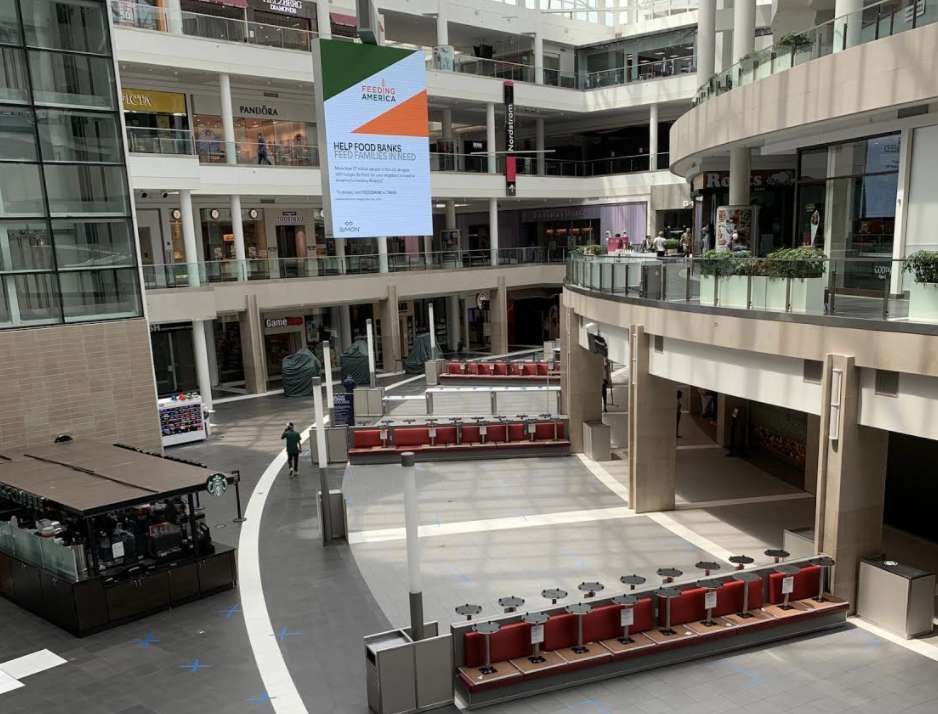
The Fashion Centre at Pentagon City mall, which is starting to reopen, was nearly empty around lunchtime, as seen above. In Clarendon, meanwhile, the outdoor patios of restaurants were busy and The Lot beer garden was especially packed Friday evening.

Here are the most-read articles of the past week:

  1. Neighborhood Abuzz Over Bear Sighting in East Falls Church
  2. N. Va. Expected to Reopen, Masks Required on Friday
  3. Distance Learning to Start School Year ‘Very Probable,’ APS Says (May 22)
  4. Local Gentlemen’s Club Reopening Friday, Sans Dancers
  5. State Police Chase Ends in Pentagon City
  6. Testing Up, Deaths Now Over 100 As Reopening in Sight
  7. County Board Approves Process for Temporary Outdoor Restaurant Seating Areas
  8. Yorktown Principal Apologizes for Banner Seen as Racist (May 21)
  9. Arlington Hits a Few Bumps in Park Reopening Process

Feel free to discuss those or any other topics of local interest in the comments. Have a nice weekend!

Photo courtesy Ryan Kelly


Arlington and the rest of Northern Virginia are set to begin the first phase of the region’s reopening on Friday.

With coronavirus cases increasing steadily, but not exponentially, and hospitals having sufficient extra capacity, local health officials say localities can start reopening relatively safely. (Much of the rest of the Virginia started reopening on May 15. D.C. is also partially reopening this coming Friday.)

Wearing masks indoors in public spaces will be mandatory in Virginia starting Friday, with some exceptions, and businesses will only be partially reopening, with extra safety precautions. More from a county press release:

Highlights of the Governor’s Forward Virginia Phase 1 – Effective May 29

  • Non-essential businesses can open at 50 percent capacity, with strict requirements.
  • Take-out and curbside pickup for restaurants and beverage services can continue and outdoor seating will be allowed at 50 percent capacity (see more on this below).
  • Gyms and fitness facilities can offer limited outdoor exercise options.
  • Outdoor swimming pools may be open for lap swimming only, with one person per lane.
  • Beauty and nail salons, barbershops and other personal grooming services can provide services by appointment only and must follow strict guidelines.
  • Places of worship can open for drive-in services or services inside at 50 percent capacity.
  • Spray parks, basketball courts, and racquetball courts must remain closed, as well as entertainment facilities such as movie theaters.
  • Social gatherings of more than 10 people are still banned.

There are mixed feelings about reopenings, in debates that have played out in states and counties across the country.

Some say reopenings will unnecessarily cause further disease and death. Others say the stay-at-home orders are no longer needed and are only causing more economic hardship. Still others are just happy to be able to get a haircut and spend some more time outside of the house.

In a word, how are you feeling about Arlington’s reopening?


Good news: a holiday weekend is here.

If you’ve been fortunate enough to be able to continue working, you are likely getting an extra day off. This is especially welcome if you’ve been working while trying to wrangle kids at home.

ARLnow’s news coverage will be taking a break, barring breaking news, until Tuesday. In the meantime, here are the most-read Arlington articles of the past week.

  1. Yorktown Principal Apologizes for Banner Seen as Racist
  2. Tall Man Wearing Short Shorts Prompts Call to Police
  3. ACFD Helps Battle Fire at Edy’s Chicken & Steak on Route 7
  4. Boston Market Closes Permanently on Columbia Pike
  5. Data Shows Demographic Disparities in Arlington’s Coronavirus Cases
  6. Two Teens Arrested for Vandalism at New Middle School
  7. Arlington County Planning to Distribute Free Masks
  8. Coronavirus Hospitalizations Down, Cases Continue to Rise in Arlington (May 18)
  9. National Guard Conducts Mass Testing at Local Senior Care Facility

Feel free to discuss those or other topics in the comments. Have a great Memorial Day weekend!


What’s Next with Nicole is a biweekly opinion column. The views expressed are solely the author’s.

The Centers for Disease Control updated guidance to slow the spread of COVID-19 by suggesting multi-unit buildings such as apartments and condominium buildings:

“Clean and disinfect shared areas (laundry facilities, elevators, shared kitchens, exercise rooms, dining rooms) and frequently touched surfaces (e.g. tables, hard-backed chairs, doorknobs, light switches, phones, tablets, touch screens, remote controls, keyboards, handles, desks, toilets, sinks) using EPA-registered disinfectants more than once a day if possible.” April 25, 2020.

Two-thirds of Arlington households are in multi-unit buildings. From anecdotal feedback, buildings ranging from luxury to affordable have done almost nothing to change their normal cleaning habits unless a COVID-19 case has been identified.

“Every day when I go down the elevator to walk my dog, I am in a gigantic petri dish,” one person told me. “I am in an enclosed space, touching hundreds of people’s germs on buttons and door handles. We are in a viral pandemic and our building has still not changed our once a week cleaning schedule”.

As Northern Virginia plans to reopen in the next few weeks, we will collectively increase our chances of germ spreading. Part of Arlington and Northern Virginia’s path for reopening should include CDC recommendations for multi-unit building cleaning and disinfecting as a part of their plan.

Arlington County has already done an impressive job collecting information about building managers for their effort to inform landlords about courts being closed for evictions and renters’ rights during COVID-19. This contact information data can and should be used in a proactive effort to remind buildings about CDC recommendations to clean multi-unit building high-touch spaces multiple times a day. This seems like a little, easy, accomplishment that we should be able to get done and might be able to save lives upon our reopening.

Contrary to public belief, people of all ages live in multi-unit buildings. With the knowledge that a significant amount of virus carriers are asymptomatic, we should not be waiting for residents to proactively tell management that they are sick to trigger regular cleaning of common spaces. Extraordinary measures that the CDC has laid out in their guidance should be taken when you have over 1,000 people living in one building sharing the same front door.

Between dog care, groceries, and taking a mental health break, it is inevitable that people will need to go outside. It is in the interest of public health for the majority of Arlingtonians that live in multi-unit buildings to have a safe home to walk in and out of. I hope the Department of Community Planning, Housing, and Development can work with the communications and public engagement team to get the word out to apartment and condominium management about updated CDC guidelines for disinfecting as part of our reopening plan.

Resources if you are in need of assistance:

Do not feel ashamed to ask for help.

If you are in need of assistance for rent, food security, help filing for Medicaid or unemployment benefits go to this website: Department of Human Services Assistance, call 703-228-1350, or if necessary visit 2100 Washington Blvd in Arlington. Someone will work with you to get the help you need.

Nicole Merlene is an Arlington native and former candidate for Virginia State Senate. She has served as a leader in the community on the boards of the Arlington County Civic Federation and North Rosslyn Civic Association, as an Arlington Economic Development commissioner, in neighborhood transportation planning groups, and as a civic liaison to the Rosslyn Business Improvement District.


Peter’s Take is a biweekly opinion column. The views expressed are solely the author’s.

The Northern Virginia Regional Parks Authority (NOVAParks) owns and operates Arlington’s primarily natural Potomac Overlook, Upton Hill and W&OD Trail regional parks.

But NOVAParks seems to have lost the trail outlined in its own Mission Statement which emphasizes (at p.7) enriching our lives “through the conservation of regional natural and cultural resources.”

Arlington’s statistically valid resident park survey (at p. 4) found that our community’s three most desired park features are multi-use trails, hiking trails, and natural areas & wildlife habitats. Yet NOVAParks is now single-mindedly pursuing funding for a project to dramatically widen the W&OD trail to create an environmentally damaging commuter thoroughfare.

NOVAParks’ W&OD trail widening project

NOVAParks proposes replacing the two-mile-long, 10-12 foot-wide segment of the trail paralleling Four Mile Run between N. Roosevelt St. and North Carlin Springs Road. In many areas the new trail will be two parallel paved trails — a 12-foot-wide bike trail, an 8-foot-wide pedestrian trail, a 2-foot median and outside buffers — for a total width of at least 26 feet, equal to some residential streets! Elsewhere, the trail will be widened to 16 feet with outside buffers for a total width of at least 20 feet.

This project should be withdrawn

This project will destroy almost two acres of green space while adding almost two acres of impermeable paved surface, including within Chesapeake Bay Resource Protection Areas (RPA’s) and flood plain along Four Mile Run, threatening increased flooding in Arlington’s BonAir and Bluemont parks. NOVAParks has failed to conduct an “alternatives assessment” of less expensive and environmentally destructive solutions. Finally, NOVAParks has failed to conduct any safety assessment of whether its proposed wider trail, with potentially higher bicycle speeds and volume, will actually increase bicycle speeds, and therefore the frequency and severity of accidents.

(more…)


View More Stories