July turned to August this week, as life in Arlington slowed just a touch and there were signs that fall is beginning to approach.

Maybe you noticed a bit less traffic on the roads as summer vacations ramped up. Or the Oktoberfest beers on local store shelves.

We noticed a bit less news — one factor: fewer people around and no County Board meeting in August — but ultimately there was still plenty to report.

Here are the top 8 most-read articles in Arlington this week (excluding this one):

  1. ‘Good Company’ in Ballston Rakes in the Dough
  2. Roads Closed in Clarendon for Vice Presidential Visit
  3. Arlington County Fair to Include Beer Garden, Goat Yoga This Year
  4. Rebuilt Taco Bell Now Open on Lee Highway
  5. Committee: Amazon HQ2 Designs Are Colorful But Unambitious
  6. APS Names Interim Superintendent
  7. Maizal Opening Tomorrow at Ballston’s Quarter Market
  8. One More Page Books Holding Auction to Cover Rising Rent

Enjoy what should be a relatively pleasant weekend — there will only be three more before Labor Day weekend. Feel free to discuss the stories above or any other local topic of interest in the comments.


Peter’s Take is a weekly opinion column. The views and opinions expressed in this column are those of the author and do not necessarily reflect the views of ARLnow.com.

In his column last week, Mark Kelly discussed the recent unfortunate Supreme Court decision (5-4) concluding that federal courts could not provide relief from partisan gerrymandering.

In her persuasive dissent in that case, Justice Kagan concluded:

“In the face of grievous harm to democratic governance and flagrant infringements on individuals’ rights — in the face of escalating partisan manipulation whose compatibility with this nation’s values and law no one defends — the majority declines to provide any remedy.”

Despite this Supreme Court decision, Virginia is on its way to less partisan redistricting

Like many other states, Virginia currently has a partisan redistricting system.

For at least twenty years–up until early this year, Republican leaders in the Virginia House of Delegates fought non-partisan redistricting. They wanted to retain their control and saw partisan redistricting as the best way to do it.

Many Democrats believed they would do better with non-partisan redistricting. But that did not stop some Democratic legislative leaders, like 28-year incumbent Democratic Senator “Dominion Dick” Saslaw, from spearheading the disastrous 2011 legislative deal under which Virginia Senate Democratic leaders gave Virginia House Republican leaders free reign to draw partisan Delegate lines while Virginia Senate Democratic leaders received free reign to draw partisan Senate lines.

Partisan redistricting has served us poorly. The reasons were explained convincingly by a group of 20 business leaders from Virginia, Maryland and DC in this January 2019 statement:

“The endemic dysfunction in our government stems from incentives in politics that promote ideological purity over pragmatic problem solving and cooperation. … We believe anti-gerrymandering measures are the logical starting point for reform, and they are urgently needed in both Maryland and Virginia. A system in which politicians pick their voters, rather than the other way around, is inherently wrong and dysfunctional. Partisan gerrymandering is a protection racket for incumbent politicians….”

Sweeping gains by Democrats in the 2017 Virginia House of Delegates elections, combined with the prospect that Republicans might lose control of one or both legislative houses in the 2019 general election, finally led the Virginia Republican House leadership to support a form of non-partisan redistricting.

With strong bi-partisan support, Virginia enacted a 2019 law that will lead to a less partisan redistricting system.

(more…)


The Right Note is a weekly opinion column. The views and opinions expressed in the column are those of the author and do not necessarily reflect the views of ARLnow.com.

The Progressive Voice opined this week that it may be time to take measures that rein in growth.

It is slightly ironic that the growth in high rise housing has helped give Democrats a virtual lock on local elections is also causing consternation among “progressives.” It is also amusing that progressives complain about traffic and parking while many of them are advocating for eliminating travel lanes on already congested streets, stopping scooter rentals and eliminating parking spaces.

Growth is just one of the things Democrats have been fighting with each other about in Arlington.

Also on the list, whether to provide subsidies to big corporations like Amazon; the debate over preserving neighborhood schools when redrawing boundaries versus making diversity the priority when setting new lines; whether a strong, experience prosecutor is more important than an unknown and unproven Commonwealth Attorney who promises to reform the office; disagreements over whether accessory dwelling units were bad for neighborhoods; and changing the name of Washington-Lee to Washington-Liberty high school.

The anti-Trump sentiment that drove Democrats to the polls in 2018 overshadowed the issues facing the county as well as the check to one-party rule that having an independent voice on the County Board provided.

The Board read the results differently. They went on a post-Vihstadt spending spree, including millions to build more bus stops on Columbia Pike. They voted to raise their own pay by as much as 60%. Yet things like ongoing water main breaks and the recent flooding reminded voters that basic local governance decisions on things like infrastructure have often not received enough attention.

There is undoubtedly continued discontent with how our elected officials are making decisions. One option is for Democrats to run more candidates in primary contests against incumbents in future years. But there is tremendous opportunity to partner with the Independents and Republicans who want to see our county run well and in a fiscally responsible manner.

It might even be time for the community to come together and back a write-in campaign for John Vihstadt. And since it’s a two seat County Board year, maybe a Vihstadt-Stamos write-in ticket? If Vihstadt’s win in 2014 sent a shock wave through the establishment, imagine if it happened again without his name appearing on the ballot.

Mark Kelly is a 19-year Arlington resident, former Arlington GOP Chairman and two-time Republican candidate for Arlington County Board.



Progressive Voice is a weekly opinion column. The views and opinions expressed in the column are those of the individual authors and do not necessarily reflect the views of their organizations or ARLnow.com.

By Eric Harold

Floods, traffic, school capacity, lack of affordable housing. What do these increasingly recurring issues in Arlington have in common? All, in some form or fashion, are exacerbated by the increased growth and development throughout Arlington County for more than 20 years. There are many positive aspects to continued growth, but growth is not an unbridled good. The question is how to better manage it.

Arlington’s 2018 resident survey illustrates people’s increasing concerns over how the County has managed growth. Fewer than 50% of Arlingtonians are “very satisfied” or “satisfied” with how well the county is managing growth. More than a fourth of residents (26%) are “dissatisfied.” This topic (see p. 7) ranked next to the bottom in residents’ satisfaction.

A separate question asked residents which Economic Development and Planning items were most important to them. “Efforts to manage and plan for growth/development” ranked first (42%) (see p. 31).

Since the 2018 survey, Amazon has chosen Arlington as “HQ2,” with up to 25,000 new jobs expected over the next 15 years. Development continues apace in Arlington, with Crystal City, Columbia Pike and Ballston being hot spots along the major transportation corridors. In addition, infill housing and residential additions/teardowns and rebuilds continue in neighborhoods away from the major corridors. All of this contributes to the continued increases in enrollment in Arlington Public Schools, as well as increased flood damage, more traffic, and less affordable housing.

Things will not get better without a rigorous assessment and substantial change in County policies. So what can be done to improve this situation?

Historically, the County has managed growth using “smart growth” principles from nearly 50 years ago as Metro was being constructed. These principles (see slide 15):

  • Concentrate high and mid-density redevelopment around transit stations, then taper down to existing neighborhoods
  • Encourage mixed-usage in these areas
  • Focus on pedestrian and open space environments
  • Preserve and reinvest in established residential neighborhoods.

The County developed a General Land Use Plan (GLUP) that zoned 11% of the County along the two rail corridors to encourage mixed-use, high density development, while leaving 89% of the County zoned primarily as low-density. It then developed a Site Plan process by which developers can get increased density in return for building consistent with the GLUP, including significant amount of public improvements, and compliance with LEED and affordable housing goals.

Arguably, encouraging greater density in the transportation corridors while limiting development options in the neighborhoods limits the supply of available housing. Ever greater density also contributes to overcrowded streets and schools.

Should the County Board exert tighter oversight? Should the County Board employ more strategic thinking on development decisions, or put less emphasis on increasing density? Does the County need changes or additional tools for better managing development?

The tools for managing growth often work at cross-purposes to each other. Recently “upzoning” (rezoning to allow taller buildings or denser development) has been proposed as a means to increase affordable housing. But denser development affects local infrastructure (roads, sewers, stormwater management).

(more…)


The last full week in July is coming to a close and a warm but relatively pleasant weekend is on tap.

It has been a busy week at ARLnow — a week we announced a new readership record and three new hires. (Technically, thanks to strong readership yesterday, our trailing 30-day traffic is now up to 1.415 million pageviews, another new record.)

Here are the top six most-read articles we published on this busy week.

  1. Officials Warn of Foodborne Illness Outbreak in Arlington and N. Va.
  2. A Bridge Too Far: The Dating Divide Between D.C. People And Arlingtonians
  3. Missing Man Found Dead in Arlington Was a Career Center Employee
  4. Arlington Brothers Save Child from Drowning in Ireland
  5. JBG Smith Unveils New Expansion Plan for RiverHouse Property Near Amazon HQ2
  6. Columbia Pike Dry Cleaner Closing Leaves Customers Hanging

Feel free to discuss these stories or any other topics of local interest in the comments. Have a nice weekend!


Peter’s Take is a weekly opinion column. The views and opinions expressed in this column are those of the author and do not necessarily reflect the views of ARLnow.com.

As Arlington residents try to cope with the increasing frequency and severity of flooding, as outlined in last week’s column, a combination of code violations by Washington Golf & Country Club (WGCC), together with County errors and budget shortfalls, has polluted Donaldson Run and wreaked havoc on Zachary Taylor Park.

A WGCC course-redesign project has caused repeated, serious flows of mud and chemicals into Donaldson Run.

For months, mud and project-related chemicals from a WGCC course redesign project have run into Tributary A downstream of the bridge and into Donaldson Run. This Run flows under Military Road and becomes the stream flowing through the Potomac Overlook Regional Park (POP). (See December videos of Tributary C effluent from WGCC here and here and photo of mud ingress to clean Tributary A here.) POP is a 66-acre natural park with a Nature Center, streams and pathways for walking and hiking. Contamination of the streams poses a health risk to people and pets crossing the stream.

First observed by residents in June 2018, the matter was investigated by the VA Department of Environmental Quality (VADEQ) and deemed worthy of further oversight and penalties under Virginia law.

VADEQ then turned the matter over to Arlington County. According to sources at the Donaldson Run Civic Association, as of mid-July 2019, the County has identified six or seven serious violations, with fines against WGCC totaling somewhere between $11,000 and $15,000.

To its credit, the County has ordered that any golf course work related to renovating the course for purposes of play be suspended until the water flow in Tributary C has been stabilized. This is a consequential demand given the importance of the golf course to members.

On the other hand, the total financial penalties imposed as of this date are a pittance and are based on a staff interpretation of County codes limiting a fine for any “event” to $2,500. By contrast, if a private civil suit were to be initiated, the Virginia state code under which VADEQ operates states (at p.5) that “ultimately, civil charges and civil penalties cannot exceed the statutory maximum, usually $32,500 per day for each violation.”

To provide a real deterrent to future malfeasance, County code penalties for these kinds of environmental infractions should be increased substantially and scaled with inflation. Those revised, much higher penalties, also should be applied to destruction of important trees, currently limited to $2,500 per tree (County Code §67-8).

(more…)


The Right Note is a weekly opinion column. The views and opinions expressed in the column are those of the author and do not necessarily reflect the views of ARLnow.com.

Much has been made of the recent Supreme Court decision that said partisan redistricting is not a constitutional question for the federal courts. Ultimately, the justices opted not to force federal trial and appellate judges to review every map ever produced simply because the “losers” didn’t like the outcome.

Reformers were up in arms. How could the Supreme Court arrive at such a decision?

There is a larger question of how to arrive at a clear test as to what maps were too partisan? Some reformers have suggested that maps should produce roughly the same number of Congressional districts as if they were allocated proportionally on a statewide vote. Another suggestion is that states draw as many competitive seats, drawn to be 50/50 in partisan breakdown, as possible.

Either of these would almost certainly still produce countless odd-shaped districts that break up communities of interest in order to achieve the stated goal. This is primarily because Democrats tend to be more heavily concentrated in urban areas. The latter would tend to produce regular swings back and forth based on the changing political environment, and maybe some would say that’s a good thing.

Ultimately these questions will now play out in state legislatures and state courts.

If the proportionality standard were implemented, it would be good news for Congressional Democrats in Texas, Ohio and Michigan. At the same time, it would also be good news for Congressional Republicans in California, Maryland, Illinois, and to a lesser extent, Virginia. And, it might be good news for incumbents who would sit in districts designed to achieve a certain partisan outcome.

One study suggests that while Republicans were overperforming nationally for much of the past decade, that Democrats now currently hold the exact number of seats they should hold based on the proportional national vote. In other words, despite what many experts believed was a Republican gerrymandering advantage, Democrats still won control of the U.S. House.

This tends to happen over time. In Virginia, Democrats drew their preferred map in the State Senate after the last Census only to see Republicans win control. Republicans drew their preferred map in the House, only to see Democrats come within drawing the name out of a bowl of a 50/50 split in 2017.

This year, Virginia passed a constitutional amendment to implement a 16-member commission made up of lawmakers and citizens to draw maps in the future. The measure would need to be passed again by the General Assembly in 2020 before heading to voters for approval.

In California, the Independent Commission favored by Republicans produced maps that favored Democrats. According to Pro Publica, Democrats deployed an aggressive effort to influence the commission to draw maps that aligned with their interests. According to one report, party operatives invented a local interest group to push for the Democrats’ favored map.

In other words, you cannot necessarily trust an “Independent Commission” to produce independent results. And if you think the parties would not look for any way to game the system in Virginia, you would be fooling yourself. 

Maybe the answer is to create a computer algorithm that puts some weight on partisan “fairness” while favoring compactness and communities of interest? Then again, a human still has to write the algorithm.

Mark Kelly is a 19-year Arlington resident, former Arlington GOP Chairman and two-time Republican candidate for Arlington County Board.


Progressive Voice is a weekly opinion column. The views and opinions expressed in the column are those of the individual authors and do not necessarily reflect the views of their organizations or ARLnow.com.

By Del. Patrick Hope

An elderly constituent recently contacted my office upset over a phone call from someone claiming to be a Deputy with the Arlington County Sheriff’s Office. The caller accused my constituent of failing to appear for jury duty and said a warrant for his arrest was coming unless he paid a fine.

My immediate instinct was that this was a scam. We contacted the Arlington Sheriff’s Office and confirmed that it was. Fortunately, no money was exchanged, but it’s easy to go from being the target of a scam to the victim of one.

Scams are a growing problem–and we need to do much more to prevent them. Other examples reported to me include “utility companies” threatening to shut off services if not provided immediate payment; the “IRS” collecting fees for unpaid taxes; and family members allegedly having suffered an illness requiring payment. Scams can come through a phone call, email, or door-to-door salesperson. Someone may offer computer tech support and then gain access to the victim’s computer and bank accounts; a scammer may say you’ve just won a sweepstakes and need to wire money to pay fees, or offer to do home repairs, especially after a storm.

Scammers’ favorite targets? The elderly and other vulnerable adults, due to isolation, disability or cognitive impairments. A recent study lists Virginia as having the fifth-highest rate of fraud crime targeting older adults, noting “More than one in five Virginia seniors fell victim to elder fraud in the past year.” It estimated $1 billion was stolen in roughly 265,000 cases. And this was just what we know, since the vast majority of cases go unreported, often because of the victim’s embarrassment.

Unfortunately, it’s not just strangers who financially exploit elderly and vulnerable adults. It’s frequently a relative, caregiver or someone in a position of trust. The Virginia Department for Aging and Rehabilitation Services reported 1,016 cases of financial exploitation in 2015. But since most cases go unreported, the agency estimated there were probably more than 44,000 incidents that year. With an estimated average loss of $28,000 per victim, such exploitation costs victims $1.2 billion.

Bank tellers are often the last line of defense when it comes to preventing financial exploitation. This year, the Virginia General Assembly passed a law to give financial institutions the ability to refuse a transaction if they believe it may involve financial exploitation. This law also empowers those institutions to report their good faith suspicions, with immunity, to their local or state adult protective services.

(more…)


Congratulations to you, dear reader, for making it to the end of this long, hot week.

On the plus side, it’s almost the weekend. On the downside, the heat is forecasted to continue, cancelling weekend events throughout the D.C. area.

It’s also been another week of post-flooding clean-up, with thousands of homeowners and business owners reportedly having filed for damages.

Some businesses have begun to re-open, while Westover residents launched a GoFundMe to repair their homes. We featured one affected family in our Pet of the Week column this week.

Meanwhile, the Department of Environmental Services is trying to fix a stream that mysteriously disappeared after the storm.

Reflecting on legacies has also been a running theme this past week — from the 100th anniversary of the Cherrydale fire house, to the 10th anniversary of District Taco. The decade-long debate over Columbia Pike transit stations also got a new funding push to build four bus stops.

And this week will surely go down in local lore as the first battle between two Arlington titans: Advanced Towing and Amazon.

In addition to the stories above, here are some others of note from the past week:

What was your favorite story this week? And how do you plan to beat the heat this weekend? Let us know in the comments below and feel free to discuss any other issue of local importance.


Peter’s Take is a weekly opinion column. The views and opinions expressed in this column are those of the author and do not necessarily reflect the views of ARLnow.com

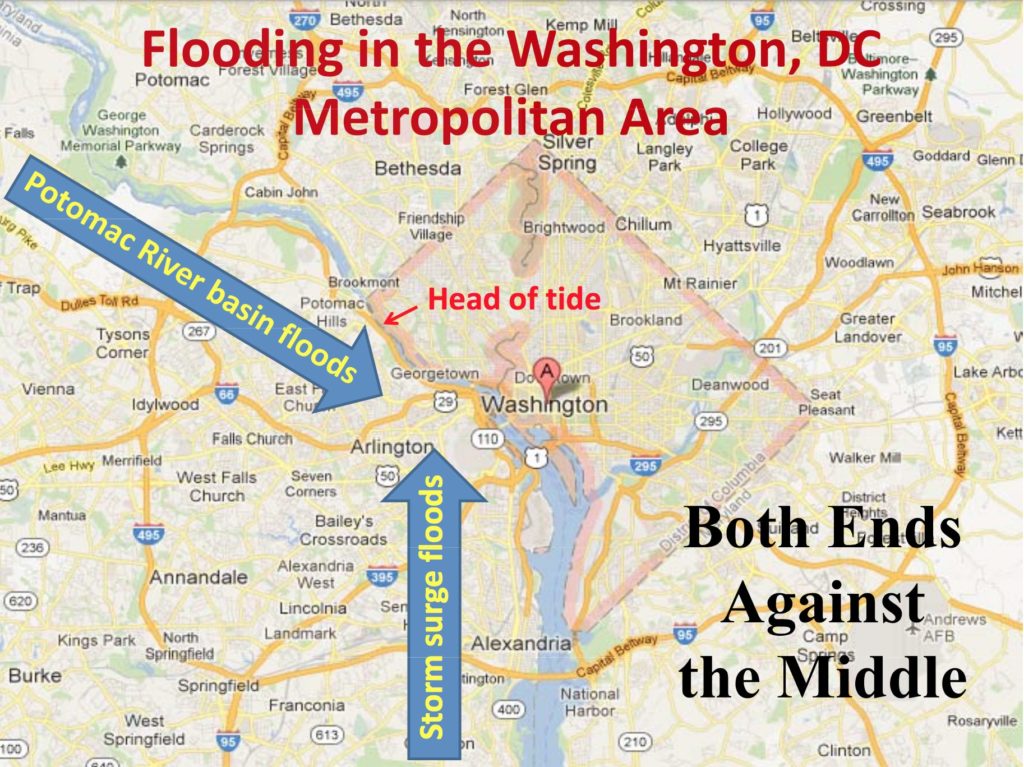
Arlington’s massive July 8 flash flooding — vividly captured by ARLnow.com in videos and photos — exposes yet again Arlington’s failed approach to stormwater planning. That is the emergency Arlington also should have declared last week.

Preliminary County government stormwater-damage estimates set repair costs for public infrastructure, particularly bridges in local parks, at $4.1 million. Actual costs are likely to be much higher. Flood damage to private property will add millions more.

Climate change and sea level rise are here. Wake up, Arlington!

Arlington is in a floodplain

Make Arlington’s flood-prevention approach proactive

Arlington residents are suffering:

“Alexandra Lettow was near tears as she described the losses her family suffered from Monday’s flooding to neighbors and county officials gathered at a home in Arlington’s Waverly Hills neighborhood….

“She and other residents say the county government has taken far too long to study the problem without making any fixes, especially in an era where climate change is triggering more intense and frequent storms….

“Five years ago, several projects to fix Arlington’s aged storm drain system were on the capital improvements program list, only to quietly fall off without explanation. The repairs would have addressed Spout Run stream overflows in Waverly Hills.

Implement mitigation strategies now

County government has chosen not to exercise legal powers that Arlington already possesses to reduce our rapidly growing environmental threats.

Arlington’s land use and development practices — which the County Board controls — exacerbate increases in the speed and volume of stormwater runoff. Whether or not flooded areas lie in FEMA-designated floodplains is immaterial. Board members must acknowledge nature’s latest wake-up call by strengthening County codes and planning to address increasingly unsafe conditions in Arlington.

Slow dramatic increases in impervious surfaces

As Arlington redevelops and adds density, one statistic stands out: between 2001 and 2017, the percentage of impervious surfaces covering Arlington has grown from an estimated 40% to 45%, with 3% of that increase occurring within the past 4 years.

According to County staff, the pace and intensity of redevelopment adds nearly 9 acres of impervious surface area each year–about 29 acres every three to four years, equal to the size of the Pentagon’s footprint.

“Preserving undisturbed vegetative cover during land development is a much more cost- effective approach than destroying these features and having to construct new stormwater management practices to replace the functions they originally provided,” says the Center for Watershed Protection.

(more…)


The Right Note is a weekly opinion column. The views and opinions expressed in the column are those of the author and do not necessarily reflect the views of ARLnow.com.

Tonight the County Board is going to consider building four more bus stops on Columbia Pike at a total allocated cost of $1.65 million, or roughly $412,000 per stop. The current Capital Improvement Plan contemplates the construction of 23 new transit stops for a total of $16.9 million, though Arlington taxpayers would not be on the hook for the entire bill.

It seems like an eternity ago that the $1 million model for these stops caused a political firestorm and even garnered national attention. The coverage put into perspective the magnitude of the Columbia Pike streetcar project, helped elect Independent John Vihstadt, and eventually lead to project’s cancellation. For those who may have forgotten, the rather small stop does not really keep you dry when it is raining and the “state-of-the-art” screen that was supposed to provide riders with information is often out of commission.

That the County Board thinks spending around half a million dollars each to build another 23 is a good fiscal decision still boggles the mind. The decision to proceed only looks fiscally responsible relative to $1 million, not relative to what else you could spend $13.3 million on, or not spend it at all.

In a larger sense, after the Board raised taxes and found no real budget savings this Spring, it is yet another piece of evidence that the once again all-Democrat County Board is slipping back into old habits when it comes to spending our money.

Speaking of watching spending decisions that are supposed to benefit the community, the Washington Business Journal recently reported that business incubator 1776 was unable to come to lease terms with JBG Smith and is relocating to the District. In 2015, the County Board voted to give 1776 up to $450,000 in economic development grantsto create 300 new jobs in the county. Four years later, those jobs are leaving the county.

Economic development incentives (giveaways) are a game that all states and major metropolitan areas play. This case serves as a reminder that they do not always work out over the long run.

Mark Kelly is a 19-year Arlington resident, former Arlington GOP Chairman and two-time Republican candidate for Arlington County Board.


View More Stories