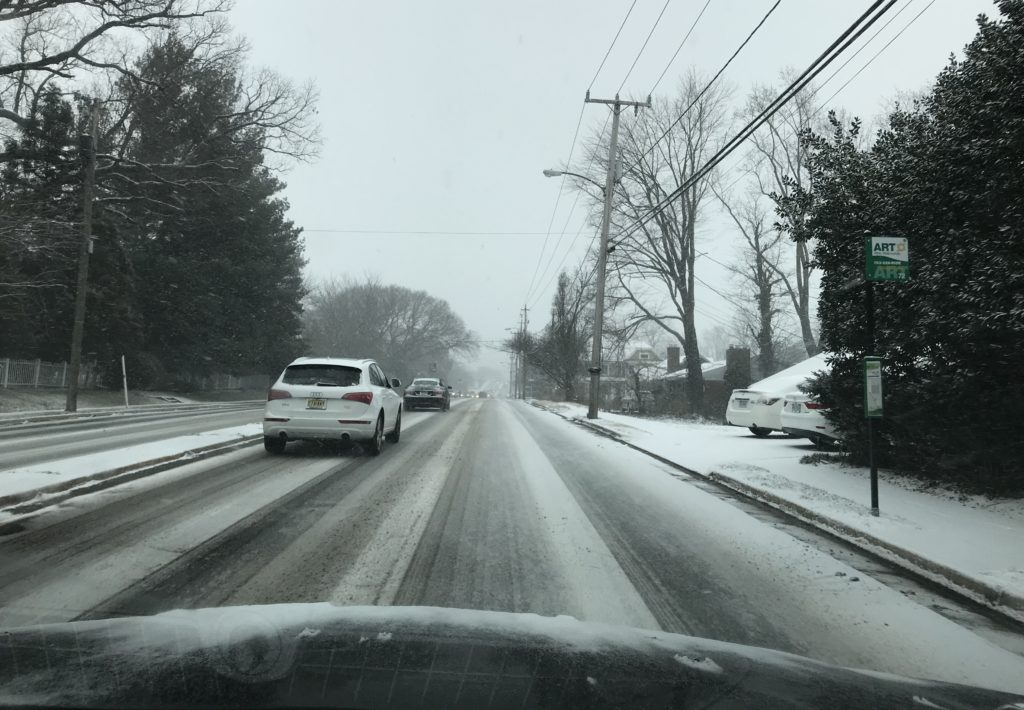
Say goodbye to all that unseasonably warm weather we’ve had recently — it seems winter is making a comeback.

Forecasters say temperatures will plummet tonight, with plenty of gusty winds returning for both Saturday and Sunday. There’s even some chance of snow early next week.

Still, if you feel like braving the cold, you can check out our event calendar for some suggestions of things to do around Arlington this weekend.

Or stay by the fire and read up on our most popular stories of the past week:

  1. Lynn Street Closed After Explosion Heard in Rosslyn
  2. Disturbing Video Prompts Arrest of Falls Church Teen
  3. ‘Never Let a Crisis Go to Waste’: Amazon Prompts Debate Over How to Make Arlington Homes Affordable
  4. Thousands of Lottery Tickets Are Littering 10th Street Near Clarendon
  5. D.C. Bar ‘Rebellion’ Plans Expansion into Old BrickHaus Space on Columbia Pike

Head down to the comment to discuss these stories, your weekend plans, or anything else local. Have a great one!

Flickr pool photo via Jim Havard


The following letter to the editor comes from Craig Esherick, a former chair of the Arlington County Sports Commission, former coach of the Georgetown Hoyas and husband of Commonwealth’s Attorney Theo Stamos.

Esherick writes to express his support for the county’s recommendations in a draft of an updated Public Spaces Master Plan, a process otherwise commonly known as a “Plan for Our Places and Spaces” or POPS.

The draft has come under fire from some county residents in recent months, who have argued that the document demands more land for new athletic fields than the county actually needs, particularly as Arlington grapples with a lack of land for all manner of public facilities. The Arlington Civic Federation also recently passed a resolution overwhelmingly urging county staff to withdraw some of their recommendations involving athletic fields. 

But Esherick argues that sports have a vital role to play in the county, and urges the County Board to consider their importance as it prepares to adopt a final version of the plan in the coming weeks.

As a longtime resident of Arlington County and one who has dedicated my life’s work to sports as a coach, author, TV commentator and academic, I felt compelled to weigh in on a subject that is getting lost in the current debate about sports fields versus open spaces: the many benefits of sports to a vast cross-section of our community.

My views are shaped by decades of county involvement through a period of tremendous growth and change. When I moved to Arlington in 1990, the population was 171,000. Today, it is 235,000 and expected to grow to 290,000 by 2030, but our footprint isn’t getting any bigger.

Over the years, I’ve seen recreational and youth sports evolve to reflect the times. Both my sons played several sports in the county-sponsored leagues and for Arlington school teams. Demand for field space has exploded as our youth population grows and new sports have entered the scene. Compared to just 10 years ago, this demand had resulted in less weekly practice time, smaller practice spaces, and bigger teams in order to share limited field space among so many users. And this trend is likely to continue.

Adults in Arlington are active field users as well. Adults of all ages enjoy playing soccer, softball, Ultimate Frisbee, kickball and other sports near where they live and work, and then socializing together afterwards in nearby parks or at area restaurants.

Are these sports activities important to our community? As a lifelong sports enthusiast, the answer seems obvious. Yes, sports teach kids about leadership, teamwork, and working hard to perfect your craft. I’ve seen first-hand how character is built from lessons learned on the sports field. Yes, sports lure kids away from electronic devices and keep them physically active.

Sports also provide myriad health benefits to young and old alike.

But I would argue that the most important role that sports plays in our modern world is that it connects us to each other, and that is good for the community. As our kids participate in sports, they make friends from across the county which expands their world and breaks down barriers. Many of these friendships endure throughout high school and into adulthood. Studies show that the more young people play sports, the more they are engaged in school and in their community. These community benefits transfer to parents, who make new friendships and engage with others through the sports participation of their children. Sports also offer new residents a way to make friends and become part of the Arlington fabric.

As Arlington continues developing its new 10-year Public Spaces Master Plan – a comprehensive, long term plan that provides direction on how the county should develop and maintain public spaces to serve a growing population – it is important not to lose sight of why this matters to the health and vitality of Arlington over the long term. Arlington values trees and parks and trails and dog parks, and it values its sports fields.

Sports provide a community good and making room in our limited acreage to accommodate them is in the community interest.

ARLnow.com occasionally publishes thoughtful letters to the editor about issues of local interest. To submit a letter to the editor for consideration, please email it to [email protected]. Letters may be edited for content and brevity. 

Photo courtesy Dennis Dimick


Update at 11:45 a.m. — The Washington Post is now reporting that Amazon is “reconsidering” its New York City plans.

Earlier: There is some local opposition to Amazon’s forthcoming Arlington presence and incentive package, but it’s nothing compared to the public protests and opposition from elected officials in New York.

“Amazon doesn’t care about locals who live in Long Island City,” said a key New York state senator who’s among the leading critics of the incentive package offered to the tech giant. “All they care about is how much they can squeeze out of the public till in New York.”

That lawmaker, state Sen. Michael Gianaris, has been appointed to an oversight board that has the power to torpedo the deal. Meanwhile, Virginia’s incentive package for Amazon was signed into law this week.

Should Gianaris or other NYC Amazon critics manage to turn up the heat on the company to a boiling point, it’s possible that Amazon’s plans for a huge new office and 25,000-40,000 additional jobs in New York could fall apart.

Should that happen, hypothetically, might Arlington be the beneficiary? Amazon could opt to make Arlington its full “HQ2,” as originally proposed during the HQ2 search.

If that were to happen, would you support Amazon doubling its presence in Arlington? Or should they look elsewhere?


Peter’s Take is a weekly opinion column. The views and opinions expressed in this column are those of the author and do not necessarily reflect the views of ARLnow.com.

Like many other states, Virginia has a partisan redistricting system. Partisan redistricting has served us poorly.

Background

Entrenched incumbents from both major Virginia political parties have worked hard to retain the current system — placing greater value on keeping their own seats than on what is in the long-term best interests of all Virginia voters.

For at least 20 years, up until last month, Republican leaders in the Virginia House of Delegates fought non-partisan redistricting. They wanted to retain their control and saw partisan redistricting as the best way to keep power.

Locked out of power, many Democrats believed they would do better with non-partisan redistricting. But that did not stop some Democratic legislative leaders, like 28-year incumbent Democratic Sen. Dick Saslaw, from spearheading the disastrous 2011 legislative deal under which Virginia Senate Democratic leaders gave Virginia House Republican leaders free reign to draw partisan delegate lines while Virginia Senate Democratic leaders received free reign to draw partisan Senate lines. Litigation over the partisan House delegate lines continues right up to today.

Sweeping gains by Democrats in the 2017 Virginia House of Delegates elections, combined with the prospect that Republicans might lose control of one or both houses of the legislature in 2019, finally has led the Virginia Republican House leadership to support some form of non-partisan redistricting.

Why non-partisan redistricting is so important

On Jan. 28, a group of 20 business leaders from Virginia, Maryland and DC published a compelling statement explaining why it is so important for both Virginia and Maryland to adopt non-partisan redistricting:

“The endemic dysfunction in our government stems from incentives in politics that promote ideological purity over pragmatic problem solving and cooperation. … We believe anti-gerrymandering measures are the logical starting point for reform, and they are urgently needed in both Maryland and Virginia. A system in which politicians pick their voters, rather than the other way around, is inherently wrong and dysfunctional. Partisan gerrymandering is a protection racket for incumbent politicians….”

Now is a critical moment in the 2019 legislative session

Non-partisan redistricting can only be adopted via a constitutional amendment. To amend the Virginia Constitution, an identical amendment must be passed by both legislative houses and signed by the governor in two consecutive years. After passage in the second year, Virginia voters need to approve the amendment in a statewide vote.

Those two consecutive years must be 2019 and 2020 in order to have the new non-partisan system in place in time to be utilized when the 2020 U.S. census results must be used (in 2021) to draw new legislative lines for 2021-2031.

The clock is ticking on the 2019 legislative session.

Where the 2019 legislative session stands now

Competing non-partisan redistricting bills are under consideration in the legislature: “All the bills on the table show real movement toward reform, said Brian Cannon, executive director of OneVirginia2021 [a redistricting reform advocacy group].”

On January 31, the Virginia Senate unanimously (40-0) passed SJ306, a bill defining the Senate’s preferred version of non-partisan redistricting.

One provision in HJ615, a Virginia House of Delegates bill sponsored by Del. Mark Cole (R-88th District), has drawn criticism from Democrats. That provision seeks to “preserve the political parity between the two political parties receiving the highest and next highest number of votes in the immediately preceding gubernatorial election.” Progress Virginia, a liberal advocacy group, correctly concludes that this provision “defeats the purpose of redistricting reform, regardless of what political party may benefit from the rule.”

Conclusion

Virginia legislative leaders from both parties need to agree in this legislative session on bipartisan legislation providing non-partisan redistricting reform. Please contact them and urge them to do so.

(Disclosure: I called on Governor Northam to resign.)

Peter Rousselot previously served as Chair of the Fiscal Affairs Advisory Commission (FAAC) to the Arlington County Board and as Co-Chair of the Advisory Council on Instruction (ACI) to the Arlington School Board. He is also a former Chair of the Arlington County Democratic Committee (ACDC) and a former member of the Central Committee of the Democratic Party of Virginia (DPVA). He currently serves as a board member of the Together Virginia PAC-a political action committee dedicated to identifying, helping and advising Democratic candidates in rural Virginia.



The Right Note is a weekly opinion column. The views and opinions expressed in the column are those of the author and do not necessarily reflect the views of ARLnow.com.

It is hard to put into words exactly what to make of the past week for Democrats in Richmond. If someone had pitched the storyline to a Hollywood producer, it might have been rejected as too unrealistic.

Lost in the series of breaking news stories is the ongoing effort in the General Assembly to adjust Virginia’s tax code to conform with the new federal tax law. Republicans want to send the excess revenue created by the changes back to Virginians in the form of income tax relief. Democrats want to spend most of the new tax revenue.

Republicans in Richmond also advanced redistricting reform bills through the House and Senate. The House bill would rightly keep elected officials accountable for redistricting decisions rather than pushing off that decision to unelected individuals. If one of the versions makes it through the General Assembly, it would have to be passed again next year before making it to a statewide vote.

Last week, Rep. Don Beyer (D-8th District) weighed back into the issue of helicopter noise. Beyer sent a letter asking for a federal study of flight times, flight patterns and altitude. It was also suggested that a Republican House majority prevented him from getting very far with the Pentagon in prior attempts to get the Department of Defense to listen to his concerns or his suggestion to just fly a little higher. Of course, flying higher would require helicopters to burn more fuel, and burning more fuel is in direct contradiction to one of Beyer’s other stated goals which is reducing fossil fuel usage.

Also last week, in less than one minute and with no discussion, the County Board approved 3.25 percent pay raises for the county manager, county attorney, clerk and auditor. There was no discussion of raising salaries for these four to an average of $193,000 despite the Board almost certainly preparing to hit taxpayers with a tax rate increase on top of the new property tax assessments.

The Board followed that up by passing, also without discussion, a resolution authorizing the lawsuit to claw back a $200,000 deposit they made on a now defunct land deal. Based on what we know so far, this lawsuit does not seem to have a great chance of success as the period to ask for the money back seems long passed. The Board could be doing so as a strong-arm tactic designed to get something out of the property owners who may wish to avoid legal fees.

Both of these Board items warranted some sort of public discussion.

Mark Kelly is a 19-year Arlington resident, former Arlington GOP Chairman and two-time Republican candidate for Arlington County Board.


Progressive Voice is a weekly opinion column. The views and opinions expressed in the column are those of the individual authors and do not necessarily reflect the views of their organizations or ARLnow.com.

By Gizem Korkmaz

Local governments are awash in ever-growing streams of administrative data. From school registrations to property tax transactions and records of every call made to 911, these data provide opportunities to build insights to meet people’s needs and prepare for the future.

Making government work more effectively is a bedrock progressive value. Yet as communities take advantage of the information hidden within these streams of data, they need assistance on statistical methods and social science expertise.

Two examples in Arlington show how such data insights strengthened public safety initiatives. One pinpointed where smoke alarms were most needed — thus improving the likelihood of reducing home fire deaths. The other aimed to help reduce late night alcohol-related crime in bars and restaurants in Clarendon. The projects were done in collaboration with Arlington County Police and Fire Departments.

Our research group, the Social and Decision Analytics Division (SDAD)* of the University of Virginia, collaborates in such projects as we help communities use new techniques for collecting, combining and analyzing data. We are a multidisciplinary team of researchers spanning statistics, economics, sociology and data science. We combine expertise to transform data into actionable knowledge and to support evidence-based policy.

Predicting Residential Smoke Alarm Need in Arlington

A smoke alarm maintained properly can be a life-saving resource. Yet three of every five home fire deaths were in homes that lacked a functioning early detection system, according to the National Fire Protection Association.

ACFD launched Operation Firesafe, an initiative that sends fire officials door-to-door offering free installations and repairs of smoke alarms. ACFD partnered with us to analyze data from early home visits and to determine where future visits should be directed to meet the greatest need.

We examined information on nearly 2,000 successful visits, showing 32 percent of those homes needed a new smoke alarm. Combining this information with publicly available housing data (value, age and location), our team developed a model to predict which homes were most likely to lack a functioning smoke alarm.

With predictions covering nearly 50,000 Arlington residences, fire officials can make targeted choices about where to canvass for smoke alarms. Initial estimates showed that older homes in the county’s southwestern section were far less likely to contain a working fire-detection system.

Evaluating the Impact of the Arlington Restaurant Initiative on Alcohol-Related Crimes in Clarendon

Arlington features appealing restaurants and nightlife destinations. Clarendon alone has more than 20 restaurants with ABC licenses and each year, approximately 580,000 patrons visit Clarendon between 9 p.m. and 3 a.m.

Visits are especially high at times such as St. Patrick’s Day and July 4, when alcohol consumption is quite high. This area has become a difficult issue for police to manage due to alcohol-related crimes such as public intoxication, DUI, disorderly conduct and sexual assault.

ACPD launched the Arlington Restaurant Initiative (ARI) which focuses on employee policies and effective practices for restaurants and nightlife to reduce the risk of alcohol-related disorder. By providing training and standards, the restaurant staff can intervene early before issues become problematic. The staff are given training to detect fake identifications, understand criminal/civil liability, public safety expectations and “Bar Bystander” sexual assault intervention training.

The ACPD Nightlife detail officers (those working Friday-Saturday late nights) use more personal, proactive interactions to nip potential alcohol-related crimes in the bud; for instance, spotting someone who is having trouble walking and sending them home in a cab right then. After two years, more interactions and fewer crimes were occurring in Clarendon, yet were the extra resources (such as the late-night overtime pay for police) justified?

To probe the social and economic costs, we needed to scrutinize the data more strategically. Master Police Officer Dimitrios Mastoras partnered with us to evaluate effectiveness of ARI. First, we used the data on interactions that the officers collected during ARI weekend activities in combination with the crime data to show a decrease in arrests over two years of the program. Our next step is to estimate the reduction in crime solely due to ARI and to calculate cost savings.

We keep looking for more ways that strategic data analysis can help local government be even more effective. What issues keep Arlington County leaders up at night? Data science based on good statistical and social science research methods can help solve some of these questions — and help governments do an even better job of serving their citizens.

Gizem Korkmaz is an Associate Professor at the Social and Decision Analytics Division (SDAD), in the Biocomplexity Institute & Initiative at the University of Virginia. The hallmark of her research is to blend her knowledge in traditional economics with big and messy data using tools from social network analysis and machine learning. She works with traditional as well as novel data sources such as social media, 911 calls and crime incidents to ask how we can make data useful for people and communities.

* Our research group was part of Virginia Tech until October 2018, when it moved to UVA with offices in Rosslyn.


It’s been a week full of snow, but spring-like conditions are possible this weekend.

Once the snow flurries finish tapering off, the forecast calls for temperatures to rise into the 40s and 50s for the weekend, with even warmer days possible next week.

Swing by our event calendar if you need some suggestions on how to enjoy the nice weather this weekend, or where to watch the Patriots and the Rams square off Sunday.

Or you can catch up on our most popular stories of the past week:

  1. Person Struck by Train at Courthouse Metro Station
  2. Arlington Must Open Up Single-Family Neighborhoods to Different Housing Options, Advocates Argue
  3. ACPD Investigating Shooting in Nauck
  4. Spider Kelly’s Co-Owner Launching New Restaurant ‘The Freshman’ in Crystal City
  5. Long-Vacant Ballston Office Building Could Soon Lure New Tenants as Part of Revitalization Bid

Head down to the comments to discuss these stories, your weekend plans or anything else local. Have a great one!


Peter’s Take is a weekly opinion column. The views and opinions expressed in this column are those of the author and do not necessarily reflect the views of ARLnow.com.

On Tuesday (Jan. 29), the County Board approved a contract for a new A/V system for the Aquatics Center.

It first appeared from a reading of a county staff report (Item 23 at pp. 2-3) that the “soft costs” of the new A/V system were being paid for out of a total of $3.2 million in “new funding.”

Background

When the County Board approved the Aquatics Center’s design-build contract in Nov. 2017, $7.5 million was included for soft costs (at p. 12) to cover “construction administration, county staff time, permits, other consultants, FF&E, technology, and public art.”

The staff report before the Board last night said that these soft costs had escalated 42.7 percent to $10.7 million (at pp. 2-3). Of the additional $3.2 million, the only new soft cost specified was a $450,700 expenditure for new A/V system:

“soft costs include construction management, project management, County staff time, permits, other consultants, FF&E, audio-visual, and public art. The funding for the audio-visual package was funded from the $10.71 million in associated soft costs, from the following funding source and account: Pay-As-You-Go (PAYG) capital funds (313.480001.80001.LBAD.0649.0000).”

The staff report does not explain how the remaining $2,749,300 of costs are allocated among all the other items noted, such as for staff time or consultant fees.

Payment for the additional soft costs

A vote on the new A/V system was pulled from last Saturday’s consent agenda by Katie Cristol after the Board received a letter from John Vihstadt questioning the expenditure.

Last night, staff members from Arlington’s Department of Parks and Recreation (DPR) said that the $3.2 million in PayGo capital used as the source for the funding of these additional soft costs had been in last year’s CIP for the Aquatics Center all along. Therefore, they claimed, using these funds for the new soft costs did not represent any increase in the total project cost for the Aquatics Center. That total cost had been $70.7 million all along, not the $67.5 million the community had assumed.

Based on what it heard, the Board voted last night to approve the new contract for the A/V system.

The right talk, but not the right walk

The Board should not have approved the A/V contract in these fiscally austere times.

At its Jan. 2 organizational meeting, the County Board prepared the community for anticipated tough fiscal times this year: “The only responsible course is fiscal austerity, County Board Chairman Christian Dorsey said….”

Late last year, the County Manager had already warned about projected major shortfalls facing us in his proposed FY 2020 budget: “In all, the county’s combined budget deficit [including APS] could be as large as $78 million.”

Canceling the Aquatics Center project entirely still makes fiscal sense

In a June 2018 column, I explained why Arlington should cancel the Aquatics Center project entirely. The county manager’s protestations that contractors would no longer bid on Arlington contracts if we cancelled lacks credibility. So long as we meet our contractual obligations (paying the cancellation costs), contractors will continue to line up for our business.

As to the argument that cancellation would be a breach of faith with the long-time Aquatics Center advocates, we must weigh their great disappointment against the long-lasting costs to the entire Arlington community of moving forward — the opportunity cost of devoting $70.7 million in total capital funding to this project.

For the next decade, we are bumping up against our 10 percent debt service limit. Cancelling the Aquatics Center project entirely and paying off some of that debt would give us much needed wiggle room. Closing an FY 2020 budget gap of up to $78 million will preserve the priorities of the entire Arlington community far better if we cancel the Aquatics Center.

Conclusion

Canceling the Aquatics Center offers two alternatives. The Board could choose to repay the debt, giving us more flexibility in capital spending. Or it could redirect the net post-cancellation savings to other legally permissible uses.

The manager has confirmed that the County Board legally could reprogram the approved Aquatics Center bond funds for other park and recreation priorities, including these:

  • land acquisition for new parkland (the current CIP contains $0 for acquisition of new parkland over the next 10 years)
  • park infrastructure (including a smaller community pool) at Long Bridge or elsewhere

Peter Rousselot previously served as Chair of the Fiscal Affairs Advisory Commission (FAAC) to the Arlington County Board and as Co-Chair of the Advisory Council on Instruction (ACI) to the Arlington School Board. He is also a former Chair of the Arlington County Democratic Committee (ACDC) and a former member of the Central Committee of the Democratic Party of Virginia (DPVA). He currently serves as a board member of the Together Virginia PAC-a political action committee dedicated to identifying, helping and advising Democratic candidates in rural Virginia.


The Right Note is a weekly opinion column. The views and opinions expressed in the column are those of the author and do not necessarily reflect the views of ARLnow.com.

Last week, I questioned the political wisdom of newly minted Arlington County Board Chairman Christian Dorsey’s comments regarding just how hard, or not hard, a Board member should work.

Dorsey pondered aloud just what a member’s role should be and questioned whether it was a good thing for someone serving on the Board to go above and beyond the call of duty. He called this hard work “not helpful.”

Last week’s column also noted that the County Board loves to talk about tough budget choices facing them. After years of wearing out the phrase and having money leftover to spend at the end of the year, this year they apparently really mean it. They are searching for as much as $70 million to close their annual “gap.” Schools, Metro, Medicaid expansion and Amazon are all putting pressure on budget decisions for FY 2020.

The more you hear Board members bemoan the budget, the more remarkable it is that the chairman of the Board facing “tough choices” can suggest Board members should take a step back from their workload. If the choices are truly that difficult, it demands more of your time and attention than ever before, not less.

Dorsey’s “work less, delegate more” approach was front and center at last Saturday’s board meeting when it came to light that costs are once again creeping up on the new Long Bridge aquatics facility. A new dollar figure was slipped into a Board report on the audio-visual contract for the project that was on the consent agenda on Saturday. The report noted a $3.2 million increase in so-called “soft costs” for the facility.

John Vihstadt, who was a lone voice in opposition to moving forward with the project, is no longer around to officially dig into the details, but he is still asking county staff about it and talking about it on social media. It may have been his inquiries that caused Katie Cristol to pull it from the Board’s “rocket docket” Saturday in order to have a discussion tonight. Otherwise, it would not have warranted even a single minute of debate from the Board under Chairman Dorsey’s agenda.

Hopefully, tonight Christian Dorsey will let us know why he did not want to have a public discussion on this. Maybe he will explain that he is content to just give the County Manager another blank check. (In November, the Board approved a $2 million slush fund for the County Manager as part of the closeout appropriation.)

Of course, Democrats have regularly required taxpayers to give the Board more of their money under the guise of a budget crunch without paying a political price as a party. The amount of time Dorsey dedicates to doing so may not matter, so the “work less” approach may make sense.

He certainly seems to be banking on voters to send him back to the Board this November no matter what he says, or does, or doesn’t want to do.

Mark Kelly is a 19-year Arlington resident, former Arlington GOP Chairman and two-time Republican candidate for Arlington County Board.


Progressive Voice is a weekly opinion column. The views and opinions expressed in the column are those of the individual authors and do not necessarily reflect the views of their organizations or ARLnow.com.

By Wilma Jones Killgo

Arlington neighborhoods are facing a multitude of challenges as the divergent interests of organizations and the people who live near them are decided by the County Board.

These decisions are determined after vigorous debate on websites, blogs and media, both social and traditional. Our communities are pressured to accept proposals with conditions and/or designs that are either completely out of character or blatantly unfair to their residents. The neighborhoods are labeled NIMBYs (Not in My Back Yard) by people who have little understanding of the issues.

As a civic activist and fourth-generation resident of the Halls Hill-High View Park community, I have been involved in my fair share of these projects, including the rebuilding of the Langston-Brown Community Center, the proposed relocation of Fire Station 8 and most recently, the Virginia Hospital Center expansion.

Everyone knows that things change. No one expects that development will stop. We see our communities growing and new people moving in. We see new businesses open and existing organizations expand. We know that Arlington is changing. We are not fighting change. All we ask for is fairness.

There were some rough times during the process for each of these projects but the outcomes for each were better for the neighborhoods involved than the original proposals. Those solutions were achieved because of major efforts by civically active neighbors and our citizens associations appealing to county staff, commission and Board members in multiple meetings and emails. On some occasions when the direct appeals fell on deaf ears, we had to resort to major media, like a Washington Post article to point out the inconsistencies and erroneous information being spread by people and organizations with obvious business interests in the organization’s preferred outcome.

It is troubling and to be honest, a bit exhausting to have to continually fight these battles. But I remain hopeful because I think the message may be starting to break through in some areas. One ray of hope was evidenced in the remarks of our new County Board Chairman, Christian Dorsey, in his message on Jan. 2, when he stated his goal to “imbue our public policy with an emphasis on equity.” If our leaders can help to shift the discussions, debates and decisions in this manner, it could help improve the relationships between the county, the organizations that are a part of our communities and the residents who live and want to thrive in the neighborhoods every day.

Now let’s talk about what exactly this looks like. What does “an emphasis on equity” look like to me?

My initial hope is that county staff begins being neutral as they work on requests from organizations that seek to enter our communities or expand within them. Currently, community activists feel as if we must fight the organization leaders AND county staff, who it seems often support the organizations’ requests with little consideration for how it impacts the community.

For example in September 2018, we secured a deferment and a motion from the County Board to have the Virginia Hospital Center expansion walkways to the Halls Hill-High View Park community redesigned. These areas were characterized by one neighbor as “an alley and a tunnel.” They had multiple pedestrian dangers and safety concerns (near medical waste facilities, etc.). The Neighborhood Task Force spent three years asking the county staff to support this effort and received no support. Due to pleas from residents at what was to be the final meeting on this expansion, the community was finally given equity.

In addition, at two meetings with county staff during these discussions, I was told that the staff members were getting tired of all the meetings with the community. I pointed out that they were being paid with our tax money to attend while many of the community members were using their annual leave to take valuable time from our day jobs.

There are many areas where equity can be addressed in Arlington County government decision-making. But from my view, it starts at the ground level and that is with county staff. I’ve said this to each County Board member in 2018, and I stand on my opinion.

Wilma Jones Killgo is a fourth-generation resident of the Halls Hill-High View Park community. She is serving her third term as president of the neighborhood civic association, the John M. Langston Citizens Association. She is the author (under her maiden name of Wilma Jones) of the historic memoir, My Halls Hill Family: More Than a Neighborhood. Learn more at HallsHill.com.


The Newseum is selling its Pennsylvania Avenue home of the last 11 years to Johns Hopkins University and is now looking for a new location.

A museum of the journalism profession and the First Amendment, the Newseum first opened in Rosslyn in 1997 before moving to the District in 2008. Its Rosslyn location was featured in the TV show The West Wing and later, after the Newseum decamped for D.C., became the short-lived Artisphere.

The former Newseum space is now a co-working space and Rosslyn now has a new marquee tourist attraction, but given that the Newseum is looking for a new home we thought we’d ask: do you think it should return to Rosslyn?

Flickr pool photo by TheBeltWalk


View More Stories