
Title insurance is boring, but Allied Title & Escrow is here to decode the jargon and make it (somewhat) more interesting. This biweekly feature will explore the mundane (but very necessary!) world of title insurance while sharing interesting stories of two friends’ entrepreneurial careers.

Question: Do I need insurance for my house flip project?

Answer: If you don’t want the hassle of buying a home and renting it out to others, then buying a fixer-upper and selling it for more is the next best thing. While the process sounds rather simple, there is something really important that should never be overlooked — and that is the need for home insurance for flipping houses.

Since no one is living in your investment property, you may feel that you really don’t need insurance. However, that is not true at all. Believe it or not, there are so many things that can go wrong during remodeling projects while the house sits vacant for months at a time — such as falls, fires, vandalism, theft of pipes/fixtures and more. Traditional insurance providers and homeowner’s policies view house flipping as ‘high risk’ and are not designed to protect vacant properties or properties that are needing rehab.

Flipping houses requires a special type of insurance coverage that a typical Home Owner’s Insurance policy does not provide. The insurance policies discussed below will protect your property and personal assets and provide peace of mind.

Dwelling Policy

A Dwelling Policy is designed for vacant buildings and protects against any direct, physical damage to the property. This is a common type of insurance used for flipping houses. It isn’t always easy to see the issues that may arise during even the simplest renovations.

Although a dwelling policy is a way to remain protected, it should be noted that this policy will not cover any materials or equipment used in the renovation.

Builder’s Risk Policy

A Builder’s Risk policy is also designed to protect vacant property and it is necessary if your renovation includes tampering with the structure. This policy, again, covers the direct physical damage to the property while it is in the construction process.

Unlike dwelling policies, a builder’s risk policy does cover the renovation materials. This is often purchased as a rider in addition to the dwelling policy.

General Liability Policy

As you can tell, dwelling policies and builder’s risk policies focus on the damage to the property itself, and potentially the materials. But what about bodily injury? It is not uncommon for injuries to occur during a renovation. Should you get hurt, your general liability policy would be in place to protect you, but it does not protect your contractors or people you have working at the property.

What it does do, though, is protect you in case you are sued due to an injury at the property. Any medical expenses or legal fees that arise due to a slip and fall, for example, will be handled by this insurance company.

Have questions related to title insurance? Email [email protected]. Want to use Allied Title & Escrow when you buy a home? Tell your agent when you buy a house to write in Allied Title & Escrow as your settlement company! 


This is your chance to start building long-term wealth and financial independence through homeownership!

The home-buying process and competitive DMV real estate market can be overwhelming to navigate alone. That’s why Keri Shull Team is hosting a seminar to help aspiring buyers maximize their home search.

Bridget Mendes, an expert Buyer Success Agent with Keri Shull Team, will be leading this seminar at our office in Rosslyn.

Attend to learn:

  • How to find off-market homes — hidden gems that don’t appear on popular home search websites
  • How to get out of your lease so you can move on your timeline
  • The “4 C’s” that determine home prices in any market
  • How to set a realistic budget for your home search
  • And much more!

Why squander the opportunity to have the best possible home buying experience, especially when there’s no cost to you?

Join us on Thursday, April 7, from 6-7 p.m. for this FREE in-person seminar! Parking will be validated for those commuting by car.

Register for this event today.


This article was written by Conor Courtney, Strategic Initiatives Manager for Arlington Economic Development.

Associates, bachelor’s and master’s degrees traditionally dominate the education component of workforce development. However, a lesser-known alternative is poised for tremendous growth and opportunity: continuing education programs. Companies choose to locate in Arlington because of its highly-educated workforce, making Arlington a prime destination for continuing education programs.

What are Continuing Education Programs?

Continuing education encompasses any post-secondary education that degree-holding professionals pursue. These programs are agile, affordable, responsive and customizable, showcasing their importance in a rapidly changing economy. They come in various formats, including micro-credentialed programs, industry certificates and customized courses based on company needs.

Such programs can last anywhere from two weeks to a semester, and you no longer must enroll in a multi-year program to reap the benefits. Employers, universities and working professionals have a unique opportunity to further higher education’s role in workforce development.

The Learner’s Perspective

Newly acquired skills from a continuing education program can unlock immediate career growth potential. Several universities even offer self-paced courses to meet the time constraints of many working professionals. Acquiring new and relevant skills for your profession dramatically increases your earning and career growth potential. Perhaps you are looking to change careers but don’t want to spend tens of thousands of dollars for a new degree; continuing education programs help break down those barriers. They equip you with industry-relevant skills, grow your professional network and increase your marketability.

The Employer’s Perspective

Investing in your employees is not a new concept, but identifying how to invest in your employees is not always straightforward. Employers, especially those in rapidly changing industries, need their employees to constantly adapt and grow to meet industry demands. Offering continuing education programs to employees is a strategic investment that can produce immediate and long-term benefits.

Your employees will learn cutting-edge technologies and best practices within weeks, improve retention and identify your company’s future leaders. Some universities even offer custom employer cohort programs, where the employer and university collaborate in developing a tailored curriculum for that specific employer.

(more…)


Give a warm welcome to the southern belle that is Callie, the newest Adoptable Pet of the Week!

This beautiful 10-year-old girl is looking for a friend to shower her with pets.

Callie’s friends at Lost Dog & Cat Rescue Foundation had this to say:

Callie is a true southern belle — brought from Alabama for a new life in the North, all she wants is a nice soft surface to sit on and a friend or two to pet her.

She politely asks for pets (taps your arm) and also drinks with her paws (like a lady). During the day she’s a very low energy cat, but at night she will trot right up to you to make sure you pet her nice and good.

Callie doesn’t need a lot of space, she’s happy with 2-3 spots to nap in and would do well in an apartment.

Can you give Callie enough pets? Read her complete profile to learn more and to see how Callie spends her day, check out her Instagram @spookyfosterkitty.

Want your pet to be considered for the Arlington Pet of the Week? Email [email protected] with a 2-3 paragraph bio and at least 3-4 horizontally-oriented photos of your pet. Please don’t send vertical photos — they don’t fit in our photo galleries!


Each week, “Just Reduced” spotlights properties in Arlington County whose price have been cut over the previous week. The market summary is crafted by Arlington Realty, Inc. Maximize your real estate investment with the team by visiting www.arlingtonrealtyinc.com or calling 703-836-6000 today!

Please note: While Arlington Realty, Inc. provides this information for the community, it may not be the listing company of these homes.

As of April 4, there are 105 detached homes, 41 townhouses and 200 condos for sale throughout Arlington County. In total, 16 homes experienced a price reduction in the past week, including:

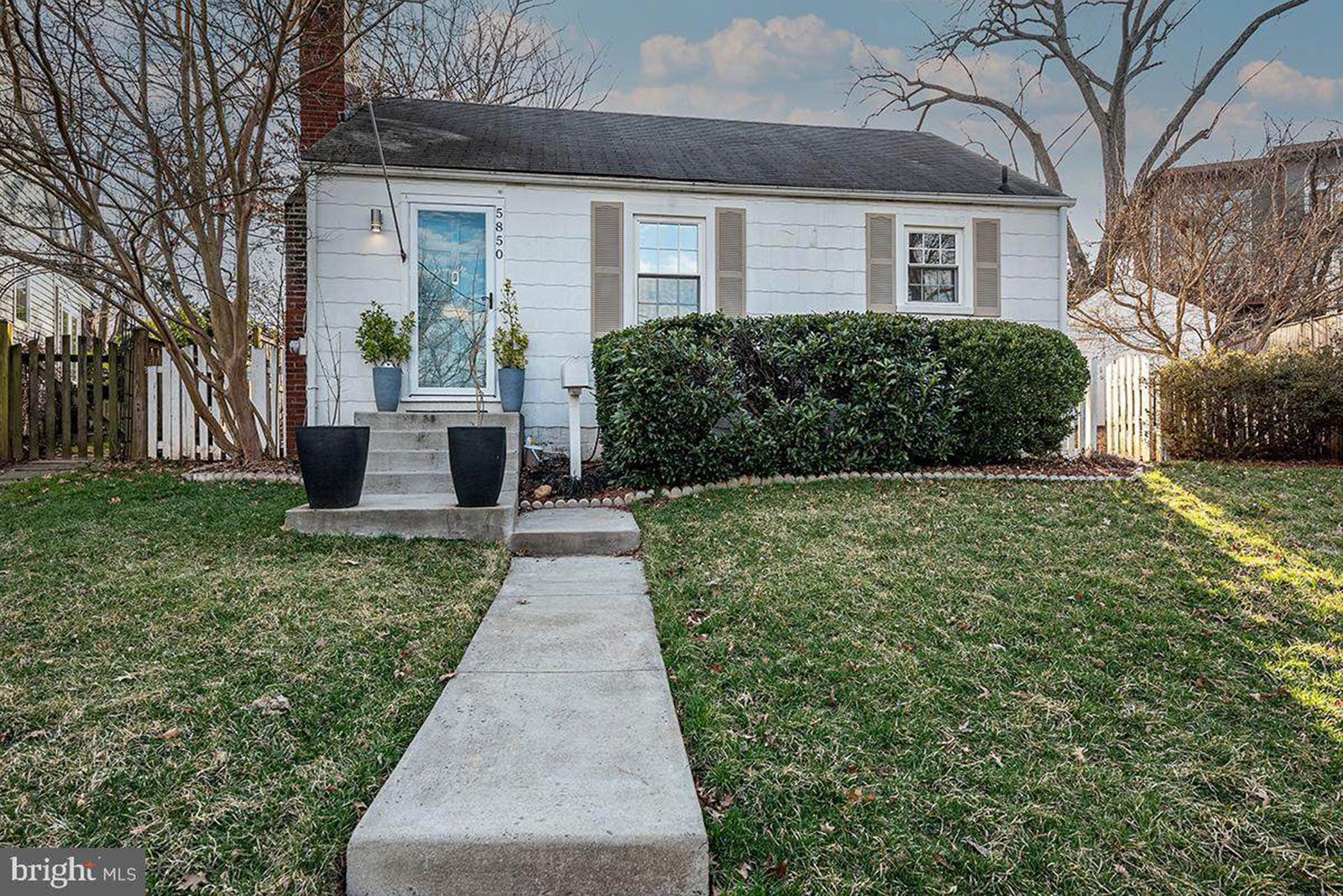
5850 20th Street N.

Please note that this is solely a selection of Just Reduced properties available in Arlington County. For a complete list of properties within your target budget and specifications, contact Arlington Realty, Inc.


The contemporary fair celebrating artists of color, female artists and LGBTQ+ artists will come back to the nation’s capital from April 7-10 for Superfine DC at 713 7th Street NW in partnership with the DMV League of Artists, the Hue2 Foundation, and Oxford Properties.

The fair will feature a private collector’s brunch, VIP vernissage, hundreds of pieces of art from 70+ artists, and will be open to thousands of attendees. With a combination of the highest quality artists and affluent art-hungry collectors, Superfine DC is paving the way for art fairs.

Superfine Art Fair was created in 2015 and over the past seven years and 14 fairs around the U.S., we’ve grown into the number one platform for independent artists and the art lovers plus collectors who support them.

Save 20% when you buy online!

Visit superfinedc2022.eventbrite.com for tickets.

Follow @superfinefair on Facebook.


This regularly scheduled sponsored Q&A column is written by Eli Tucker, Arlington-based Realtor and Arlington resident. Please submit your questions to him via email for response in future columns. Video summaries of some articles can be found on YouTube on the Ask Eli, Live With Jean playlist. Enjoy!

Question: Do you have any advice to help reduce the risk of not doing a home inspection before buying a house?

Answer: The unfortunate reality of the current market (and the market of the last ~18 months) is that, in most cases, to make a competitive offer on a home, buyers are absorbing all the risks (financing, appraisal, inspection, etc). Understanding the risk/benefit trade-offs and the downside potential of these risks is critical in such a fast-paced, expensive real estate market.

Risk Management is Critical

If I had to guess, I would say that at least 75-80% of winning offers on local homes that go under contract within the first 1-2 weeks do not have a home inspection contingency, meaning they are either not doing a home inspection at all (unfortunately common) or doing a pre-offer home inspection. As with nearly every decision you make in real estate, this needs to be done with great consideration for the cost of the risk and the value of the upside to make sure it is the right decision for you on a specific property.

Part of that risk assessment is making a determination on the condition of the home — whether it has “good bones.” Having a home inspection done is the best way to reduce the risk of buying a home with condition/maintenance issues but is no guarantee that everything will be caught. If you can’t do a home inspection, seeing a home with a trusted, experienced real estate agent or somebody in the home building/improvement industry (contractor, builder, etc) is also a good way to reduce your risk.

Property condition/maintenance issues show up in a multitude of ways. Below I’ve summarized some tips on assessing a home’s condition from inspectors I work with, an article written by Stephanie Dickens of BOWA, a local design-build firm, and my personal experience.

Observe How Water Moves

Water is a home’s worst enemy and poor water management can lead to water pooling against a home and getting into the cracks of the foundation, which can lead to structural deterioration over time. A musty smelling basement is a sign of poor water management. Look at where gutters drain — I often find that they’re dropping water right next to the house instead of sending it away. Look at the grading (slope of the yard) and if water is running towards the house, look for drainage systems. Sump pumps are nice, but they should be connected to a battery back-up in case power goes out.

Good vs Bad Cracks

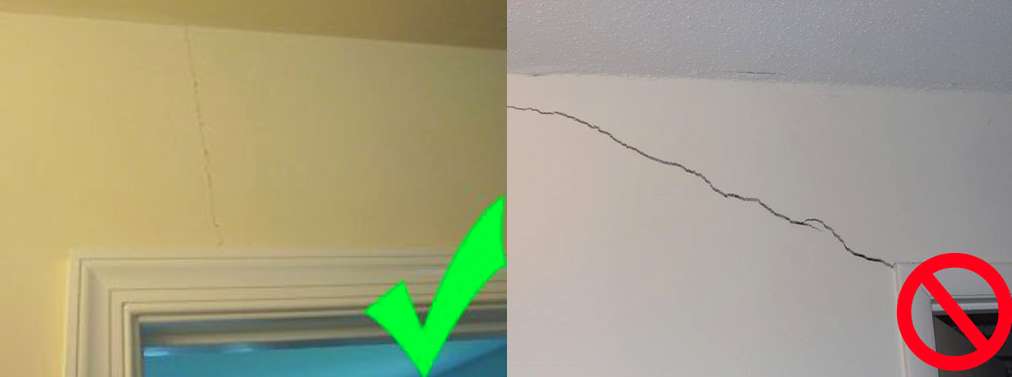
Cracks can be deceiving. Something as small as a crack in the drywall could be a sign of larger structural issues, but are most likely cosmetic. Straight, hairline cracks above openings or at joints, like the one pictured below to the left, are nothing to be alarmed about.

If you see jagged, diagonal cracks that are wider than 1/8″, like the one below to the right, the house may have settlement issues or insufficient framing. A pattern of uneven floors and cracking around support (e.g. lintels) in one section of a home can be a sign of a bigger issue.

Level Floors Are a Good Sign

A nice, level floor indicates good structural support. If you look up to where the ceiling and the wall meet, the corner crease should be mostly straight. If the floor looks wavy or dips down in the middle, the floor joists may be sagging and need reinforcement. Uneven floors do not necessarily indicate a problem, rather are justification for a harder look to see if there are other signs of active issues. We have plenty of well-built old homes with uneven floors around here that have been that way, without issues, for decades.

(more…)


Just Listed highlights Arlington properties that just came on the market within the past week. This feature is written and sponsored by Andors Real Estate Group.

Hello, Arlington — good morning and welcome to Just Listed!

I’m in my tenth year in Arlington real estate, grew up watching my father sell Arlington real estate my entire life, and neither of us have seen anything like what we’re experiencing now!

This is truly an extraordinary dynamic of fast paced, high stress, unbalanced and exuberant frenzied activity and I’m seeing people start to get weary. Buyers get disheartened after losing out on several houses they would like to have called home, while sellers can’t get enough of it! Realtors are tired (of showing houses and then delivering bad news to their buyers), lenders are tired (of issuing pre-approval letters that go nowhere), appraisers are tired (of lenders and agents hounding them to move quicker) and it’s still early spring!

December 13, 2018 — it’s been that long since interest rates were this high! Rates are sitting at 4.67% and projected to rise farther this year. Sky-high inflation, strong consumer demand and geopolitical uncertainty are just a handful of reasons why these rates just keep going up

Rising interest rates may be starting to impact inventory — it’s somewhat indirect and I can’t only attribute it to this, but inventory is rising. Inventory starts to rise in the spring due to more homes hitting the market, and this happens each year. It’s early, but I may be seeing a trend, it’s just hard to know everything to attribute it to. I’ll keep a close eye on this and let you know what I’m seeing each week, as always!

This week in Arlington there are 20 more properties available in the county than last week, totaling 282. Sellers listed 105 homes for sale, seven more than last week.

Rate volatility may be pushing some buyers out of the market, and simultaneously encouraging others to do everything they can to get a piece of the metaphorical Arlington pie! Ratified contracts are up two more than last week, with 72 contracts in the past seven days. 35 of those were homes listed just within the past seven days.

Of the 282 homes currently available for sale, 69 are detached homes, 36 are semi-detached/townhomes, and the remaining 177 are condominiums. These properties range in price from $100,000 all the way up to $7,950,000.

Average list price for currently available homes is $822,484, and the median price is $588,950. These homes have been on the market for an average of 50 DOM (days on market) and a median of 20. Median days on market of less than three weeks is a first for me — this is absolutely incredible to think that over 50% of homes in the county sell in less than three weeks!

This week last year, there were 426 homes available for sale throughout the county. Sellers had listed 108 homes for sale and buyers ratified 96 contracts. Interest rates were just 3.18%!

PICK OF THE WEEK — 2931 S. Grant Street, Arlington, VA 22202 — $2,125,000

No detail overlooked in this stunning 2019 Craftsman home with 5 bedrooms, 4.5 baths on three beautifully finished levels on a grassy, gently sloping and landscaped 9,000sf lot, fenced in the rear. An entertainer’s dream with 5000+ sq. ft. of luxury living including HGTV-worthy gourmet kitchen w/professional-grade appliances open to a vaulted-ceiling great room with gorgeous stone fireplace, and a banquet-sized dining room. Abundant fine finish carpentry and high-end details throughout. Bright walk-out lower-level with 11′ ceilings has a great room featuring a gas fireplace, a gorgeous, expansive walnut wet bar with seating, large bedroom with full bath (perfect au pair/in-law space) and plenty of storage. This home is perfect for multigenerational living. Oversized 2-car garage with extra storage over a huge workshop. Rear screened porch and deck offer skyline views.

Find me and my team here this weekend, Saturday and Sunday from 1-4 p.m. for the public open houses!

Click here to search currently available Arlington real estate. If you see a home that you’re interested in purchasing, give us a call!

Call the Andors Real Estate Group today at (703) 203-1117 to talk more about buying or selling Arlington real estate. Below are eight new listings that I think you might like to check out.


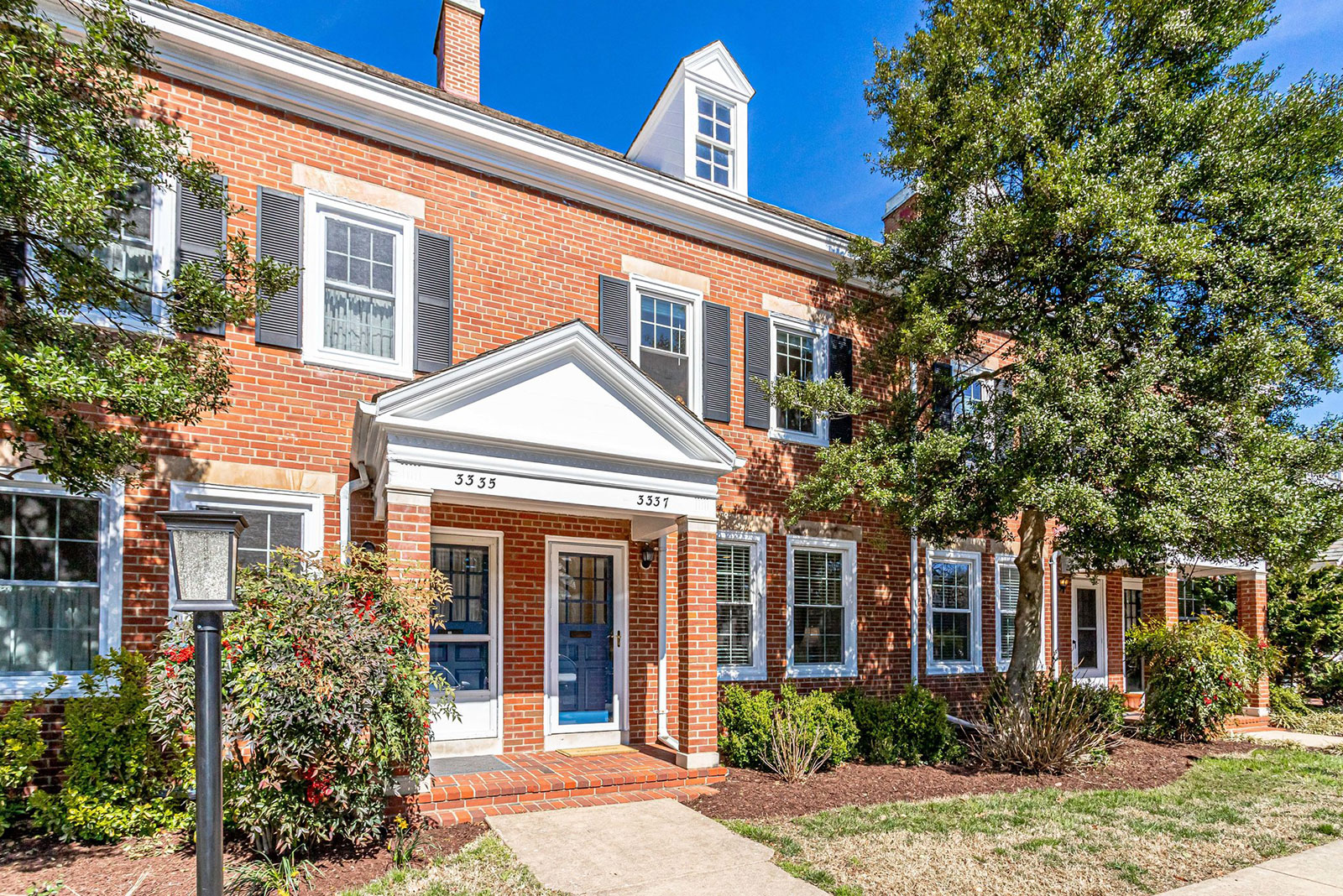
Address: 3337 S. Stafford Street
Neighborhood: Fairlington Meadows
Listed: $609,000
Open: April 2-3, 2-4 p.m.

Stunning 2 BR/2 BA, 3-level Clarendon I townhome located in Fairlington Meadows. Just one block to the pool, tennis courts, Fairlington Park playground, and community center with popular farmer’s market on Sundays.

The airy, light-filled living room and dining room feature hardwood floors, recessed lights, and fresh neutral paint. Gourmet kitchen with pass-through, featuring all SS appliances, granite countertops plus newly refinished white cabinets. Rear door leads to a flagstone patio with wood deck — a perfect spot for relaxing or entertaining — and opens to an expansive grassy parklike setting behind.

Primary bedroom features two closets (one walk-in) plus hardwood floors. Second bedroom offers lovely treed views. Enormous attic has high-ceilings, thick flooring, new insulation and a dormer window. The opportunities are endless for transforming the attic into a 4th finished level.

Fully finished lower level features a spacious rec. room with recessed lighting, tile flooring, and a separate office/guest bedroom with an en-suite full bathroom plus laundry nook (with new LG washer and dryer). One-of-a-kind built-in bookshelf and media center designed to maximize use of the space under the stairs.

Reserved parking space at front door and ample visitor spaces. Easy access to D.C., National Landing and Pentagon via I-395; walking distance to Shirlington shops/restaurants.

Listed by:
Liz Lord
Compass Real Estate
571-331-9213
[email protected]
www.arlvahomes.com


We are excited to announce that Arlington’s 8th Solar and Electric Vehicle (EV) Charger Co-op will launch on April 1st (no joke) and run through August 31st for County residents and those in surrounding jurisdictions.

COVID has proven we can do great things even during uncertain times. The 2021 all-virtual Arlington Solar and EV Co-op installed more than twice as many new home solar power systems and EV Chargers than in any previous year with 107 systems. Much of the credit goes to our wonderful non-profit partner Solar United Neighbors.

Is this the first time you are hearing about this opportunity? No problem. We are inviting you to be part of a group purchase that can drive down your costs of going solar and owning an EV. Some group members are even installing home battery systems to provide backup power during grid outages.

Almost 400 homeowners have already taken advantage of Arlington’s Solar and EV Charger Co-op, which helps residents, small businesses and non-profit organizations buy home solar panel systems and electric vehicle (EV) chargers at a discounted price through bulk purchasing. The cooperative provides support to make the purchasing process easy.

Arlington and the region have an opportunity to take action now to help change the trajectory of climate change. Installing solar and driving an electric vehicle can make a difference in cleaning our electric grid and reducing dependence on fossil fuels.

Take advantage of federal residential solar and EV charger tax credits and pay less for improving your home and transportation options. This year the residential tax credits are 26% for solar and will drop to 22% in 2023. Business tax credits are also available.

Learn more about solar, electric vehicle charging and solar battery storage and help our community become carbon neutral by 2050. Be a part of this growing movement.

Register for the Co-op.

Below are links for upcoming virtual info sessions. Click to RSVP for the date and time that works best for you:


This sponsored column is by Law Office of James Montana PLLC. All questions about it should be directed to James Montana, Esq., Doran Shemin, Esq., and Laura Lorenzo, Esq., practicing attorneys at The Law Office of James Montana PLLC, an immigration-focused law firm located in Arlington, Virginia. The legal information given here is general in nature. If you want legal advice, contact us for an appointment.

The United States and the countries of the European Union are offering differing levels of protection to Ukrainians fleeing the war.

These differences reveal deeper characteristics of the immigration bureaucracies, and the political systems that operate them, in both sides of the Atlantic. In this (mildly editorializing) explainer, we will explain the differences between the European and American approaches, and provide our assessment, as practitioners, about the workability of the U.S. approach.

As always, we welcome comments and will reply to all that we can.

Europe: Temporary Status Now, Benefits in the Interim, Adjudication Later

Every single country in the European Union that borders Ukraine currently offers free entry to Ukrainian refugees. Although the European authorities ask that Ukrainian refugees carry valid travel and vaccination documents with them, failing to bring those documents will not prevent you from entering the EU. No visa is necessary to enter.

Once a Ukrainian refugee enters an EU border state, she can move at will throughout the Union. She is eligible for an immediate grant of temporary immigration status until March 4, 2023. (This temporary protection will not prevent her from applying for permanent protection via the asylum processes of each member state.) She is eligible for social welfare assistance, medical care, education for her children and eligible to work.

This one-year temporary status will be extended to a full three years if the war continues.

United States: Temporary Status for People Already Here, Promises of Future Resettlement, No Visas, Unpredictable Behavior at the Border

The United States has taken a broadly different approach to Ukrainian refugees, characterized mainly by a preference for pre-existing law.

  • The United States announced (but has not implemented) Temporary Protected Status for Ukrainians present in the U.S. on March 1, 2022. We discussed this at length in our last Statutes of Liberty — read all about it.
  • USCIS has announced special flexibility for Ukrainians who are looking for certain immigration benefits, including (1) changing visa status, (2) expedited processing of advance parole requests, (3) easier rules for obtaining off-campus employment for Ukrainian students, (4) faster decisions on petitions and applications, including work permit applications.
  • President Biden promised to admit “up to” 100,000 refugees to the United States through the U.S. Refugee Admissions Program.
  • CBP has begun to admit Ukrainian nationals at the US-Mexico border who are seeking asylum under slightly looser guidelines, providing exemptions from Title 42 restrictions. These applicants are being paroled into the United States, which allows them to live and work here for one year while seeking another immigration status.

What are the differences between the U.S. and European approaches?

The difference is legal formalities; the U.S. is insisting on them, and the European Union is not. That difference is a big one, and it is creating – as law always does — absurdities. For example:

  • Ukrainians applying for visitor visas to enter the United States are being turned down right, left and center, because — as a matter of legal formality — applicants for a visitor visa must prove that they intend to return home within 90 days. That legal formality doesn’t apply at the border, so, predictably, Ukrainians are showing up at the border. This is a stupid combination of policies. (Dear Uncle Sam: If you intend to admit Ukrainians tout suite, don’t make them fly to Mexico first. If you don’t intend to admit them, don’t admit them.)
  • The U.S. is working within its existing legal framework to provide protection for Ukrainians already here — even previous visa violators –– but is offering nothing but a promise of future resettlement to people who aren’t here already. That promise is probably empty, because the U.S. refugee resettlement bureaucracy can’t handle the promised flow.

It is hard to say why the United States is pursuing a formalist approach to managing refugee flows. Simple proximity is probably the most important reason; the Europeans have nearly a million refugees at their doorstep, and we don’t. But, as practitioners in this area, we think that another important limitation on the U.S. response is the unmanageability of the bureaucratic machinery.

Without Congressional action, the Biden administration can only operate within the formal structure of pre-existing law, and the immigration machinery, divided as it is between bureaucracies with differing remits and differing levels of competence, is neither nimble nor humane.

We have seen Congressional action before, in previous refugee crises, like the breakup of the Soviet Union and the collapse of the South Vietnamese government. If the U.S. is going to do its part to shelter those fleeing the conflict, Congress is going to have to get off its collective duff and pass a law.


View More Stories