
By 3:00 this afternoon, VDOT expects to have 2,000 trucks helping to keep Northern Virginia roads clear of snow. Still, the agency is bracing for “rapidly deteriorating weather conditions” and warning of a “very difficult rush hour.”

VDOT started pre-treating bridges and ramps and other trouble spots on state roads and highways yesterday, according to spokeswoman Joan Morris. Spots on I-66, I-95, I-395 and I-495 were treated with liquid magnesium chloride, while parts of major roads like Route 50 and Route 1 were pre-treated with salt brine.
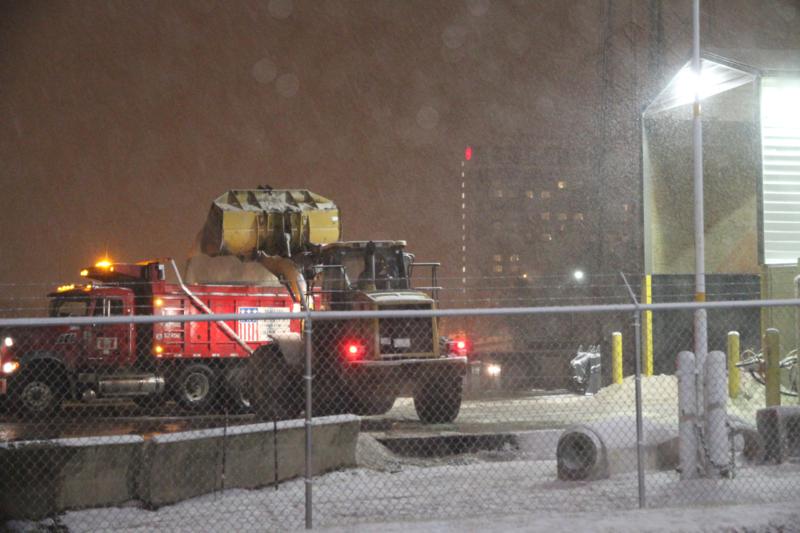
Now, crews are in position to tackle snow that’s expected to fall at a rate of 1″ to 2″ an hour later this afternoon.

“Treatment trucks and plows are pre-positioning along interstates, major roads and in subdivisions throughout Arlington, Fairfax, Loudoun and Prince William counties for quick response,” VDOT said in a statement.

The agency is asking Northern Virginia drivers to stay off the roads tonight, if at all possible.

“The Virginia Department of Transportation urges motorists to plan ahead for their evening commutes, and to limit travel after 4 p.m. today,” VDOT said. “If motorists must travel, they are encouraged to check current weather, road conditions and traffic cameras before traveling by visiting www.511Virginia.org or by calling 511.”

VDOT also issued the following winter driving tips:

  • Ensure that your vehicle is winter-ready.
  • Slow down, and keep a five-second distance or more behind other vehicles. Do no pass trucks applying chemicals unless absolutely necessary.
  • Be aware of areas prone to freezing such as ramps and bridges.
  • When driving on ice, do not slam on brakes. Turn gently and slowly.
  • Keep an emergency winter kit in your car.
  • Always wear your seatbelt.

Update at 3:30 p.m. — The road has reopened.

Wilson Boulevard has been shut down in the area of North Jackson Street and Washington Boulevard in Clarendon.

A vehicle collided with a utility pole, splitting it in half near the Hess gas station. Dominion is on the scene replacing the pole, which has transformers on it, complicating the process.

No word on when the street will reopen.


The county board has approved two projects designed to improve traffic flow and reduce emergency response times.

The board awarded a $651,000 contract to install an emergency vehicle preemption system along the entire Arlington stretch of Lee Highway. The system will allow emergency vehicles to get an automatic green light at approaching intersections, thus reducing travel times and enhancing safety.

“Emergency vehicle preemption technology is critical to saving lives by giving responders safe, speedy passage through intersections and cutting precious minutes off the time it takes to get patients to life-saving care at a hospital,” Arlington Fire Chief James Schwartz said in a statement.

The board also awarded a $4.7 million contract to install six miles of fiber optic line. The line will run from Rosslyn to Ballston, down Glebe Road and along the eastern end of Columbia Pike. It’s part of a larger, $20 million project to upgrade the county’s communication and traffic management systems.

The fiber line will connect 54 county traffic signals and will allow for the installation of additional traffic monitoring cameras and motorist information signs.

“Arlington’s dense urban corridors require a modern system that offers greater efficiency and flexibility for monitoring traffic, operating signals, and providing real time driver information,” said William O’Connor, Director of Arlington’s Department of Environmental Services. “Expanding and enhancing the system will help ensure that the Arlington streets operate as seamlessly and safely as possible both day-to-day and during emergency situations.”

The fiber line will replace an aging copper line as well as lines leased from Comcast.

“Built in the early 1980s, the County’s current communications network lacks the speed and capacity to meet present and future demands, and is nearing the end of its useful life,” the county noted in a press release. “It consists of outdated and increasingly unreliable twisted pair (copper) cables and a leased private network.”

Chesapeake Electrical Systems has been chosen as the contractor on both projects, which are expected to take six to eight months to complete. The work is being paid for with a combination of federal and local funds.

Flickr pool photo by Chris Rief


Chain Bridge Road is expected to remain shut down for the next half an hour as firefighters work to rescue a man trapped in a van that knocked over a utility pole.

Initial reports suggest the driver of a delivery van knocked over a utility pole while backing out of a driveway on the 100 block of Chain Bridge Road, just north of Chain Bridge. Live power lines fell on the van, trapping the driver inside.

Firefighters are now working to free the man.

Police have shut down the road between North Glebe Road and the Fairfax County line. The road should open up shortly after the rescue is completed.

Update at 1:30 p.m. — The rescue is complete and power has been shut off to the power lines. A lane closure may remain as Dominion installs a new utility pole.


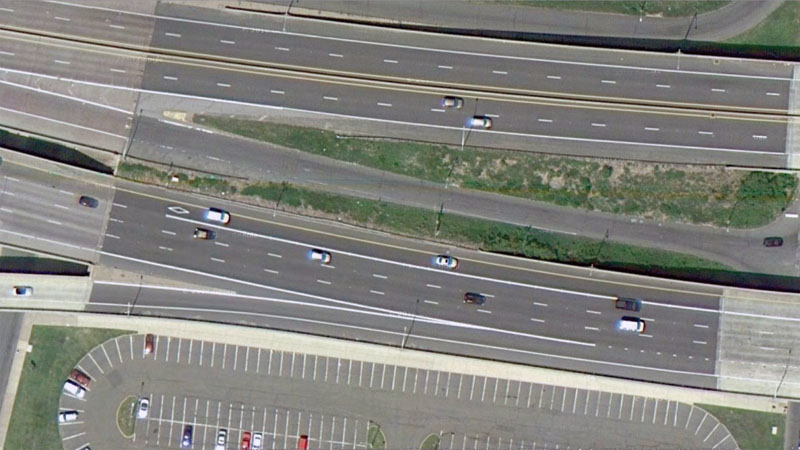
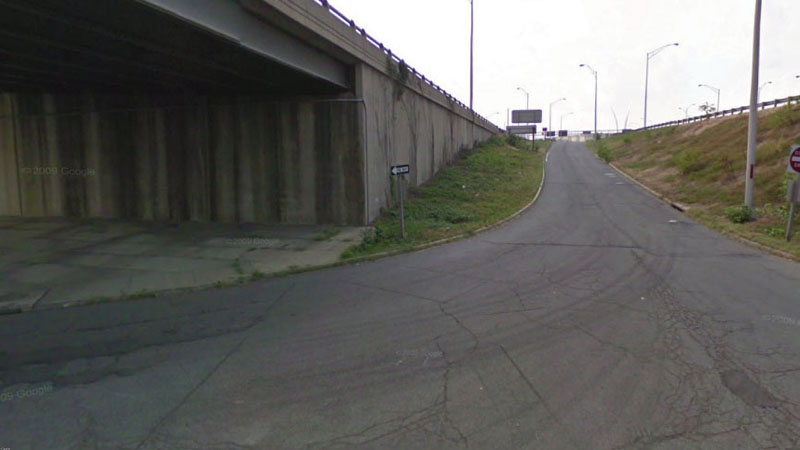
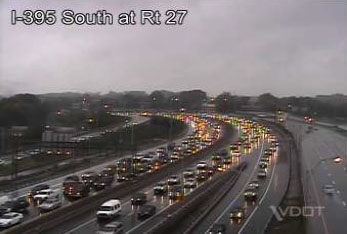
VDOT is planning to widen the ramp from the HOV lanes of I-395 to Eads Street in Pentagon City.

The project would add an extra turn lane to the ramp, which often gets backed up during the morning rush hour. The ramp serves commuters heading to both Pentagon City and to the Pentagon itself. The left turn necessary to head to the Pentagon parking lots is a bit tricky, leading to some of the backups.

VDOT advertised the project in yesterday’s Washington Post. The agency says it will hold a public hearing on the project if anyone requests it in writing.

The proposal seems rather uncontroversial. The ramp is tucked away in the existing I-395 concrete jungle next to the Pentagon, several blocks from the nearest residential building. A VDOT report found no significant adverse impacts resulting from the project.


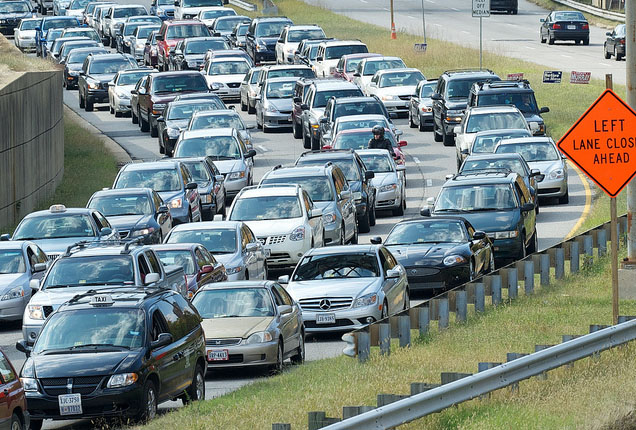
The Washington metro area is tied with Chicago for having the country’s most congested roads.

According to a new study, auto commuters in Washington and Chicago spend about 70 hours — nearly three whole days — of extra time in the car thanks to traffic. We beat out the famously congested Los Angeles area, where commuters only spend 63 extra hours in the car each year.

Washington also ranked #1 for “fuel wasted per peak auto commuter” and #2 for “commuter stress” and “cost of delay per peak hour auto commuter” (at $1,555 per year).

In the wake of the study’s release, the Northern Virginia Transportation Alliance, a group that supports additional spending on highway capacity and other transportation projects, issued a snarky press release “congratulating” the region for the distinction.

“Persistence pays off!” the Alliance proclaimed. “Years of state fiscal neglect and local opposition to planner’s priorities have finally moved the Commonwealth’s economic engine, Northern Virginia, to the top of the congestion-delay heap.”

The news comes less than two weeks after Virginia Gov. Bob McDonnell (R) announced plans to roll out billions in additional transportation spending.

Researchers with the Texas Transportation Institute, which conducted the study, came up with a number of general strategies to help alleviate traffic congestion, including:

  • “Get as much use as possible out of the transportation system we have.”
  • “Add roadway and public transportation capacity in the places where it is needed most.”
  • “Change our patterns, employing ideas like ridesharing and flexible work times to avoid traditional ‘rush hours.'”
  • “Provide more choices, such as alternate routes, telecommuting and toll lanes for faster and more reliable trips.”
  • “Diversify land development patterns, to make walking, biking and mass transit more practical.”
  • “Adopt realistic expectations, recognizing for instance that large urban areas are going to be congested, but they don’t have to stay that way all day long.”

Getting from place to place by car or bus may be getting a bit easier in Arlington.

This weekend the county board is expected to approve a $4 million contract that will install six miles of fiber optic line along the Rosslyn-Ballston corridor, Columbia Pike and Glebe Road. It’s the first phase of a long-term traffic management project that planners hope will allow more intelligent, real-time management of traffic flow in the county.

In addition to connecting 54 county traffic signals, the fiber line will add capacity for traffic management tools like traffic cameras, motorist information signs, and traffic counters.

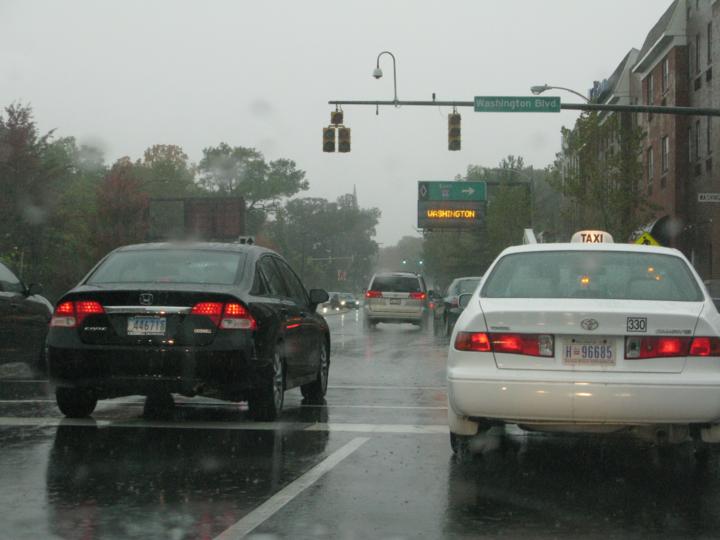
The initial phase of the project includes four new traffic monitoring cameras, at the intersections of Washington Boulevard and Wilson Boulevard, Columbia Pike and Walter Reed Drive, Columbia Pike and Glebe Road, and at Glebe Road and Arlington Boulevard (Route 50). An additional 17 cameras throughout the county could be installed by the end of the year, according to Traffic Engineering and Operations Bureau Chief Wayne Wentz. The new cameras would supplement the Arlington’s existing 29 traffic cams.

The first phase of the project also includes a new motorist information sign — commonly used to relay real-time traffic information or advisories — on Route 50 at Pershing Drive. Additional signs are planned as more fiber is installed.

Through enhanced monitoring and improved communication, the fiber lines will eventually lead to a smarter traffic management system that is able to automatically change traffic signal timings to deal with unexpected changes in traffic patterns.

“Our long-term plan for our intelligent transportation system is to measure traffic in real time and adjust traffic signal timing patterns on a daily or hourly basis,” Wentz said. “It will let us do more things to deal with congestion.”

Currently, traffic signal timings are adjusted systematically every three years. Individual re-timings are conducted more frequently in response to specific complaints, Wentz added, and systems are in place to deal with specific high-traffic events like the Fourth of July or an evacuation of D.C.

In addition to traffic management applications, the fiber lines will also be used as a common network backbone for county facilities, from schools to libraries to bus depots. The traffic monitoring systems will also be of use to public safety agencies, who will be able to “monitor special events and reduce response time to incidents,” according to a staff report.

When the multi-phase project is completed, fiber optics will have replaced 52 miles of “outdated and unreliable” copper lines from the 80s, at a cost of about $20 million. Most of the project is expected to be complete by the end of 2014, Wentz said.

Flickr pool photo by pderby


Police are urgently calling in salt trucks to the Arlington Forest neighborhood, where a number of cars have been sliding down a steep hill on North Edison Street.

Cops are starting to block off access to the road in the area of Carlin Springs Road and North Emerson Street. They’re reporting on the radio that the street is coated with ice.

At least two cars are reported to have been involved in a collision, and at least one county vehicle is stuck at the bottom of the hill.

Update at 9:55 a.m. — Dangerous, icy conditions are also being reported in the area of South Hayes Street and Fort Scott Drive in Aurora Hills.


Utility relocation work along Columbia Pike in the Barcroft area has been delayed after workers discovered conflicts with pre-existing underground utilities.

As a result, the project — which started last summer and was originally slated to take 15 months — has been prolonged by an estimated three months. Planners will now have to redesign the relocation process. Work is not expected to resume until “late spring,” according to a letter from the county to local residents and organizations.

The delay will also affect the Metro and ART bus stops that were closed and relocated as a result of the project.

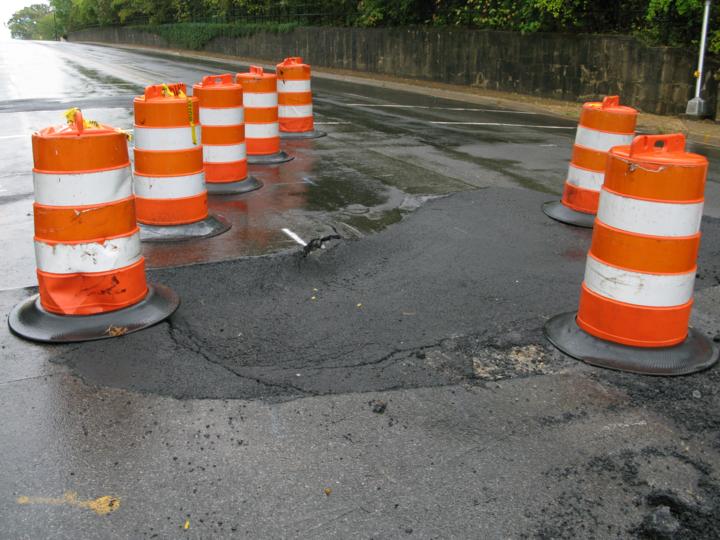
Separately, the county announced that it’s working to repair the torn-up and uneven stretch of the Pike between Four Mile Run Drive and South Wakefield Street. However, cold temperatures are expected to keep the necessary asphalt work from being completed until mid-February.

Residents have been complaining about the potholes and sinkholes and other car-rattling pockmarks in the roadway.

“Right now the road is in a very bad state,” said Takis Karantonis, director of the Columbia Pike Revitalization Organization. “Folks have complained often to us.”


View More Stories