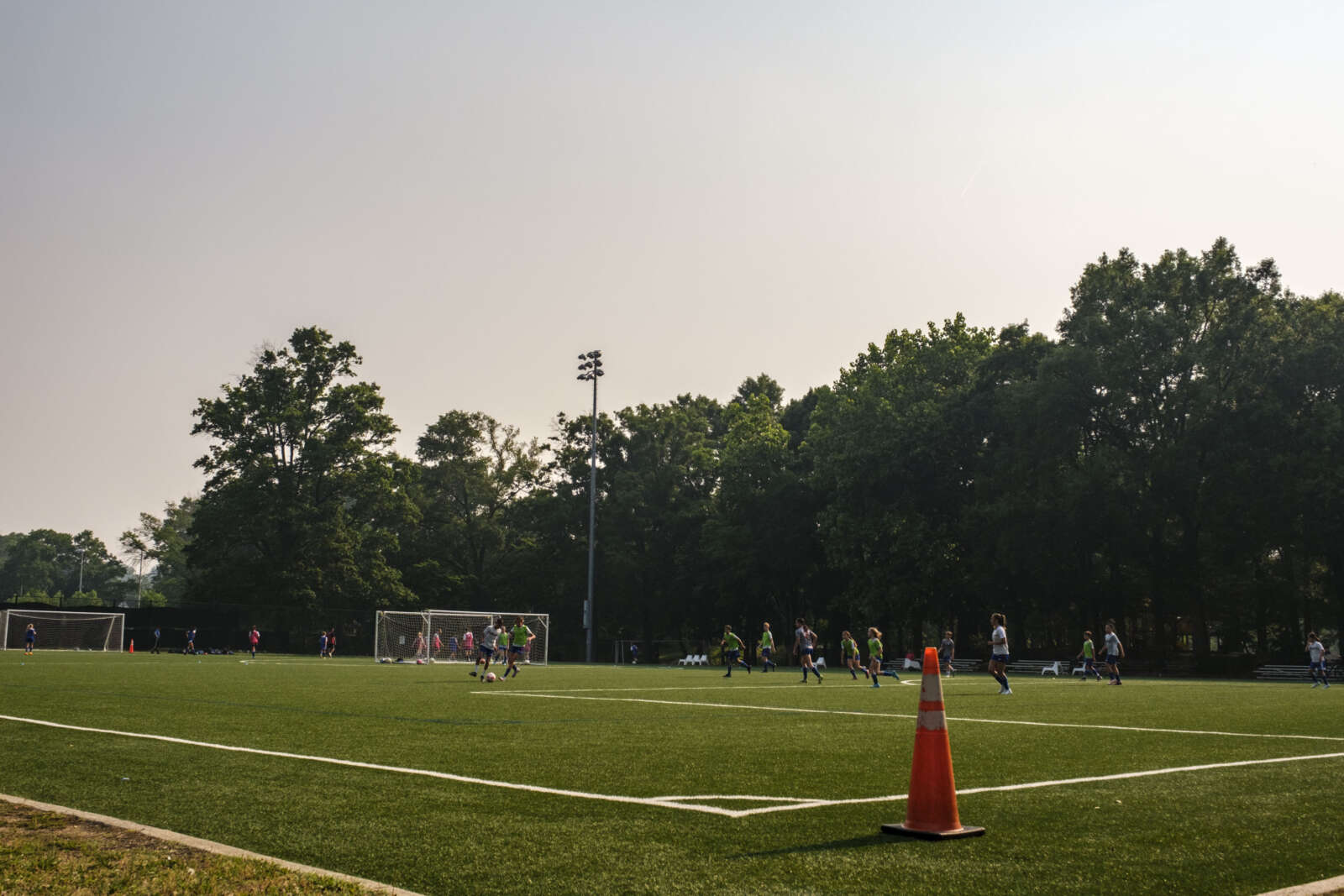
Widespread haze. Mostly sunny, with a high near 80. Northwest wind 6 to 10 mph. At night: Widespread haze before 2am. Partly cloudy, with a low around 57. Northwest wind around 7 mph. See more from Weather.gov.
💡 Quote of the Day
“What lies behind us and what lies before us are tiny matters compared to what lies within us.” – Ralph Waldo Emerson
🌅 Tonight’s sunset
Thanks for reading! Feel free to discuss the day’s happenings in the comments.
Wednesday is forecast to be a “Code Orange” day in Arlington and across the D.C. area.
That’s according to the Metropolitan Washington Council of Governments, which says local air quality will be “unhealthy for sensitive groups.”
Air quality is low across much of the eastern U.S. as smoke from wildfires in Canada is blown south, making for hazy skies and, in some cases, a campfire-like smell outside.
The smoke — making the Eastern U.S. look like California at the peak of fire season — is not normal. The air is compromised from Minneapolis to DC to Boston, and the worst from western NY to arround Ottawa. A thread… 1/ pic.twitter.com/cV8MnfdWRI
— Capital Weather Gang (@capitalweather) June 6, 2023
More on the Code Orange alert, below, from MWCOG.
The Metropolitan Washington Council of Governments (COG) has forecast a Code Orange air day for the metropolitan Washington region tomorrow: Wednesday, June 7. Code Orange levels mean the air is unhealthy for sensitive groups. Smoke coming from fires in Canada will contribute to the increased levels of fine particle pollution.
On unhealthy air days, COG advises the following health precautions:
Children and older adults should reduce outdoor activities.
Healthy individuals should limit strenuous work or exercise, especially outdoors.
Individuals with respiratory and heart ailments, emphysema, asthma, or chronic bronchitis should limit their activity level. If breathing becomes difficult, move indoors.
Residents can check current air quality conditions on COG’s website or by downloading a free air quality app from Clean Air Partners.
On unhealthy air days, residents are encouraged to take the following actions to help reduce pollution:
Turn off lights and electronics when not in use and follow tips from your electric utility about how to use less electricity to cool your home.
Avoid lawn mowing or use an electric mower.
Use transit, carpool, or work from home to limit driving. Fill up your gas tank during evening hours.
COG provides air quality forecasts and current air quality conditions for metropolitan Washington. It also educates the public about voluntary actions people can take to reduce pollution and the health risks of bad air quality through its Clean Air Partners program, which is co-sponsored by the Baltimore Metropolitan Council.
It’s possible that a Code Red air quality alert could be issued in the coming days, as the smoke gets worse locally, according to the Capital Weather Gang.
DC's air quality dipped to code orange (hazardous for sensitive groups) today as smoke from Canada poured in. It could still get worse. Reporting by @islivingston: https://t.co/inHdf5m5s0
— Capital Weather Gang (@capitalweather) June 6, 2023
This recurring Real Estate feature is sponsored by The Eli Residential Team. Their mission is to guide, educate, and advocate for their clients through real advice, hands-on support, and personalized service. This week’s post is written by Carolanne Korolowicz.
In Arlington, the contention between urban development and environmental preservation is ever present. Citizens went to bat to save Arlington’s tree canopy during the Missing Middle debacle, there are environment-focus ballot measures almost every election, and plenty of local associations with a mission to preserve the county’s green landscape. But, did you know that debating over trees is actually an Arlington tradition? Before boundaries were even drawn, trees have been at the center of almost every development project.
On October 21, 1767, the stage was set by John Carlyle and Charles Alexander. The two prominent figures went to trial to dispute whose land (modern day Arlington and Alexandria City) was whose. Twenty-four witnesses gave their testimonies about the land boundaries defined by tree markers. Many of these witnesses were quoted mentioning the trees’ ages, whether they had been marked as line or corner trees, and the type of instrument used. With tree-defined boundary lines, the testimonies became a source of confusion rather than clarity.
In other historical accounts, it is clear that the DC-area forefathers viewed trees as part of the area’s heritage. A friend of Thomas Jefferson wrote, “Nothing affected Mr. Jefferson like this wanton destruction of the fine trees scattered over the (Federal) City grounds.” The friend also stated that Jefferson himself once said, “The unnecessary felling of a tree, perhaps the growth of centuries, seems to me a crime little short of murder.” As obvious by these statements, the conservation cause has always been one of great passion.
(A part of George Washington’s Oak Tree Displayed at The Glencarlyn Library, Photo: ArlingtonHistorical.com)
The acknowledgement of prominent trees has been documented over the centuries. George Washington’s survey oak in Glencarlyn being one of the first. Later in 1860, a large, anciently marked poplar tree was noted to be a landmark for the Cherrydale Neighborhood, but was cut down for the Washington and Old Dominion Railway in 1912. George Nicholas Saegmuller, an original owner of “Reserve Hill”– today’s Knights of Columbus Arlington Headquarters– planted a strip of evergreen forest from LIttle Falls Road to Old Dominion Drive as a homage to his homeland of Germany. Most importantly, the first tree to be given protection was one of the oldest oak trees of the Nation at the Grunwell Estate, located in Country Club Hills, in the late 19th century.
(A Champion Ash tree in Barcroft Park being measured, Photo: Arlington County)
Citizens acting as stewards of wildlife are deeply rooted in the makeup of Arlington. This symbiotic relationship remains today through the Forest and Natural Resources Commission’s Notable Tree Nominations. Since 1987, the volunteer-led program has awarded over 400 significant trees and their caregivers. In 2024, eleven trees were selected, including four on Fort CF Smith, six in North Arlington and one located on the corner of Columbia Pike and George Mason Drive. Though not legally protected, the status has proved helpful when communicating the importance of conservation during development projects.
What makes for a notable tree? The committee looks for these three items: size, neighborhood value, and uniqueness. Nominations are due every year on October 31st – so it’s not too late to submit! For legal protection, an application must be submitted for a ‘Specimen Tree’ through the Trees and Shrubs Ordinance. This designation requires tree conservation and protection if development of a site occurs. Violations result in a civil penalty of up to $2,500. Applications are due September 30th every year.
(A 2024 Notable Tree Winner: Deodar Cedar on Fort CF Smith, Photo: Arlington County)
As headbutting between developers and “tree-huggers” continues on, Arlington County has made efforts in favor of the area’s ecosystem over the decades. The citizens hold the power to improve these protections. Nominating trees for significance, or legal protection, is the easiest way to make a difference.
To quote the late local historian Eleanor Lee Templeman, “Although Arlington County has already lost a great deal of its forests through careless development of subdivisions, an awakened public concern over this priceless heritage will save a great deal of remaining beauty. Our stream valleys and palisades still possess true wilderness areas which must be preserved for posterity.” (Arlington Heritage: Vignettes of a Virginia County, 1959)
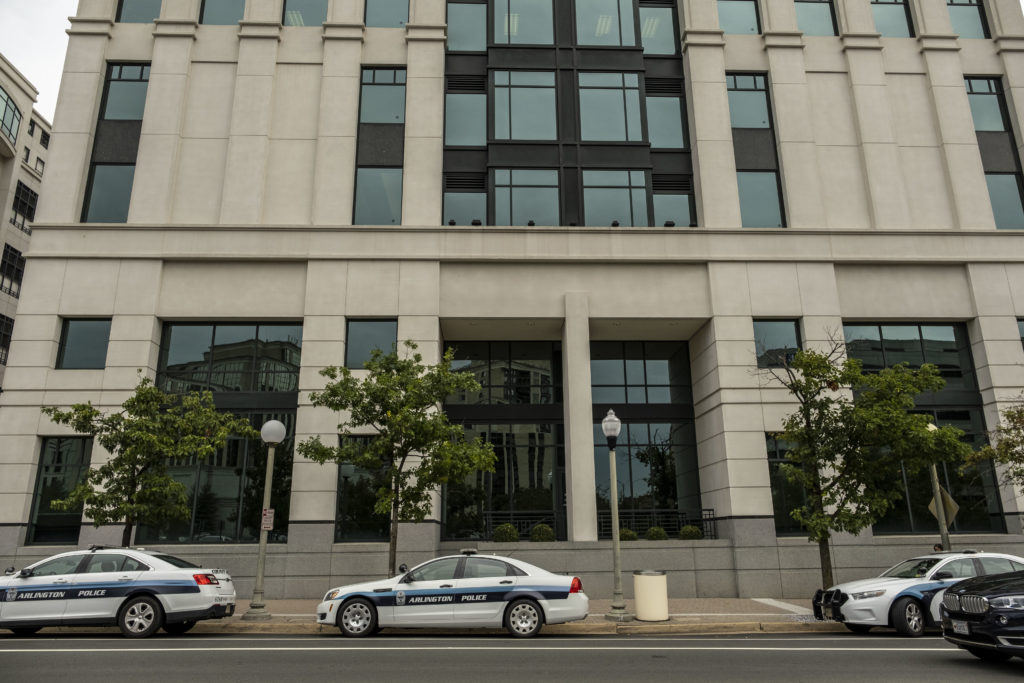
Arlington County courthouse and police headquarters in Courthouse (file photo)
(Updated at 5:45 p.m.) When Braylon Meade died in a car crash, a juvenile court judge handed down a sentence of one year of incarceration and two years of probation to the 17-year-old who crashed into him.
Prosecutors asked for a longer confinement term.
Had the crash happened just two months later, however, the driver would have been 18, would have been tried as an adult in circuit court, and likely would have received a stronger sentence.
Meade’s mother, Rose Kehoe, argued last month that this case should have been transferred to Arlington County Circuit Court, which handles felonies, given the age of the young man who killed her son and the severity of the crime. The then-17-year-old was driving 95 mph, had a blood-alcohol content of under 0.08%, according to Chief Public Defender Brad Haywood, who spoke with multiple people familiar with the case.
Last month, Kehoe backed Josh Katcher, who is running against incumbent Commonwealth’s Attorney Parisa Dehghani-Tafti, citing the judgment call and how she was treated as by Dehghani-Tafti’s office.
“Meaningful reform requires nuanced thinking regarding the facts of each individual case and applying the law fairly and appropriately,” Kehoe wrote in a letter to State Sen. Barbara Favola, who endorsed the sitting Commonwealth’s Attorney. “In the case of Braylon Meade, we have no doubt that Ms. Dehghani-Tafti’s political rigidity on the issue of refusing to charge juveniles as adults is what governed this case.”
Justice for victims … or the lack thereof has become a defining storyline in this election. We are up with our first ad and I am grateful that Rose Kehoe is willing to share her family's experience with my opponent. pic.twitter.com/e33HdBzHRi
— Josh for Arlington (@Josh4Arlington) May 23, 2023
One of Dehghani-Tafti’s campaign promises was to not try children as adults where it was in her power to decide. In this case, she said the rehabilitative services provided by the juvenile system would be better for holding the defendant accountable than potentially incarcerating him in an adult prison.
The politicization over whether to try this one juvenile as an adult posed questions about whether it ever makes sense to try a juvenile as an adult and whether Arlingtonians want a top prosecutor to take a discretionary approach to trying juveniles as adults, or to never do it all.
Arguments for and against the practice
Dehghani-Tafti’s resolve reflects a trend in prosecutorial reform to advocate against trying children as adults. Proponents argue children are not mini-adults and their brains work differently and that keeping juveniles plugged into developmentally appropriate services improves their outcomes later in life.
Fair and Just Prosecution nonprofit executive director Miriam Krinsky takes this view. Her organization advocates for a evidence-based, rehabilitative approaches to juvenile justice and, in a statement to ARLnow, she said cases like this one are hard but prosecutors should follow the science.
“Science shows that young people under the age of 25 are developmentally different from adults and should be treated differently by the system,” she said. “The science also shows that young people have a greater capacity for rehabilitation, are more responsive to treatment than adults because their brains are still developing, and are more likely to age out of criminal behavior.”
ARLnow also heard from lawyers who agree with the starting point that children should not be in adult prison — but who have a different view about trying a case in circuit court, which operates differently than a juvenile court.
“The Commonwealth’s Attorney has tons of discretion on every bit of it and can pursue plea deals, deferred dispositions, all kinds of things that could have been done and it would have given everybody involved the superior resources of the circuit court,” says Greg Hunter, a local defense attorney.
In short, if, after a hearing, a juvenile is transferred to circuit court for trial, adult prison is not a guarantee and a sentence can come with more oversight and a broader range of services.
They say this makes sense for older juveniles, who age out of the supervision of juvenile court after they turn 21 and thus have a shorter probation period in which reoffending has greater consequences. Judges can blend juvenile and adult sentences, which one study says did not impact recidivism outcomes.
The discussion unfolds, however, in a county where children are rarely tried in circuit court to begin with. One notable recent exception is when Maxwell Adams was tried as an adult for murdering his father, for which he received a 32-year prison sentence.
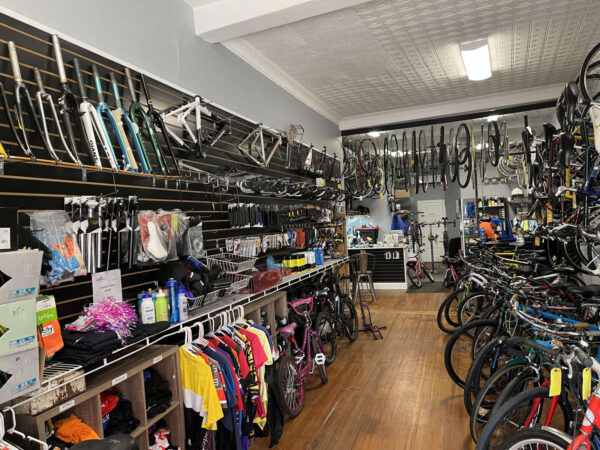
The location at 2647 N. Pershing Drive has been serving customers for a few months, but will formally celebrate its opening on Saturday, June 10. The event will include a ribbon cutting at 11 a.m. and giveaways.
“During Saturday’s celebration, we will offer a 20% discount on bikes and accessories,” said John McClanahan, a volunteer for the cooperative. “Giveaway items will include socks, shirts, caps, and basic tune-ups with pickup at Arlington. And, we’ll offer coffee, water, juices, and small pastries.”
Founded by John Patterson and Christian Myers in 2009, Velocity aims to foster an inclusive biking community through “affordability, education, and embracing the fun of riding,” according to its website.
The new Lyon Park location is its second location; the first is at 2111 Mt. Vernon Avenue in Alexandria’s Del Ray neighborhood.
Velocity’s storefronts facilitate sales, bike donations, bike education, as well as do-it-yourself and full-service repairs. Regular shop hours in Arlington are Tuesday-Friday from noon to 6 p.m., Saturday from 10 a.m. to 5 p.m., and Sunday from noon to 5 p.m.