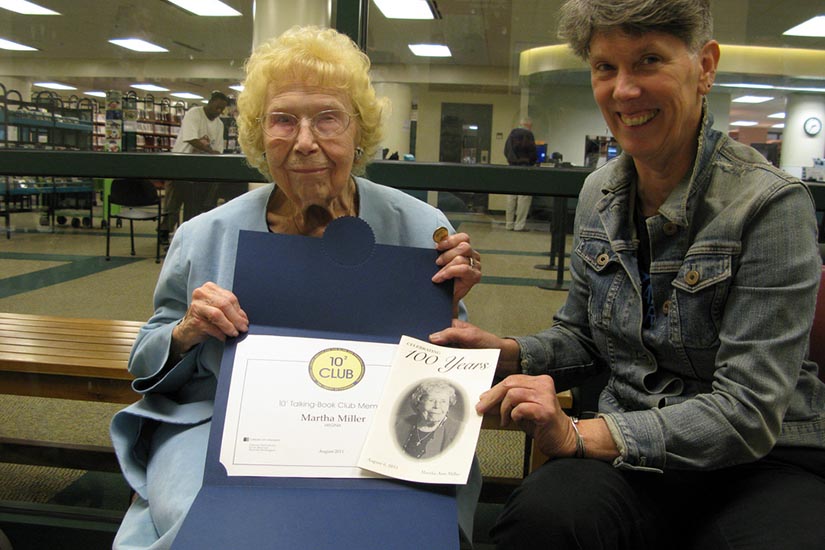
A longtime Arlington educator and resident, who helped secure the county’s ability to elect its School Board and self-published her memoirs at the age of 101, died last week.

Martha Ann Miller died at the Sunrise at Bluemont Park senior living facility on Wednesday, August 16. She was 106.

Along with her husband, Malcolm D. Miller, she helped lead a group in Arlington called the Citizens Committee for School Improvement, who wanted to improve the standard of Arlington Public Schools just after World War II by letting the county elect its own School Board.

Before, a county electoral board appointed School Board members, but the group lobbied hard in Richmond. State law changed in 1947 to allow Arlington to elect its School Board.

Meg Filiatrault, one of the Millers’ two surviving children, said it was inspiring as a child to see the group in action. From the basement of their home in Arlington, volunteers worked to send out campaign literature and prepared to testify before state bodies.

“It was a real community effort, just normal people doing what they felt they had to do to get what they wanted for their children,” Filiatrault said. “My parents were extremely well-invested in good schools and in public schools, and so were a lot of the committee.”

Miller taught math at what was then known as Stratford Junior High School, now the H-B Woodlawn Secondary Program. And in 1959, just four years after the U.S. Supreme Court ruled segregation in schools unconstitutional in “Brown vs. Board of Education,” she was one of the first teachers in the county to volunteer to teach black students.

Four students began a math class with her on February 2, 1959, and Filiatrault said she remembered no instances of violence, even amid tension and a large police presence.

Miller had her first taste of the Washington, D.C. area as a child. As a 14-year-old living in Evansville, Ind. in a family of farmers, she won a bread baking competition at the Indiana State Fair, with the prize of a scholarship to Purdue University and a trip to D.C.

On that trip in 1925, she met then-President Calvin Coolidge, then returned to D.C. after graduating from Purdue with a major in Home Economics and a minor in Math. She met her husband at Foundry United Methodist Church in D.C., then the pair settled in Arlington.

Despite losing most of her sight to macular degeneration in her 90s, Miller wrote her autobiography, “The First Century and Not Ready for the Rocking Chair Yet,” and independently published it at the age of 101.

She wrote with the help of cousin and editor Jo Allen. Miller typed some of the work herself then dictated the rest, all because of her desire to tell her descendants about her life. The book has sold more than 800 copies.

“She was a very tenacious person, and she really wanted to leave this as a legacy for her great-grandchildren,” Allen said. “Her grandchildren pretty much knew the stories, but the great-grandchildren were too young to know that much about her life. She thought it was important to leave them a legacy.”

Beyond education, Allen remembered Miller for her love of the board game bridge, as well as her support of public television, including WETA, founded in 1961 and now based in Shirlington. She was also active in the American Association of University Women, the local Teachers’ Association and Clarendon United Methodist Church, where until recently she was head of the music committee.

Miller was born in 1911 in Indiana, and had three brothers. She put her long life down to super B complex vitamins, which she initially took for knee pain in the 1960s.

Miller is survived by two children, Malcolm R. Miller and Meg Filiatrault, and predeceased by two children and her husband Malcolm D. Miller. She is also survived by four grandchildren and seven great-grandchildren.

Visitation is scheduled for Thursday, August 24 at 2-4 p.m. and again at 6-8 p.m. The funeral will be on Friday, August 25 at 11 a.m. at Clarendon United Methodist Church (606 N. Irving Street).
The following Letter to the Editor was submitted by Washington-Lee High School 2015 graduate Alexander Wallace, who is now a student at the College of William & Mary.

Activists called for Lee’s name to be removed from W-L at the Arlington School Board meeting on August 17, in the wake of this past weekend’s events in Charlottesville.

Board members announced they would study the names of all current and future schools in the county and decide if any should be changed.

Since the violence in Charlottesville over the removal of the statue of Robert E. Lee, there have been calls to rename Washington-Lee High School, Arlington’s oldest. Others want to keep the old name.

As a 2015 graduate, I have thought about this subject often, especially after the Charleston massacre, which was on the day of my graduation.

I understand the argument for renaming the school. Robert E. Lee fought for a government whose raison d’etre since its inception was the preservation of chattel slavery; the Cornerstone Speech by their Vice President, Alexander Stephens, makes this clear as day.

In fighting for said government, Lee therefore fought to preserve that vile institution even if it was not his premier motive, and that in and of itself leads to just condemnation. That fact certainly makes the banner in the halls “Washington-Lee Celebrates Diversity” more than a little ironic.

That being said, I also understand the opposition to the name change. Washington-Lee, as a name divorced from its namesakes, has become an honored name, with famous graduates like Sandra Bullock and Warren Beatty, and academic and athletic success. Thousands of people by now have formed memories and friendships under that name.

Additionally, changing the name to proposals such as “Washington-Lincoln” or “Washington-Lafayette” (which I have both seen) would cause a significant degree of financial trouble to the school administration as they would have to replace signs, songs and logos on just about everything.

In full understanding of both perspectives I propose a compromise as a plan of action. We need not change the name “Washington-Lee,” but the name “Lee” could be rededicated to Robert’s father, Henry Lee. The elder Lee fought for the early Republic during our war for Independence in both Northern and Southern campaigns, and died long before the Confederacy was ever even an idea.

In doing so, we could keep the name “Washington-Lee,” the mascot “Generals” (for they were both generals in the Continental Army, and both from Virginia), the alma mater (which refers only to ‘Washington-Lee’ as a collective), and most everything else. All that would need to be changed are some portraits, like the ones in the main office and little theater, and one of the logos.

This compromise would allow the complete removal of the stain of the Confederacy from the school whilst maintaining its long-standing traditions. It is a compromise that I find ideal and hopefully would spare the school from the worst of the ongoing culture wars and bring the dispute to a quiet conclusion, one that would not attract undue attention.

In these trying times, I share the sentiment of our alma mater: “Washington-Lee, Washington-Lee, humbly for thee do we pray.” Our alma mater will need it.

ARLnow.com occasionally publishes thoughtful letters to the editor about issues of local interest. To submit a letter to the editor for consideration, please email it to [email protected]. Letters may be edited for content and brevity.


A $13.8 million plan to move Arlington Public Schools’ offices from the Education Center to prepare for its use as a high school is set to begin later this year.

The Education Center, which houses various APS offices as well as the Arlington School Board’s meeting rooms, will be used as part of a “hybrid option” alongside the Career Center to add 1,300 high school seats for APS. The Education Center is adjacent to Washington-Lee High School.

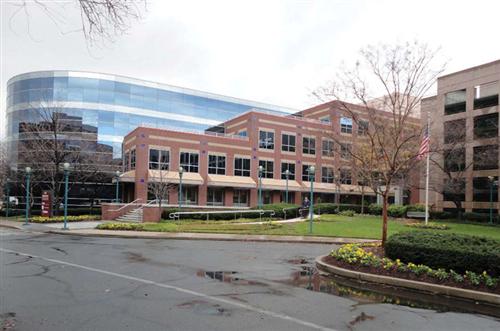
APS’ offices are set to relocate to Sequoia Plaza Two at 2100 Washington Blvd, which already houses the School Health Bureau that provides health programs and services, as well as the Parent-Infant Education and Environmental Health programs.

Separately, the county’s Department of Human Services consolidated more than 80,000 square feet of facilities into three buildings at its headquarters at Sequoia Plaza in 2014.

As part of a plan approved last December, the School Board agreed to amend its lease at the property and add just under 80,000 square feet of new office space. In May, the Board approved a design for the office space, which will be spread across four floors.

At its meeting Thursday, August 17, the School Board advanced a construction contract for Sequoia Plaza Two, and will vote to approve the contract as an action item at its September meeting.

Under a timeline presented by APS staff, construction would begin in September and take until April 2018. The first phase of moving would begin in December, with the second phase to begin in April once construction is complete.

Jeff Chambers, APS’s director of design and construction, said that first moving phase would be to move APS staff already based at the building elsewhere to accommodate construction. Chambers said the project will not require any more funding than the $13.8 million already budgeted.


(Updated at 10:45 p.m.) Arlington School Board chair Barbara Kanninen announced Thursday (August 17) it will revisit all school names in the county with a view to possibly changing some, including Washington-Lee High School.

Kanninen’s announcement came after the violence in Charlottesville over the weekend, and a new petition for Arlington Public Schools to change the name of Washington-Lee High School, named in part for Confederate Gen. Robert E. Lee. The petition already has more than 200 signatures.

Though there has been talk of removing Lee’s name previously, the current backlash against Confederate symbolism has put the idea on center stage. Speakers at Thursday’s meeting and a letter to the editor published earlier in the day called for changing the school’s name, which has been its moniker since it opened in 1925.

The Board is going to be naming new schools at the Wilson, Stratford, Education Center and Career Center sites, and with that in mind, Kanninen said the time is right to look again at who schools are named after.

“Given all this, it is simply clear to us as a Board that now is the time,” Kanninen said. “It’s time to talk about the names of our schools, and what they mean and why they matter. It is time to talk about the values these names reflect and the messages we are sending our children.”

Kanninen said there will be extensive community input when discussing school names, and the process will include a “wide range of voices.” She said the Board will look to establish a naming criteria for schools that “reflects our values,” which will ensure debate is “focused on facts, not opinions.”

“We are committed to this community conversation, but it will take time and resources to get it right,” Kanninen said. “As the governing body of our school system, we have to be careful and deliberate.”

During the Board’s public comment period at the same meeting, numerous speakers showed support for changing the name of Washington-Lee, given Lee’s history with the Confederacy. Of the dozen speakers to testify, the majority expressed support for a name change.

“Today, Lee remains a potent symbol of hate, as witnessed by the events in Charlottesville,” local resident Ryan Sims said. “[It] is time for Arlington Public Schools to acknowledge its history, change the name and move on.”

“We must build on the momentum of the current crisis and use this as a teaching moment in Arlington Public Schools,” said Marc Beallor of the group Indivisible Arlington.

Not everyone who testified spoke in favor of changing the high school’s name, however. Mila Albertson, president of the Washington-Lee Alumni Association, said changing the name could set a precedent that could lead to changing numerous names and flags throughout Virginia. She said that precedent could include changing the name of the capital city of Richmond, the capital of the Confederate States of America, or renaming Virginia.

Instead, Albertson said, the school has gained a reputation for producing tens of thousands of graduates who have led productive lives.

“The name Washington-Lee is exalted because of its graduates, not because of the two [people] it is named for,” Albertson said.

Local resident and “unofficial W-L historian” John Peck urged caution and urged residents to learn more about Lee’s history, especially after the Civil War.

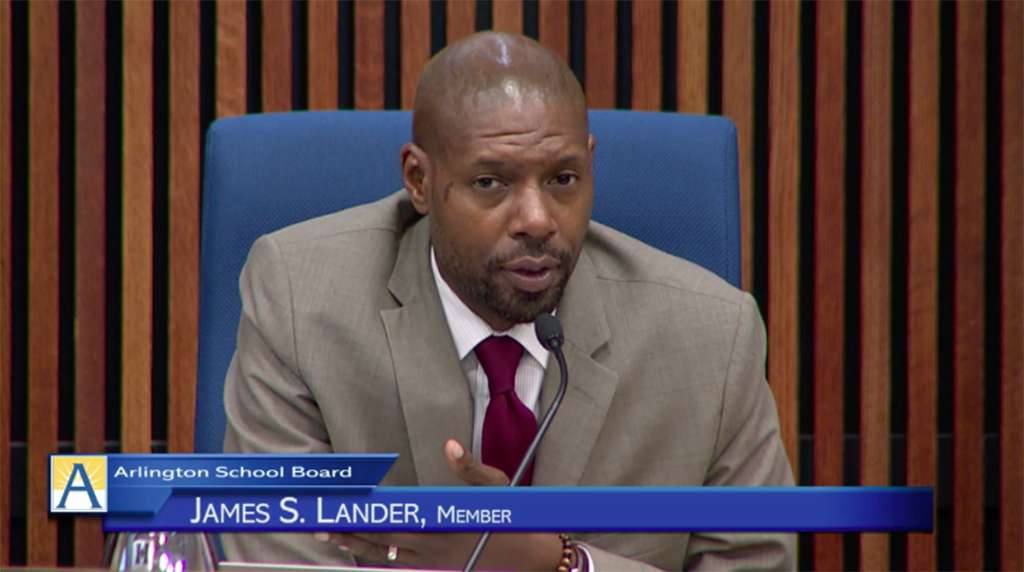
In a rarity for School Board meetings, two members spoke after the public comment period — urging patience for those who wish to change the name quickly. James Lander, the Board’s only black member, said it is important that community members continue to focus on students who face discrimination every day.

“I just don’t want us to take our eye off the ball and the children who are looking to us for examples,” Lander said.

Board colleague Reid Goldstein promised a robust process involving a wide range of opinions and community members, and no “knee-jerk” decisions.

“It’s very, very important that we do this right, or we’re going to keep doing this over and over again,” Goldstein said.


The following Letter to the Editor was submitted by writer and Washington-Lee High School graduate Waleed Shahid, who has started an online petition to push for removing Robert E. Lee’s name from the school.

Activists are also expected to call for Lee’s name to be removed from W-L at tonight’s Arlington School Board meeting, in the wake of this past weekend’s events in Charlottesville, sources tell ARLnow.com.

When I was a student at Washington-Lee, I clearly remember being taught in history class that Robert E. Lee “did not fight for slavery; he fought for Virginia.” I didn’t make much of it until I left Virginia for college. Many of my classmates thought it was strange that I went to a school named after the leader of the Confederate Army and that there was a highway that ran through my hometown honoring Jefferson Davis. These were racist slave-owners who rebelled against the American government and Abraham Lincoln, they told me. I shrugged and didn’t make it much of it.

But over the past few years — and particularly over the past week — many Americans have been beginning a conversation about our nation’s living wounds. It’s clear that too many are ignorant of our country’s history. And this past week has shown that a small minority of white nationalists are increasingly comfortable with publicly stirring up the worst aspects in American society by pitting Americans against each other.

To these white nationalists, Robert E. Lee represents their deep commitment to racial hierarchy. When three of his slaves escaped, Lee whipped them and had their backs washed with stinging brine. Lee ordered his Confederate soldiers to respect white property, but declared that any black people they encountered — regardless of their previous ‘status’ — were to be seized and returned to the South to be sold into slavery. At the Battle of the Crater, Lee’s Army even killed black prisoners of war. This is the history we honor when we name our school after Robert E. Lee — and why white nationalists felt so threatened by the removal of his statue in Charlottesville.

We must understand the stakes too. Arlington Public Schools should not shy away from taking a clear stand on this issue. It’s up to our civic leaders and institutions to take steps toward reconciling and repairing our nation’s living wounds where we can make a difference. Washington-Lee High School should be renamed so that we can move toward creating a school, county and country that truly belongs to all who call it home. If the President of the United States is unwilling to provide the leadership our country needs, then we need to provide it ourselves.

America was founded upon a revolutionary promise: freedom and justice for all. But, the revolutionary promise of America has never been fulfilled. We, the people has never included all of us. The story of our nation has always been a struggle over who America belongs to: the chosen few, or all of us? This is what is at stake when we honor the leaders of the Confederacy. Which side of that struggle will we honor? Germans don’t honor Nazi soldiers; South Africans don’t honor those who held up Apartheid. But Americans still honor Robert E. Lee and countless other Confederates who raised up a new flag and started a rebellion against the United States of America. Why?

It’s time Arlington honor those who fought tirelessly to create an America for all of us. As an alum of Washington-Lee High School, I urge you to consider re-naming our school Washington-Douglass or Washington-Tubman High School. As a Muslim-American who grew up in Arlington, continuing to have my alma mater named after Robert E. Lee is like seeing a Confederate Flag being constantly waved in my face. It makes me sick to my stomach knowing that we are honoring a man who fought to shackle and chain other human beings.

In many ways, Washington-Lee is a microcosm of America. My alma mater — just like my country — is still working to perfect our experiment in constructing a vibrant multi-racial democracy. This past week has been a reminder that some still hope to thwart our collective project and take us back to darker times. But by committing to change the name of Washington-Lee High School, we can take concrete steps toward living up to our best traditions and creating a nation where we all feel like we belong and where “We, the People” includes all of us. This is our historic responsibility as Americans in this moment in our history.

ARLnow.com occasionally publishes thoughtful letters to the editor about issues of local interest. To submit a letter to the editor for consideration, please email it to [email protected]. Letters may be edited for content and brevity.


Hundreds Ticketed for Passing Stopped School Buses — Last year, 618 drivers in Arlington County received a $250 fine for illegally passing a stopped school bus. A police spokeswoman said it was “very alarming” that so many drivers were ignoring the lights and stop arm on buses. [WJLA]

Firefighter Places Fourth in Bodybuilding Competition — An Arlington County firefighter, Capt. Tiffanye Wesley, finished fourth in the 40+ figure bodybuilding competition at the 2017 World Police and Fire Games in Los Angeles. [Twitter]

Arlington Bishop’s Statement on Charlottesville — Bishop Michael Burbidge released a statement earlier this week about the deadly white nationalist rally in Charlottesville. Burbidge condemned “racism, bigotry and self-proclaimed superiority,” writing: “For Christians, any form of hatred, no matter who it is against, is an offense — a sin — against the Body of Christ. Each person is created by God and bestowed with His unyielding love.” [Catholic Diocese of Arlington]

Hate Groups in Arlington — The Southern Poverty Law Center lists three hate groups as being headquartered or having a presence in Arlington, though the local connection is questionable for at least two of them. ProEnglish, an anti-immigrant group, is listed by the SPLC as having an Arlington headquarters, but it has a Washington, D.C. office address listed on its website. The National Policy Institute, headed by white nationalist Richard B. Spencer, lists an Arlington P.O. box but its headquarters is in Alexandria, according to news reports. The Center for Perpetual Diversity, a white nationalist organization that is fighting immigration in Europe and pushing for African Americans to return to Africa, is listed as having an Arlington headquarters. It has an Arlington P.O. box with a 22204 ZIP code. [Southern Poverty Law Center, Patch]

Arlington Near Top of Va. SOL Results — “Pass rates for Arlington Public Schools students on Standards of Learning tests taken last spring were up in 11 cases, down in 12 and unchanged in six from a year before, according to new state data. The county school system met or exceeded statewide passing rates in all but one of 29 exams, and exceeded the statewide rate by 5 points or more on 17 of the assessments.” [InsideNova, WTOP]


Advanced Towing Lobbied Hard for Bill — Advanced Towing spent $10,000 on lobbyists and made a $1,500 donation to state Sen. Barbara Favola while successfully pushing for a state bill to override Arlington’s second-signature towing requirement. Supporters of the bill say it passed and McAuliffe ultimately signed it because it had the support of the business community. Advanced is one of the largest towing companies in Northern Virginia and has drawn the ire of many local residents for its ruthless efficiency at trespass towing from private lots. [NBC Washington]

Russian Military Jet Flies Over Arlington — Yesterday an unarmed Russian military jet flew over the Pentagon, CIA headquarters, and the U.S. Capitol “as part of a longstanding treaty that allows the militaries of the United States and Russia to observe the other from the air.” [CNN, Axios]

Arlington Still Hiring Teachers — Arlington Public Schools is still hiring teachers for the upcoming school year. “A total of 280 full- and part-time contract positions were unfilled as of Aug. 1… as the school system continues to process applicants,” the Sun Gazette reported. [InsideNova]

Uber, Lyft Make Mark on Local Restaurant Biz — Although readers were skeptical in a poll late last year, the Washington City Paper reports that Uber and Lyft are having a significant impact on the local restaurant industry, drawing customers from a wider area geographically than would have visited before the ride hailing services existed. It’s also bringing more customers to hot non-Metro-accessible restaurants. And it’s not just hipster-y D.C. restaurants drawing customers from around the region: Lyft said Clarendon’s Don Tito was its most visited bar in the D.C. area in 2016. [Washington City Paper]


Applying to college is a scary but exciting process. Picking out schools, writing a personal statement and stacking up all of your best accomplishments.

But there was only one experience that I was never able to put into simple words, and that was the 11 years that I spent in immersion classes.

Arlington County is home to four Spanish immersion programs, at Claremont and Francis Scott Key elementary schools, Gunston Middle School and Wakefield High School.

Arlington Public Schools says the goal of the programs is to develop “high levels” of proficiency and literacy in two languages, promote high academic achievement and cross cultural competence.

I started second grade at Claremont Immersion School in 2003. It was the first year the school opened and students came from the immersion programs at Abingdon Elementary and my former school, Oakridge. I spent half my first day reciting the multiplication tables in Spanish, the other half in English.

It was not always easy, I struggled with both science and math as I got older and the content got more complicated. I stuck with it, although it was common for classmates to leave the school so they could thrive in a traditional setting.

Language skills improve even more in middle school, when there are 11 hours of Spanish instruction a week. Because subjects switch throughout the day, there’s a possibility to go back and forth from English to Spanish. It’s a brain workout to go back and forth between the two every 45 minutes. Unlike the elective Spanish classes offered in middle school, the Spanish Language Arts class that immersion students take is structured much like an English class.

High school is the true test. Some students struggle with AP level Spanish, as you don’t practice the language the way you do in middle school. With block scheduling, you may only get one day of Spanish instruction.

Continuing to practice Spanish every day is a valuable commitment. Many of my friends are double majoring or minoring in the language. They have traveled to Spain, Cuba and Costa Rica to practice the language.

“I’ve gotten to travel the world with confidence in my ability to speak the language,” said Peyton Johnson, a senior at James Madison University double majoring in Communications and Spanish.

(more…)


Texas Murder Suspect Arrested in Arlington — A suspected MS-13 gang member, wanted for two Houston-area homicides, was arrested in Arlington on Saturday. Twenty-year-old Douglas Alexander Herrera-Hernandez, also known as “Terror,” was taken into custody while walking near the intersection of Columbia Pike and Four Mile Run Drive. [Fox 5, WTOP]

Family of Murder Victim Donates Reward Funds — The family of an Iraq war vet shot to death in front of the Pentagon Row shopping center in 2006 has donated $5,000 in unclaimed reward money to Arlington Crime Solvers. “Despite an intensive investigation, a suspect and motive have not been identified,” said Arlington County Police. “This case remains an active cold case investigation.” [NBC Washington, WJLA, Twitter]

Some Arlingtonians Pay to Attend D.C. Public Schools — A handful of Arlington residents pay tuition for their children to attend D.C. public schools. Most are paying for enrollment in the renowned Duke Ellington School of the Arts in Northwest Washington. Arlington, which is still facing a school capacity crunch, does not allow nonresident students as does D.C., Fairfax County and Montgomery County. [Washington Post]

APS May Buy Home Next to Glebe Elementary — The Arlington School Board is considering buying a home next to Glebe Elementary School for $525,000 to provide emergency vehicles another point of access to the school. The home was recently sold to an investment firm for just over $400,000 this past January. [InsideNova]

Explanation for Low-Flying Helicopter — If you spotted a helicopter making low passes over Arlington this past weekend, it might have for a survey by the National Nuclear Security Administration “to measure naturally occurring background radiation.” [Twitter, National Nuclear Security Administration]

Flickr pool photo by Kevin Wolf


The following Letter to the Editor was written by Aaron Wajsgras, who serves on Arlington Public Schools’ Budget Advisory Council and its Career, Technical and Adult Education Citizens Advisory Committee.

It’s no secret that workforce needs are changing. From coding to manufacturing, industry is pining for a STEM workforce that can think critically and creatively. No longer are the times of the switch board operator or the repetitive assembly line worker.

So, exposing students to rigorous, hands-on learning where they can apply content knowledge to promote higher-order thinking skills is necessary for the future workforce. And, at the rate technology is changing, “the future” could be just a few years away.

According to the NOVA Workforce labor market dashboard, over 6,800 positions in management, science, technical consulting and computer systems design and related services were posted between April and June of this year. Additionally, across the country, skills gaps (what’s available versus what’s needed) exist in manufacturing, healthcare and other major industries to the tune of 5 million unfilled jobs by 2020, according to Georgetown University.

The skilled and creative future workforce has been a hot-topic for the last handful of years. Consequently, the Congressional STEAM (Science, Technology, Engineering, Arts, and Math) Caucus and the CTE (Career and Technical Education) Caucus held a joint briefing to discuss opportunities to incorporate arts and design into in-demand CTE and STEM curriculum; and Arlington Public Schools represented half the panel last week.

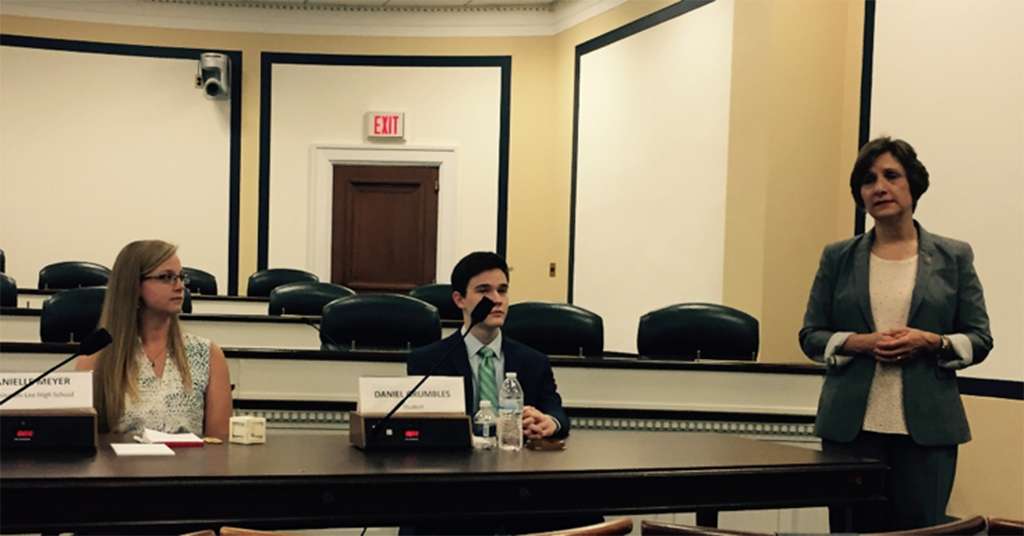
In addition to perspectives from General Electric and the Rhode Island School of Design, Danielle Meyer, the technology and engineering teacher at Washington & Lee, along with Daniel Grumbles, a recent graduate of W&L and a student of Meyer’s, were invited to discuss W&L’s engineering and technology program.

Danielle teaches several courses focused on engineering and technological design (the “A” in STEAM) and shared testimony about the importance of the aesthetics in her field. “We talk about the design process with our projects. The students create sketches and drawings and then use software to add dimensions, and we redesign and test when necessary.”

“Creativity is difficult,” she exclaimed, and uses the question “Would you buy that?” to keep students focused on the importance of the “consumers” of the projects. Giving the student perspective, Daniel highlighted his gratefulness for the collaborative nature of Danielle’s courses, the improvement of his technological literacy, and expansion of his creativity that he “did not always get to use in his mainstream courses.” All necessary skill-building for Daniel’s future career.

Of note, Daniel discussed the generous resources that APS has provided towards engineering courses to purchase items like 3D printers. Hoping students in other schools across the country can get the opportunity that he had, he stated, “It was not simply to provide the technology, but to facilitate the integration of it into the classroom.”

The value of skills in STEM and CTE fields are currently, and will continue to be, critical for the future workforce. However, the importance of creativity and higher-order thinking combined with in-demand skills helps to create our leaders of tomorrow.

ARLnow.com occasionally publishes thoughtful letters to the editor about issues of local interest. To submit a letter to the editor for consideration, please email it to [email protected]. Letters may be edited for content and brevity.

Pictured: Danielle Meyer, Technology and Engineering Teacher, Washington-Lee High School; Daniel Grumbles, Class of 2017, Washington-Lee High School; Rep. Suzanne Bonamici (D-Ore.), STEAM Caucus co-chair. Photo by Aaron Wajsgras.


Arlington County is home to many of Virginia’s top public schools. According to the popular ranking website Niche, Arlington Public Schools is ranked as the No. 1 school system in the state, out of 132 different school districts.

Within APS there are nearly three dozen public K-12 schools. So how do they rank?

Ranking methodologies, it should be said, have their flaws and do not necessarily reflect the quality of instruction at any given school. They’re also relative — so even the last-ranked elementary school in Arlington, an excellent school system, received an overall “A” ranking from Niche.

But for those who want to see how Arlington public schools stack up, debatable methodologies and all, we’ve taken some of the most prominent school rankings and averaged them to get a better picture of which are at the top and which have room for improvement.

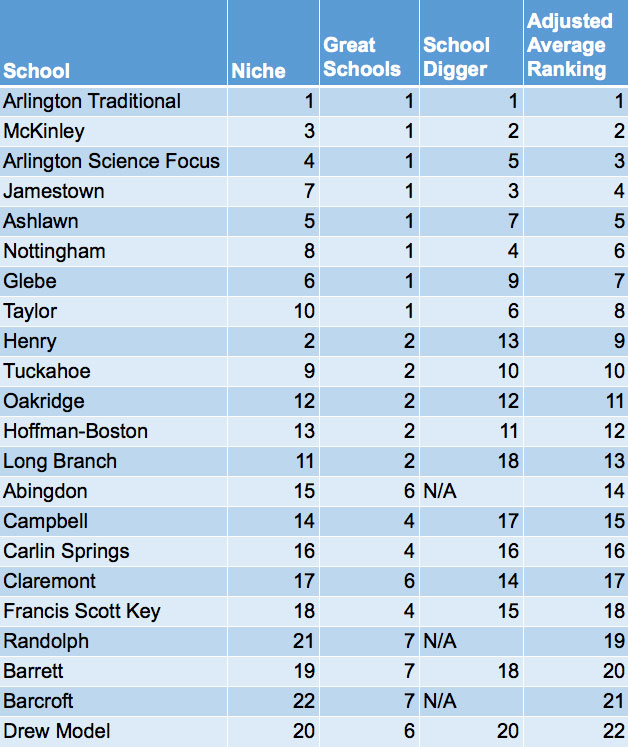
The following chart compares how three different school ranking websites, Great SchoolsNiche and SchoolDigger, ranked APS elementary schools.

Discovery Elementary, which opened in 2015, is not included in the rankings.

Great Schools operates in a system similar to Yelp, where a school receives a certain amount of stars out of 10. For example, four schools were tied for having 10 stars, or a perfect and “highest” ranking score, three for nine stars, and so on which is why so many elementary schools have the same Great Schools ranking.

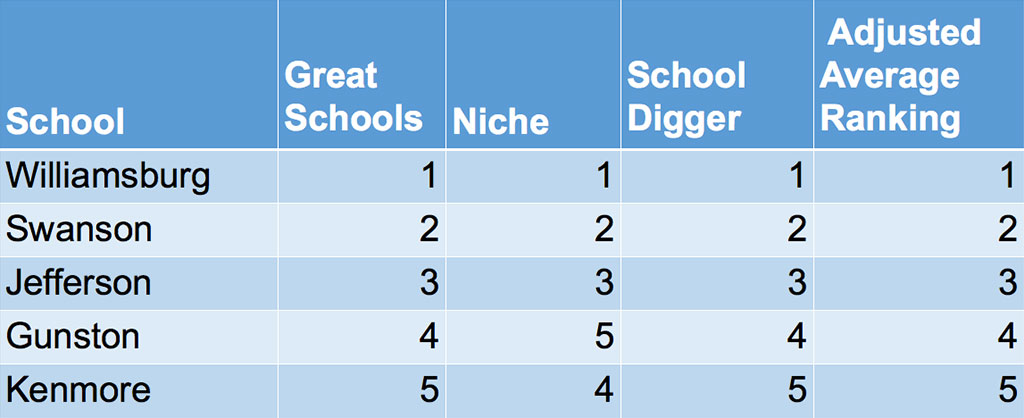
The next chart shows how APS middle schools compared to each other’s ratings on Niche, SchoolDigger and Great Schools.

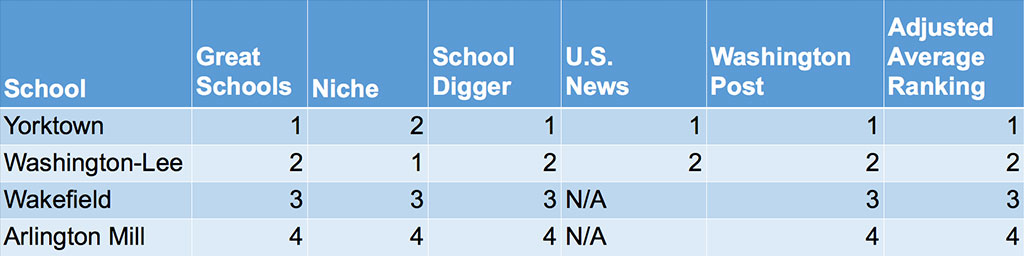
The last chart details the rankings of APS high schools from four websites: Niche, SchoolDigger, Great Schools, U.S. News & World Report and the Washington Post. The H-B Woodlawn Secondary Program is excluded.

Article written by Katherine Berko and Kalina Newman


View More Stories