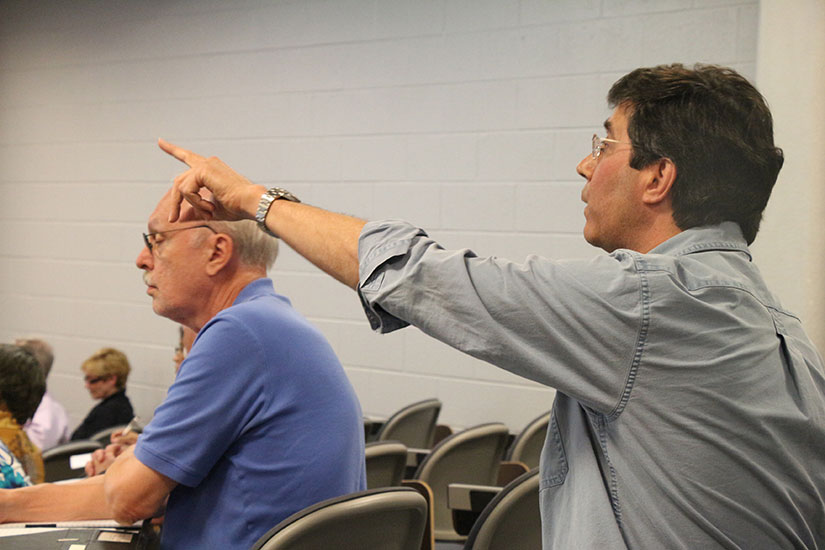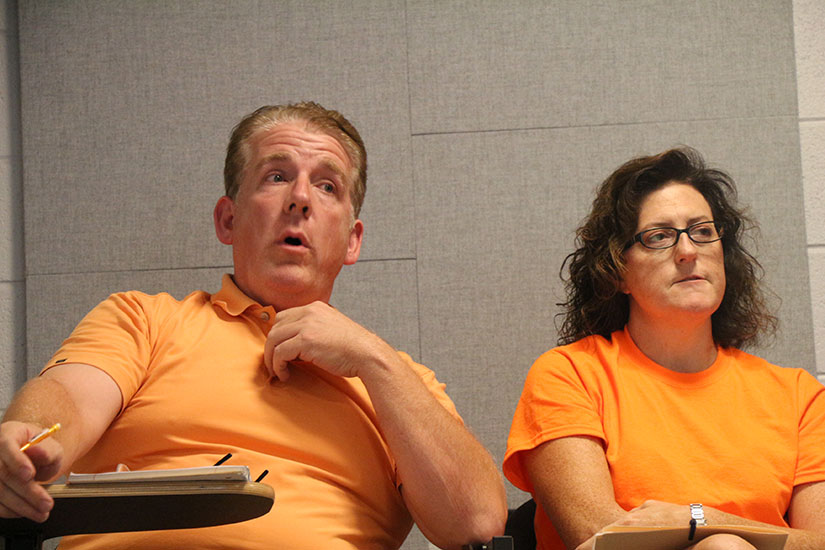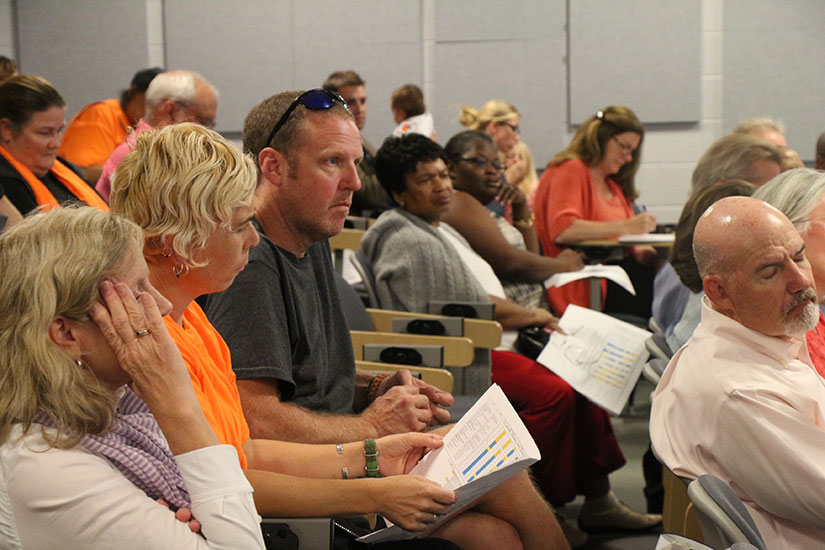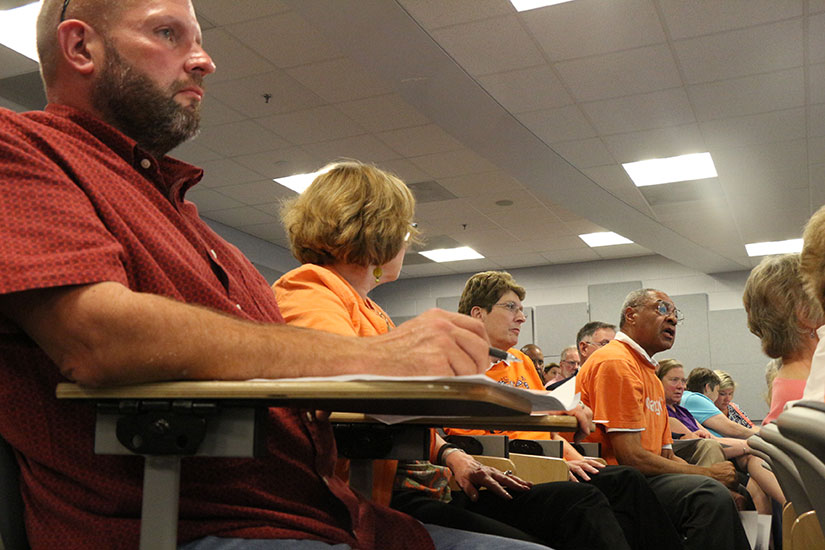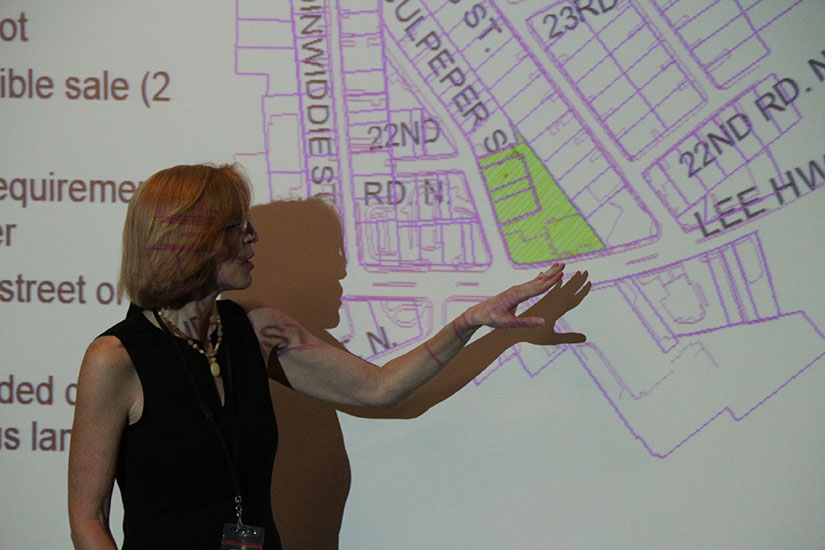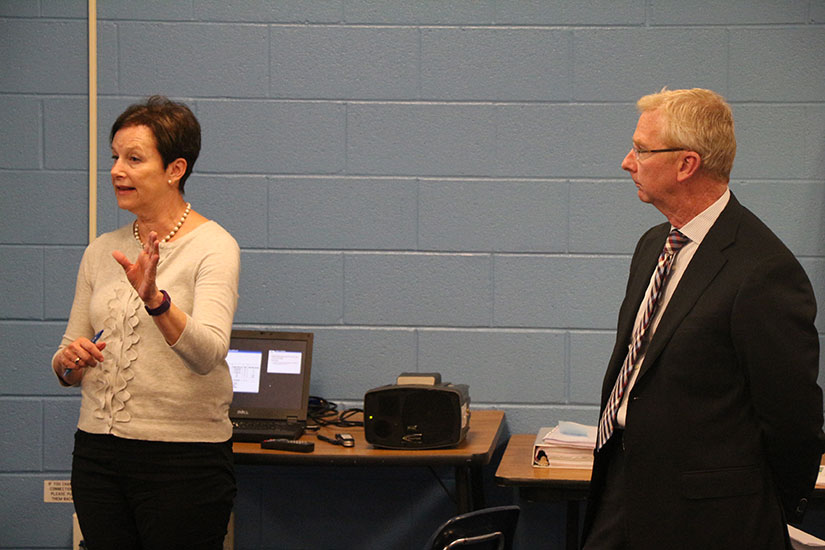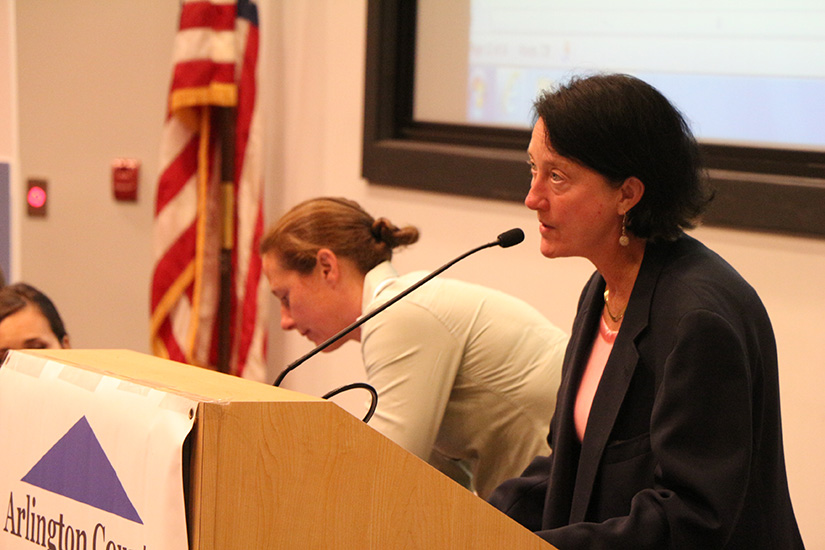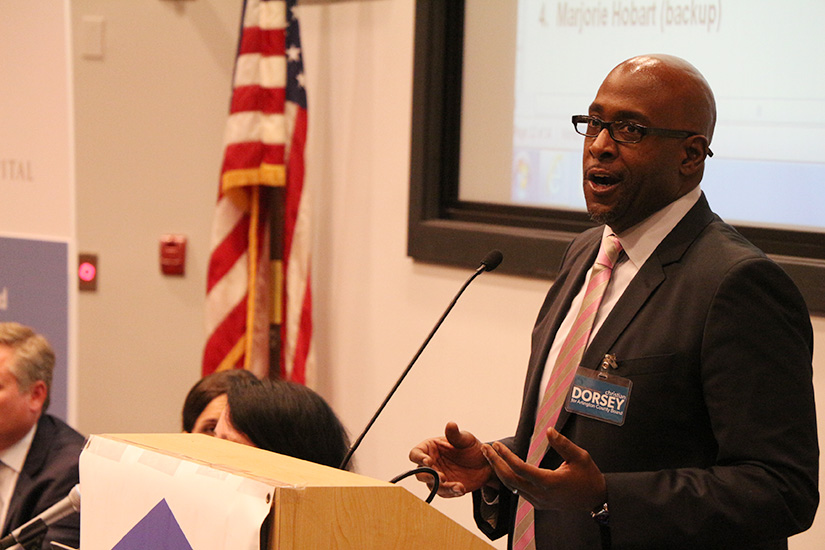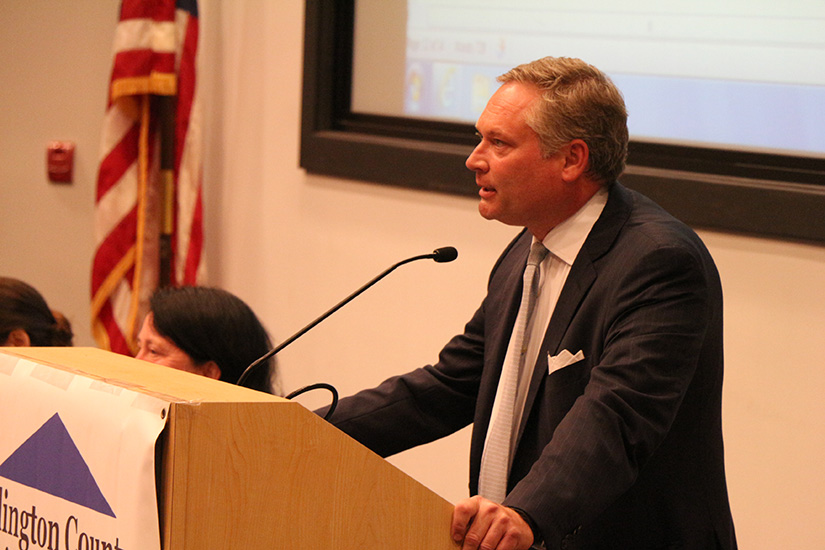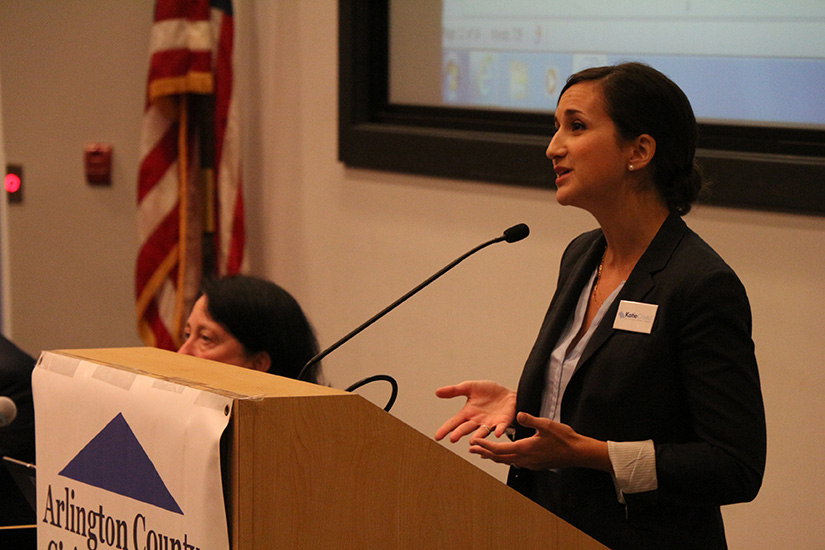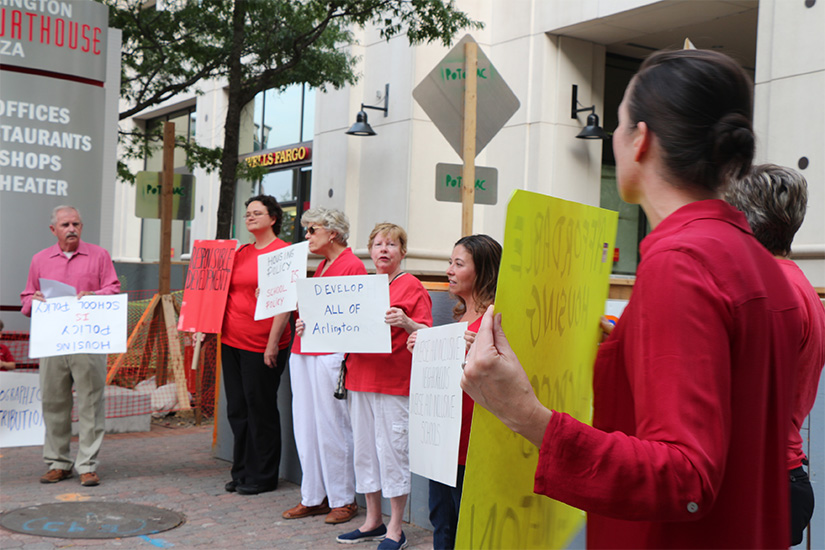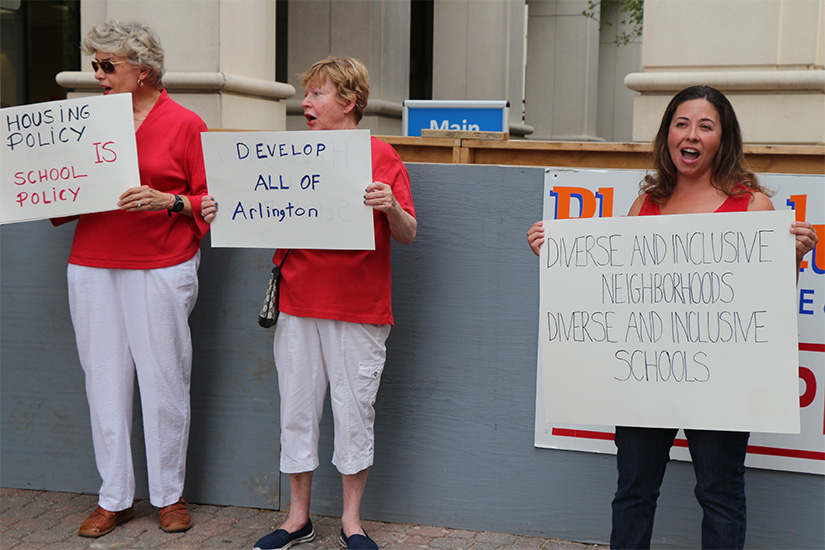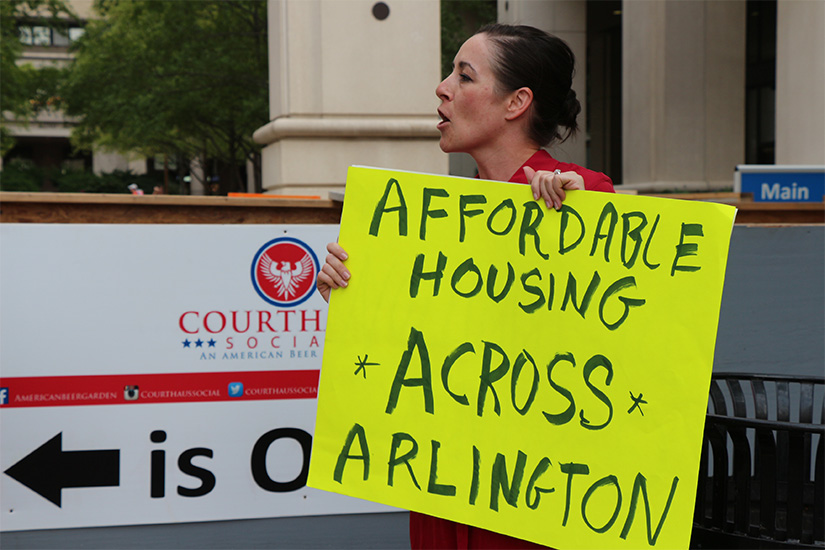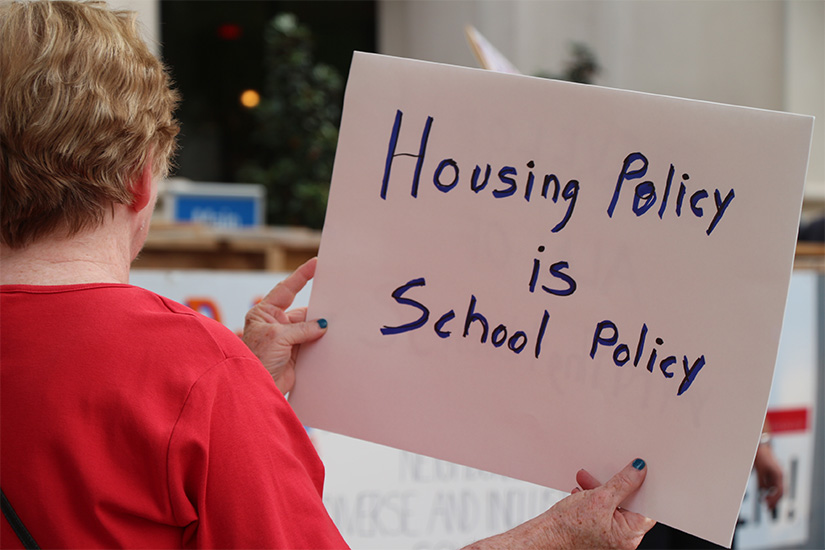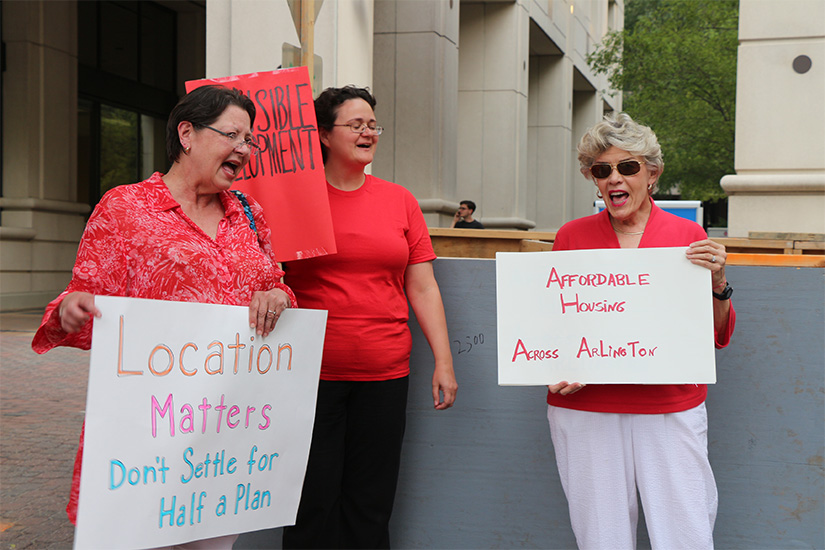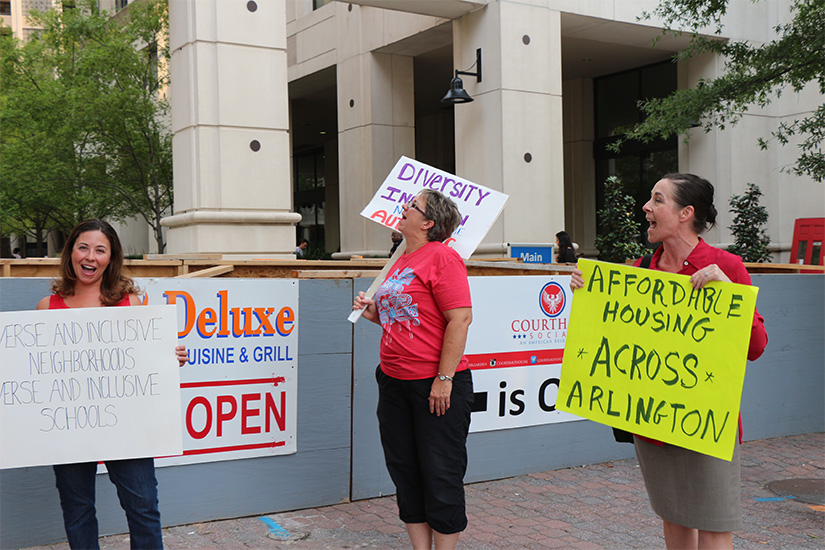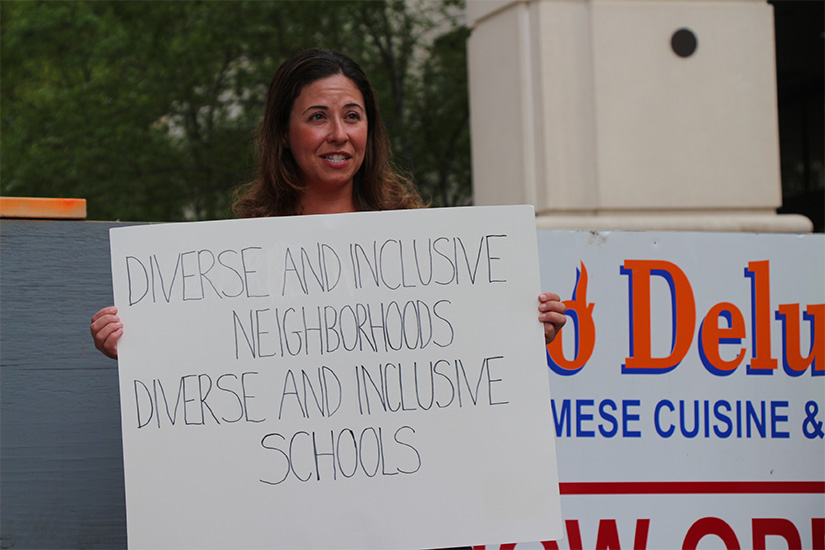
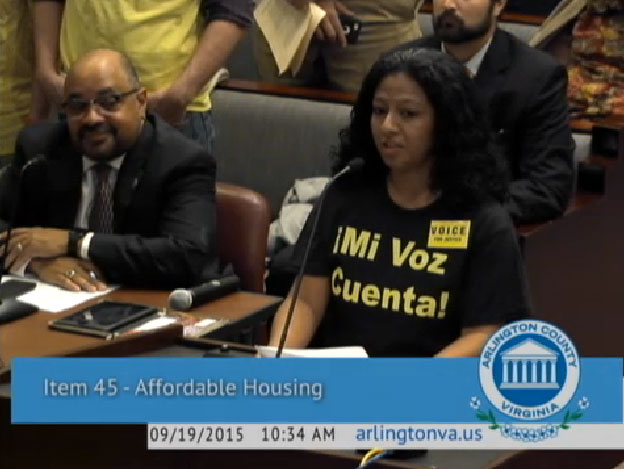
Speaker at County Board meeting on affordable housing plan(Updated at 3:20 p.m.) Following nearly five hours of discussion and heartfelt testimony, the Arlington County Board on Saturday approved an ambitious plan to replace rapidly disappearing market rate affordable housing in the county with more subsidized, committed affordable units.

Affordable housing supporters showed up in force to the meeting, well outnumbering critics who questioned the use of taxpayer funds to house residents who could otherwise not afford to live in a desirable, increasingly affluent inner suburb like Arlington.

Young parents, immigrants, teachers, seniors, businesspeople and clergy members, among others, spoke passionately in support of the plan, which calls for the creation of 15,800 new committed affordable housing units over the next 25 years.

“My parents always say that they know that in the future we will do a lot more than they have… and I believe that,” said one speaker, an Arlington Public Schools graduate and current Marymount University student who grew up in affordable housing. “I want our future generations to have better access to economic mobility, and in order for them to excel and become successful professionals, they need a stable home and a world-class education just like the one I know I am blessed to have received from APS and affordable housing.”

The Affordable Housing Master Plan approved by the Board was the culmination of three years of study and community engagement. Board members and community members spoke of the “marathon” process that led to the plan’s passage. Some spoke of continuing “the grand legacy” of former County Board members and local legislators who were instrumental in the county’s early support of affordable housing.

The plan provides a framework and goals for affordable housing in Arlington, but stops short of funding or planning individual housing developments. Under the plan, the County will try to dramatically increase the supply of housing that’s affordable primarily to those making less than 60 percent of the area median income.

“Between 2000 and 2013, the number of units affordable to low-income individuals and families in Arlington decreased from approximately 23,000 to 10,000,” the county noted in a press release. “Most of the 13,500 rental housing units were ‘lost’ to rising rents and redevelopment activity. The County’s current inventory of 7,000 Committed Affordable Units (CAFs) — units that are contractually obligated to remain affordable for decades — has only partially alleviated the loss of market-rate affordable units (MARKs).”

“The plan’s rental supply goal targets 22,800 affordable units by 2040 — a return to the number of affordable units that were available in 2000.”
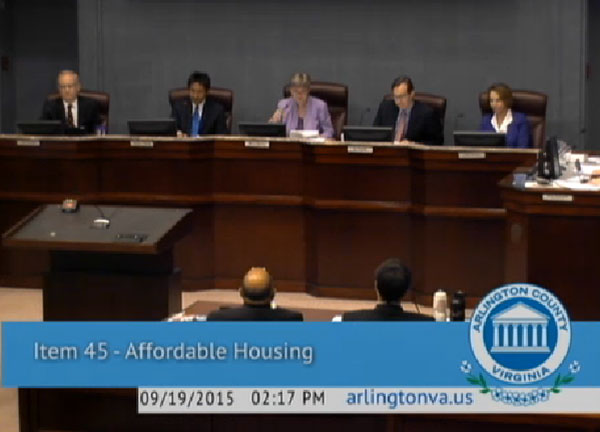
County Board meeting on affordable housing planCounty Board Chair Mary Hynes said that affordable housing is integral to keeping Arlington an inclusive and diverse community.

“This affordable housing plan continues our long tradition of providing housing so that individuals of all ages, races and incomes can come together to make a great community we can all call home,” Hynes said in a statement. “In the end we — and the generations that follow us — will all benefit from the great thinking that went into this plan.”

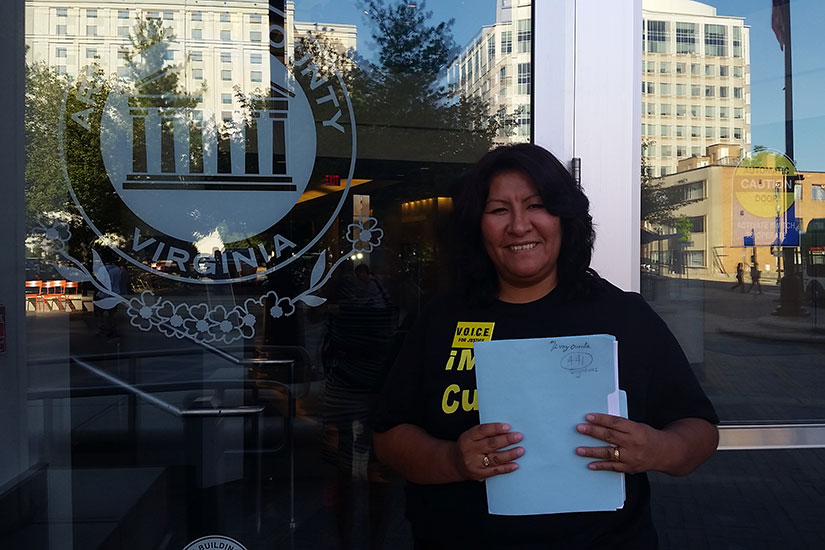
Among the personal affordable housing stories the Board heard was one from Claudia Delgadillo, an APS teacher and parent and a representative of the newly-formed group Mi Voz Cuenta — “My Voice Counts.” Delgadillo was once a recipient of free and reduced launch at school, but said she worked to put herself through Northern Virginia Community College and George Mason University.

Delgadillo said the hard-working immigrant community along Columbia Pike — those who are relying on Arlington Public Schools to educate their children so they can achieve a better life — deserved to have their voices heard, since they were among the most vulnerable to getting priced out of Arlington.

“We are the residents who are most actively feeling the housing crisis,” she said. “You think about us as statistics and have good intentions. We build your houses, we teach and take care of your children, we make your pupusas — don’t push us out, don’t speak for us.”

Also speaking in support of the plan was Katherine Novello, a founding member of the group Coalition of Arlingtonians for Responsible Development. Mi Voz Cuenta was formed partially in response to CARD, which pushed back against what it saw as an increasing concentration of affordable housing in South Arlington. Novello said the group was satisfied with changes to the plan intended to better distribute affordable housing throughout the County.

The plan “better reflects the vision of Arlington as a truly diverse and inclusive community,” said Novello. “I feel fortunate to live in a place where all voices count.”

(more…)


Foggy view of D.C., the Capitol and the Memorial Bridge from Arlington (Flickr pool photo by Kevin Wolf)

Arlington Woman Sues Restaurant — Laura Donahue, a 36-year-old Arlington resident, is suing the new D.C. restaurant Fig & Olive, saying she became ill with salmonella after eating there.The restaurant was shut down by the health department for several days after numerous reports of diners afflicted with salmonella. [Washington Post]

County Board Approves Street Projects — At its meeting on Saturday, the Arlington County Board approved $2.9 million in neighborhood street improvement projects. The projects, in Ashton Heights, Lyon Village, Arlington Ridge and Leeway, will be paid for with neighborhood conservation bond funds. [Arlington County]

Refinancing to Save County Millions — Arlington County expects to save $2.2 million over 14 years via a refinancing of wastewater and water system bonds that was approved unanimously by the County Board on Saturday. [Arlington County]

Water Main Rehab Contract Approved — The Arlington County Board has approved a $2.4 million contract to rehabilitate some of the county’s aging water mains. Some of the mains set for a cleaning and a cement mortar lining are more than 60 years old. [Arlington County]

Flickr pool photo by Kevin Wolf


The last planned community meeting on the topic of Fire Station 8’s potential relocation turned heated quickly as residents strongly objected to the county staff’s recommendation to move the fire station to what’s now a salt dome at 26th Street N. and Old Dominion Drive.

The county plans to replace the aging fire station with a larger, “state of the art facility,” which requires the station to be relocated to a larger piece of land or for the current building to be torn down and rebuilt. For the most part, residents at the meetings have objected to any relocation of the fire station, citing the station’s history and importance to the surrounding community, among other issues.

“I have been at these meetings and at every one of them, one or two or five people have suggested either a newer cooperative station or a new station for emergency medical services in the northern part of the county and leaving Fire Station 8 renovated and modernized where it is,” one neighbor said. “And yet immediately that suggestion is dismissed and does not appear on any of these studies that you present. It doesn’t look like you have taken back suggestions in any form for your consideration.”

County staff are planning to recommend the salt dome at 26th Street N. and Old Dominion Drive as the location of the new Fire Station 8 to the county manager. The county manager will then draft a recommendation that will be made to the County Board.

The site at Old Dominion Drive and 26th Street N. is only one of the possible 19 locations that fit the parameters set by the County Board. Under these guidelines, the new location had to improve response times in North Arlington, have at least an acre and a half of land, be county owned or have a willing seller, have access to an arterial road and not exist in a resource protected area. The total cost of acquiring the land and building the new four-bay station also had to be $12 million or less, according to Deputy County Manger Carol Mitten.

Throughout the process, the largest concern has been improving response times to homes in North Arlington, said Deputy County Manager James Schwartz, who previously served as the fire chief.

If the fire station is relocated a minute north to 26th Street N. and Old Dominion Drive, 3,000 more homes will be able to have a four to six minute response time from the fire department, police and emergency medical services, he said.

In most of the county, emergency services are able to get to people within four to six minutes, except in the far northern most part of Arlington, where times can be eight or 10 minutes, he said.

“A person that’s in cardiac arrest must receive basic life support, that’s CPR, in four to six minutes or there’s irreversible brain damage,” he said.

(more…)


A member of Mi Voz Cuenta at county government offices (Courtesy of Mi Voz Cuenta)

(Updated at 5:40 p.m.) A new group made up of South Arlington residents and teachers are asking the County Board to approve the Affordable Housing Master Plan at its meeting this Saturday, Sept. 19.

The plan calls for an additional 15,800 affordable housing units to be built by 2040, to bring the county’s percentage of affordable housing to 17.7 percent. The plan has caused a divide in South Arlington, with the new group, Mi Voz Cuenta asking for the County Board to approve the plan, while the group Coalition to Arlingtonians for Responsible Development (CARD) is continuing to ask the Board to ensure that affordable units will be spread throughout the county instead of clustering them around Columbia Pike.

Mi Voz Cuenta, which translates to My Voice Counts, is composed of South Arlington residents, many of whom are parents of children attending Arlington Public Schools, including Randolph, Barcroft, Campbell and Claremont Elementary Schools.

“For many of us, English is not our first language, and many of us were not born here. Nevertheless, we have made Arlington our home, and it has been a community which we have contributed to and enriched economically, culturally, and socially,” the group said in a letter to the County Board, which had more than 440 signatures.

Mi Voz Cuenta says it organized in response to another South Arlington group that has asked for affordable housing to be spread throughout the county and has connected low-income housing to poor school performances, an apparent reference to CARD.

“We know of communications you have received from our neighborhoods and know that they do not speak for us,” members of Mi Voz Cuenta said. “Our voices and our perspectives have not been adequately or correctly represented in these communications. In fact, we feel discriminated against. Most of us were not invited or ever made aware of the forums from which official messages claiming to represent our neighborhoods were sent. We would have liked to be included in these conversations since we are also part of the neighborhood.”

Mi Voz Cuenta is advocating for affordable housing in the neighborhoods near Columbia Pike, adding that the mixed-income neighborhoods have attracted diversity, and with it vibrancy, to the area, the group said. The group is also open to affordable housing throughout the county, said group spokeswoman Jessica Sarriot.

(more…)


Flag over I-395

Arlington Generates $3 Billion in Travel Spending — Arlington County generated $3 billion in tourism spending in 2014, a 5 percent increase over 2013, according to data released Monday. Tourism supports almost 25,000 jobs in Arlington and generated $80 million in local tax revenue. Arlington accounted for about an eighth of Virginia’s $22.4 billion in tourism spending. “These record numbers are a testament to the excellent quality and value of Arlington’s travel and tourism offerings, and the strong collaboration between the County and local businesses in promoting our destination both domestically and internationally,” said Arlington Economic Development Director Victor Hoskins. [Arlington County]

Tejada: Crazy Transportation Ideas Better Than No Ideas — Retiring Arlington County Board member Walter Tejada says monorail-like pod transit on Columbia Pike may seem like a crazy idea, but at least it’s an idea. “The JPods or gondolas – some folks might chuckle, but at least the residents are coming up with options, and those who oppose things are not,” he said in an interview. [WTOP]

Moran: Federal Shutdown Coming — Former Democratic congressman Jim Moran, who represented Arlington in Virginia’s Eighth District, says he believes a federal government shutdown is coming because of a budget impasse between Republicans and Democrats. “We have a dysfunctional legislative branch,” said the 12-term congressman, who took a job as a legislative advisor for a D.C. law firm after leaving office. [WTOP]

Future I-66 Tolls May Be Steep — A plan to toll vehicles with fewer than three occupants on I-66 may cost commuters up to $16 round trip just for travel between D.C. and the Capital Beltway. [Washington Post]

County to Buy, Tear Down Home for Park — The Arlington County Board on Saturday is expected to approve the purchase of a home at 2827 N. Harrison Street. The county plans to raze the home and incorporate the 9,632 square foot site into adjacent Chestnut Hills Park. The total cost will be nearly $800,000 and will come from the county’s parkland acquisition fund. [InsideNova]


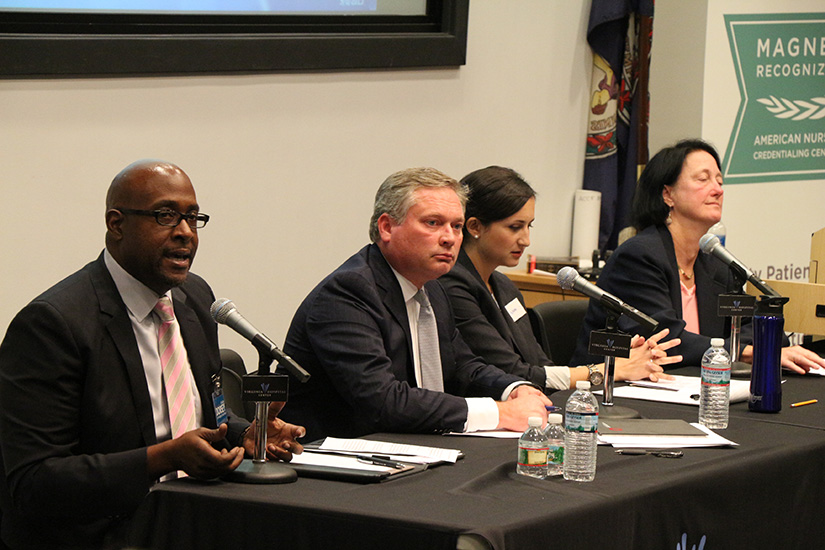
Candidates field questions from the audienceAffordable housing in the county has become a dividing line between the Democratic and independent candidates for County Board.

The candidates fielded questions from Arlington’s civic associations about various issues facing the county, including communication with residents and the commercial vacancy rate during a Civic Federation meeting last night. Arlington residents will vote for two new County Board members on Nov. 3.

Democrats Christian Dorsey and Katie Cristol both spoke in favor of the Affordable Housing Master Plan, which the Board will decide on this month, while independents Mike McMenamin and Audrey Clement said they would vote against the plan.

The problem with the affordable housing plan, said Clement, is that it continues to rely on “densification” — building more housing in order to also add subsidized affordable units. Development has made housing more expensive, and has contributed to the loss of market rate affordable housing, she said.

Audrey Clement

“The actual economic assumption behind it is fallacious,” said Clement.

If voted onto the County Board, one of her first priorities would be the creation of a housing authority, which would put all housing agencies under one roof, similar to Fairfax County, Clement said. She also took issue with what she said would be a $90 million cost that the county would shoulder each year.

Dorsey disagreed, arguing that the plan is good for the county from an economic standpoint.

Christian Dorsey

“When you have people who can live affordably, you have people who can spend money in your community,” Dorsey said.

For Cristol, the plan presents a way to help protect the middle class. While campaigning, she has heard from residents who say they would not be able to afford their homes if they had to buy them today.

“I believe the status quo in Arlington is hostile to the middle class,” Cristol said.

The plan isn’t perfect, Cristol said, adding that some of her South Arlington neighbors have asked for the plan to be more firm about geographic distribution.

“It’s a tough issue,” Cristol said. “It’s a complex issue.”

Michael McMenaminWhile housing affordability is an important topic, McMenamin said it is the wrong issue to be prioritizing, separating himself from the three other candidates who include affordable housing as a top platform issue.

“We’re betting everything on affordable housing when we have a school crisis,” he said, referring to the burgeoning student population, overcrowded schools and the proliferation of trailer classrooms across the county.

Arlington also needs to focus on the commercial vacancy rate, McMenamin said, an issue all candidates agreed on.

The county needs to work on “getting businesses back in the county,” he said. The county should focus on becoming a home for large companies like Marriott — which is considering moving from Maryland — but also provide a nurturing environment for startups, he said.

The county needs to find “creative ways, like tax relief,” to make the county more attractive to business, McMenamin said.

Making it easier for small businesses is an absolute must, Dorsey said. He proposed streamlining the process of starting a business in Arlington.

Katie CristolCristol agreed that Arlington could be a hub for new businesses, such as companies in the medical technology industry, but she said that the county should not keep lowering the tax rate without a plan.

“We need to plan for the Arlington we want to see instead of blindly lowering the tax rate,” she said.

Candidates were also asked about the process behind County Board decisions, which some residents said is unsatisfactory.

All candidates said they would work to be open and more transparent about decisions, acknowledging decisions around the Western Rosslyn Area Plan, Reevesland Farmhouse and Fire Station 8, were not handled properly when it came to informing the community.


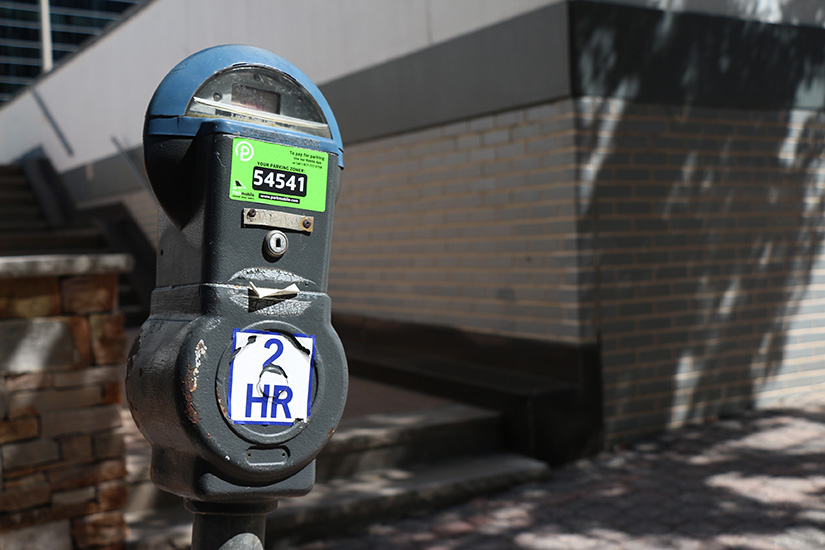
Parking meter on N. Oak Street

(Updated at 10:50 p.m.) Street parking in Arlington will now cost an extra quarter.

The 25 cent rate increase for parking meters went into effect on Sept. 7. The raise was approved by the County Board in May.

Rates for short-term, two hour parking are now $1.50 per hour, up from $1.25. Four hour, or long-term, parking rates are $1.25 per hour, instead of $1.

The increase does not apply to meters with reduced rates of 50-75 cents per hour. Areas with lower parking demand, such as near Virginia Hospital Center, were also not affected by the change, said county spokeswoman Jessica Baxter.

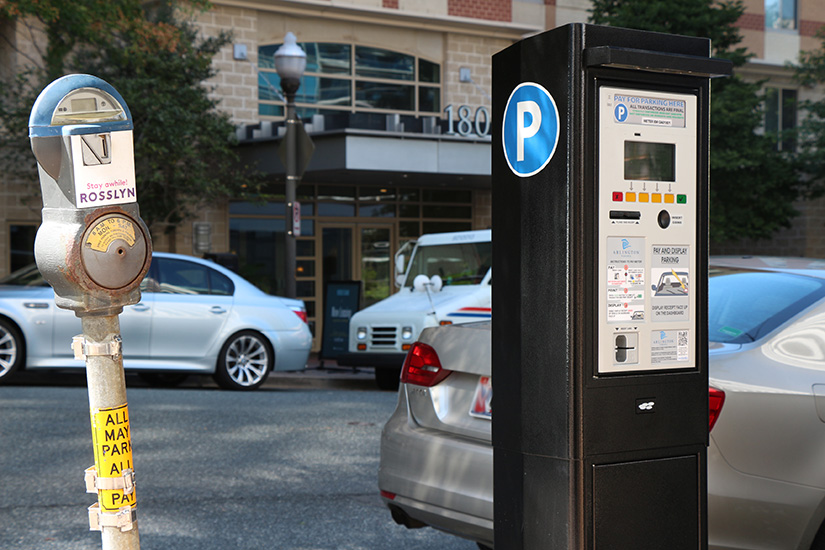
All digital, multi-space parking meters have been switched to the new rates, Baxter said. Parkmobile, a mobile app that allows users to pay for meters through their phones, has also been updated to reflect the new prices.

Old meter (left), digital meter (right)

Older, mechanical parking meters for individual space will most likely reflect the changes by the end of the week, Baxter said.

“County staff is working diligently to convert the older mechanical meters (this requires a manual effort where staff physically reprograms each individual meter to the new rates),” she said in an email.

The 25 cents increase is predicted to bring in $1 million in revenue per year, but was prompted by higher demand for street parking, according to a county press release from May.

“Raising the rates to levels closer to the rates charged in nearby parking garages and closer to those of the rest of the region will help level the playing field ensuring that businesses that need short-term parking spaces on the street for their customers are more likely to have them available,” County Board Chair Mary Hynes said in a May statement.

The County Board is also expected to discuss a proposal to extend the hours that paid parking is enforced by two hours. If approved, people will have to pay to park until 8 p.m. instead of 6 p.m.


Acting County Manager Mark SchwartzArlington County today is embarking on a series of policy discussions that will explore ways to improve county services while keeping costs down.

Addressing “longer-term budget and service delivery issues” is a top priority of Acting County Manager Mark Schwartz, who says Arlington must think and act strategically as the county continues to grow and develop.

“Too often, we are so wrapped up in our day-to-day responsibilities that we lose sight of the importance of planning for the longer range,” Schwartz said in a press release that was sent out Friday. “These conversations will focus on what the future is for service delivery, staffing and management and how we make sure we are on the cutting edge of planning for that future.”

According to Arlington County, policymakers will discuss:

  • How Arlington’s growing population and changing demographics impact service delivery
  • How service delivery choices and investments can help meet the county’s economic development goals
  • The impact of technology on how county government delivers services
  • Opportunities to achieve efficiencies while improving service delivery

“While no formal action is expected by the County Board at these sessions, the discussions will help inform future budget and Capital Improvement Plan discussions,” the county said.

The first County Board work session will be held at 3 p.m. today, in the County Board Room at 2100 Clarendon Blvd, and will discuss Arlington’s public libraries. Other work sessions are scheduled for Oct. 13, Nov. 10 and Dec. 8.


Members of the Coalition of Arlingtonians for Responsible Development, a group that wants affordable housing throughout the county, protested before a County Board work session on the Affordable Housing Master Plan last night.

The Affordable Housing Master Plan calls for 17.7 percent of all housing in Arlington to be affordable by 2040 for those making up to 60 percent of the average median income. Under the plan, the county would add roughly 15,800 new affordable units.

“It’s housing for our low wage workforce, or our lower wage workforce,” said County Board member Jay Fisette after the work session. “It’s the people we all rely on and come across every day in our lives in Arlington.”

The County Board will vote on the plan in September, and CARD members said they do not think the plan does enough to spread affordable housing throughout the county. Instead, the group said that new affordable housing units will be clustered around Columbia Pike.

“I think the county can make a stronger commitment to placing CAFs [Committed Affordable Units] in school districts that don’t have a high concentration of poverty,” said CARD member Katherine Novello, who lives in Barcroft.

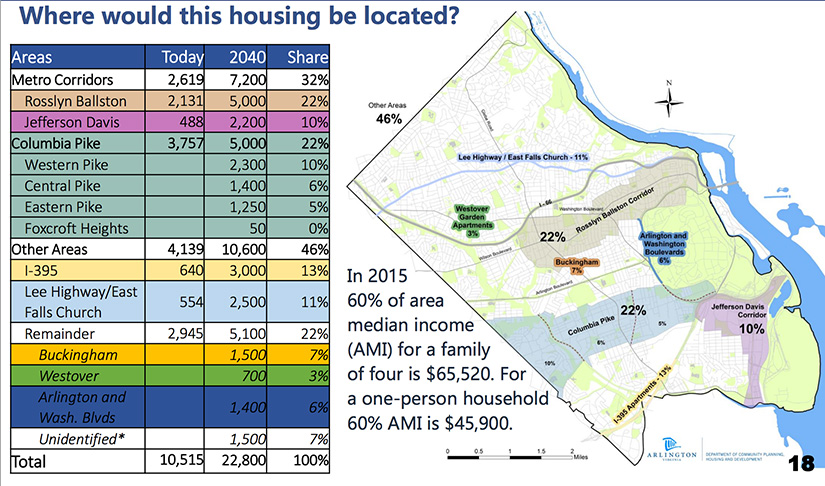
Housing Distribution forecast map (via Arlington County)

The plan includes a map that forecasts the distribution of affordable housing units throughout the county. By 2040:

  • Rosslyn-Ballston corridor will have 22 percent of the affordable housing units
  • The Route 1 corridor (Crystal City and Pentagon City) will have 10 percent
  • Columbia Pike will have 22 percent
  • The area around the Arlington and Washington Blvds will have 6 percent
  • Buckingham will have 7 percent
  • The Westover Garden Apartments will have 3 percent
  • Apartments along I-395 will have 13 percent
  • The neighborhoods along Lee Highway to East Falls Church will have 11 percent

Under the plan, no affordable housing units would be added to areas in the northern most part of Arlington, including the Bellevue Forest, Arlingwood, Old Glebe and Rivercrest neighborhoods.

Many of the CARD members are concerned that the lack of distribution throughout the county will hurt school achievement by clumping high levels of poverty in some schools, while others have very few students who need free or reduced meals.

“If you create pockets of poverty, you’re not creating opportunities for people to succeed in life,” said CARD member Sue Campbell, who lives in Glencarlyn.

The lack of diversity in some schools also goes against the county’s slogan of diversity and inclusion, Campbell said.

The County Board received many comments from the public asking for geographic distribution and urging the county to do more to ensure it, said County Board member John Vihstadt during the work session.

“I’m just looking at pages and pages of the comments looking at the survey [on affordable housing],” Vihstadt said. “We’re moving in the right direction. The question is what more can we do.”

Vihstadt said after the meeting that he thinks the plan is better than before and is hopeful that the final plan presented in September will be something he can support.

“I think this plan now has goals as well as some teeth,” he said.

CARD founding member Joye Murphy said this morning that while the County Board members, “especially John Vihstadt,” were listening to the group, the plan still does not do enough to enforce geographic distribution.

“The county continues to harp on ‘preserving’ affordable housing,” she said in an email. “The only place housing is ‘market-rate affordable,’ (this means ‘low rent apartments’) is basically along Columbia Pike. This thinly-veiled ‘goal’ of ‘preserving affordable housing’ means dumping more committed affordable units on the Pike. We are not drinking that Kool-Aid.”


CARD logoA group that’s pushing for a wider distribution of affordable housing throughout Arlington plans to protest a County Board meeting tomorrow (Tuesday).

The Board will be holding a final work session on its new affordable housing plan at 7 p.m. Tuesday. The draft plan calls for adding 15,800 affordable housing units in Arlington by 2040.

The Coalition of Arlingtonians for Responsible Development says it “organizing a peaceful demonstration opposing the plan” at 6:30 p.m., at the intersection of Clarendon Blvd and N. Wayne Street. The group will also hold signs and “observe the markup process” at the meeting.

CARD says the county has been concentrating affordable housing along Columbia Pike, hurting student achievement. The group says county officials have not been responsive to its concerns.

From a CARD press release:

Over the past decade, Arlington has become socio economically segregated, with pockets of poverty along the west end of Columbia Pike. This area continues to be targeted for even more affordable housing. The second-order effects on schools like Randolph and Barcroft are 80% free-and-reduced-meal rates and an achievement gap. The coalition is dismayed that county leadership is not responding to its concerns and wishes to see affordable housing as an avenue for upward economic mobility for tenants. We want children living in affordable housing to have access to the highest-achieving schools.

September is Affordable Housing Month in Arlington. Public hearings on the affordable housing plan are scheduled for Sept. 8 and 19.


Affordable Housing Month logo (via Arlington County)

Arlington County and a local nonprofit are raising awareness of housing and hunger in September.

September is Affordable Housing Month in Arlington. Throughout the month, Arlington County will be holding events that celebrate “the County’s long-term commitment to preserving and creating housing opportunities that benefit the whole community.”

There will be bus and bike tours of affordable housing complexes, a speech from national affordable housing advocate Chris Estes and a public forum about the benefits and challenges of offering affordable housing in the county.

During the month, there will also be public hearings on the Affordable Housing Master Plan on Sept. 8 and 19. The plan addresses the decline of affordable housing in the county and includes the creation of 15,800 additional affordable housing units by 2040.

“For decades, we have invested in our affordable housing programs to help us achieve our vision of a diverse and inclusive community,” County Board Chair Mary Hynes said in a statement. “These efforts support our residents at all ages and stages of life, improve our neighborhoods and strengthen our economy. This September, we will come together to celebrate our successes and discuss our challenges.”

Affordable Housing Month kicks off on Wednesday, Sept. 2 with a speech from Estes, the president and CEO of non-profit National Housing Conference. The opening reception is from 4-6 p.m. in the County Board room (2100 Clarendon Blvd, room 307).

The following events are also part of Affordable Housing Month:

AFAC celebrates 25th anniversaryThe Arlington Food Assistance Center will also spend September educating residents about hunger and food demand in the county as part of its Hunger Action Month.

The organization will hold discussions about hunger, a golf tournament, a film screening and multiple food drives to raise awareness of Arlington residents who struggle with feeding their families.

There will also be a month-long exhibit about AFAC and hunger in the lobby of the Arlington Central Library (1015 N. Quincy Street), with an accompanying presentation on Sept. 23 at 7 p.m.

“Over 2,200 families are coming to AFAC each week to access fresh and healthy supplemental groceries, freeing up tightly stretched funds for child and health care, rent, and other financial demands. The growing need shows no signs of abating and Hunger Action Month creates an opportunity to share AFAC’s story and expand its reach to every Arlington resident suffering from food insecurity,” the organization said in a press release.


View More Stories