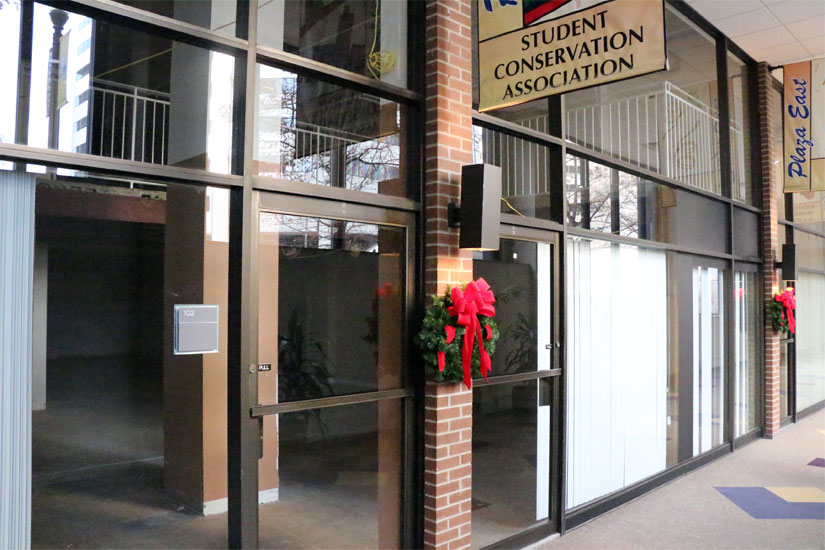
A retail space at 1800 N. Kent Street that has been vacant for six yearsFour vacant retail spaces — three in Rosslyn and one in Courthouse — could be converted into medical or office space following action by the Arlington County Board this weekend.

The Board has four items in Saturday’s consent agenda dealing with the conversion of space mandated to be retail, based on building’s site plans, to office or medical uses. One of those items is for a dentist’s office already in operation in Courthouse Plaza under a temporary site plan amendment.

The other three agenda items are for:

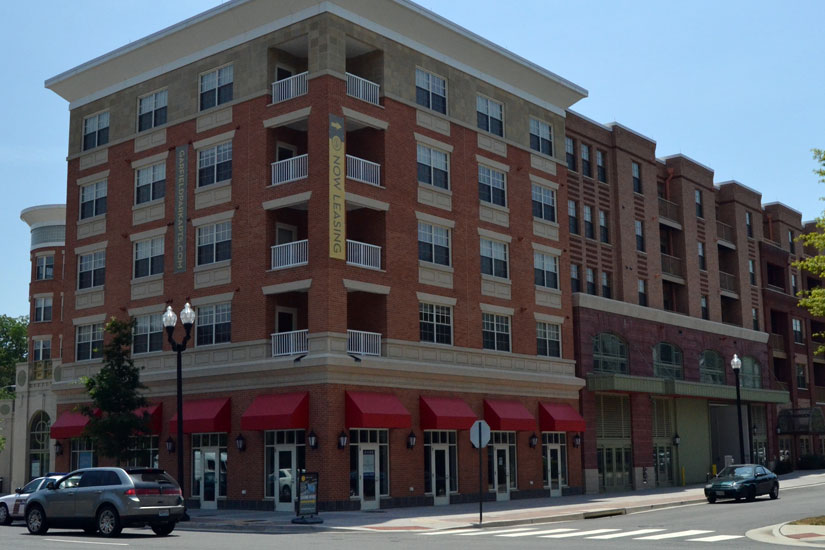
  • Two vacant retail spaces, totaling 3,696 square feet, at 1800 N. Kent Street. One space (pictured above) was a private school space that has been vacant for six years. The other had been occupied by dry cleaners, but has been vacant for 10 years, according to the staff report.
  • A 2,830-square-foot vacant space on the ground floor of 2001 15th Street N., in the Odyssey Condominiums. The space fronts Clarendon Blvd, but it has been vacant for five years, other than serving as a temporary leasing office for the now-opened apartments across the street, the staff report states. Since the leasing office has relocated, the owner reports difficulty finding a tenant for the space.
  • A 1,520-square-foot space at 1600 Wilson Blvd, the former site of the Sir Speedy Printing Center, which has been vacant since July. The space, according to the staff report, “has a history of retail vacancy and poses some location challenges for retail attraction.”

County staff identified no issues for any of these sites, suggesting a “medical/physical therapy office, will help activate the street and pose no adverse impacts to the neighborhood,” in all of the reports.

The county seems to be taking a softer line on mandated ground floor retail spaces, in recognition that some storefronts are just not viable for traditional retail. For instance, 1800 N. Kent Street is well hidden from Rosslyn’s main N. Lynn Street drag, resulting in a relative paucity of the foot traffic that could bring customers to a small business.

County staff, in recommending approval of the motions, used the draft Arlington Retail Action Plan as guidance in its decisions.

The draft action plan, which would replace and expand upon the 2001 Rosslyn-Ballston Corridor Retail Plan, includes a map that specifies which type of retail can go where. According to the county’s planning staff, all four locations on Saturday’s agenda are considered appropriate for medical or office use under the draft retail map.
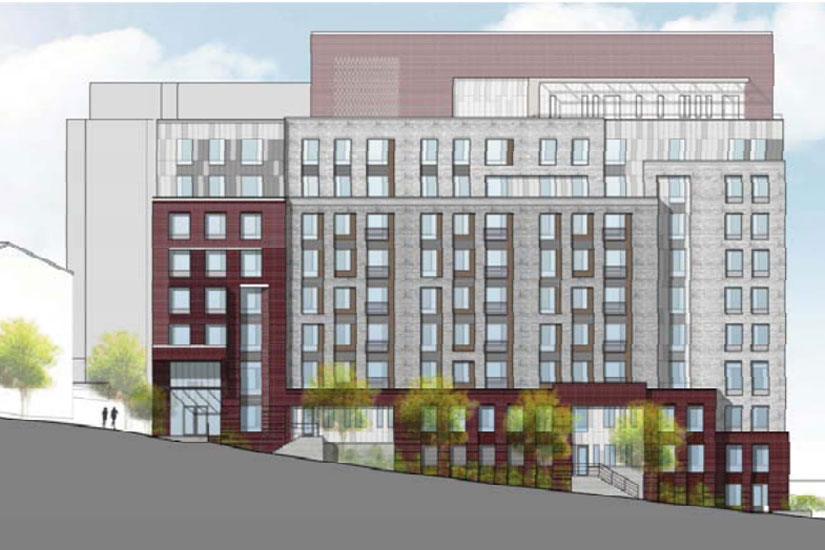
Rendering of the proposed Columbia Hills development on S. Frederick StreetSome stakeholders along Columbia Pike are asking the Arlington County Board to name the area a “revitalization district” — a designation normally reserved for blighted and impoverished communities — in order to spur affordable housing development.

County Manager Barbara Donnellan has yet to issue a recommendation on the item, which the Board is set to discuss at its meeting this Saturday.

According to Virginia Code, an area can be deemed a revitalization district if:

  • “the area is blighted, deteriorated, deteriorating…”
  • “the industrial, commercial or other economic development of such area will benefit the city or county but such area lacks the housing needed to induce manufacturing, industrial, commercial, governmental … enterprises or undertakings to locate or remain in such area,” or
  • “private enterprise and investment are not reasonably expected, without assistance, to produce the construction or rehabilitation of decent, safe and sanitary housing and supporting facilities that will meet the needs of low and moderate income persons and families.”

Columbia Pike Revitalization Organization Executive Director Takis Karantonis said the Pike isn’t blighted, but he believes it may qualify for revitalization district standards because “when a community lacks the diversity of housing that would support certain types of economic development, then it still can qualify for Low Income Housing Tax Credit (LIHTC) points.”

Those points are crucial for affordable housing on the Pike, as LIHTC money funds “9 out of every 10 of America’s apartments for low-income families,” according to the Housing Advisory Group. In Virginia, those funds are distributed by the Virginia Housing Development Authority, which gives projects 30 points toward its total qualification score simply for being located in a revitalization district.

“In the past, these points weren’t really critical to obtain tax credits,” Karantonis told ARLnow.com. “Now they are critical. If you don’t have a project in a revitalization district, you can really forget about LIHTC support.”

Karantonis said the decision to apply for the district had “nothing to do with” the recent cancellation of the streetcar project.

It’s unclear if the County Board will have the same interpretation of Virginia Code as CPRO and the Pike’s affordable housing developers, but at least one project in the pipeline is relying on the designation.

The Arlington Partnership for Affordable Housing has submitted initial plans to build two eight-story residential buildings, containing a total of 229 apartments on S. Frederick Street, a block from Columbia Pike in the Columbia Forest neighborhood. The building, whose rendering is pictured above, would be built on what is currently the parking lot of the Columbia Grove apartments.

That application is in the early stages — it’s scheduled to be discussed by the Form-Based Code Advisory Working Group today — but Karantonis said it an projects like it on Columbia Pike need the revitalization district designation to continue receiving federal support for affordable housing.

“This is exactly the kind of density related to the future transportation system’s capacity,” Karantonis said. “In order to get this kind of density, you need the financial support to do that, and you have to weave it together. One of the important parts in the LIHTC subsidy, and for this we want to qualify.”

Rendering via APAH


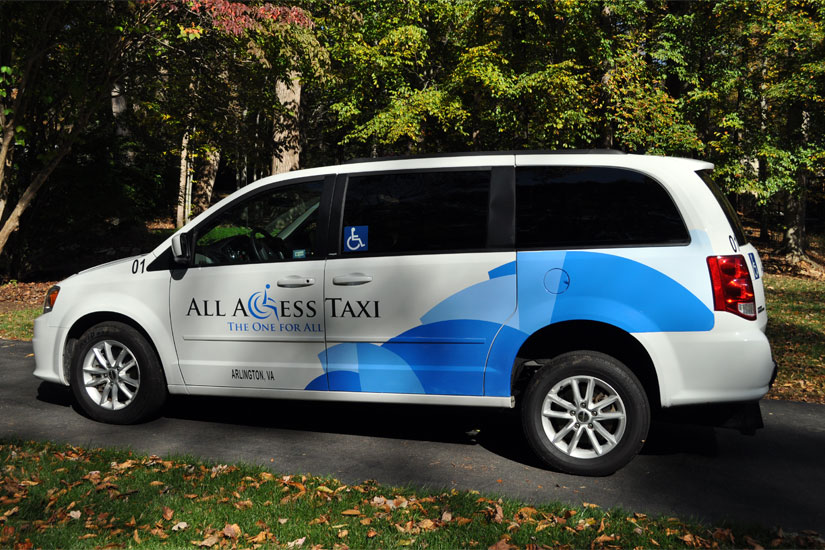
An All-Access Taxi cab (photo courtesy All-Access Taxi)Arlington appears likely to get an influx of dozens of wheelchair-accessible taxis in the near future.

The Arlington County Board will vote on whether to approve 40 new taxi licenses — all for taxis accessible to those with disabilities — at its meeting this Saturday. County Manager Barbara Donnellan, after initially recommending no new taxi licenses be issued for 2014, changed her mind in October, pushing for the new licenses.

Thirty of the new licenses would go to new company All Access Taxi, which had requested 60 taxi licenses. Ten of the new licenses would go to Blue Top Cab, bringing the total number of accessible cabs in the county to 77, or 9.3 percent of the county’s 827-vehicle fleet.

At its Oct. 30 meeting, Arlington’s Transportation Commission recommended the County Board approve 80 new taxi licenses for accessible cabs. County staff noted that even the 40 licenses its recommending could have adverse impacts on crowding at taxi stands and could impair the ability of current drivers to earn a living.

“It is not desirable to add new vehicles to the taxi fleet if a drop in taxi utilization due to [companies like UberX and Lyft] is resulting in existing taxicabs being idled,” the county staff report states. “It is uncertain how much the size of the overall taxi consumer market would increase with the presence of additional accessible taxis and whether that market increase could offset the additional taxicabs.”

Staff also said it recognizes the challenges All Access Taxi will face as a new company with a “limited” fleet of vehicles, but added the approved 30 licenses will require a significant up-front investment and “if needed, other mechanisms, other than through Arlington County certificate process, could be pursued.” Staff also questioned both Blue Top and All Access Taxi’s ability to recruit professional drivers and train them to handle disabled customers.

The County Board is scheduled to discuss the licenses this Saturday morning as a regular hearing item.

Photo courtesy All Access Taxi


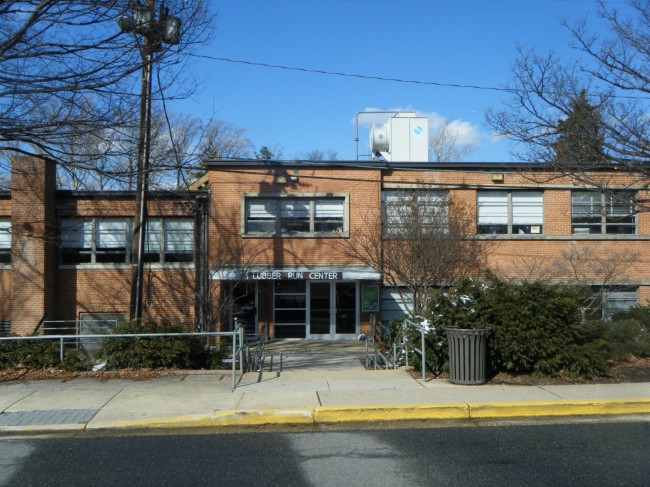
Lubber Run Community CenterArlington’s “Public Land for Public Good” initiative should be “reassessed,” according to the Long Range Planning Committee of the county Planning Commission.

The initiative, launched this year by County Manager Barbara Donnellan, is intended to identify county-owned land where affordable housing could be built. That could include parks, community centers and public safety facilities, such as fire stations.

The county received public comments this fall on the guidelines for evaluating sites. After reviewing those comments, the LRPC determined that the guidelines should be “set aside” while the entire initiative — and how the county engages the community in its decision-making process — is re-evaluated.

Among the committee’s strongest indictments of the current process is its recommendation that the criteria Donnellan used in her preliminary report to the Board in May — the catalyst for the public opposition to the initiative since — should be “withdrawn and reassessed.”

“The term Public Land for Public Good does not capture the importance and benefits of other public facilities and uses and should be reconsidered,” the report, approved at the LRPC’s meeting last week, states.

All of the LRPC’s recommendations include reaching out to the community before continuing the process further. The committee recommended that the county’s deliberations over which sites are evaluated and why need to be made more transparent. “This process should result in an understanding of how site selection is conducted and how the public participates in the decision,” the report states.

The LRPC’s report comes on the heels of County Board Chair Jay Fisette’s statement during last month’s Board meeting that the “Public Land for Public Good” rollout “didn’t work.”

While recommending the county slow down on evaluating land it currently owns, the LRPC also recommends Arlington adopt an “aggressive land acquisition policy.”

The Planning Commission will likely discuss the LRPC’s recommendations at a meeting this week. The County Board could discuss the issue at its Saturday, Dec. 13 meeting.


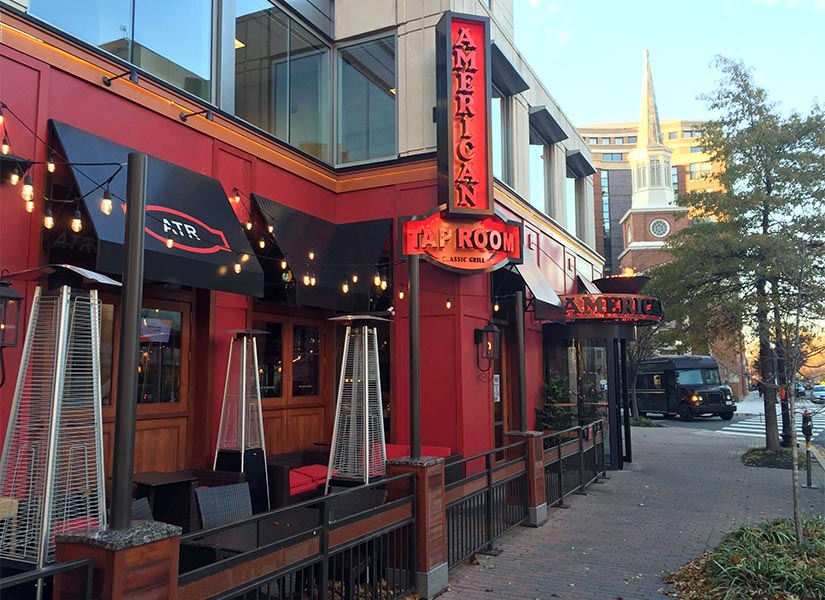
American Tap Room in ClarendonAmerican Tap Room (3101 Wilson Blvd) in Clarendon had its live entertainment permit renewed last week, but the establishment’s staying power in Arlington is uncertain.

ATR’s permit renewal request was pulled from the Board’s “consent agenda” for non-controversial items by County Board member Mary Hynes. It was instead heard individually on Tuesday, giving Hynes, a nearby resident, a chance to inquire about a couple of noise complaints she had received from her Lyon Village neighbors.

The Board was assured by an ATR manager that the bar has addressed the noise issue and that it in fact doesn’t host any live entertainment anymore — instead it’s seeking to hang on to the permit “just in case.” That was enough assurance for Board, which took little additional time to approve the routine renewal request.

While it won the battle, it’s unclear if ATR in Clarendon will win the war. Restaurant and commercial real estate industry sources have told ARLnow.com that American Tap Room has been seeking a buyer to take over its lease.

We’re told that the company pays more than $650,000 per year in rent for the Clarendon location, which has not enjoyed the same level of success as its locations in Bethesda and Reston. The latter two locations are “crushing it” and the company may simply be looking to focus on more profitable ventures, a source says.

However, everything seemed business as usual with the ATR manager who spoke at the County Board meeting. He gave no hints of any possible changes to come.

Responding to an inquiry sent to a media representative, an ATR manager contacted ARLnow.com last week. The manager said the Clarendon location is not closing, but declined to speak on the record and sought assurances that an ARLnow.com editor was not recording the call.

American Tap Room opened its Clarendon location in 2011.


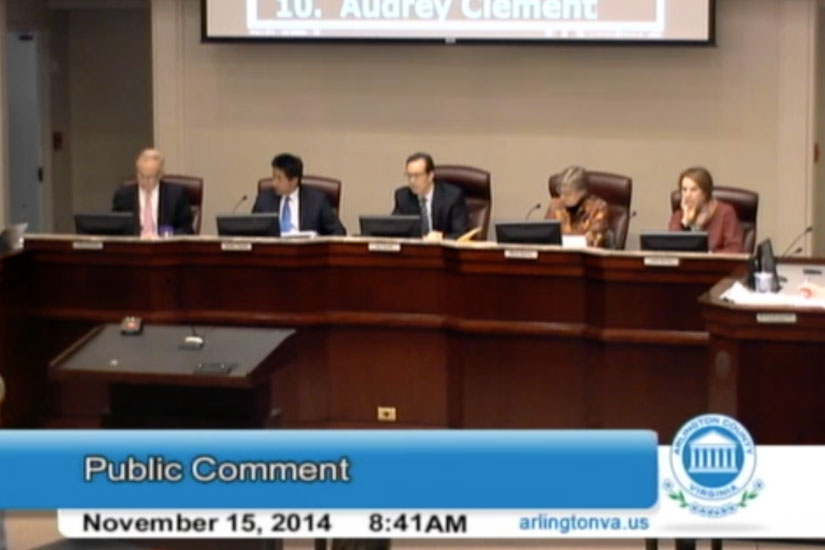
The Arlington County Board, Nov. 15, 2014The Arlington County Board officially closed out its FY 2014 budget — which covered from July 1, 2013 to June 30, 2014 — this week and allocated all of its $233.1 million in carryover funds.

Of that money, $203.3 million has already been allocated for FY 2015 programs, toward county reserves or spent according to county policy.

This includes $46.7 million toward Arlington Public Schools and $62.4 million toward “maintaining the operating and self-insurance reserves” required to keep the county’s current bond rating.

A significant leftover sum is present nearly every year and was accounted for in the FY 2015 budget process. This year, there’s $29.8 million in discretionary funds remaining the county can spend as they see fit.

The County Board approved in a 5-0 vote the county manager’s recommendation to allocate:

  • $13 million for “FY 2016 budget issues,” including $6.3 million in capital improvements like ConnectArlington and the continued move of Department of Human Services divisions to the Sequoia Plaza along Arlington Blvd
  • $8.2 million to the affordable housing investment fund for FY 2016
  • $3.4 million for “employee compensation and management,” including recruiting for the Arlington County Fire Department, staffing the Emergency Communications Center and the fourth year of the county’s pay reclassification program
  • $2 million for safety and technology investments, such as field training, software replacement and records retention
  • $2.4 million for programs like economic development and for contingency funds
  • $1.5 million to housing grants

Among the $13 million is $1.3 million for funding Artisphere. Next month, County Manager Barbara Donnellan will give the County Board a recommendation on the future of the facility, which was expected to be self-sustaining but instead requires millions of dollars in county funding per year.

Donnellan declined to give a preview of her recommendation, but said that even if the county decided to terminate its contract, it would still need to pay $1.1-1.3 million as part of its commitment to the owner of the building that houses Artisphere.

Last year, the county had a $25 million surplus and spent it on many of the same projects: Artisphere, employee compensation and affordable housing. During the County Board’s discussion on Tuesday, no Board member brought up the idea of directing funds elsewhere, including back to taxpayers.


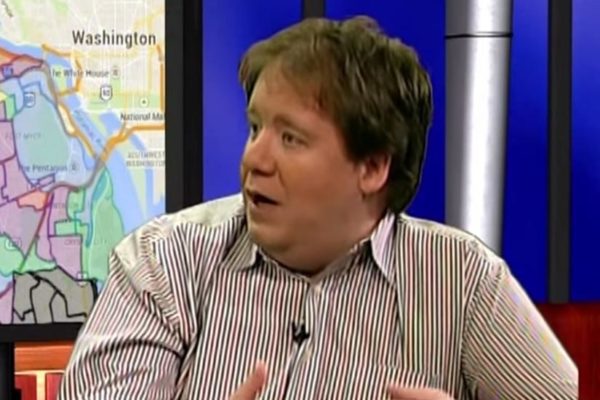
Local political blogger and Democratic strategist Ben Tribbett, who correctly predicted that the election of John Vihstadt would doom Arlington’s streetcar project, recently analyzed the Nov. 4 County Board election on the public access program Inside Scoop Virginia.

Tribbett placed the blame for Democrat Alan Howze’s stunning defeat squarely on the shoulders of the County Board itself and its communication “meltdowns.”

“The Arlington County Board is insular, arrogant, doesn’t listen well to the community, insults people when they disagree with them,” Tribbett said.

In addition to discussing the role the streetcar, the million dollar bus stop and other spending projects played in stoking voter discontentment, he examined the precinct-by-precinct crossover vote — those who voted for Democratic Sen. Mark Warner but also voted for independent John Vihstadt.

The smallest crossover vote margin in a precinct was 28 percent, Tribbett said. The largest was 82 percent, in the Arlington Forest precinct, which has objected to a plan to build affordable housing on top of the neighborhood’s Lubber Run Community Center.

Tribbett also blasted the belief of some Democrats that John Vihstadt “tricked” voters by running as an independent and not as a Republican.

“Arlington County has just been full of debacles recently. You can see how Democrats are upset at the local level and making conscientious decisions,” he said. “This is where the Arlington County Board is really messing up. These are extremely well-educated voters. They know exactly what they’re doing. They’re not mistakenly voting for the Republican. And [Democratic leaders] keep expecting them to turn around as if it’s a mistake.”

“[It’s] in the heart of the most liberal area of Northern Virginia… the whole thing in Arlington has just been breathtaking,” Tribbett concluded.


The future location of the Sehkraft Beer Garden and Haus, the Garfield Park ApartmentsThe Arlington County Board has approved a live entertainment permit for the under-construction Clarendon beer garden, from the owners of Westover Beer Garden, without much of a fight.

Sehkraft Beer Garden and Haus, which is planning on opening next spring in the ground floor of 925 N. Garfield Street, was approved for live entertainment at the Board’s Tuesday meeting. However, its request to keep its doors and windows open during live entertainment — while supported by the community — was denied unanimously.

The Westover Beer Garden and its owner, Devin Hicks, had a long, contentious battle with the county a few years ago over Hicks’ desire to have amplified music in its outdoor space. Since 2012, Hicks’ and the county’s relationship has improved — County Board members John Vihstadt and Walter Tejada said they are now proud customers of the restaurant — but the memories of the permit fight were still on some of their minds.

Sehkraft Beer Garden and Haus' logo (Image courtesy Devin Hicks)“There were some issues early on, and I don’t want to gloss over some of the history or the occasional problem now,” Vihstadt said, but added, “I think the beer garden is a huge community asset. It really is the embodiment of what makes Westover great.”

The difference between Westover and Sehkraft, county staff pointed out, is the new brewpub is in the ground floor of an apartment building and has residential developments nearby. Westover Beer Garden is in a business district and is 110 feet from the nearest single family dwelling.

However, the Lyon Park Civic Association supported Sehkraft’s request to keep the windows open so those in outdoor seating could hear the music. William B. Lawson, a real estate lawyer representing Hicks, told the County Board the request was intended to be a trial period.

“We think that an exception is appropriate,” he said. “Devin has put a lot of money into soundproofing and construction techniques that we think will lessen the impacts of the music. If there are any problems we’ll shut the doors.”

Although the Board denied the exception — agreeing with county staff that allowing it “would be inconsistent with current practice” — Board member Libby Garvey recommended Hicks come back in a year when the permit is up for renewal and suggest opening the doors and windows at that time.

“I think we should sort of ease into it a little bit,” Garvey said. “We’re hearing so much from folks in complaints [about noise’ that I think it would be better to ease into it.”

When he spoke to ARLnow.com in July, Hicks said he plans to open the beer garden and brewpub in March 2015.


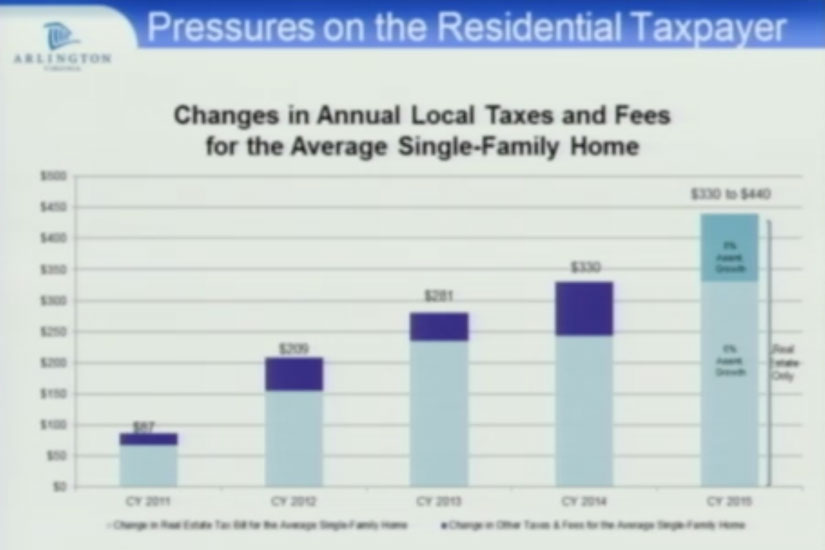
A graph presented to the County Board showing the increases in Arlington resident taxes and fees the last five yearsThe Arlington County Board says no tax rate increase and no new program expansions should be in next year’s budget.

The County Board approved its annual budget guidance to County Manager Barbara Donnellan yesterday, the framework from which Donnellan will work before she presents her proposed budget to the Board in February. As part of the direction, the Board says Arlington Public Schools should again receive 45.9 percent of county revenue, but County Board Chair Jay Fisette said that number will go up.

“The percentage share is going to change,” Fisette said. “It will end up being a percentage increase to the schools, I think. It will end up being inevitable through the process.”

The county is projecting a 3 percent growth in real estate tax revenue, but that will come entirely from a 6-8 percent increase in residential real estate assessments, according to county CFO and Finance Director Michelle Cowan. Commercial real estate assessments are “flat,” Cowan said, which, coupled with the county’s now 21.4 percent office vacancy rate, is putting “increased pressure” on commercial real estate growth.

“We’re sort of back to where we were in mid-90s,” Cowan said about tax revenue. “Back then, where we were growing was in commercial [growth]… now it’s residential.”

According to the county’s projections, expenditures will outpace revenue based on funding levels from the FY 2015 budget. On the county side, there’s projected to be a $4 million to $6 million funding gap; for Arlington Public Schools, that gap is projected at $20 million.

The chair of APS’ Budget Advisory Council, Moira Forbes, asked the county to increase its funding level to the district, if only to cover the cost of the higher-than-anticipated enrollment growth the schools are experiencing this year.

“While the county of course also is experiencing a lot of pressures and desire for public services because of population growth, the costs associated with new students are immediate, significant, and driven partially by state and federal requirements,” Forbes said. “The Budget Advisory Council suggests that the County Board either increase the revenue sharing percentage or provide a fixed amount to offset half of the $14.1 million in costs [APS is expected to incur] associated with the enrollment growth.”

To help trim costs, the Board asked Donnellan to “eliminate duplication and inefficiencies, and explore further collaborations with Arlington Public Schools as well as regional collaborations and partnerships that might lead to cost savings and efficiencies.”

The Board also directed the manager to provide an alternative option in her recommended budget that would include a 1 percent cut of operating expenditures. In the event that tax revenue exceeds the county’s projections, Donnellan is asked to look at either lowering the tax rate or providing more funding for schools, new facilities and affordable housing — or some combination of the two.

County Board member Libby Garvey suggested postponing the budget guidance until next month to allow the public to comment, but her motion ultimately failed by a 4-1 majority.

“One of the things we could improve in how we engage the public is bringing them in more at the beginning level,” Garvey said. “Having people read this through and think it through… I think that’s helpful.”

Donnellan, when asked, said she hasn’t spoken to her department heads about the FY 2016 budget, and postponing the budget process for a month would make it far more difficult to present a full budget by her February deadline. Fisette and Vice Chair Mary Hynes each said the public had ample opportunity comment on the budget and tax rate later in the process.

“I think we have a good idea of what we would hear,” Hynes said. “This is the box, not the stuff in the box. We will hear a lot from the public about what’s in the box.”


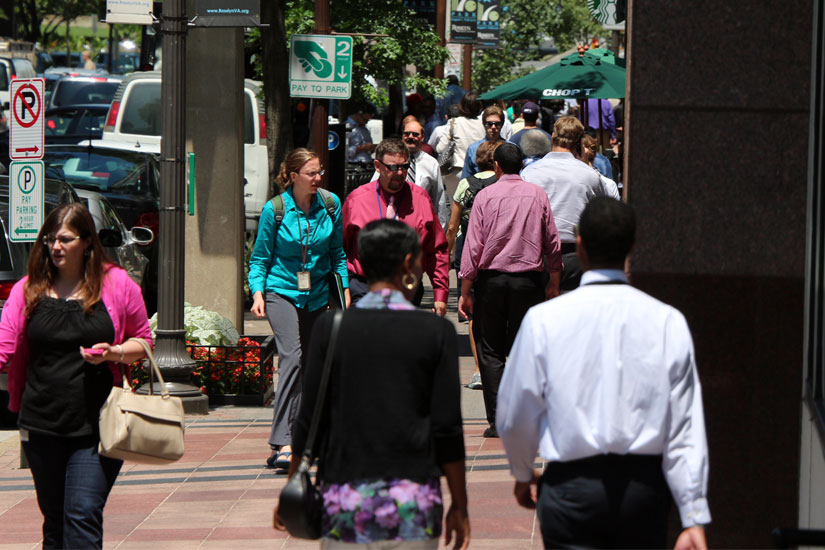
Pedestrians on Rosslyn sidewalkArlington is considering adopting a plan to incorporate design guidelines, best practices and incentives to increase retail activity throughout the county.

The Arlington County Board will discuss a proposed update to the 2001 Retail Action Plan, which covered the Rosslyn-Ballston corridor. The update expands the plan’s footprint to the Crystal City and Columbia Pike corridors, includes recommendations to improve the county’s retail environment and asks the Board to change regulation to allow for retail growth.

“This is a big deal and this has taken a long time to work through,” County Manager Barbara Donnellan told the Board. “This is a report that will guide us for many years to come on how we’re going to move forward. Retail will succeed where it can thrive.”

The Virginia Department of Taxation reported more than $2 billion in retail and food and beverage sales in Arlington last year, but the opportunity is there for much more local retail spending, the plan states.

“The estimated demand for retail and food and beverage is in excess of $4.7 billion dollars,” the report states, citing data from the Bureau of Labor Statistics Consumer Expenditure Surveys. “With a demand greater than sales, Arlington is considered to have a leakage of retail opportunity — customers must travel outside of Arlington to purchase many goods and services — in most broad retail categories.”

Among the key recommendations are developing design guidelines to make “retail look like retail,” developing a specific retail map to guide which kinds of retail businesses should go where — encouraging clustering of specific types of retail to draw in more customers — and encouraging public art and accessibility.

Stores should be encouraged to design their exteriors creatively, the plan says, and to “design storefronts for three miles an hour (pedestrian speed) rather than 35 miles per hour (vehicular speed).” That’s a bit of a departure from years past, when retail signage rules were more stringent in Arlington, discouraging retailers from standing out too much. For interior design, the plan advocates for higher ceilings on the ground floor of buildings and to ” to allow for maximum flexibility and use of the space.”

The draft plan also recommends softening regulations on food trucks and other mobile vendors. It says “vending zones” are under consideration in Rosslyn, Courthouse and Ballston, which would allow food trucks to park for more than two hours at a time.

“With social media and serial followers, vending can help pull customers into different areas,” the plan says. “Establishing vending zones, to allow trucks to vend for longer than two hours or for alternative hours, can help prime an area that is not quite ready for retail or can attract people to other uses — parks, cultural venues or other businesses.”

Grocery stores are seen as a key component of Arlington’s retail plan, as they serve as anchors for retail districts. The plan generally lauds the Arlington County Board for its flexibility in approving grocery stores, including most recently the store planned at 1401 Wilson Blvd, whenever the property is redeveloped. However, it says the term “grocery store” should be more clearly defined for administrative purposes. “The policy should clearly articulate how and when incentives or mechanisms to support the construction of a grocery store are applied,” according to the plan.

Many of the actions the plan suggests include amending the county’s Zoning Ordinance and special exception policies to factor in broader retail goals. It’s those changes that gave some of the County Board members pause and led them to schedule a work session in January, before the plan is up for a vote in February.


The Arlington County Board, Nov. 15, 2014The “Public Land for Public Good” initiative the Arlington County Board launched last December has led to miscommunication and confusion, and County Board Chair Jay Fisette admitted as much this weekend.

The Board asked County Manager Barbara Donnellan to identify at least three public land sites that could be identified for public housing. One was with the redevelopment of the Lubber Run Community Center, a proposal that initially was the brainchild of an Arlington interfaith group and was floated as a potential solution by Donnellan.

The proposal set off broad opposition in the county to the idea of building affordable housing on parkland. Fisette said on Saturday that it was never the intention to do that — at most, the community center would be redeveloped and affordable housing would be built on top of it.

“It was never the intent… to have a standalone affordable housing building on an officially designated park, nor is it the interest of the Board to do that,” Fisette said. “I think there’s a real understanding that the way the concept was put forward in the direction for the manager didn’t work the way it was anticipated… We all felt this was a way to start a conversation. It was the very beginning of a discussion that would have taken quite a bit more time to solve. Some people were anxious that it was the end of a conversation, and it was the beginning.”

Several speakers during the County Board’s public comment session spoke about the issue, including one, Max Lyons, who presented a statistical breakdown of the 577 responses the county received to its public land site evaluation survey. Lyons said that 61 percent of respondents commented on using park land for affordable housing. Of those comments, 94 percent opposed the idea.

“Chairman Fisette, I was concerned by your recent characterization of those comments,” Lyons said. “You wrote, ‘As we have reviewed the summary of comments received to date on the draft Public Land Site Evaluation Guidelines, we recognize that many commenters agree with these goals and practices, which will surely inform the final guidelines.’ My review of the comments led me to a very different conclusion. ”

Lyons said that more than 100 respondents gave unsolicited endorsements of other county affordable housing policies, but 75 percent of those responses still opposed affordable housing on park land. Another speaker, Rick Epstein, said he understands where the miscommunication came from, but still thinks the Board is taking the wrong approach.

“I genuinely believe that much of this miscommunication could have been avoided if the Board had followed the Arlington Way prior to passing the December resolution,” Epstein said. “The Board and county manager should preferably have engaged the entire community in open and thorough discussion, not simply about public land for public good, but for the future use of public lands. The site review process by the county manager is not a substitute for a broad community discussion” on public land.

County Board Vice Chair Mary Hynes plans to take on a larger role on the issue in the coming year, she said, and responded to many of the comments by promising to engage the community more, although she didn’t say how.

“We need to take a look collectively at how this community moves forward to meet any number of needs,” she said. “We need to understand that there are short-term, medium-term and long-term needs in our community, and we need to focus on all of them. In the end, it is about our collective future and where as a county we go, and the time really has come to dive deeply into that question.”


View More Stories