Columbia Pike streetcar renderingArlington County officials are pressing forward with plans for a Columbia Pike streetcar system, despite the federal government’s initial rejection of the county’s funding request due to projected cost overruns.

Officials explained last night, at a County Board meeting, that the Federal Transit Administration rejected its request for $75 million in grant funding because the total project cost was estimated to exceed the $250 million — the cap for projects to receive funding under the FTA’s Small Starts program.

Though pegged by the county at $245.9 million, a contractor hired by the FTA estimated the project cost to instead be between $255.9 and $402.4 million, including contingencies, and thus ineligible for a Small Starts grant. The contractor said $310.1 million was “a most likely cost.”

County officials said the contractor’s report and a subsequent in-person meeting with senior FTA staff lead them to believe the project is still likely to receive federal funding.

“They made it very clear that their action wasn’t based on the merits of the project,” Arlington County Transportation Director Dennis Leach told the Board. “It was really that technical factor that they felt our cost estimate was likely to be somewhat higher.”

Arlington will actually be eligible to receive more than the initially-requested $75 million in federal funding if it applies under the FTA’s New Starts program. Unlike Small Starts, New Starts doesn’t have a cap on total project cost.

Rendering of a streetcar along Columbia Pike“If the county were to choose to reapply as a New Start, the project could qualify for more federal funding,” said Stephen Del Giudice, Arlington County Transit Bureau Chief. “We have a high likelihood of success in addressing the goals of the project.”

“What’s clear at this point is that changes to the evaluation criteria will most likely have a positive impact on FTA’s future rating of our project,” echoed Brian Stout, the county’s federal liaison. “We’ll continue… to work with our partners at FTA to identify federal opportunities for them to support the Columbia Pike streetcar project.”

Even before the report on the FTA’s rationale for its decision, County Board Chair Walter Tejada said the county was not abandoning plans for the streetcar.

“Moving forward with a modern streetcar is our stated policy, and that’s what we’re committed to doing,” Tejada said. “We can repeat it many times, but nothing’s going to change.”

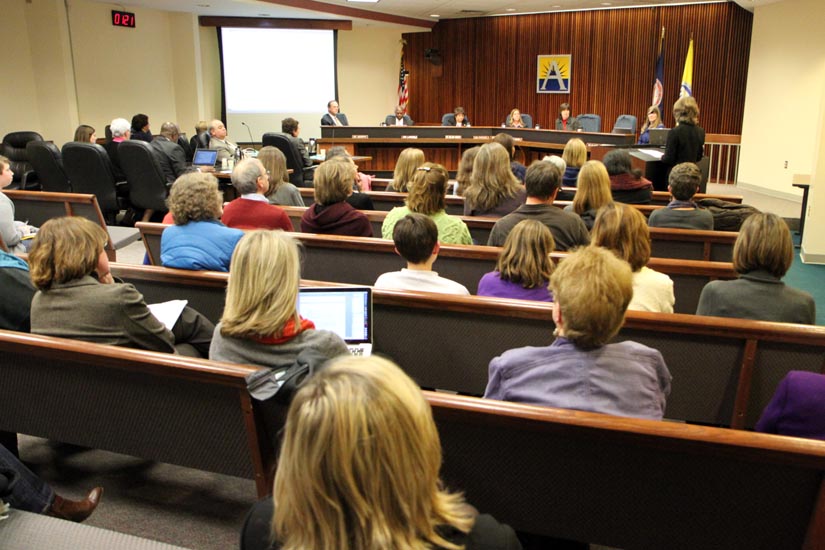
Tejada’s vote of confidence for the project came after Libby Garvey, the lone streetcar critic on the five-member County Board, gave a PowerPoint highlighting problems with other streetcar systems around the country. News reports cited by Garvey include:

“I have not made up the articles, I have not made up the facts,” Garvey said. “These facts are facts. They’re inconvenient, but true.”

(more…)


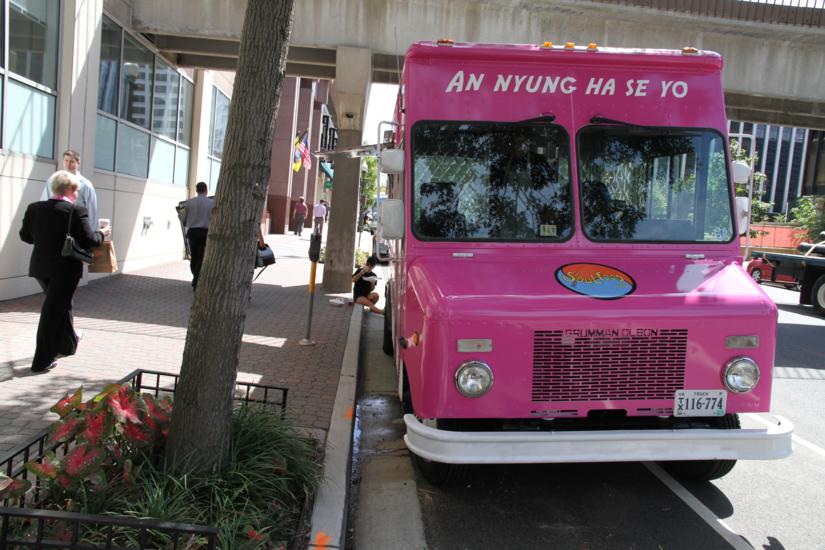
Seoul Food truck serves up Korean cuisine (File photo)The Arlington County Board last night voted to extend the one-hour parking limit for food trucks by another hour.

Food trucks will now be able to serve customers on local streets for up to two hours. They will not, however, be able to stay longer than the time allocated by the meter zone they’re parked in.

The previous one-hour limit had led to complaints and even legal challenges from food truck owners who argued that an hour doesn’t give them enough time to serve hungry customers in busy parts of the county where parking is at a premium.

“The extension of the vending time better reflects typical lunch hours and more closely aligns with the metered parking zones in Arlington,” the county said in a press release. “More than 90 percent of metered parking spaces within Arlington’s metro station areas are regulated for two or more hours.”

In voting unanimously for the change, Board members said food trucks are increasingly integral part of the community.

“Street vending has become a growing part of the retail scene in Arlington,” said County Board Chair Walter Tejada. “These changes, by giving vendors flexibility and ensuring consistent enforcement, provide balance and clarity for all of Arlington’s businesses that serve customers.”

Doug Maheu, Arlington County Director of the Food Truck Association of Metropolitan Washington and owner of the Doug Food Dude food truck, said in a statement that food truck owners are largely pleased with the change, but would have liked even more time to vend.

Although the members of Metropolitan Washington Food Truck Association would not consider these amendments perfect, we do understand that they are a work in progress. We look forward to participating in future conversations with Arlington County as well as other stake holders on crafting equitable vending regulations. We applaud the Arlington County Board for moving forward to make Arlington a thriving diverse business community.

Maheu said food truck owners will continue to ask for four hour “block permits” that would allow even more vending time. As for the possibility of an influx of food trucks from D.C. to Arlington, should the District enact strict food truck regulations that have been proposed by Mayor Vincent Gray, Maheu said he’s not overly concerned.

“I believe that the market will take care of competition as it always done,” he said.

Maheu said he’s aware of 3 or 4 D.C. food trucks that have applied for permits to serve customers in Arlington, but added that he didn’t believe those applications were made in response to D.C.’s proposed regulations.


Fairlington sign (photo courtesy Arlington County)(Updated at 7:05 p.m.) The Arlington County Board approved a new Neighborhood Conservation Plan for the Fairlington and Shirlington neighborhoods on Saturday.

The Board unanimously approved the plan, which updates a previous plan that was passed in 1987. The new plan seeks to protect the communities from traffic impacts, maintain public infrastructure and foster a sense of community. It was created over the course of eight years with the help of community input.

“The program reflects the County’s belief that no one understands what a neighborhood needs better than the people who live there,” County Board Chair Walter Tejada said in a statement. “The County Board thanks the residents of Fairlington-Shirlington for working for eight years to produce this thoughtful, realistic plan to help ensure this area of the County will remain a great place to live for decades to come.”

Fairlington, with a population of 8,000 residents, is southwest of Shirlington, population 1,500, and bisected by I-395.

Fairlington was created as a publicly-financed housing complex for defense workers during World War II. Shirlington was a swampland before becoming a shopping center in the 1940s. The current Shirlington began to take shape, with high rise housing and and an “urban village” of retailers, after being purchased by Federal Realty Investment Trust in 1995.

The new Neighborhood Conservation Plan contains 35 service and infrastructure recommendations. The full list, which can be found below (after the jump), includes recommendations ranging from increased speed enforcement to new bus shelters to efforts to curb helicopter noise.

“In the coming year, County staff will be working with the association and residents to help identify priority improvement projects for funding,” the county said in a press release.

Photo courtesy Arlington County

(more…)


Arlington County BoardThe Arlington County Board has unanimously approved a new $1.09 billion budget that, as expected, raises real estate taxes by 3.5 cents.

The Board raised taxes slightly above the 3.2 cent increase recommended by County Manager Barbara Donnellan, citing the need to eliminate proposed cuts to the police and fire departments and the county’s child care office, and the need to increase funding to safety net programs and Arlington Public Schools.

Arlington’s tax rate will now increase to $1.006 per $100 of assessed value.

“The overall tax and fee burden for the average Arlington homeowner will increase 4.1% — or about $23 a month,” according to a county press release (below, after the jump). “The adopted tax rate is lower than the advertised rate of $1.021 per $100 of assessed value. (It is also lower than the proposed rates for all other Northern Virginia jurisdictions, which range from $1.038 to $1.33.)”

Additional funding for the budget came thanks to an improved financial outlook, which in turn boosts tax revenues.

“This allowed the Board to restore many proposed service reductions, while only increasing the tax rate three-tenths of a cent above what was included in the proposed budget,” the county said.

(more…)


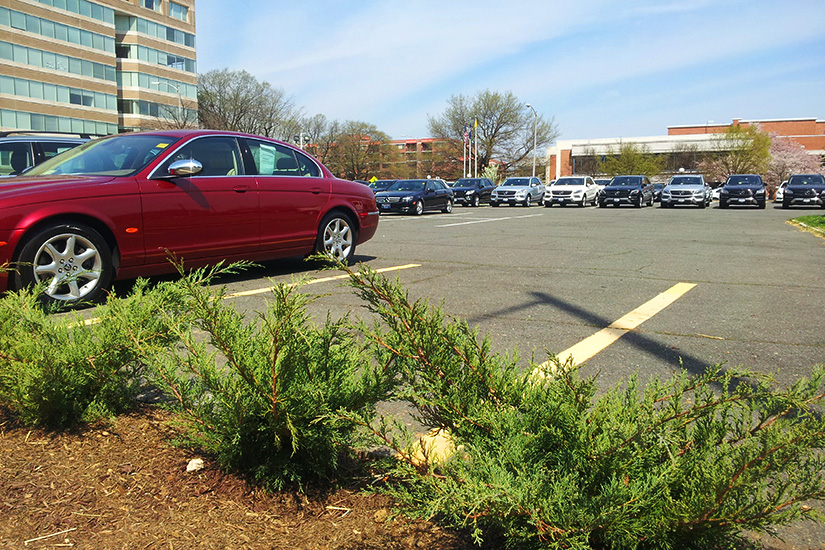
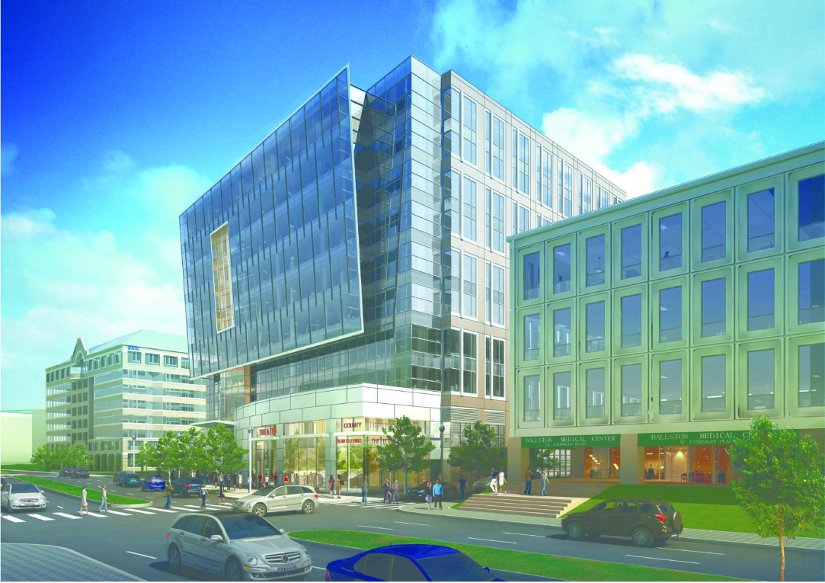
Parking lot at 3901 N. Fairfax Drive  Rendering of Virginia Square development at 3901 Fairfax Dr.

Arlington Funeral Home at 3901 N. Fairfax Drive in Virginia Square was demolished last June in anticipation of the construction of a new mixed use development. For now, the site instead serves as a temporary surface parking lot.

The County Board approved the development’s site plan at its meeting on January 21, 2012. The idea is to build a 10-story building with three levels of underground parking. The development would contain office space, ground floor retail and a black box theater.

Per the site plan, the developer may use the land as a surface parking lot for a period of three years, which would end in January 2015. After that, the developer does have the option to ask the county for an extension on the site plan if a building permit has not yet been applied for and approved. That would keep the parking lot there for an amount of time agreed upon in the extension.

The site sat empty for months, but in the past couple of weeks workers from Mercedes-Benz of Arlington (585 N. Glebe Road) have been spotted dropping off dozens of vehicles in the 85 space Virginia Square parking lot. An employee at the dealership confirmed that the business is leasing parking space from the developer.

Parking lot at 3901 N. Fairfax DriveThis location is reportedly one of several lots Mercedes-Benz of Arlington uses for such purposes. Apparently, strong sales have prompted an increase in the volume of cars the dealership keeps on hand, and it doesn’t have enough space to keep all the vehicles on its own lot. The employee said leasing parking space is not an ideal situation in the long-term and Mercedes continues to be on the lookout for spaces suitable for permanent expansion.

As part of the agreement for a parking lot, the developer is required to abide by a number of conditions laid out in the approved site plan. For example, the property must be kept in good condition, hedges must be installed as screening from headlights and no new driveways may be added.

So far there’s no definite word on how long the parking lot will remain before construction begins on the new development. County staff confirms, however, that the developer has applied for two permits — one for shoring and sheeting, and one for building.


Seoul Food truck serves up Korean cuisineArlington’s food trucks may have an easier time adhering to the law if the County Board adopts changes to an ordinance this weekend. The parking issues that have been plaguing food truck vendors and resulted in legal battles in recent months will come up at Saturday’s board meeting.

Proposed ordinance changes include extending the amount of time food trucks can park in one space from one hour to two hours. Currently, food trucks must move after one hour, but the ordinance wording is vague and doesn’t specify how far the vehicle must move, causing problems with enforcement. That’s another issue board members will examine on Saturday.

Food truck vendors have argued that the 60 minute rule hurts business because they were often forced to move in the middle of a lunch rush, or else face a citation. County staff appears to agree, based on the following excerpt from the staff report:

This time limitation is challenging for vendors and customers when typical lunch hours are between 12:00 noon and 2:00 p.m. A vendor is not able to adequately serve customers and patrons are unable to purchase lunch if their hours don’t correspond. Further, the overwhelming majority (approximately 90 percent) of parking meters within the Metro Station Areas are for at least two (2) hours.

Under the proposed ordinance amendments, the two hour limit would only cover time when vendors are actively selling to customers, not food prep time or clean up time. After a vendor’s time expires, sales would be required to stop and the vehicle would need to be moved to another marked parking space. If the parking area does not have metered spaces, the vehicle would need to be moved at least 25 feet.

Last month, a representative for the Food Truck Association of Metropolitan Washington told ARLnow.com that the organization supports the county’s proposed ordinance changes.


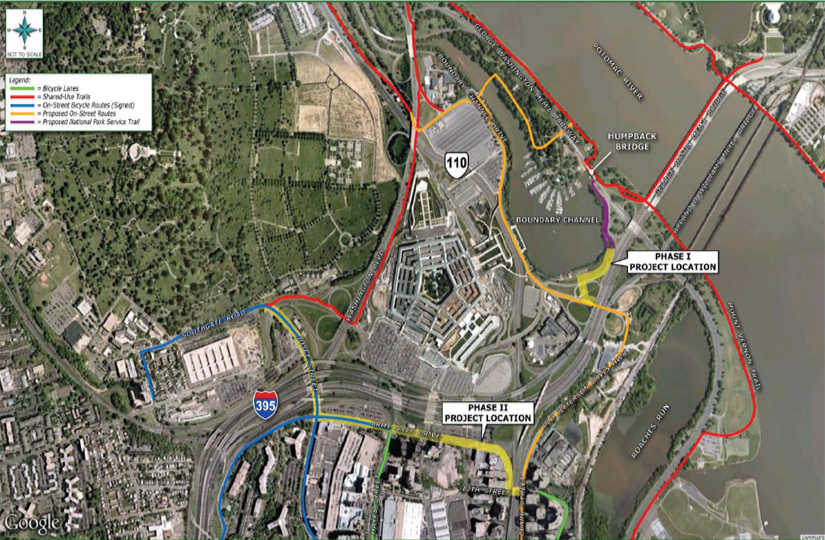
Proposed Army Navy Drive bicycle track plan(Updated at 5:00 p.m.) At its meeting this Saturday (April 20), the County Board is scheduled to vote on moving forward to create a bicycle track on Army Navy Drive.

Due to the way the street moves drivers onto, off of and around I-395, it’s considered “inhospitable” for pedestrians and cyclists. A plan has been in the works for years to create a separate track for cyclists and to reconfigure the street to improve travel between the Pentagon, Pentagon City and Crystal City.

According to the county staff report, the project would reconfigure 3,300 feet of Army Navy Drive from S. Joyce Street to 12th Street. It would provide shorter and safer pedestrian crossings, improve pedestrian space and construct a separate two-way bicycle track. The redesign is also intended to make room for the future streetcar line.

In Fiscal Year (FY) 2006, Arlington County was granted Public Lands Highway Funds to make trail improvements. In FY 2012, the county was awarded a grant by the Federal Highway Administration to transform Army Navy Drive into a Complete Street. Designing the project is expected use the $706,000 of grants, and the County Board will vote on whether or not to accept and appropriate the funding for the project. It will then require additional funding for construction.

“This project aligns with the goals of Arlington County’s Complete Streets program to expand safe travel options for all modes of transportation along our roadways,” said the county staff report. “The proposed cycle track will be one of the first in the Commonwealth of Virginia.”

County staff did not report any issues with the plan and recommends the County Board approve it on Saturday.


Arlington County websiteArlington County is in the process of building a brand new county website.

The site is being built in phases, according to county spokeswoman Jennifer K. Smith. The first components of the project — some interior portions of the website — should be launched in “the next couple of months.” If all goes well, the rest of the project is expected to be complete — homepage and all — by the end of the year.

The new county website will built on an enterprise version of WordPress, an open source content management system utilized by tens of millions of websites, including ARLnow.com. By building on WordPress, instead of the current proprietary code, the county should be able to reduce the cost of development and upkeep, and make it easier for employees to update web pages.

Arlington County is also trying to improve the navigation of the site.

“We’re trying to make it more resident-focused, as opposed to county hierarchy-focused,” Smith said. “We’re pretty excited. I think it’s going to be a positive change.”

County staff have proposed making the code that’s custom-developed for its new website open source — in other words, freely available for other developers to copy and tinker with. The County Board is set consider a measure that would allow open source publishing at its meeting this Saturday.

“As new functionality and features are developed by County staff, in the spirit of the open-source community and open government, staff desires to release code developed by County teams under an open-source license, so that others may use and/or improve the code,” staff wrote in a report to the Board.

County staff says developing open source code would come with the following benefits.

1) Open and transparent government

2) Enhances the County’s attractiveness as a workplace; benefits recruitment of programmers who believe in open-source

3) The possibility of even more enhancements being available for County use. Arlington’s changes may inspire others to contribute as well.

4) Lower maintenance needed for code, if County contributions are accepted into the main distribution. If Arlington’s modifications are not shared, the County will have to ensure that any updates made by others and which County staff want to incorporate do not interfere with Arlington’s customizations.

“Website code is a large part of the open-source community because websites are so versatile and have become so easy to set up,” staff wrote. “County staff has found many open-source bits of code that will help the County’s website meet the County’s customers’ needs, and in some cases, staff can easily customize the code for an even better fit. Since the County is benefitting from someone else’s open-source code, staff members want to reciprocate and release County modifications back to the open-source community.”

Although it might sound like a security risk, Smith says allowing the public to view the county’s website code shouldn’t open the site up to illicit activity.

“It shouldn’t present any security risks,” she said. “There are many, many government sites running on open source code.”


Arlington County Board members on Dec. 8, 2012The Arlington County Board is set to vote on modified version of County Manager Barbara Donnellan’s recommended budget that includes a 3.5 cent tax hike while eliminating proposed cuts to the police and fire departments.

Donnellan had proposed a 3.2 cent real estate tax increase. The Board gave itself extra budget wiggle room by advertising a 5 cent increase in February. At a Fiscal Year 2014 budget markup work session Tuesday afternoon, the Board tentatively settled on a tax rate in-between the two, but closer to that proposed by Donnellan. The extra 0.3 cents will bring nearly $1 million in additional tax revenue.

The Board will vote on a final budget and tax rate at its meeting on Saturday.

The marked-up budget removes Donnellan’s proposal to slash community policing and reduce fire department fill-in staffing. As promised by County Board Chair Walter Tejada, it also restores funding for the county’s child care office.

Other additions to the budget, as reported to ARLnow.com, include $400,000 for permanent supportive housing, $660,000 for human services case managers and community nursing.

The Board also made some preliminary decisions about what to do with $11 million in “close out” funds left over from the FY 2013 budget. Among other measures, the Board will consider directing $3 million to the Affordable Housing Investment Fund and $2 million to a land acquisition fund for the parks department, along with additional funding for numerous community non-profit organizations.


Audrey Clement at Radnor/Fort Myer Heights candidates night debateAudrey Clement is running for Arlington County Board under the Arlington Green Party banner, for the fourth time since 2011.

Clement, a long-time Arlington resident and IT consultant, will face off against incumbent Democrat Jay Fisette in November. The Arlington Green Party is urging a vote for Clement to “end one-party rule in Arlington.”

“Arlington needs new leadership,” the party said in a press release. “Jay Fisette says he is for sustainability, but the tax hikes County Board plans to impose on county residents to fund boondoggles like the Pike trolley and heated bus stops are unsustainable.”

Clement was nominated at the Greens’ April 3 meeting. She is running on a platform that includes:

  • Adopt a referendum sponsored by the Arlington Green Party to create a Housing Authority to provide more affordable housing at less cost.
  • No more tax rate increases. Repave streets. Fund schools and libraries, not wasteful projects, like million dollar bus stops on Columbia Pike.
  • Use commercial real estate tax to fund ART buses not the $250 million Pike trolley.
  • Fund school construction to ease overcrowding.
  • Open Arlington public libraries 7 days a week.
  • Retrofit public buildings with renewable energy.
  • Reduce waste. Increase recycling in apartments and businesses.
  • Ban single-use plastic bags and Styrofoam in retail stores and food outlets to reduce litter.
  • Provide free residential energy audits.

Clement received 12.9 percent of the vote in November 2012. Green Party candidate John Reeder received 32 percent of the vote when he ran against Fisette in 2009.

The Arlington County Republican Committee has set May 12 as the filing deadline for potential County Board candidates.


Parents pack an Arlington County School Board meeting on block scheduling at middle schools(Updated at 8:35 p.m.) The Arlington School Board will present its proposed budget to the Arlington County Board tonight. The joint meeting comes as the School Board has requested an additional $3.1 million in tax funding from the County Board.

The School Board’s proposed budget calls for $524.5 million in expenditures, roughly $4 million more than Superintendent Dr. Patrick Murphy’s proposed budget. The board’s budget keeps most elements of Murphy’s budget in tact — including merit-based pay raises for teachers, no increase in class sizes and funding to buy more school buses — but scales back some proposed cuts.

Cuts to teen parenting staffing, elementary reading teachers, high school gifted teachers, Standards of Learning teachers and minor construction/major maintenance have been reduced collectively by $2.3 million. The budget also adds a $600,000 reserve, and $1.1 million to account for an increase in projected school enrollment.

Arlington Public Schools logoMurphy’s budget expected enrollment to increase from 22,613 students this school year to 23,586 students for the 2013-2014 school year. The latest spring projection puts 23,725 students in Arlington classrooms for the next school year.

All told, the increase in enrollment will require $11.1 million for additional staffing, materials, furniture and relocatable classrooms, according to the School Board’s budget presentation, set to be delivered tonight. The new trailer classrooms alone will cost $2 million.

The School Board is asking the County Board for a dedicated 0.5 cent real estate tax increase to help pay for the reduction in cuts and the added enrollment. The tax hike would be expected to bring in an additional $3.1 million. The rest of the $4 million is expected to come from one-time funding and additional state funding.

Arlington Public Schools are expected to face additional budget pressures in the next several years, as enrollment continues to grow and as new schools and school additions are built. An addition to Ashlawn Elementary is expected to be complete in time for the 2014-2105 school year, while a new elementary school on the Williamsburg Middle School campus is expected to be complete in time for 2015-2016.

Those new additions and schools will come with additional administrative and operational costs. This comes at a time of weakness for property values in Arlington — the main driver of revenue for the county and the school system. During a meeting with reporters in February, Dr. Murphy said future budgets “could be challenging.”

While teachers for the new Williamsburg elementary will be largely pulled from overcapacity schools, administrative and materials costs for the school are slated to be included in next year’s budget process.

“If all things stay the same, we’re very concerned for FY 2015,” Murphy said.

The joint School Board/County Board work session will take place at 7:00 p.m. tonight (April 9) in rooms 101/103/105 of the Syphax/Sequoia building at 2110 Washington Blvd. The public is encouraged to attend.

Residents will get a chance to weigh in on the School Board’s budget at a public hearing on Thursday, April 18.


View More Stories