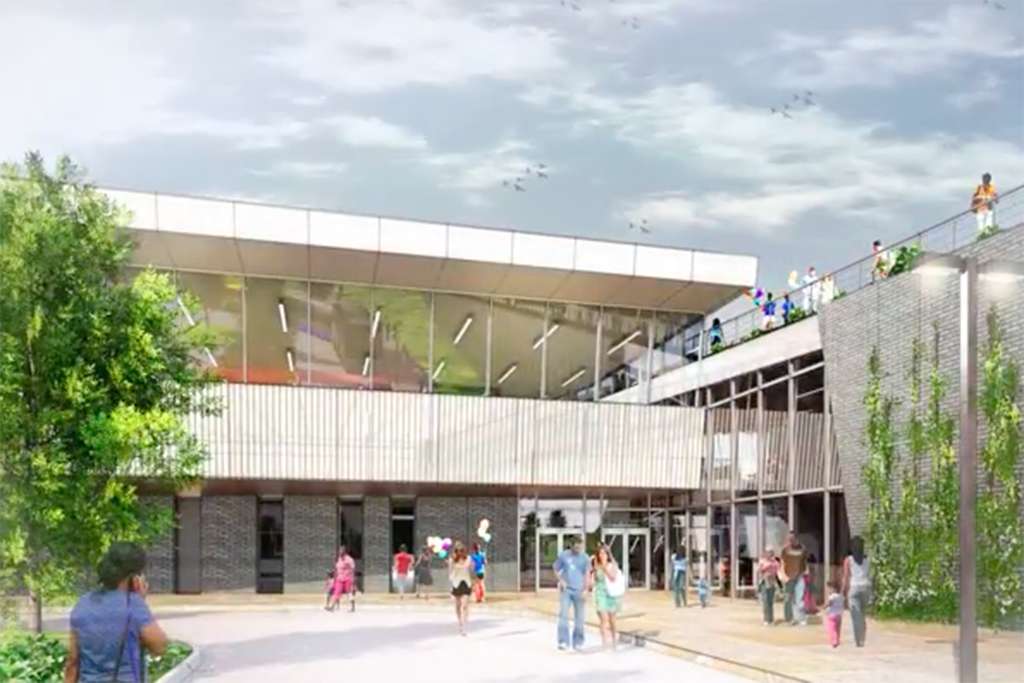
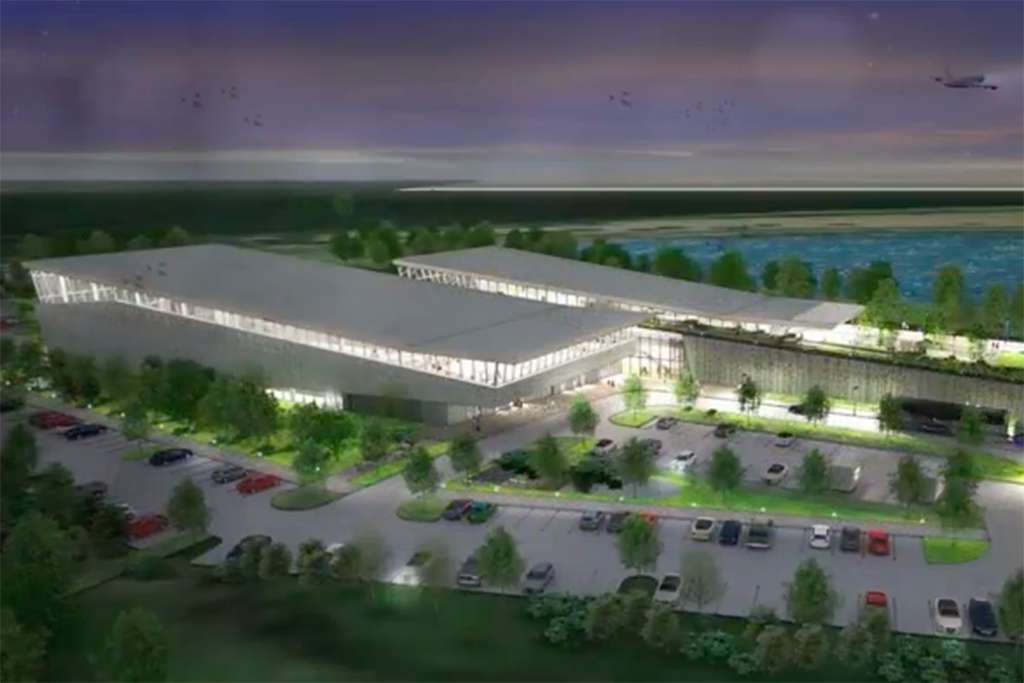
After many long months of debate, county officials are set to have their say next month on an extensive proposal for the Virginia Hospital Center’s expansion.
The project has attracted plenty of criticism from neighbors and transit advocates alike, prompting a brief delay of the county’s consideration of the 101-bed expansion of Arlington’s lone hospital.
But the county’s business community recently threw its support behind a swift approval of the project, as has another longtime civic leader. Julian Fore, a former president of the Arlington Community Foundation, is also urging the County Board to lend the project a full approval in a letter he shared with ARLnow.
Letter to the Editor:
I am an Arlingtonian and frequent user of Virginia Hospital Center (VHC). This first-rate hospital provides excellent acute care and places an emphasis on needed follow-up services and disease management. VHC is a community jewel and is deserving of our support for its expansion project. I urge the County Board to approve the VHC application.
We should all be in favor of VHC’s desire to improve the efficiency, convenience and accessibility of healthcare. These are important community benefits and should be acknowledged. Moreover, the newly proposed Behavioral Health Center will enable our friends and neighbors who are suffering from mental illness to receive immediate outpatient care. The VHC proposal also expands the number of psychiatric beds based on a community-negotiated formula and subject to State approval.
It is important to note that under the VHC proposal, 1.3 acres of the 5.5 acre Edison Street site are either landscaped or open space to bring visual relief and more greenery to the site. The placement of the landscaping and open space creates a “sense of place” and a welcome oasis to an urban village. This action demonstrates VHC’s commitment to enhancing the appearance and livability of the surrounding neighborhood.
At this point, we need to acknowledge that the cumulative effect of additional requested changes to the VHC proposal will affect the broader community goal of increasing the availability of low-cost, high-quality, patient-centered healthcare. VHC is the only stand-alone community hospital in the greater Washington D.C. Metro area. It is in the public’s interest to enable VHC to contain development costs, so the Hospital has more dollars available for needed state-of-the-art equipment and other patient related services.
I hope the County Board recognizes that the overall public benefits provided by the VHC expansion are too important to be held hostage by the narrow concerns of nearby neighbors.
Sincerely,
Julian Fore
ARLnow occasionally publishes thoughtful letters to the editor about issues of local interest. To submit a letter to the editor for consideration, please email it to [email protected]. Letters may be edited for content and brevity.
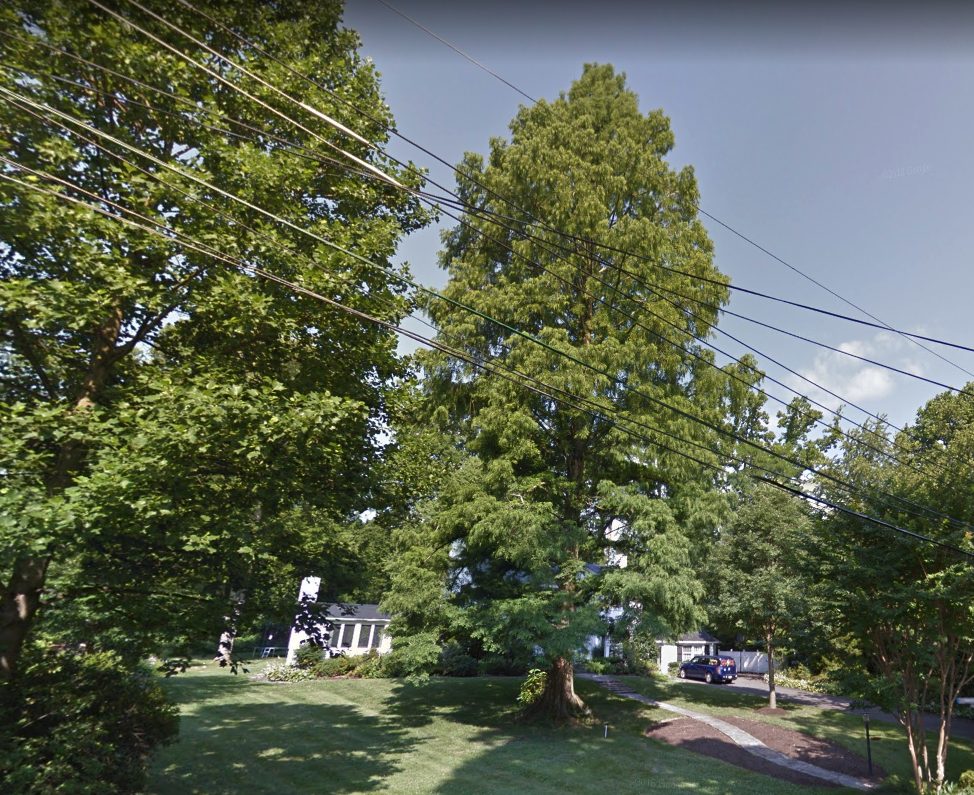
A 114-foot-tall dawn redwood tree along N. Ohio Street (photo via Google Maps)
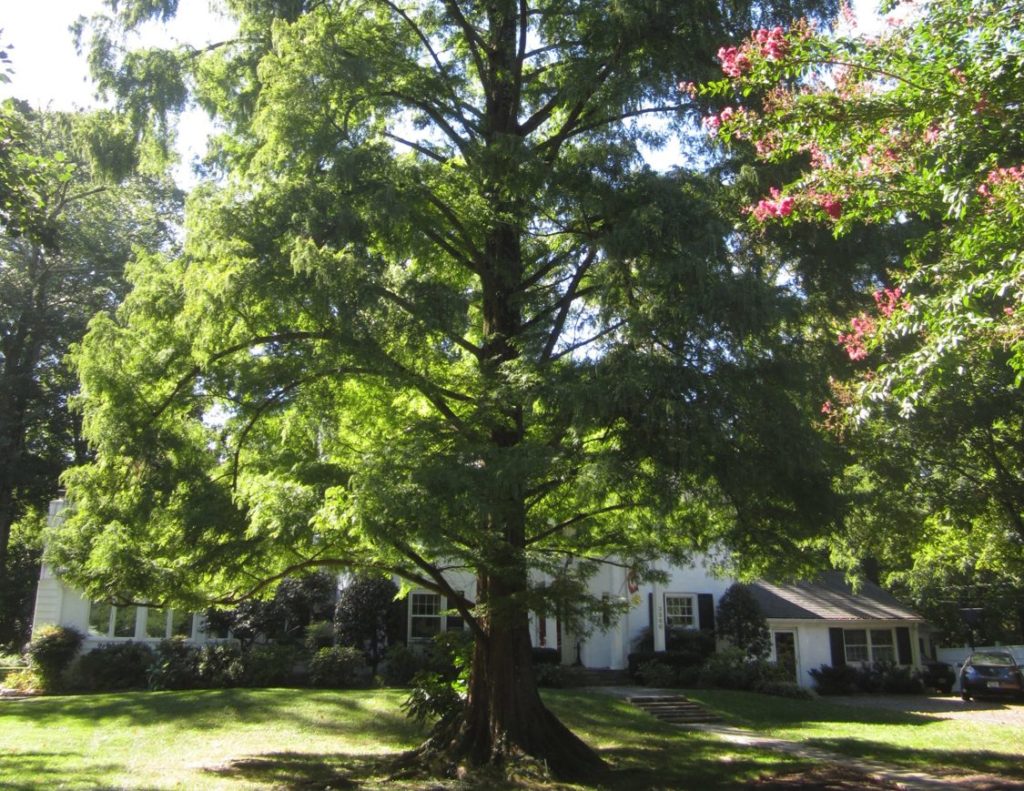
A 114-foot-tall dawn redwood tree on N. Ohio Street (photo via Virginia Tech)
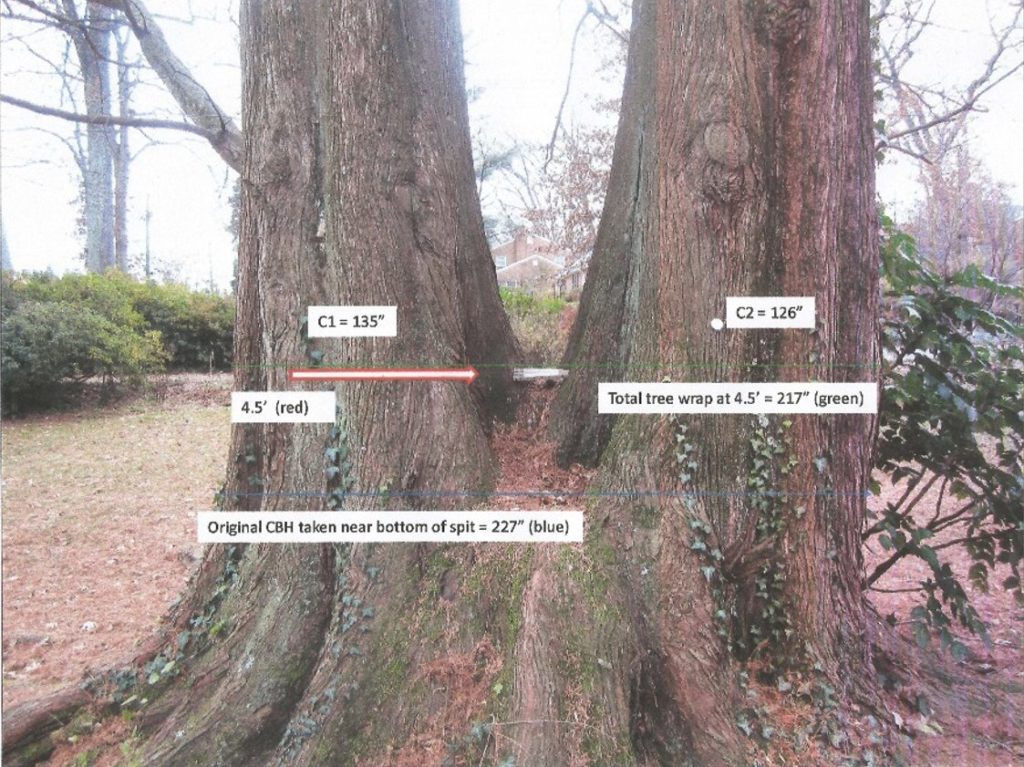
A dawn redwood tree along N. Ohio Street (photo via Virginia Tech)
Despite some intense opposition from conservationists and the community, plans to chop down a massive dawn redwood tree in North Arlington are moving ahead.
Since April, a developer has been hoping to remove the 114-foot-tall tree as part of a larger project on a property along the 3200 block of N. Ohio Street in Williamsburg.
The county recently approved a permit to let that work move ahead, according to a community letter sent Wednesday (Aug. 15) by the County Board and provided to ARLnow. A county spokesman confirmed the letter’s veracity, and added that the developer “intends to move forward with removal of the tree.”
Environmentalists had hoped to save the dawn redwood, as it’s recognized as one of the largest of its species by both county and state officials, and it could live to be up to 600 years old if left in place. The tree also sits within a “Resource Protection Area,” known as an “RPA,” giving the county the chance to scrutinize these construction plans quite closely.
But the Board wrote in the letter that it just couldn’t find any way to justify denying the permit, citing the developer’s “considerable rights as a private property owner” to redevelop the site. Richmond Custom Homes is hoping knock down the existing single-family home on the property, and build two in its place, a tactic frequently favored by developers in Arlington’s residential neighborhoods.
“While staff did ask Richmond Custom Homes to explore options to preserve the tree, the developer could not identify a design that both provided for the subdivision of the property and preserved the dawn redwood,” the Board wrote. “Pushing the homes to the rear of the lots would impact other large trees on the property also located within the RPA — and likely still would have jeopardized the dawn redwood during construction.”
The Board did note, however, that the approved plan “does protect multiple large trees on the back end of the property, which provide a significant benefit to the watershed adjacent to the Little Pimmit Run stream,” pointing out that the developer also agreed to replace the trees removed during the construction.
Nevertheless, the whole process has left conservationists feeling like the county isn’t listening to their concerns.
“The county could find ‘no’ way to preserve this living fossil, which had become extinct in North America and worldwide millennia ago, with the exception of a few remaining trees located in China and the few planted here in an effort to save the species,” Suzanne Sundberg, a local activist focused on environmental issues, told ARLnow. “What does that tell you about the county ordinance?…County staff and the Board are not doing all that they could to preserve the mature tree canopy here in Arlington.”
The Arlington Tree Action Group was similarly critical of the Board, arguing in a statement that it “decided not to use the powers at its disposal in its own Chesapeake Bay Preservation Ordinance” to contest the developer’s plans, making this a “landmark case.”
“In failing to make a decision in favor of the environment and the voices of concerned residents, the county puts at risk its own widely touted ‘progressive’ credentials in environmental protection,” the group wrote. “The letter does not provide reassurances of how the RPA, which runs the length of the lot, will be protected once the lot is subdivided. ATAG will be looking for answers.”
The Board noted in its letter that members “share community concerns about the significant pressures on mature trees from redevelopment of properties across the county” and plans to kick off the process of updating the county’s Urban Forest Master Plan and Natural Resources Management Plan early next year.
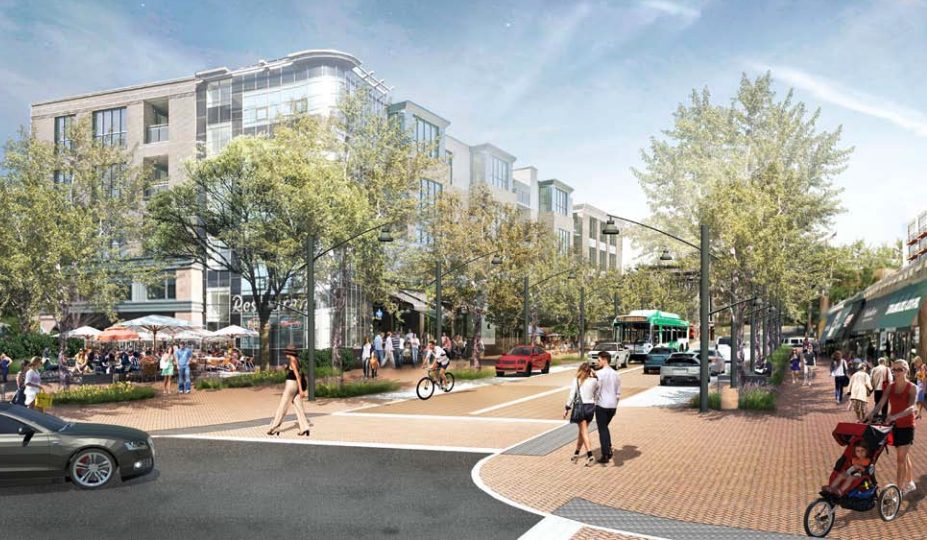
A rendering of possible new development at the Lee Heights shopping center (via Arlington County)
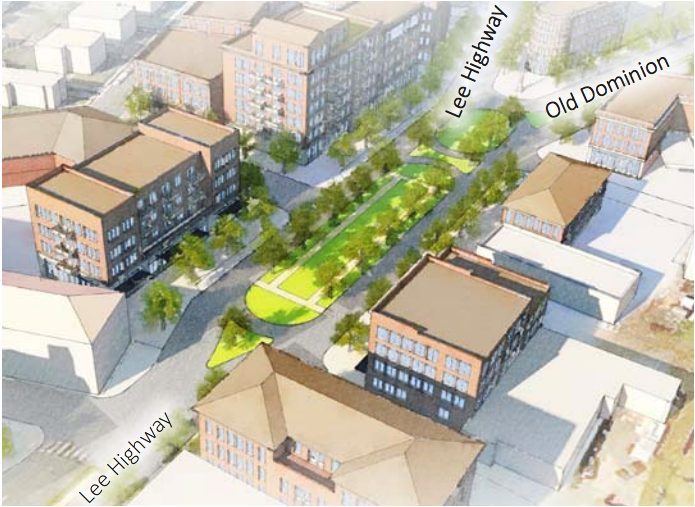
A rendering of possible new development at Cherrydale’s “five points” intersection (via Arlington County)
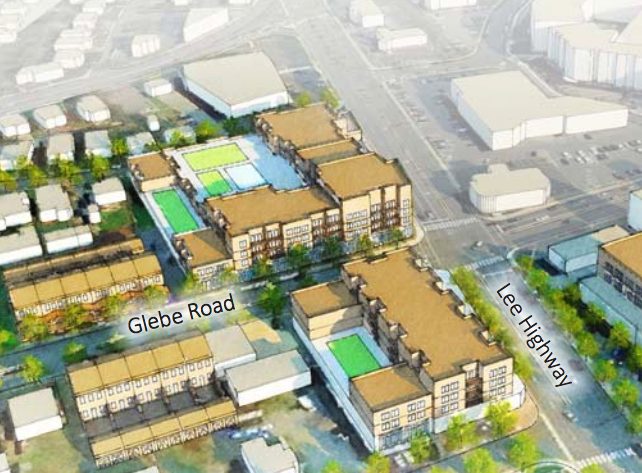
A rendering of possible new development at Glebe Road and Lee Highway (via Arlington County)
In many ways, the Lee Highway corridor is the last part of Arlington that looks like the rest of the Northern Virginia suburbs.
With high rises coming to define both the Rosslyn-Ballston corridor and Crystal City, and neighborhoods along Columbia Pike becoming ever more dense, Lee Highway has remained persistently suburban in character with its procession of low-slung shopping centers and vast parking lots.
But should it stay that way as the county keeps growing? And if not, how should it change?
Those are the questions the community and county planners will try to answer as they embark on a years-long planning process for Lee Highway in the coming months.
With land-use policies last updated in 1955, Arlington officials have long seen the corridor as ripe for a new round of planning. Now, after years of back-and-forth, the county is set to hire a consulting firm and kick off the process in earnest this fall.
“The next big planning frontier is Lee Highway, from Rosslyn all the way out to East Falls Church,” said County Board member John Vihstadt. “The brewing consensus is that it’s appropriate for some increased density. We’re an urbanizing county, but we also have to be sensitive to the neighborhoods that flank Lee Highway.”
Certainly, the question of density along the highway will be among the most contentious issues to be resolved in the planning process. As Vihstadt puts it, “nobody wants to see the Clarendon-ization of Lee Highway,” considering that so many single-family homes sit directly behind the roadway.
Michelle Winters, the executive director of the Alliance for Housing Solutions and a board member for the Lee Highway Alliance, isn’t so sure about that.
The LHA, a coalition of civic associations and community groups along the corridor, helped spur the start of this new round of planning in the first place, largely out of concern that development was likely coming to the highway and needed to be managed appropriately. Winters reasons that there is room for dense, mixed-use developments along some sections of the highway — she feels it was only the “bad math” guiding the area’s current zoning that prevented the right mix of residential and commercial properties from moving to the corridor in the first place.
“Would the community want another Ballston? Maybe not,” Winters said. “But another Clarendon, especially if it looks like the less dense parts of Clarendon? Maybe.”
Natasha Alfonso-Ahmed, a principal planner on the county’s comprehensive planning team, allows that the county won’t know the best way to proceed until the process wraps up, noting that planners are “going to test every possible scenario” for the corridor.
But, as Winters suggested, Alfonso-Ahmed expects that certain “nodes” on the highway could be rezoned to allow for more density, perhaps creating more walkable communities on the otherwise car-heavy corridor.
In an initial “visioning study” in 2016, the community identified five such areas that could become home to taller buildings and mixed-use spaces — East Falls Church near the Metro station, the intersection with N. Harrison Street and N. George Mason Drive, the intersection with N. Glebe Road, the Cherrydale neighborhood near N. Quincy Street and Lyon Village near Spout Run. Alfonso-Ahmed believes the county could approach each of those “nodes” differently, allowing more density only where it makes the most sense.
“A lot of the communities in that area…want to be able to walk or bike to places like a restaurant or a coffee shop,” Alfonso-Ahmed said. “At the same time, they want to be able to get in a car and go to the supermarket or the cleaners. They’re not totally independent of the car yet, like in other parts of Arlington…The goal is to balance both.”
But what will become of the existing shopping centers on the highway? As Alfonso-Ahmed points out “it’s not like it’s a blighted corridor,” and is filled with plenty of successful small businesses that the county doesn’t want to lose.
That means Arlington officials will need to think critically about what “sort of incentives or tools will be needed for business owners to even entertain” moving, she added. Or perhaps the county could allow for the expansion of those existing commercial areas, which would then bump up into residential neighborhoods.
“Are they comfortable with the encroachment of the commercial properties?” Alfonso-Ahmed said. “If they are, how much of it are they comfortable with?”
Another possibility that intrigues Vihstadt is the expansion of affordable housing options in the area. County Board Chair Katie Cristol agrees, and suggested one “illustrative example” of a change the county might make is rezoning some areas meant for single-family homes to allow for “by-right duplex development” on the edges of neighborhoods.
But, once more, such a change would surely require extensive community engagement to allay concerns about the corridor’s changing character.
To that end, Alfonso-Ahmed expects the whole process will take three years in total, with both a large “community forum” and a smaller working group constantly weighing in on the effort and lots of chances for the community to see the county’s work.
It should all start “before the end of the year,” she said, once the county can pick a consultant to help guide the effort. Though the Board had to scale back some of the process’s funding, thanks to the county’s constrained finances, Alfonso-Ahmed says planners have everything they need to move forward, and are plenty anxious to do so.
“We really want to get it started,” she said. “We know it’s been too long.”
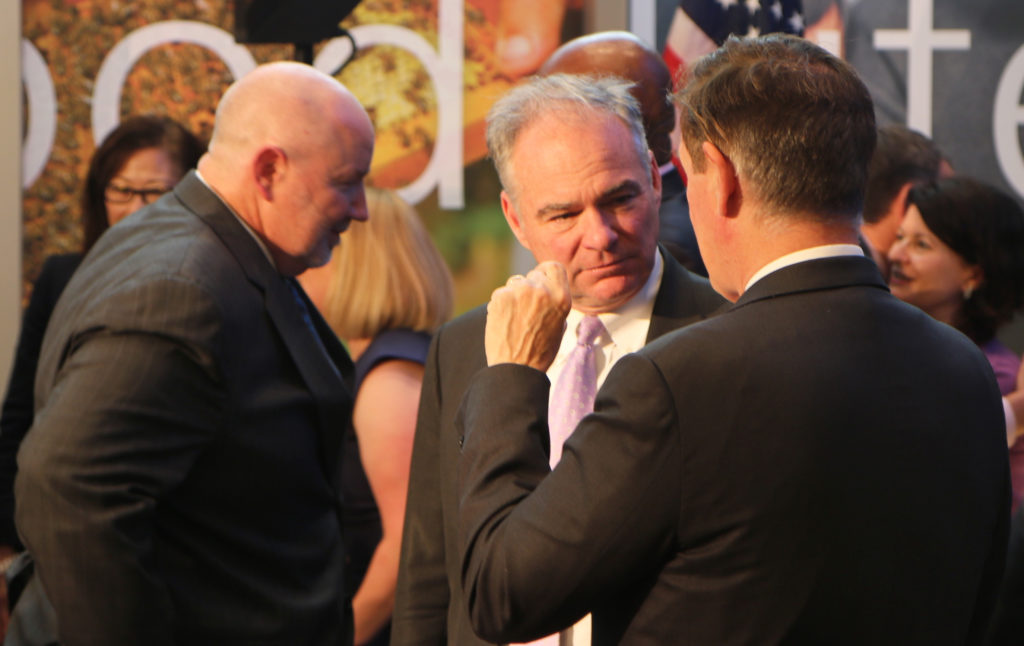
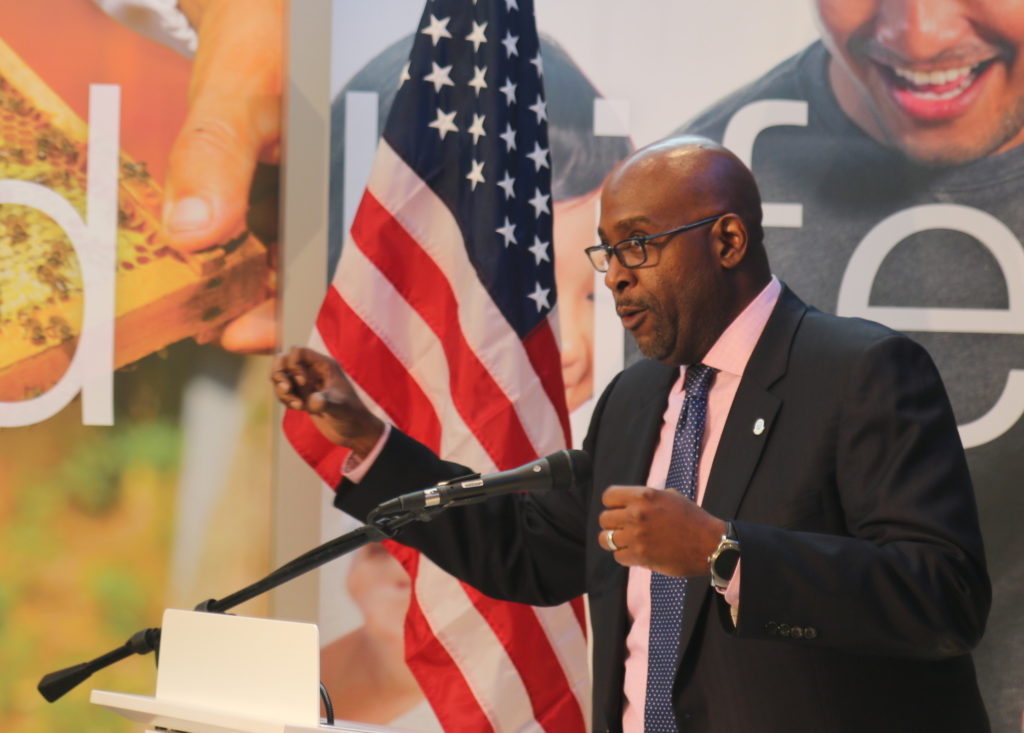
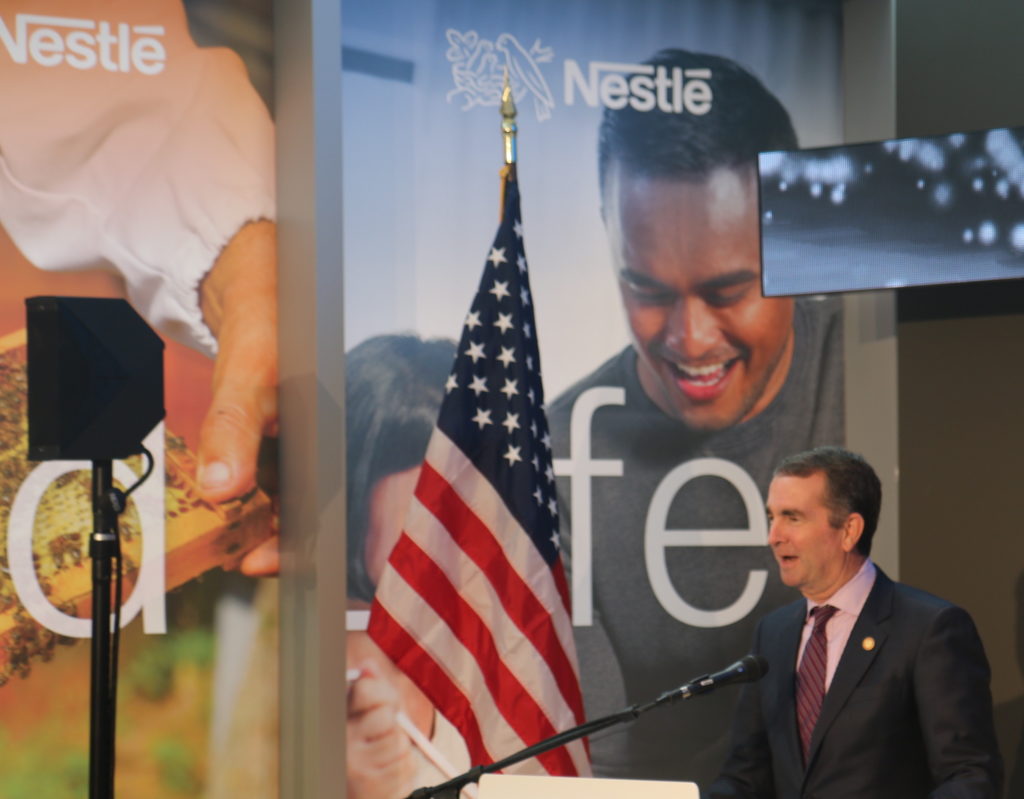
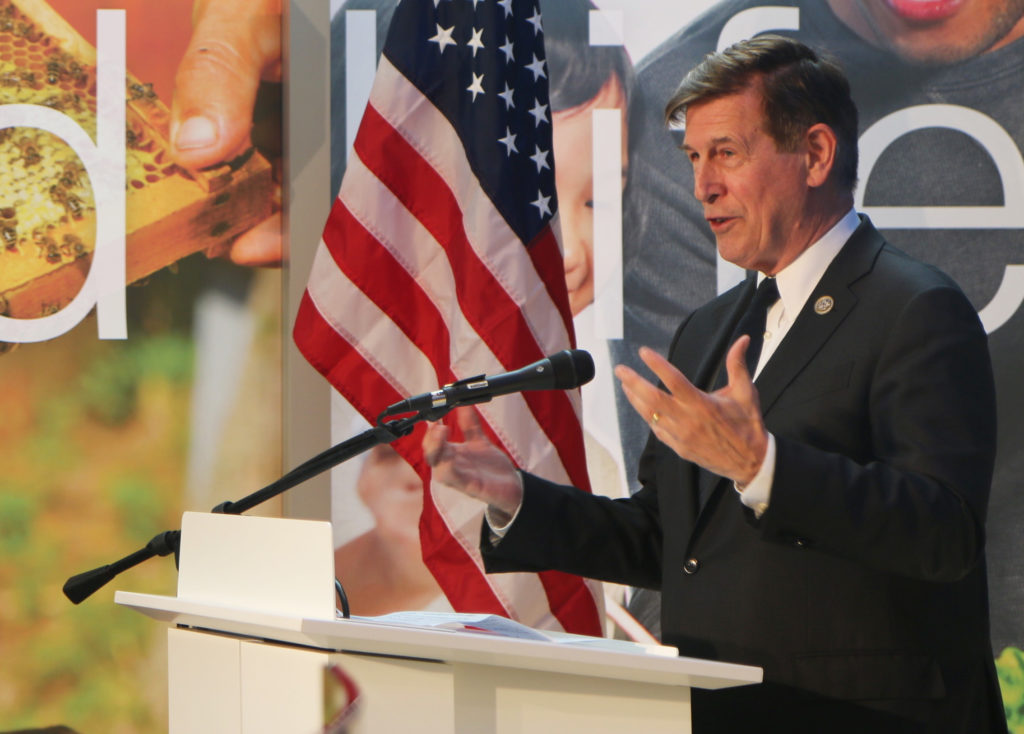
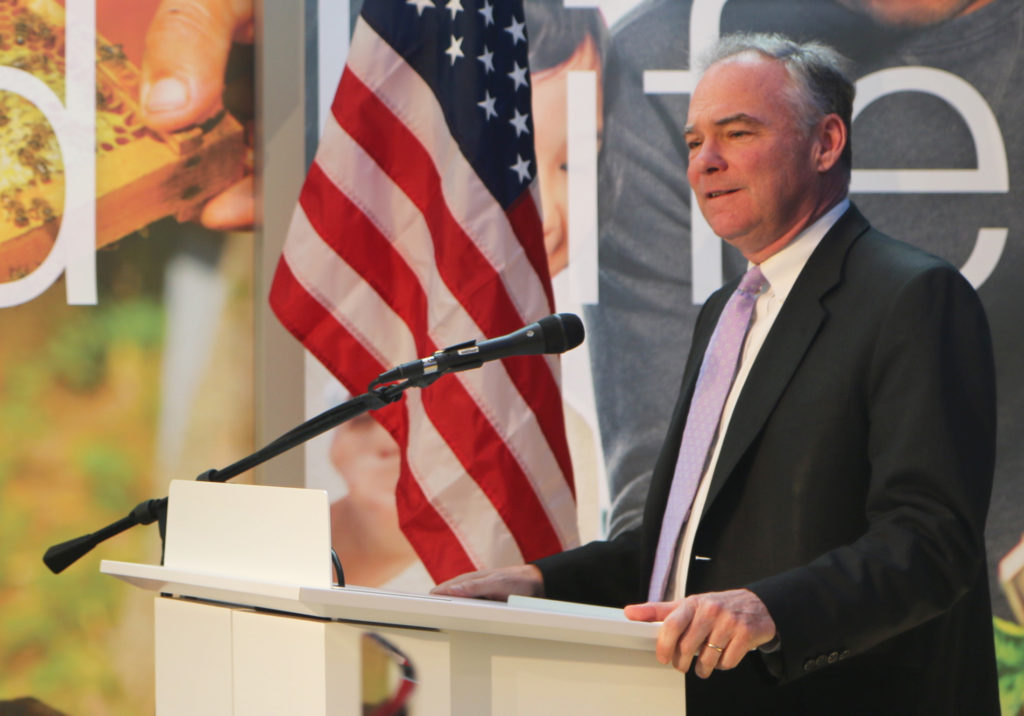
Sen. Tim Kaine (D-Va.) and Rep. Don Beyer (D-8th District) chat at Nestle’s Rosslyn ribbon cutting.
County Board member Christian Dorsey speaks at Nestle’s Rosslyn grand opening.
Gov. Ralph Northam (D) speaks at Nestle’s Rosslyn ribbon cutting.
Rep. Don Beyer (file photo)
Sen. Tim Kaine (D-Va.) speaks at Nestle’s Rosslyn ribbon cutting.
(Updated Aug. 1, 9:15 a.m.) For Rosslyn, and perhaps Arlington itself, Nestle’s arrival could represent a bit of a breakthrough.
As the federal government’s cut back on office space and more companies shift to telework, the neighborhood has seen its office vacancy rate skyrocket over the past few years, straining the county’s finances in the process. But the packaged food giant’s decision to relocate its corporate headquarters from California to Arlington, bringing 750 jobs to a high-rise at 1812 N. Moore Street, could very well signal the reversal of that trend.
Or, at least, that’s what local leaders are counting on.
“We were in a long kind of slump,” County Board member Libby Garvey told ARLnow, reflecting on Nestle’s impact as the company officially opened its Rosslyn offices today (Tuesday). “But this is really a turning point, and I think it’s really positive.”
Garvey points out that the building Nestle is moving into was built “on spec,” without any tenants locked in before its construction, and sat vacant for years after its completion in late 2013.
But since Nestle announced last year that it’d be moving to Arlington, she’s seen a domino effect in the neighborhood. The company’s not only brought one of its subsidiaries to Rosslyn, announcing Gerber’s relocation to the area this spring, but Nestle’s arrival also helped convince the Grocery Manufacturers Association to move to get closer to the company, Garvey says.
“It just put us on the map,” Garvey said. “You just start to attract birds of a feather.”
While those businesses may very well help fill the county’s coffers, they didn’t come without a cost. The Board handed out about $4 million in performance grants and committed to $2 million in infrastructure improvements to woo Nestle to Rosslyn in the first place, earning criticism from people all along the political spectrum in the process.
Yet Garvey points out that the county’s denied relocation incentives for some smaller companies looking to come to the area in the wake of Nestle’s move, only to win their business anyway. She has full confidence in county staff to make sure that Nestle is living up to the economic benchmarks laid out in the grant requirements, noting “if there’s a problem, I assume they’ll tell us.”
“But I don’t think there’s going to be a problem,” she said.
Incentives for corporations are a touchy subject around the county these days, with much of the debate around Arlington’s bid to win Amazon’s second headquarters centered on what exactly the county’s offered the tech company to move here.
Officials have largely been silent on the subject, citing the fierce national competition to win HQ2 and its promised 50,000 jobs. But with other states publicly offering billions in incentives and transportation improvements, Virginia leaders have noted that the county’s surest path to luring the tech giant may be highlighting its highly educated workforce and top-ranked schools.
Steve Presley, Nestle USA’s chairman and CEO, repeatedly highlighted the quality of the school system in laying out why his company picked Arlington, and that’s the sort of feature the county’s boosters believe could prove similarly persuasive to Amazon.
“They’ll be thinking not only, ‘Can we find the qualified workers we need?’ but, ‘How do our workers feel about coming to Virginia?'” said Sen. Tim Kaine (D-Va.) “Workforce and the education system go hand in hand. That’s what we always need to focus on to attract businesses and we need to sell the fact that we have a really good education system compared to other states. That’s a real strength.”
Gov. Ralph Northam (D) has certainly been involved in making that pitch to Amazon, reasoning “the more talent we bring in here, the more folks that follow.”
But he says there’s no telling when Arlington might know if Nestle is the biggest fish the county will land, or if there are more ribbon cuttings in its future.
“I think they’re keeping their cards pretty close,” Northam said. “I don’t know anything you don’t.”
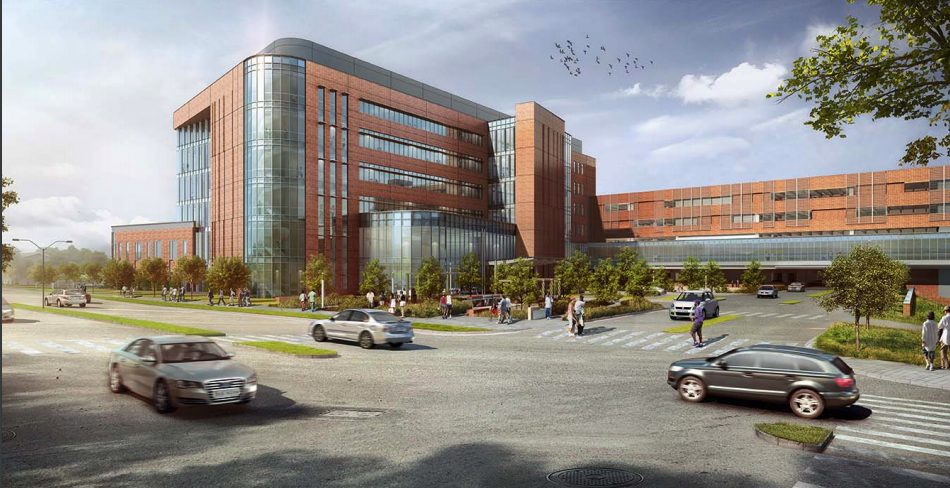
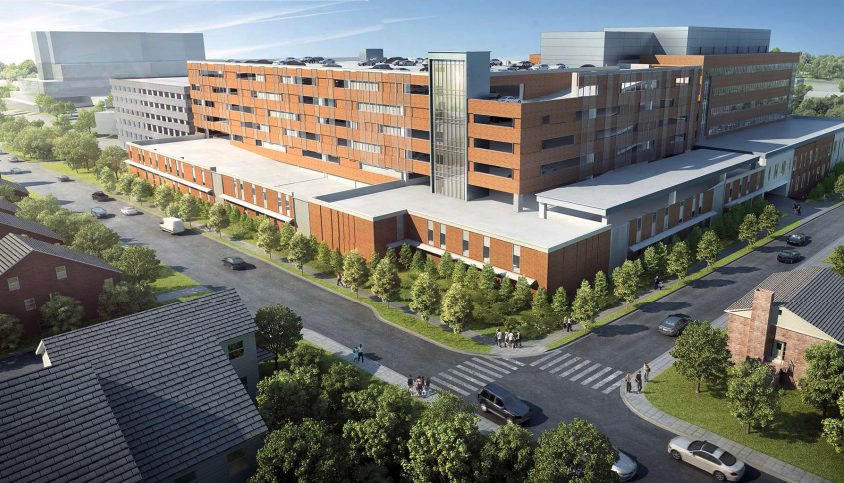
A rendering of the expanded Virginia Hospital Center (via HDR)
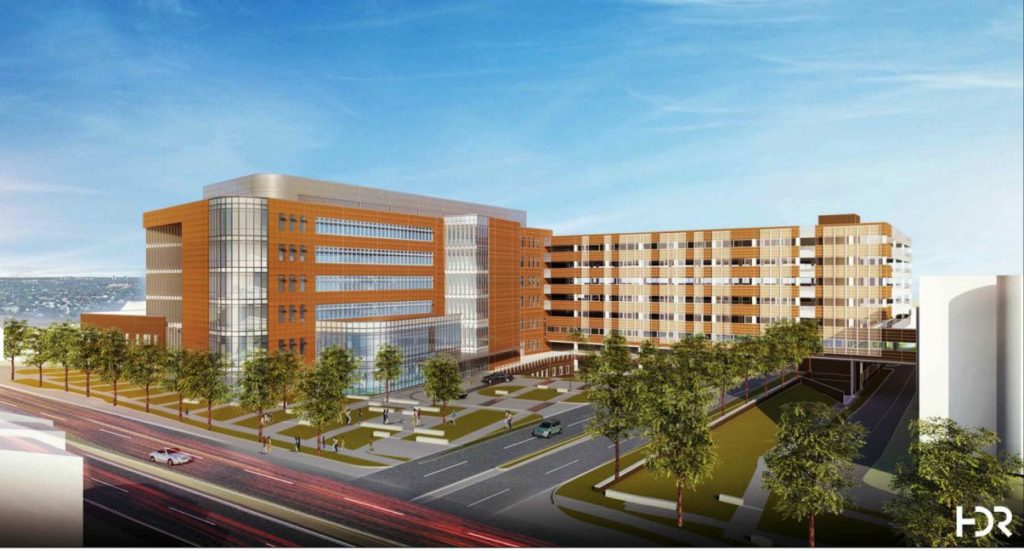
A rendering of the expanded Virginia Hospital Center (via HDR)
A rendering of the expanded Virginia Hospital Center (via HDR)
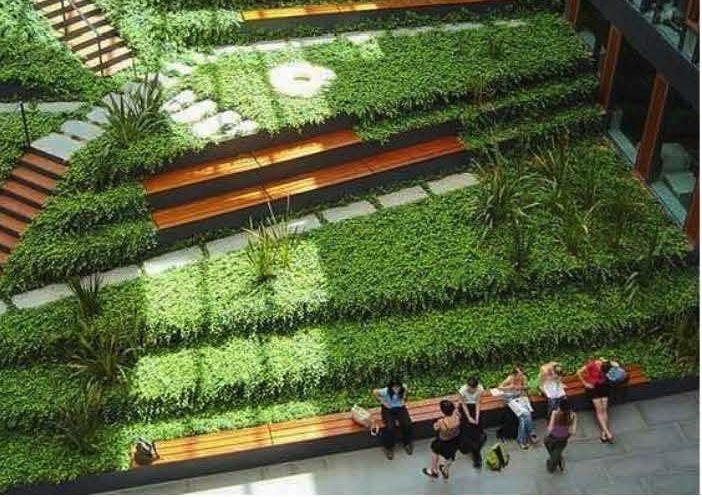
A rendering of the expanded Virginia Hospital Center’s “sunken garden” (via HDR)
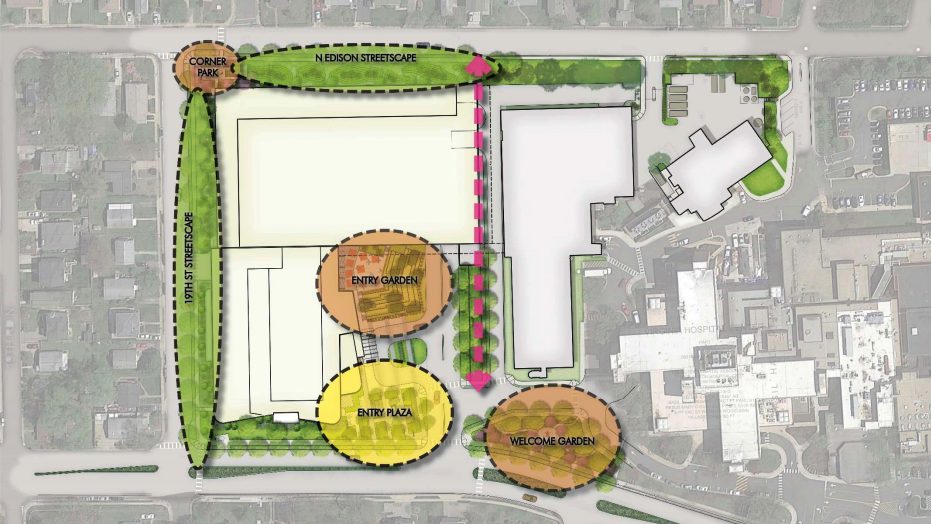
A rendering of the expanded Virginia Hospital Center’s planned green space (via HDR)
Arlington’s business community is urging county leaders to approve the Virginia Hospital Center’s expansion plans, arguing the project’s delays have already cost the company dearly.
The county’s lone hospital rolled out plans last fall to add a seven-story outpatient facility and a 10-story parking garage next to its existing campus at 1701 N. George Mason Drive. The County Board approved a land swap last summer to make the expansion possible, trading a parcel of land near the hospital on N. Edison Street for a property along S. Carlin Springs Road, and VHC has spent the ensuing months hammering out designs for the new buildings.
Yet some of the hospital’s plans have drawn ire from neighbors and transit advocates alike, convincing the Board to push back any consideration of the expansion until the fall.
In a letter to the Board on July 23, Arlington Chamber of Commerce President Kate Bates called that decision “very disappointing,” and urged county leaders to lend the project an “expeditious approval.”
“The hospital is doing everything it can to accommodate the requests of neighbors and to honor good planning principles,” Bates wrote. “At this point, however, the cumulative effect of additional changes needs to be evaluated within the broader context of providing convenient, high-quality, patient-centered healthcare in a fiscally prudent way for the next 50 years.”
Bates argued in the letter that the hospital desperately needs the expansion to cope with Arlington’s growing population — VHC expects it’ll need an additional 85 hospital beds over the next five years to handle the county’s growth, and could use another 130 beds over the next 15 years. The hospital currently plans to convert around 120,000 square feet of existing outpatient space to 101 new beds once it can complete the proposed expansion.
Bates adds that “patients and visitors are frequently frustrated and unnecessarily delayed by current parking constraints” at the hospital, making the roughly 1,800 parking spaces in the new garage a key element of the plan as well. However, the garage has attracted some of the fiercest opposition of any element of the project, with neighbors worried about its size and staff and activists worried that it overly encourages driving at the expense of biking or transit options.
Yet Bates points out that VHC has already agreed to shrink the garage by about 200 spaces from its original proposal, bringing down its height to about 67 feet in all.
Furthermore, she wrote that the hospital has worked with the community to add more buffers and greenery to both 19th Street N. and N. Edison Street, demonstrating “a commitment to enhance the appearance and livability of the surrounding neighborhood.”
According to a VHC presentation at a May community meeting, the hospital is planning 27,000 square feet of buffers around the hospital’s perimeter, in addition to lots of green space on the property itself. In all, the hospital hopes to build a 11,000-square-foot entry plaza with a similarly sized “welcome garden” nearby, and a 9,000-square-foot courtyard complete with a “sunken garden” of tiered planters.
The hospital will also sketch out a “master plan” for the site to give the community a roadmap for its designs on future expansion efforts, including a push to someday buy more land for the redevelopment of its older buildings and the construction of a new “central power plant.”
In all, the Chamber sees this work as plenty of evidence that the Board shouldn’t press for any additional changes from the hospital and let the expansion move ahead quickly.
“Since the initial VHC project application, the hospital has made more than 100 modifications to the design in an effort to address issues raised by county staff and community stakeholders,” Bates wrote. “The Chamber respectfully requests that the Board prioritizes this effort and approves the VHC site plan application so this important project can move forward.”
Both the Planning Commission and the County Board are set to hold public hearings on the project in September.
A rendering of changes in the Four Mile Run valley as part of the proposed parks master plan (via Arlington County)
Jennie Dean Park rendering, with field alignments approved by the County Board
Rendering of the renovations to Jennie Dean Park, with field alignments previously approved by the County Board (Image via Arlington County)
With a key bit of planning work on the Four Mile Run valley in Nauck wrapped up, the county is pushing ahead with the development of additional design guidelines for parks and other features in the area.
The County Board approved a “policy framework” for the area in May, sketching out general goals for the remainder of the planning process. Chiefly, the work is focused on the redevelopment of Jennie Dean Park, the evolution of pedestrian and cycling options along roads like S. Four Mile Run Drive and the promotion of the arts industry in the area.
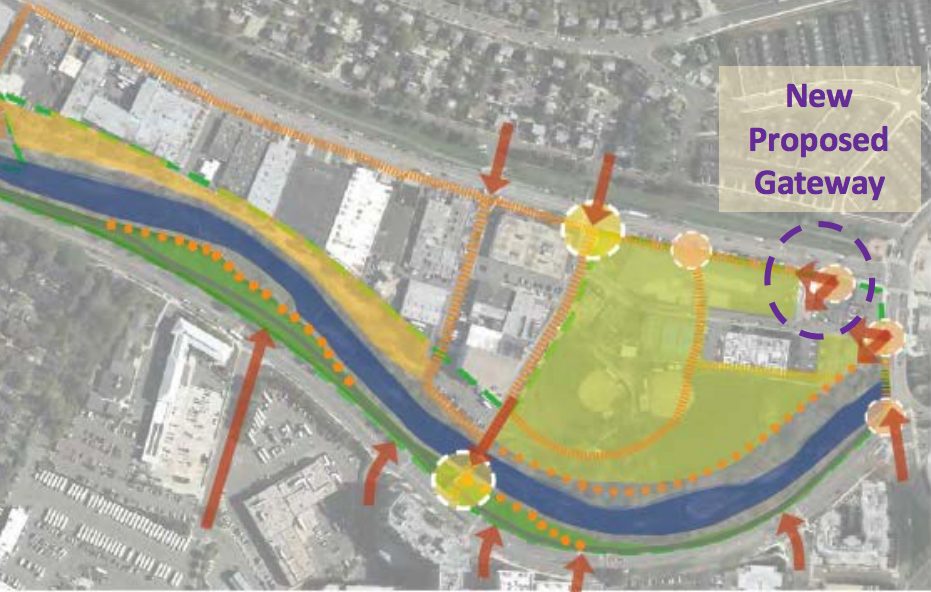
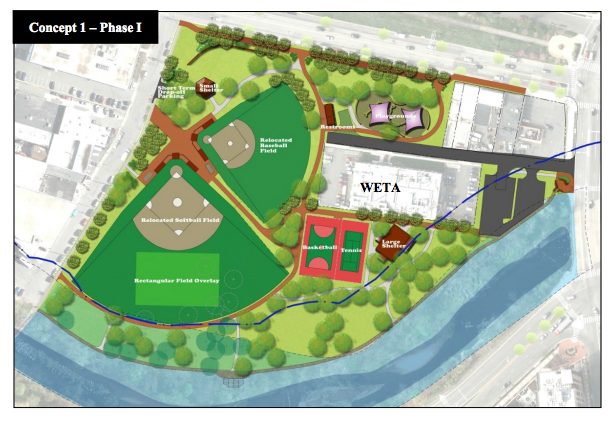
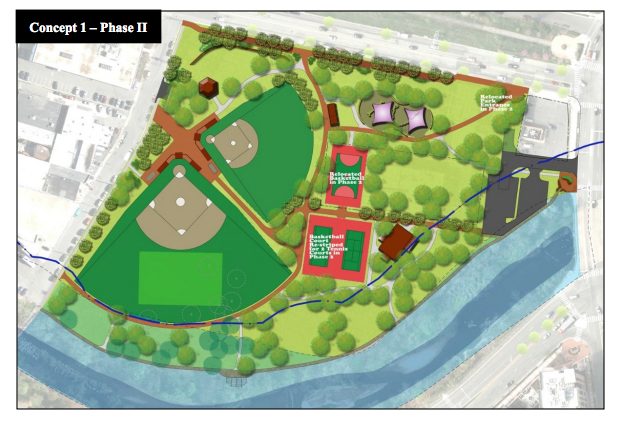
In the framework, the Board endorsed one plan for the redesign of Jennie Dean to account for the county’s plans to someday acquire WETA’s building in the area (3620 27th Street S.).
The Board expects to approve a plan calling for two planned baseball and softball fields to be aligned closer to S. Nelson Street, with new basketball and tennis courts on the site of the WETA building, even though it attracted some fierce pushback from some in the Nauck community. Now, the public will get another chance to weigh in on the design, including the county’s plans to add a new “gateway” to the park near the Weenie Beanie on S. Four Mile Run Drive.
The plans also include details on how the county might manage stormwater in the area moving forward, and future tweaks to features throughout Shirlington Park. The area’s dog park, however, won’t see big changes under the proposed plans, after the Board declined to move forward with any reduction in size for the park.
The Board expects to vote on a final parks plan in September, and could sign off on the area plan in November.
Demolition work is now fully underway at the Powhatan Springs Skate Park, as part of an effort to fully overhaul the 14-year-old facility.
The park, located at 6020 Wilson Boulevard in the Boulevard Manor neighborhood, is the county’s only park designed specifically for skateboarders. The County Board gave the green light for construction to get started back in May, as the facility had started to deteriorate and needed a facelift, and workers started tearing down the park earlier this month.
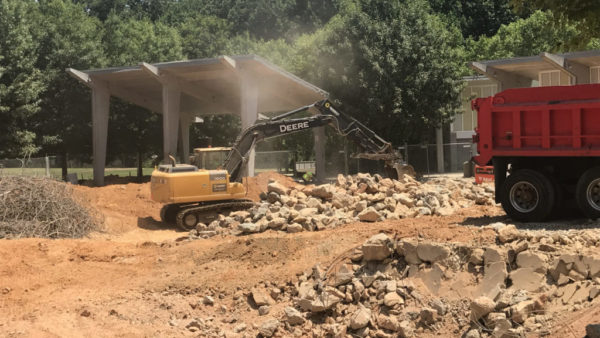
In all, crews will “remove some 500 cubic yards of poured concrete weighing nearly 2 million pounds,” according to a news release, and then transport that concrete to a county facility in Shirlington to crush it up. The county plans to use the rubble that remains “as the base layer of crushed rock beneath rebuilt county roads, providing drainage and stability for the asphalt that sits on top.”
“While recycling the concrete rubble of the old park won’t save the county a lot of money, it will reduce waste, consistent with Arlington’s commitment to environmental consciousness and stewardship,” the county wrote in the release.
Workers hope to finish removing all the concrete from the site by the time the month is up, then plan to start work on some stormwater management upgrades and electrical work. By mid-September, the county hopes to have a contractor starting work on the new park features, which include a completely new set of bowls and half pipes for skaters.
The county hopes to have the new park open by early next year.
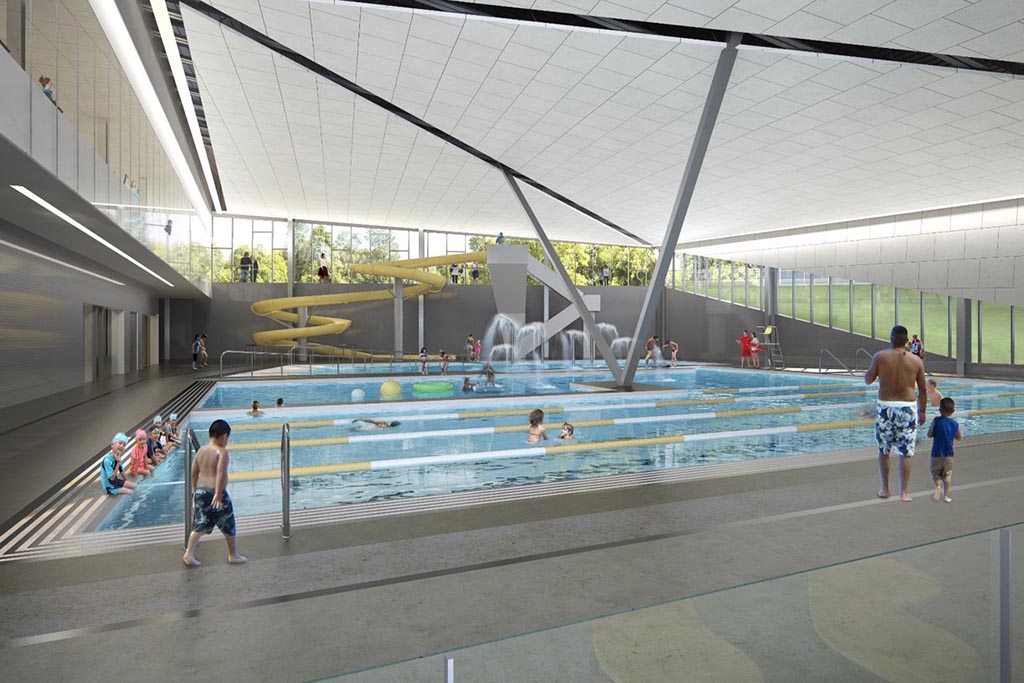
Long Bridge Park aquatics center family pool (via Arlington County)
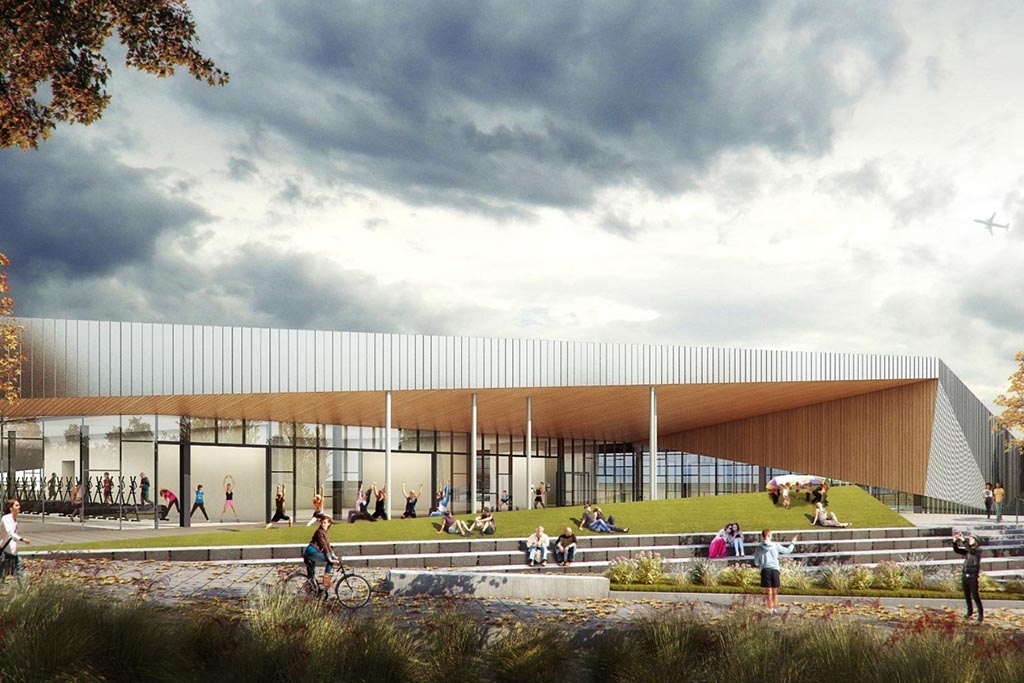
Long Bridge Park aquatics center exterior (via Arlington County)
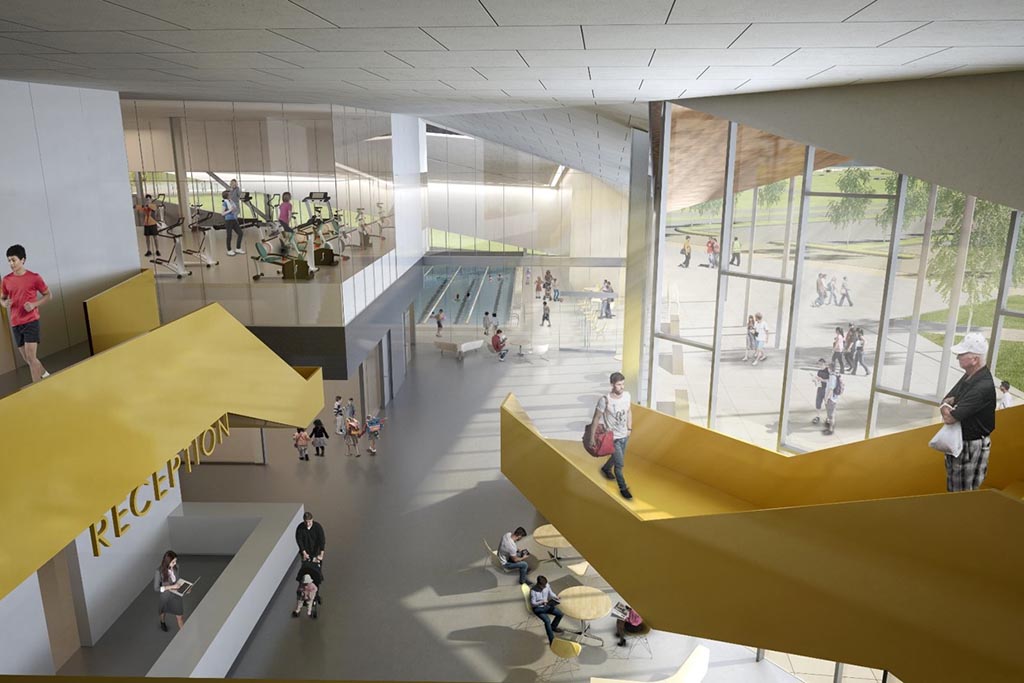
Long Bridge Park aquatics center interior (via Arlington County)
Long Bridge Park aquatics center exterior (via Arlington County)
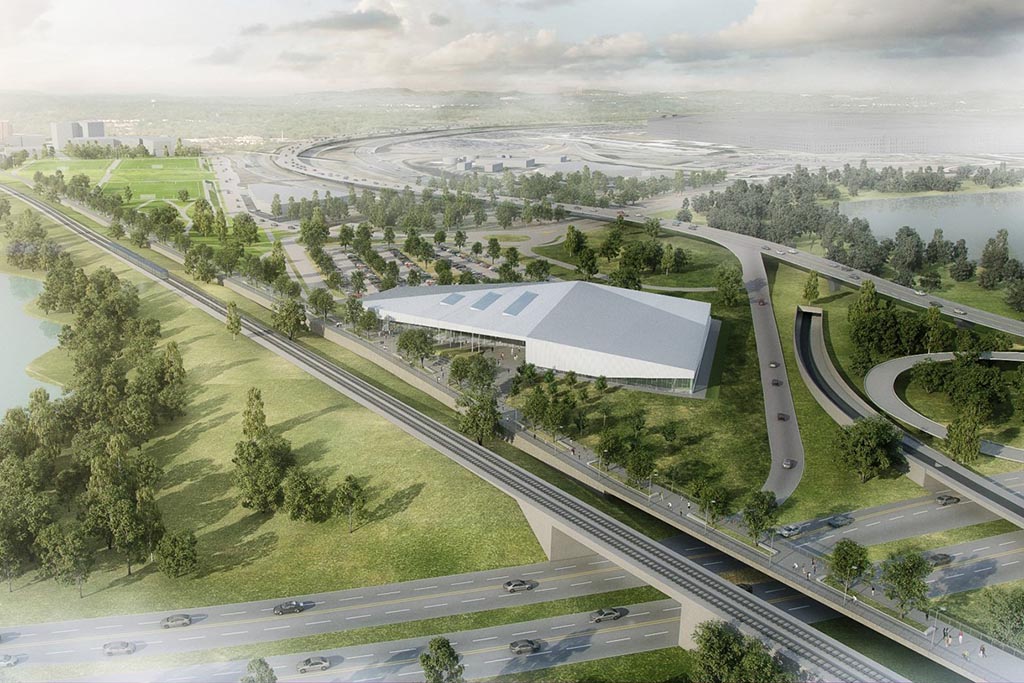
Long Bridge Park aquatics center exterior (via HESS/VMDO)
Long Bridge Park aquatics center exterior (via HESS/VMDO)
County officials haven’t given up hope that they might someday find corporate sponsors for the Long Bridge Park aquatics center, in order to offset some of the costs of the controversial project.
With work on the $60 million facility formally kicking off this week, the county is also moving closer to hiring a marketing firm to help it recruit potential partners for Long Bridge. Officials hope to start soliciting bids from companies before the year is out.
The project has had its fair share of financial challenges over the years, with substantial cost overruns prompting the County Board to postpone its construction in 2014. All throughout the process, however, county staff have kept hope alive that a naming rights sponsor or some other corporate partner might step in to help make the pool a bit more affordable for Arlington taxpayers moving forward.
The county initially hoped that the D.C. region might win the 2024 Summer Olympics, attracting plenty of private sector cash for Long Bridge in the process. That bid fizzled, and the Board subsequently oversaw a substantial rollback in the project’s scope and cost, yet officials have remained hopeful that businesses or even local universities might step up to cover some of the pool’s ongoing operating costs.
County Manager Mark Schwartz conceded in a July 10 work session that part of the reason the county’s struggled so much on this question is that this “is not an area where we have a lot of expertise or experience.”
The county does have a deal with Marymount University backing one field at Long Bridge Park itself, and another sponsorship arrangement with George Washington University at Barcroft Park, where the university’s baseball team plays its home games. But Lisa Grandle, the county’s park development division chief, points out that the county generally “does not have any major sponsorships for Long Bridge or any of our other parks.”
She says the county has spoken “with a variety of potential sponsors and partners” for Long Bridge over the years, and even previously worked with a consultant to find some takers for the pool. Yet with all of that effort for naught, she says the county feels putting out a request for proposals for “on-call partnership and consulting services” is the surest way to finally manage a breakthrough.
The exact form of a corporate sponsorship for Long Bridge remains up in the air until the county can find a marketing partner, but Grandle did say the county has some general ideas.
“In general, sponsorships take the form of cash contributions from corporate entities in exchange for ‘entitlements’ from the county, such as naming rights, identification on signage, acknowledgement on staff uniforms or publications such as class catalogs, use of a facility for a ‘corporate day,’ or discount entrance passes,” Grandle wrote in an email. “The cash contributions for sponsorships can be structured in various ways, such as a large lump sum payment up front with smaller payments agreed upon over a period of time or a small lump sum up front payment with larger payments over agreed upon period of time.”
Grandle added that any consultant would initially focus on finding sponsors for Long Bridge, but the firm could also seek partners for other county parks in the future.
While there’s no guarantee that this new effort will succeed at Long Bridge, Schwartz expects that the mere fact that the county’s actually started work on the project after years of debate has to help matters.
“It makes it easier for us to go to prospective sponsors and saying, ‘Here’s the plan, here’s the actual timeline,'” said Schwartz, noting that the facility is currently set to open in 2021. “The process had been bit inchoate and now, to the extent we’re ever optimistic, we’re slightly more optimistic.”
Arlington officials are moving closer to setting up a new financial assistance program to help families afford childcare, with overhauls to zoning and parking requirements for daycare facilities possible before the year is out.
In the near term, the county will work with local businesses and nonprofits to set up a program to defray childcare costs for families who don’t qualify for state subsidies, similar to existing efforts in Alexandria and D.C. Staff also plan to study the county’s childcare needs and shortcomings in more detail, building on work they’ve done over the last year or so, and make the county’s online resources for childcare providers a bit more streamlined.
By December, the Board plans to rewrite some of its zoning ordinances to make it a bit easier for daycare centers to open and operate in the county, with the goal of bringing costs for parents down in the process. That same month, the Board will propose changes to the county’s childcare codes, with a vote on the edits soon afterward.
Leaders haven’t quite finalized what all of those changes will look like, with community engagement and public hearings to discuss the specifics set for the coming months, but they’re broadly aiming to give parents more affordable options for daycare around Arlington.
“We’ve come a far way, but we’ve got a long way to go,” said Board member Libby Garvey.
Board Vice Chair Christian Dorsey pointed out that Arlington parents foot the highest average annual bill for childcare for an infant and a 4-year-old out of any locality in the region. The county’s average cost of $42,705 per year, compared to $40,521 in D.C. and $37,787 in Alexandria per staff’s findings, left Dorsey “gobsmacked” and eager to see what the Board could do to bring that figure down.
“I can’t imagine our rents are higher than they are in D.C.,” Dorsey said. “The District has just as much supply-demand pressure, yet we’re more expensive… I’m not interested in Arlington exceptionalism when it comes to this.”
One contributing factor could be the county’s parking requirements for daycare facilities. Deborah Warren, the deputy director of the county’s Department of Human Services, noted that Arlington currently requires providers to have one parking space for each employee, in addition to space for pickups and drop offs.
The Board could tweak that requirement to make it easier for more facilities to open in the county’s densest neighborhoods, or even let smaller, family daycare providers avoid the lengthy process of applying for a special use permit before opening their doors.
“If it takes less time, there’s less of a process to go through, hopefully we can increase the number that’s out there,” said Kimberly Vacca, an associate planner with the Department of Community Planning, Housing and Development.
With roughly 13,435 children under the age of 5 in the county and 6,894 spaces in licensed daycares, as of 2015, county leaders recognize they have an urgent need to somehow attract more providers to the area.
Dorsey urged the Board not to lose sight of the county’s focus on using its regulations to enforce high standards at all of its daycare facilities, yet the entire Board expressed a desire to see some of those requirements somehow loosened by the time this process wraps up.
“To the extent that the pendulum swings between affordability and quality, the pendulum might’ve swung a bit too far away from affordability here,” said Board Chair Katie Cristol.
County attorney Steve MacIsaac clarified that the county is intervening on behalf of the Census Bureau in a different case than the one originally described in this article. We regret the error.
Arlington County is weighing filing a lawsuit targeting pharmaceutical companies over the opioid crisis, and intervening in a separate case as well to protect the Census Bureau’s practice of counting undocumented immigrants in population surveys.
The County Board voted unanimously last Wednesday (July 18) to move ahead with the legal action, after consulting with county lawyers behind closed doors.
The county is retaining the services of some outside lawyers to explore the possibility of joining dozens of other localities in suing drug manufacturers over fallout from the opioid crisis. Arlington recorded a 245 percent spike in patients seeking treatment for addiction to drugs like heroin and fentanyl from 2015 to 2017, and any lawsuit would seek to secure damages against pharmaceutical companies involved in flooding the market with prescription drugs that can often lead to addiction.
However, the Board would need to approve the specifics of any opioid lawsuit before the county moves forward with legal action.
The county also plans to lend its support to the Commerce Department in an ongoing federal case, after the state of Alabama mounted a legal challenge to the “resident rule.” The state is looking to ban the Census Bureau from counting undocumented residents in any count of an area’s population, as census data is used to determine boundaries of congressional districts and hand out federal money.
Arlington is joining with a variety of other localities to oppose that move, considering that the county has a large undocumented population. Census data show that Arlington had roughly 29,400 non-citizens living in the county through 2016. That was equivalent to roughly 13 percent of the county’s total population, one of the highest margins in the country.
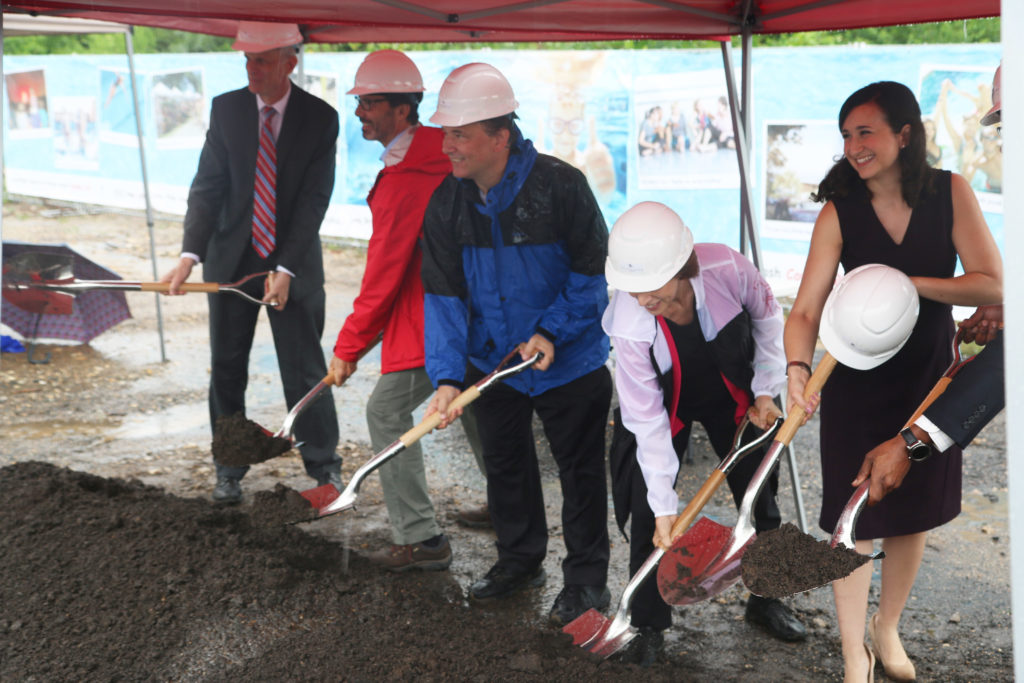
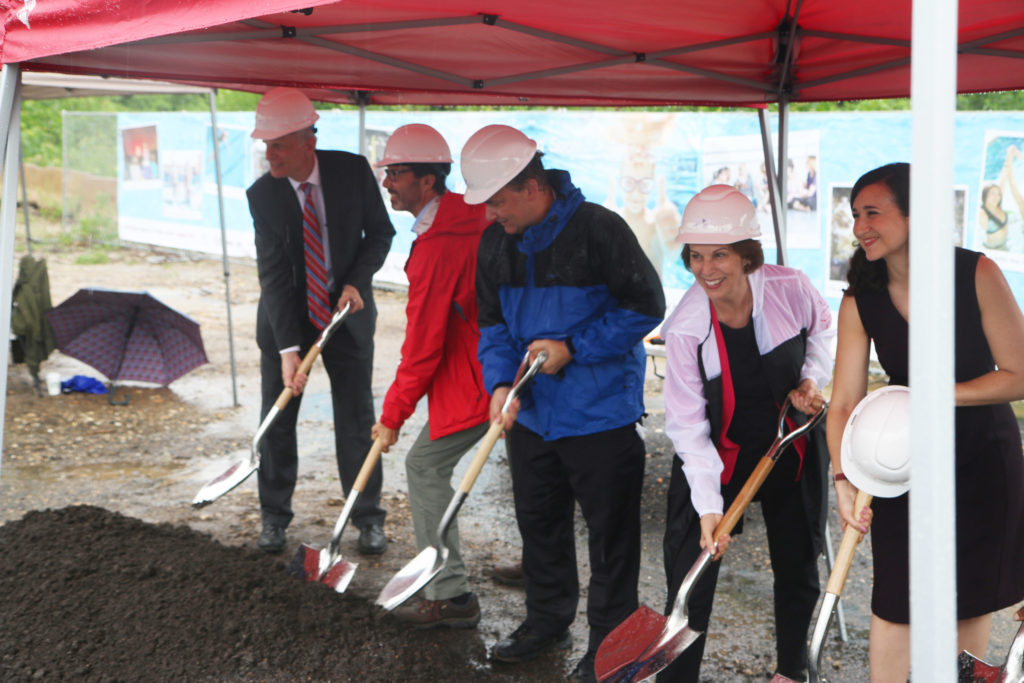
County Board members Libby Garvey and Katie Cristol, right, help break ground on the Long Bridge Park aquatics center.
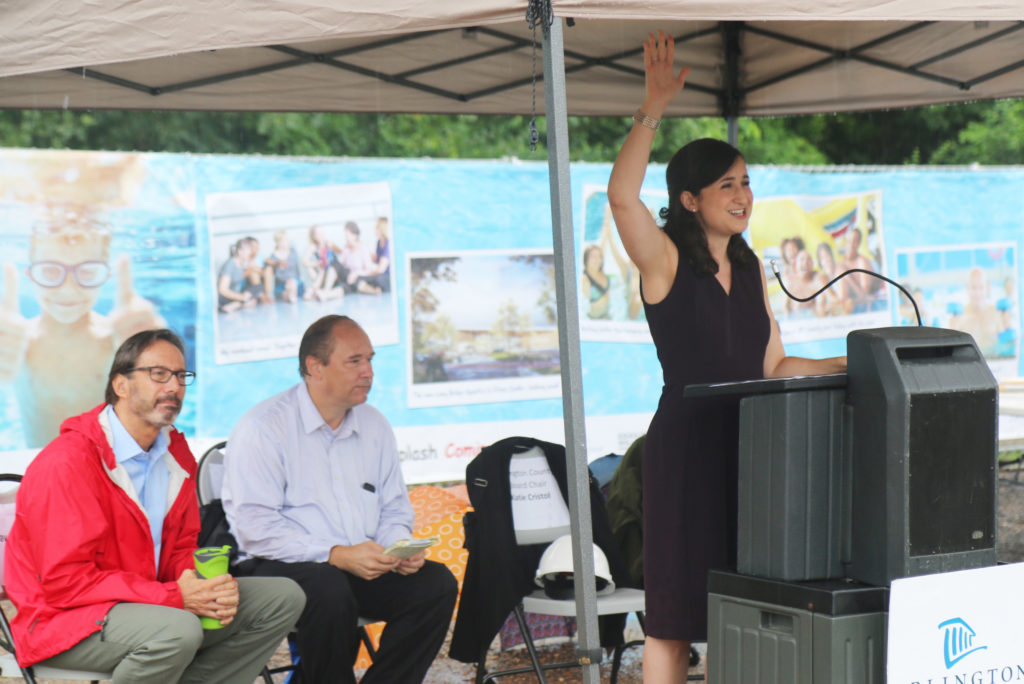
County Board Chair Katie Cristol speaks at the Long Bridge Park aquatics center groundbreaking
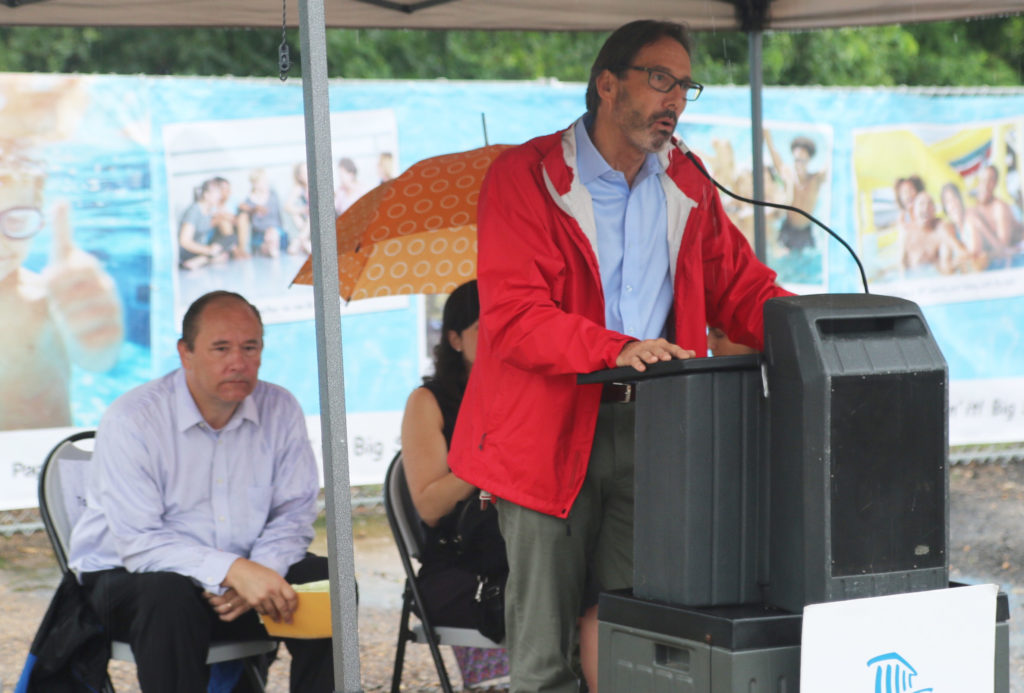
Former County Board member Jay Fisette speaks at the Long Bridge Park aquatics center groundbreaking
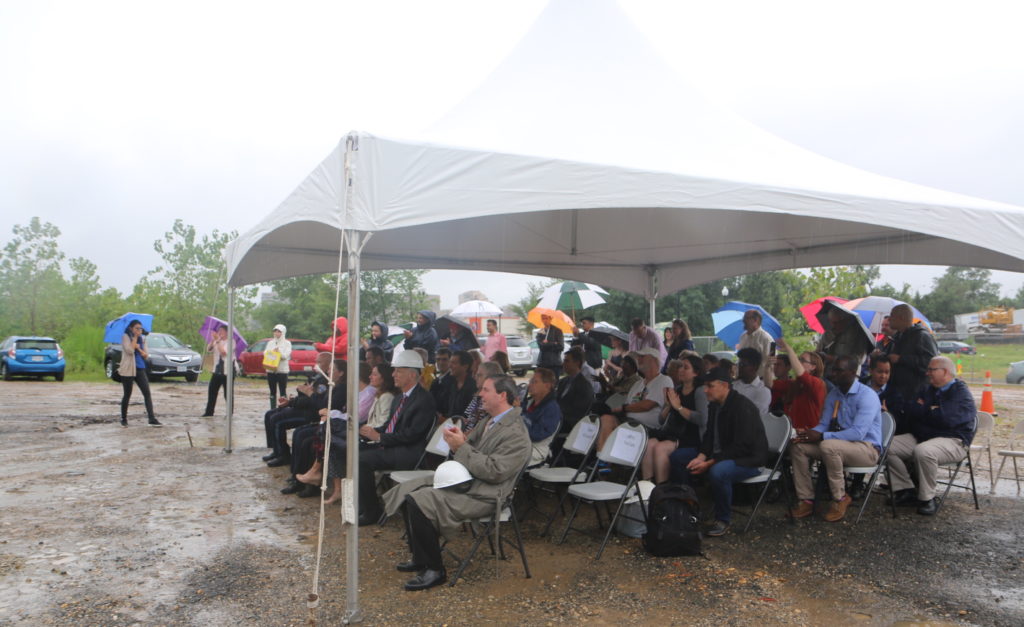
Attendees dodge raindrops at the Long Bridge Park aquatics center groundbreaking.
County Board members Libby Garvey and Katie Cristol, right, help break ground on the Long Bridge Park aquatics center.
Long Bridge Park aquatics center family pool (via Arlington County)
Long Bridge Park aquatics center exterior (via Arlington County)
Very little about the effort to build an aquatics center at Long Bridge Park has ever been easy — and that includes the project’s long-awaited groundbreaking.
Mother Nature had one last obstacle in store for county leaders as they gathered to finally turn some dirt at Long Bridge, delivering a formidable deluge that thoroughly soaked the construction site ahead of Tuesday’s ceremonial start to construction.
Yet even as the rain turned the ground to mush and tested the limits of attendees’ umbrellas, Arlington officials pressed on with a celebration of a project that’s been decades in the making.
“This project has endured worse than a little rain,” joked County Board Chair Katie Cristol.
Voters approved funding for the project in a 2012 bond referendum, but major cost overruns prompted county leaders to delay the facility’s construction two years later, and it quickly became a hot-button issue in that year’s local elections.
After a lengthy process of scaling back the project’s scope, and reducing its cost, the Board signed off on its construction last fall — but even still, some in the community would rather see it pushed back once more as the county wrestles with a budget dilemma.
Those are all big reasons why Jay Fisette, who served on the Board for 20 years, compared the project to a church in Barcelona, Spain that’s been under construction since 1882. Toby Smith, a local activist who helped lead the Long Bridge Park planning process, added that he “can measure the project’s length by the height of my kids.”
“It’s fair to say I did have doubts over the years, even as the community was largely still behind it,” Fisette told ARLnow. “It wasn’t clear every moment that it was going to happen… but groundbreaking helps it become eminently real.”
Fisette remembers some delays prompted when planners working to design the park, which opened across from the Pentagon in 2011, decided to shift where the aquatics center would be located within Long Bridge. He also puts some of the blame for the project’s long timeline on himself, recalling his insistence that the facility meet the new energy efficiency standards he fought to impose for county buildings.
“It was never expected to happen quickly,” Fisette said. “Good things sometimes take a long time.”
Still, Cristol lamented that it was “bittersweet” that the county would break ground on the project without Carrie Johnson around to see it. As one of the county’s longest tenured planning commissioners, Johnson played a key role in shepherding the entire Long Bridge Park project through the process, but she passed away this May.
“Years down the road, we’ll all be thanking Carrie Johnson for this,” Smith said.
But for all the project’s long history, Cristol points out that many of Arlington’s new arrivals are only now learning about aquatics center. She feels Long Bridge is as much about the county’s future as its past, and she hopes the upcoming construction work “will give people a chance to learn about what will be coming here.”
Work is set to wrap up in 2021, with a 50-meter pool, diving towers, a family pool and a series of additional park improvements on tap for the area by the time it’s completed.
So even if the project required some long nights, a few headaches and one last morning in the rain, Fisette feels it was all worth the effort.
“This area used to be an invisible place,” Fisette said. “It was a wasteland, where you’d only come if your car got towed. This is going to transform it into a vibrant community amenity.”