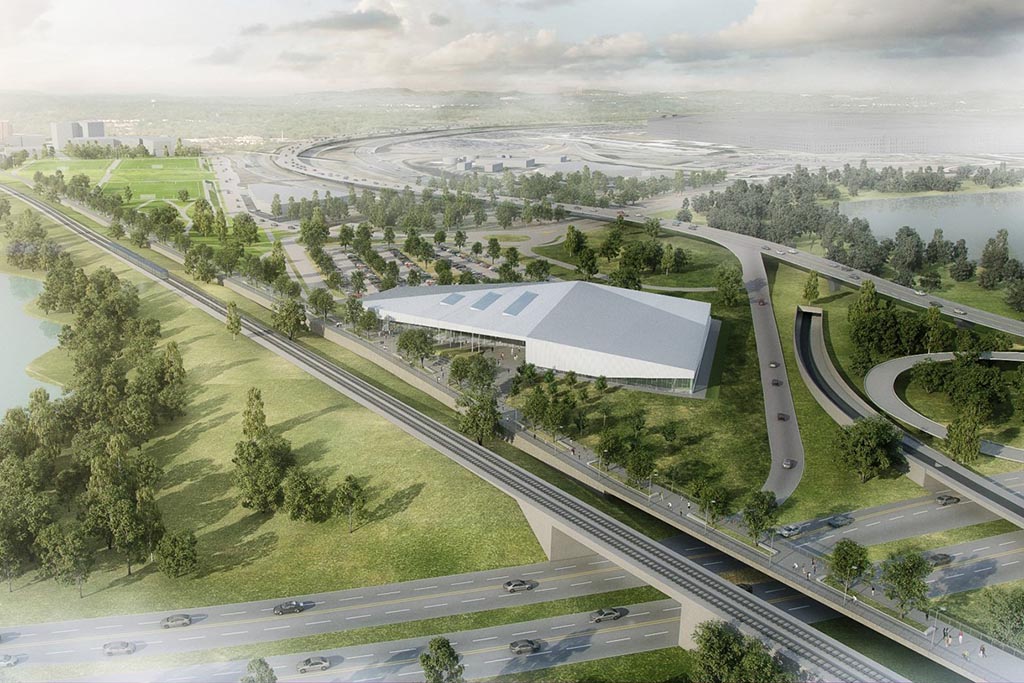
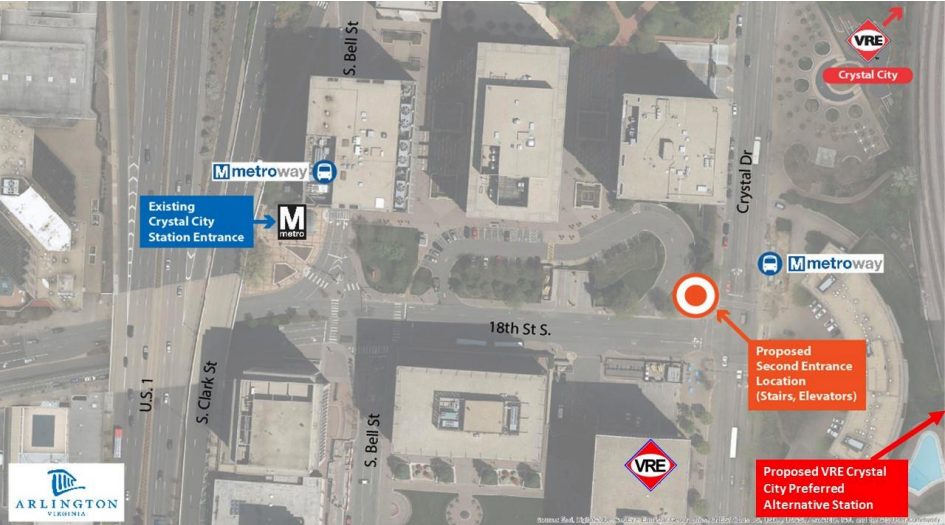
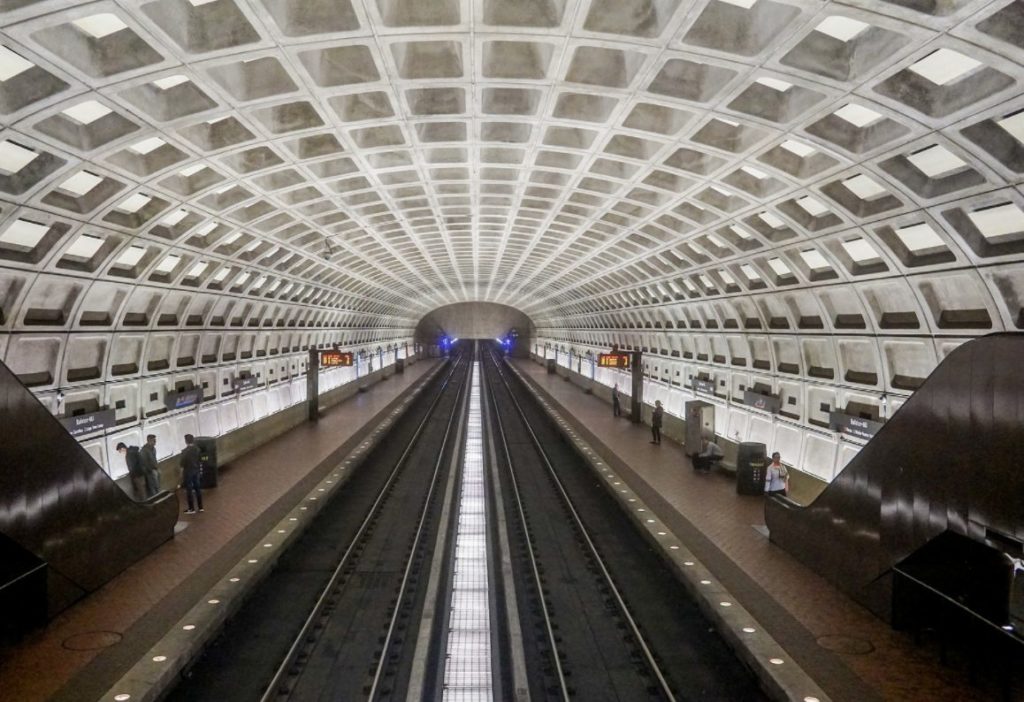
(Updated at 10 a.m.) Arlington is getting ready to seek nearly $78 million in state transportation funding to build a second entrance at the Crystal City Metro station.

The County Board is considering submitting the project for “Smart Scale” funding, money handed out by the Commonwealth Transportation Board for big-ticket projects around the state. If approved, Arlington would have the money it needs to add an eastern entrance to the station at the northwest corner of the intersection of Crystal Drive and 18th Street S., perhaps by sometime in 2024.

The county has spent years studying the prospect of a second entrance to ease access to the Crystal City station, particularly as planners project substantial increases in housing development in the area over the next few decades, with or without Amazon’s potential arrival. The project would also include two street-level elevators and a new underground passageway and mezzanine to reach the Metro platform.

Yet the county has hit some roadblocks when it comes to finding funding for the $91 million project.

Arlington’s recent budget woes, brought on by declining commercial tax revenues and new funding obligations for Metro service, means that the county will need to rely on outside funding for the second entrance. The county expected to get most of that money from the Northern Virginia Transportation Authority, a regional body that funds major transportation improvements.

But the NVTA recently told the county that it can only chip in about $5 million towards design work for the project, as the group adjusts its own funding plans after losing out on tens of millions in annual revenue as a result of a deal to provide dedicated funding to Metro.

That forced Arlington officials to turn to the statewide “Smart Scale” program to for funding, an outcome local lawmakers predicted as a result of the NVTA losing out on money as part of the Metro deal. The county is similarly concerned about how it might pay for second entrances at the Ballston and East Falls Church stations in the coming years due to these same factors, but officials only chose to submit the Crystal City project for “Smart Scale” money.

State transportation officials will evaluate the Crystal City entrance against other projects across the state, and award funding based on factors like how much congestion they will relieve and how much economic development they’ll spur. Should Arlington win the full $78 million it’s asking for, county officials plan to use the NVTA money and some local tax revenue to fund the remainder of the project’s cost, according to a staff report.

The county also plans to submit three more projects, with a total cost of roughly $10.1 million, for “Smart Scale” funding.

Those include the expansion of Transitway service in the Crystal City area, the installation of new equipment and software to create a demand-based pricing system for county parking meters and the procurement of software to better manage Arlington Transit (ART) bus service.

More on the parking meter proposal:

Performance Parking Deployment in Commercial Corridors ($6.1 million)

This project will install equipment and software to support demand-based pricing of on-street meters and improved public information about parking availability. On-street parking is limited by the finite length of curb on County streets and competing curb uses while offstreet parking is very expensive to build. Given these limitations, it is critical that the parking supply is managed effectively. Modern parking technology enables a much more efficient management of the system. County policy, as stated in the Master Transportation Plan’s Parking and Curb Space Management Element, supports the use of multi-space meters and other high performing technologies. The project will support the installation of hardware and software to monitor and display occupancy, turnover, and parked duration information from the curbside metered spaces and County owned and operated off-street facilities in order to support demand-based pricing of on-street meters and improved public information about parking availability.

The County Board will formally vote to endorse these “Smart Scale” applications at its meeting this Saturday (July 14).

Photo via Arlington County
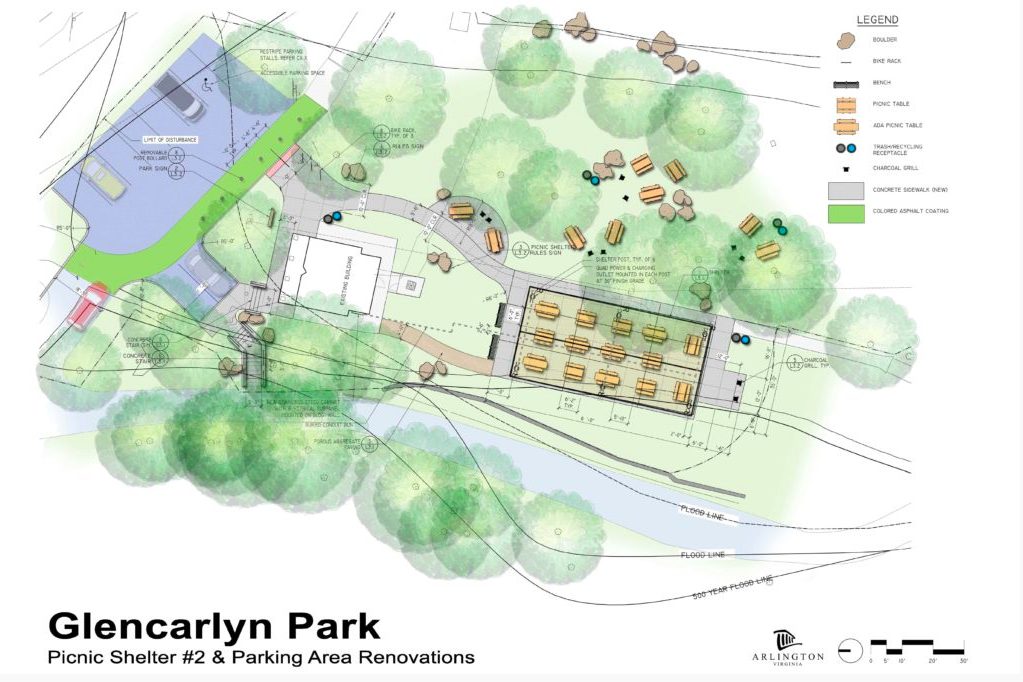

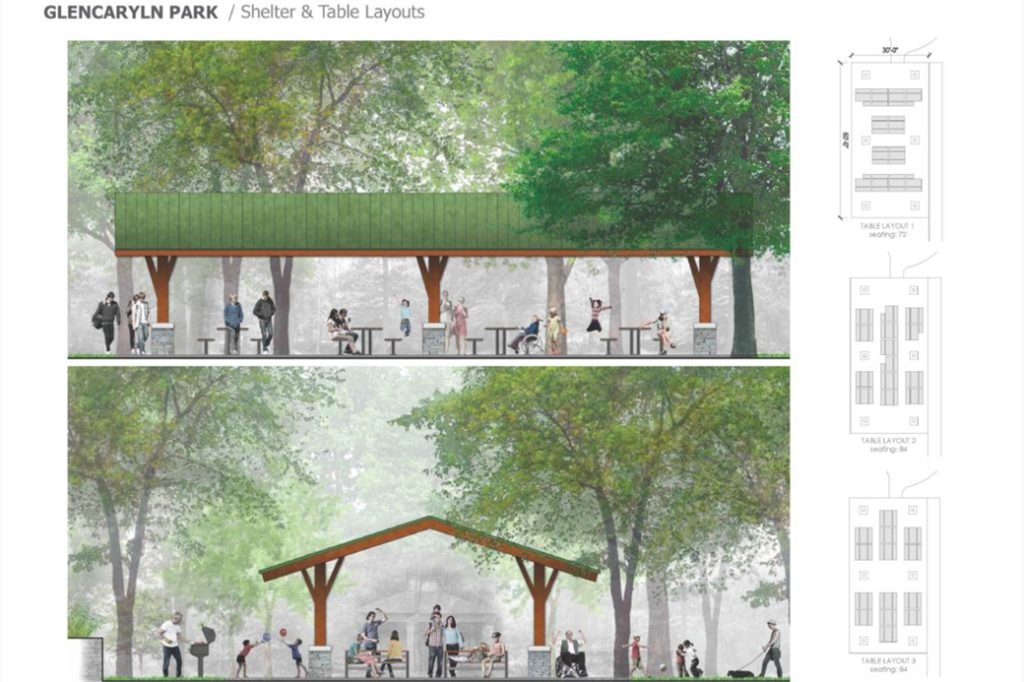
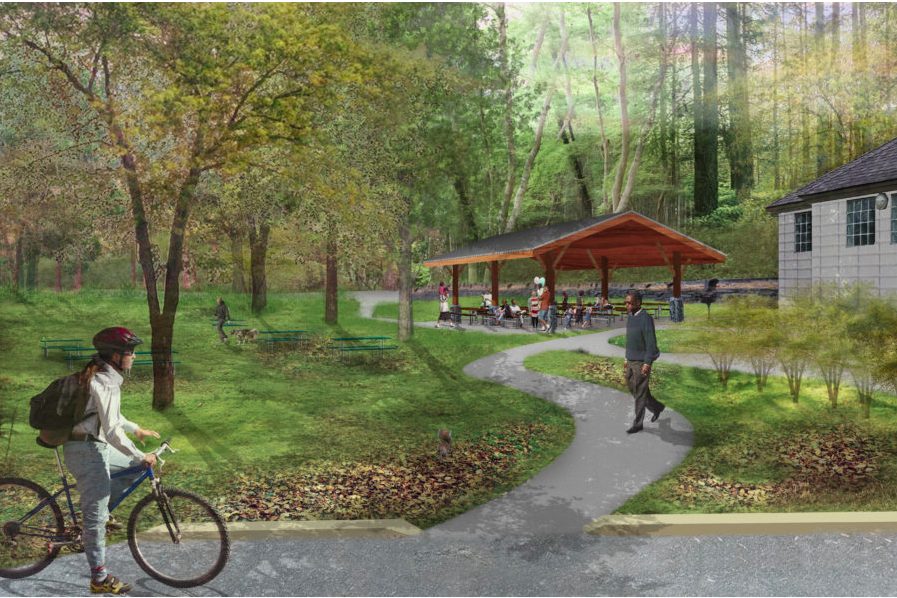
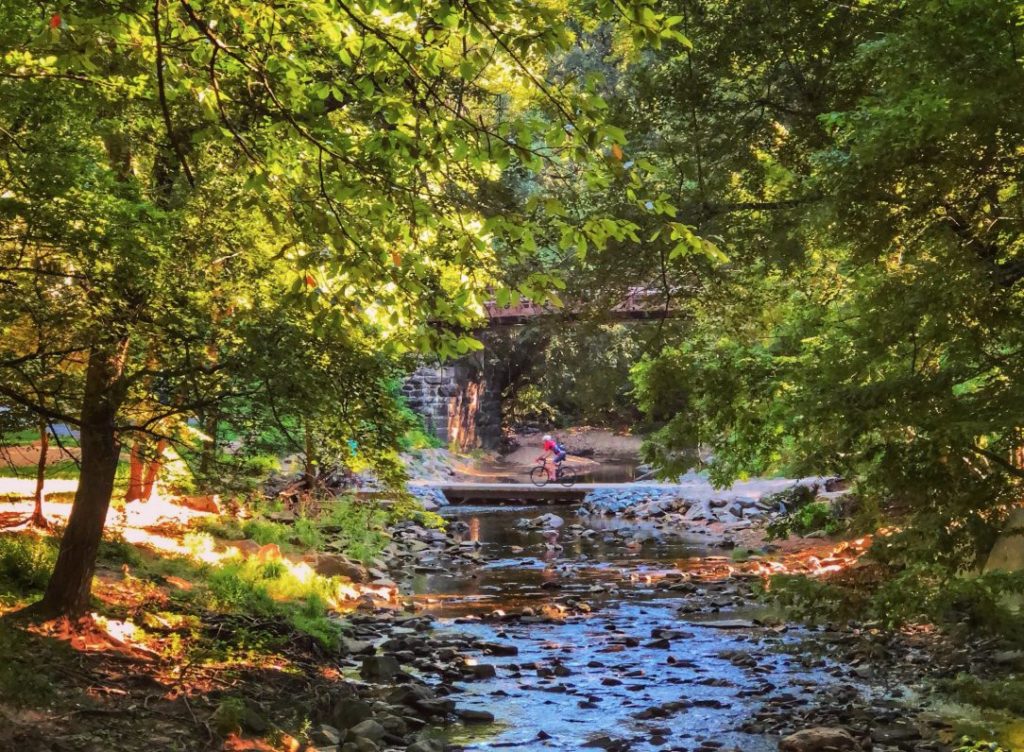
Construction work on some improvements to Glencarlyn Park will likely kick off later this year.

The County Board will consider a roughly $685,000 contract for renovation work at the park during its meeting Saturday (July 14). Crown Construction Services, Inc. is set to manage the renovations.

The work will include replacing one of the park’s picnic shelters, which is “beyond reasonable repair,” according to a county staff report, and updating the park’s open picnic and parking areas. The county expects the renovations to wrap up early next year.

The Board will also consider awarding a construction contract to install synthetic turf at Gunston Park’s Diamond Field at the meeting Saturday.

Photos via Arlington County

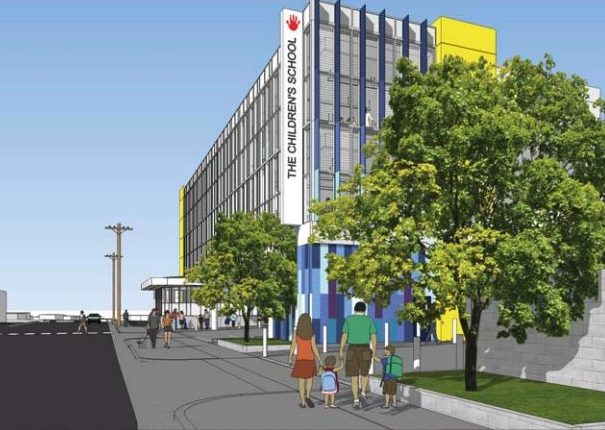
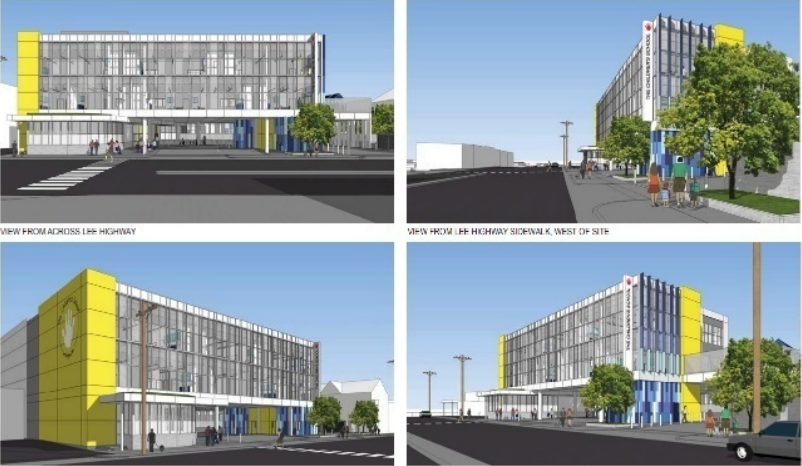
The Children’s School is moving closer to finding a permanent new home, as it pushes forward plans to build a three-story daycare facility along Lee Highway.

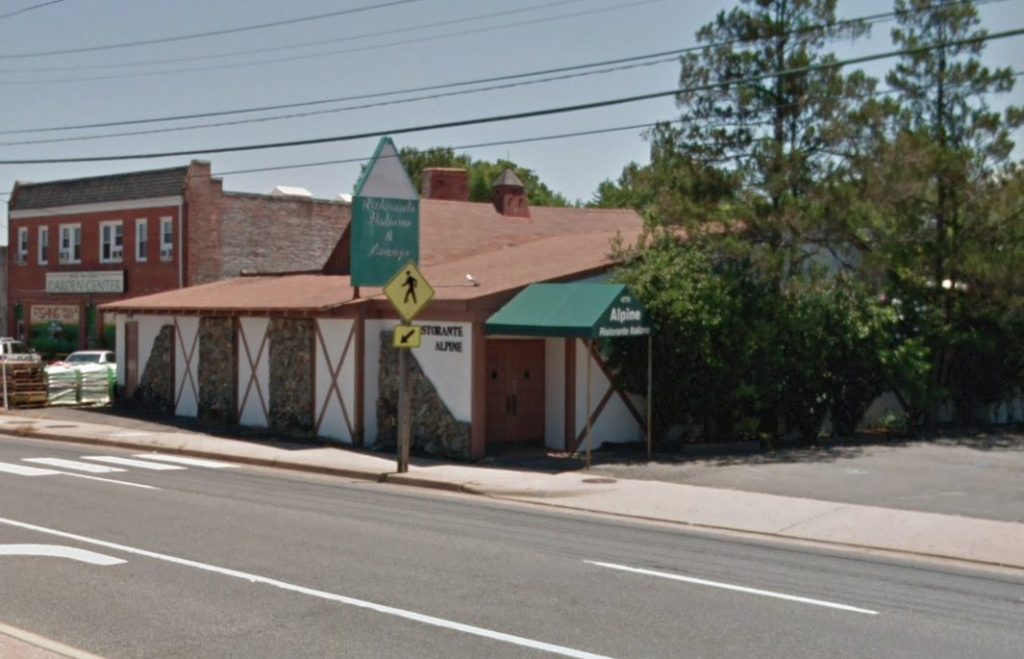
The child care program for Arlington Public Schools employees is looking for a county permit to redevelop the space once occupied by the Alpine Restaurant at 4770 Lee Highway, marking the first formal proposal that the school would seek to build a a 27,500-square-foot facility on the property.

The Children’s School got its start in 1987 at the Reed School building in Westover as a childcare program owned and operated by school system employees, but APS’ plans to build a new elementary school at the site pushed the program elsewhere.

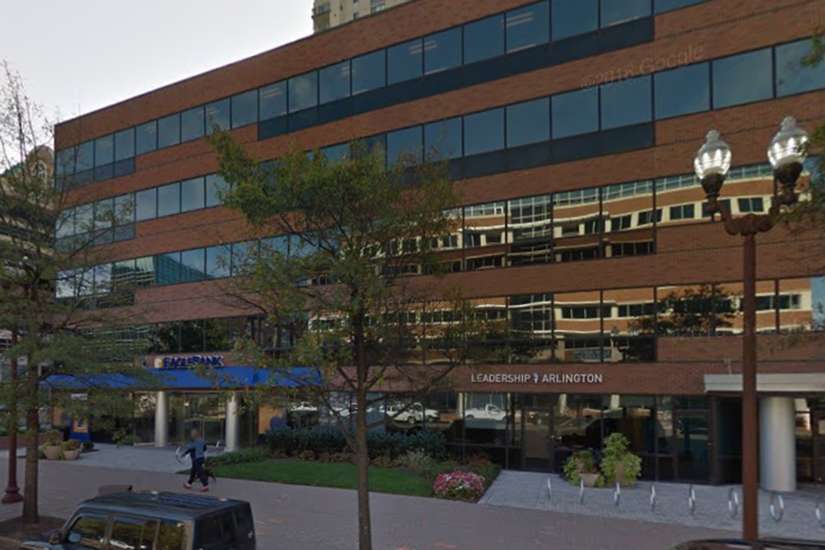
The co-op is currently operating out of a Ballston office building, and would look to use the Alpine site to expand its operations and serve about 235 children in total. Anywhere from 60 to 70 of those students would likely be part of the “Integration Station” program, which is reserved for kids with developmental or other disabilities, allaying initial worries that The Children’s School wouldn’t be able to maintain its relationship with the program.

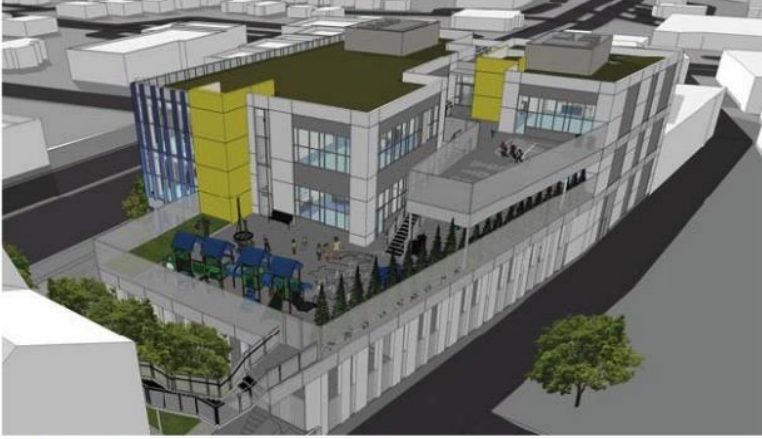
The school is hoping to demolish the current restaurant on the property, then build a three-story facility complete with two outdoor play spaces and a one-level underground parking garage.

In all, there would be 42 parking spaces located on site, as well as nine extra spaces on an adjacent lot to serve the roughly 40 employees at the program. The building would also include a “covered drive aisle” to facilitate easy pick-up and drop-offs by parents, with hours running from about 6 a.m. to 6 p.m. each weekday.

The play areas, designed to serve kids from 2 months old to 5 years old, would be located on the second- and third-floor roofs of the property, and both will be enclosed by a 7-foot-tall mesh fence. Those will face away from the road and toward the residential neighborhoods behind the building.

County staff are recommending that the County Board approve the project, writing in a report that the program has managed to work up the right sort of plans to mitigate any potential traffic impacts along Lee Highway. The Lee Highway Alliance also endorsed the project in a letter to the Board.

Board members will consider the permit request Saturday (July 14) as part of the Board’s “consent agenda,” which is generally reserved for non-controversial matters that are passed without debate.


County Board to Vote on Arts Grants — “County Board members on July 14 are slated to approve $215,810 in direct support to Arlington arts groups for the coming year. The funding request, which is in line with those of previous years, comes from the Arlington Commission for the Arts.” [InsideNova]

New Building Sign in Rosslyn — The logo for the University of Virginia Darden Graduate School of Business now sits atop one of Rosslyn’s skyscrapers. The school recently expanded its facilities within the building at 1100 Wilson Blvd. [Twitter]

‘Instagrammable’ Sights in Arlington — Stay Arlington, the county’s tourism promotion agency, has a list of the “Most Instagrammable Places in Arlington.” The list includes: the Air Force Memorial, the Netherlands Carillon, murals in Crystal City, Theodore Roosevelt Island, New District Brewing Co. and the Mount Vernon Trail. [Stay Arlington]

Local Young Professionals Spend Wisely — A “money diary” for a married, young professional couple in Arlington has none of the excesses usually found in the genre. Instead, the couple jointly makes $175,000 per year, plus bonuses, and spends it modestly on things like cheddar Chex Mix and a $1,600 per month one bedroom apartment. [Refinery 29]

New Look for Our Homepage — You might have noticed that ARLnow’s homepage has a new look. This is an interim step on our way to launching an entirely new website design. Please let us know what you think about it in the comments. Also, let us know if you find any significant bugs or problems, as we’re still working out the kinks.

Nearby: Dual-Use Path on W&OD Trail — “Within the next year, pedestrians and bicyclists will be able to use separate, parallel sections along the trail in the city of Falls Church.” [InsideNova]

Photo courtesy Dennis Dimick


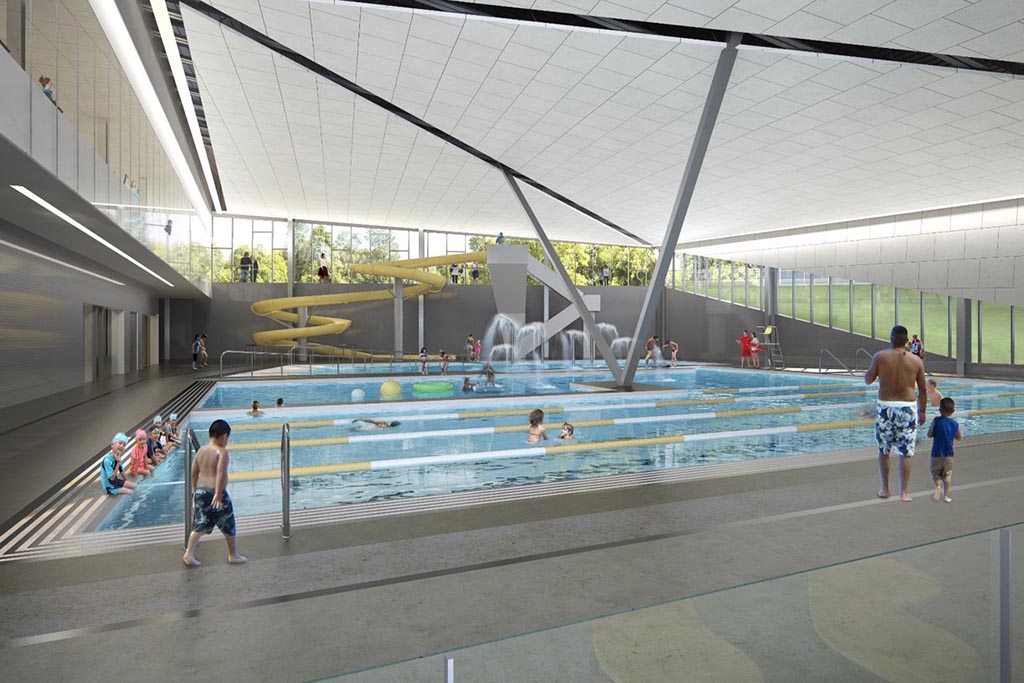
County Board member John Vihstadt is renewing his push to delay the construction of the Long Bridge Park aquatics center.

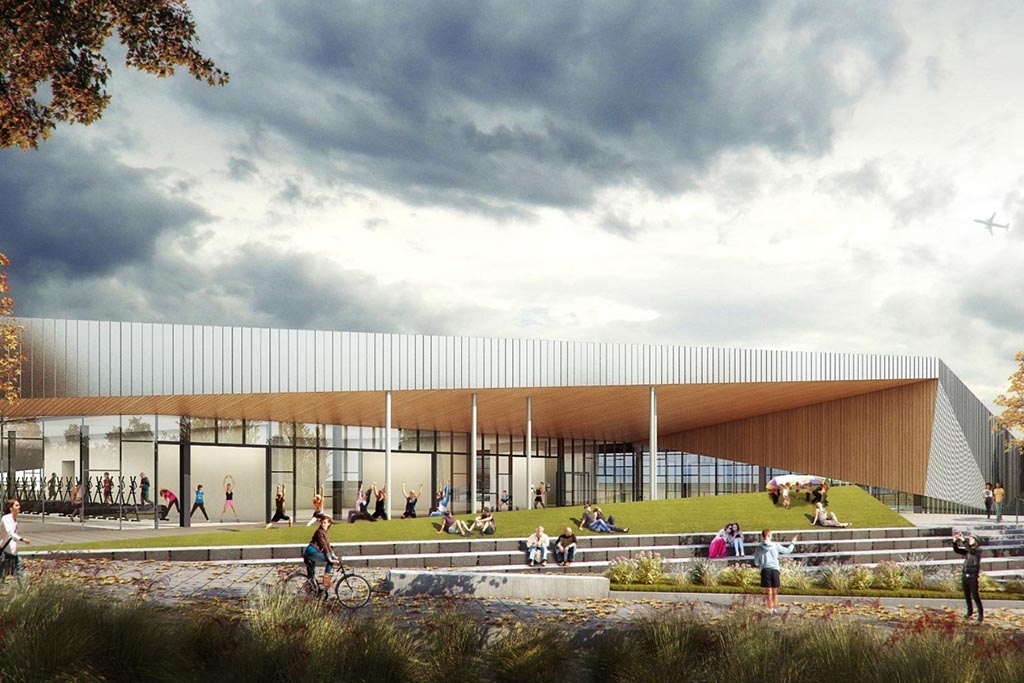
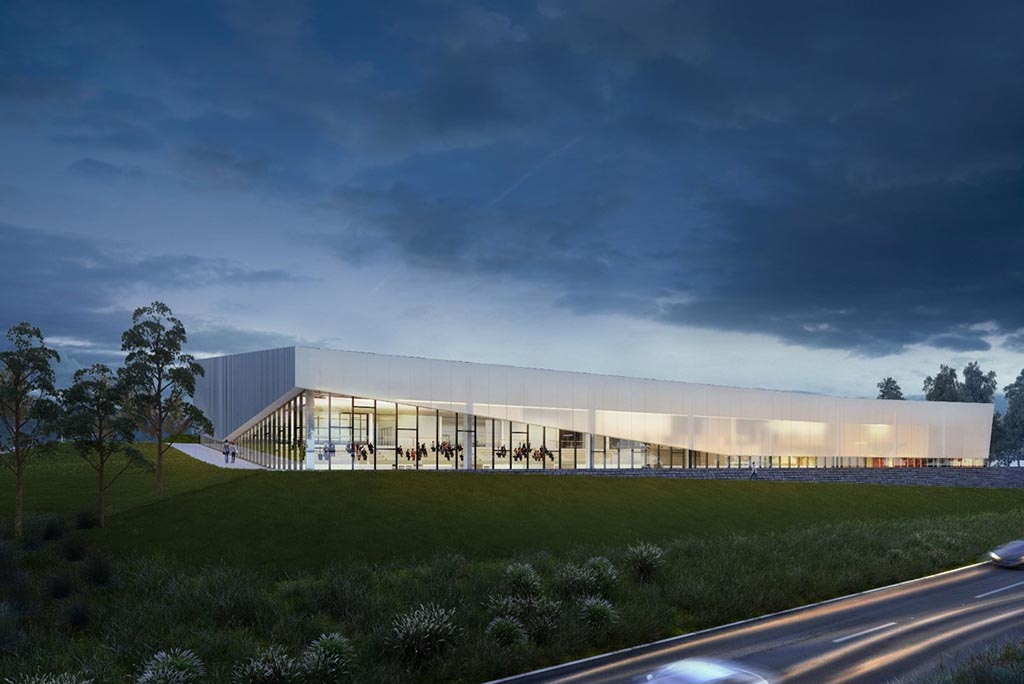
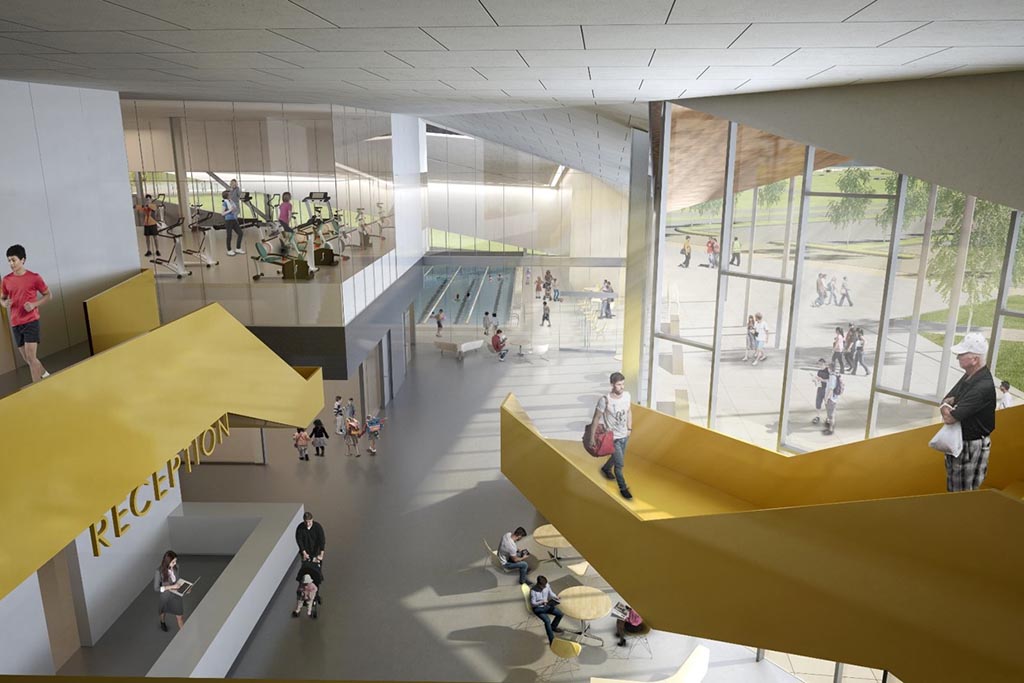
Vihstadt is waging a lonely battle against the oft-postponed project as the county’s budget picture grows increasingly grim. He says the $60 million the county’s set to spend on the new pool would be better spent on building new schools or buying additional park land, particularly considering that Arlington is feeling a financial squeeze at the moment.

Between sending more money to Metro and declining commercial tax revenues, the County Board is facing some challenging headwinds as it nears a final decision this weekend on a new, 10-year plan for construction spending. Vihstadt, the Board’s lone independent who is running for re-election this fall, thinks the 72,000-square-foot pool complex can wait a bit longer.

The project’s skyrocketing costs have convinced the Board to repeatedly adjust its plans it over the years, and Vihstadt made an effort to drive down its cost a key plank of his 2014 bid for office. But he still feels that even the facility’s reduced cost is too much for Arlington to take on right now.

“Times change, circumstances change, and I just don’t think it’s right to go forward on that project,” Vihstadt told ARLnow. “Schools have a higher priority. Parks have a higher priority.”

Yet, just as when he cast the lone vote against the project’s construction last December, Vihstadt appears to be in the minority on that position. His four colleagues on the Board all told ARLnow that they wouldn’t support any effort to postpone the Long Bridge project, even with the county’s money troubles in mind.

“Raising these issues when he first ran for election was an important contribution, because it shifted that narrative to value engineering,” said Board Vice Chair Christian Dorsey. “That success is something John ought to feel he positively contributed to. Now, it’s the responsibility of the rest of us to follow through.”

The pro-pool Board members all point out that the project has been in the works for decades, with the community formally signing off on money for the aquatics center as part of a bond referendum back in 2004, and would fill a void for such a facility in the Crystal City area.

But they also stress that the process of unwinding the work the county’s already done would be so costly as to make the effort pointless. County Manager Mark Schwartz believes that cancelling the county’s existing contract to build the facility would prompt extensive litigation, with financial consequences to follow.

“We cannot simply break the contract,” Board member Libby Garvey wrote in an email. “Likely there would be real financial penalties for us if we did, to say nothing of the damage to our reputation among builders. Companies bidding on our projects in the future would likely add extra cost because we could not be trusted to fulfill our contracts.”

The aquatic center’s proponents also see any move to reverse the Long Bridge decision as one that would send the wrong message to the community, or as an effort to “re-litigate the past,” as Board member Erik Gutshall puts it.

(more…)


Arlington’s personal property tax car decals coon soon be a thing of the past, even as the tax associated with the tags looks set to stay.

The County Board is now considering eliminating the requirement that vehicles garaged in Arlington display a decal to demonstrate its owner has paid the necessary property tax on the car, effective July 1, 2019.

The county would instead rely entirely on workers using a license plate reading system to determine whether the owner of any given vehicle is up to date on their taxes. Vehicle owners will still need to pay the annual property tax, as well as the “motor vehicle license fee,” commonly known as the “decal fee.”

Commissioner of Revenue Ingrid Morroy’s staff will use the license plate reader technology, which the county first purchased back in 2004, “to more efficiently and effectively ensure personal property tax compliance without vehicle owners displaying a decal,” according to a county staff report prepared for the Board.

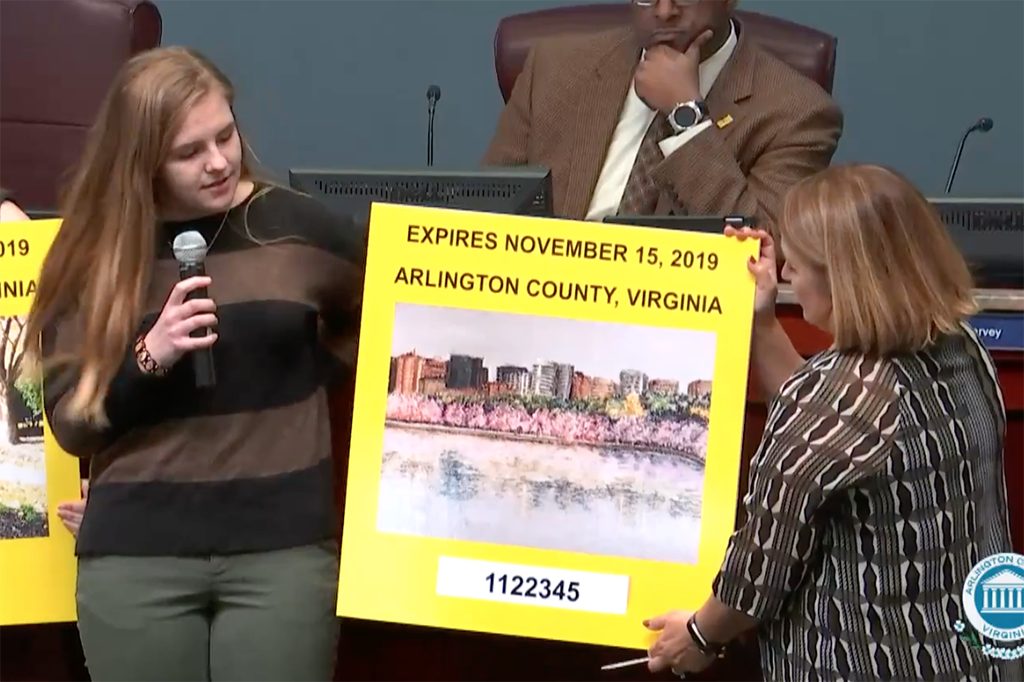
Staff also believe the change will “relieve an unnecessary burden on taxpayers,” ending a requirement that’s been in place in the county in one form or fashion since 1949. The move would also mark the end to the annual design competition for the decals, which has given high school students the chance to feature their artwork on the tag since 2005.

Arlington is one of 21 localities around the state to still require the car decals, according to the staff report, and Loudoun County recently eliminated its requirement for the tags.

A decision on the matter is still a ways off, however. The County Board will vote at its Saturday (July 14) meeting whether to call for a public hearing on the question, which would then be set for September 22.

File photo


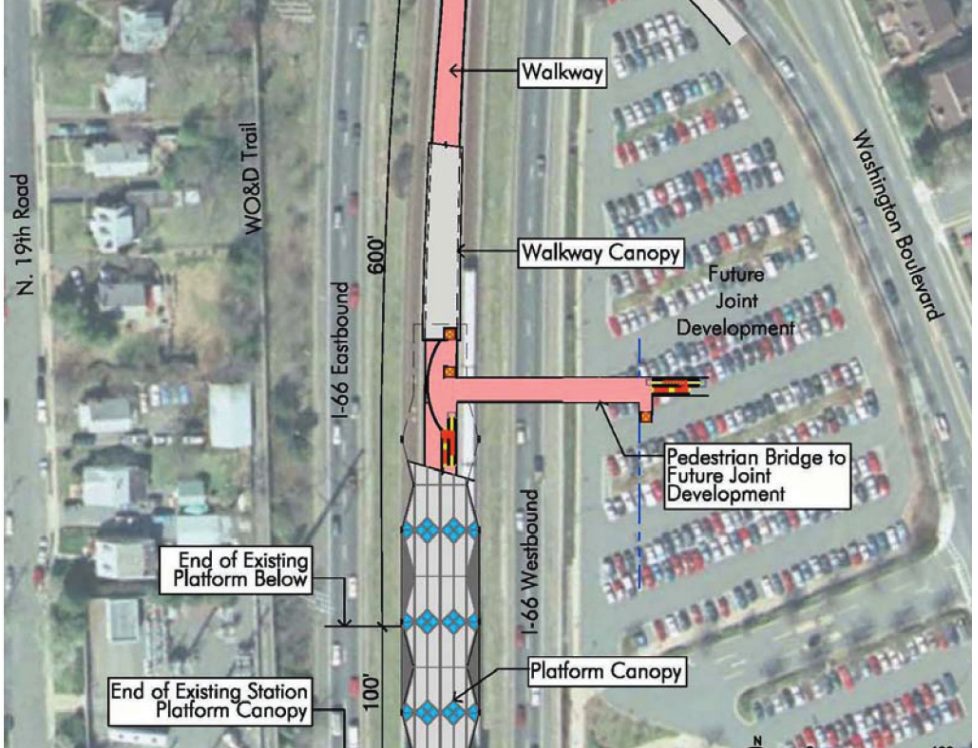
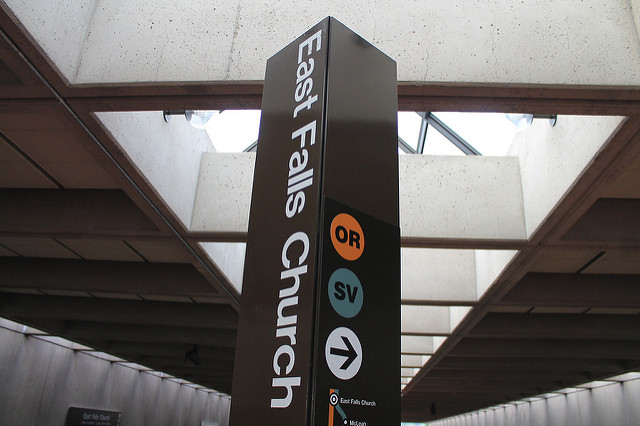
Arlington likely won’t be able to add a second entrance at the East Falls Church Metro station until sometime in the 2030s, as county officials re-examine their funding priorities for the next decade.

The county has hoped for years to build a western entrance to improve pedestrian access to the station, particularly with plans to someday re-develop the parking lot and properties surrounding the station.

But the project’s roughly $96 million price tag makes it difficult to afford as officials grapple with a tight revenue picture. County Manager Mark Schwartz is proposing delaying any funding for the second entrance until at least fiscal year 2028 in his new ten-year Capital Improvement Plan.

“Given the pipeline of existing, high-priority stations, it really made sense to move this out,” county transportation director Dennis Leach told the County Board during a work session last Tuesday (June 26).

Schwartz is calling for the county to dedicate $8.8 million in state and regional transportation dollars for design work at the station starting in 2028, pushing back any construction spending indefinitely. The Board’s last CIP, approved in 2016, called for the planning process to start in fiscal year 2022, and construction to start in 2024.

As Leach mentioned, the county is eyeing second entrances at both the Crystal City and Ballston Metro stations as well, and officials are also struggling to fund those efforts as the county copes with increased Metro spending to provide the service with dedicated annual funding.

Complicating matters further is that the county was hoping the Northern Virginia Transportation Authority, a group that hands out money for transportation improvements around the region, would be able to fund the bulk of the construction of all three projects. But the same dedicated funding deal for Metro involved pulling away about $80 million from the NVTA each year, meaning the group is scaling back how much money it can offer all but the most large-scale projects.

“We can’t do them alone,” Leach said.

(more…)


Supporters of Arlington’s Neighborhood Conservation program are warning county leaders that the steep budget cuts they’re contemplating could effectively kill it.

County Manager Mark Schwartz is proposing slashing $24 million from the program’s funding over the next 10 years as part of his new Capital Improvement Plan, dropping its coffers down to $36 million through 2028.

Neighborhood Conservation has long helped dole out money for modest community improvements, like new sidewalks or landscaping, yet the county’s grim budget picture convinced Schwartz to target it for some hefty cuts. That prompted several community activists and managers of the program to lobby the County Board to restore that funding at a public hearing last Wednesday (June 27).

“This is almost a death knell for Neighborhood Conservation,” said Bill Braswell, a former chair of the county’s Neighborhood Conservation Advisory Committee. “All the interest in it will dissipate, and it will take forever to get started again.”

County staff say that these proposed cuts would mean that projects already in line for funding will still move ahead, but any new applications from neighborhoods will go on the back burner. Accordingly, Phil Klingelhofer, deputy vice chair of the program’s advisory committee, believes that such a delay would mean that any “neighborhood with a recently proposed project should expect to wait 15 to 30 years for a project to come to the top for current funding.”

“If you decide to accept this… we recognize this is really the end of the program, and at that point, you should take the final step and end the program permanently,” Klingelhofer said.

For some in the community, that doesn’t sound like such a bad idea. Some activists have started arguing that the program has outlived its usefulness, including columnist Peter Rousselot, who points out that it can already take five or 10 years for a project to move through the Neighborhood Conservation process.

County Board member John Vihstadt has similar concerns about the program’s efficacy, noting that those delays are often driven by “quality control or monitoring issues” with the county switching contractors for some projects two or three times each. That’s why he sees this CIP process has a chance to reform the program, and “mend it, not end it.”

“Things are not good right now, and we’re looking at what we’re going to do,” Vihstadt told ARLnow. “If we’re going to fund the program, it needs to be modified and reformed.”

Braswell and Klingelhofer both told the Board at the hearing that they’d be willing to study ways to make the program run more efficiently, particularly if the alternative is steep funding cuts.

(more…)


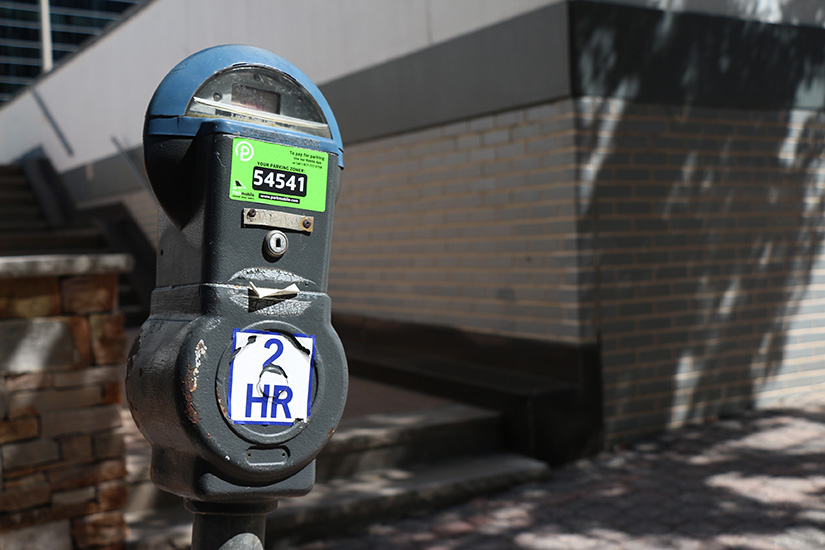
Keep an eye on the meter if you’re parking on the street in Arlington today — some changes to county meters just took effect.

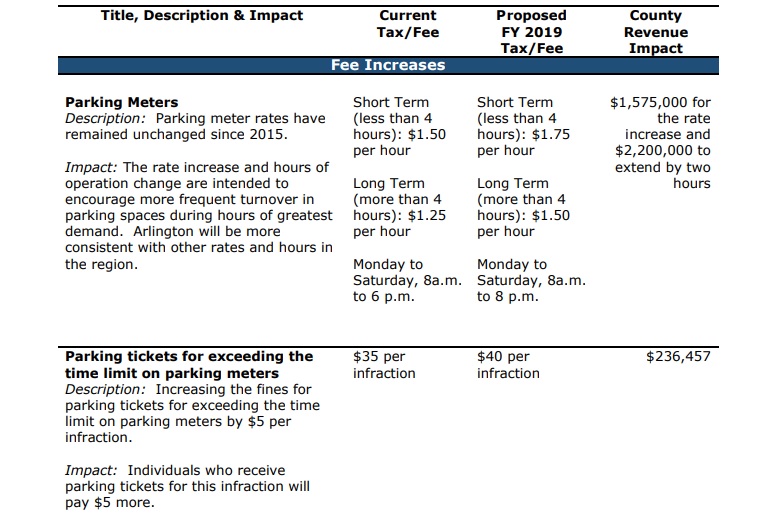
You’ll now need to feed the meter from 8 a.m. to 8 p.m. Mondays through Saturdays, a two-hour extension of the old meter timeframe.

Prices are also jumping up a bit. Rates at meters set aside for short-term parking, or any parking less than four hours, is going up a quarter to $1.75 per hour. Any parking for more than four hours will now run you $1.50 per hour, up from $1.25.

Parking ticket fines will also rise a bit, jumping from $35 to $40 per offense.

The County Board signed off on these changes as part of its budget for fiscal year 2019, which meant they officially took effect yesterday (July 1), even though meters don’t run on Sundays.

In all, the county hopes to raise an additional $4 million each year through these changes, in order to help offset some of the financial pressure Arlington is feeling at the moment. County staff also envision these tweaks bringing the county a bit more in line with the higher parking prices of neighboring jurisdictions, as well as increasing parking turnover in high-demand corridors.

This change marks the first increase in Arlington’s parking meter fees since 2015.


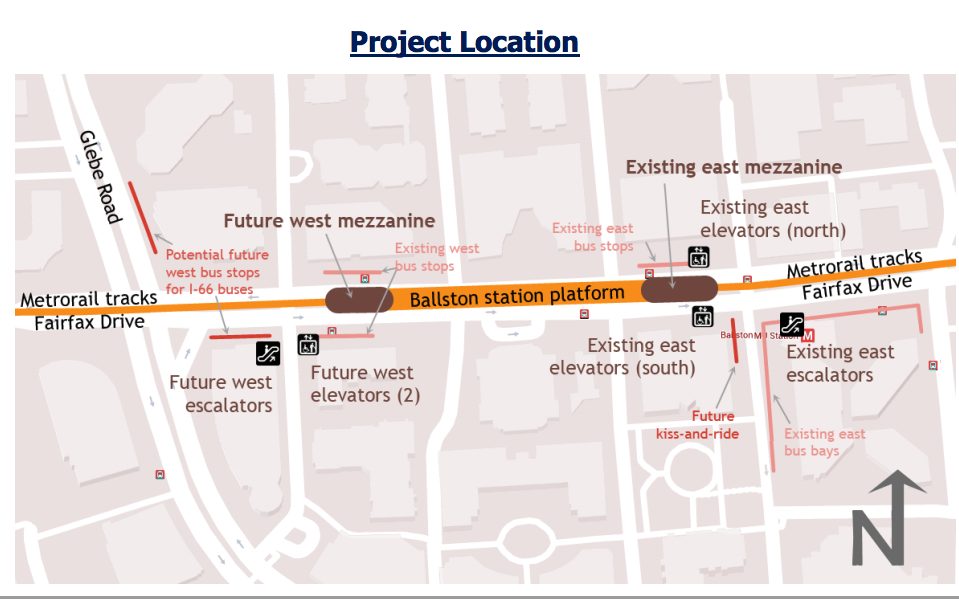
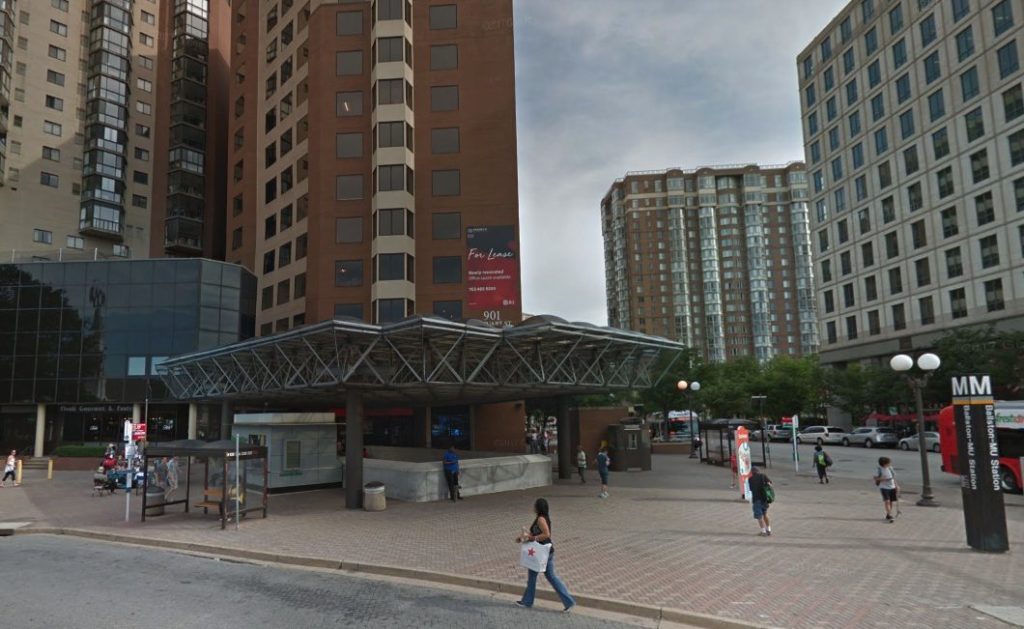
Arlington officials worry that their plans to build a second entrance to Ballston Metro station could stall and be delayed indefinitely if the county and WMATA can’t make progress soon.

To get a move on and finally construct a western entrance for the highly trafficked station, county leaders say they need millions more in funding, and they’ve had trouble tracking down that money.

Arlington asked for $72 million from the Northern Virginia Transportation Authority to help pay for design work and construction, but the regional group passed over the project entirely in its new six-year funding plan. Without that cash, County Board Chair Katie Cristol worries that the roughly $25 million Arlington’s already received in state transportation funding for the project could go up in smoke, throwing its future in jeopardy.

“We have not spent down… very much of the design funds that have already been awarded,” Cristol told ARLnow. “I don’t think it’s imminent that they’re about to be clawed back if we don’t make progress. But I think they could be, especially in a time where resources are constrained everywhere.”

Cristol, Arlington’s representative to the NVTA, says the group ultimately chose not to award more money for the Ballston project because its leaders just didn’t see enough forward momentum on design work for the effort.

“We’re a little stuck, and we do need to show progress,” Cristol said.

It doesn’t help matters, as Cristol pointed out, that the group will lose roughly $80 million a year as a consequence of the deal to provide dedicated annual funding to the Metro system, and has had to scale back how many projects it will fund around the region.

Even still, the NVTA was able to send the county $5 million to pay for additional design work on a second entrance for the Crystal City Metro station, falling far short of the county’s $87 million request but still helping push the project forward.

What set the Ballston project apart from Crystal City, Cristol notes, is the work the county still needs to do with Metro to draw up what the construction will actually entail. Broadly, officials know they’d like to build another entrance near the intersection of N. Fairfax Drive and N. Vermont Street to improve access to the spate of new developments on N. Glebe Road.

Beyond that, however, Cristol says the county and Metro need to work out the details. As WMATA grapples with the existential issue of how to bump up service levels and lure riders back to the system, Cristol worries Ballston could get lost in the shuffle.

“It’s not opposition to the project,” Cristol said. “I don’t even think it’s a sense that the project is too complicated, it’s just a bandwidth problem.”

(more…)


Arlington County’s official logo should be changed because of its “repugnant” association with slavery, at least according to one outspoken resident.

Susan Flaherty, an attorney who lives in the Rosslyn area, wrote a letter to the County Board calling for a replacement to the logo, which is a stylized representation of Arlington House, the Robert E. Lee Memorial at Arlington National Cemetery.

Noting that the mansion is the “former home of [a] slaveholder and enslaved persons,” Flaherty said that “maintaining the current brand/logo… will do damage to the county’s image.”

The letter follows a wave of statue removals, name changes and other actions to expunge Confederate symbolism in the wake of the events in Charlottesville last summer.

The Arlington School Board voted earlier this month to approve new school naming guidelines that would prompt the removal of Lee’s name from Washington-Lee High School. The county, meanwhile, has been pushing for legislative authorization to remove the name of Confederate leader Jefferson Davis from Route 1, as Alexandria recently did.

In response to Flaherty’s letter, an aide to Arlington County Board Chair Katie Cristol said that “budget constraints” currently preclude a redesign of the logo. However, the response (below) also pledged that the Board will “give the matter more thought as budget and staff resources become available in future years.”
Dear Ms. Flaherty:

I am writing at the request of Chair Cristol and the Arlington County Board to thank you for your message inquiring about the possibility of changing the Arlington County Logo. A copy of your message was provided to each of the Board Members.
As you may be aware, the Logo was last redesigned to reflect the County Seal some fourteen years ago through a time and resource intensive process. Unfortunately, given current budget constraints, the County lacks the resources to dedicate towards another redesign of the logo. I want to note however that the Board understands your concerns with the design, and will certainly give the matter more thought as budget and staff resources become available in future years.

Thank you again for sharing your thoughts with the County Board, and please let me know if there is any other way I can be of service.

Sincerely,

Mason Kushnir
Aide to Katie Cristol
Chair, Arlington County Board

Flaherty, in turn, said that “times have changed so much in the last year or so that this really needs to be made a higher priority.” Her full reply is below, after the jump.

(more…)


View More Stories