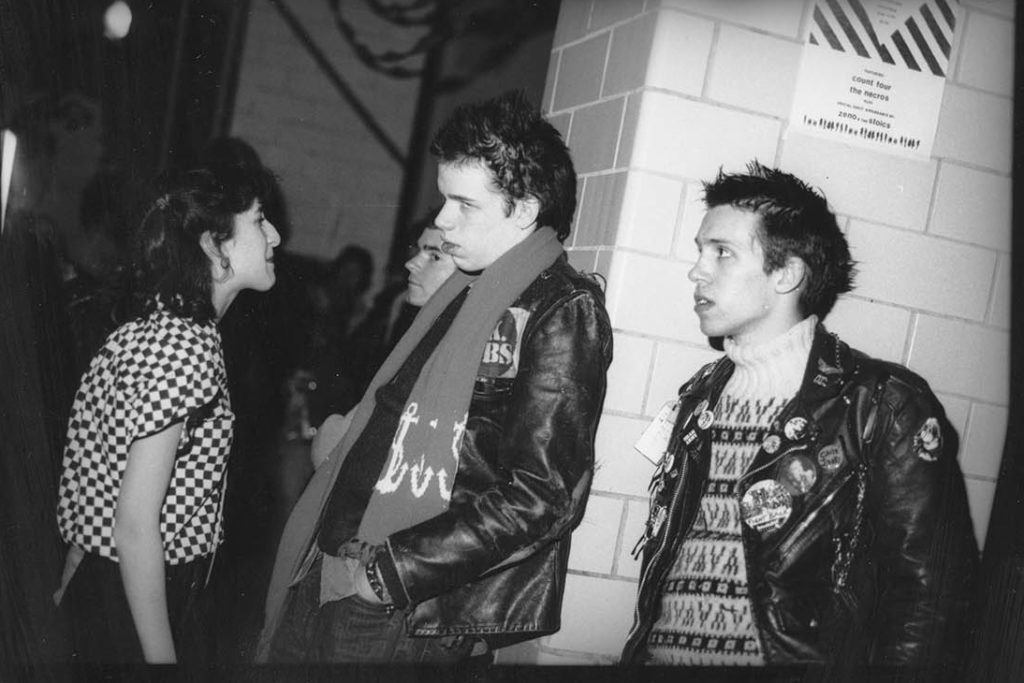
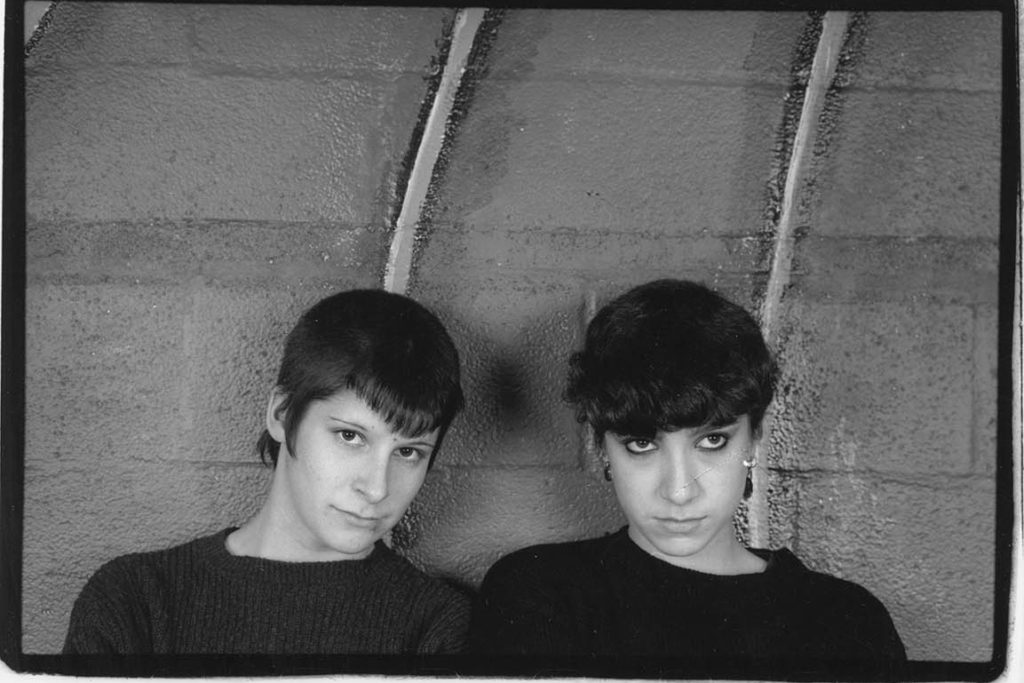
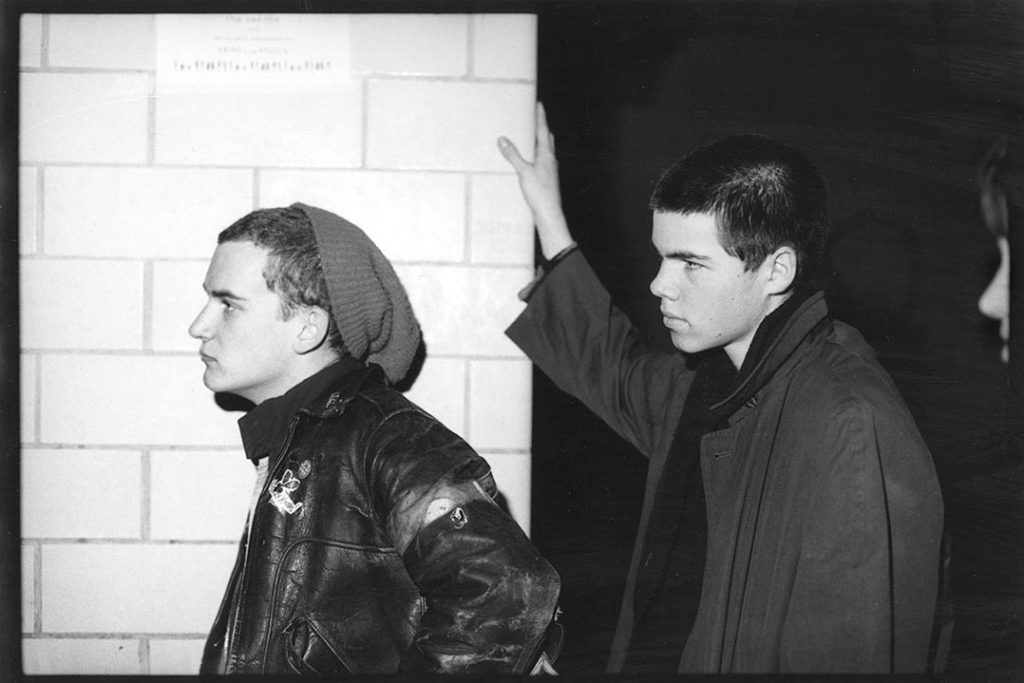
When the photography department at Arlington’s H-B Woodlawn needed some extra funding, then-teacher Lloyd Wolf held a couple of yard sales.

But those “sucked in terms of making money,” Wolf, a noted local photographer, recalls. So, in the early 1980s, they threw some dances.

Though the most successful dance, as Wolf recalls it, featured a southern rock band called the Dixie Road Ducks, there was also interest in the raw, energetic performances coming out of the burgeoning punk scene.

“There were punk kids who went to that school,” said Ian MacKaye, who was a punk kid himself at the time.

Minor Threat, a band whose members included MacKaye and Jeff Nelson, the co-founders of famed independent punk label Dischord Records, played the school cafeteria on May 9, 1981 and Oct. 30, 1982 in six- and four-band lineups.

“I was exposed to something way beyond Elvis Costello and kind of new wave poppy stuff,” said Amy Pickering, a student at H-B Woodlawn around that time who went to some of the punk shows. She would go on to form Dischord band Fire Party (active from 1986-1990), and to work at Dischord Records for more than 20 years.

The H-B Woodlawn shows represent one of many stories of punk linked to Arlington, too many to capture in one article. It was a time when “if you wanted something to come out, you totally had to do it yourself,” Pickering said. For many, Arlington became somewhere to live, practice, collaborate and create as punk expanded in the D.C. area.

MacKaye moved to Arlington from his parents’ northwest D.C. home in Oct. 1981. He and four others had three conditions in their joint search for a living space.

It had to be a detached house, “because we wanted to play music in the basement,” affordable, because they were making something like $175 a month each, and safe, so that their predominantly high school-aged friends could make it to the house from a bus or train stop without incident, MacKaye said.

The first place they toured — a four-bedroom detached house in Lyon Park that rented for $525 each month — seemed to fulfill all of those criteria.

“Arlington afforded sort of a… neutral territory, you know, [we] didn’t get much grief from anybody,” MacKaye said.

Dischord House, as it came to be known, also acted as the headquarters for Dischord Records. MacKaye now owns the home, though he moved back to D.C. after living in Arlington for 21 years — an amount of time he hadn’t anticipated spending in the suburbs as a fifth-generation Washingtonian.

Dischord House may well have been the “first of our generation… punk house,” MacKaye said, but there was already “all this early punk rock stuff” in Arlington when they moved in, and there was more to come.

“I’d say by the late ’80s and early ’90s… other group houses started to pop up, friends of ours would come out,” MacKaye said. It was “a brief period of time where there [were] all these pockets. We didn’t all spend tons of time with each other, but it was nice to know that you might pop by.”

Punk activist collective Positive Force D.C., founded in 1985, established a home base in Arlington after holding its first meetings near Dupont Circle. They first moved to a house on N. Fairfax Drive, but development on that block pushed them closer to Virginia Square in November 1988.

For the nearly 12 years Positive Force spent in that second house, rain would drip in around the windows, so they grew plants in the windowsills.

“It was kind of our bargain to do our thing — [you let us] run a radical political organization out of our house, we won’t ask you to fix stuff,” Positive Force co-founder Mark Andersen said.

Jenny Toomey and Kristin Thomson ran their record label, Simple Machines, out of Positive Force House’s second floor kitchen in 1990. They soon moved into the first of multiple houses the label would occupy in Arlington before shutting down in 1998.

Living near other outposts, like Dischord and Teen-Beat Records, fostered information sharing, Thomson said.

“We were trading information, asking questions, trying to sort out things to the best of our abilities quite often,” Thomson said.

Exchanges among people within and beyond Arlington helped produce the Simple Machines Mechanic’s Guide. That project was conceived as “a sort of second edition” to a Dischord/Positive Force benefit record insert that covered, among other topics, how to put out a seven-inch record, Thomson said.

The Mechanic’s Guide, in various editions, would be mailed out thousands of times.

“It became like a little ‘Consumer Reports,’ in some ways,” Toomey said. “We know a bunch of independent labels that still exist used the guide for their first releases.”

The guide reflects the do-it-yourself attitude that pervaded the punk scene and, more broadly, independent music in the D.C. area and outside of it.

“Punk was about starting something from nothing,” said Cynthia Connolly, a photographer, artist and curator who worked “on and off” for Dischord. “Literally we would go to the Ballston Common Mall and go into the dumpsters and get the cardboard,” to cut up and use to mail out records.

Connolly documented the D.C. punk scene as it looked between 1979 and 1985 in a book she co-compiled and published in 1988, entitled “Banned in D.C.” The book is now in its seventh edition.

“It’s almost like a storybook story, and it’s kind of romantic in a way because the bands [then] really influenced some of the bands today,” Connolly said.

The DIY attitude in many cases seemed to extend to the punk bands’ desired sound, which was “raw,” said Don Zientara, who founded Inner Ear Studio (today at 2701 S. Oakland Street) in the late ’70s and has recorded numerous punk bands. “That just sort of fit in with the fact that I had [at the time] very little equipment, and some of it was kind of questionable, cheap… take your own word for it.”

Wakefield High School alum Mark Robinson started going to shows, which primarily took place in D.C., when he was 15 or 16. “Seeing other kids playing in punk rock shows” made the idea of being in a band seem possible, he said.

“Before that, you would see like the band Kiss or something and that just seemed like an unattainable thing,” he said.

Robinson would form indie rock band Unrest and Teen-Beat Records in the mid-1980s, while still in high school.

Teen-Beat operated out of a house in Arlington for much of the 90s, by which time the layout that characterizes much of the area today had yet to fully form. When Clarendon bar and indie rock venue Galaxy Hut first opened in 1990, for instance, “there was a vacant Sears across the street. There was nothing there, rent was super cheap,” said Lary Hoffman, who co-owns Galaxy Hut today.

As Andersen recalls it, “there was another Arlington that existed, and that was a much more humble Arlington.”

The second Positive Force House has been demolished, as have many of the other group houses, to make way for new developments. One known as Kansas House was vacated for that purpose in 2009.

Many members of the scene have dispersed to different locations and adopted new roles — Pickering lives in New York and Robinson is in Massachusetts, for instance, and Connolly works as Special Projects Curator for the county. Still, the DIY principles behind much of the activity Arlington played host to remain relevant.

When Toomey and Thomson compiled the Mechanic’s Guide, they certainly didn’t present the applications of their resourceful attitude as limited to their scene, or to music.

“There is nothing that you can’t do with a little time, creativity, enthusiasm and hard work,” the introduction to the guide’s 2000 edition reads. It concludes several pages later with a simple send-off: “Good luck!”

Thanks to Andrew Goodwin, Arlington-based podcaster / WednesdaysWithAndrew; photos courtesy © Lloyd Wolf / www.lloydwolf.com


On a summer day in 1988, prosecutor Helen Fahey addressed an Arlington jury. It was the sentencing phase in a six-day long capital murder trial.

“Something is terribly, terribly wrong with Timothy Spencer,” she said.

That trial opened 30 years ago this month, on July 11, 1988. It ended with a death sentence.

Spencer, sometimes known as the “South Side Strangler,” was convicted for the brutal rape and murder of Susan Tucker, a 44-year-old Fairlington resident. He would eventually accumulate three more death sentences for similar killings in and around Richmond.

The story is significant in American legal and scientific history because it represents the nation’s first capital murder conviction based on DNA evidence. No serial killer in any country had previously been convicted with DNA.

Richmond-based writer Richard Foster is chronicling the story in painstaking detail through a 10-episode podcast, entitled Southern Nightmare.

“The fact is there was no other evidence directly linking Spencer to the scene besides the DNA,” Foster said. “That’s what’s really so groundbreaking about this case.”

Foster spoke with sources including homicide detectives, FBI profilers and friends and family of Spencer’s victims to outline a chilling tale of escalating criminal behavior, tragedy and the struggle for justice.

Years earlier, from summer 1983 through January 1984, investigators believe Spencer committed a series of crimes including eight rapes in and near Arlington in what Foster describes as a “seven-month terroristic campaign.”

Those crimes culminated in Spencer’s first murder, in the 23rd Street S. home of lawyer Carolyn Hamm.

That January, the attacks abruptly stopped, only to resume in September 1987 with the rape and murder of Debbie Davis, a 35-year-old Richmond resident.

As Foster relays in the podcast, Arlington County detective Joe Horgas discovered that this timeline lined up with a prison stint for Spencer — he was arrested for an Alexandria burglary in January 1984, and released to a halfway house in Richmond in September 1987.

When Horgas visited the halfway house in Richmond, he found something else. Spencer had been signed out of the house when each of the murders occurred, and he had furlough to visit his mother in Arlington when Susan Tucker was killed.

Arlington detectives arrested Spencer in Richmond on Jan. 20, 1988 with a grand jury indictment for burglary, rape and murder.

Spencer was never tried for the 1983-84 crimes or for Hamm’s murder. The DNA left behind at the Hamm murder scene had degraded beyond usefulness, and he had received death sentences for the other murders.

But Spencer’s implication in the Hamm case led Virginia Gov. Gerald Baliles to pardon David Vasquez, who had been sentenced to 35 years in prison for Hamm’s murder after submitting an Alford plea — not admitting guilt, but conceding that there was enough evidence to convict him.

Vasquez’s sentence “was an obvious miscarriage of justice and it’s very sad,” Foster said. “[Vasquez] was a man who functioned at about the level of a 10-year-old depending on the situation.”

The Spencer case, in spite of its significance, seems to be “one of those cases that… fell through the cracks, historically,” Foster said.

At the time, DNA evidence was quite new to the courtroom, and there was uncertainty over whether juries would accept it. This case “made it so it wasn’t as difficult to put on DNA cases… in the future,” Foster said.

Without DNA evidence in Spencer’s trials, “I definitely don’t think they would’ve gotten the four convictions they got,” Foster said. “I think that would’ve been a lot tougher.”

Spencer was executed April 27, 1994 — the last person in Virginia to be put to death with the electric chair.

Photo via Facebook


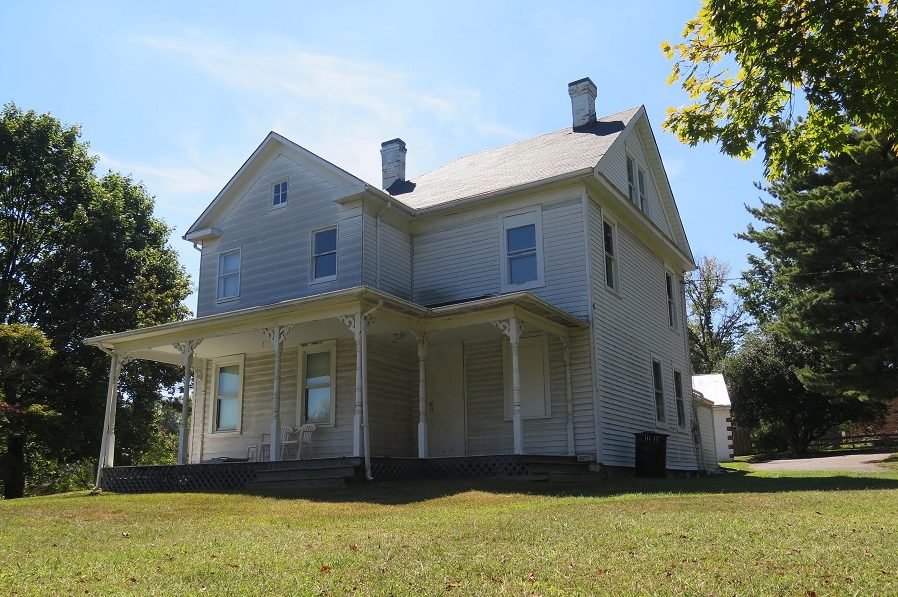
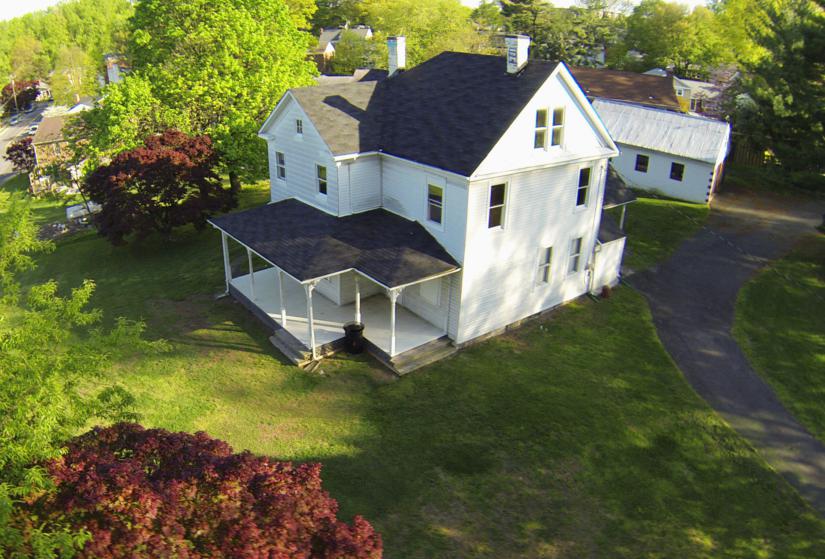
After years of debate over the future of the historic Reeves farmhouse in Bluemont, a solution that the community likes and does not require lots of taxpayer dollars may have been found.

County officials have worked up a plan to team up with Habitat for Humanity to transform the farmhouse into a group home for adults with developmental disabilities.

The Northern Virginia branch of the nonprofit is currently exploring the prospect of renovating the 118-year-old home, then turning it over to another group to manage it, Habitat director of real estate development Noemi Riveira told ARLnow.

The farmhouse sits on the 2.4-acre Reevesland dairy farm property (400 N. Manchester Street), which the county purchased in 2001. The County Board has long hoped to find some other use for the home, with community groups urging the county to transform it into a museum or learning center, but the high cost of renovating the house convinced the Board to move toward selling it instead.

Riveira cautions that her group is still in the “very, very preliminary” phases of studying the property, and she isn’t sure yet whether this plan would involve Habitat buying the farmhouse from the county. Board Vice Chair Christian Dorsey suggested that the nonprofit could end up purchasing it, then transferring ownership to whichever entity runs the group home, or simply lease the house from the county instead.

Regardless of the details, however, both Riveira and Dorsey are cautiously optimistic that this arrangement could prove to be the best possible outcome for the historic home.

“Any opportunity we have to serve anyone that needs a shelter, we’re happy to assist,” Riveira said. “It’s a bit outside of our normal program scope… but this is a demographic that needs homes, so we’re there to help.”

Riveira noted that the “community came to us” with this proposal. Specifically, Chris Tighe, president of the Boulevard Manor Civic Association, says he first floated the idea of reaching out to Habitat in a conversation with Dorsey roughly a year ago.

“A lot of nonprofits valiantly tried to save it over the years, but all of that just sort of petered out,” Tighe said. “So at one point I just said, ‘How come no one’s thought of [Habitat] before?'”

Tighe reached out to the nonprofit, and brokered a meeting with the group and Dorsey to work up an initial proposal.

Broadly, Habitat would agree to renovate the exterior of the house and select portions of the interior, as well as constructing an addition. The county estimates that renovating the home via contractors would cost anywhere from $2.5 million to $3 million, though at this stage Riveira is unsure how expensive the work would be with volunteer help.

“That was a lot of money for us… but they’re a nonprofit that can leverage volunteers, so it provides a great opportunity for a traditional renovation not paid for in traditional market ways,” Dorsey said.

(more…)


Arlington officials are pledging to take a fresh look at how they manage local historic districts, after one neighborhood’s design standards is forcing a Maywood family to pay tens of thousands of dollars for a roof repair.

Brendan and Jody Devine have spent more than a year working with county officials to get permission to use asphalt shingles when overhauling the roof of their home along the 3500 block of 21st Avenue N. But the county’s Historical Affairs and Landmark Review Board, known as the HALRB, blocked that request because the home is located in the Maywood Neighborhood Historic District, and the board feared replacing its current stamped tin shingle roof with a more modern style of roof would leave it out of step with the rest of the neighborhood.

The Devines appealed that decision to the County Board, but members voted unanimously yesterday (Tuesday) to uphold the HALRB’s decision.

Board members, however, expressed a great deal of remorse over that vote, lamenting that the county code obligated them to side against the Devines, even if they agreed with their concerns about the tin roof’s cost.

“We’re ending up on the wrong side of justice if we don’t provide a way to promote the architectural compatibility with the neighborhood, while at the same time accounting for real life circumstances,” said Board Vice Chair Christian Dorsey. “I think we can figure out a way to do better.”

Brendan Devine noted at the meeting that the tin shingles would likely cost as much as $30,000, compared to $5,000-6,000 for the asphalt option, and that that is only for a portion of the roof. He argued that the county would be effectively making the neighborhood an “enclave” for the wealthy if the Board forced homeowners to embrace such expensive options.

In general, Board members agreed with that sentiment, though they felt there was little they could do to make a difference in this particular case.

County Attorney Steve MacIsaac cautioned that members had little choice but to side with the HALRB’s ruling unless the Devines could prove that board made some sort of “arbitrary and capricious” decision. The Board took heed of his opinion, but with some communities around the county trying to pursue historic districts in order to protect affordable housing options, several members expressed a willingness to revisit the county’s policies on the matter.

“This is a cautionary tale,” Chair Katie Cristol said. “We’ve had members of our community who have sought to use a historic designation overlay as a tool to protect affordability… but to the extent we’re looking to protect either garden apartments or single family homes, it can sometimes work at cross purposes.”

Board members were particularly interested in finding a way to get the HALRB to consider the cost of a change like this as a central part of their deliberations. Joan Lawrence, the HALRB’s chair, told the Board that her group did indeed take the expense of the tin shingles into account, but ultimately felt making an exception in this case could lead to a slippery slope.

“A defining feature of this historic district is this particular roof,” Lawrence said. “We’re dealing with a situation of death by a thousand cuts… I don’t think being good stewards of a historic neighborhood, a historic house, is making it an enclave.”

(more…)


More Water Infrastructure Repairs — Work to replace a collapsed 18-inch stormwater pipe on Arlington Ridge Road is expected to continue through the weekend, prompting detours on Arlington Ridge between 23rd Street S. and S. Glebe Road. Also today, crews from the Arlington Dept. of Environmental Services are working to fix a broken water main, affecting 50-100 water customers, on the 1600 block of N. Jackson Street in Lyon Village. [Twitter, Twitter]

History of the Namesake of Hall’s Hill — The historically African-American neighborhood of Hall’s Hill in Arlington is named after an “infamous” 19th century slaveowner named Basil Hall who once shot a slave in a fit of “bravado.” In 1866 his land was sold to form the neighborhood. Hall had a sister, a downtown brothel keeper named Mary Ann, whose land in Arlington later became Marymount University. [Falls Church News-Press]

Local Kids Pen Hamilton Book — Just in time for Hamilton, the wildly popular musical, to arrive at the Kennedy Center, two Arlington kids (and their dad) have self-published a 50-page book “about the Washington-area sites related to Alexander Hamilton, his wife Eliza, Thomas Jefferson, George Washington and other Founding Fathers.” [Amazon]

Photo courtesy John Sonderman


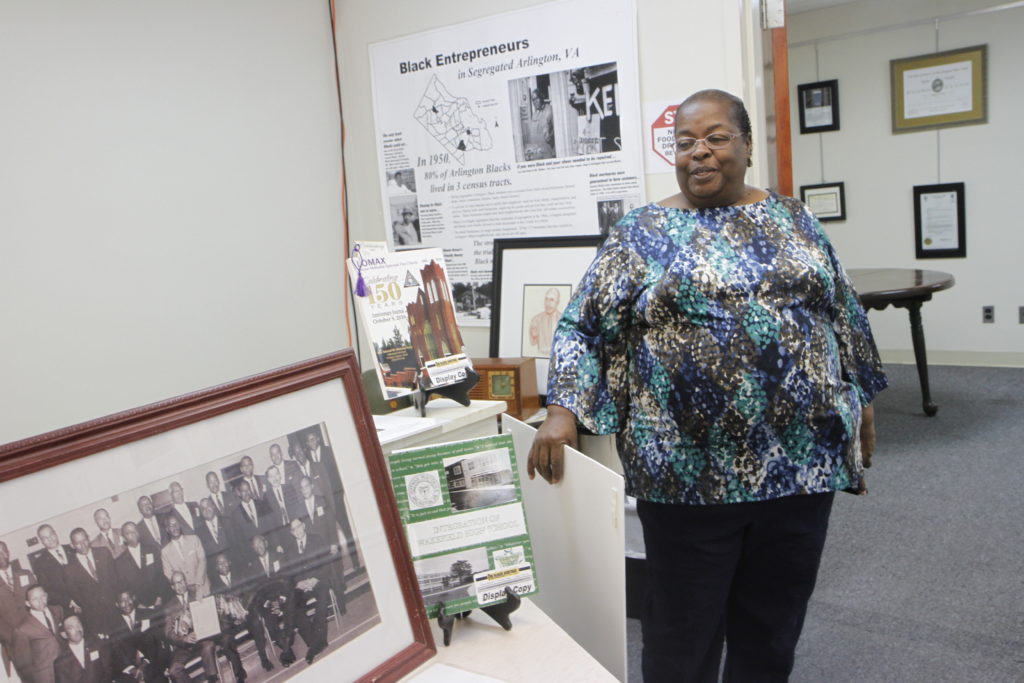
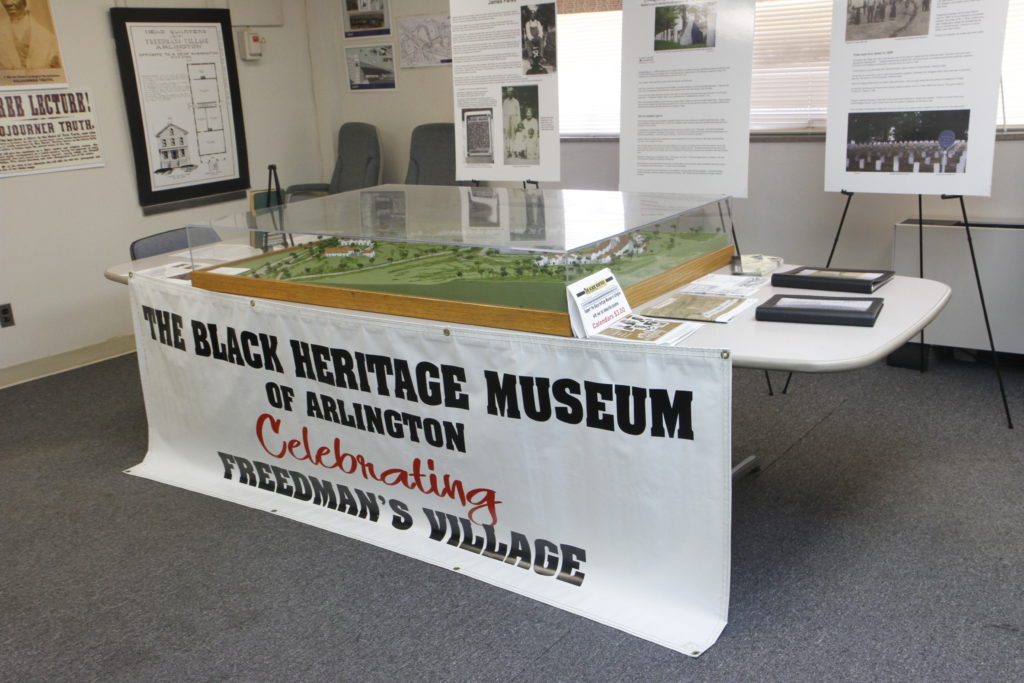
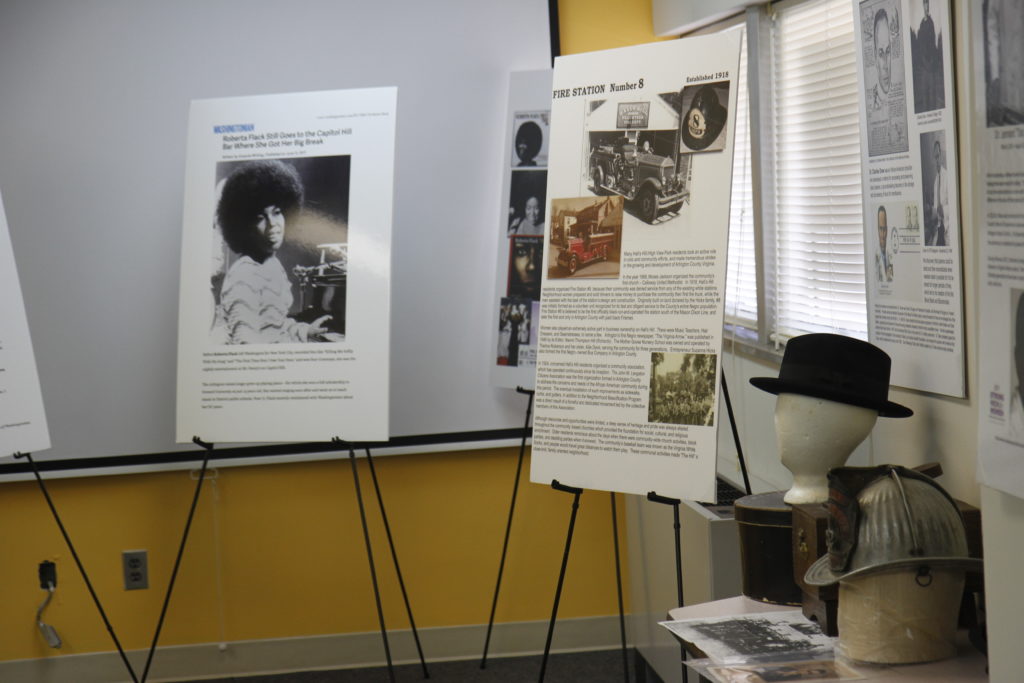
Arlington’s Black Heritage Museum, once only a virtual museum, opened a physical, though temporary, location today (May 1).

A bit sparse, the museum’s exhibits and decor are still in the works; at least one exhibit room still needs to be filled. Though it opened in 1996, the museum has only had an online presence.

It’s a relatively bare-bones space, nestled on the top floor above the Sun Trust bank at 3108 Columbia Pike. It’s intended to be temporary until a suitable, permanent home for the collection can be located.

“It is what it is,” said Portia Clark, the museum’s volunteer office manager and the Nauck Civic Association’s president.

“For now, we just need a presence, so we don’t have a preference,” Clark added.

While additional exhibits are lined up, those currently available provide a glimpse into what Clark calls the rich history of the three predominantly African American communities in Arlington — Nauck, Hall’s Hill and Johnson’s Hill (now Arlington View).

In one area of the musuem, a visitor can learn about the life of prominent African-American Arlingtonian John Robinson; in another, the history of how black Arlingtonians never could truly say that they were born in the county since black families had to go to Washington to give birth, according to Clark.

“There are so many stories to be told,” she said. “There’s a number of stories that we’re still collecting to tell.”

Volunteer staff are still planning fundraising events, and Clark said that the museum hoped to raise much-needed funds at a Founders Day event, as well as at a possible art show and a book signing later in the summer.

The Black Heritage Museum is currently open on Tuesdays from 11 a.m.-3 p.m., on Thursdays from 3 p.m.-6 p.m., and on Saturdays from 1 p.m.-4 p.m., but different exhibit viewing times can be arranged by calling ahead and making a request.


The legacy of Arlington’s Fire Station No. 8, and how to honor it, will be the subject of a community discussion this weekend.

The event is scheduled from 3-4:45 p.m. on Saturday (April 14) at the Arlington Central Library auditorium (1015 N. Quincy Street).

During segregation Fire Station No. 8 was the only Arlington station staffed by African Americans.

The Fire Station 8 History and Legacy working group is hosting the discussion, “to share memories, perspectives and ideas on how to recognize, emphasize and honor the history and legacy of the Hall’s Hill/High View Park Volunteer Fire Department and Fire Station No. 8,” according to an Eventbrite page.

The group is due to submit recommendations for ways to honor the fire station’s legacy by late May.

A new, four-bay station is set to be built at 4845 Lee Highway, where the existing Fire Station No. 8 stands. The design process is scheduled to begin this summer.

Photo via Arlington County 


Northam Talks Golf Course Bill — Speaking on WTOP’s “Ask the Governor” program, Gov. Ralph Northam (D-Va.) addressed the country club tax bill that Arlington officials want him to veto. Northam said the taxation of Army Navy Country Club, which counts numerous veterans among its members, particularly “needs to be addressed” and that if negotiations are not successful he will “step in and take action,” though the exact action he would take is unclear. [WTOP]

How Arlington Almost Was Home to the Nationals — Boosters of baseball in Arlington almost succeeded in bringing a Major League Baseball team to the county. The Nationals, before landing near Navy Yard in D.C., were considering a stadium site in Pentagon City, but a series of unfortunate events nixed it. [Arlington Magazine]

ART Bus Turns into Sauna — From a Twitter user yesterday: “@ART_Alert my bus driver just begged me to contact you and ask to get his bus fixed. The heat is stuck on the bus and it must be 95 degrees inside.” [Twitter]

Flickr pool photo by John Sonderman


(Updated 2:35 p.m.) The Arlington Public Library’s Center for Local History has unveiled a new digital profile collection of women who influenced Arlington’s development through their “quiet but not silent” persistence.

The collection seeks to bring up the names of those women who “were frequently hidden in the background” but “were nonetheless ground breakers and trailblazers” who fought for better education, libraries, conservation, and health care in a modernizing county.

Focusing on women from 1900-1975, the center is seeking community donations and oral histories of little known facets of Arlington history to add to the their collection.

The center “will follow their journey as it is revealed through [the] archival collections and oral histories” over the next year, according to the collection’s website.

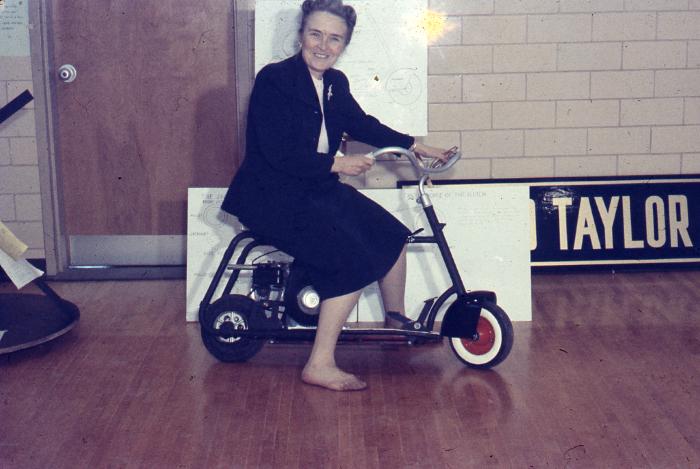
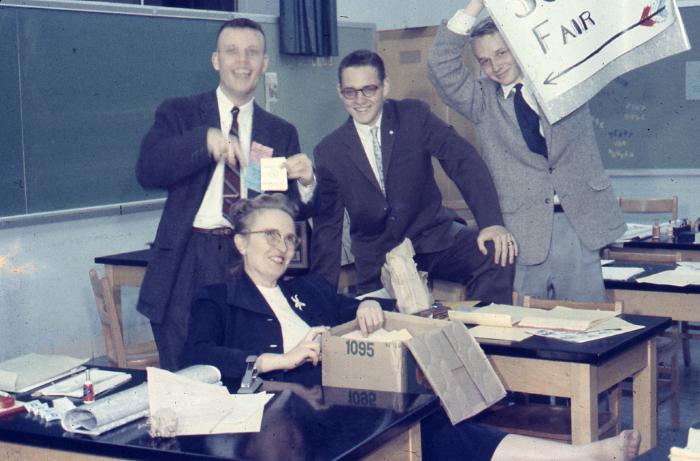
One subject of the in-progress collection is Dr. Phoebe Hall Knipling, who was responsible for bringing an annual science fair to Arlington Public Schools and was the first APS science supervisor — and the first in Virginia. Dr. Knipling, finding that there were few pristine natural spaces in the fast developing county, took three years to track down an outdoor lab in Fauquier County for her students to experience and work in nature.

Margarite Syphax, a U.S.O. entertainer turned prominent African-American businesswoman and real estate developer, was also featured. The archive entry on her life stated that after World War II, she and her husband had a difficult time finding adequate housing in still segregated Northern Virginia.

The injustice led the couple to eventually form W.T. Syphax Real Estate Company, a property development and construction business focused on minority affordable housing.

Other notable Arlington women in the collection include the members of an interracial, interdenominational women’s group focused on community building and social justice, as well as several groups of women who either founded or contributed to the creation of several Arlington libraries.

Photos via Center for Local History


Social Media Threats Against Arlington Schools — “There is an increased police presence at a middle school and high school in Arlington Friday after authorities say they were the targets of social media threats Thursday night. Arlington County Police say ‘threats of violence’ were made to Williamsburg Middle School and Yorktown High School… police have identified a person in connection with the incident.” [WJLA, Twitter]

Cannonball Found Near the Run — “A remnant of the most turbulent period in Arlington’s history was unearthed during the recent renovation of the Arlington Food Assistance Center’s warehouse space in the Four Mile Run corridor. A 24-pound spherical shell was found during the construction period.” [InsideNova]

Snow Showers Dust Area — Winter is not over yet. A brief period of snow showers left some white patches on lawns this morning. Meanwhile, a potential snowstorm looms for next week. [Twitter, Capital Weather Gang]


Eligibility Changes Proposed for Cemetery — “With Arlington National Cemetery set to run out of space in the coming years, restrictions on who can be buried there need to be considered, officials said Thursday.” [WTOP, Army Times]

Emergency Metro Repairs Next Weekend — Emergency repairs will mean reduced service on Metro’s Silver Line and some changes to Blue Line service next weekend, during St. Patrick’s Day and peak cherry blossom season. [Fox 5]

ACPD Conducts DUI Education Event — To discourage driving under the influence, Arlington County Police and the Washington Regional Alcohol Program conducted an anti-drunk driving event during Saturday’s Shamrock Crawl. Among other activities, attendees were invited to try to shoot basketballs into trash bins while wearing impaired vision goggles. [WTOP, Twitter]

Video Project Keeps Iota’s Memory Alive — A video series called The Iota Chair is “an oral history project on Facebook with musicians who frequented Iota Club & Cafe,” which closed last year. [Northern Virginia Magazine]

Local Journalist Pens History Book — “Arlington resident Michael Doyle recounts the life and times of a 19th century morality crusader who campaigned against an infamous ‘free-love’ commune, in a new book entitled ‘The Ministers’ War: John W. Mears, the Oneida Community and the Crusade for Public Morality.'” [Amazon]


View More Stories