 (Updated at 6:25 p.m.) Food truck owners are declaring victory after a successful showdown over a street vending ordinance in Arlington General District Court.
Currently, under Arlington County Code 30-9, food trucks are prohibited from vending on a public street for more than an hour in one spot. The enforcement of that portion of the Arlington County Code led to an outcry among food truck owners, who say it unfairly targets their business in order to protect brick-and-mortar restaurants.
Late last year, the Institute for Justice, an Arlington-based libertarian law firm, announced that it was taking up the case of Arlington food trucks as part of its National Street Vending Initiative, which seeks to break down legal barriers for street vendors. Today, that effort bore fruit.
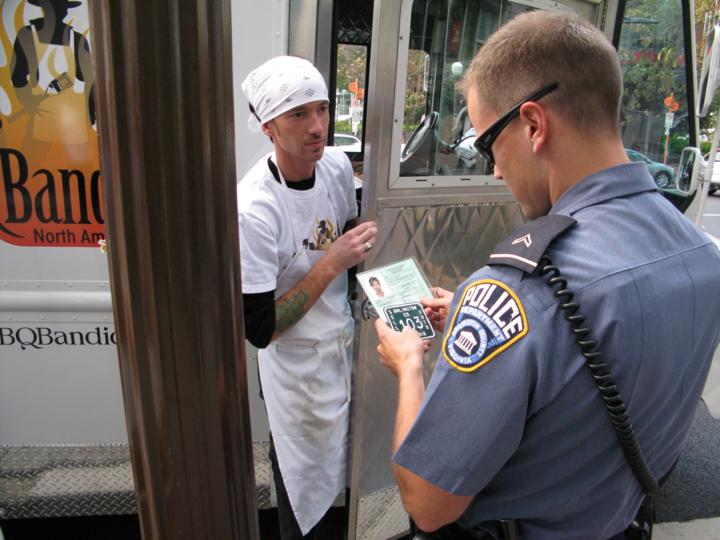
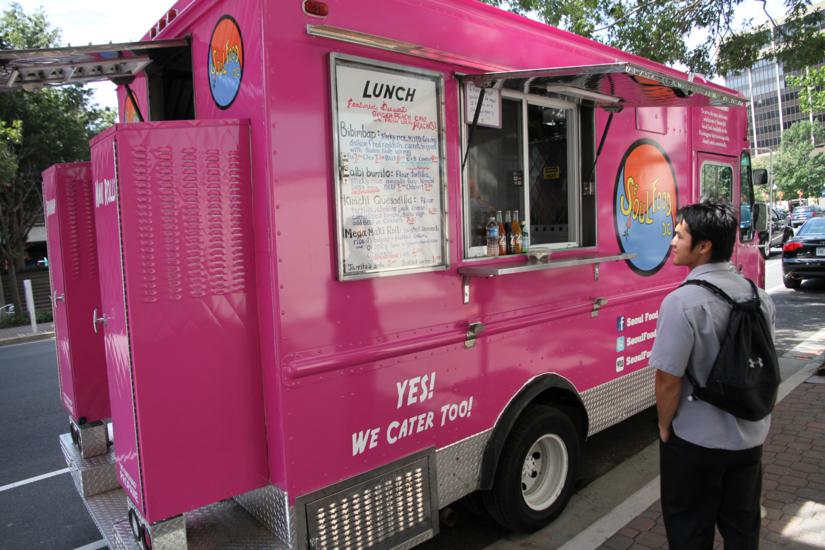
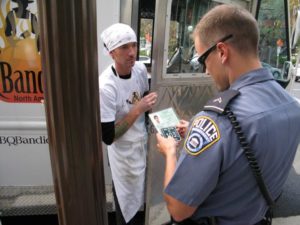
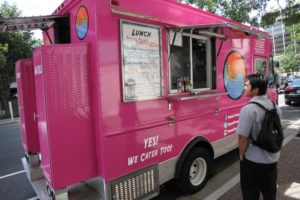 An Arlington County judge, at the request of prosecutors from the Commonwealth’s Attorney’s office, dismissed a loitering charge against Hyun “Anna” Shil Goree, co-owner of the Seoul Food truck. Goree was charged with the crime — a Class 1 misdemeanor punishable by up to a year in jail and a fine of up to $2,500 — after a police officer determined that she had not moved her truck “far enough” to comply with the law.
Last year Goree was fined $25 and $200 after pleading no contest to street vendor loitering charges in August and October. After being charged again in December, she decided to fight back, enlisting the help of the the Institute for Justice and the law firm of Gibson, Dunn, & Crutcher LLP. The charged was dismissed today via a nolle prosequi motion.
The Food Truck Association of Metropolitan Washington, which has spoken out against the Arlington ordinance, says the dismissal is a victory against an arbitrary law that’s “vague and open to different interpretations.”
“This case highlights the absurdity of treating what amounts to a parking violation as a crime on par with assault,” said Doug Povich, co-owner of Red Hook Lobster Pound truck and Chairman of the Food Truck Association. “The Food Truck Association hopes to work with the County in the months ahead to craft a food-truck law that serves the County’s residents and workers and keeps food trucks as a vibrant part of Arlington’s business community and streetscape.”
Arlington County spokeswoman Mary Curtius said the county is indeed working to change the ordinance.
“We realize that the 60-minute time limit is challenging for vendors and for customers, and we are working to change it,” Curtius said. “We hope to be bringing something forward in the Spring.”
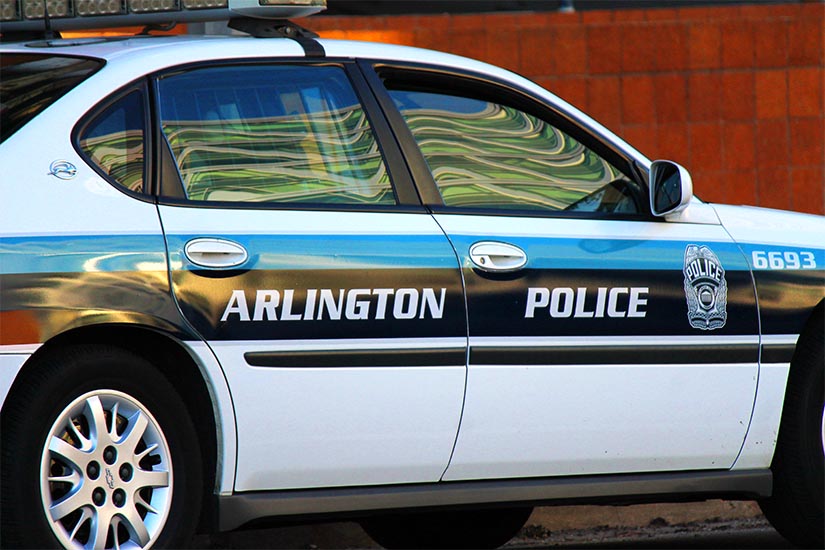
Arlington Commonwealth’s Attorney Theo Stamos said she asked for the charges to be dismissed after consulting with the police department.
“I made the decision… in consultation with the police department and with the awareness that the current ordinance is very difficult to enforce,” she told ARLnow.com. “It’s difficult to enforce because it requires a police officer to watch a truck for an hour (or some other witness willing to come to court to testify to the fact that the food truck hasn’t moved in 60 minutes)… then there is the definition of ‘move’ that is also problematic. Does it mean an inch? A parking space? Around the block?”
“The officers were responding to requests from store owners to enforce the ordinance,” Stamos continued. “Unfortunately, the ordinance, as written, is rather unclear and a criminal statute is always construed against the Commonwealth and in favor of the defendant, which is as it should be.”
Stamos said it’s “unlikely” that her office will prosecute additional loitering cases against food trucks until the County Board updates the ordinance.
The full press release from the Food Truck Association, after the jump.
File photos
(more…)


 A Reston man’s plan to steal a car from a repair shop was foiled by the shop’s garage door, according to Arlington County Police.