Larry RobertsProgressive Voice is a weekly opinion column. The views and opinions expressed in the column are those of the individual authors and do not necessarily reflect the views of their organizations or ARLnow.com.

The tragic deaths last week in Baton Rouge, Falcon Heights, and Dallas, which followed the recent horrific killing of 50 in Orlando, shook the nation.

In Orlando, it was the scale of the killings and the targeting of LGBT community members. In Dallas, it was seeing law enforcement officers targeted for death based on the color of their skin. In Baton Rouge and St. Paul, it was the sight of two more African-American men killed by law enforcement officers for — based on eyewitness and video evidence — no discernible reason.

For a brief time, it appeared that these latest killings would lead to a discussion more fundamental than whether or how gun laws should be changed. There was a sense that we needed to bridge divisions in our society that were taking a dangerous turn.

Columnists, political analysts and other commentators wrote about an inflection point in our recent history – where there was room for unity, acknowledging the complexity of our problems, and a need for more listening, more humility, and less hostility and angry rhetoric.

Close to home, ARLnow was part of that trend, stating that “[t]imes like these remind us of the darker side of humanity — but should inspire us to counter that with kindness and respect for our fellow humans. Here in our little 25.98 square mile Arlington bubble, we hope that that extends to our comment section.”

Our two most recent Presidents sought to convey the message as well. President George W. Bush, at the memorial service in Dallas for the five fallen police officers cautioned that “[t]oo often we judge other groups by their worst examples, while judging ourselves by our best intentions.”

President Obama expanded on this theme: “[W]ith an open heart, we can learn to stand in each other’s shoes and look at the world through each other’s eyes … With an open heart, we can abandon the overheated rhetoric and the oversimplification that reduces whole categories of our fellow Americans not just to opponents, but to enemies.”

Yet even in the midst of these words, in a country in need of healing, the public discourse devolved yet again. Instead of encouraging the hard work that will be needed to resolve problems faced by our communities and our nation, we were presented with division, rancor, finger pointing, and the notion that there are only two sides to every debate, that people must choose which side they are on, that those who would choose the other side are enemies, and that only by defeating those enemies will we restore peace, order, and greatness.

The reality is that we live in complicated times that demand from our citizenry a sober minded reflection on how Americans can come together to address those challenges and move our country forward.

This will take hard work, resources, listening to and respecting one another, and seeking solutions that bind us together and elevate our society and ourselves.

In times past, we may have looked to great leaders for guidance.

Speaking of toleration, George Washington said that “the Government of the United States, which gives to bigotry no sanction, to persecution no assistance, requires only that they who live under its protection should demean themselves as good citizens…”.

Lincoln sought to bring together a nation that had devolved into civil war not by triumphalism, but through humility and understanding: “With malice toward none, with charity for all, with firmness in the right as God gives us to see the right, let us strive on to finish the work we are in, to bind up the nation’s wounds…”.

Roosevelt, at a time when the nation faced economic devastation, asserted his “firm belief that the only thing we have to fear is fear itself … In every dark hour of our national life a leadership of frankness and vigor has met with that understanding and support of the people themselves which is essential to victory.”

Today we live in a time where leadership is viewed with skepticism, where institutions face a lack of trust, and individuals are free to assert their views widely and without filter.

In such a time, it will take asking ourselves how we can take individual actions to restore a sense of unity, purpose and advancement.

Respecting the views of others, watching the tone of our own discourse, countering division and ideologies, and supporting the hard work needed to address our problems, are building blocks needed for recovery and for success.

Larry Roberts has been active in civic and political life in Arlington for nearly 30 years and is an attorney in private practice. He has been active in County civic life. He also chaired two successful statewide campaigns, served as Counselor to the Governor in Richmond, and served as Chief of Staff to the Chairman of the Democratic National Committee.
Alfonso LopezProgressive Voice is a weekly opinion column. The views and opinions expressed in the column are those of the individual authors and do not necessarily reflect the views of their organizations or ARLnow.com. 

By Alfonso Lopez

As last week’s Progressive Voice columnist pointed out, U.S. Senator Tim Kaine continues to be mentioned as a top contender to be Hillary Clinton’s Vice Presidential running mate.

I wanted to share my own perspective of Tim Kaine as one of three Arlingtonians appointed to a Cabinet-level position in his gubernatorial Administration.

My mind is immediately drawn to his response to the terrible tragedy at Virginia Tech on April 16, 2007, when 32 of Tech’s finest were killed and many others wounded.

Governor Kaine had just reached Japan to start an Asian economic development trip when he received word of the shootings. He immediately returned to Virginia and arrived in time to attend the campus memorial convocation for the victims the next day that was broadcast around the world.

Kaine spoke without notes or prepared remarks, quoted scripture and urged the Tech community to hold onto the “spirit of community” that it had shown the world amid such grief. He comforted grieving families and visited the wounded. His empathy and strength brought Virginians from across the Commonwealth together.

If we measure a person by their reaction in moments of extraordinary tragedy and stress, then throughout those horrible days the nation saw in Tim Kaine both a public servant and a leader of great courage, empathy and determination to do right by the victims and their families, Virginia Tech and our Commonwealth.

I was fortunate to be selected by Governor Kaine to serve as the Director of the Virginia Liaison Office in Washington, D.C. In that position, I was responsible for coordinating Congressional and Federal Affairs on behalf of the Governor and more broadly, Virginia’s interests.

In that position, I saw Governor Kaine working closely with Congress and both the Bush and Obama Administrations — fighting for key infrastructure projects, legislative initiatives, and federal grants to improve the lives of Virginians.

He successfully advocated for the expansion of conservation easements and the preservation of open space, increased educational opportunities, and modernized the state’s workforce development initiatives. He championed federal recognition of Virginia’s Native American tribes and secured funding to clean up the Chesapeake Bay.

To move Virginia forward, Governor Kaine worked across the aisle to further the goals of his Administration and secure accomplishments that provided real progress for his constituents.

Here are some examples:

  • At a critical point in the debate of the Post-9/11 GI Bill, Governor Kaine organized bipartisan gubernatorial letters in support of the legislation to help it become law.
  • He worked closely with Virginia’s Congressional delegation to ensure the Navy did not transfer a nuclear-powered aircraft carrier (and thousands of attendant jobs) from Norfolk to Florida.
  • As Chair of the Southern Governors’ Association, he negotiated a broad regional initiative to address the impacts of climate change.
  • Working in a bipartisan manner, Kaine led Virginia’s successful effort to reverse a Federal Transit Administration ruling and secure final federal approval and funding for the Silver Line that will extend to Dulles Airport and beyond – a major boost to the Northern Virginia economy.

During his years as Governor, Virginia received accolades as the “Best State for Business,” the “Best Managed State” and the “Best State to Raise a Child.” He recruited several Fortune 500 companies to relocate to Virginia and secured more than $13 billion in new investment.

The accomplishments of the Kaine Administration resonated with Virginia voters, who elected him in 2012 to the U.S. Senate– where he continues to serve with distinction.

The talk about Senator Kaine as a potential VP is happening for a reason. Simply put, he is experienced, effective and above all authentic.

Virginia residents, business leaders, fellow Members of Congress and senior Administration officials echo these sentiments.

They see, as I saw, that he is a tireless public servant who is respected on both sides of the aisle for his vision, intelligence, clarity, friendliness and ability to get folks from all points of view to work together. Genuine, pragmatic and focused on results, he has an infectious optimism. He looks at every decision from a people perspective.

And through all his success, he treats people with respect — an aspect of his personality that shines through in all of his interactions.

In a world that sometimes feels like it has lost its way, the nation would benefit greatly from someone like Tim Kaine.

Alfonso Lopez represents the 49th District in the Virginia House of Delegates and serves as the Democratic Whip. He also served as the Director of the Virginia Liaison Office in Washington, D.C. for former Governor Tim Kaine. 


Larry RobertsProgressive Voice is a weekly opinion column. The views and opinions expressed in the column are those of the individual authors and do not necessarily reflect the views of their organizations or ARLnow.com. 

By all accounts, Virginia’s Senator Tim Kaine is on the short list that Hillary Clinton will consider in choosing her Vice Presidential running mate. We will likely learn of her decision on the eve of the Democratic National Convention that will be held in Philadelphia in late July.

These accounts should come as no surprise since Kaine was also among the three final VP choices that Barack Obama considered in 2008 before selecting Joe Biden as his running mate.

Since that time, Kaine has completed a successful term as Virginia Governor, served as Chairman of the Democratic National Committee working collaboratively with the President, won a Senate election against a former senator and governor, and earned a reputation as an effective senator with service on the armed services, foreign relations, and budget committees.

In addition, he announced his support for Hillary Clinton in May 2014, before she even announced she was running for President. And he campaigned for Hillary in the 2016 Virginia primary, which she won with over 64 percent of the vote.

The perspective I would like to share is an Arlington perspective about Tim Kaine. The connections are many. Here are a few.

In 2001, Kaine was serving as Mayor of Richmond and was supporting Yorktown High School graduate Emily Couric in her quest to become the first woman to serve as Virginia’s Lt. Governor. Sadly, Emily had to withdraw from the race due to the onset of her fatal bout with cancer.

With Emily’s encouragement, Tim decided to run for Lt. Governor. He was quickly joined in the race by two popular members of the House of Delegates.

I was serving as Chair of the Arlington Democrats at the time. One afternoon, I received a call from Tim’s long-time assistant asking if I could arrange for the Mayor of Richmond to meet with some Arlington grass roots volunteers. On short notice, we pulled together a group to meet the next day.

That was my first encounter with Tim Kaine. At that meeting, Kaine displayed the authenticity, intelligence, wit, empathy, and competitiveness that I came to know well over the years. All of us were very impressed, particularly with a story about his service on Richmond’s City Council.

Kaine had grown tired of the racial divides affecting City Council. As a result, he ran against an incumbent for a seat on City Council together with African-American reform candidates. He told us that before he took office there had been many votes on Council that were divided completely along racial lines. But with the help of other new Council members, he brought people together so that there had never been a vote split on racial lines during his tenure on Council and as Mayor.

Among Kaine’s early supporters in Arlington for the Democratic primary were Paul Ferguson, Peg Hogan, Ed Fendley, and Jody Olson. I apologize to others I haven’t mentioned.

Kaine went on to win the three-way primary with 40 percent of the statewide vote. Arlington turned out to be one of his strongest jurisdictions with 52 percent of the Democratic primary vote. Only four other jurisdictions gave Kaine more votes than the 2,910 votes he received in Arlington.

Kaine went on to win a close general election race in 2001. He won by a more comfortable margin in the 2005 Governor’s race and again in the 2012 U.S. Senate race.

As Governor, Kaine appointed three Arlingtonians to his Cabinet and focused intently on issues of importance in Arlington, including transportation, land use, economic development (helping to keep DARPA in Arlington), education (notably advancing pre-K), and conservation.

During my years in the Governor’s office, there were many significant developments and events.

Importantly, I remember how the Governor treated his staff and the tone he set. No matter what had happened the day before, the Governor came to the office with a spirit of trying to make positive things happen for the Commonwealth. He was energetic, optimistic, and well prepared.

We knew that it was our obligation as staff to work hard, be honest, and keep the needs and interests of Virginia residents firmly in mind. If we met those goals, Tim Kaine would support our efforts whether we accomplished all of our objectives or not.

I was proud to serve with Tim Kaine and I know the country would be the beneficiary were he to be selected by Hillary Clinton as her running mate.

Larry Roberts is a 30-year resident of Arlington and an attorney in private practice. He is former Chair of the Arlington County Democratic Committee, chaired two successful statewide campaigns, and served as Counselor to the Governor in Richmond.


Abby Raphael
Progressive Voice is a weekly opinion column. The views and opinions expressed in the column are those of the individual authors and do not necessarily reflect the views of their organizations or ARLnow.com.

By Abby Raphael

Today we celebrate the accomplishments of our high school seniors, as they cross the stage to receive their high school diplomas. This is a time to reflect on how families, friends, schools and the community have supported our students’ success.

In Arlington, we work together to help our young people make good choices to be healthy, safe, and successful in school and in life. Despite our best efforts, many choose to use drugs and alcohol. According to the 2014 Arlington Community Report Card: “Youth who regularly use alcohol and drugs are more likely to be victims of violence, commit violent acts, engage in unplanned and unprotected sex, have trouble in school, and engage in other unsafe activities.”

Thousands of Arlington high school students use drugs and alcohol. Data from the most recent Youth Risk Behavior Survey in Arlington shows that 33% of 10th and 12th grade students are current users of alcohol (used alcohol in the last 30 days), and 17% of them are current users of marijuana. It also appears that more students are starting to drink alcohol at a young age.

While 9% of 12th grade students reported having used alcohol for the first time before the age of 13, the same survey showed that 16% of 8th grade students began their alcohol use before they became teens.

We are fortunate in Arlington to have the Second Chance Program for middle and high school students to intervene early in their drug and alcohol use.

Now in its fifth year, Second Chance teaches teens about the harmful effects of drugs and alcohol and how to make healthy choices. Parents learn how to set clear expectations and limits for their teens. Families can refer their children to the program, which is free to all Arlington residents.

Successful completion of Second Chance also can be an alternative to school suspension and criminal prosecution. That second chance can make a real difference in teens’ lives when they apply for a job, to college, or the military.

Second Chance has its roots in the Partnership for a Healthier Arlington, which found that Arlington teens were drinking at rates higher than the national average and in surrounding jurisdictions. In response, the community recognized the need for an early intervention program. Stakeholders focused on youth came together to create Second Chance, including developing the curriculum and securing funding.

The work continues today under the auspices of the Partnership for Children, Youth and Families Foundation, with the commitment, collaboration and support of the School Board and County Board, Arlington Public Schools, the Arlington County Police Department, the Courts, the Probation Office, the Arlington Commonwealth Attorney’s Office, the Department of Human Services, and many others.

Students referred to Second Chance attend a three-day program, learning about the effects of drugs and alcohol on the developing teen brain, practicing skills to deal with peer pressure, and creating an action plan to help them make healthy choices.

Parents or guardians must attend a three-hour session to educate them as well, to discuss effective communication with their teens, and to help them set clear limits and expectations.

Students and their families return for a booster session to review their action plans and to evaluate what changes are needed for students to remain drug and alcohol-free.

Second Chance has received the National School Boards Association Magna Award and the Virginia Municipal League’s Achievement Award. More importantly, students who have completed Second Chance have changed both their attitudes and their behaviors about drugs and alcohol.

In the last four years, 88% of students referred to the program by APS have not been involved in any additional school substance abuse violations. Students and parents report that Second Chance has had a positive impact on their lives.

Since 2011, about 465 students have attended Second Chance – a small fraction of the number of students we know use drugs and alcohol. Second Chance Program Coordinator Sarah Gortenburg reports that students have been using alcohol or drugs for 9 months to two years before being referred to the program.

Many parents think that teen alcohol and drug use is a rite of passage: it is not. Parents who know or are concerned that their children might be using drugs or alcohol are encouraged to refer them to Second Chance. Together, we can help Arlington youth be healthy, safe, and successful.

For more information about Second Chance, go to: SecondChanceArlington.org, or call: 571-340-8368; or email: [email protected].

Abby Raphael is a founding member of the Second Chance Advisory Committee. She served on the Arlington School Board from 2008-2015, including two terms as Chair. She also is a co-chair of Arlington’s Project Peace Prevention Committee.


Joseph-Leitmann-Santa-CruzProgressive Voice is a weekly opinion column. The views and opinions expressed in the column are those of the individual authors and do not necessarily reflect the views of their organizations or ARLnow.com. 

By Joseph Leitmann-Santa Cruz 

I am proud to call myself an Arlingtonian. One of the reasons for this pride is that I believe our community recognizes the importance of creating opportunities for all to succeed regardless of one’s country of origin and/or immigration status. Ours is an inclusive community that proactively gets involved in the process of effecting positive change, especially on education-related matters. 

My blended Welsh, Latin American, Jewish and German heritage as well as my having been born outside of the United States and having migrated here at the age of 16 enables me to see immigration from different angles.

I am the descendant of different immigrant communities and experiences. Some of my ancestors sought new and better economic opportunities in the New World (working the mines in Pennsylvania and working the land in Guatemala) and others had to flee Austria to survive fascism and the Holocaust. For those who came to the United States, this country granted them the opportunity to achieve a better life through hard work, service, and education.

Post-secondary education continues to be a critical pathway toward achieving the American Dream. Here in Arlington, we have an amazing organization providing opportunities for low- and moderate-income immigrant youth to be given a shot at achieving the American Dream.

For the past two years, I have had the privilege of being on the Board of Directors of the Arlington-based Dream Project. Dream Project is a non-profit organization with a mission to empower students whose immigration status – over which most had no control — creates barriers to education by working with them to access and succeed in college through scholarships, mentoring, family engagement, and advocacy. 

On June 10, Dream Project hosted the 2016 Scholarship Awards Ceremony at Wakefield High School. On that day, we awarded college scholarships to 76 hard-working young immigrant scholars who graduated from high schools in Northern Virginia.

The young scholars came to the United States from countries in Africa, Asia and Latin America.

While we are pleased to be able to assist dozens of young scholars in their quest to become American success stories, there is still a lot more work to be done. Just this year, we received over 115 scholarship applications from seniors in more than 15 Northern Virginia high schools as well as from college students who graduated from high schools in this region. Our mentoring program is also assisting students from Arlington, Fairfax County, the City of Alexandria, and even from Prince William County, a jurisdiction that at times has been at the forefront of anti-immigrant legislative efforts. 

I encourage you to be part of our efforts to build bridges and not walls amongst the multiple ethnic and national groups that make up our community.

The logic behind supporting and empowering these immigrant neighbors is simple: the better educated these scholars are the more productive members of our society they can be. As with the hard work, innovation, and success achieved by previous generations of American immigrants, we can all benefit from their success.

Just as importantly, it is the right thing to do for students who have embraced American education, succeeded academically, and demonstrated their commitment to making a positive contribution to our community and our society.

To learn more about Dream Project, please visit www.dreamproject-va.org and engage with us on Twitter. We welcome supporters and community members to assist in our mentoring, advocacy, family engagement and scholarship programs.

Dream Project’s work is guided by our vision of a supportive and inclusive community where all people are empowered through education to pursue their dreams and achieve their full potential. This is the type of community I believe Arlington aspires to be. And that is one of the key reasons my wife and I have made it our home; and why we are raising our two children here.

Joseph Leitmann-Santa Cruz works for an asset-building organization in Washington, DC and is a member of the Board of Directors of the Arlington-based non-profit organization Dream Project. 


Larry RobertsProgressive Voice is a weekly opinion column. The views and opinions expressed in the column are those of the individual authors and do not necessarily reflect the views of their organizations or ARLnow.com.

By Lawrence Roberts

In generations past, the American dream for many was a home in the suburbs. That dream served our country and our County well for those who could afford to make that dream a reality.

The growth of the suburbs represented a massive shift of wealth, human capital, employment, education, and innovation away from cities and urban centers that, in turn, saw declines across most measures of urban quality of life.

In recent generations, we have seen continued demand for suburban living matched by a desire by many residents and businesses to be located in urban centers.

Millenials have sought a lifestyle that is less dependent on long commutes and is more focused on transit and urban amenities. Baby boomers who raised families in the suburbs have shown an interest in returning to urban areas to downsize their housing and find walkable communities.

And businesses have shown an increasing interest in locating near transit – in our region that means primarily near Metro stations. This is a competitive advantage for Arlington and is a primary reason for our County to show leadership in improving Metro’s facilities and finally creating a realistic financial plan for system maintenance.

The revitalization of urban and transit-oriented centers need not be at the expense of suburban living. Indeed, the vision of Arlington leaders and taxpayers in supporting high-quality schools and planning for urban corridors near Metro stations, lower density growth along highway corridors, and strong protection of suburban-style neighborhoods has made the County a highly desirable place to live.

But Arlington can’t meet the challenges generated by growth and its own success by striving to keep things just as they are or have been. Keeping the status quo is simply not possible. Retrenchment and disinvestment are even worse.

We must continually move forward or we will inevitably see a decline.

Housing affordability is an issue that requires our attention if we are to move forward. Healthy, vibrant urban centers and nearby suburbs require housing affordability in order to sustain economic growth. A modern economy needs workers across a range of income levels who do not have to commute long distances. When people can afford to live closer to work, then they can free up roads and lessen traffic congestion that constrains an economy.

The unsustainable desire to keep things just as they are has been given the term NIMBY – not in my backyard.

Of course, there have been many times when communities have rejected poorly-conceived projects that would have destroyed neighborhoods, failed to deliver economic returns, or wreaked environmental havoc.

But today, increasing numbers of people view NIMBY actions as preventing the investments in infrastructure and creative housing policies that will be necessary to accommodate the desire of people of all ages to live in settings much like Arlington – urban and close-in suburban areas that have access to multiple transportation options.

Will Arlington continue to achieve a sustainable balance that accommodates growth and preserves neighborhoods? Will we find ways to make housing affordable so that people can live and work in Arlington?

Across the country, communities have done far worse than Arlington in planning for growth and sustainability. The result is a housing crisis with growing demands for building more housing.

The movement is coalescing around the name “YIMBY” – “Yes in My Backyard.”

The epicenter has been in California, which has often been at the forefront of national movements. San Francisco and Silicon Valley are experiencing the most painful housing affordability and displacement problems. But well-organized YIMBY groups have also grown up in New York, Los Angeles, Seattle, Toronto, Austin, and elsewhere – places that are economic competitors of Arlington and the greater Washington region.

The national momentum will build later this month with the first national YIMBY conference, in Boulder, Colorado.

Hopefully, Arlington will find creative solutions that need not be caught up in a NIMBY/YIMBY battle.

For the foreseeable future, people of all ages will want to move to places like Arlington. We can embrace that trend, try to stop it, or be overrun by it.

Arlington’s success has been due in large part to getting ahead of problems, building consensus, and implementing forward-moving change to avert crises.

It is time for us to meet the challenge of housing affordability through creativity, flexibility, consensus, and uniquely Arlington solutions.

Larry Roberts has lived in Arlington for over 30 years and is an attorney in private practice. He has been active in County civic life. He also chaired two successful statewide campaigns, served as Counselor to the Governor in Richmond, and served as Chief of Staff to the Chairman of the Democratic National Committee.
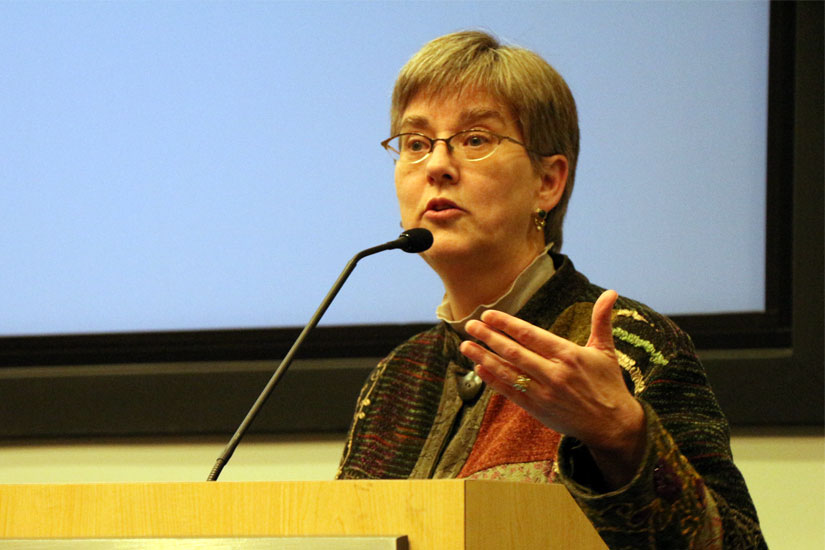

Arlington County Board Chair Mary Hynes speaks to the Arlington Civic FederationProgressive Voice is a weekly opinion column. The views and opinions expressed in the column are those of the individual authors and do not necessarily reflect the views of their organizations or ARLnow.com.

By Mary Hynes

In theory, everyone is for transparency in government – residents, politicians and public servants, businesses, non-profits, and government workers.

But what does transparency really mean for government operations and citizen interactions?

Is it the Board giving 48 or 72 hours of notice of its pending actions? Is it televising more government meetings? Is it posting information on the web or sending newsletters?

Recently, our current County Board Chair – someone who talks frequently about more transparency as a community solution – called the last minute, unadvertised (some would say non-transparent) announcement of a Blue Ribbon Panel the Board’s “biggest mistake.”

But she relieved the Board of any fault by saying “Our biggest mistake was thinking it would be a concept easily understood by the community.”

The Board did, at least, take a pause – until July 2016 — to hear directly from the community about their “idea”. I doubt the community will say that the task the Board laid out was clear or, in the scope of Arlington’s challenges, urgently necessary.

In evaluating the importance of transparency, let’s consider some other examples:

In 2009, the School Board hired a consultant to develop new school locations. That may have been transparent for school parents who were in the know about the process, but not for neighbors who, after repeated requests, couldn’t determine whether their needs were factored into a 50-year school location plan.

In August 2010, the School Board changed the rules on who could ride the bus in September without public discussion. That non-transparent action upended family plans all across Arlington with little time to develop alternatives.

In 2015, the County Board addressed the lack of success over three years in seeking publicly vetted solutions for the Reevesland property by directing the County Manager at a televised meeting without prior public notice to begin the legal process of creating a divided property. This was probably not transparent, though the public would have opportunities to weigh in on three additional public Board votes required before effecting changes at the property.

On the plus side, it’s good that the County Board is televising its works sessions. And it’s probably good that Planning and Transportation Commission meetings are being televised.

Both actions allow more people to watch, which can give a dedicated viewer a window into issues and choices and might spur an observer into broader participation in the process.

But for decisions that must stand the test of time — whether it’s the 50-year location of a new school or changes to bus routes that touch thousands of families – we need more than television.

Such decisions alter the very fabric of the community and they require broad resident participation and engagement. That special ingredient is what tends to make a decision a good one for the broad community.

When neighbors, government, community groups, and businesses sit and talk to each other about how to solve a real problem or address a complex challenge, the solution achieved is richer, more nuanced, better understood, and is more accessible even to those who couldn’t participate directly.

Such participation and the ability to explain is THE key ingredient our community has employed for many decades to create today’s great place.

Paying lip service to transparency for its own sake misses what really matters. Real community engagement isn’t more opportunities to watch or checking a box. Real community engagement – the roll-up-your sleeves hard work – is how great communities get great.

Today, more than ever, we need elected leaders who understand this on both the School Board and County Board. We need our County Manager and Superintendent to value the varied perspectives and needs that residents bring to the table.

We should commit to continuously developing strong civic engagement skills in County and School staffs so that our greatest resource — the talents and skills of those who choose to call Arlington home – are put to good use.

More than transparency for its own sake, we need greater opportunities for honest civic engagement. It’s our legacy and our future.

Mary Hynes served as an Arlington elected official for 20 years. In 12 years on the School Board she began the open office hours program and instituted a monthly newsletter and liaison meetings with PTA leaders. During eight years on the County Board, her PLACE initiative focused on civic engagement and the County’s commission structure. She instituted Open Door Mondays as an opportunity to meet a County Board member in a casual setting without an appointment. In 2015, she launched the citizen-led Community Facility Study that involved more than 200 residents.


Andrew SchneiderProgressive Voice is a weekly opinion column. The views and opinions expressed in the column are those of the individual authors and do not necessarily reflect the views of their organizations or ARLnow.com.

By Andrew Schneider

For Progressive voice readers and commenters – and those of ARLnow’s other opinion columns — I invite you to tune it to a new program called Arlington Voices that I host on Fridays on Arlington’s very own low power community radio station WERA-LP (96.7 MHz on the FM band).

The program is focused on Arlington as a unique place. Our geographic location near Washington, relatively small size, eclectic mix of Southern and Northern tendencies, transient nature of many residents, shifting demographics, and long-standing commitment to inclusiveness and progressive public policy all make for a lot of interesting ideas generated in Arlington that, in my opinion, are worth talking about.

I want Arlington Voices to be a place where we look more closely at what makes Arlington such a unique community – through dialogue, insight, whimsy, and serendipity. I am committed to maintaining a non-partisan, non-agenda driven show where anyone can feel comfortable, safe, and willing to share their thoughts and their journey.

How did the program come about?

In January 2011, President Obama signed the Local Community Radio Act, the culmination of a decade-long campaign by low power FM advocates to foster community radio across America. Thousands of applications have been filed with the FCC to open low power FM stations across the country.

Despite power levels far below commercial and noncommercial radio stations, community radio stations can make a difference in their communities. With that in mind, Arlington Independent Media launched our own community radio station, WERA-FM, in December 2015.

WERA’s mission is to “enlighten, enrich, and entertain Arlington’s diverse community by promoting and facilitating independent radio.” Like AIM’s long-standing, award-winning, community-based television and film production, WERA enables every day citizens to produce educational, cultural, and “local-centric” programming.

I learned some things running for County Board that I discussed with Paul LeValley in the context of an idea I had for a radio program. During the campaign, I talked to thousands of Arlingtonians who helped me see that everyone has a story to tell. I learned about the unique journeys like the bus driver who has lived in the same house their whole life, the lawyer who dreams of being a landscape architect, parent advocates, community leaders, young residents, immigrants, and the swim coach from my youth.

Paul and I discussed how I might take a deeper look into Arlington one interview at a time. I humbly described my show as a mashup of Diane Rehm, Marc Maron, Charlie Rose, and … Howard Stern.

I didn’t want guests just talking about their professional lives and delivering talking points. I wanted to hear more personal stories about what brought people to Arlington, why they have stayed, and where they see Arlington heading in the future.

Last week, in the inaugural show, my guest was attorney Ted Bilich. I knew we would talk about Ted’s legal career and his work in risk management. But we went much further in discussing how the concept of risk plays out in our professional, personal, and civic experiences.

Ted described risk management as akin to “looking under the rock.” It’s never quite as scary as you think it’s going to be, and the consequences of not looking are always more significant than you imagine.

I hope my guests and I will continue to look under the rocks, calm fears and encourage thoughtful progress.

In the weeks and months ahead, I look forward to continuing the conversation. My next guest, Susan Anderson, is an unsung hero of Arlington – always in the middle of things but never the center of attention; without Susan many things wouldn’t get done. The following week, I will interview Sherriff Beth Arthur. We’ll discuss not only the role Arlington plays in innovative criminal justice and how Arlington handles undocumented individuals, but also leadership and what Arlington means to her.

Please join us and send me your thoughts at [email protected]. Building on the local dialogue that takes place every day on ARLnow, I hope to highlight important conversations that are taking place or should be taking place throughout Arlington. Let’s look under the rock, together.

Andrew Schneider is a lifelong Arlingtonian. He is the Executive Director of Arlington Thrive, a non-profit that provides same day emergency financial support to neighbors in need. Learn more at Arlintonthrive.org. His radio show, Arlington Voices, can be heard every Friday at 10am on WERA-LP 96.7 FM.


Larry RobertsProgressive Voice is a weekly opinion column. The views and opinions expressed in the column are those of the individual authors and do not necessarily reflect the views of their organizations or ARLnow.com.

By Lawrence Roberts

I was pleased to join fellow ARLnow columnists Mark Kelly and Peter Rousselot on a panel discussion at “ARLnow Presents: Hot Topics on Columbia Pike.” We had a spirited discussion of County issues and I hope you’ll watch the video when it appears on Arlington Independent Media and ARLnow.

While I don’t often agree with ARLnow’s “The Right Note” column, I was pleased that Mark identified Metro as the County’s highest transit priority.

Metro is vital to Arlington’s economy, serving tourists and providing the impetus for a commercial tax base carrying half of Arlington’s real estate tax burden – a substantially higher percentage than other area jurisdictions.

Metro is also vital to Arlington’s mobility – for commuters to and from Arlington as well as people using public transportation to get around the region without driving. Metro (and other transit options) helps Arlington avoid massive traffic gridlock in its urban corridors and along residential streets.

Today’s federal government could not function without Metro and the ripple effect of reduced federal activity without Metro would be highly detrimental to Arlington companies and workers intersecting with the federal sector.

So what are we to make of this week’s National Transportation Safety Board’s report on the L’Enfant Plaza accident in January 2015 that led to NTSB’s heavy criticism of Metro and, in particular its lack of a safety culture?

I believe that Arlington’s first reaction should be to acknowledge that Metro is essential to Arlington’s economy, its desirability as a place to live, its mobility, and the health of a commercial tax base that supports the many public services that Arlingtonians want and expect, including schools, public safety, parks and social services.

For that reason, Arlington government officials and residents should be at the forefront of efforts to support and encourage Metro as it undergoes necessary changes.

Second, Arlington should be working with our federal delegation and regional partners to demand dedicated funding streams for Metro – as most urban transit systems have.

Essentially, the federal government takes the position that it heavily funded Metro’s construction and that its obligations largely stopped there without ensuring an adequate dedicated funding stream for operations and maintenance.

While federal warnings about safety are important, it is easy to lay blame on Metro management and employees without acknowledging that the federal government has not been a reliable partner in solving the chronic and well known problem of deferred maintenance due to lack of funding.

Metro’s importance to the federal workforce and travelers from across the country who come to the Nation’s Capital warrant strong federal financial support.

Third, we should not fall prey to the convenient and simplistic assertion that if only Metro management had been more disciplined about spending there would be no safety problem. Metro management could squeeze every ounce of waste, fraud and abuse out of the system without making a dent in the structural deficiencies in Metro funding.

Fourth, it is important not to jump on the bandwagon of finding fault with Metro at every turn. I had occasion to review the Washington Post’s 2015 stories about Metro. They constituted a steady drumbeat of identifying one problem after another that would lead one to conclude that no one is able to commute effectively or safely by Metro.

(more…)


Eric HaroldProgressive Voice is a weekly opinion column. The views and opinions expressed in the column are those of the individual authors and do not necessarily reflect the views of their organizations or ARLnow.com.

By Eric Harold

It’s ironic that ARLnow’s April 22 article said “Gutshall attempted to re-litigate the streetcar…” at the first County Board candidate debate held on April 20.

Nothing could be further from the truth. Along the Pike and in Crystal City we know that “streetcar” is no longer on our menu of transit choices. We understand that neither Erik Gutshall nor Libby Garvey is in favor of bringing the streetcar back, and both further agree that Arlington needs to move forward with alternative plans to address Columbia Pike.

The real difference between the candidates is that only one has, for well over a year, been in a position to act yet hasn’t.

Residents of Columbia Pike and Crystal City waited in vain throughout 2015 to hear more specifics from longtime BRT proponents Libby Garvey and John Vihstadt. While we attended meetings and filled out on-line surveys, these leaders offered no new ideas for us to consider – even though they had assured us that easily implemented alternatives were readily available.

Arlingtonians for Sensible Transit (AST) folded its tent, too, leaving us to wonder about its true purpose. AST’s Peter Rousselot, a very vocal opponent of the streetcar, has been thunderingly silent in advocating for any transit alternative. In fact, everyone involved with the “BRT movement of 2013-2014” disappeared completely from publicly advocating for improved transit services that met our well-articulated vision and needs.

The staff-led Transit Development Plan (TDP) process somehow became a reason NOT to provide active leadership for the Pike and Crystal City.

We thought that perhaps we would see the Board’s BRT proponents’ commitment to us in the recently adopted FY17 budget. After all, the draft TDP identified improvements in connectivity between the Pike and Ballston as well as enhancements in the Crystal City area as funding priorities in FY17. In fact, only one new route was funded in the FY17 budget — the ART 55 — a northside bus replacing a Metro bus route.

Unfortunately, our elected BRT leaders’ silence continues. The draft TDP contains nothing new or creative here for 22202 and 22204 to rely on. The TDP says our mode is “BUS and only BUS” and as proposed will do a great job of moving people OUT of Arlington but very little to help people move AROUND Arlington, and especially on the Pike.

Yes, some service is more frequent; and some commuters will get service during rush hour with fewer stops; but for those of us who were hoping to ditch our cars to do most of our regular errands off-peak there isn’t enough here to make leaving our cars behind practical.

Arlington’s success has been built in large part on long-term vision and strategic public investment in solutions that provide mobility beyond the car for those of us who live here — especially in our densest neighborhoods. Making sure this continues to happen on the Pike and in Crystal City is critical to Arlington’s long-term success. We can’t do baby steps or we will strangle our economic recovery.

The streetcar — vilified as it was by some — was a transformational option developed over ten years with significant public input. We’ve removed it, but the problem still remains. Now, we need even more ongoing focused creativity to ensure that the Pike achieves its adopted vision and Crystal City becomes a great place to live as well as work.

In her New Year’s Day remarks, Ms. Garvey stated that “…we have all been frustrated at how long it seems to be taking to design a substitute [for the streetcar].” That is an understatement for residents of the Pike and Crystal City.

We are still waiting for leadership from the County Board — most particularly from Ms. Garvey, who worked so hard to kill the streetcar and advocated so loudly for buses. It is clearly easier to “just say no” and to criticize than to constructively develop and implement positive solutions.

Eric Harold has lived in the Barcroft neighborhood of Arlington since 1998. He has served twice as president of the Barcroft School & Civic League (the Barcroft civic association) and for twelve years until 2013 on the County’s Environment and Energy Conservation Commission (E2C2). He currently serves on the APS Advisory Commission on Facilities and Capital Construction (FAC).


Terry SavelaProgressive Voice is a weekly opinion column. The views and opinions expressed in the column are those of the individual authors and do not necessarily reflect the views of their organizations or ARLnow.com.

By Terry Savela

It is deeply disappointing when political leaders say one thing and do the opposite. That is why it was so troubling to see Tuesday’s County Board action violating the Board’s own public notice requirements – that Board Chair Libby Garvey had previously advocated for vigorously – in order to set in motion a review of “Strategic Priorities for Arlington.”

Acknowledging that Board members had discussed the proposal for months, she nevertheless initiated a wholesale review of County priorities by an unelected small group without providing any opportunity for comment by the public, Advisory Commissions, the School Board or Arlington’s many engaged community organizations. The draft Charge was not posted on the County’s website until the start of the Board’s Tuesday meeting where it was voted upon.

Whether or not one believes that the County’s priorities over recent years – schools, affordable housing, public safety, parks, environmental stewardship, and economic competitiveness – should be changed, this was not the way to do it.

The call for a six-member “Blue Ribbon” Panel – one member appointed by each County Board member and one appointed by the County Manager – will proceed without any selection by School Board members even though nearly half of our County’s budget goes to our excellent schools and we face a large and growing enrollment challenge.

The Panel’s Charge is to “provide an evaluation of the current policy goals and objectives for the County…and recommendations for a plan to reconcile and prioritize those goals.” Ms. Garvey talked at length about the need to “do things differently” and set priorities among all the service areas. Yet her repeated call to focus on “core” services suggests she has already decided which services she intends to downgrade. Those of us who take pride in services that reflect Arlington’s progressive values, including parks, trails, human services, arts, libraries and the environment, have reason to worry about service cuts.

In addition, it appears that the six Panel members will recommend which adopted County policies should be de-emphasized. I expect many Arlingtonians who labored on the Community Energy Plan, Affordable Housing Master Plan or Master Transportation Plan will be deeply concerned whether this small group will push to change or undo their recommendations.

By contrast, the well-received 2015 Community Facility Study resulted from a timely and efficient process involving more than 200 individuals and groups. The need for the Facility Study was identified in multiple campaigns and in both school and County advisory groups. The County and School Boards appointed a 23-member group that was a cross section of Arlingtonians – by age, geography, ethnicity, and leadership experience. And the charge mandated broad community involvement from interested Arlingtonians and organizations.

Perhaps, we shouldn’t be surprised by this contrast. It hearkens back to a failure by Ms. Garvey during her School Board tenure to engage our schools community in creating a long-term vision for addressing growing enrollment. The result has meant that every boundary change, proposed new school or programmatic adjustment stirs distrust from parents who care passionately about the education of their children. And she has shown little interest in acting on the widely-supported recommendations of the Community Facilities Study that would help address that earlier failure.

Perhaps the most telling moment of Tuesday’s discussion came when, addressing Jay Fisette’s comment about the importance of broad civic engagement in the development of Arlington’s plans, John Vihstadt noted that it would be up to the Board to decide in December whether the work of six Panel members would actually be used or might “end up in the proverbial circular file.”

So is the launch of the “Blue Ribbon” panel only the start of a longer process? Or is it meant to unwind community priorities that have evolved over a great deal of time and through broad-based discussions?

Is this the beginning of an effort to examine the Arlington County budget holistically and establish a common-sense approach for setting budget priorities? Or is it just a way to play favorites?

Whatever the motives, violating the Board’s own prior notice requirements and launching a wide-ranging review without input from residents, businesses or community groups is wrong. It certainly isn’t the Arlington Way.

Terry Savela has lived in Arlington since 1985 and served as a County Planning Commissioner, Transportation Commissioner, and as the vice chair of the Crystal City Task Force.


View More Stories