Lisa-025-Edit-color

Progressive Voice is a weekly opinion column. The views and opinions expressed in this column are those of the individual author and do not necessarily reflect the views of their organization or ARLnow.com.

Arlington has long been known for mastering smart infrastructure investments that have boosted the local economy, made Arlington an attractive place to live, and led to high levels of satisfaction in surveys of County residents.

Now, County leaders face a public that is cool to ambitious approaches to transportation, planning and infrastructure other than, perhaps, new and expanded schools.

For many, Arlington’s 2014 decision to cancel streetcars in Crystal City and Columbia Pike dealt not only a blow to transportation, but to community pride as well. What if, however, this gives us a timely, useful pause to consider improvements that are less capital-intensive? While I do not believe they can be the only solutions, it is important that we explore such alternatives.

Several fast-changing trends are converging to change how we live, work, shop, play – and get around. This is happening all over the world, but has special relevance for Arlington as we expand a planning focus from Metro station areas to other ways of delivering services, opportunity and quality of life.

These trends – technology, demographics, and shifts in work and workplaces – require new types of planning.

For transportation, Uber and Lyft are mainly known for disrupting the taxi industry, but it is really the smart phone platform that is transforming everything from biking to parking to travel.

So what are the opportunities in Arlington and what does it mean for planning?

Ride and Van Share – New companies like Bridj and Split are building new “microtransit” services that range from $2-$7 per trip. They fit a service level somewhere between solo driving and ART bus lines. They work by using algorithms to assign passenger pick-ups based on the most efficient origin-destination routes among several shuttle buses.

bridj

For example, residents living near the intersection of Columbia Pike and George Mason Drive can hail shuttles going to Seven Corners, Ashburn and other job centers not served by Metro (or that require multiple transit connections). These new transit companies are eager to work with localities to share data, incorporate services into formal transportation planning, and optimize public transit routes.

ParatransitArlington Transit offers on-demand rides for travelers with limited mobility. While costs have decreased (28% over the past three years to $27 per trip), these new services could reduce the costs of transportation further. As Arlington develops aging-in-place strategies throughout the County, these rides are incredibly important.

Car Owners – Yes, we have the Car-Free Diet, but what about support for drivers? Let’s face it, many Arlingtonians live in areas where a car is really the only practical travel option. However, many drivers want to reduce the hassles of driving, finding a parking space and car ownership. Fortunately, there are apps for all of these. The availability of these resources means that we should expand our transit programs to find ways to use our roads and parking resources in ways that help drivers — since reduced driving through efficiencies and easier route and parking navigation can result in less congestion for us all.

Locally Grown Transportation Companies – Arlington and DC are home to transportation companies like TransitScreen. Mobility Lab tracks new trends at the intersection of transportation, cities and technology. Arlington’s Economic Development chief Victor Hoskins wants to focus on tech for security, health and education. Given Arlington’s leadership in land use and transportation, and with the addition of 1776 to Crystal City, it makes sense to add smart cities to the list.

But there are also questions. How do public agencies incorporate private companies into transportation and infrastructure programs? For land use, what is Transit Oriented Development (TOD) when the transit comes to you through more individualized services? How do people without smart phones access broader mobility services? And finally, how will self-driving cars and transit ultimately disrupt the current disruptors?

Certainly tech-enabled ride sharing apps won’t exactly replicate the performance of a streetcar line. But they can provide immediate, cost-effective mobility options and supply the data needed to support the right kind of larger transportation and other infrastructure investments in the future.

In times such as these, the winning bet may not always be the big bet, but a series of strategic, iterative bets can help continue moving us forward.

Lisa Nisenson is a long-time civic advocate in Arlington and is founder of GreaterPlaces, a startup and member of the tech incubator 1776.
Frederico Cura

Progressive Voice is a weekly opinion column. The views and opinions expressed in this column are those of the individual author and do not necessarily reflect the views of their organization or ARLnow.com.

How are we to understand the “gotcha” video attacks on Planned Parenthood – an organization serving low-income women nationwide with a network of family-oriented and community-strengthening health centers?

It started with a deceptively edited video a few weeks ago attacking Planned Parenthood’s health centers. The next step was a Republican push in Congress to gut funding for the centers, an outcome that would threaten lifesaving cancer screenings to countless low-income women, as well as critical access to contraception and reproductive education.

Then we saw an organization dedicated to criminalizing abortion hacking into the women’s health centers’ computer system.

These efforts go beyond bullying tactics we’re so used to from the right. When right wingers play “hard ball’ — as some of them put it — integrity becomes a lesser priority. What happened to the moral values of honesty and love of neighbor? They seem incompatible with today’s Republican and anti-abortion “me-only” ideologies.

Moreover, these latest attacks on women’s reproductive health advance a continuing right wing campaign to impose a radical “me-only” mindset on those who share the more common framework of “me-and-us.”

It is part of a multi-pronged effort by right wingers to rewrite our great nation’s history by asserting that the uniquely American idea of separation of church and state, which has served us well for over 200 years, was not really meant to be. This historic separation and the rich cultural-religious tapestry our nation has become conflicts with their “me-only” mindset.

This “me-only” mindset suggests that we should all accept as the only valid American morality their interpretation of the role of women and reproductive biology — fetuses, fertilized eggs, and sperm.

The right wingers want to protect fetuses no matter how much the women who carry them may be harmed. We cannot continue the historic neglect of women’s physical and mental health. Enough is enough! A woman should have the freedom to make her own health care decisions in consultation with her doctor and, for women of faith, her God.

I do not expect that everyone should share my point of view. But I also do not expect that I must accept the “me-only” point of view as a divine destiny.

We must especially not allow government actions – pushed by the pro-criminalization forces – to make lesser citizens of women. When government does not trust women, we all suffer as result.

Being bicultural, originally from Latin America, I see what women experience in places that have strict prohibitions on termination of unwanted pregnancies and even on birth control. We see something like where we were before Roe v. Wade — botched illegal abortions, troubling suicides by young and desperate pregnant women, high juvenile hopelessness, violence in places with chronic unemployment and high fertility rates, and the prosecution and marginalization of women experiencing miscarriages.

What the “me-only” activists fail to see is the fundamental notion that we Americans are greater and stronger as a united people than we are in a nation of radical individualism. Our success depends on everyone – men and women – getting an equal opportunity to contribute to our society.

We want an economy that works for everyone and does not leave women behind with less reproductive health, justice and freedom. We want strong families and communities that can depend upon family wellness and access to quality and affordable health care by everyone. That’s how we will move forward together.

Over the years, Planned Parenthood’s lifesaving women’s health centers have contributed to the strength, structure and stability of the American family and communities. Instead of defunding Planned Parenthood, Republicans should support Medicaid expansion so that lower-income women are less dependent on the health centers for cancer screenings and other lifesaving health services.

In our country, we must value women’s lives and freedom. Women, who should be trusted as much as men, should have what they need — including Planned Parenthood’s lifesaving health centers — to avoid unwanted pregnancy and childbirth as well as unwanted forced marriages resulting from those pregnancies.

It is also vitally important to have wanted children. In a society valuing women’s lives and freedom, motherhood should be voluntary. As author Katha Pollitt writes, “motherhood should add to a women’s ability to lead a full life, not leave her on the sidelines, wondering how she got there.”

The recent attacks on Planned Parenthood’s network of women’s health centers reflects the “me-only” ideology that hurts women’s health, lives and freedom, and greatly weakens the American family.

Federico E. Cura is a strategic communication trainer, outreach specialist and grassroots organizer. He spent years as a K-12 educator teaching Spanish and ESOL, and served on the Arlington County Transportation Commission.


Larry Roberts

Progressive Voice is a weekly opinion column. The views and opinions expressed in this column are those of the individual author and do not necessarily reflect the views of their organization or ARLnow.com.

For decades, Arlington residents have enjoyed outstanding schools, parks, recreation facilities, libraries, public safety enhancements, transportation options, and a strong social safety net. All of these attractive features and others as well have been heavily subsidized by a strong commercial sector.

The strength of that commercial sector was due in part to: Arlington’s ideal location close to the nation’s capital and close access to the Pentagon; the buildup in federal spending over decades; and Arlington’s ability to attract and retain highly educated residents prized by employers.

We have also benefited from wise planning decisions and infrastructure investments that included, for example, multiple Metro stops that have become increasingly attractive to employers. We have managed to have a transportation system that helps people move around in Arlington and through Arlington while largely preserving single family neighborhoods.

For much of that period of time, Arlington’s ideal location and the educational achievement of its residents made Arlington largely immune from competition from other area jurisdictions.

Unfortunately, those days are gone.

Federal cutbacks are here to stay.

One need only see the dramatic transformations taking place in the District and in Tysons Corner to see how the public sector – working closely with the private sector – can attract commercial tenants, help increase revenues to support valued services without depending more heavily on homeowner taxes, and through planning and zoning measures help create more public space and better transportation options as part of those redevelopments.

Our residents are more critical of County spending and more sensitive to tax increases than has been true in the past 20 years. Yet many individual residents want the County to increase spending on items that matter most to them – for some that is schools, for others parks or open space, for others better pay for public safety personnel, for others it is added transit capacity, others want to ensure that housing is more affordable to young people, lower-wage workers, and those want to age in place. Others want more spending on services for mental health services. And others want expanded recreational facilities and community centers to meet growing demand.

Are we as County residents prepared to make difficult choices among these competing priorities? Will the answer be that services important to me should be maintained or enhanced, but spending important to others should be cut? Will housing prices continue to escalate and the tax rate be maintained? If so, there will be more revenues for the County government to provide services favored by residents. But it will also mean current cash flow challenges for many homeowners who won’t realize the profits from home price increases until they sell their homes.

The best answer in the past has been to rely on a thriving commercial sector to pay 50 cents of every dollar spent by the County.

That can still happen in Arlington, but only with a strong economic development effort and a dedicated effort to reduce commercial vacancy rates in the County.

Our commercial vacancy rate is somewhat deceptive. With a few exceptions, vacancies are concentrated in older buildings and those with fewer amenities or floor plans that require major adjustments to accommodate the needs of today’s workplace.

If we want to reduce those vacancies and leave more money available for school capacity and other priorities desired by Arlington residents, we will need Arlington’s economic development experts working closely and creatively with the private sector to identify the types of companies and actual prospects that can make use of Arlington’s existing inventory or we will need to find ways to encourage redevelopment of those dated or lower quality structures that are not likely to be successful in today’s marketplace.

Arlington is taking steps along this path. Those efforts should be encouraged. It is our best chance to keep services that residents strongly support and enhance our quality of life without adding to the burdens of homeowners.

Larry Roberts is an attorney in private practice. He chaired two successful statewide campaigns and served as Counselor to the Governor in Richmond. During his term as Chair of the Arlington County Democratic Committee, Democrats won every election in Arlington.


Mary Rouleau

Progressive Voice is a weekly opinion column. The views and opinions expressed in this column are those of the individual author and do not necessarily reflect the views of the author’s organization or of ARLnow.com.

In September, the County Board will vote to adopt the Affordable Housing Master Plan (“Plan”) as part of the County’s Comprehensive Plan. The draft Plan has undergone review and revision and continues to be a hot topic in local blogs and print outlets. Here’s my case in support of its adoption.

Let’s start with what the Plan is: a policy document that contains enabling principles, goals and objectives. It is not a master housing siting plan or an allocation of new resources. The Plan, with a 20+ year look forward, does not commit to a specific course of action or number of committed affordable units (CAFs). In fact, it specifically reserves the right to make adjustments based on feasibility and market conditions.

There is a fair amount of confusion about the impact of the accompanying Implementation Framework (“Framework”), a staff guidance document that describes the existing and potential tools that will be used to achieve the Plan. The County Board will be asked to “accept” the Framework to guide staff efforts to develop new housing tools and consider housing site plans. These resulting processes to evaluate those tools and plans will be subject to community review and input–as has been the tradition.

So why has the County, guided by a citizen working group, spent the better part of three years preparing the Plan? For one thing, a change in state law now requires the County to incorporate an affordable housing plan into its state-mandated Comprehensive Plan which currently contains the County’s policies regarding land use, energy, transportation, and public spaces. This helps ensure integrated planning.

But more importantly, it’s time to re-examine housing needs, given that the last major study and current housing goals and targets were created 15 years ago. Since then, rents and housing prices have doubled, and the County has lost 13,000 rental units that were once affordable to households making 60 percent of AMI (Area Median Income — roughly $46,000 for a single person and $65,500 for a family of four).

Three other trends require the new policies expressed in the Plan.

First, available land in Arlington is scarce and costly. New approaches are needed to encourage market forces to develop affordability and allow for its distribution throughout the County. The Plan proposes exploring new approaches including land use and zoning changes, simplified approvals, and new housing design, including revisiting the accessory dwelling ordinance. Specifically, however, the Plan commits the County to using its financing (loan fund) and land use tools and sector planning to incentivize distribution of affordable units throughout the County.

Second, affordability challenges now confront the middle class. That and the growth in Baby Boomers who wish to “age in place” and Millennials require a fresh look at housing options. The Plan includes policy language and potential tools for addressing these concerns, including using land use and zoning policy to incentivize ownership housing affordable to households between 80-120 percent of AMI. The Plan includes new County policies to both help the middle class and enable Arlingtonians to age in community.

Third, Arlington’s economic sustainability in the face of increased competition requires a robust and stable employee base and a housing mix to support that base. In expressing support for the direction and goals of the Plan, the Arlington Chamber noted the importance of housing to employee recruitment and retention and business location decisions. The Plan expresses a preference for existing residents and Arlington-based workers in using County funds for rental or ownership programs.

Market forces, strong property rights laws and the Dillon Rule notwithstanding, our success in meeting current and future challenges — if we are to remain a place that is both diverse and economically sustainable — will depend on creative approaches and flexibility. The policies and objectives of the Plan provide that foundation.

Mary Rouleau is a 25-year resident of Arlington. She is the Executive Director of The Alliance for Housing Solutions.


Max Burns

Progressive Voice is a weekly opinion column. The views and opinions expressed in this column are those of the individual author and do not necessarily reflect the views of their organization or ARLnow.com.

Politics isn’t just a contest of competing visions for our community. As this year’s primary victories by Katie Cristol and Christian Dorsey and last year’s victory by John Vihstadt show us, successful campaigns understand the importance of a strong “ground game.” Message matters, but people need to hear it, see it and feel it.

Across Arlington and the broader 8th Congressional District, I’ve met progressive candidates with values and messages worth vocalizing. Yet they struggle with an important but often hidden problem: good campaign teams don’t fall out of the sky. Building top-notch campaigners takes training and hands-on experience.

We can do more to develop strong campaigners and campaign teams at the local level even though we lack the resources of a state or federal operation.

That’s why, in collaboration with the 8th District Democratic Committee, we launched the Next Generation Leaders Program. NGLP is unique mentorship initiative that connects passionate Democrats with elected officials, candidates and community leaders to build a strong bench of future campaign professionals.

Then we did one better and made sure the program would be absolutely free of charge. We believe financial limitations should never prevent a future campaign superstar from taking her or his first step.

Applicants to NGLP are largely younger Democrats and those looking to make a career out of campaign management, and we built the program with them in mind. After our successful applicants are chosen from those who apply before our July 15 deadline, they’ll work directly with active campaigns and Democratic leaders to learn a broad range of fundamentals, from fundraising to event management, campaign communications and crafting direct mail.

We’re especially focused on applying at the local level, where reliance on volunteers is no longer enough for candidates in competitive races. These skills are vital in races that lack large resource pools.

By building up real-world political management skills, NGLP offers diligent, committed Democrats the opportunity to stand out over the course of a campaign. It also marks the start of a growing network of NGLP participants and mentors with long-term value even for those who decide professional campaigning isn’t in their future.

I’m proud of the hard work of the 8th District Democratic Committee and the volunteer mentors from every city, county and magisterial district in developing NGLP. This program and its future participants will ensure that our candidates’ progressive values are backed by strong campaign organizations that ensure a good dialogue between voters and candidates and that those progressive values are communicated effectively in Arlington and beyond. It makes us more competitive as a party, and fosters a new generation of experienced, skilled political managers.

There’s still time to apply for our 2015 Pilot Program. If you’ve been looking for an opportunity to turn your progressive values into marketable job skills, look no further. We’re ready to see what you’ve got.

Max Burns is a member of the 8th District Democratic Committee and served as President of the Arlington Young Democrats.


Joseph-Leitmann-Santa-Cruz

Progressive Voice is a weekly opinion column. The views and opinions expressed in this column are those of the individual author and do not necessarily reflect the views of their organization or ARLnow.com.

This column is written by Joseph Leitmann-Santa Cruz.

My wife and I are proud to raise our family in and be part of a community that recognizes the importance of investing in our public education system. Arlingtonians have built a world-class education system and we need to celebrate that; however, not everyone throughout the County — especially our kids and families in South Arlington — has benefited equally.

South Arlington has been growing rapidly in the past few years. This rapid growth has been placing a burden on how effectively our elementary schools in South Arlington are able to address the needs of the current and projected school population.

Nine out of 10 elementary schools in South Arlington have significant projected seat deficits for the upcoming 2015-2016 school year. Two of those schools, Barcroft and Claremont, have reached overcapacity by 24% and 20%, respectively. Fast forward five years and the projected overcapacity figures increase to 35% and 23%. This is unacceptable. We can do better.

Our kids and families in South Arlington can and should have access to more and better programs, services and facilities.

Because Arlington cares, we seem to be moving in that direction.

On June 25, at the invitation and request from the Arlington School Board, I had the privilege of joining representatives from over 40 civic association, parent teacher associations, and other community organizations from South Arlington as we launched the first meeting of the South Arlington Working Group to Site a New Elementary School. I know, it’s quite a long name!

To achieve the School Board’s goal of opening a new, 725-seat neighborhood elementary school in South Arlington, preferably by the fall of 2019, the Working Group is charged with analyzing site options and providing input on related program moves with two key goals –addressing crowding and enhancing instructional opportunities — in South Arlington elementary schools.

Some might view this as redoing what the Thomas Jefferson Working Group already did. Hopefully, most will view our Working Group’s approach as focusing on having a broad, extensive, and transparent decision-making process.

There is a lot to learn from what worked and didn’t work from the TJ Working Group. Furthermore, our goal is a broader one of having all options “on the table” for community consideration.

The challenges are many but so are the opportunities to truly make available a world-class education system to every child in Arlington regardless of which neighborhood her or his family lives in.

From the very first meeting, the Working Group rolled up its sleeves and got to work. There is no issue too big or too small to be considered: site location, diversity matters, cost effectiveness, open/green space, traffic management, etc.

The focus and resources that the School Board is devoting to seeking solutions for school crowding and enhancing instructional opportunities is commendable, as is the spirit of cooperation and collaboration that the County Board and School Board have adopted this year to help ensure that we maintain a superior school system.

The Working Group will meet every two weeks. Our meetings are open to the public, so please join us and be part of the process. Furthermore, we invite and encourage the community to keep track of our Working Group’s progress by accessing our meeting minutes and discussed materials at http://www.apsva.us/moreseats.

This Working Group and other similar fora we have in our community are what helps make Arlington a special place where different voices can be heard. I look forward to being part of our collaborative approach to benefit all in the community.

Joseph Leitmann-Santa Cruz is the Director of External Relations for Capital Area Asset Builders (CAAB) and a member of the Board of Directors of the Arlington-based non-profit organization Dream Project.


Sally DuranProgressive Voice is a weekly opinion column. The views and opinions expressed in this column are those of the individual author and do not necessarily reflect the views of the author’s organization or of ARLnow.com.

Economic development is the art of attracting the right business to make a prosperous and vibrant community for residents, businesses and visitors to enjoy. Arlington is a unique place where business and residents have together created Arlington’s success and economic prosperity.

We’ve achieved an enviable and unique position in having a 50 percent/50 percent split in the residential/commercial share of property taxes. In some of our neighboring jurisdictions, for example, there’s a 70/30 split in the share of property taxes. That 50/50 split means commercial property taxes reduce the tax burden on residents; help fund schools, parks and infrastructure; and allow Arlington to maintain its triple-A bond rating.

What’s more, those commercial property owners and businesses pay business taxes and contribute into special funds for affordable housing, arts, sidewalks, landscaping, street lights and more.

Economic development is a topic that is not without its share of controversy in Arlington. As many of you know, our County is facing an unprecedented office vacancy rate that exceeds 20 percent. The team at Arlington Economic Development is diligently working to reduce that rate.

Two years ago, Arlington’s Economic Development Commission (EDC) established a competitiveness task force to look at Arlington’s position in the marketplace. That task force determined that Arlington’s public investment in Metro over the past three decades created distinct competitive advantages for Arlington’s economy and transformed Arlington into one of the most successful and “intelligent” communities in the country.

In the past, our location next to Washington, DC, lower business tax rates, public transportation and infrastructure made Arlington the low cost alternative and a key location for federal agencies, federal contractors and businesses. However, it’s a new time. Moving forward, those federal agencies are just one driver of Arlington’s economy, and we have more competition for those office rents.

In response, Arlington is in the process of diversifying its businesses so our residents can continue to enjoy the benefits that come from that 50/50 split in residential/commercial property taxes. We are investing in smart “mixed-use” planning and transportation for our urban villages and revitalizing shopping areas. We made changes at the County level too – with innovation-friendly, less costly processes and faster response times to attract and retain businesses.

Arlington has always been an early adapter, and the EDC recognized the need to focus on an “Innovation Economy” for the future. We recently completed a study on the Future of the Arlington Office Market, and as a result, we’re exploring creative and flexible approaches to using commercial spaces that will make Arlington’s commercial space more attractive and affordable to small businesses, start-ups and emerging new economy businesses.

We’re also fostering partnerships between business, government and universities to make Arlington a desirable destination for collaboration. And, we’re providing needed incentives and technology infrastructure improvements to support “mom and pop” storefronts, high-tech startups and solo entrepreneurs — all measures that are helping Arlington stay competitive in this rapidly changing marketplace.

Arlington values being an unique community that combines small town charm of walkable streets,  great schools, restaurants and shopping with the big city amenities, such as Metro, world-class hotels, universities and arts.

Right now, we’re in the midst of a transition – one that requires us to compete in the business marketplace and global economy of the future. It’s not an easy process, nor is it a short-term one. It will take everyone, including businesses and residents working together with the county, to find fair solutions that will improve the efficiency of Arlington’s development processes and meet these new challenges while still maintaining our shared community values.

Sally Duran is Chair of the Arlington Economic Development Commission. She is a health insurance policy consultant with SJD Associates.


Krysta Jones

Progressive Voice is a weekly opinion column. The views and opinions expressed in this column are those of the individual author and do not necessarily reflect the views of the author’s organization or of ARLnow.com.

Last week I attended the Women’s Campaign School at Yale (WCS). This 20-year-old non-partisan, issue-neutral leadership program works to increase the number and influence of women in elected and appointed office in the United States and around the globe. Several of the speakers repeated the same line all week, “Women are 53 percent of the population…stop acting like we are in the minority.”

Arlington’s own Allida Black, (Eleanor Roosevelt Scholar and co-founder of Ready for Hillary), spoke at WCS about her journey as a child of the civil rights movement to creating a social movement for Secretary Clinton’s candidacy: “Politics is equal part dream, courage, and sheer grit. WCS is essential training for any woman, especially women in Arlington, who want to run for office. It shows in very real ways what decisions you must make in order to fortify yourself, concretize your dream, build your community, and give you the confidence to introduce your vision for an effective community-based party.”

My WCS classmate from Arlington, Natalie Trisilla (program manager for a DC-based nonprofit) concurred. We intend to rely on our vision, courage and grit to use what we learned at WCS to make a difference in Arlington.

Fortunately, Arlington has been a leader in women’s empowerment issues in both the political and business contexts.

For example, The Leadership Foundry, in conjunction with Northern Virginia-based Women in Technology, prepares women to serve on corporate boards. The Leadership Foundry is co-chaired by the Arlington Commission on the Status of Women’s (CSW) Vice Chair Marguerete Luter.

Marguerete has also been a key part of local Congressman Don Beyer’s efforts to promote women’s economic empowerment. In May, Congressman Beyer introduced the Gender Diversity Investment Act, which would provide federal employees the freedom and flexibility to invest their retirement savings in companies that demonstrate a strong commitment to gender diversity and women’s economic empowerment.

The progress of women leaders in Arlington was the focus of CSW’s Women of Vision reception on June 11, honoring women who have made an impact in Arlington in the government, nonprofit and business sectors.

CSW awarded its government award to Karen Darner, who served in the Virginia House of Delegates from 1991 to 2004. Delegate Darner set an example that continues today. Our County Board is chaired this year by a woman, Mary Hynes. In November, the ballot will reflect continued engagement by women leaders. Incumbents on the ballot will include Barbara Favola (State Senate), Ingrid Morroy (Commissioner of the Revenue), Carla de la Pava (Treasurer), and Theo Stamos (Commonwealth’s Attorney). Among other women running for office will be CSW member Katie Cristol (County Board candidate).

Notwithstanding Arlington’s successes and programs like WCS and the Leadership Foundry, women still continue to lag behind in political and corporate leadership, both nationally and throughout Virginia. Women represent only about 19 percent of the U.S. Congress. In Virginia, about 20 percent of our state senators, and 25 percent of our state delegates are female. Recent research shows that women hold only about 17 percent of the board seats at Fortune 500 companies, and about 15 percent of senior executive positions.

There is much discussion about the women’s vote, but not as much recognition of the key role of African American women in electoral politics. As Jessica Byrd, formerly of Emily’s List, has noted, since 2008, Black women voters have the highest turnout percentage in electoral politics.

Although Arlington has never elected an African American woman to the County Board, we have elected African American women to the School Board, and African American women are active in other positions of leadership. CSW gave its nonprofit award this year to Sarah Summerville, long-time community leader and cofounder and president of the African American Leadership Council of Arlington.

CSW awarded its business award to Mary-Claire Burick, President of the Rosslyn Business Improvement District (BID). Among other women serving as President of leading business groups in Arlington are Kate Roche (Arlington Chamber of Commerce) Angela Fox (Crystal City BID) and Tina Leone (Ballston BID).

I am proud to say that in Arlington, we generally don’t act as though women are in the minority. Our progressive values have led us to elect and promote women to the highest levels of leadership. Hopefully, Arlington’s leadership can help our state and our nation to put even more cracks in our glass ceilings.

Krysta Jones is founder and CEO of Virginia Leadership Institute, former chair of the Arlington Commission on the Status of Women, and a member of both the Leadership Foundry and the Junior League of Northern Virginia.


Larry RobertsProgressive Voice is a weekly opinion column. The views and opinions expressed in this column are those of the individual author and do not necessarily reflect the views of the author’s organization or of ARLnow.com.

Congratulations to Katie Cristol and Christian Dorsey on their successful campaigns for the two Democratic nominations for Arlington County Board. Good wishes also to those who ran solid campaigns but came up short – Peter Fallon, Andrew Schneider, James Lander, and Bruce Wiljanen.

Fortunately for Arlington Democrats, Katie and Christian will enter the general election with the support of their former opponents and solid support within the Democratic Party. My hope and expectation is that Arlington voters will elect Katie and Christian to the Board in November. I know they will both work hard to earn the trust and support of voters across the political spectrum.

The past two years have not been easy ones for Arlington Democrats. They have had divisions over key community issues. Retirements among elected officials led to many special elections that present the highest risk for Democratic candidates in Arlington. An Independent County Board candidate won election in 2014 special and general elections — the first time since 1999 that Democrats lost a County Board election. Not only did Independent candidate John Vihstadt defeat the Democratic nominee, but he did so with endorsements from some Democratic elected officials and significant Democratic voter support.

Vihstadt’s election led to the abandonment of the streetcar project. Later, the nonpartisan County Manager announced her retirement. And two incumbent Board members announced they would not seek re-election, meaning that Democrats would have to defend two open seats against a newly-energized Republican Party that had helped elect John Vihstadt.

This would seem to create vulnerability and lack of unity among Democrats.

Yet, as the Democratic primary process unfolded, it became clear that the six candidates were not seeking to divide the Party further. Instead, they focused on running positive, issue-focused campaigns. They all took pride in Arlington’s many accomplishments while looking for ways to make Arlington a better community.

While taking issue with some County Board decisions and offering somewhat different views on what the County’s top priorities should be, the candidates did not engage in Board bashing. Rather, they presented serious policy ideas for moving the County forward.

In offering endorsements spread out among the candidates, current and former elected officials stressed the qualities of their endorsed candidates – not undermining other candidates.

Board member Libby Garvey, who has been at the center of controversies within the Party, offered the following thought on election eve: “I have not endorsed anyone because there are some who have tried to make me an issue in the election. That is a needless distraction from the real issue: who will best serve Arlington as a member of the County Board…. The County Board is a team. A good team is made up of intelligent, hardworking people who bring different strengths to the table and work together to see that the Board’s collective strengths are maximized and its weaknesses minimized.”

The positive, issue-focused actions of the candidates, campaigns, supporters and Democratic elected officials bode well for Democrats this year.

As they continue to honor what is right about Arlington while offering fresh perspectives on County policy goals and priorities, Cristol and Dorsey are well positioned to unify Democratic support and earn support from independent voters as well as some Republicans.

The County needs a Board that works together well. We also need continued cooperation between the County Board and School Board to accommodate student growth and learning needs without exhausting County resources or shortchanging other important County priorities.

We face growing competition from the District and other nearby jurisdictions. Increasingly we compete with other urban centers and internationally. Building unity within Arlington – both among elected officials and among County residents – will enable Arlington to compete more effectively for jobs and businesses that support our core community values and create a revenue base that helps make Arlington a livable, sustainable, progressive, and attractive place to call home.

Larry Roberts is an attorney in private practice. He served as Counselor to Governor Tim Kaine. He chaired two successful statewide campaigns and is a former Chair of the Arlington County Democratic Committee.


Progressive Voice is a weekly opinion column. The views and opinions expressed in this column are those of the individual author and do not necessarily reflect the views of the author’s organization or of ARLnow.com.

Gillian BurgessEvery May, millions of Americans take to the streets, trails and paths on two wheels to enjoy the feeling of the wind in their hair, the sun on their helmets and the pedals under their feet in celebration of bike month.

This May has been a wonderful time to bike here in Arlington. In addition to the mostly beautiful weather, we have had some very successful events, which show the growing popularity of cycling in Arlington.

Bike and Walk to School Day, which was on Wednesday, May 6th this year, was a record-setting success for Arlington Public Schools. Arlington was fourth among U.S. cities with registered events at 33 schools, including diverse participation from neighborhood and county-wide schools. Students arriving on bike or foot were treated to VIP entrances and rallies, a special obstacle course for cyclists, and lots of goodies.

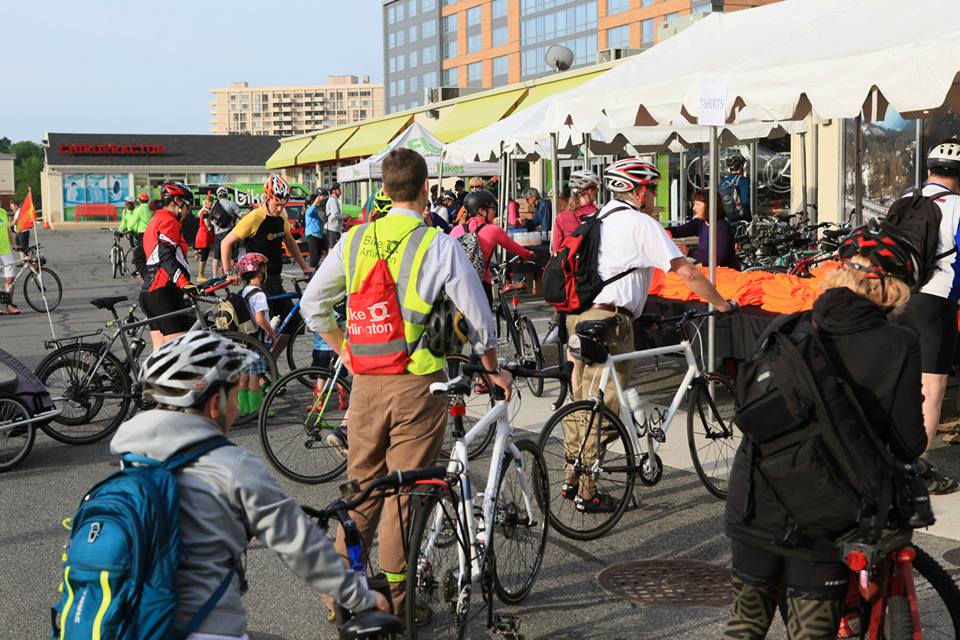
Bike to Work Day 2015 (photo via Bike Arlington/Facebook)Many APS staff biked to work, including at least one principal, and were rewarded with gift cards. A huge thanks to Tom Norton, the APS Safe Routes to School Coordinator, and to all APS and Arlington County staff and partners who had a role in this great day. Pictures can be found online using the hashtag #BWTSD15.

For adults (and kids who were towed along), Bike to Work Day was Friday, May 15th. It was also hugely successful. Arlington hosted six pit stops, including a new stop along Columbia Pike in Penrose, where cyclists could stop on their way to work and be treated to coffee, treats, swag, and lots of excited cheering from superheroes, unicyclists and elected officials.

In all 2,596 people registered for the Arlington pit stops and almost 17,500 registered for pit stops across the region. Both were a 4% increase over 2014. Over 1,000 of Arlington registrants were first timers! BikeArlington, WABA and their partners deserve thanks for hosting this great day. Pictures can be found online on the BikeArlington website and using the hashtag #BTWDDC.

With so many new riders, the growth in Bike to Work Day was no surprise. More impressive is the general growth of cycling in Arlington and the region. Anecdotally, we’ve all noticed more cyclists on the roads and on the trails, and that we’re seeing a more diverse group of people on bikes.

Bike racks at local schools and offices are filling up on “normal” weekdays. My family’s preschool has multiple families biking with their toddlers. Bike parking along the Rosslyn-Ballston corridor fills up at night and on the weekends. It’s great to see more women, more people of color, and more families cycling on streets and trails.

Data backs up our experience. Many of Arlington’s automated counters of bicycle and pedestrian trips along some trails and bike lanes have shown significant increases in bike traffic. Some – like the counter on the Mount Vernon Trail south of DCA – have shown a greater than 20% increase from May 2014 to May 2015. Clearly, Arlingtonians are hopping on bikes more often.

(more…)


Progressive Voice is a weekly opinion column. The views and opinions expressed in this column are those of the individual author and do not necessarily reflect the views of the author’s organization or of ARLnow.com.

Frederico CuraWith Arlington’s school population growth, the need for expanded classroom space has become an important priority.

Throughout the 1990s, Democratic General Assembly candidates ran on a platform of making state funds available to lessen the heavy financial burden of localities facing growing demand for classroom space.

Unfortunately for Arlington, the General Assembly remained under Republican control and state funding for school construction has been kept off the table. Virginia’s Department of Education website reflects this short-sighted policy: “Counties and cities in Virginia are independent political entities of the state (so are school boards that own and maintain their facilities). Therefore public school construction projects are financed through local funds.”

State funding for local school construction makes sense given the significant state educational mandates. But General Assembly Republicans have refused to supplement local classroom construction funding.

As we see now, it is difficult for localities to cut spending, raise taxes, promote economic development, or create debt capacity quickly enough to meet high growth in student population. Availability of the state’s significantly greater resources in times of unusually rapid student population growth would promote high-quality education.

What did the Republican legislators do instead of providing school construction funds?

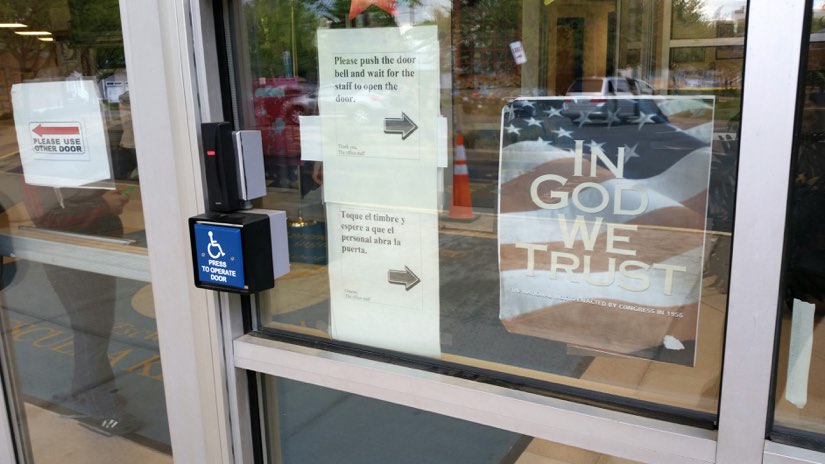
In God We Trust sign in front of Key Elementary (photo courtesy Frederico Cura)They mandated pushing on the state’s children — of diverse backgrounds and religious beliefs — state-sponsored religion in taxpayer-funded, government-run public schools.

I discovered this when I went to my kids’ elementary school in Arlington and noticed a large prominent sign next to the front door with “In God We Trust” superimposed on an American flag. It felt like a throwback to Cold War efforts to set ourselves apart from the communist Soviet Union.

After some inquiries, I learned that the General Assembly mandated that all public schools in Arlington, and across Virginia, put up that sign. (The words are based on the advice in Proverbs 3:5 — “Trust in the Lord with all your heart.”)

Some may think this isn’t a big issue. Kids may not pay much attention to symbols and tend to adapt to just about anything. But imagine for a moment being a 10 year-old raised Unitarian or Buddhist, or having atheist or agnostic parents, and you see that powerful, patriotic symbol every day when you come to school just before you recite the Pledge of Allegiance. How welcome would that sign make you feel?

We know what most kids want more than anything – to fit in. We want our professional learning communities to be welcoming places where ALL children can maximize their talents and become productive members of society.

(more…)


View More Stories