Startup Monday header

Sponsored by Monday Properties and written by ARLnow.comStartup Monday is a weekly column that profiles Arlington-based startups and their founders, plus other local technology happenings. The Ground Floor, Monday’s office space for young companies in Rosslyn, is now open. The Metro-accessible space features a 5,000-square-foot common area that includes a kitchen, lounge area, collaborative meeting spaces, and a stage for formal presentations.

There’s some cool stuff going on inside Two Six Labs, a security technology company based in Ballston.

Two Six Labs works in research and development, primarily with the Department of Defense and other government agencies like DARPA. The company’s offices are a mix of segmented workspaces and mechanical workshops.

The company was founded in 2010 as tech company Invincea’s lab group. The group moved to Ballston in 2013 to be closer to the government clients. In early 2017 the group broke away from Invincea and took on its new name.
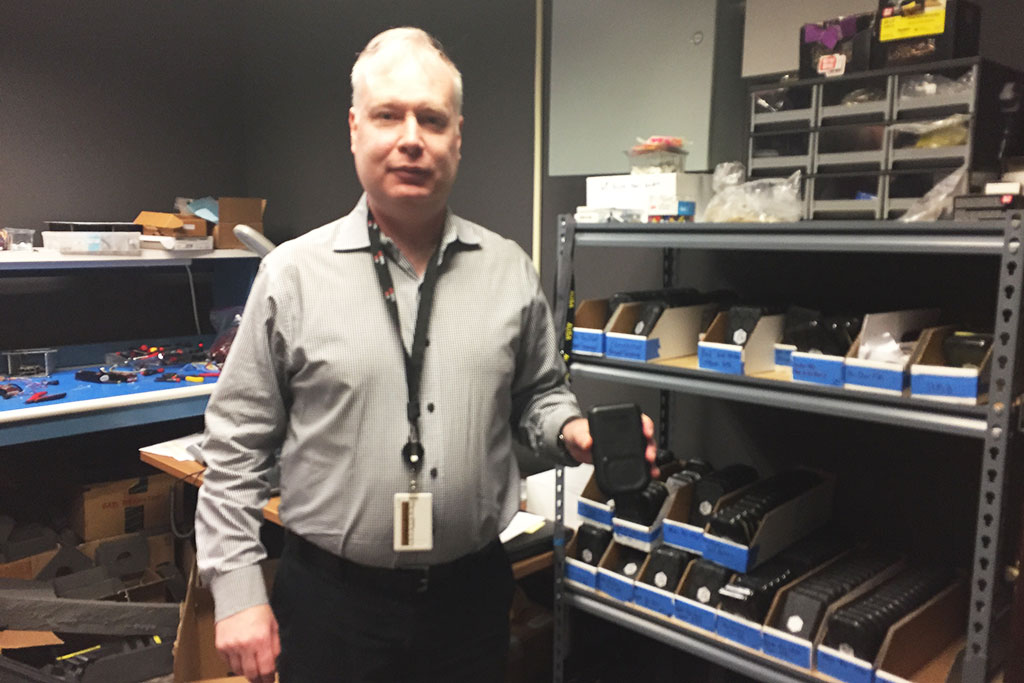
Chris Greamo, President and CEO of Two Six Labs, said the group is currently almost entirely supported by government contracts. Over the next few years, Greamo said one of his goals is to shift that balance to about 60 percent supported by government contracts and thirty percent by commercial ones, typically with a private sector variant of the technology developed for government use.

One recent example is Sigma, a low-cost radiation monitoring device. Greamo referenced the unexploded pipe bombs sent across the country last week and said his nightmare would be a radiological version of those bombs. Greamo said enough of them scattered across a wide area can provide a comprehensive net of coverage to catch those types of threats

“Imagine if every police car could monitor for those types of threats,” said Greamo.

DARPA’s contract with Two Six Labs also allows the company to retain the rights to their products, meaning Sigma will soon be commercially available to hospitals or large stadiums.

There was talk that DARPA might leave Ballston, but when the organization stayed Two Six Labs doubled down on their presence in the area. Greamo said the group had continued to grow and expand at its current location on the fourth floor of The Ellipse (4350 Fairfax Drive) but eventually reached a point where they were too large for the building.

Last Wednesday (Oct. 24) the company announced it would be moving to Ballston Metro Center at 901 N. Stuart Street, increasing from 19,000 to 29,798 square feet.

The group has also expanded across the country, with offices in Mount Laurel, San Antonio, Austin and Tacoma, but Ballston remains the central location for the company. Greamo also said the group is hoping to expand in the region and is looking for a new office in Northern Virginia because many employees are finding the commute untenable. Greamo said the group is looking at Reston in particular, likely avoiding Tysons because of the area’s reputation for heavy traffic.
Startup Monday header

Sponsored by Monday Properties and written by ARLnow.comStartup Monday is a weekly column that profiles Arlington-based startups and their founders, plus other local technology happenings. The Ground Floor, Monday’s office space for young companies in Rosslyn, is now open. The Metro-accessible space features a 5,000-square-foot common area that includes a kitchen, lounge area, collaborative meeting spaces, and a stage for formal presentations.

While most Startup Monday articles profile a local business getting off the ground, today’s feature highlights Startup Arlington: an initiative aimed at bringing those businesses to Arlington.

Startup Arlington is an annual competition hosted by Arlington Economic Development that invites applications from promising startups that would be interested in moving to Arlington County. Applications for the latest round are available online and due Nov. 2.

The application consists of basic personal and company information, assessment of company growth/financial traction and the submission of a business plan and pitch deck.

Judges will review applications based on the overall strength of the team and the team’s knowledge of the market. The viability of the product, service, or technology will also be rated alongside an assessment of the company’s revenue and financing plans.

The winner of Startup Arlington will receive:

  • Three months of free living space in Rosslyn Residence Inn hotel
  • Three months of free office space in a coworking facility
  • Legal advice for the new business
  • Complimentary gym access
  • A stipend for public transportation fees

A full list of rules is available online, but in general applicants to Startup Arlington must be:

  • The CEO and/or founder (or co-founder) of an existing tech company
  • At least 21 years old at the time you complete your application
  • Able to live in Arlington County throughout the competition period

Winners of the competition must relocate to Arlington for at least four months. The startup also cannot be a business that is already located in Arlington or the Washington, D.C. region.

The previous year’s winner was GreenSight Agronomics, a system that converts drone imagery into actionable information.


Sponsored by Monday Properties and written by ARLnow.com, Startup Monday is a weekly column that profiles Arlington-based startups and their founders, plus other local technology happenings. The Ground Floor, Monday’s office space for young companies in Rosslyn, is now open. The Metro-accessible space features a 5,000-square-foot common area that includes a kitchen, lounge area, collaborative meeting spaces, and a stage for formal presentations.

Ballston-based startup Fend is working to make infrastructure assets un-hackable.

“The goal is to protect infrastructure from cyber attacks,” said Fend’s founder Colin Dunn. “That’s everything from the electric supply to water systems. What worries me is hackers taking down our services.”

Dunn said he was frustrated looking at new technology being developed for infrastructure development that was turned down because of cybersecurity concerns.

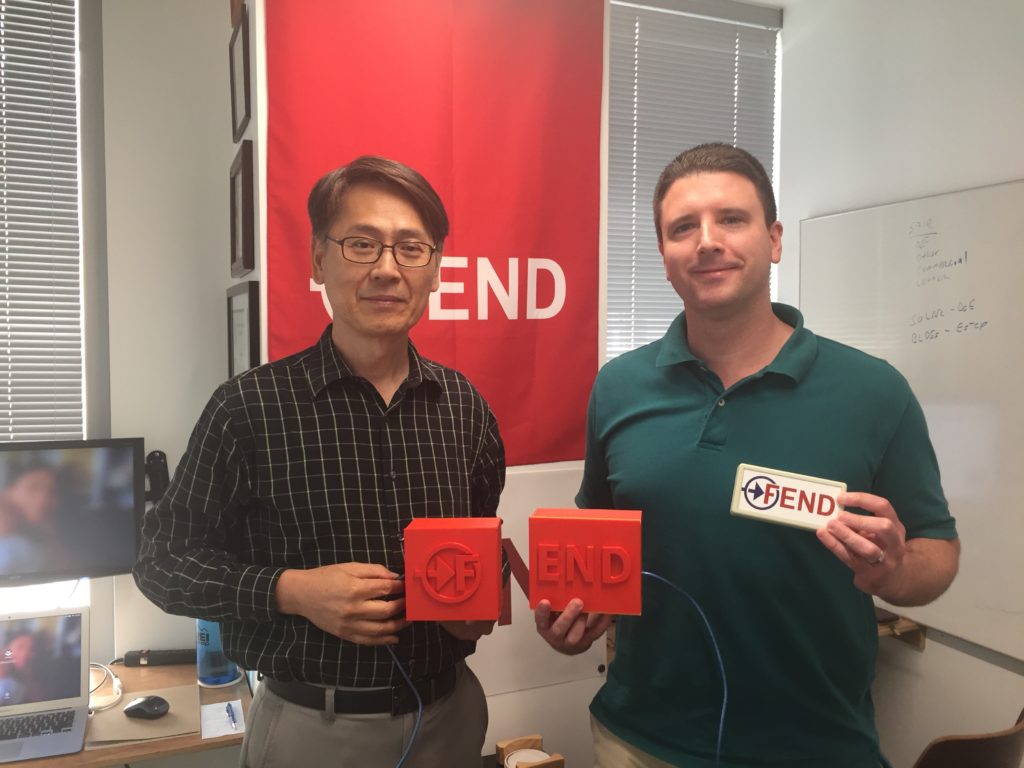
Fend’s hardware is a device inserted into the data stream connecting industrial equipment (the asset) to cloud network stream. Information comes in from the asset, like a power plant or a truck, into one half of the device. That data is converted into a unidirectional beam of light fired into the second half of the device, which then sends the information into the network.

Because the information is physically transported in a one-way beam, there’s no opportunity to use the hackable network to access the asset. Dunn says Fend allows equipment operators to receive live updates on the assets without concern that the asset could be compromised.

According to Dunn, the technology adapts technology that has been used to defend nuclear power plans and the intelligence community but makes it easier to use and more price accessible for building owners or local governments.

Fend started in 2017 out of Smart City Works, a business accelerator in Reston, but has since moved to Techspace, a shared office space in Ballston. It was awarded a Department of Energy Small Business Innovation Research award earlier this year for the technology’s potential to help protect solar farms. According to the Department of Energy, the technology could prevent large-scale economic disruption.

The funding from the Department of Energy has allowed Dunn to bring on another full-time employee, Sang Lee, who is now the chief engineer for Fend, and move forward into a pilot phase. The first batch of 10 units are currently under construction in Charlottesville and will be ready in four to five weeks.

Dunn said the program is scheduled for six weeks of pilot testing as Dunn starts to work on developing clients. Currently, Dunn says the company has one outside investor, but Fend will be looking for more investors and clients as the program looks beyond the pilot into full-scale implementation.


Sponsored by Monday Properties and written by ARLnow.comStartup Monday is a weekly column that profiles Arlington-based startups and their founders, plus other local technology happenings. The Ground Floor, Monday’s office space for young companies in Rosslyn, is now open. The Metro-accessible space features a 5,000-square-foot common area that includes a kitchen, lounge area, collaborative meeting spaces, and a stage for formal presentations.

Joanne Sonenshine says she did the “typical rotation” after arriving in Washington as a development economist 16 years ago.

She started off working for the federal government, then moved to a lobbying firm before ending up at a large nonprofit, all while working on issues in developing countries. But no matter what hat she wore or organization she worked for, she couldn’t shake the feeling that she wasn’t making as much of a difference as she might like.

“It became very clear that what was needed to make the most difference for some of these communities was someone to come in and be much more straightforward and clear about partnership building,” Sonenshine told ARLnow. “Bringing together nonprofits, governments, the private sector… and I thought a company could help fill that gap.”

So, on one long airplane ride, Sonenshine drew up a detailed methodology for how someone might convene all those various groups together around an issue like tackling poverty, or food insecurity. She showed it to a few friends and colleagues and got some positive feedback, so she quickly decided to “make the jump” and start a consulting firm of her own.

Sonenshine founded Connective Impact in 2014 in Bluemont, her home with her husband since moving to the area back in 2002. Though it started off as a one-woman operation, she says it’s since grown to include two full-time employees and a part-time researcher, and is currently funded entirely by herself and a small circle of “family and friends.”

She says the business now has “anywhere from three to 10 clients” at any given time, depending on the season, and they run the gamut from large corporations to renowned nonprofits to governments themselves. Past clients have included Nespresso, Oxfam and the United States Agency for International Development.

Her goal with all of her clients is to organize people around causes with “social, environmental and economic impact,” with a focus on developing nations.

For instance, if a large company is looking to reduce poverty in nations that help form the backbone of its “supply chain,” Sonenshine says Connective Impact would be able to step in. Her company could help the company connect with “local partners in communities” to achieve that goal, or even provide a connection to some of its competitors to understand how the industry might be worsening poverty in a country with its business practices.

“We can do the same thing on the nonprofit side,” Sonenshine said. “We can connect them with governments, local communities… just be much more specific about roles and responsibilities, about who should be working on what.”

Eventually, she hopes to expand her staff and begin developing workshops and seminars to offer independently of Connective Impact’s consulting work, to essentially export the work her company does elsewhere.

But no matter how much the company expands, she doesn’t plan on leaving Arlington anytime soon.

“We just love the school system and love working in Arlington,” Sonenshine said. “It’s always had such a great community feel.”


Sponsored by Monday Properties and written by ARLnow.com, Startup Monday is a weekly column that profiles Arlington-based startups and their founders, plus other local technology happenings. The Ground Floor, Monday’s office space for young companies in Rosslyn, is now open. The Metro-accessible space features a 5,000-square-foot common area that includes a kitchen, lounge area, collaborative meeting spaces, and a stage for formal presentations.

A Rosslyn-based security startup has pulled in $11 million in new funding.

LiveSafe announced the news last Wednesday (Sept. 26), noting that the new capital will help the company “further build out” some of its software offerings and expand its sales and marketing efforts.

The company was founded back in 2012 with a focus on campus security, in particular — co-founder Kristina Anderson is a survivor of the Virginia Tech shooting — but the startup has since expanded its scope to include a whole range of organizations looking to secure buildings or large events.

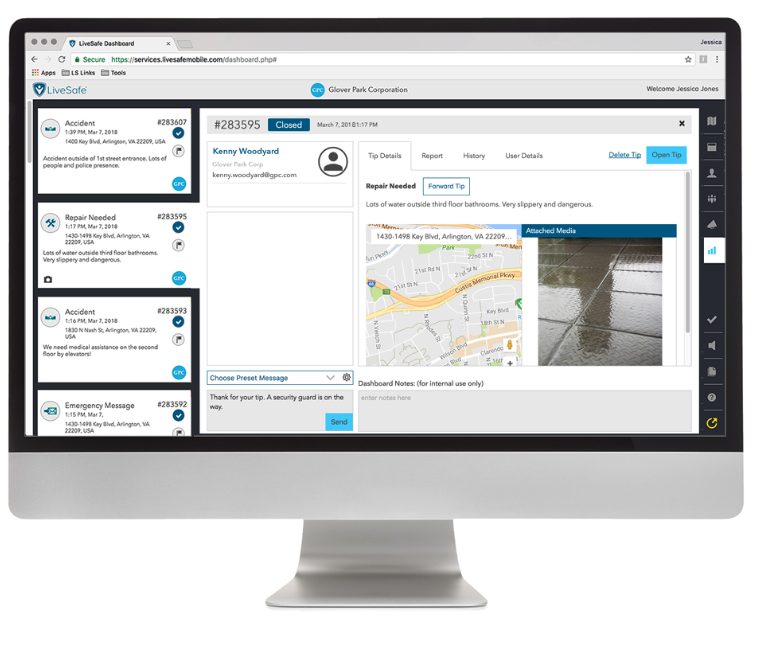
LiveSafe offers both a mobile app and a “command and communications” dashboard, in order to help businesses and universities alike collect information from employees or students about potential problems in the workplace. The company aims to protect the privacy of these reports, which can run the gamut from instances of sexual harassment to threats of violence from a coworker.

“Twenty-first century corporate leadership must treat safety, security, and incident prevention as a business priority,” Carolyn Parent, LiveSafe CEO, wrote in a statement. “The majority of costly, small- and large-scale risks that threaten organizations are known by some employees. It is critical that organizational leaders tap into their greatest sources of incident prevention intelligence — their people. Our mission is to enable companies to surface these risks via crowd-sourced intelligence to prevent any harm from occurring.”

LiveSafe says it now boasts more than 300 customers across the country, up from around 50 just three years ago. Those clients include major firms like Hearst and Cox Communications, and even sports teams like the San Francisco 49ers.

The Crystal City-based Consumer Technology Association, a lobbying group for some of the nation’s largest tech firms, has also started working with LiveSafe to collect data ahead of its massive “CES” conference in Las Vegas.

“We use several strategies to focus on attendee safety and our relationship with LiveSafe provides an important additional layer to our security operation,” CTA President and CEO Gary Shapiro wrote in a statement. “The LiveSafe technology seamlessly connects our security professionals directly with the event’s hosts, guests, and vendors, enabling open and anonymous communication about potential incidents and concerns. This helps our safety and security experts to act preemptively, discovering incidents before they can develop into crises.”

LiveSafe got started in a co-working space for startups, but moved to an office on the ground floor of 1400 Key Blvd in 2013, where it remains based today.

The company says this latest round of funding was part of a “Series B-1 extension,” with roughly half of the new $11 million coming from new investors and the rest coming from firms which had previously chipped in for the company.

Two of LiveSafe’s co-founders, Shayan and Eman Pahlevani, have since founded another startup in Clarendon: Hungry.

Photo via LiveSafe


Sponsored by Monday Properties and written by ARLnow.comStartup Monday is a weekly column that profiles Arlington-based startups and their founders, plus other local technology happenings. The Ground Floor, Monday’s office space for young companies in Rosslyn, is now open. The Metro-accessible space features a 5,000-square-foot common area that includes a kitchen, lounge area, collaborative meeting spaces, and a stage for formal presentations.

(Updated at 1:30 p.m.) Cybersecurity is an ongoing and growing concern in the corporate sector, but IT security company Praetorian seeks to help test corporate security networks and make the internet a safer place to do business.

Praetorian started in Austin, Texas in 2010, but recently opened their office inside Techspace in Ballston this summer. Matthew Eble, Practice Director at Praetorian’s Arlington branch, said the move to Arlington was prompted by the local talent base — namely, the large number of active duty military and veterans in and around Arlington.

“We find that people who are most successful in what we do are disproportionately former military,” said Eble. “We wanted to focus on where the expertise is.”

In addition to Arlington, Eble said there are plans to expand elsewhere on the East Coast as the company grows, though the Ballston office is likely to remain the biggest of the satellite locations.

“There’s a massive supply and demand mismatch in cybersecurity,” said Eble “There is a lot of need for cyber security expertise.”

Praetorian sets itself apart by focusing on the attacker perspective, Eble said — instead of providing a general defensive structure, Praetorian probes system networks to find vulnerabilities.

“There are people that defend a network, that’s risk management, but there’s a lot of need for understanding what the attackers [look for],” said Eble. “We help clients solve those security problems.”

Eble said companies start with a network penetration test to find the holes in a security system that attackers could exploit. These vulnerabilities can range from hardware to software-related issues.

Beyond network testing, Praetorian works with clients to develop a roadmap for greater security coverage to help organizations prevent, detect, and respond to security threats.

There are six employees at the Arlington location but around 50 overall in the company. That includes 30 engineers, who work directly with clients, according to Eble.


Startup Monday header

Sponsored by Monday Properties and written by ARLnow.comStartup Monday is a weekly column that profiles Arlington-based startups and their founders, plus other local technology happenings. The Ground Floor, Monday’s office space for young companies in Rosslyn, is now open. The Metro-accessible space features a 5,000-square-foot common area that includes a kitchen, lounge area, collaborative meeting spaces, and a stage for formal presentations. 

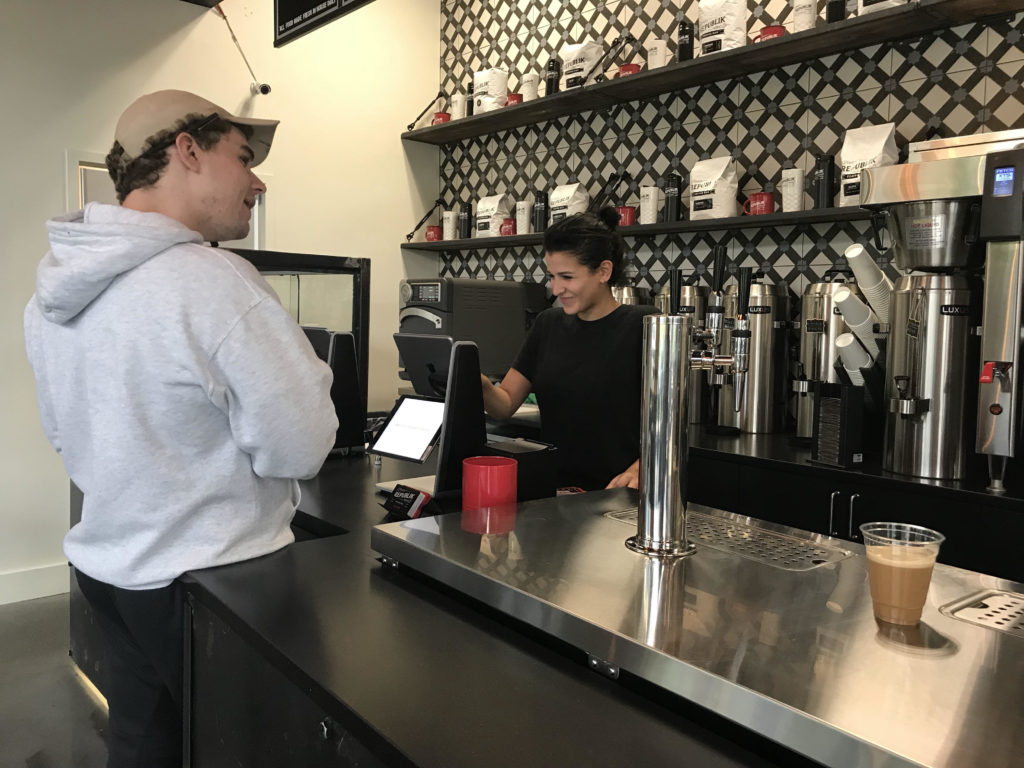
(Updated at 2:10 p.m.) Republik Coffee Bar was founded out of frustration.

Elan Irving, director of operations for Republik Coffee Bar, said when the founders of the coffee bar were looking a premium coffee options in the area, they were underwhelmed.

“We were looking for a place to enjoy premium coffee served in an inviting environment staffed by friendly baristas with a pleasant ambiance,” said Irving. “Surprisingly, there are very few places that embody all of these qualities, so we decided to provide such space for like minded coffee lovers.”

Irving said the largest challenge that faced the burgeoning company initially was finding a price balance.

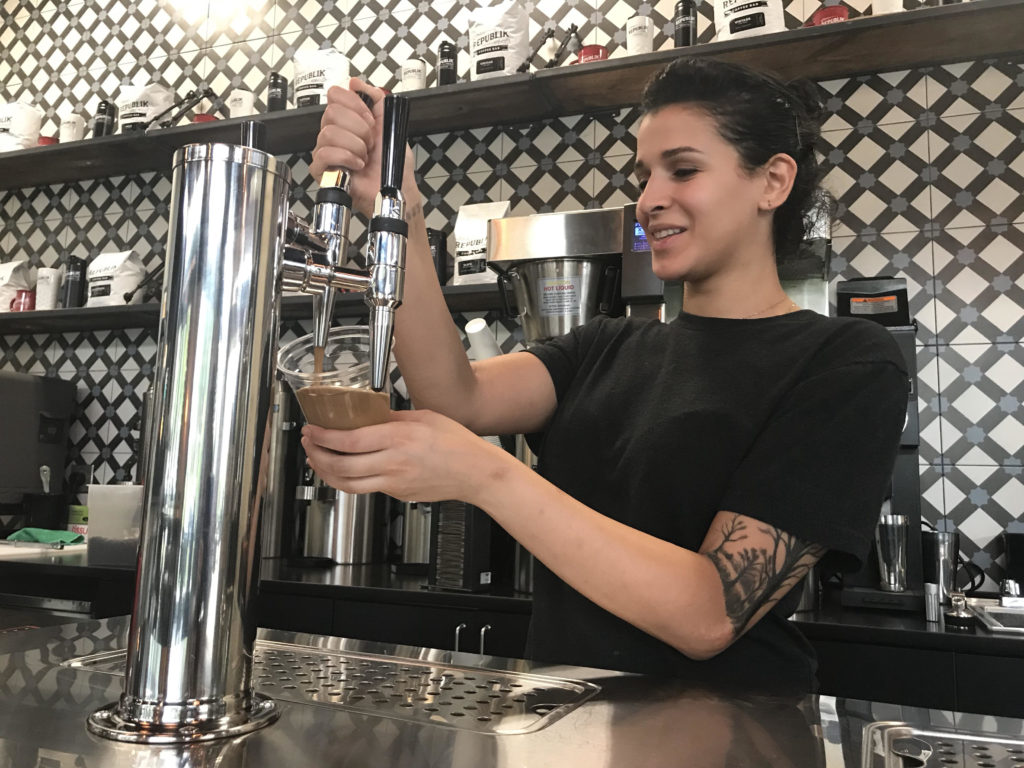
“One of the challenges is to keep prices low without sacrificing on the quality of the product as well as keeping a staff of highly qualified baristas,” said Irving. “We were always in pursuit of better coffee, better brewing methods, and very competitive prices. We don’t believe in charging $5 for a six-ounce cappuccino.”

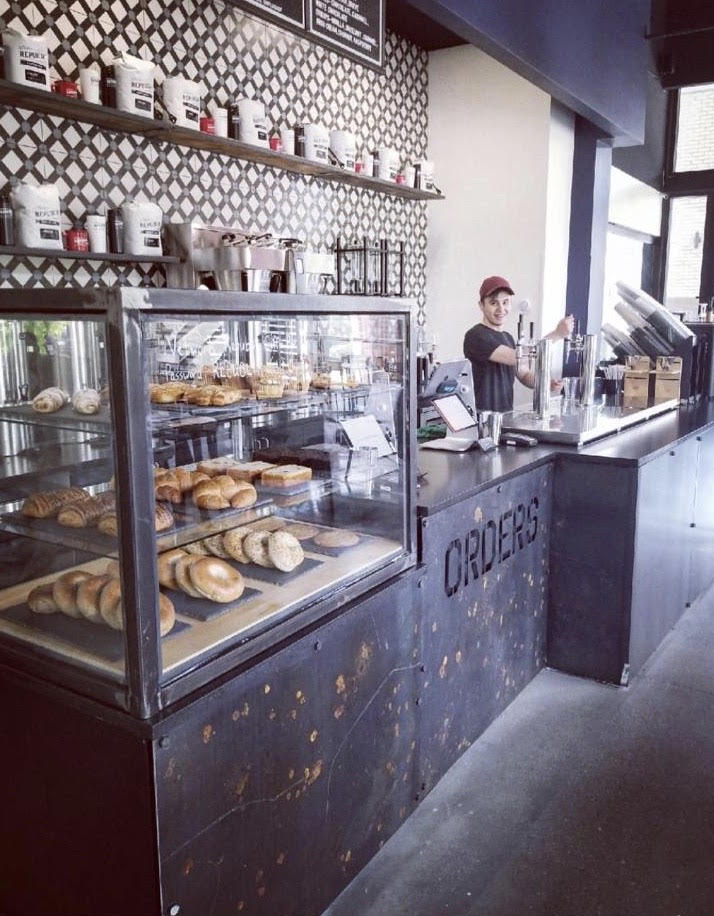
Since launching, Republik Coffee Bar has started an aggressive expansion campaign. Less than one year since its Ballston location opened, Republik has started a second franchise coffee bar in McLean. In six months, Republik plans to open two more locations inside D.C. and eventually another in Fairfax.

“If you are afraid of taking calculated risks, you shouldn’t be in business of investing in new businesses,” said Irving. “This is also true in our business. We are very confident in our concept and very happy to see the response we received in Ballston. This has encouraged us to expand into other locations.”

For now, Republik Coffee Bar is local, but the chain has much larger ambitions if the continued regional launches go well.

“Our short term goals are establish our brand into a very respectable local brand in the D.C. metro area,” Irving said. “If we are successful in achieving this, we will continue to expand regionally and then one day, nationally.”


Sponsored by Monday Properties and written by ARLnow.com, Startup Monday is a weekly column that profiles Arlington-based startups and their founders, plus other local technology happenings. The Ground Floor, Monday’s office space for young companies in Rosslyn, is now open. The Metro-accessible space features a 5,000-square-foot common area that includes a kitchen, lounge area, collaborative meeting spaces, and a stage for formal presentations.

Before virtually every business’s opening and closing times became available via search engine, Michele and Mathias Hansen developed an app to help people find grocery store and coffee shop hours near them.

In order for nearly 5,000 stores to be displayed in that app, which launched in 2013, they needed to convert addresses to latitude and longitude coordinates.

“Whenever you see a map online… the addresses are always converted to latitude and longitude first,” Michele Hansen said. “A computer doesn’t really understand an address, but it understands coordinates.”

The services available to perform that conversion had several shortcomings, and the married couple knew there had to be a better way. So, they came up with it.

Geocodio, which launched in Jan. 2014, makes that address to coordinate conversion and goes beyond it, offering services like data appends that enable users to get congressional district and timezone information with their lookups.

“What we focus on is trying to make things as easy as possible,” Michele Hansen said. “No one sits around and collects latitude and longitude coordinates for the fun of it.”

With other services, if you needed to convert more than 2,500 addresses a day, you had to upgrade from free use to a $20,000 per year enterprise license, Michele Hansen recalls.

Looking up 5,000 addresses, the number the Hansens had needed for their app, costs $2 on Geocodio without add-ons.

And with other services, “you weren’t allowed to store that crucial information in your database so that you could show the map later,” Michele Hansen said. “Conversely, with our services, you can just get it once… and then you can store the database and never need it from us again.”

Geocodio’s clients “run the gamut,” and include academics studying elections, insurance companies looking to understand the risk of insuring a property and “the website that our daughter’s swim team uses to coordinate scheduling,” Michele Hansen said.

“We have 18,000 companies using the service, or thereabouts,” she added.

Geocodio works as a “foundational building block where we [are] sitting behind a curtain and providing the data that other apps need to shine, essentially,” Mathias Hansen said. “It’s crazy how many different use cases there are.”

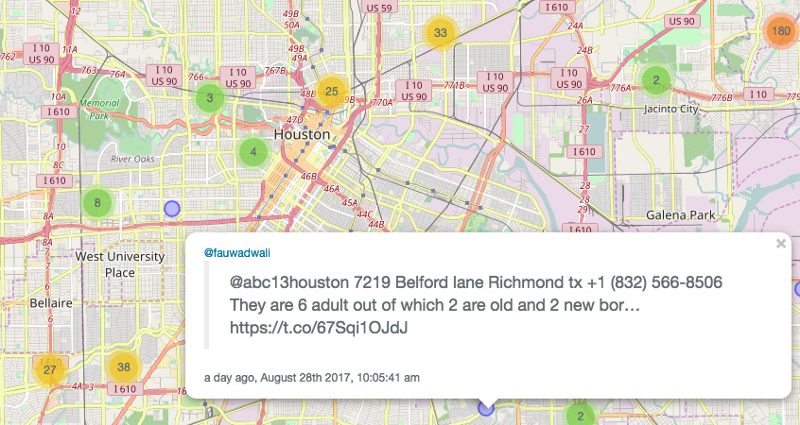
In one innovative application of their service, the Hansens created a map based on addresses individuals stranded during Hurricane Harvey posted to Twitter.

After they stayed up until 2 a.m. building the map, “I sent out an email to anyone on our customer list who had either a Red Cross email or had something to do with Texas,” Michele Hansen said.

Though “we can’t say for sure whether we helped anyone get rescued,” she said, “we did have a couple of organizations reach out to us asking to use it.”

Michele Hansen has worked on the company full-time since last fall, while Mathias works on it part-time. Geocodio has been funded via bootstrapping so far.

“We’re not opposed to [investment], it’s just that we have never needed it,” Michele Hansen said.

Going forward, Michele and Mathias Hansen plan to continue to listen to their customers and work to improve their service.

“From the beginning, we set out to solve those frustrations that we have, and so it’s very important to us to be affordable and easy to work with,” Michele Hansen said, “And not just stand over our customer’s shoulders and nitpick them about how they’re using our service and the data they’re getting back from it.”

Photos courtesy Michele Hansen


Sponsored by Monday Properties and written by ARLnow.com, Startup Monday is a weekly column that profiles Arlington-based startups and their founders, plus other local technology happenings. The Ground Floor, Monday’s office space for young companies in Rosslyn, is now open. The Metro-accessible space features a 5,000-square-foot common area that includes a kitchen, lounge area, collaborative meeting spaces, and a stage for formal presentations.

As student debt continues to mount, Vemo Education is working to build a different way for students to finance some of their tuition bill.

“We consider ourselves a progressive, mission-driven company that’s really trying to expand opportunity and mobility and financial security for students and learners in this country,” Vice President of Policy and Social Impact Andrew Platt said. “We think income-based financing programs [are] going to help do that.”

Income-based student financing programs, also known as income-sharing agreements or “pay as you succeed tuition,” require students to pay back a certain percentage of their income after graduation for a set number of years in exchange for some amount of tuition financing.

“What we do is help universities, colleges and training [programs] build income-based financing programs to eliminate financial barriers for education access, retention and completion,” Platt said.

Vemo Education, which was founded in 2015 and moved to Rosslyn just last month, has worked with over 30 schools to date to build such programs.

Accepting income-based financing as part of an aid package can be preferable to taking out more loans because it reduces the student’s risk, Platt said.

“What’s at the core of this is that it shifts the risk away form students and more towards the school,” he said.

Options to garner financing for these programs for schools include using endowments and working with investors or gathering alumni donations.

When Vemo Education works to develop income-based financing options, they look to build in three “very student friendly” features, Platt said: a minimum income threshold, a maximum number of payments and a payment cap.

“Those are inherently progressive features of an income share agreement that are good for a student in a way that other financing options aren’t,” Platt said.

Vemo Education is a venture-backed company that has raised around $9.4 million, Platt said. Holding at 39 employees as of mid-August, Platt said they’re looking to grow.

Vemo Education has worked with institutions such as Indiana’s Purdue University and New York’s Clarkson University to establish income-based financing programs, and Platt expects their clientele to increase in the near future.

“We think over the next couple of years, we’ll help more and more schools, particularly large schools, understand and implement and launch large income-based financing programs for efforts of increasing educational opportunity and mobility,” Platt said. “I think over the next year you’ll see some pretty big announcements in terms of who’s doing [it].”

Photos via Twitter


Sponsored by Monday Properties and written by ARLnow.com, Startup Monday is a weekly column that profiles Arlington-based startups and their founders, plus other local technology happenings. The Ground Floor, Monday’s office space for young companies in Rosslyn, is now open. The Metro-accessible space features a 5,000-square-foot common area that includes a kitchen, lounge area, collaborative meeting spaces, and a stage for formal presentations.

(Updated Aug. 23 at 8:40 a.m.) For people living in countries where many banks have yet to set up shop, even the simple task of paying the bills can require waiting in long lines.

Compounding this problem, family members living abroad, in places such as the United States, can face difficulties sending payments home. And when payments do get sent, there is often “no ability to see where it’s being spent… or peace of mind to make sure the basic services are being paid,” Nelson Irizarry said.

Enter PayKii. Founded in 2015 by Irizarry, Fabian Saide and Daniel Barragan, PayKii processes cross-border bill payments to allow “individuals living outside their home countries to directly pay expenses” for family back home, said Irizarry, who serves as the company’s chief operating officer.

To make this possible, PayKii builds relationships with money transfer operators like Xoom along with local “bill payment aggregators,” which can include technology companies and banks, Irizarry said.

“On one end, our clients are primarily the money transfer operators, and then on the other end we have… a local partner, and they’re the ones that are connected with all the utility companies,” Irizarry said.

PayKii’s transfers are “primarily what we call from rich countries to poor countries,” Irizarry said. “U.S. outbound is one market that we’re very active in.”

Since its founding, PayKii’s staff has grown from three to twelve members, divided between headquarters in Arlington and Monterrey, Mexico.

Just last month, PayKii closed a “Seed Series” investment round worth $1.5 million, Irizarry said. Through that round, they brought on Alta Ventures and Assembly Capital Partners as investors, he said.

In all, PayKii processes over 100,000 transactions per month in 13 markets. By the end of the year, the company hopes to establish a presence in “upward of 24 markets,” Irizarry said.

“Our primary focus is building a platform and building relationships,” he said.

Photos via Facebook


Sponsored by Monday Properties and written by ARLnow.com, Startup Monday is a weekly column that profiles Arlington-based startups and their founders, plus other local technology happenings. The Ground Floor, Monday’s office space for young companies in Rosslyn, is now open. The Metro-accessible space features a 5,000-square-foot common area that includes a kitchen, lounge area, collaborative meeting spaces, and a stage for formal presentations.

When schools, booster clubs, scout troops or any number of other organizations need support, they often turn to their communities with a product for sale.

But when Mark Abbott’s kids had to fundraise with products  “that were expensive and not healthy,” it “just did not seem like a 21st century solution to the problem of under-resourced schools,” Abbott said.

So, Abbott founded FarmRaiser, an online platform “with a goal of creating healthy fundraisers that also helped local farmers and food artisans,” that launched in May 2015, Abbott said.

FarmRaiser, which moved to Crystal City in 2017, connects organizations looking to fundraise with local suppliers of goods like fresh produce, dark chocolate and granola.

Typically, the cause and suppliers share sales revenue in about a 50/50 split, with a small amount going to FarmRaiser, Abbott said.

FarmRaiser also works with “food aggregators” like The Common Market to “get product to all of our schools” from the local sellers, Abbott said.

The model FarmRaiser uses looks to benefit all parties involved — in school fundraisers, for instance, students can learn about the benefits of eating healthy, local food, Abbott said. For community members purchasing FarmRaiser goods, “you know that a good portion of your check went to the cause,” he said. And suppliers on the FarmRaiser platform can support good causes in a way that benefits them “as well as the cause,” Abbott said.

“At the very end of the campaign… the supplier gets a check for the amount of goods that were ordered and they get email contacts for all of the folks who have bought that product,” Abbott said.

In 2017, over $600,000 worth of merchandise was sold through the FarmRaiser platform, Abbott said. This year, they expect that number to increase between three- and four-fold.

“A good portion of that growth [is] coming from other types of companies that are doing fundraising now,” Abbott said, like garden seed companies or cut flower stores.

Those companies adopt FarmRaiser’s system, which “is pretty much automated from A to Z,” Abbott said.

FarmRaiser is a “venture-backed company,” Abbott said. They’ve done two full rounds of funding, through which they raised “just over a million dollars,” supporting two versions of the platform, Abbott said. They’re also closing a seed series round that includes funding from angel investors and Virginia’s Center for Innovative Technology.

“The goal is to grow big enough that we can do maybe an institutional round of funding before we’re self-sufficient,” Abbott said.

In measuring the success of the company, “of course, common metrics for us are the amount of merchandise that’s sold on the platform, but we also think about… the amount of kind of sugar and preservatives that we divert from family households,” Abbott said. Whenever someone sells a healthier product, “we consider that a win.”

Photos via Facebook


View More Stories