
Startup Monday header

Editor’s Note: Sponsored by Monday Properties and written by ARLnow.com, Startup Monday is a weekly column that profiles Arlington-based startups and their founders. The Ground Floor, Monday’s office space for young companies in Rosslyn, is now open. The Metro-accessible space features a 5,000-square-foot common area that includes a kitchen, lounge area, collaborative meeting spaces, and a stage for formal presentations.

PaperCardShop's cardsGlen Homan was “semi-retired” and spending his time trading stocks when inspiration hit him to create his own startup company.

Shopping in CVS for an anniversary card for his wife, Homan couldn’t find anything to his satisfaction and found the whole experience “unpleasant.” With some time on his hands and motivation to try something new, he launched PaperCardShop.com in December 2011 with the hope of helping people avoid the same experience.

Since the site launched, Homan said he’s “having trouble finding traction” in the market. He hopes to soon raise money from investors to launch a marketing campaign, putting his company on sites like Angel.co. Eventually, he said, he believes his site has the ability to dominate the market.

“The greeting card market is about $7.5 billion,” Homan said. Most card sellers “have chosen not to sell their cards online. We’re the only general purpose online greeting card store. That’s pretty odd.”

PaperCardShop’s key is a patent for Homan’s browsing platform, InstaView. The website displays each card’s front and inside as a user’s cursor drags over the card. Each image is of the actual hard copy of the card, photographed by Yorktown High School graduate J.P. Tribby.

A screenshot of PaperCardShop.com“People have been selling greeting cards the same way for 100 years,” Homan said. “With innovation, you generally think of new products like an iPhone, but there’s also innovation in product presentation. With InstaView, people could save millions of hours shopping for cards.”

Homan worked in advertising in Chicago before moving to Virginia and starting Flar Graphics, a print and poster store that once had three locations around the D.C. area. Homan sold Flar Graphics about 20 years ago, he said, and hadn’t started a new venture since.

“I was itching to do something instead of just trading stocks,” he said. “It just sort of bothered me that such an inefficient market existed for greeting cards.”

In 2010, he made the decision to try to solve the online card market. He set about looking for web developers, which is what he called the hardest part of the process. Developers “are kind of like prima donnas,” he said, and many of them weren’t open to changes he suggested.

Glen Homan of PaperCardShop

While he was looking for developers, he was contacting artists across the country, buying cards for the site. Homan said he “cherry picks” the best cards from independent publishers, trying to find a wide range and variety. He relied on his own judgment for many of the cards, but was sure to ask the artists which ones sold best, and ask friends and family members their thoughts.

He eventually found a web developer, with whom he created the InstaView system. Homan works largely out of his home and has piles of boxes of greeting cards in his basement, which he ships himself.

Because the greeting card business has low overhead, Homan said he “can hang on indefinitely” until traffic on the website — and with it, sales — picks up.

“It’s an untapped e-commerce opportunity,” he said. “It’s one of the most profitable e-commerce niches, and there’s no competition. The challenge is to change consumer buying behavior in a low-involvement product.”

If Homan can get enough people to think about buying greeting cards online, instead of sifting through the racks in stores, he thinks PaperCardShop can “become the dominant player in the market.”

“We have a great proposition for consumers,” he said. “The market needs to move online. Eventually, that’s the way the market is going to go, it’s just a question of when.”

Photo (bottom) courtesy Glen Homan

Startup Monday header

Editor’s Note: Sponsored by Monday Properties and written by ARLnow.com, Startup Monday is a weekly column that profiles Arlington-based startups and their founders. The Ground Floor, Monday’s office space for young companies in Rosslyn, is now open. The Metro-accessible space features a 5,000-square-foot common area that includes a kitchen, lounge area, collaborative meeting spaces, and a stage for formal presentations.

Two years ago, every major healthcare provider was facing a massive change in the way they would operate when the Affordable Care Act was signed into law, and almost none of them knew exactly what was changing.

Frank Williams was the CEO of The Advisory Board Company — a healthcare consulting firm — when he and his colleagues realized the knowledge gap was not just a burgeoning problem in their industry, it was an emerging market.

“We were going through a massive change of service that was massively complex, and no one knew how to do it,” Williams said.

Evolent logo at its Ballston officeWith a $25 million investment from The Advisory Board and the University of Pittsburgh Medical Center, Williams helped launch Evolent Health two years ago, with a mission to help guide medical providers through the changes in America’s health care system.

Now, Evolent occupies two floors of the new 800 N. Glebe Road building in Ballston, and has a satellite office in San Francisco. Evolent serves MedStar Health in this area, IU Health in Indianapolis and Premier Health in Ohio, among other companies.

Even with a $25 million investment, Williams said the hardest part of launching Evolent was convincing healthcare systems that they needed Evolent’s services.

“We’re talking about a significant vision of transforming the whole organization,” Williams said. “How do you convince a MedStar to work with us?”

Ultimately, Williams said, it was not how much money Evolent raised, but from where. The backing of The Advisory Board and UPMC gave it credibility in the eyes of potential clients.

“UPMC is a $10 billion health system,” he said. “That gave us an immense street credibility.”

Evolent's headquarters in BallstonOnce Evolent signs on with a client, the work doesn’t get any easier. The big shift for providers with Obamacare, Williams said, is providers have to provide healthcare for a population at large, not at a client-by-client basis. Instead of caring for patients only while they are within a hospital’s walls, the new approach Evolent teaches is continual care, including calling patients to check in on their well-being.

Evolent uses massive sets of data to “engage patients with their health,” Williams said. It also helps companies with risk and financial management and sets up businesses’ infrastructure in the new system.

The new system has found resistance, but that comes with all change. Williams said once doctors, nurses and other healthcare workers see the difference — more time with patients, a focus on wellness as opposed to “filling a bed” — they embrace it.

“Everyone needs to think very differently,” Williams said. “You really have to invest time into it, but I think when people see they can spend a lot more time with their patients, they are excited. It’s very exciting.”

Workers at Evolent's Ballston officeEvolent was being conceived before the Affordable Care Act was even passed, and Williams said the months before it was signed into law were “very wobbly.” Even with the debate in Congress before the recent government shutdown and much of the rhetoric during the 2012 presidential campaign, Williams never thought his company’s future was in doubt.

“People had the view that they wouldn’t have to change [if Obamacare hadn’t passed],” Williams said. “Now, they would acknowledge that people are asking for value, and they would have anyway.”

Today, Evolent has close to 400 employees, many of whom work remotely with the clients in cities across the country. Last month, Evolent announced a $100 million investment from TPG Capital, a firm with more than $40 billion worth of global assets.

Now, Williams is focused on being a leader in the market that is brand new, but a part of the largest industry in the country, healthcare. Even though clients signing up for Evolent have to make a big leap of faith, demand has been high, Williams said.

“Market demand has been there more than we expected,” Williams said. “This is a huge potential transformation in the industry and hopefully much better care for all of us. If we’re successful, we’re truly transforming an industry.”


Startup Monday header

Editor’s Note: Sponsored by Monday Properties and written by ARLnow.com, Startup Monday is a weekly column that profiles Arlington-based startups and their founders. The Ground Floor, Monday’s office space for young companies in Rosslyn, is now open. The Metro-accessible space features a 5,000-square-foot common area that includes a kitchen, lounge area, collaborative meeting spaces, and a stage for formal presentations.

TransitScreen display of U Street MetroNot all tech startups are born in a garage, or in coffee shops, with idealistic expectations of disrupting an entire industry or changing the way people interact with each other.

One of Arlington’s more promising startups got its start under the wing of Mobility Lab, an Arlington County-funded transit research organization. TransitScreen began as a fellowship in the Mobility Lab with now-president Matt Caywood and a few colleagues trying to figure out a way to “make transit easier.”

They developed a monitor system that displays up-to-the-minute transit information for the area in which it is displayed. The display shows Metro and buses, but also information about Capital BikeShare stations, streetcars and other transportation options.

The fellowship lasted four months, during which much of TransitScreen was developed, but there was nowhere to go within the Mobility Lab after that.

“We did some interesting and great stuff there, but there wasn’t continuity,” Caywood said. “There was a weird interregnum after that was over because we needed to go commercial. The screens needed support.”

Caywood began to grow TransitScreen along with co-founder Ryan Croft. Initially, TransitScreen was started only in Arlington, then expanded to all of Washington, D.C. This month, TransitScreen installed its first screen in San Francisco — where Croft is currently located — and is in discussions for screens in New York, Boston, Chicago, Los Angeles, Portland, Ore., and Vancouver, Canada.

TransitScreen President Matt CaywoodIn June, TransitScreen was accepted into the Ballston Business Improvement District Launchpad competition, where it is an alternate in the semifinal stage. Caywood spoke to ARLnow.com from the Launchpad’s office in the old Chevy’s restaurant in Ballston, while Croft was on a conference call from his new home base in San Francisco.

Like most tech startups, TransitScreen was formed to solve a problem, Caywood says.

“We had to figure out how to bring all these services together,” he said. “Our goal is to bring all the relevant information to the user in 10 seconds.”

Caywood, Croft and their contracted designers and engineers designed a platform that could adapt to any metropolitan area with a multitude of transit options, but Caywood said the D.C. area was the perfect place to start the experiment.

“Places like Arlington and D.C. are ideal,” he said. “It’s a city that’s committed to transit-oriented development and a population that is open to trying new things. It helps if the decision-makers are familiar with transit. In D.C. and Arlington, everyone who makes the decisions also uses the transit system.”

The screens are designed right now to be an amenity for residential and commercial developments, although TransitScreen does have a partnership with the Columbia Pike Revitalization Organization.

TransitScreen“You turn the screen on and it attracts a lot of attention,” Caywood said. When the screen at the Launchpad office is turned on, passers-by on the street frequently stop and look. “We want to create enough of a presence where people will rely on it for their transit needs.”

Caywood said in the D.C. area, a large percentage of travelers only ever consider Metrorail as an option, and one of his company’s challenges — and opportunities — is to convince travelers to use other options.

“Seventy percent of people use multimodal transportation, whether it’s Metro and bicycle, car and bus,” Caywood said. “But buses are very mysterious. People see them and don’t know where they go or where they come from. People need to be informed, and I think that’s where we’re going.”


Startup Monday header

Editor’s Note: Sponsored by Monday Properties and written by ARLnow.com, Startup Monday is a weekly column that profiles Arlington-based startups and their founders. The Ground Floor, Monday’s office space for young companies in Rosslyn, is now open. The Metro-accessible space features a 5,000-square-foot common area that includes a kitchen, lounge area, collaborative meeting spaces, and a stage for formal presentations.

Dreamwire screenshotOmar Hijaz is about as atypical as any tech startup founder could possibly be.

Hijaz started his product, Dreamwire, after he had a dream about a social network for people to instantly write down and share their dreams. He said he did research and found that there wasn’t an app or program out there for that, so he decided to build it himself. There was only one problem.

Hijaz didn’t know how to write a line of code.

Hijaz, a patent engineer with the U.S. Patent and Trademark Office in Alexandria, spent the next six months of his free time, starting in January 2012, listening to lectures and reading every book he could on coding, then three months building Dreamwire before its first iteration launched last fall.

“Up until then it was a big secret,” Hijaz said. “I didn’t want anyone to steal it. That’s when I realized I didn’t know what I was doing, because I hadn’t talked to anyone about it. People really didn’t like it.”

Dreamwire's Omar HijazThe site was built how Hijaz had dreamt it: users could like each other’s dreams, comment on them and share dreams to different networks. But Hijaz had never taken a design course in his life, and he didn’t anticipate that maybe other people didn’t want everyone to know their dreams.

“Dreams are a really personal thing,” Hijaz said. “What I find out is people want to own their dreams. They don’t necessarily want to share them.”

So the patent examiner went back to the drawing board, taking classes with Design Alexandria — which he has since taken over — beta testing to get feedback, and bringing in some outside help to shape the website. Version 2.0 launched last month, and it’s a much more simplistic, streamlined product.

Dreamwire's Omar Hijaz

Users now can head to Dreamwire and record what they dreamt as soon as they wake up, with a description of the dream and associate an image from 500px, plus describe the dream as nightmare, lucid, recurring or fragmented, plus add the emotion felt upon waking up.

Hijaz knows that very few, if any, users will record a dream every morning. Dreamwire is intended primarily for the dreams that inspire people; like the one that led to Dreamwire’s creation.

“We dream every night,” he said. “Sometimes it’s a good or bad dream, sometimes you wake up from a really amazing dream, and we try to let people capture that feeling. Once you start recording these awesome dreams, it’s going to inspire your life.”

DreamwireHijaz gets home from his day job and works on Dreamwire about “three to four hours, every night,” he said. He is the captain and crew of the company, which is completely bootstrapped. but he said he wants more time to continue to improve the product before he seeks any funding.

In his research for building Dreamwire, the entrepreneur found himself reading almost as much from famous dream researchers like Carl Jung. He reached out to several dream researchers for guidance while building the product, but was a little disappointed with the response.

He acknowledged that university professors also conducting research are exceedingly busy, but remarked “a lot of them are not tech-savvy.”

“You have to really beat it into them that this a powerful tool,” Hijaz said.

He sees the potential for research; after all, if Dreamwire gains traction, it will be perhaps the largest data mine of dreams in the world.

“I think it could be a huge tool, but I’m not really sure how,” Hijaz said. “Everyone dreams differently and would use this differently. I don’t think anyone would know how this would be used.”

The next step for Dreamwire is an app for iPhones and iPads. While he was being interviewed, a large book on programming for iOS (Apple’s mobile operating system) was sitting on the table. He’s also toying with the idea of commenting on public dreams; all dreams are private by default, but users can choose to share them with the rest of the Dreamwire community.

Eventually, Hijaz would like to make Dreamwire his full-time job, but he’s a long way from there. For now, he says he’ll work to expand Dreamwire’s reach and offerings — and continue to dream.


Startup Monday header

Editor’s Note: Sponsored by Monday Properties and written by ARLnow.com, Startup Monday is a weekly column that profiles Arlington-based startups and their founders. The Ground Floor, Monday’s office space for young companies in Rosslyn, is now open. The Metro-accessible space features a 5,000-square-foot common area that includes a kitchen, lounge area, collaborative meeting spaces, and a stage for formal presentations.

Curiosity Media works on its new program, FluenciaChris Cummings was already the CEO of a media company with a language translation website, SpanishDict.com, that was drawing 5 million unique page views a month in 2011 when he graduated from law and business school.

His bootstrapped company consisted only of him and one other employee when he moved to Arlington and decided to poll his visitors, asking, “how many of you are learning Spanish right now?”

With more than 6,500 answers to the survey, 77 percent said they were learning Spanish while using SpanishDict. Cummings, no longer running the site during evenings and weekends, decided to dive into teaching Spanish, not just translating it.

Last month, Cummings and his company, Curiosity Media, launched Fluencia, a Spanish learning program that Cummings says is more modern and data-driven than any that have come before it.

Fluencia3“I’ve always felt we could do a much better job with foreign language education,” Cummings said. “People were not happy with the options out there. Most of them were too boring, too expensive or just didn’t work.”

Now based in The Ground Floor in Rosslyn, Fluencia was primarily built starting in 2012 in a small office above Spider Kelly’s in Clarendon. Cummings said working late on Thursday and Friday nights was “not an option” with the loud music blaring from below, but that didn’t prevent him and his team from building the program, which runs on desktop, tablets and smartphones.

What separates Fluencia from more established programs like Rosetta Stone, Cummings said, is that it’s constantly collecting data on user experience, figuring out what the user is learning and struggling with, and adapting lesson plans accordingly.

“The tools people use to learn are really antiquated,” Cummings said. “The tools we use are so interactive. We stay at your pace, we have native speaker audio, and we collect data on what you’ve learned and bring it right back to you.”

(more…)


Startup Monday header

Editor’s Note: Sponsored by Monday Properties and written by ARLnow.com, Startup Monday is a weekly column that profiles Arlington-based startups and their founders. The Ground Floor, Monday’s office space for young companies in Rosslyn, is now open. The Metro-accessible space features a 5,000-square-foot common area that includes a kitchen, lounge area, collaborative meeting spaces, and a stage for formal presentations.

The Gusto team in its Rosslyn officeAnyone who’s worked in a restaurant remembers the struggles when they first started — remembering orders, doing side work and learning when to check on a table — knows every experience pales in comparison to learning the restaurant computer system.

Brett Guidry has been investing in restaurants for years, and he, with his co-founders Bill Schafer and Bill Draper, knew that the “point-of-sale” (POS) systems in restaurants were ripe for new ideas. So Guidry, Schaffer and Draper launched Dovetail, now known as Gusto, a POS system beginning to roll out in Washington, D.C., restaurants.

Gusto held its launch party in late September, and they’re already in one area business, the Embassy Suites in Chevy Chase. Guidry said when they installed the Gusto system, it took less than a day to train the servers.

Gusto's point-of-sale system“The staff picked it up very quickly,” Guidry said. “It didn’t make them feel dumb. I see people smiling when they use it.”

The Gusto system took more than a year to design — the business was founded in early 2012 — because Guidry and his coworkers knew that full functionality and an optimal design were keys to get restaurants to switch from entrenched industry giants, such as Micros and NCR.

Paramount to the development were the user experience, navigation, ease of use and ease of learning, Guidry said. Gusto also runs on a “hybrid cloud” system, meaning it runs wirelessly over the Internet, but it’s fully capable if the Internet in the restaurant goes down. Managers and owners can also access their financial systems and real-time information from anywhere, a wrinkle that Guidry said has drawn rave reviews.

“The amount of dissatisfaction and frustration in restaurants was stronger than we thought,” Guidry said. “After talking to restaurateurs, it’s much higher than you would expect.”

Gusto's touchscreen point-of-sale systemThese conversations gave the Gusto even more confidence as they were building their product. Guidry realized the market was even more ripe for disruption than he had previously realized.

“If someone’s not in pain, it’s hard to sell them on someone else coming in and solving a problem,” he said.

Although it’s early, Gusto claims it has pinpointed the most profound pain felt in restaurants and found a solution. The next step is curing what ails more and more restaurants. While not ready to announce their next partners, Gusto is ready for any challenge, Guidry says.

“We’ll be able to handle scale,” he said. “From one small restaurant to several thousand locations. We’re an open platform for restaurant technology. Our goal is to be the platform for serious restaurateurs.”

A James Beard award-winning chef has agreed to use Gusto in his upcoming restaurant, but Guidry said he can’t reveal who the chef is or where and when the restaurant will open. There is also discussion with some national chains, but those are preliminary.

Although New York is generally hailed as the food capital of the country, Guidry said D.C.’s burgeoning restaurant industry is the ideal spot for his team’s young business.

“The food scene is expanding in the D.C. area, and there’s lots of new thinking,” Guidry said. “We want to be associated with those new thinkers.”


Startup Monday header

Editor’s Note: Sponsored by Monday Properties and written by ARLnow.com, Startup Monday is a weekly column that profiles Arlington-based startups and their founders. The Ground Floor, Monday’s office space for young companies in Rosslyn, is now open. The Metro-accessible space features a 5,000-square-foot common area that includes a kitchen, lounge area, collaborative meeting spaces, and a stage for formal presentations.

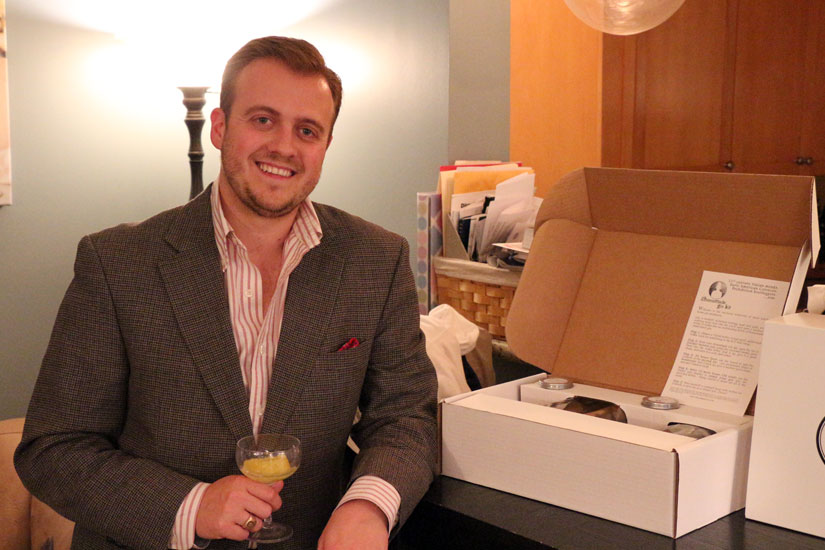
Homemade Gin Kit co-founder Joe MaiellanoAsk what the average person thinks when they hear the words “homemade gin,” their mind will probably go to bootleggers and bathtubs.

Arlington resident Joe Maiellano’s mind, however, goes to high-quality juniper berries and botanicals, a strainer and a funnel.

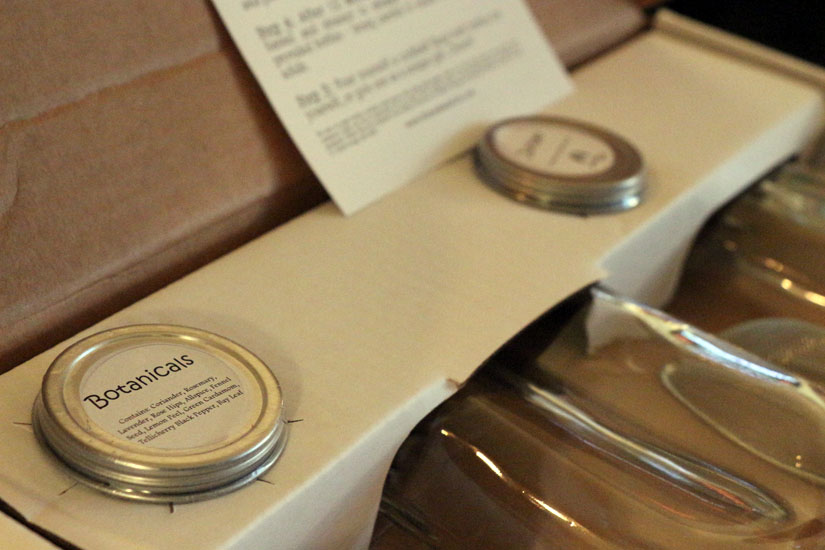
Maiellano founded The HomeMade Gin Kit with his wife, Sarah, and friends Jack and Molly Hubbard last November. The company pre-packages the instruments and ingredients needed to make gin — minus one critical component: vodka — and ships them across the country for $49.95 a box.

Like many startups, the Maiellanos and Hubbards didn’t come together with the idea of shipping out do-it-yourself gin kits. One day, while drinking gin and tonics made from Maiellano’s homemade recipe, Joe and Jack looked at each other decided they wanted to open a distillery together.

It didn’t take long before their research revealed that opening a distillery costs nearly $1 million before a single bottle of spirit is ever produced. The two full-time D.C. professionals had neither the time nor money for that, and the dream almost died then and there.

“Jack said, ‘the recipe is still good,'” Maiellano said. “That’s when we came up with making the kits.”

The HomeMade Gin KitThey ordered Italian glass bottles and all the other components to make homemade gin, and spent a month putting together 250 packages, stacking them “floor to ceiling and wall to wall” in the Maiellanos’ den in their apartment near Potomac Yard.

Once they launched last November, the four entrepreneurs were hoping to sell their 250 kits by Father’s Day, Maiellano said. A month later, they had sold more than 2,500.

“We took vacation days from our day jobs, we brought in family and friends,” he said, “and gave them a kit so they would help us.”

Back then, Maiellano was making trips to the FedEx Office downstairs in his apartment building every day to ship orders coming in on their website. Mere months later, HomeMade Gin Kit is contracting with a storage and shipping facility in Dulles, Va., shipping out truckloads of kits to online retailers like Uncommon Goods and RedEnvelope and negotiating deals with major national retailers.

HomeMade Gin KitThrough it all, Joe and Jack continued their work as fundraisers for D.C. nonprofits, and Sarah and Molly also kept full-time jobs. For The HomeMade Gin Kit team, the project is one of passion: although the bootstrapped company is profitable, Joe said, all of the profits are being reinvested back into the business for now.

In addition to the kit, HomeMade Gin Kit sells refills of the botanicals and juniper berries for $10 apiece. Maiellano recently perfected a Christmas-themed gin — with a flavor reminiscent of a Christmas tree — that the company will sell. It’s the first step toward expanding HomeMade Gin Kit’s product line.

Maiellano wants to build kits for different spirits, as well. His passion for Absinthe led him to try several different recipes, but he couldn’t find one that wasn’t horribly bitter, he said. A spirits perfectionist, he said it took him 12 different tries to finalize the gin recipe he and his co-founders built the business upon.

“I think it’s the best gin-and-tonic gin there is,” he said. “Not all of my friends are big drinkers, but pretty much everyone I get to try it likes it.”

Different flavors of gin and new homemade spirit kits may be next on the to-do list for the Maiellanos and Hubbards, but there is still one dream left to chase.

“We would still love for this to lead to opening a distillery,” Maiellano said. “Craft distilling is where craft brewing was in the 1980s. We’re hoping to get in on the ground floor of that.”


Startup Monday header

Editor’s Note: Sponsored by Monday Properties and written by ARLnow.com, Startup Monday is a weekly column that profiles Arlington-based startups and their founders. The Ground Floor, Monday’s office space for young companies in Rosslyn, is now open. The Metro-accessible space features a 5,000-square-foot common area that includes a kitchen, lounge area, collaborative meeting spaces, and a stage for formal presentations.

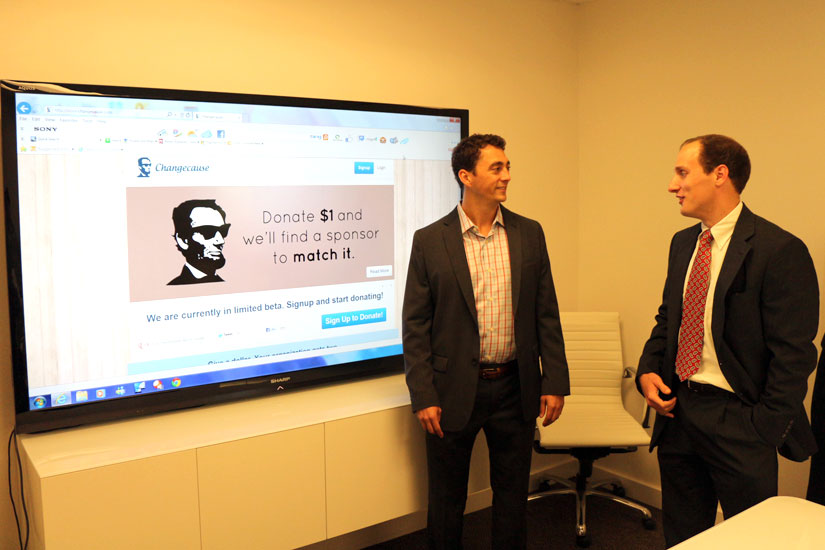
Changecause CEO Zach Liscio, left, and COO Edward RidgelyWhen Zack Liscio, the CEO and co-founder of Changecause, moved from his job at Google in July to work in Arlington full-time and help his startup get off the ground, his friends and coworkers in Silicon Valley were confused.

“Everyone assumes that San Francisco is a more fertile group for startups,” he said. “I don’t think that’s true. It’s such a dense marketplace that it’s really hard to stand out. Plus, in the D.C. area, the talent and access to capital and mentors blows that out of the water.”

Liscio, as well as co-founder and COO Edward Ridgely, knew something about Washington, D.C.-based startups before they launched Changecause; they met at perhaps D.C.’s most successful tech startup, LivingSocial. When Ridgely and Liscio met at LivingSocial, they shared with each other their passion for helping nonprofits and donating to charities.

Incorporated last November, Changecause was a side job for Liscio, Ridgely, Chief Technology Officer Michael Seid and Chief Strategy Officer Patrick Costello. They initially set out to build an app designed to be a mobile wallet, where users could pay for goods on their smartphones. After seeing the small fees from each transaction and realizing how much money, on a grand scale, that could add up to, Liscio and Ridgely adjusted course.

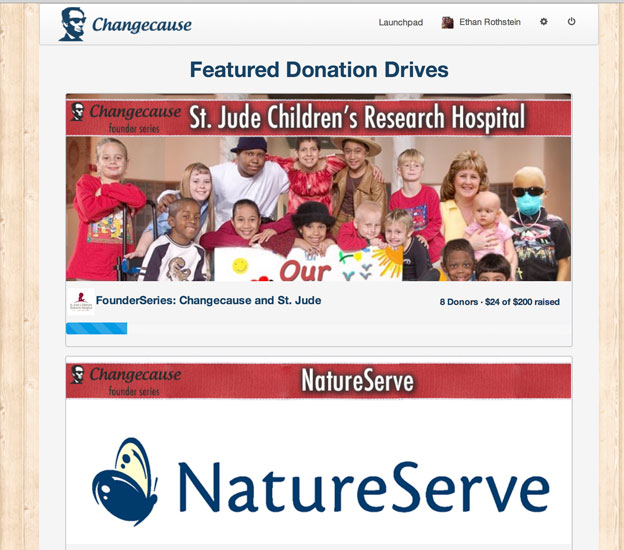
Changecause screenshot“There was such an emphasis on local commerce at LivingSocial,” Ridgely said. “So I started thinking what was the way I could give back.”

Eventually, they landed on the idea that would become Changecause. Users can donate small amounts — typically between $1 and $5 — to a charity of their choice, and brands looking to increase awareness of both themselves and their philanthropy will match the donation.

“Donating to charity can be as effective as advertising for a brand,” Liscio said. “The reasons why brands like Toms are so big is because of cause branding and social responsibility.”

To add to the appeal to brands, Changecause will pair brands with donors whose demographics match a particular brand’s target market; if a 27-year-old donates to charity and lists running as its interest, a brand like Nike would match that donation.

The Changecause team became “active on all the local tech listserves,” Ridgely said, seeking advice, mentors, potential partners; anything really. They applied to the Ballston Business Improvement District Launchpad program, which provides startups with occasional office space, mentorship programs and networking opportunities.

(more…)


Startup Monday header

Editor’s Note: Sponsored by Monday Properties and written by ARLnow.com, Startup Monday is a weekly column that profiles Arlington-based startups and their founders. The Ground Floor, Monday’s office space for young companies in Rosslyn, is now open. The Metro-accessible space features a 5,000-square-foot common area that includes a kitchen, lounge area, collaborative meeting spaces, and a stage for formal presentations.

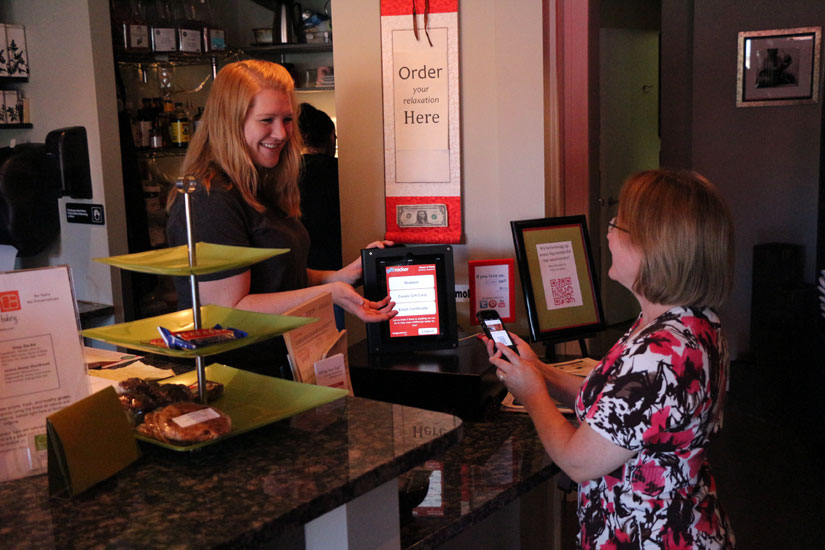
Giftrocker in action at House of SteepAlex Robertson was working as an IT manager when, for a charity event, he visited some local retailers to have them donate gift certificates to raise money.

One by one, he would walk in and see every restaurant, every coffee shop, every boutique had a different method for gift certificates; Some took as long as 15 minutes to provide one.

“I saw it as really ripe to be automated,” Robertson said. “The whole concept needed to be redone. I was doing software managemnt for years, and all of those experiences made me think ‘I could do better than that.'”

Two years ago, Robertson “just quit the day job and decided to do it.” He launched GiftRocker, with no outside funding, and brought in veterans of the local retail scene — head of business development Michael Scruggs in 2011 and Vice President of Sales Michael Rosen a few months ago — to try and revolutionize the way small businesses handle gift cards.

Rosen and Scruggs are gregarious sales types with connections all over the area. While Robertson is engaging when talking about his company and product, he is most comfortable building the product itself, and letting his work do the talking.

“As a technology guy, building the product, that was fun for me,” Robertson said. “It’s like a long crossword puzzle.”

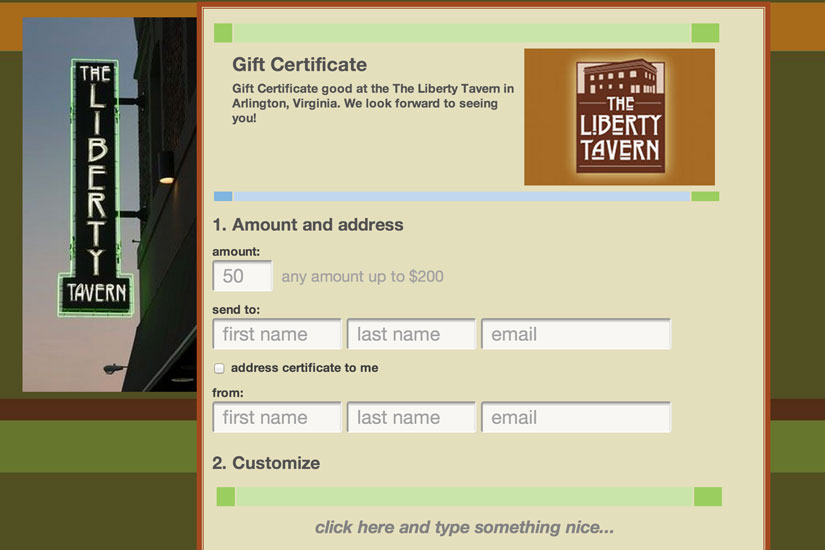
GiftRocker is a tool for businesses to create customizable gift certificates, sold online, on mobile or in store. It can also be used for pre-selling event tickets and designing and creating promotions, among other services. The biggest distinguisher between GiftRocker and well-known sites that offer comparable services, like Groupon or Eventbrite, is each service is offered as an extension of the client’s brand, not GiftRocker’s.

Giftrocker coupon to Liberty Tavern“We just provide a service,” Robertson says. “Their customers are their customers.”

The GiftRocker icon is just subtly placed at the bottom of each gift certificate page, which, despite being hosted by GiftRocker.com, are designed to strongly resemble the client’s website.

The GiftRocker team has already brought its services to about 30 Arlington businesses, and approaching 100 in the greater Washington, D.C., area.

One of the businesses Robertson has partnered with is House of Steep at 3800 Lee Highway in Cherrydale. Owner Lyndsey DePalma is about to celebrate her one-year anniversary of running the store, and started offering gift cards with GiftRocker last October.

Giftrocker's Michael Scruggs, left, Alex Robertson, center and Michael Rosen

“I tried traditional gift cards and it not work out for me,” DePalma said. She was managing a spreadsheet that was getting unmanageable. Now, about 30 percent of her gift card sales occur online. “I just remember reconciling my books after the first round of online orders and saying ‘where did all this money come from?'”

Before GiftRocker, Scruggs was working for the group that owns Lyon Hall, The Liberty Tavern and Northside Social in Clarendon. Now, the three restaurants are all GiftRocker clients, coming on board after Backyard BBQ, Giftrocker’s first customer, and Lebanese Taverna, GiftRocker’s first “anchor client,” as Rosen puts it.

“The system is really a victory for consumers,” Rosen said. “There’s so much noise in the marketplace in this area. Cutting through it is very difficult, and we have a tool to do that.”

They’re still operating remotely — out of their homes in Arlington and various coffee shops — but nimbly enough to adapt to each client’s needs. GiftRocker’s next step is to expand nationally, but Robertson, Scruggs and Rosen are still deliberating over how to do it.

“When we figure it out, we’ll tell you,” Robertson said.


Startup Monday header

Editor’s Note: Sponsored by Monday Properties and written by ARLnow.com, Startup Monday is a weekly column that profiles Arlington-based startups and their founders. The Ground Floor, Monday’s office space for young companies in Rosslyn, is now open. The Metro-accessible space features a 5,000-square-foot common area that includes a kitchen, lounge area, collaborative meeting spaces, and a stage for formal presentations.

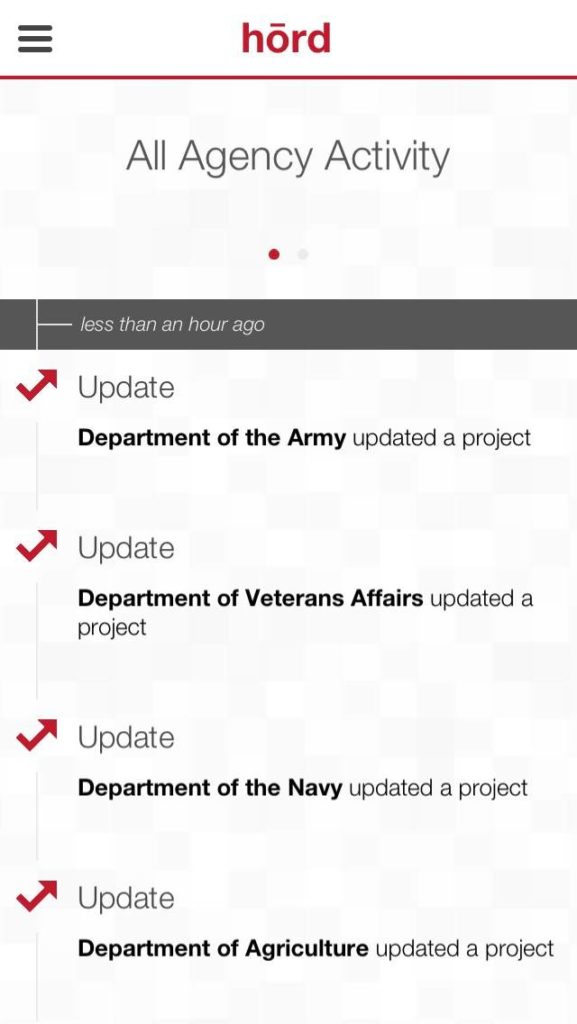
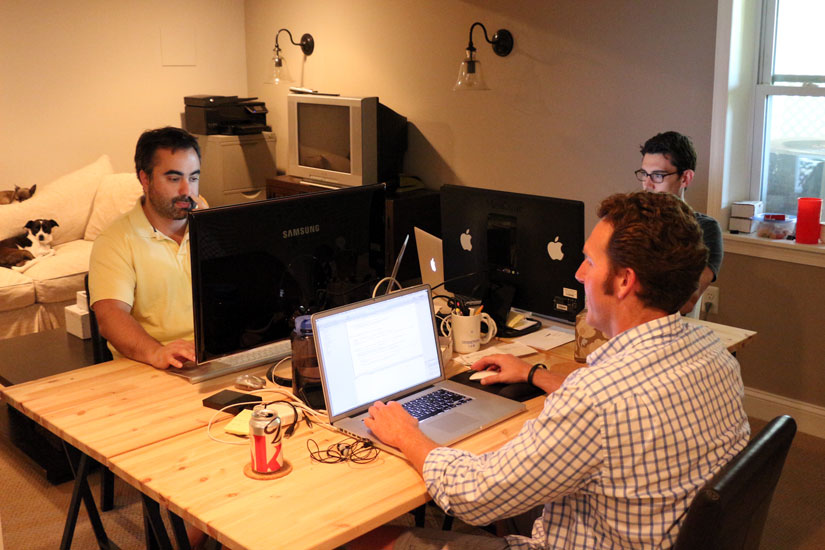
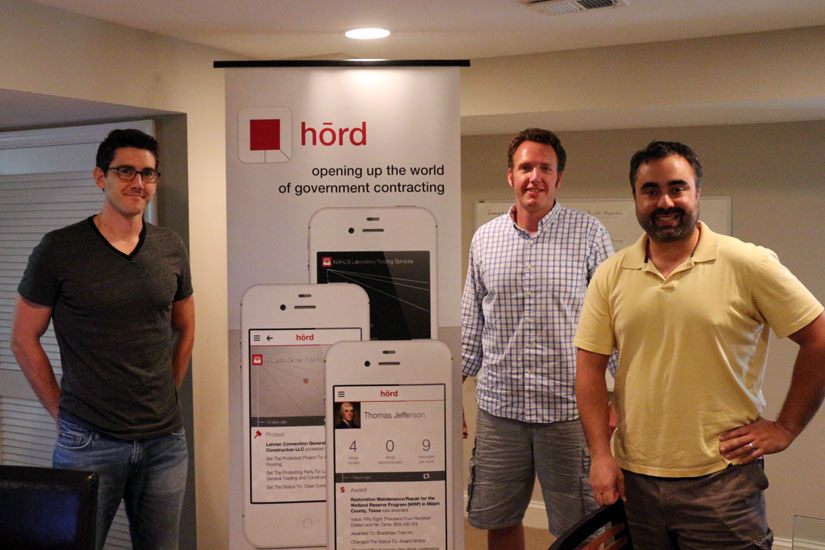
Screencap of hōrdOperating out of a basement in Arlington Ridge, the three-man team that makes up GovTribe has worked under far harsher conditions.

CEO Nate Nash, CFO/COO Marc Vogtman and Chief Technology Officer Jay Hariani, while working for Deloitte, traveled to, among other places, Saudi Arabia and Iraq as technology consultants. Compared to working on a laptop in the middle of the desert, working on an iPhone app in a basement doesn’t sound too bad.

Together, Nash, Vogtman and Hariani make up GovTribe, which is the company behind hōrd, an app that updates federal government contracting information in real time, simplifying a process that can take days or weeks down to a few finger swipes.

“We felt like the tools available for this were less than stellar,” Hariani said. “We thought it could be improved upon.”

GovTribeThe app easily shows when a federal agency posts a new contract, amends a contract and awards a project. It shows the details of each project, including the point of contact, shows the agency’s history of awarding contracts and shows firms’ contract history. All of the data is publicly available, but the government’s websites for the information can be difficult to navigate, and not all of the information is in the same place.

“This goal of making our former lives easier has thrown ourselves into the business of building off of open government data,” Nash said. “We’re trying to use that data to give insights into how it works for the customer at a personal level.”

Nash, Vogtman and Hariani left Deloitte and started GovTribe in September 2012. This January, they launched the beta version of hōrd, sending it to friends and other testers before formally launching the official app Aug. 9.

Screencap of hōrdNash declined to say how many downloads hōrd has seen so far, but said it exceeded its monthly goal by 50 percent. It’s free to download on the app store and free to use for a month, after which it’s a $5 monthly subscription.

The reviews have been largely positive so far — hōrd has eight ratings in the App Store and is averaging five stars — and GovTribe will next develop an interface for iPad and one usable in a browser.

“It’s blowing their minds,” Hariani said when asked to gauge user reactions. Nash added, “A lot of people have said ‘I can’t believe this didn’t exist before.'”

GovTribe doesn’t have any venture capital funding — “We are completely bootstrapped,” Nash said — and none of Nash, Vogtman and Hariani had any experience building an iPhone app. When they decided that was the best platform for what they wanted to build, they simply taught themselves how to create it.

“We taught ourselves everything we think we need to know,” Nash said, “but by no means do we think we’re done learning.”

GovTribe, from left, Marc Vogtman, Nate Nash and Jay HarianiGovTribe didn’t launch initially to build what would become hōrd; in fact, they were focused on building a tool to make bidding for a process easier. The more they got into the data, however, the more they realized what they needed to build.

“It was about finding a problem to solve,” Vogtman said. “We’d be at these proposal meetings and people would ask questions, and nobody really knew any of the answers. We realized that was the best place to start.”

Like many industries in Washington, contracting can frequently be determined by who you know. Hariani and Nash said they wanted to “democratize the process,” and making it easier for new or aspiring contractors to break through. Frequently, small contractors aren’t even aware of whom they’re competing against for projects, which makes preparation more complicated, Vogtman said.

Hōrd’s name is a mixture of horde and hoard — horde because the multitude of agencies and contracts evoked for Nash a large, disorganized group, and hoard because Nash and his wife binge-watched “Hoarders,” and he realized putting specific agencies into your personalized feed was a lot like hoarding them.

The south Arlington basement isn’t filled to the wall with decades-old newspaper clippings, just three work stations and a couple of friendly dogs. The bootstrapped company would like to start gathering one thing, however: in a couple of weeks, they will be seeking their first round of outside investment.


Startup Monday header

Editor’s Note: Sponsored by Monday Properties and written by ARLnow.com, Startup Monday is a weekly column that profiles Arlington-based startups and their founders. The Ground Floor, Monday’s office space for young companies in Rosslyn, is now open. The Metro-accessible space features a 5,000-square-foot common area that includes a kitchen, lounge area, collaborative meeting spaces, and a stage for formal presentations.

LiveSafe homepage  Students at Virginia Commonwealth University are headed back to college with new clothes, books and the LiveSafe mobile app to keep them safe on campus with a GPS network connecting them to school security.

Rosslyn-based LiveSafe’s free mobile app is designed for college students to use geo-location on their phones to anonymously report incidents or suspicious behavior on campus, or even to request college security to monitor them late at night. More than 20 law enforcement agencies and schools have used LiveSafe as pilot programs since the app launched in April. The company is transitioning those trial periods into sales of the GPS map dashboards, which allow security officials to follow LiveSafe’s crime and safety alerts.

LiveSafe Co-Founders Shy Pahlevani and Kristina AndersonThe 2013-2014 school year will be the first big test for the app’s popularity, said LiveSafe Co-Founder Kristina Anderson. Downloads of the app are spiking with the start of the school year at three colleges that have formally purchased the dashboard, including Virginia Commonwealth University, she said.

Campus security is a personal mission for Anderson. During the mass shooting at Virginia Tech in April 2007, Anderson was shot three times hours after the first shots were fired on that terrible day. Hopefully the LiveSafe mobile app that gives police GPS locations of alerts will help spread awareness during emergencies, she said.

“Schools are a great place to start but eventually we are looking at communities,” Anderson said. “There are commonplace reports that could be useful like reporting people who are intoxicated or reporting lost children.”

The Andalusia City Police Department in Covington County, Ala., is one of the first police departments to purchase the LiveSafe dashboard to monitor alerts in their community.

LiveSafe Co-Founder Shy Pahlevani displays the LiveSafe alert map for ArlingtonThe Arlington Police Department is considering using the LiveSafe dashboard, and the company is “in conversations to sell the dashboard to government agencies, stadiums and military bases,” said LiveSafe Co-Founder Shy Pahlevani.

The organizers of the Arlington Police, Fire & Sheriff 9/11 Memorial 5K also coordinated with LiveSafe to provide the app as an information source for the participants of the 5K, sharing race-related information including weather delays and safety tips, Anderson said.

“If I’m at the race and I’m using the app, I can report three bikes being stolen. Then others can add new tips on that crime when they see that anonymous tip on the map. That empowers me as a user to share information,” Pahlevani explained.

The company raised $1 million from individual investors and is now marketing the app to colleges at the price of $2 per student on a campus, Anderson said.

(more…)