Plans to make Rosslyn a bit easier to navigate for pedestrians and bicyclists are coming together, though county officials are concerned that some of the proposed changes might further snarl traffic in the area.

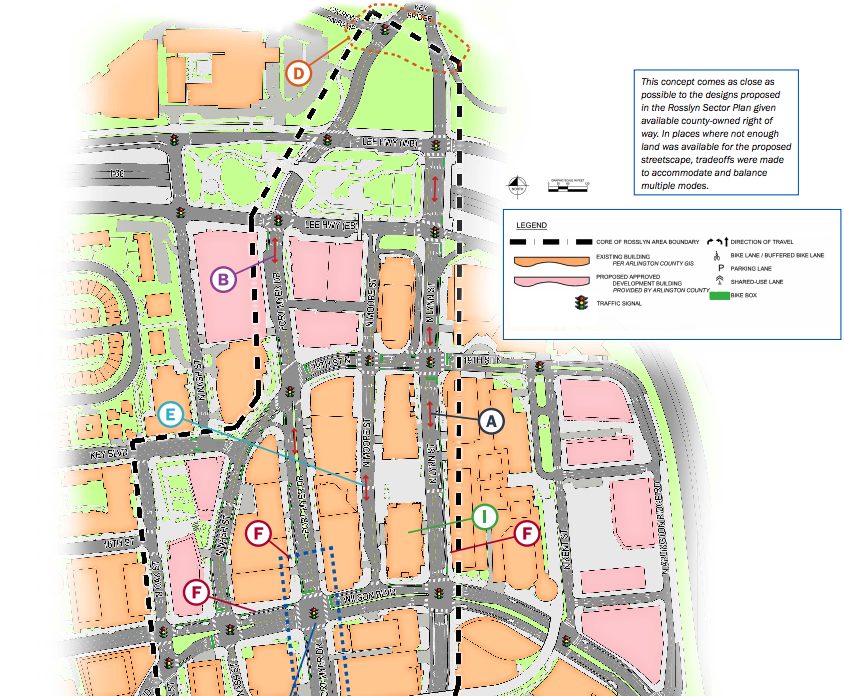
The county unveiled its latest designs for future of the “Core of Rosslyn” at a public meeting last Tuesday (Oct. 2), which includes plans to convert several streets around the Rosslyn Metro station into two-way roads, remove the Fort Myer Drive tunnel under Wilson Blvd and add a host of new connections for cyclists and walkers.

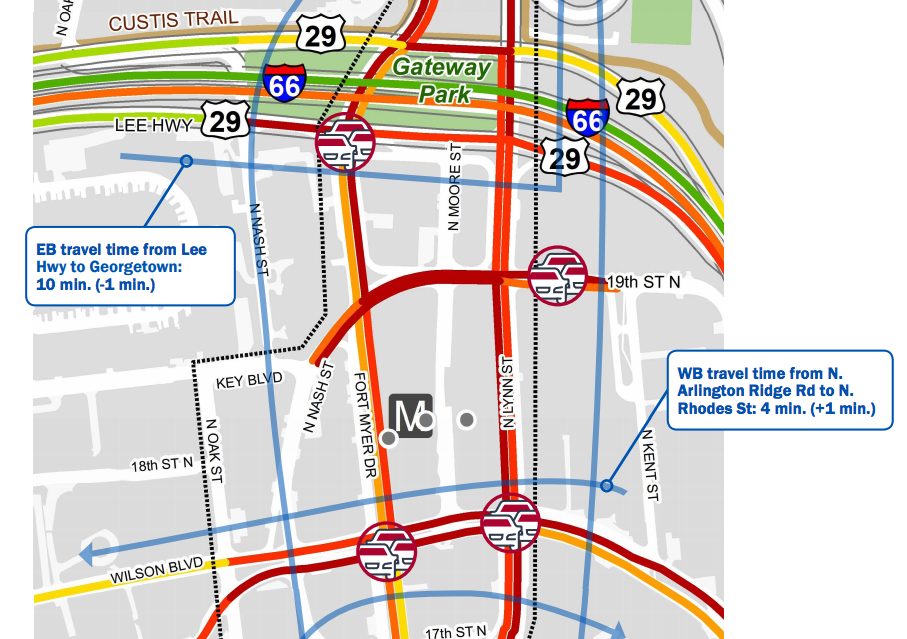
However, transportation planners worry that these alterations will produce “significant increases in gridlock” over the next decade or so, according to meeting documents.

In all, they’re projecting that the proposals will increase wait times at intersections in the neighborhood by a total of 19 minutes during the morning rush hour (with especially acute problems at the already jammed intersection of the Key Bridge, G.W. Parkway and Lee Highway) and a total of six minutes during the evening rush. They’re hoping to refine these designs in the coming months to address those issues, while maintaining the positive parts of the plan.

Certainly, planners expect the changes will result in substantial improvements in Rosslyn’s offerings for people who aren’t relying on cars to get around. The designs included 14 new or improved crosswalks for pedestrians, and more than 1.3 miles of new protected bike lanes included in the design. The lanes, largely set to run along Fort Myer Drive, N. Moore Street and N. Nash Street, are designed to ease bike connections to the Key Bridge and Mt. Vernon and Custis Trails.

The plans also keep alive the county’s long-considered possibility of building a car-free, “pedestrian corridor” running from 18th Street N.’s intersection with N. Oak Street to N. Kent Street, a change that would replace the Rosslyn skywalk system to make the Metro station more accessible.

Yet the county expects that this design would create some new challenges for walkers and cyclists as well. In particular, allowing two-way access on roads like N. Fort Myer Drive, N. Lynn Street and N. Kent Street will create a host of new “conflict points,” where cars are turning across crosswalks, prompting further delays for all involved.

That’s why Arlington officials are still accepting feedback on tweaks to the design.

Among the questions they want answered is whether people actually want to see the Fort Myer Drive tunnel filled in and transformed into a regular, signalized intersection with Wilson Blvd. The change would prompt additional delays at the intersections, and would involve “extensive construction costs and [a] long timeframe,” but could make it substantially easier for people to access the Rosslyn Metro station.

Similarly, planners want to know if making N. Lynn Street a two-way road is worth the extra traffic headaches it might entail. The county projects that the change “reduces confusion and allows for more direct routing” if it’s put in place, but it would also force officials to find new access points to the G.W. Parkway, I-66 and the Key Bridge.

The county plans to finish collecting feedback by Friday (Oct. 12), then unveil revised designs in the coming months. Officials hope to have final study recommendations for the area ready by sometime this winter.
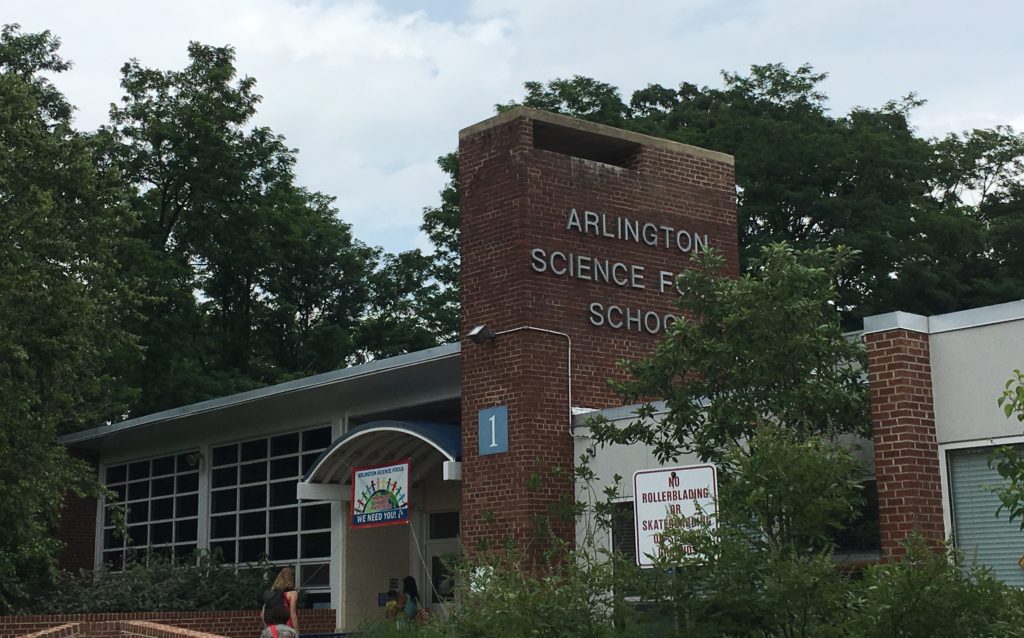


County school officials are reassuring nervous parents at Arlington Science Focus School that a state-of-the-art science lab, built thanks to nearly $200,000 in private funding, will be included as part of a controversial building swap with the Key Immersion School in the next few years.

Arlington Public Schools is still sorting out the logistics of the move, which is designed to ease overcrowding at both buildings and address the fact that ASFS is the only neighborhood school in the county to sit outside its own attendance boundaries. The school system has yet to even nail down an exact timetable for the swap, with the change on tap for either 2020 or 2021.

But the building swap is already prompting criticism from parents, including several who have spoken at recent School Board meetings to register their frustration with the process. Superintendent Patrick Murphy has said he does not intend to seek the Board’s approval for the change, arguing it’s within his power to authorize the change on his own.

Among the issues raised by parents is what will become of the ASFS “Investigation Station,” a science lab the school added in 2015. The school’s Parent-Teacher Association successfully raised more than $177,000 to fund the lab over the course of a year, and was described by the school system at the time as a tool for students to “explore the natural world with the aid of hands-on learning tools and cutting-edge technology.”

While there are plenty of details left to be worked out about the swap, APS spokesman Frank Bellavia told ARLnow that “Board members and administrators have assured ASFS staff and families that we recognize that moving equipment and other teaching materials will be inherent in any building move for both schools.”

It remains unclear, however, just how the process of swapping the buildings will actually work. APS has yet to work up a cost estimate for the process, and Bellavia said that “it’s still too far out” to know how much work on each building will be required to retrofit each school’s equipment to its new home.

“Questions about the building swap will be addressed as part of the community engagement plan that will be developed and shared with the community in January 2019,” Bellavia said.

In a memo from APS staff in response to School Board questions on the swap, staffers suggested that the school system could “refresh” each building ahead of the change, rather than shelling out for a full renovation.

Notably, Key’s current building has room for about 100 more students than ASFS, and school officials plan to add additional trailers at the Science Focus site to make up for the difference. The staff memo also notes that ASFS’ “two science classrooms will be converted back for regular classroom use” ahead of the swap.

Superintendent Patrick Murphy reassured parents at the Board’s meeting last Thursday (Oct. 4) that APS would continue to engage with the community about the issue. But the school system is also hoping to sort through its contentious elementary school boundary process first, meaning that more detailed discussions of the Key-ASFS swap will have to wait until next year.

“There still needs to be a lot more information and perhaps background around the rationale for the recommendation and I know staff will be doing that from late winter into the spring,” Murphy said.


(Updated at 3:10 p.m.) A new restaurant offering Indian and Nepalese cuisine is on the way for the Pentagon Row shopping center.

Namaste Everest plans to open its doors in spring 2019, according to a release from Pentagon Row owner Federal Realty Investment Trust.

Chef Nabin Paudel, a Nepal native, operates another restaurant under the name “Namaste” in Alexandria. The new eatery will be his first expansion into Arlington.

The menu will include an array of curries and tandoor cooking, as well as dumplings, biryani, kabobs and more. The restaurant also plans to offer a full bar, the release said.

“It has been a priority to continue to expand dining options at this location for the local community,” Kari Glinski, director of asset management for Federal Realty, wrote in a statement. “With the addition of Indian and Nepalese cuisine, diners certainly have several diverse choices to choose from.”

Other recent additions to Pentagon Row include a pop-up taco bar and a new location for local chain Basic Burger.


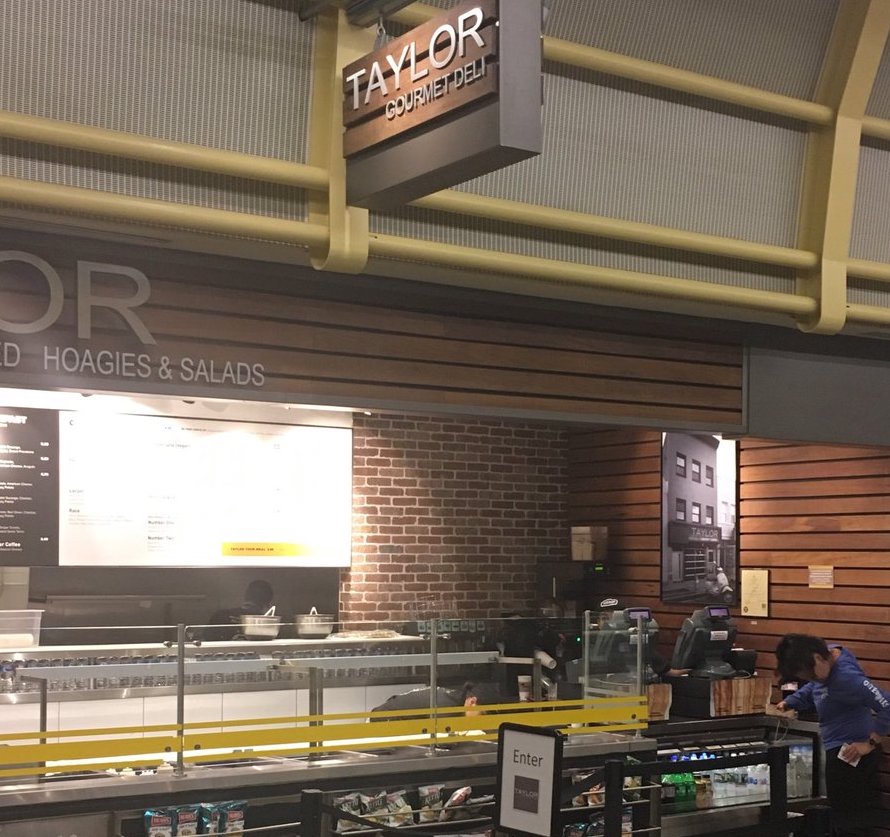
Taylor Gourmet might have shut down all its other sandwich shops around the D.C. region, but it seems hungry fliers at Reagan National Airport can still get their hoagie fix.

The chain revealed late last month that it would be shuttering its 17 stores after a major investor spurned the company, and Taylor’s Ballston and Arlington locations were closed soon after.

But, for now at least, ARLnow readers say the DCA location is still serving up sandwiches. The store is located in the airport’s Terminal B/C, near gates 23 and 24; getting there requires getting through security.

A spokesman for Taylor said the Reagan location is operated Marketplace Development, the company that manages concessions at the airport, and he declined to elaborate on why the shop is still open. The concession company did not immediately respond to a request for comment, and no one answered the phone at the restaurant Monday morning.

Taylor has since filed for Chapter 7 bankruptcy in Delaware, court records show. Company insiders have speculated that everything from co-owner Casey Patten’s meeting with President Donald Trump to the chain’s aggressive expansion plans ultimately doomed the business.

https://twitter.com/danny_shieh/status/1046864380388884481

https://twitter.com/CourtMattison/status/1048323640062889985

Photo (top) courtesy of @CartChaos22202


Sponsored by Monday Properties and written by ARLnow.comStartup Monday is a weekly column that profiles Arlington-based startups and their founders, plus other local technology happenings. The Ground Floor, Monday’s office space for young companies in Rosslyn, is now open. The Metro-accessible space features a 5,000-square-foot common area that includes a kitchen, lounge area, collaborative meeting spaces, and a stage for formal presentations.

Joanne Sonenshine says she did the “typical rotation” after arriving in Washington as a development economist 16 years ago.

She started off working for the federal government, then moved to a lobbying firm before ending up at a large nonprofit, all while working on issues in developing countries. But no matter what hat she wore or organization she worked for, she couldn’t shake the feeling that she wasn’t making as much of a difference as she might like.

“It became very clear that what was needed to make the most difference for some of these communities was someone to come in and be much more straightforward and clear about partnership building,” Sonenshine told ARLnow. “Bringing together nonprofits, governments, the private sector… and I thought a company could help fill that gap.”

So, on one long airplane ride, Sonenshine drew up a detailed methodology for how someone might convene all those various groups together around an issue like tackling poverty, or food insecurity. She showed it to a few friends and colleagues and got some positive feedback, so she quickly decided to “make the jump” and start a consulting firm of her own.

Sonenshine founded Connective Impact in 2014 in Bluemont, her home with her husband since moving to the area back in 2002. Though it started off as a one-woman operation, she says it’s since grown to include two full-time employees and a part-time researcher, and is currently funded entirely by herself and a small circle of “family and friends.”

She says the business now has “anywhere from three to 10 clients” at any given time, depending on the season, and they run the gamut from large corporations to renowned nonprofits to governments themselves. Past clients have included Nespresso, Oxfam and the United States Agency for International Development.

Her goal with all of her clients is to organize people around causes with “social, environmental and economic impact,” with a focus on developing nations.

For instance, if a large company is looking to reduce poverty in nations that help form the backbone of its “supply chain,” Sonenshine says Connective Impact would be able to step in. Her company could help the company connect with “local partners in communities” to achieve that goal, or even provide a connection to some of its competitors to understand how the industry might be worsening poverty in a country with its business practices.

“We can do the same thing on the nonprofit side,” Sonenshine said. “We can connect them with governments, local communities… just be much more specific about roles and responsibilities, about who should be working on what.”

Eventually, she hopes to expand her staff and begin developing workshops and seminars to offer independently of Connective Impact’s consulting work, to essentially export the work her company does elsewhere.

But no matter how much the company expands, she doesn’t plan on leaving Arlington anytime soon.

“We just love the school system and love working in Arlington,” Sonenshine said. “It’s always had such a great community feel.”


(Updated at 6 p.m.) Striking new research reveals that where children are born in Arlington can have a decades-long ripple effect on their futures, with kids in the county’s more ethnically diverse neighborhoods growing up to make less money and end up in jail at higher rates than their counterparts.

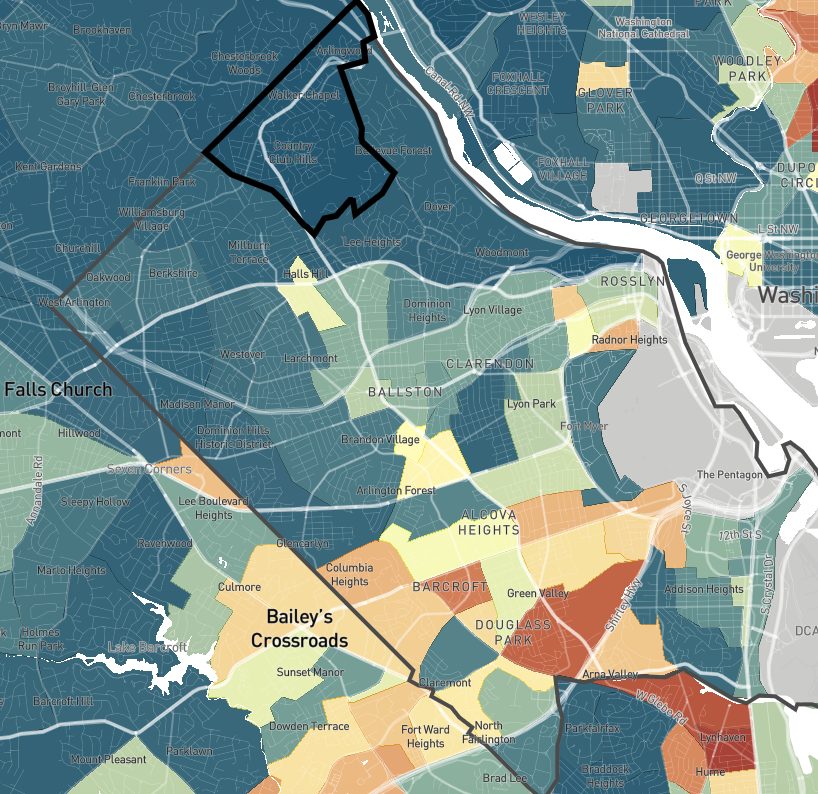
The analysis, compiled by the Census bureau and a team of academic researchers, shows that children born to a family in a wealthy, predominantly white North Arlington neighborhood earn tens of thousands of dollars more, on average, than kids from a more diverse, lower income South Arlington neighborhood. Incarceration rates generally follow the opposite pattern.

These effects largely persist regardless of a child’s race, or the income level of their parents, mirroring results researchers found around the country in creating this new “Opportunity Atlas.” The interactive map combines anonymized data on 20 million people born 30 years ago with granular Census tracts, in order to provide a glimpse of the gaps in opportunity across different neighborhoods nationwide.

Researchers are still sorting out the exact reasons behind these disparities — everything from the quality of local schools to an area’s employment rate could help explain the variations. But officials and public policy analysts increasingly view this data as a key way to guide where government intervention might be most needed to lift people out of poverty, particularly when evaluating which neighborhoods have borne the brunt of decades of racially discriminatory policies.

In Arlington, the atlas helps provide concrete examples of how the split in income levels and diversity between the northern and southern halves of the county affect residents of each neighborhood.

For instance, kids born in the Douglas Park Census tract, an area just off Columbia Pike with the largest share of non-white residents in the county as recorded in the 2010 Census, grew up to record an average household income of $36,000, regardless of their race or income level. That figure is the second lowest in the entire county.

Low-income children, defined as those born to families making $27,000 a year or less, in the area grew up to make $33,000 a year. High-income kids, who were born to families making $94,000 a year, grew up to make about $51,000.

In Nauck, a historically black community, children grew up to earn $34,000 a year, the lowest salary in the county.

Children born to low-income families made $30,000 a year, the lowest figure among that cohort in the county. Kids in high-income families there grew up to make $42,000 a year, again the lowest for the income bracket in Arlington.

People in Nauck are also incarcerated at the highest rate in the county — 4.8 percent of the people studied in the area are currently in jail. That includes 6.9 percent of children born to low-income parents and 1.6 percent of those born to high-income families, rates that are both among the highest in the county.

The results are also striking in the High View Park Census tract, which encompasses the historically black Halls Hill neighborhood, which was literally walled off from its white neighbors for decades in the Jim Crow era.

Kids growing up in the area, of all income levels, went on to make about $44,000 a year, roughly the median for the county. Low-income children, however, recorded the third lowest salary among that group in Arlington, at $29,000 per year. High-income kids went on to make about $57,000 per year, much more towards the county’s median. The neighborhood has the second-highest share of incarcerated residents in the county, with 9.2 percent behind bars.

By contrast, children born in the county’s whitest areas tend to grow up to become considerably wealthier, regardless of their family’s income level.

In the county’s Census tract with the lowest share of non-white residents (an area including neighborhoods like Bellevue Forest, Dover Crystal and Woodmont), children grew up to make an average of $68,000, tied for the second highest salary in the county. Low-income kids recorded that same $68,000 average, as did high-income kids.

Similarly, the county’s second whitest Census tract — an area in Northwest Arlington containing neighborhoods like Country Club Hills and Arlingwood — kids grew up to make $80,000, the highest salary in the whole county. Low-income kids eventually made an average of $51,000 per year, while high-income children made it to $70,000 a year.

And, in the vast majority of the county’s whitest areas, incarceration rates were below 1 percent.

Graphic via Opportunity Atlas


A holiday weekend (for some of us) is here, and the weather is cooperating with some pleasant early-fall temperatures.

Though the forecast heats up heading into next week, temperatures should hover around the 70s for much of the long weekend.

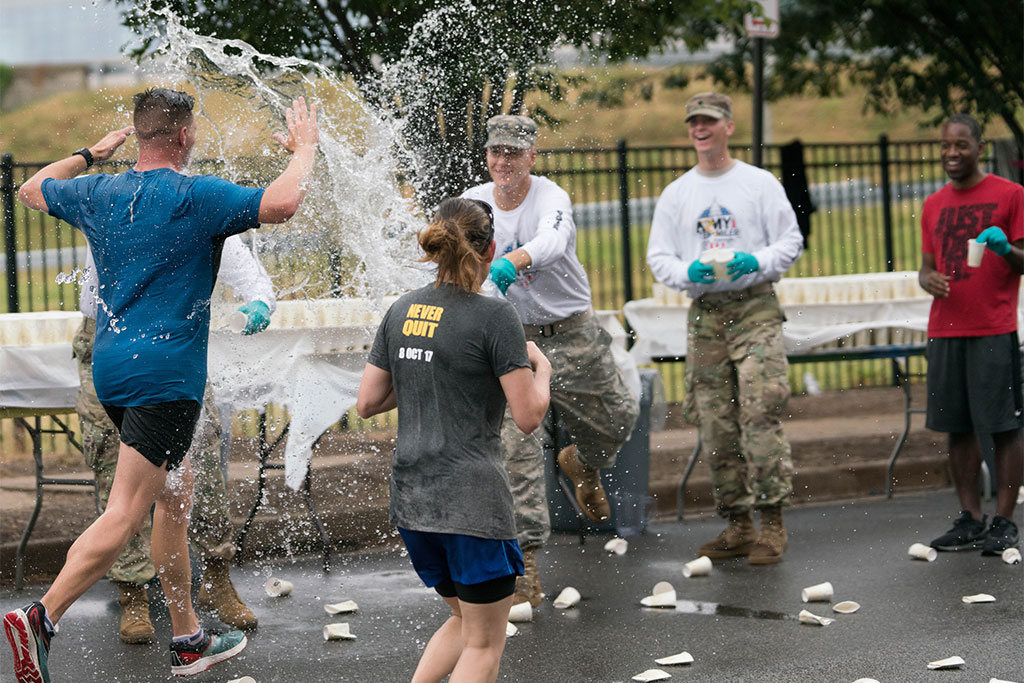
That should be good news for anyone heading out to the Army Ten-Miler race, the Columbia Pike Fall Festival, or any of the other events happening around the county this weekend.

And you can always take a few minutes to catch up on our most popular stories from the past week:

  1. Mt. Vernon Trail Blocked After Construction Equipment Damages Bridge
  2. Body Found Near Base of Antenna Tower Along Lee Highway
  3. Ballston Quarter Wins Approval for Outdoor Seating in New Plaza
  4. Three Restaurants Replacing Clarendon’s La Tasca Now Set for Early 2019 Opening
  5. Artist Emerges for Mysterious Street Art in Pentagon City, Crystal City

Head down to the comments to discuss these stories, your weekend plans or anything else local. Have a great one!

Flickr pool photo via wolfkann


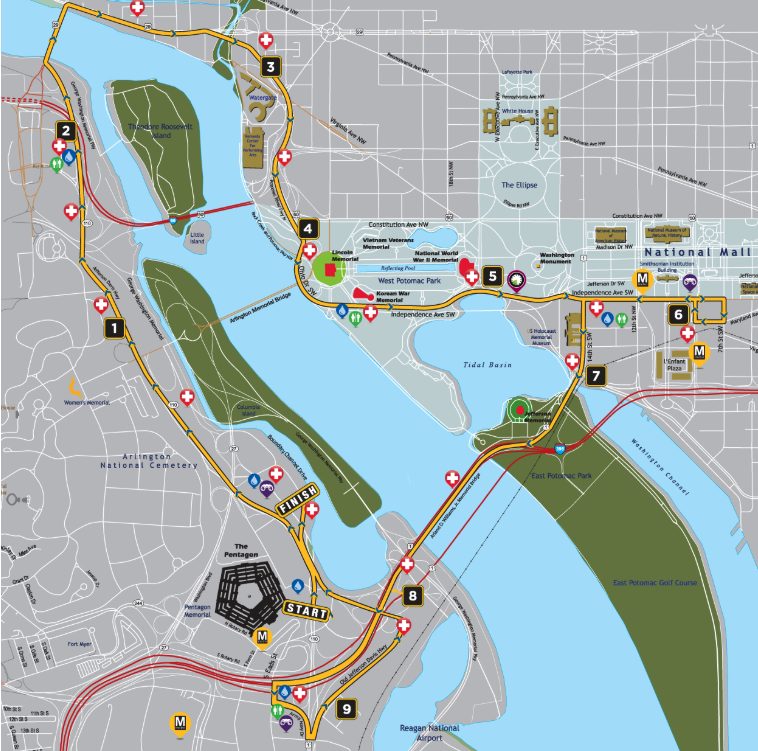
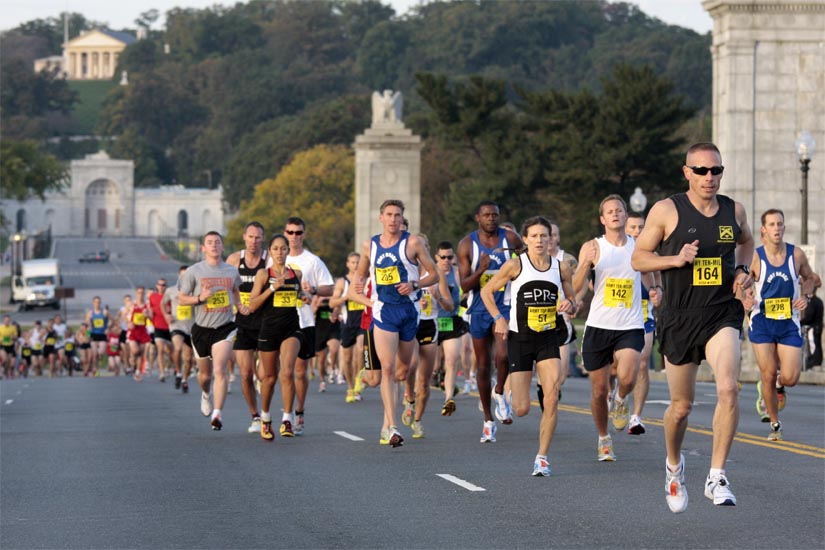
Tens of thousands of runners will flock to the streets of Arlington and D.C. Sunday for the Army Ten-Miler race, with a changed-up course that will prompt a slew of road closures.

The 10-mile race starts and ends at the Pentagon. The course will guide participants along Washington Blvd into Rosslyn, then across the Key Bridge into the District, before they return to Arlington via I-395.

This marks the first year the course won’t include the Arlington Memorial Bridge, due to substantial renovations, in the race’s 34-year history.

County police are warning drivers of an extensive list of road closures, which include the following:

  • Route 110 between Rosslyn and Crystal City will close in both directions beginning at 5:00 a.m. and will remain closed until approximately 2:00 p.m. Motorists can use the George Washington Memorial Parkway as an alternative route. There will be no access to southbound Route 110 from N. Marshall Drive. The public may access Arlington National Cemetery from N. Marshall Drive.
  • I-66 westbound from Washington D.C. to N. Nash Street will close from 5:00 a.m. to 10:00 a.m. Motorists can use the George Washington Memorial Parkway or Route 50 as an alternative route.
  • Lee Highway westbound at N. Lynn Street and Lee Highway eastbound at N. Lynn Street will close from 5:00 a.m. to 10:00 a.m.
  • The Francis Scott Key Memorial Bridge will close in both direction with no vehicular access from approximately 5:00 a.m. to 10:00 a.m.
  • I-395 HOV northbound from Crystal City to the 14th Street Bridge will close at 6:00 a.m.
  • S. Eads Street from Army Navy Drive into the Pentagon/northbound I-395 HOV lanes will close at 5:00 a.m.
  • I-395 southbound HOV exit to S. Eads Street/Pentagon south parking lot will close at 5:00 a.m.
  • Route 27 in both directions from George Washington Memorial Parkway to I-395 will close from 7:00 a.m. to 10 a.m.
  • Army Navy Drive from S. Eads Street to S. 12th Street will close from approximately 8:00 a.m. to 12:00 p.m.
  • 12th Street from S. Eads Street to Long Bridge Drive will close from approximately 8:00 a.m. to 12:00 p.m.
  • Long Bridge Drive will close from S. 12th Street to Boundary Channel Drive from approximately 8:00 a.m. to 12:00 p.m.

Police hope to re-open all of these roads, except Washington Blvd, by 12:30 p.m. Sunday.

The Pentagon’s north parking lot will be restricted to authorized vehicles only between 4:30 a.m. and 2 p.m., and Pentagon employees and memorial visitors will be able to use the south parking lot.

Police are encouraging race participants and attendees to use Metro to reach the race, as the rail service will open an hour early, at 7 a.m. The race has also designated a drop-off point for rideshare drivers at the intersection of S. 12th Street and S. Hayes Street.

Participants in wheelchairs and “Wounded Warriors” will start the race at 7:50 a.m., with subsequent waves of runners following soon afterward.

Organizers expect to attract as many as 35,000 participants and 900 teams. Full details on the new course and other logistics are available on the race’s website.


Columbus Day might make for a long weekend for federal government employees and a whole host of others, but don’t expect to see many county services on hold to mark the occasion.

Monday (Oct. 8) is the lone federal holiday where Arlington County offices and facilities remain open, with a few exceptions.

County schools will be closed Monday, as will the county’s courts and DMV locations. The county also won’t enforce parking meters on Columbus Day.

Arlington Transit will still operate, albeit with a Saturday schedule for routes 41, 42, 43, 45, 51, 55, 77 and 87. Other routes won’t run, and the ART call center will be closed.

Metro will also offer reduced service on its train and bus routes.

Trains will run on a Saturday schedule, running every 12 minutes during the day, and the service will be open from 5 a.m. to 11:30 p.m. Buses will run on a Saturday supplemental schedule, with full details available here. Planned night track work will continue as normal, which could further slow some trains.

File photo


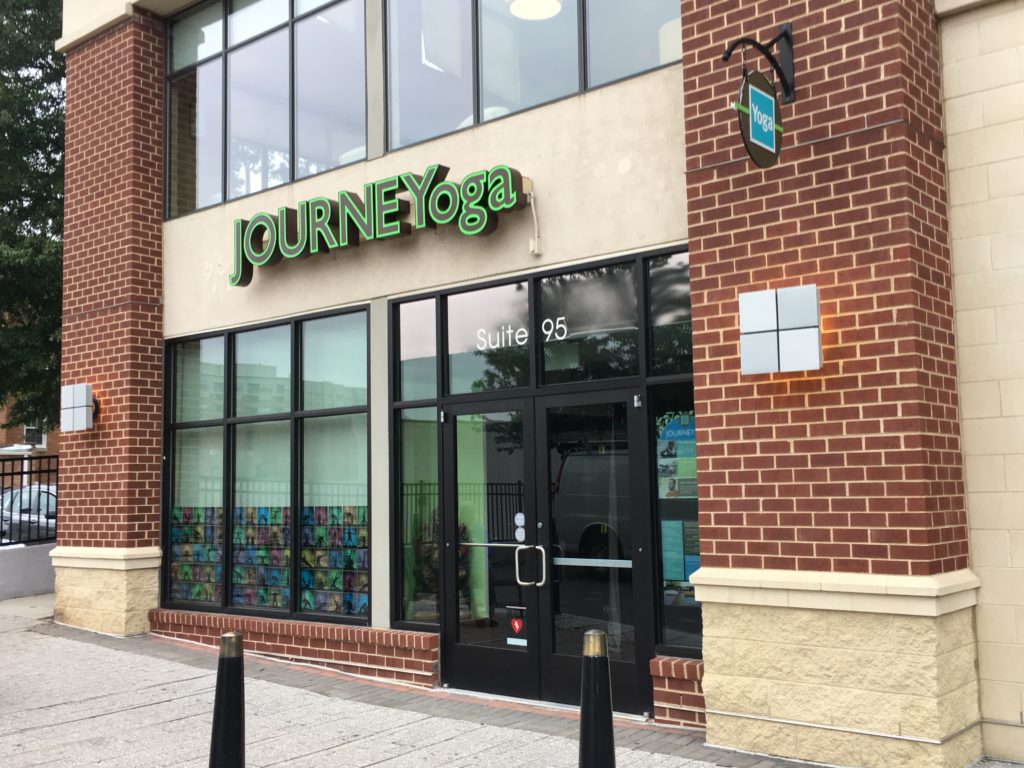
Journey Yoga is shutting down after more than a decade in business in Penrose.

The studio, located at 2501 9th Road S. in a shopping center just off Columbia Pike, announced that it will close today (Friday) in an email to its members.

“I love the community of Journey Yoga and I am honored to have been your teacher and the teacher of many of your teachers,” owner Sarah Lynn wrote in the email. “It is time for my journey to continue in a new direction. It’s been 11 amazing years, two locations, international and regional retreats, teacher trainings, workshops and special events.”

Lynn added in the email that YogaWorks, a regional chain with a location near Virginia Square, plans to honor any unused class passes from Journey Yoga attendees. Lynn herself also plans to teach some classes at the YogaWorks studio, adding “I respect YogaWorks immensely and hope you can find a home there.”

Journey Yoga plans to sell off its props and furniture in the coming days, and Lynn invited anyone looking to bid the studio farewell to drop by between 5-7:30 p.m. tonight.


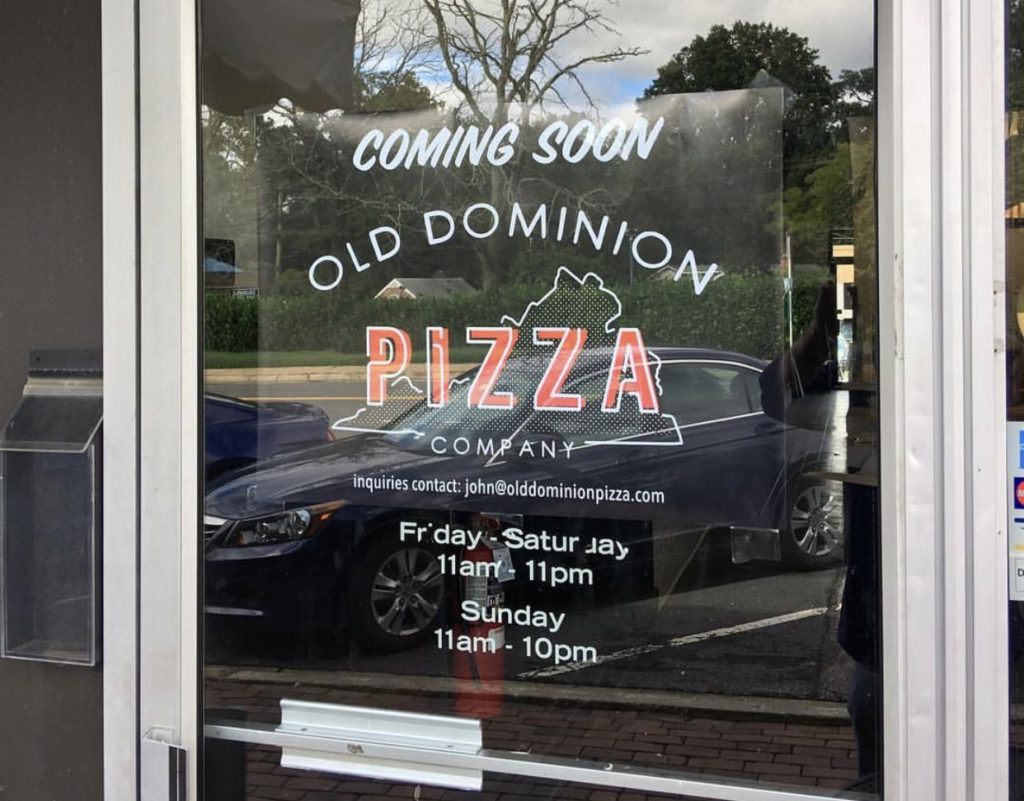
Just a few months after Upper Crust Pizzeria shut down along Lee Highway, a new pizza shop is now set to take its place.

Old Dominion Pizza Company is now planning to open up in Upper Crust’s old space at 4514 Lee Highway in the Lee Heights shopping center, owner John Rodas told ARLnow.

Rodas, who also helps run The Spirits of ’76 bar in Clarendon, says he’s still sorting out the menu for the new restaurant, but hopes Old Dominion will become a “good, local, neighborhood pizza place.”

He says he’d long enjoyed getting pizza at Upper Crust, but thought the restaurant’s management was a bit lacking. He even considered what he might do differently with the space.

“I remember saying, ‘If this spot ever comes open, I would love to put a nice neighborhood pizza place here,” Rodas said.

Accordingly, when Rodas saw ARLnow’s story on the store’s closure this July, he jumped at the chance to lease the space.

“I’d always wanted to do something in the neighborhood, but it wasn’t something I already had plans in the works for,” Rodas said. “But when I saw that it was closed, I drove right over there.”

He says he signed a lease for the space a few months ago, working in tandem with his chef at Spirits of ’76, Charles Smith, who is helping to design Old Dominion’s menu and will have an ownership stake in the pizzeria.

Rodas adds that the restaurant will deliver, and he plans to offer wine and beer in the space, though he expects the lengthy permit application process means the restaurant might not have it available as soon as it opens. As for that opening date, he’s currently hoping to start welcoming customers sometime in December.

Rodas is well aware that it might seem a bit strange to open up a new pizzeria in the same space as one that just failed, but he’s hoping that he’ll be able to bring a bit of what has made his Clarendon bar a success over to this new venture.

“We’re lucky to have great employees there, who take pride in the place and we have great customer service there,” Rodas said. “You know the guys who own the place and who work there… and we want to bring that over to Old Dominion.”

Photo via @olddominionpizza


View More Stories