
Sponsored by Monday Properties and written by ARLnow, Startup Monday is a weekly column that profiles Arlington-based startups, founders, and other local technology news. Monday Properties is proudly featuring Shirlington Gateway. The new 2800 Shirlington recently delivered a brand-new lobby and upgraded fitness center, and is adding spec suites with bright open plans and modern finishes. Experience a prime location and enjoy being steps from Shirlington Village.

Rosslyn-based Phone2Action, which helps organizations mobilize citizens via their smartphones, is on a bit of an acquisition spree.

Its newest acquisition is KnowWho, a 15-year-old company based in Newington, Virginia with an expansive congressional directory. Phone2Action CEO Jeb Ory said KnowWho runs the world’s largest, most current directory of public officials and policymakers in the U.S. and Europe.

With the addition, clients will find it easier to identify key decision-makers, make sense of new and changing policies and improve their government affairs, Phone2Action cofounder Ximena Hartsock said in a statement.

Phone2Action is still flying high from a record year of people using the platform to advocate for issues they care about, from federal aid to restaurants to police reform in the wake of the killings of George Floyd and Breonna Taylor to the election this November.

Last month, it purchased GovPredict, a technology company that helps organizations access federal data, see campaign donations, track bills and regulations and follow news.

Now, Phone2Action — which was founded in 2013 — owns the process of civic engagement from one end to the other. GovPredict identifies politicians and what issues they advocate for, KnowWho provides the best way to contact them, and Phone2Action gives regular people the chance to lobby politicians.

“Government relations and public affairs leaders have never faced such a tumultuous time as they do right now,” Ory said in a statement.

Government relations and public affairs teams will see government intelligence, find contact information and mobilize everyday citizens all in one platform, he said.

“Data powers the government relations field, plain and simple,” said KnowWho CEO and founder Bruce Brownson in a statement. “Phone2Action now directly maintains all the data that matters to government relations professionals today.”

Brownson will join the Phone2Action management team.

Phone2Action’s growth has exploded this year, according to Ory. It has 400 new clients, including eBay, Ericsson, Liberty Mutual, the National Multiple Sclerosis Society and the Leadership Conference on Human Rights.

Phone2Action is keeping its Rosslyn headquarters at 1500 Wilson Blvd, and with both companies, will have nearly 200 employees, Ory said. Some are local to the area, while others are fully remote and located outside metro D.C.

Photo courtesy Phone2Action

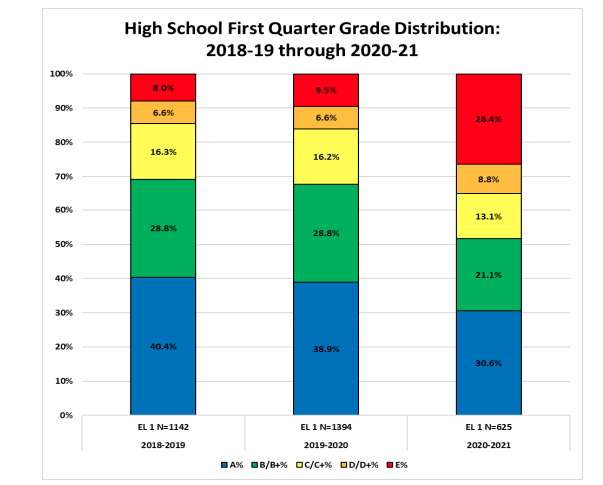
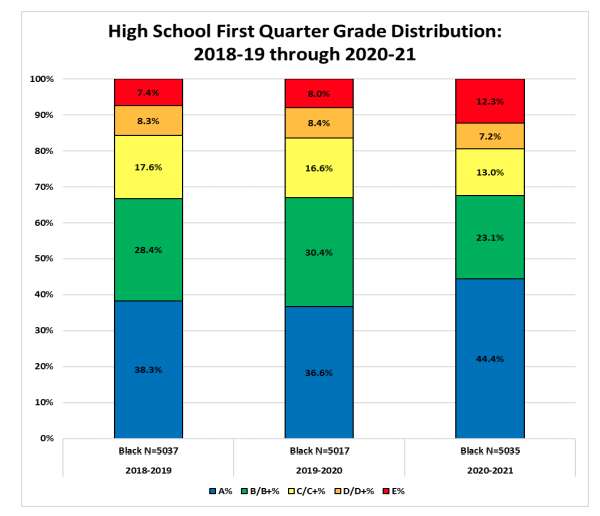
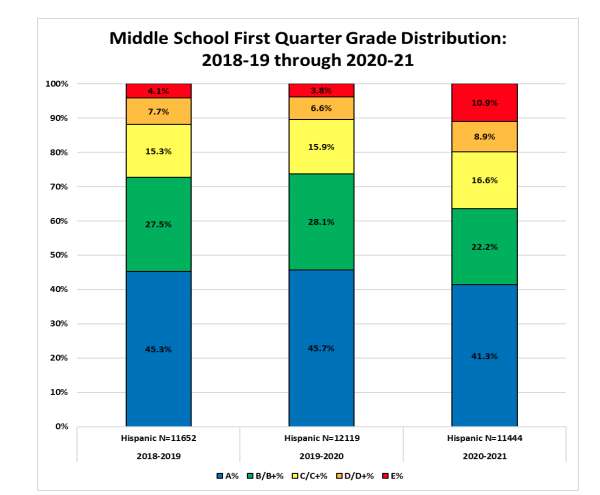
(Updated at 4:55 p.m.) In addition to elementary students, more middle- and high-school students in Arlington Public Schools are struggling to make passing grades this year, according to a new APS report.

Black and Hispanic students, English-language learning students, and students with disabilities are experiencing the deepest drops.

“We knew that we might see some degradation in scores, and this is helpful to understand exactly where we are seeing some deep drops,” School Board Chair Monique O’Grady said during the School Board meeting on Thursday night.

The new report builds on data released earlier this month, and follows on requests from School Board members for more precise data the impact distance learning is having on different groups of students. Fairfax County Public Schools released a similar report last month.

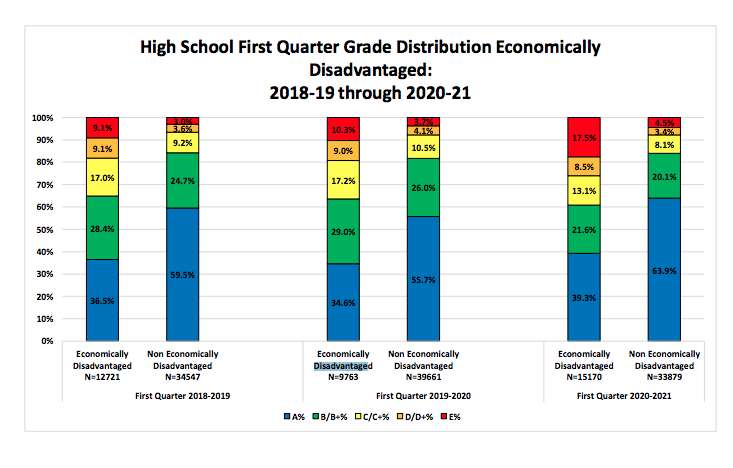
Overall, Es — failing grades — account for 2.1% of all middle school grades this year, up from 0.7% last year. This year, 5.4% of high school grades are Es, up from 4.3% last year.

The full report separates data for middle and high school, but during the meeting, Superintendent Francisco Durán presented overall trends for specific student groups.

This year, the percentage of English-language learners and students with disabilities earning Es increased by 11 and 6.2 percentage points, respectively, he said.

Among racial and ethnic groups, the percentage of Hispanic and Black English-language learners in secondary grades earning Es increased by 15 and 7 percentage points, respectively, he said.

Economically-disadvantaged students were also hard-hit, according to the report. Last year, 10.3% of economically disadvantaged high schoolers received Es, compared with 17.5% this year. In middle school, the percentage grew from 4% last year to 11% this year.

Meanwhile, white children registered smaller increases in failing grades: 1.4% of middle-schoolers earned Es this year, compared to 0.6% last year, while 3% of high-schoolers earned Es this year, compared to 1.6% last year, according to the report.

In-person learning supports — such as “work space” programs, where kids can get out of the house and study quietly at school — are being rolled out at the Arlington Career Center, H-B Woodlawn, and at Wakefield, Washington-Liberty, Yorktown high schools. Other programs are scheduled to begin at middle schools after the winter break.

Outgoing School Board member Tannia Talento said more needs to be done to support students, even if larger groups of students start returning to classrooms early next year.

“I just want to remind the community that this isn’t just about reopening schools to support these needs and growing gaps,” she said during the meeting. “We are going to have to do this for groups who choose to stay home.”

Talento asked the school system to dig deeper and find out why grades are dropping — for instance, if students are generally dropping one letter grade due to instructional quality, or if generally good students are dropping dramatically in response to factors like a mental health crisis, or a death or job loss in the family.

In addition to disparities in letter grades, Black and Hispanic students are reading at lower proficiency levels, literacy test results show — an issue existed before distance learning. APS has started working on ways to address, through instruction and extra supports, the persistent literacy problems in the system, Durán said.

Images via Arlington Public Schools


The interior of a salon on Lee Highway is set to be demolished and renovated, according to a permit filed with Arlington County.

The salon is New Image Hair Designs at 5800 Lee Highway, in Leeway-Overlee, across the street from Sloppy Mama’s Barbecue. All the finishes, plumbing and electrical fixtures will be removed and non-structural interior walls will be taken down, according to the permit.

The listed owner of the property is an LLC associated with Brian Normile, the president of Arlington-based home builder BCN Homes, which holds the demolition permit for the property.

Normile is also a partner in the Liberty Tavern Restaurant Group, which owns Liberty Tavern, Lyon Hall and Northside Social.

Rumors on the local Nextdoor social networking site that the salon would be converted into a new restaurant could not be immediately confirmed. Multiple requests for comment from the Liberty Tavern owners were not returned, nor was a request for comment from BCN returned.

Image via Google Maps


(Updated 02/08/21) The Arlington County Board has scheduled a public hearing on proposed changes to the Residential Parking Program for its regular meeting on Feb. 20.

But Board members are open to pushing off the hearing further to engage more people and give residents more time to digest the changes.

Board member Christian Dorsey said the Board is merely advertising a public hearing and the proposed changes to the program are not drastic.

“This is an evolutionary update, not a revolutionary one,” he said. “While it’s a complicated program, the degree of change is not as difficult.”

A delayed public hearing may mean implementation is deferred to the 2022-23 fiscal year, especially if the County staff is expected to do more public engagement, said Stephen Crim, the RPP review program manager.

“Some people will be unhappy no matter how we do this program,” Board Chair Libby Garvey said. “We are really trying to balance what is fair and what is right and provide flexibility.”

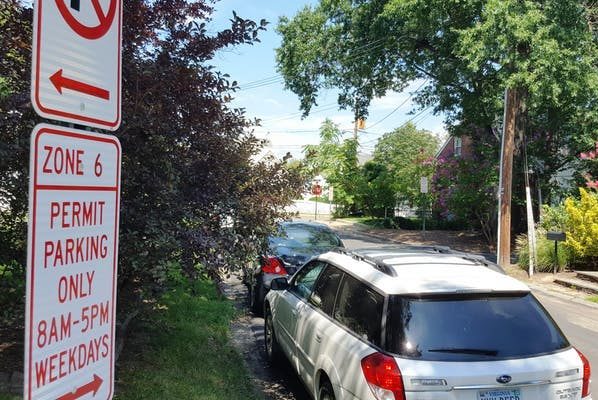
The proposed changes come three years after a moratorium was placed on new parking restrictions so a review of the program could be conducted. Among the changes, County staff are recommending adding a pay-to-park option in restricted residential zones for short-term visitors, while expanding who can petition for Residential Permit Parking restrictions.

Residential areas with RPP restrictions would have paid, two-hour parking so that short-term visitors can legally park without a pass or permit. Payments will be processed through the ParkMobile app or through the EasyPark device, instead of pay stations.

Staff also recommend granting more parking options and permits to employees of K-12 schools and group homes, and reducing the number of permits that households can receive based on whether they have off-street parking such as driveways or garages.

During the meeting, the County Board approved an amendment that would allow residents to buy a third, or even a fourth, parking pass at a higher cost.

The added flexibility came after the board heard from families who have suddenly had adult children come home due to the pandemic, along with renters, homeowners who rent out rooms and homeowners who said the program would force them to enlarge their driveways.

Another concern expressed by some: whether the county can effectively enforce the modified parking restrictions, with hourly parkers added to the mix.

With the public hearing pushed from January to February, the Board members asked residents to think about the program over the next two months.

“This is a very complex program,” Garvey said. “For anybody who is just now looking at it, they need more time to digest even what we’re doing right now.”

So far, the public engagement process has mostly drawn out homeowners who currently benefit from the parking program, but not the apartment- and condo-dwellers who are generally excluded from it, a few Board members pointed out.

“Aurora Highlands has been well-represented in the public comments,” Board member Matt de Ferranti said. “The people who might benefit from this in terms of apartment buildings aren’t here.”


The County Board approved a test of surge-price parking in Arlington on Tuesday, after discussing the potential impacts on people with lower incomes.

The $5.4 million project is funded by VDOT, and the funds are expected to cover everything from developing to installing the needed parking software and hardware. Drivers will find this new type of parking on the streets in the Rosslyn-Ballston and Crystal City-Pentagon City corridors.

The program, also known as “performance parking,” was pulled from the Saturday meeting over concerns about how this would impact people with lower incomes, parking planner Stephen Crim said during the Tuesday recessed meeting.

“I don’t have all the answers to all those concerns,” Crim said. “The grant we are asking you to approve would pay for us to do the design and planning work that allows us to consider how people with low incomes, or racial minorities, need to be considered, and map out any mitigations that are necessary.”

The Board’s first equity consideration should be who has cars, Crim said. The program will mostly affect those who own one or more cars — namely, Arlingtonians with relatively higher incomes and households headed by white people, he said.

Rather than charging everybody the same price, this program could give drivers more chances to save money if they need to, by parking on less-popular streets at lower rates than currently offered, he said.

“Rates may go up on some blocks, but it may go down or stay the same on other blocks,” he said.

The higher prices on busier streets encourage turnover, which would also benefit this same group, he said.

“Those who are disadvantaged often lack money, but they also have time pressures that privileged individuals do not have,” Crim said. “We see performance parking as an opportunity to give benefit to time-pressed drivers of all backgrounds.”

After Crim spoke, County Board members told him they were comfortable moving forward.

“I’m so glad we’re doing a pilot,” Board Chair Libby Garvey said. “It is a complicated tool that can be used for good or ill, and we want to use it for good.”

The issue drew one public speaker concerned about equity. Alexandra Guendert said the new prices will be unpredictable, making it hard for people to budget trips.

“To think that $5.4 million to essentially create a system to get the rich better access to parking is disheartening,” she said.  

The prices will not be as prone to hourly fluctuation as prices for Uber and Lyft, Transportation Commission Chair Chris Slatt, who supports the pilot, said during the public hearing.

“People are able to know before they go what that parking may cost, depending on where they find it,” he said.

With the County Board’s blessing, the next step will be to engage the public and start developing a system that detects how full parking spaces are, Crim said. After the system is installed, it will start collecting data to fill out a database, which will be used to analyze occupancy and ultimately determine future prices.

Eventually, the County will be able to publish real-time information on spot availability.

Work on the new system along the Rosslyn-Ballston corridor and Crystal City-Pentagon City corridor is expected to start kick off during the current fiscal year, which ends on June 30.

A successful pilot could motivate other municipalities to follow suit, VDOT told the County in 2018. If people ultimately do not like it, the County could turn off the pricing function of the system but still collect data, which would be valuable for drivers and the Board, noted Crim.

“Parking is important to many people, but we frequently don’t have as much data about parking as we do about other matters, such as traffic volume, speed, transit ridership, so on,” he said.


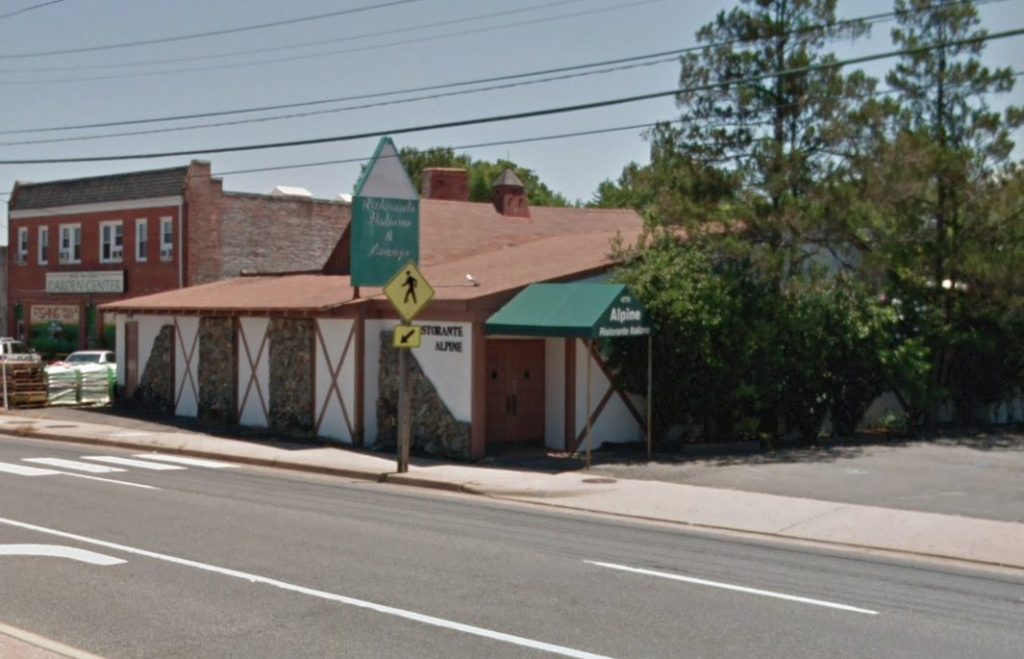
(Updated at 2 p.m.) Plans to demolish Alpine Restaurant on Lee Highway have been approved, inching forward the planned construction of The Children’s School daycare facility.

Despite the approval, the permit to demolish the building at 4770 Lee Highway, held by Trinity Group Construction, has yet to be issued.

“Once a payment is received, the permit is then issued,” said Andrew Pribulka, a spokesperson for the Arlington Department of Community Planning, Housing and Development, in an email. “Demolition may not begin until permits have been issued and posted.”

Trinity has applied for two other permits, one to excavate and another to build the facility.

Requests for comment from Trinity and The Children’s School were not returned.

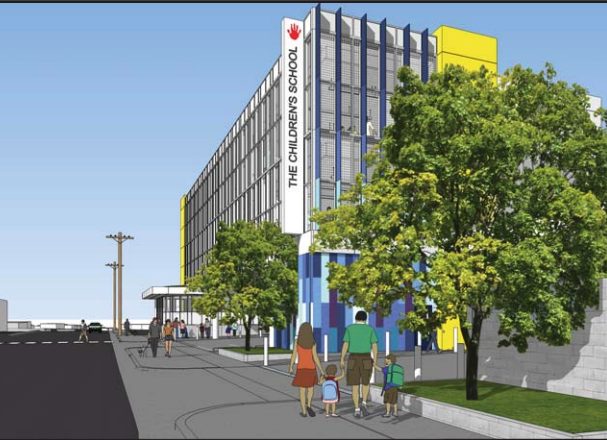
The progress comes two-and-a-half years after the County Board unanimously approved a permit to build a three-story daycare facility for children of employees of Arlington Public Schools, to be built where the long-time restaurant has stood vacant for a decade.

The private, nonprofit child care center will oversee no more than 235 children of APS staff between the ages of two months and five years old. This new facility will also be home to Integration Station, a program for kids with developmental or other disabilities.

Both the co-op daycare and Integration Station are temporarily housed in the same Ballston office building at 4420 N. Fairfax Drive. The programs were co-located in the Reed School building in Westover, but were forced out when APS decided to open a new elementary school there.

The Reed School is set to open to students in 2021.

One year after approving the project, the Board approved a request to eliminate off-site parking and modify initial architectural plans.

Most parking is below-ground with some above ground, and the plans now includes a third-story rear play deck and an expanded rear wall to shield neighboring houses from car headlights, a concern from residents.

Alpine Restaurant served Italian cuisine and was in business for 44 years before closing in 2010 upon the owner’s retirement. It was acquired by the owners of the Liberty Tavern Restaurant Group, which ultimately decided against opening a new restaurant there.

Photo via Google Maps


The County Board has granted restaurant and bar owners more leeway as to where they can set up and winterize outdoor seating.

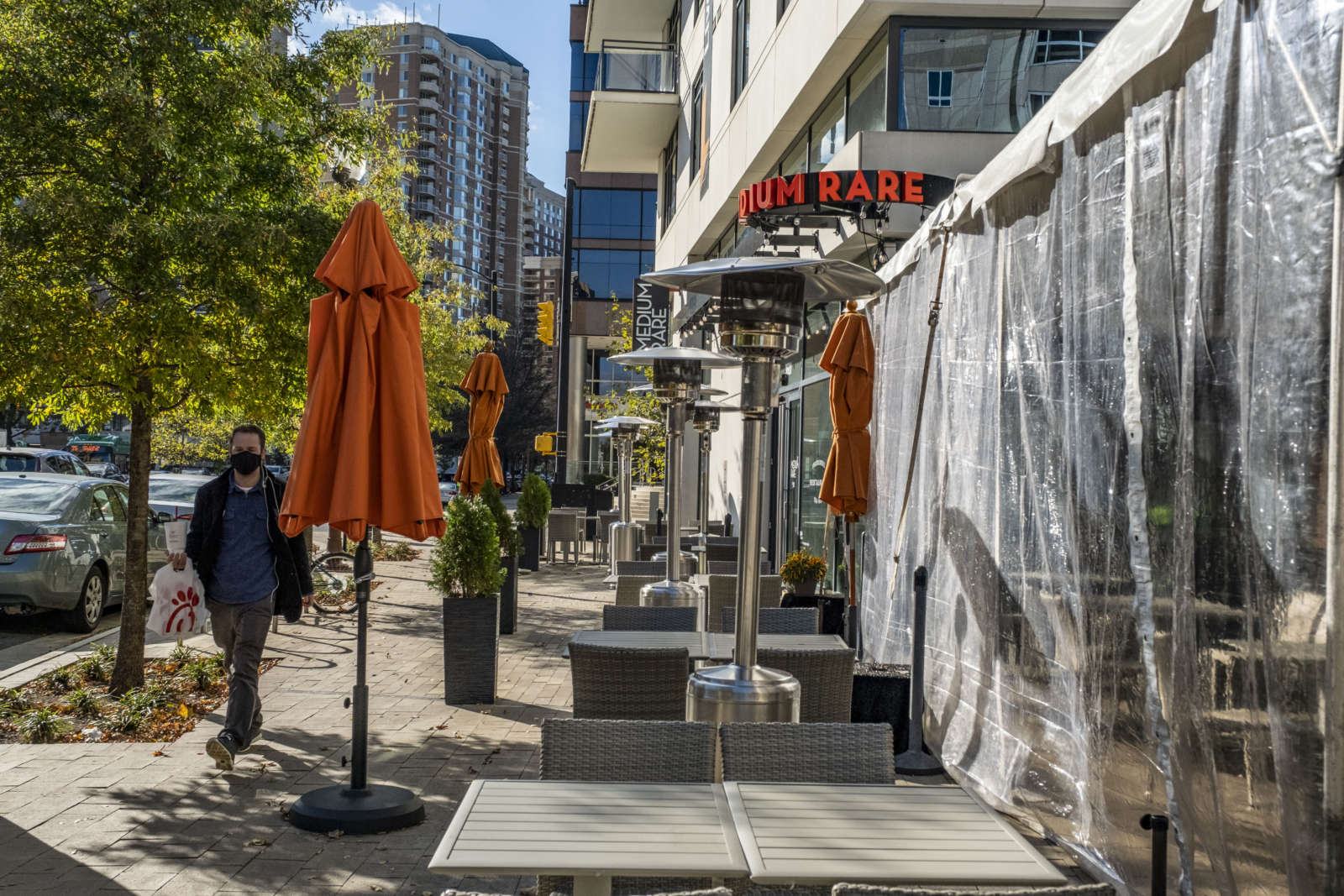
Owners will now be able to set up temporary outdoor seating areas — or TOSAs — in common areas, such as plazas, following a vote during the recessed County Board meeting on Tuesday.

In May, when the County first established a program to allow TOSAs to respond to the pandemic, the seating on sidewalks and patios had to be associated with specific restaurants and bars.

The decision to give restaurants more space and flexibility is partly in response to a request from representatives of a plaza in Shirlington to open the space to outdoor seating for several nearby restaurants.

“Businesses have discovered another dimension of work in this enhanced environment,” County Board member Takis Karantonis said during the meeting. “I believe for the most part they are working very well, I’m very thankful for the enhancement before us today.”

This seating arrangement could be here to stay, County Manager Mark Schwartz told the board.

“We may need to drop the ‘T’ in TOSA,” Schwartz said. “We’ll see.”

To keep this going post-pandemic, the County Board would have to codify it in the zoning ordinance, County Attorney Stephen MacIsaac said. This ordinance will last up to six months after the emergency is declared over.

Expanding seating options through TOSA will accelerate implementation and avoid the fees associated with existing county processes for approving outdoor seating, Anthony Fusarelli, assistant director for the Department of Community Planning, Housing and Urban Development, told ARLnow.

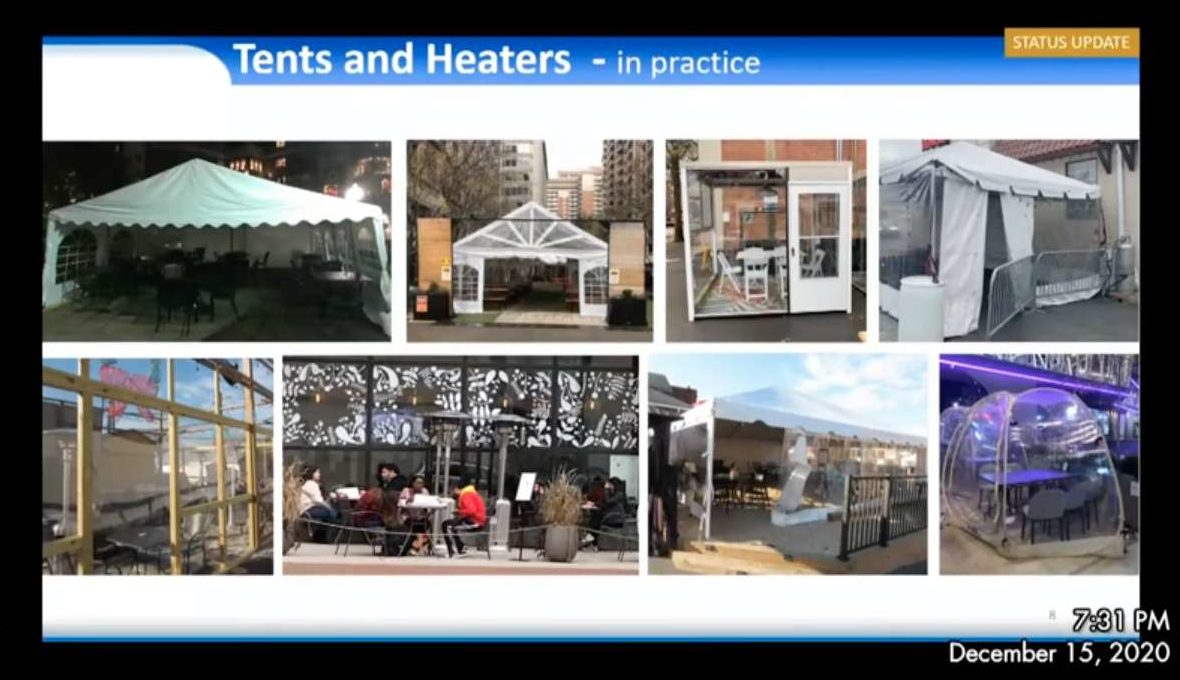
The change comes as County officials encourage restaurants, which have set up tents and heaters outside the new permitting process, to go through official channels.

“We’re finding propane heaters used and stored under tents, and tents not being set up under TOSA,” which is not allowed, Fusarelli told the County Board.

CPHD has received only a dozen tent requests through TOSA applications, which means owners may not be aware of the rules, or are going outside of them, Fusarelli said.

This spring, the County had 250 requests for outdoor dining “of some sort,” and 120 TOSA applications, Fusarelli said. Since the temporary program launched, his department has approved 93 TOSAs.

“We’re doing the best we can on our end to respond to requests,” Fusarelli said. “We approved the first applications late last week, and will approve more in the future.”

The change would especially help restaurants without space on their property to accommodate and winterize outdoor seating according to Virginia’s fire codes. Heaters have to be five feet from exits, awnings and tents, and only electric heaters are permitted under tents.

Medium Rare owner Mark Bucher, who said he has not heard back about his TOSA application, is still chafing against the restriction that prohibits propane heaters from being installed under tents.

He is doing it anyway, even though the Arlington County Fire Department has repeatedly asked the restaurant to turn the heaters off.

“We have to because people are freezing,” Bucher told ARLnow. “If I stop, and I don’t heat the tents, I’m out of business.”

(more…)


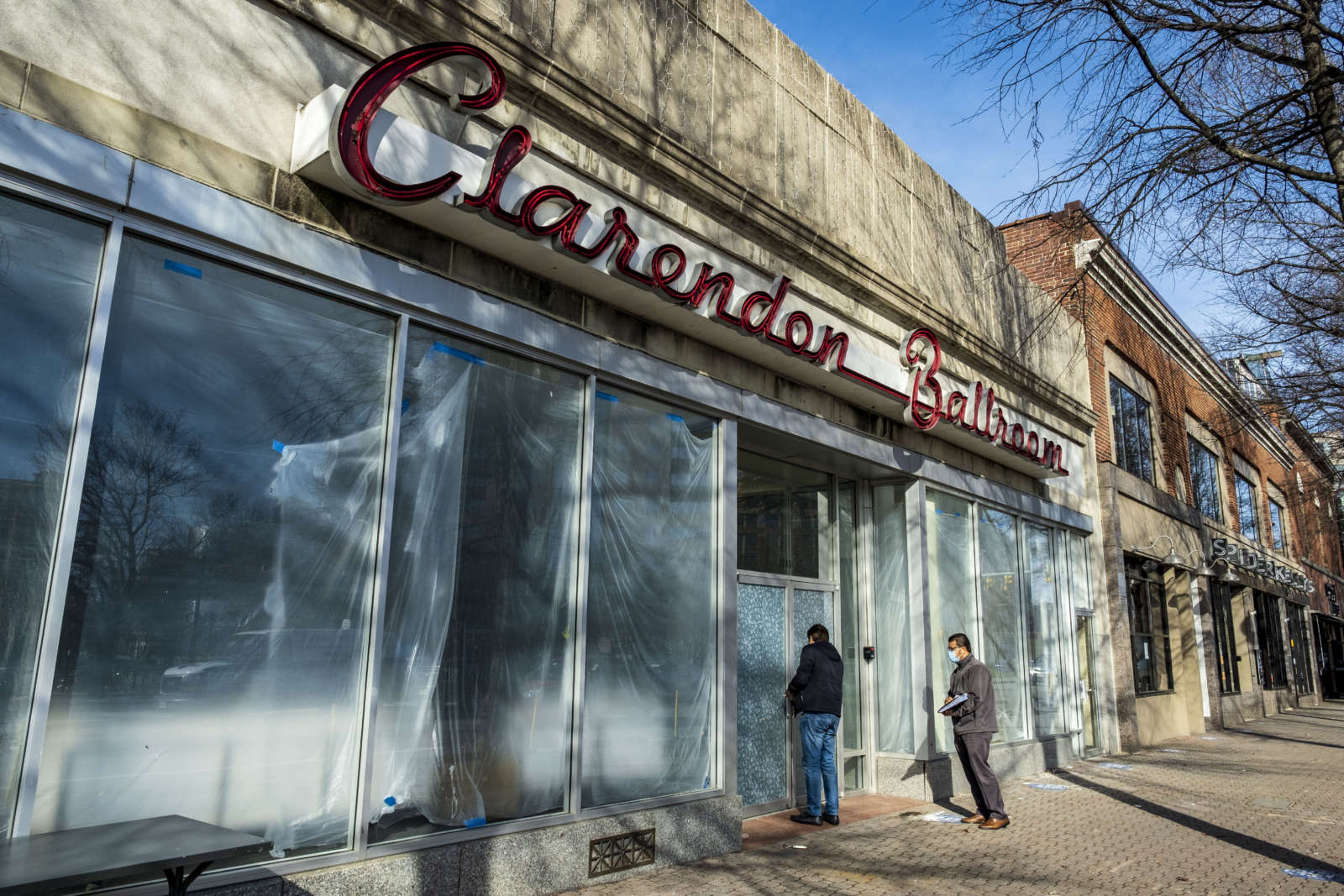
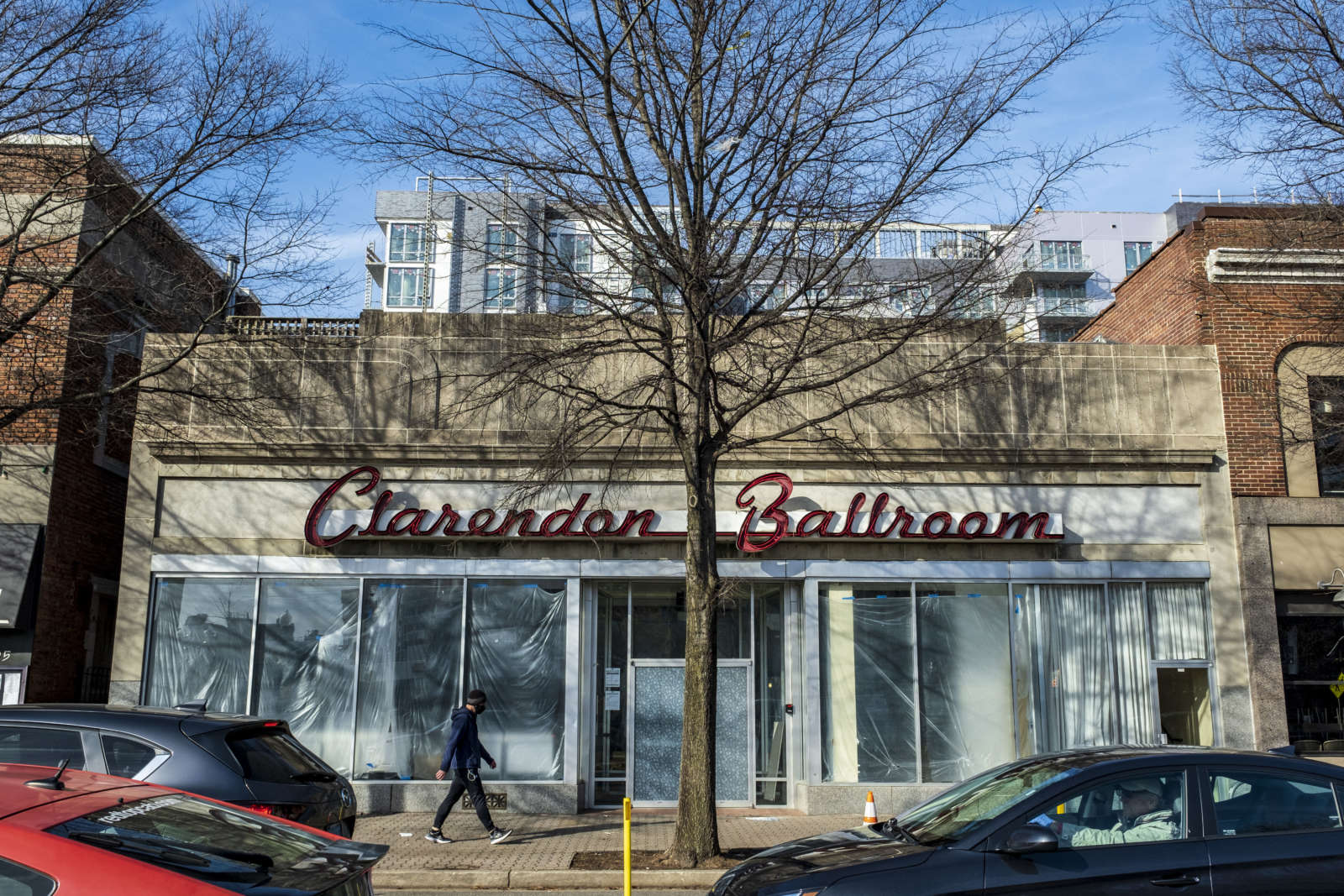
After some delays, Clarendon Popup could be hosting live entertainment and dancing in the former Clarendon Ballroom space by the end of December.

The new opening day would be almost exactly one year after the event and nightlife spot at 3185 Wilson Blvd closed after New Year’s Eve in 2019. Owners anticipated the first popup — with a “Winter Wonderland” theme — would open around this time in December, but the holidays have set them back.

“We are aiming to open by the end of the month pending no further delays,” owner Mike Bramson said in an email, adding that the popup has been set back by “typical internal delays, such as equipment arriving on time given the holidays.”

The wonderland theme was originally set to run from mid-December through New Years, with plans to extend it through the winter season “if it was a success,” Bramson said.

“Given the late start it makes sense to continue the theme and give everyone a chance to see all the decorations and experience the space,” he said. “Fortunately, our first popup, Winter Wonderland, is a theme that can be enjoyed throughout the winter.”

Bramson, one of the owners of The Lot, the popular outdoor beer garden a few blocks from the Ballroom, first confirmed the rotating, multilevel popup bar and event venue was coming in October.

On Saturday, the County Board approved Clarendon Popup’s request for a live entertainment and dancing permit. The green light came after county staff voiced their support, albeit with a few conditions.

The County is requiring the owners must abide by all local, state and federal regulations related to COVID-19 and pushing the venue to change the hours of operation, based on input from the Lyon Village and Lyon Park civic associations.

“With adherence to the proposed conditions, staff does not believe that the proposed use permit will cause any undue adverse impacts to the public health, safety or welfare, nor be in conflict with the County’s master plans,” staff said in the report.

Bramson said the popup will indeed follow all federal and state guidelines and recommendations related to the coronavirus.

“One of the biggest appeals of the venue is its size, providing for ample space to social distance,” he said.

The owners requested to operate between 11 a.m. and 1:30 a.m. Tuesday through Saturday, and 11 a.m. to 12 a.m. Sunday and Monday. Clarendon Ballroom operated with similar hours.

The Lyon Village Civic Association expressed concerns about the applicant’s proposed hours of live entertainment, especially during weekdays. In response, the County proposed alternative hours of live entertainment and dancing that are similar to neighboring nightlife spots, including Liberty Tavern and Don Tito’s, according to the report.

The new hours, which the owners agreed to, are 11 a.m. to 12 a.m., Sunday through Thursday and 11 a.m. to 1 a.m., Friday and Saturday, including the eve of all federal holidays.

“We agreed with the hours of operation as they were on par with some of the other businesses around us,” Bramson said. “I’m glad we were able to come to an agreement.”


(Updated at 5:15 p.m.) Few office and retail spaces were approved or completed in the first three quarters of 2020, but Arlington officials say it is too early to attribute the drop to the pandemic or consider it a trend at all.

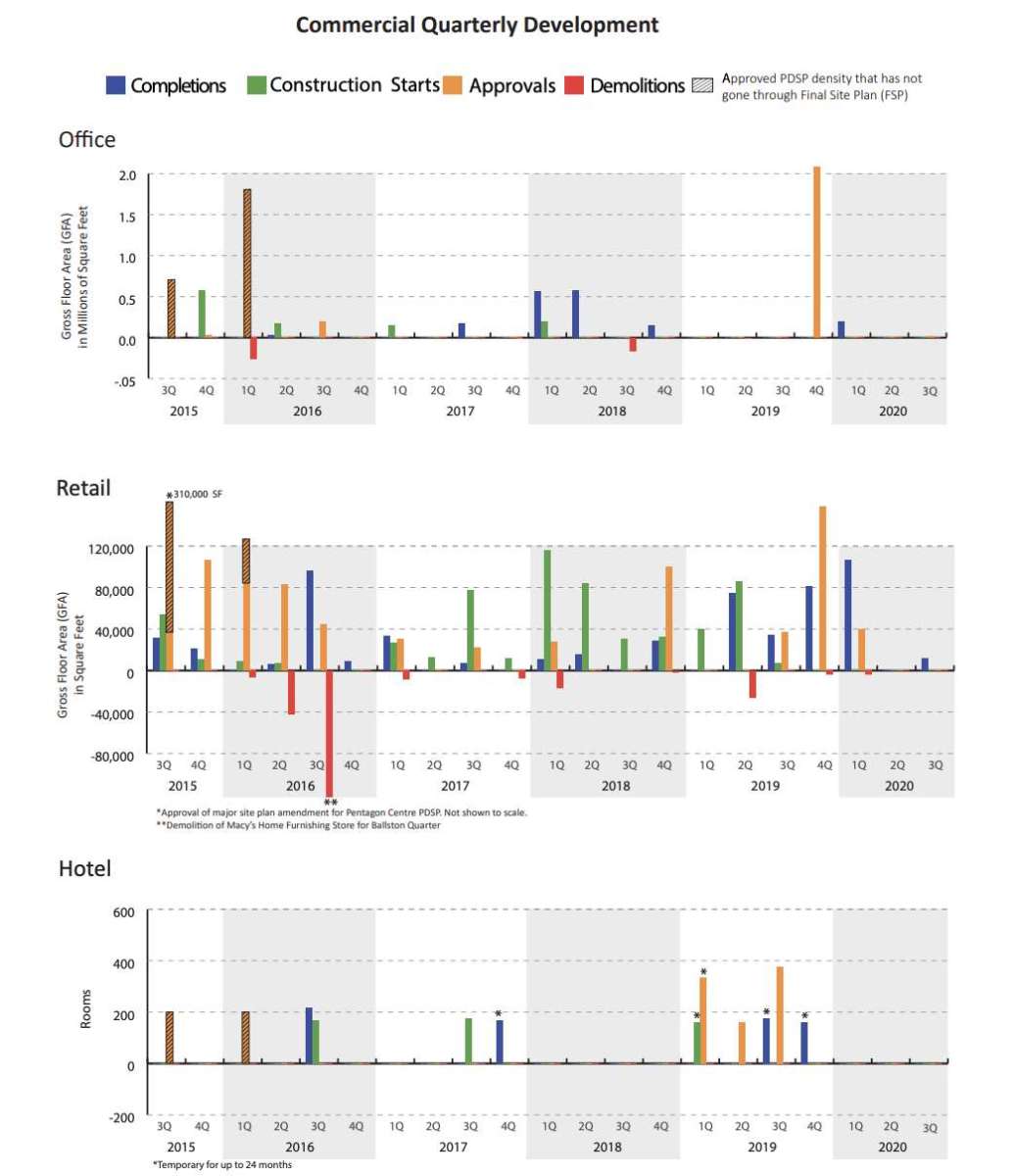
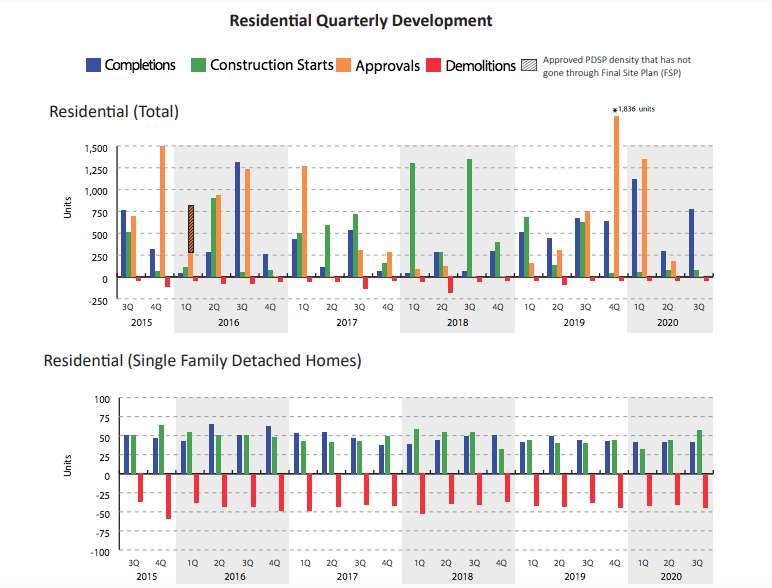
The 2020 third quarter report on retail, office, hotel and residential development appears to show that the rates at which projects are approved, buildings are demolished, and construction starts and ends have dropped off in 2020. Meanwhile, the demolition and redevelopment of single-family detached homes appears to remain consistent.

No hotel rooms have been approved or built so far in 2020 (though a former hotel was demolished in spectacular fashion on Sunday). About 120,000 square feet of retail has been completed this year, and 40,000 square feet approved, but rates exceeded both those sums in 2019. About 17,000 square feet of office space was approved this year, compared to 2 million last year thanks to Amazon’s HQ2.

“It would be easy to think because of COVID-19 that that might explain the tapering off of development, but it’s too early for us to know,” said county planner Emily Garrett, who led the Q3 Development Tracking Report. “It could be normal to have a slower couple of quarters following large projects.”

In the view of Marc McCauley, the director of real estate for the Arlington Economic Development office, the coronavirus has impacted existing properties more than future projects.

“If you’re in development and considering mixed-use, we haven’t heard a lot of projects significantly delayed or dropped because of concerns, but you may be concerned about getting a hotel financed,” he said. “It has not moved the needle one way or another in terms of development.”

Although these reports look back to the third quarter of 2015, that is not long enough in the scheme of big projects to determine if large-scale office, retail and mixed-use developments are actually slowing down, the two officials agreed.

Rather, such projects could be on four- to five-year cycles, which looks inconsistent compared to the 50 to 60 houses that are approved, demolished and rebuilt each quarter, like clockwork, Garrett said. Before Amazon was granted 2 million square feet in December 2019, the last time a comparable project came around was in the first quarter of 2016, she said.

As for retail, the change reflects the broader trend in Arlington’s development extending beyond the last five years. McCauley said. Retail clusters such as the Ballston Quarter explain the occasional retail spikes, but it is more common to have small amounts of ground-floor retail approved as part of a mixed-use project.

“There’s only so much retail clusters you can support,” he said. “Through long-term market cycles, they get repositioned because it’s about refreshing your concept to be able to compete for customers.”

Meanwhile, the housing development rates reflect the trajectory Arlington has been on for decades, Garrett said, with most new development focusing on denser housing near transit hubs.

“I would definitely say overall the way development trends aligns with the overall demographic trends of Arlington County for decades now,” she said.

The average household size shrank in 1970 and has been stable ever since, with more opting to live in smaller housing units, she said. The report shows that the number of apartment units is growing, while the number of single-family homes remain flat, with detached homes being replaced at a nearly one-to-one rate.

The last three quarters of relative inactivity come as the county is focusing on new and ongoing development plans, including along Lee Highway and in the Clarendon area.

“We’re at that point where we’re looking at studies that have been completed and… seeing where there might be additional potential,” Garrett said.

Garrett said it “could be a year, or years” before the County sees the true impact of the pandemic on development. “We’ll just have to see.”


Sponsored by Monday Properties and written by ARLnow, Startup Monday is a weekly column that profiles Arlington-based startups, founders, and other local technology news. Monday Properties is proudly featuring Shirlington Gateway. The new 2800 Shirlington recently delivered a brand-new lobby and upgraded fitness center, and is adding spec suites with bright open plans and modern finishes. Experience a prime location and enjoy being steps from Shirlington Village.

Michael Weigand was one of those “boots on the ground” Army platoon leaders, the kind often depicted in the movies.

But when the Army founded the Cyber Branch — the first new branch since the Vietnam War — Weigand decided to join. He and fellow West Point graduates James Correnti and Josh Lospinoso became part of the first 70 officers to trade a physical way of securing the nation for a virtual one.

The Cyber Branch taught the three officers how vital cybersecurity is for the transportation industry. When the three left the Army, they saw gaping holes in secure transportation in both commercial and government spheres.

“During that time, we started to appreciate that it is more than IT systems that need to be defended from criminals and foreign adversaries,” he said. “There’s been a lot of attention about securing power systems, dams and critical infrastructure, but transportation has the same needs.”

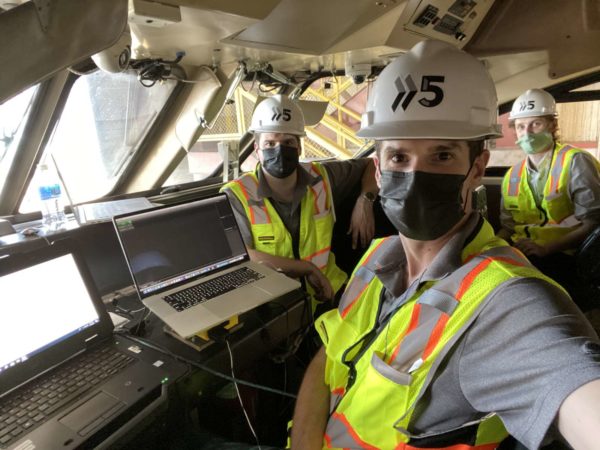
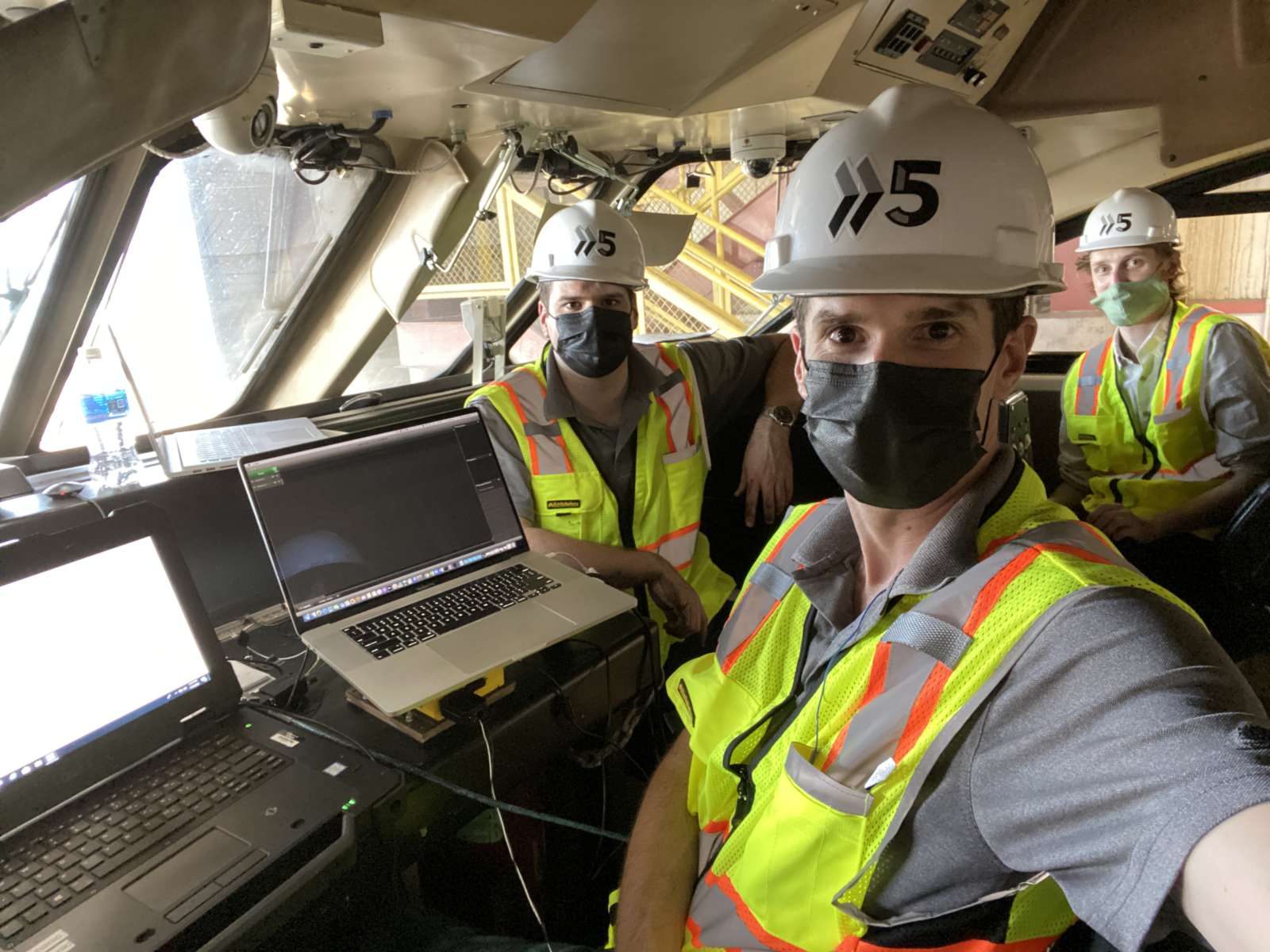
So they founded Shift5, a Rosslyn-based startup transportation data company that Weigand said helps businesses and governments run “smarter, safer and more efficiently by unlocking data.” Its office is located at 1100 Wilson Blvd.

During their stint in the Cyber Branch, the three discovered transportation ran heavily on computers but few were monitoring the data these computers collected. To protect a system, Weigand said, data has to be monitored. But the data can do so much more.

Shift5 puts that data to work. The information can automate menial tasks and make systems more reliable, he said. It can also help executives make smarter business decisions, from choosing what to invest in to analyzing how a fleet is aging and predicting when maintenance needs to be done.

“We call all of that data that is flowing inside these big transportation systems, but is not being actively recorded, dark data. We like to shine a light on that, and collect, record, monitor it from cyber-security perspective, so that everything is operating efficiently,” Weigand said. “That is where Shift5 lives.”

The company sells data solutions to both the commercial industry and to the federal government, which helps Shift5 mix the flexibility and speed of the commercial industry with the innovation of the Department of Defense.

“By supporting both customer groups, we get to help bring the best of both worlds to our customers,” he said.   

Less than a year after the startup was founded in June 2019, the coronavirus hit, and Shift5 noticed customers needed their data monitored for security and efficiency more than ever. One hard-hit area was public transit.

This year, Shift5 started working with heavy commuter rail, which experienced steep declines in ridership due to the pandemic. It is more important now to be efficient with resources, Weigand said.

“They save a lot more money than they pay for the service,” he said. “It’s an awesome service with an additional security benefit.”

Next year, the group plans to expand into even more commuter and freight rail.

“There’s an enormous enterprise value we can provide to save money, make operations more streamlined and provide security benefit,” he said.


View More Stories