An Arlington man is facing a misdemeanor charge after police report he broke into a woman’s home this weekend and sexually assaulted her while she slept.
Officers were dispatched to the scene at 3:26 a.m. on Saturday morning on the 3400 block of Columbia Pike after the woman allegedly woke up to find the man kissing her on the cheek.
She then “confronted” the intruder, police say, but he fled the area on foot. Police say they apprehended a suspect who matched the description of him and who they identified as Dominus Dayton, 37, of Arlington.
Police charged Dayton with two Class 1 misdemeanors, unlawful entry and assault and battery, for allegedly breaking into a woman’s home and kissing her while she slept. He was denied bond.
Dayton is currently out on bail and is scheduled to appear before an Arlington General District Court judge tomorrow afternoon (Wednesday) for arraignment on the assault charge.
In Virginia, assault and battery carries a $2,500 fine, and a mandatory minimum of 30 days in jail, with a possible sentence up to a year.
Below are the details from the full crime report:
UNLAWFUL ENTRY, 2019-03020058, 3400 block of Columbia Pike. At approximately 3:26 a.m. on March 2, police were dispatched to the report of a possible burglary in progress. Upon arrival, it was determined that the female victim was asleep inside a residence when she was awoken to an unknown male suspect allegedly kissing her on the cheek. Once confronted by the victim, the suspect left the residence on foot. Responding officers located a suspect matching the victim’s description and he was later positively identified. Dominus Dayton, 37, of Arlington, VA was arrested and charged with Unlawful Entry and Assault & Battery. He was held on no bond.
After months of work, Arlington officials are gearing up to advance a new round of regulatory changes designed to encourage the creation of accessory dwelling units around the county.
The county plans to hold an open house on the new regulations tonight (Tuesday), specifically on policies governing how far the homes can be set back from the street.
Commonly known as “ADUs,” or “mother-in-law suites,” the homes can include everything from basement apartments to those located above a house’s garage. The County Board passed a series of revisions to Arlington’s ADU regulations in 2017, in a bid to prompt more people to create those units and beef up the supply of reasonably priced homes in the county.
Those changes were primarily targeted at allowing homeowners to more easily create ADUs within existing structures, rather than building new ones. The rules changes also allowed property owners to create an ADU in an existing structure detached from a single-family home, like a garage, but they could not build any new structures on properties for such a purpose.
Still, the Board vowed to subsequently consider rules changes allowing people to build free-standing ADUs on properties. The homes are broadly seen as a key way to provide “missing middle” housing, or homes that fall in between luxury apartments and subsidized, affordable homes, and advocates have long championed additional ADU rules changes.
But, to allow for any new construction, officials would need to change the “setback” requirements, which stipulate how far the homes can be located from the street. County Manager Mark Schwartz has been developing proposals for such rules changes, but has yet to unveil them in a public setting.
That is set to change later this afternoon. The exact shape of the proposals remains unclear, however — a county spokeswoman could not immediately provide details on the proposed regulations. Michelle Winters, the executive director of the affordable housing advocacy group the Alliance for Housing Solutions, also said she was unsure when the county will release the details of the proposal publicly.
The ADU meeting is set for the Ellen M. Bozman Government Center (2100 Clarendon Blvd) in conference rooms C and D from 4-8 p.m. Any zoning changes discussed there would likely need to be scrutinized by both the Planning Commission and County Board before they go into effect.
USPS Decides to Relocate Rosslyn Post Office — “The U.S. Postal Service will relocate the Rosslyn Station Post Office, located at 1101 Wilson Blvd, to a yet-to-be-determined location as close as reasonably possible to the current site.” [USPS]
Netherlands Carillon to Go Quiet, Temporarily — “Bells that have been ringing high atop an Arlington hill for nearly 60 years will soon go temporarily silent as they embark on a journey thousands of miles long… The 50 bells will be taken down by crane and sent by ship to a foundry in the Netherlands, where they will be cleaned and retuned.” [WJLA]
New Memorial Bridge Lane Closures — “Work is moving ahead on the Arlington Memorial Bridge, which means that the overnight traffic pattern will change to accommodate construction lanes. Starting on Monday, March 11, the National Park Service will reduce the number of lanes that drivers can access from 9 p.m. until 5 a.m.” [WTOP]
Ballston Tech Company Acquired — “Comcast today announced it has acquired BluVector, a company that uses advanced artificial intelligence and machine learning to provide cybersecurity protection to companies and government agencies.” [BluVector]
‘Pizza With Police’ Event Planned — “Pizza with the Police, similar to the popular Coffee with a Cop series, is an informal event designed for Arlington’s residential and business communities to meet and interact with members of the police department, ask questions, discuss their public safety concerns and get to know their neighbors.” [Arlington County]
Amazon VP Tweets from Crystal City — “Delicious lunch at Federico Ristorante Italiano in #CrystalCity! It was fun to hang out with @FreddieFlamingo and see one of the great local restaurants that the future #AmazonHQ2 employees will be able to enjoy very soon!” [Twitter]
The magazine partnered with polling company PredictWise to rank all 3,000 U.S. counties on an interactive map published today (Monday) by how much “partisan prejudice” citizens from the areas expressed. PredictWise is run by economist David Rothschild and is dedicated to “help progressive change-makers,” per its website.
Counties were ranked based off of surveys of 2,000 respondents who were asked questions such as, how they felt about family members marrying across the political aisle, and whether Democrats or Republicans were “selfish, compassionate, or patriotic.” PredictWise then combined the data was combined with county “voter files” that record voter turnout and registration. The result is a heat map ranking every county from “less prejudiced” to “more prejudiced.”
The polling places Arlington County in the most “prejudiced” category of the map. Not only that, but the polling data ranked Arlington in the 100th percentile of most prejudiced counties — that’s higher than Alexandria (99th percentile), D.C. (98th percentile of most prejudiced), Prince William (81 percentile), and Fairfax (95 percentile.) The least prejudiced county in the Greater Washington Area area is St. Mary’s County which was ranked at the 52nd percentile, meaning 48 out of 100 counties have more politically divided citizens.
PredictWise found that demographic variables like age, race, education, and proximity to cities correlated with the amount of prejudice in a county. They reported predicted more prejudice in communities that are whiter, older, urban, and more highly educated.
A subsequent poll showed that Arlington also ranked in the highest category for Democrats being dismissive of Republicans. But a third poll indicated Arlington’s Republicans are not very dismissive of Democrats — bucking a national trend showing Republicans are more dismissive of Democrats on average.
PredictWise co-founder and Chief Science Officer Tobias Konitzer tweeted that polling project is “data-driven ethnography” that “opens healthy debate.”
One last larger point: What I love about the story (yes, I am biased) is its method of data-driven ethnography – not aware of many pieces nowadays that can say that – to get at incredibly complex problem. It opens healthy debate, and beats every @nytimes Ohio diner story! https://t.co/dA1jOHUMEW
The area of the country PredictWise’s data deemed the most politically close-minded was Suffolk County, Massachusetts. The most open-minded was Watertown, New York.
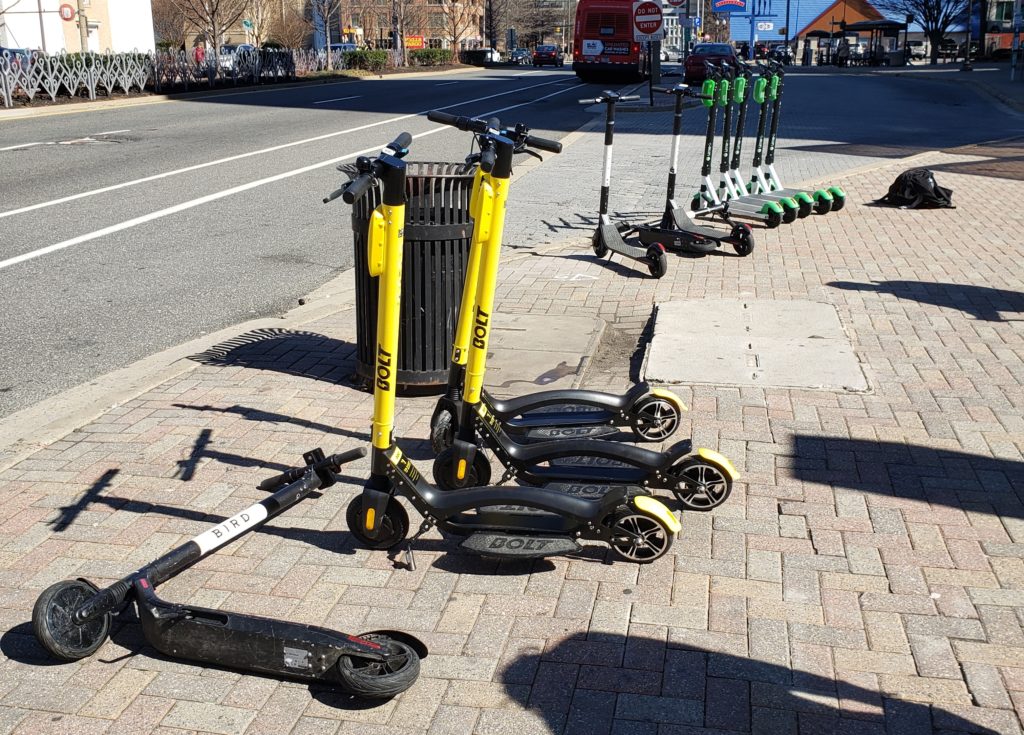
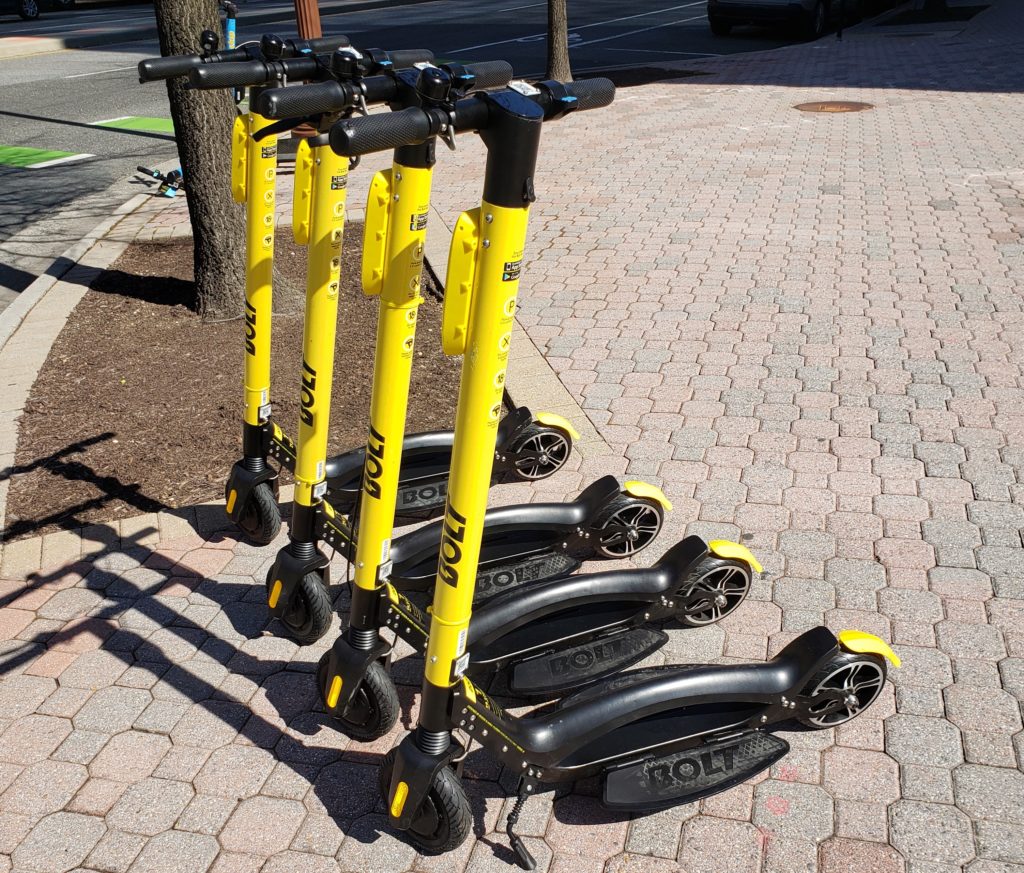
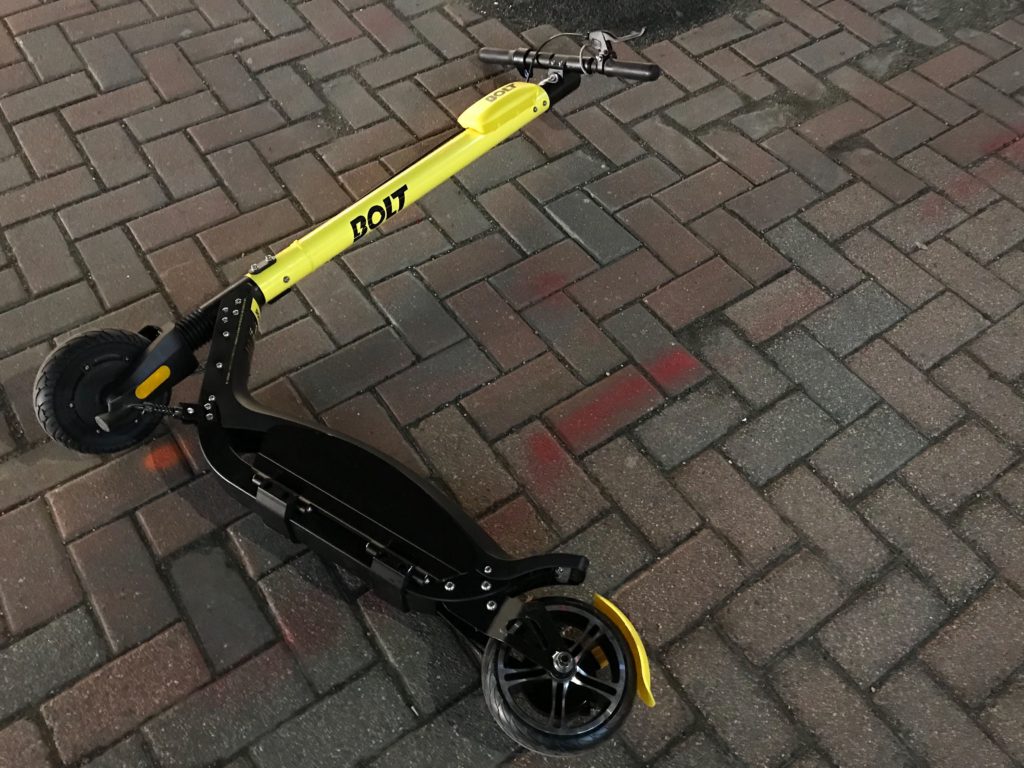
Bolt scooters in Ballston (Image courtesy of Joel K.)
Bolt scooters in Ballston (courtesy of Joel K.)
A Bolt scooter
Yet another company is now offering dockless electric scooters around Arlington, as Bolt has now becomes the seventh firm operating in the county.
Bolt first began renting out its scooters in Arlington last Wednesday (Feb. 27), county transportation spokesman Eric Balliet told ARLnow. Like its six other competitors, the company is participating in the county’s pilot program for dockless vehicle providers, which is set to run through the summer and help Arlington officials determine the best way to regulate the technology.
February was a busy month for scooter companies in Arlington, with three winning the county’s approval for participating in the program in the last few weeks alone: Skip, Spin and Jump.
Bird kicked off the flood of scooters onto county streets this past summer, when it dropped hundreds of devices around the county. That prompted the County Board to sketch out a more formal pilot program to guide the process, clearing the way for Lime, Lyft and the others to follow suit.
Under the terms of the pilot, the companies are restricted to operating 350 vehicles for their first month in the county, and can then apply for gradual increases each month (so long as they can meet certain ridership targets).
Thus far, county officials haven’t recorded many problems with the scooters, though they remain a bit vexed in how to dissuade younger riders from using them or how to enforce the county’s ban on the scooters on local trails and sidewalks.
The pilot program is set to wrap up in July, when the Board will subsequently consider passing a formal ordinance governing the devices.
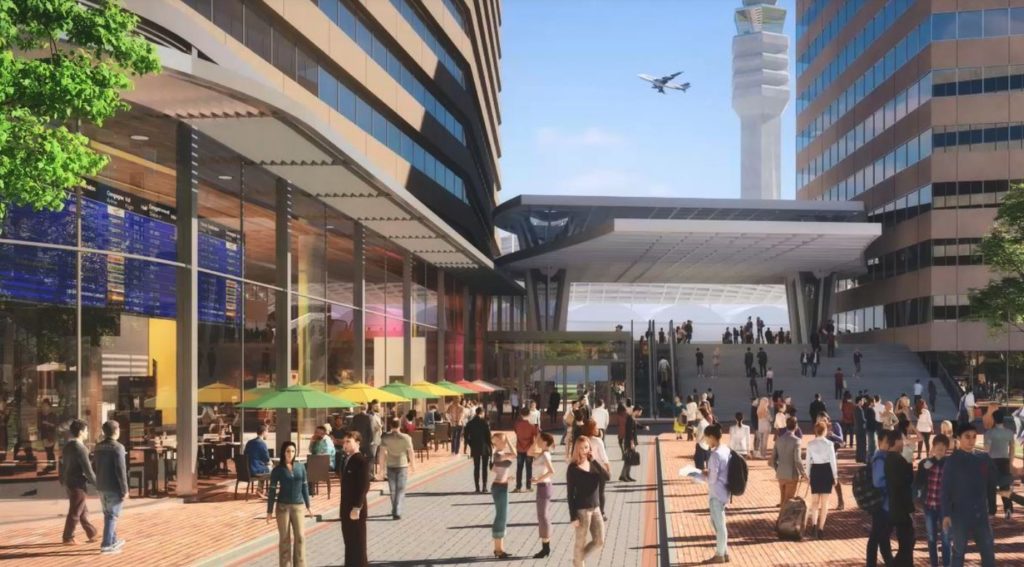
A multimodal transit hub planned for Crystal City to coincide with Amazon’s arrival. (via JBG Smith)
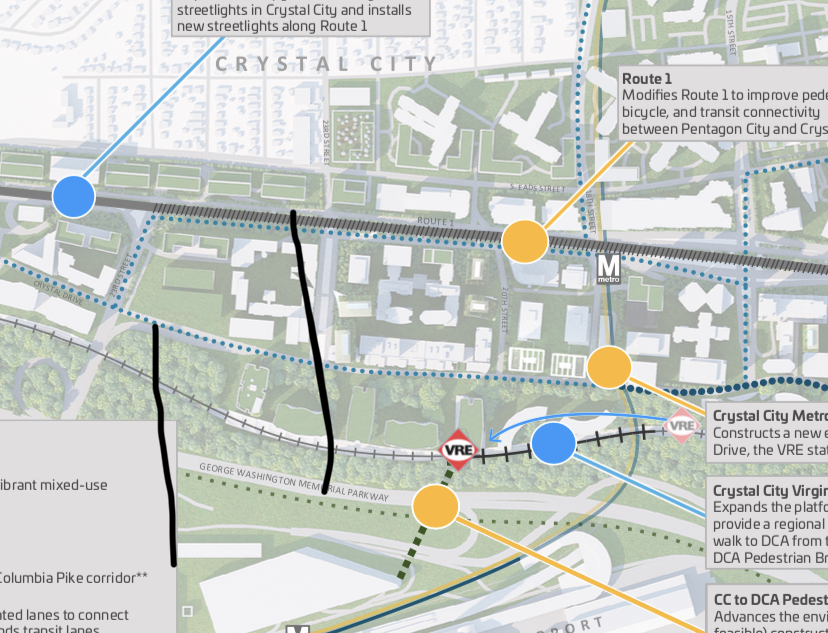
A map of proposed transportation projects around Amazon’s new headquarters in Crystal City (via HQ NOVA)
The following feature article was funded by our new Patreon community. Want to see more articles like this, exploring important local topics that don’t make our usual news coverage? Join and help fund additional local journalism in Arlington.
Major redevelopment is coming whether or not local resistance turns the e-commerce giant away, but the attention-grabbing headlines and all-at-once infrastructure proposals don’t reveal how mobility investment is a gradual process – or how Crystal City has been steadily improving its transportation infrastructure since long before the HQ2 contest even began.
Crystal City has long been slated for some major transportation investments: Long Bridge reconstruction could enable MARC to bring commuters straight from Maryland to Crystal City and let people bicycle straight to L’Enfant Plaza. A new Metro entrance would make it much easier to connect to bus service. A remodeled VRE commuter rail station would enable larger and more trains, Metroway expansion will strengthen ties with Pentagon City and Alexandria, and a pedestrian bridge to the airport would take advantage of the fact that DCA is three times closer to Crystal City than any other airport in America is to its downtown.
These projects are big: big visibility, big impacts, big cost. They have all been in the pipeline for years, and Amazon is bringing them renewed attention and new dollars.
However, these major investments aren’t the only projects that will update Crystal City’s decades-old transportation infrastructure. Just as important as these headline-making proposals are the more incremental projects that, block by block, are making Crystal City an easier place to get around — and, just like their larger counterparts, these smaller projects have been given some extra weight by HQ2.
Old Visions, New Funding
One document has guided much of Crystal City’s development for the past decade: the Sector Plan. The Crystal City Sector Plan made many suggestions for possible improvements. Not all of them have yet come to fruition, but many have, and the plan continues to drive Arlington’s conversation about Crystal City.
That conversation has recently become a little more ambitious. Amazon’s HQ2 announcement brings not only attention, speculation and more than a little resistance — it will also bring very definite funding. Arlington and Alexandria, combined, “have secured more than $570 million in transportation funding” while the commonwealth of Virginia has committed to $195 million for the same.
This new funding flows mostly toward old designs, all of them focused on alternatives to the car. Arlington’s Incentive Proposal discusses 10 transportation “example projects.” Five of them fall within Crystal City itself, of which all but one follow ideas that originated in the Sector Plan (the remaining project, VRE station expansion, isn’t new either).
Moving Block by Block
Most of Crystal City’s streets were built in the 1950s and 1960s, and followed the “modernist” school of city planning.
They separated pedestrians from cars as much as possible, often putting pedestrians in bridges or tunnels; located stores in malls rather than on sidewalks; and spaced out intersections widely so that cars could accelerate to highway speeds. The Sector Plan calls to convert these into “Complete Streets” that will “accommodate the transportation needs of all surface transportation users, motorists, transit riders, bicyclists, and pedestrians.”
It can be easy to think of transportation investments as one-off projects. The CC2DCA pedestrian bridge to the airport, for example, is an all-or-nothing endeavor. Half of a bridge wouldn’t be very useful for anybody.
Because of its focus on the street level, the Sector Plan calls for gradual change. It endorses street transformation projects that can be completed incrementally — block by block, street by street, improving the area’s transportation network over time. It seeks “to balance any proposed investments in transportation infrastructure with improvements in the efficiency and effectiveness of the existing network, so that the maximum benefit can be delivered at the lowest cost.”
This approach pairs well with Crystal City’s desirability for land developers. Most significant developments in Arlington are governed by the site plan process, through which the county negotiates with developers for community benefits — which might include a street renovation. Robert Mandle, chief operating officer of the Crystal City Business Improvement District, explained that “as a redevelopment plan, many [Sector Plan] improvements were anticipated as occurring in conjunction with opportunities presented from redevelopment.”
New Hotel for DCA? — “A hotel might be in the works for Reagan National Airport, according to Jack Potter, CEO of the Metropolitan Washington Airports Authority… A spokeswoman for MWAA said they are still in the ideas phase and nothing is concrete.” [Washington Business Journal]
Parents Fight Proposed Key Changes — “Parents are battling for the school’s future after Arlington Public Schools surprised them with a plan to relocate Key [Elementary], an announcement that animated larger questions about race, class and the purpose of bilingual education.” [Washington Post]
APS Friday Closure Questioned — “Most schools in the DC region decided to stay open despite the wintry mix Friday morning, but Arlington County Public Schools decided to close leaving parents in disbelief.” [WJLA]
Kindergarteners Learn About Transgender — “Dozens of kindergarten students sat cross-legged in his classroom at Ashlawn Elementary School in Arlington, listening as an advocate for transgender rights paged through a children’s picture book about a transgender girl,” as part of an event with the National Education Association and the Human Rights Campaign. [Washington Post]
Chamber Partners with APS — “The Arlington Chamber of Commerce is pleased to announce a partnership with Arlington Public Schools Career Center for the Young Entrepreneurs Academy (YEA!) program. The Chamber is in its fifth year of offering the YEA! Program, but this is its first class of students for the program as part of their Arlington Public Schools learning.” [Arlington Chamber of Commerce]
Dog With Dementia Falls into Storm Drain — “A small dog with dementia is missing after falling into a storm drain in Arlington, Virginia. The Animal Welfare League of Arlington tweeted out an alert Thursday and said the cute pup disappeared after falling into the sewer about 8 p.m.” [NBC Washington, Twitter]
Rosslyn is set to see a few more pedestrian safety improvement over the course of the next year or so.
The neighborhood’s Business Improvement District, which advocates for Rosslyn businesses by collecting a small property tax, is planning a variety of short-term fixes to make the bustling streets a bit safer for walkers.
In plans delivered to the County Board Saturday (Feb. 23), the BID says it hopes to use some of its tax revenue to work with county police on the fixes, as part of a broader initiative to make the area more walkable. County officials have even contemplated the more drastic step of make certain roads in Rosslyn “car-free,” though they have yet to settle on a precise strategy for the neighborhood beyond some guiding principles.
In the short term, the BID plans to build new “crash-grade planters to help delineate safer pedestrian crossings” at several intersections. Many of the roads crossing Wilson Blvd are often the site of robust crowds in the morning and evening rush hours.
The BID also hopes to expand some of its “wayfinding” efforts “that will eventually encompass not only pedestrian signs, but also traffic signage” to better brand each section of Rosslyn. The BID has already done some work in that department, setting up area maps, and even rolling out efforts to improve green space in the area, including the county’s first “parklet.”
In the long term, the BID plans to continue to work on efforts to someday convert streets like N. Fort Myer Drive, N. Lynn Street and N. Kent Street into two-way roads, though those changes are still a ways off.
Other, more ambitious efforts could someday remove the Fort Myer Drive tunnel under Wilson Blvd, or replace the existing Rosslyn skywalk system in favor of an all-pedestrian and cycling corridor leading up to the area’s Metro station. Some new developments in the area could help spur progress on the latter effort.
But all of these changes won’t be on the way until the new fiscal year, according to the BID’s proposal. The group is also asking the Board to hold its tax rate on local businesses level at $.078, though ever-rising real estate values will send the BID an extra $166,000 in revenue from a year ago.
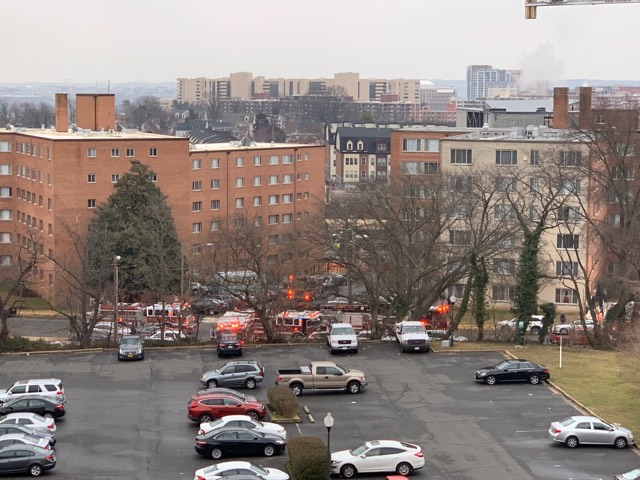
(Update at 4:15 p.m.) Arlington firefighters have extinguished a blaze at an apartment complex just off Columbia Pike.
First responders were called to a complex along the 1300 block of S. Scott Street around 3:30 p.m. today (Friday). The block is home to the Wellington Apartments.
The fire was concentrated in a commercial drier at the complex, which was quickly shut off, according to the fire department’s Twitter account.
The department said there were no injuries as a result of the blaze, though they’re still warning people to avoid the area if possible.
Units from ACFD, @FortMyerFire & @AlexandriaVAFD have extinguished the fire in a commercial dryer and continue removing the smoke. No injuries reported. Fire Marshals on scene investigating. Avoid the area as there will be large FD presence for about next 30 minutes. pic.twitter.com/yCOZumOyUw
— Arlington Fire & EMS (@ArlingtonVaFD) March 1, 2019
Arlington arts advocates are sounding the alarm about planned cuts in the county’s new budget, arguing that they’ll disproportionately impact the government’s already modest arts programs.
County Manager Mark Schwartz is proposing a total of $5.2 million in spending slashes for fiscal year 2020, in tandem with a tax increase to meet some of the county’s financial challenges. About $500,000 of those cuts will targets arts-focused programs specifically, according to an analysis by the advocacy group Embracing Arlington Arts.
“We all have to sacrifice when budgets are tough,” Embracing Arlington Arts Chair Janet Kopenhaver wrote in a statement. “However, we remain stunned at the very high proportion the small arts budget is being asked to shoulder.”
Schwartz plans to close the Costume Lab and Scenic Studio Program located at the Gunston Community Center (2700 S. Lang Street), which provide scenery construction space and costume rentals for local arts groups. That will involving laying off two employees who staff the programs, a savings of about $180,000 each year.
The manager also expects to cut funding for its arts grant program by a third, dropping it from about $216,000 to $146,000 annually. The program provides some matching funds to support local artists, and both County Board contenders last year pressed for increases to the fund.
Kopenhaver group says that would make the county’s budget for the grant program “the lowest in the region.”
The county would also ditch the use of its mobile performance stage, which is available for rent, under Schwartz’s proposal.
The Cultural Affairs Division of the county’s economic development arm would also lose an audio production specialist who worked on county events, and the facility manager and facility technology services director working at the county’s arts studio at 3700 S. Four Mile Run Drive. Schwartz expects existing staff could absorb the responsibilities of those employees, who are responsible for managing the space as a variety of different arts groups make use of it.
Finally, Kopenhaver’s group is also concerned about the proposed layoff of a supervisor of after-hours building engineers, who supervises building maintenance workers. Many county arts groups rely on county facilities after normal business hours for performance space.
In all, the arts advocates estimate that cultural affairs and arts program take up about one tenth of one percent of the county’s budget — Schwartz’s proposed cuts are much larger than that for arts-related services.
“In the end, the tiny arts program is being held accountable for a share of this year’s budget shortfall that is 62.5 times greater than its share of the fiscal year 2019 county budget,” Kopenhaver wrote. “If the cuts were proportional to the actual budget, then the cuts to the arts would be only $8,000.”
Embracing Arlington Arts notes that a recent study found that the arts generate $18 million in economic activity for the county, meaning that cuts to the arts budget could well have an impact on the county’s tax revenue.
The Board will evaluate Schwartz’s proposal over the next few months, while also keeping a close eye on school needs as well — Superintendent Patrick Murphy is already warning that the school system will face painful cuts unless the Board approves a substantial tax hike.
Officials are scheduled to finalize the budget in late April.
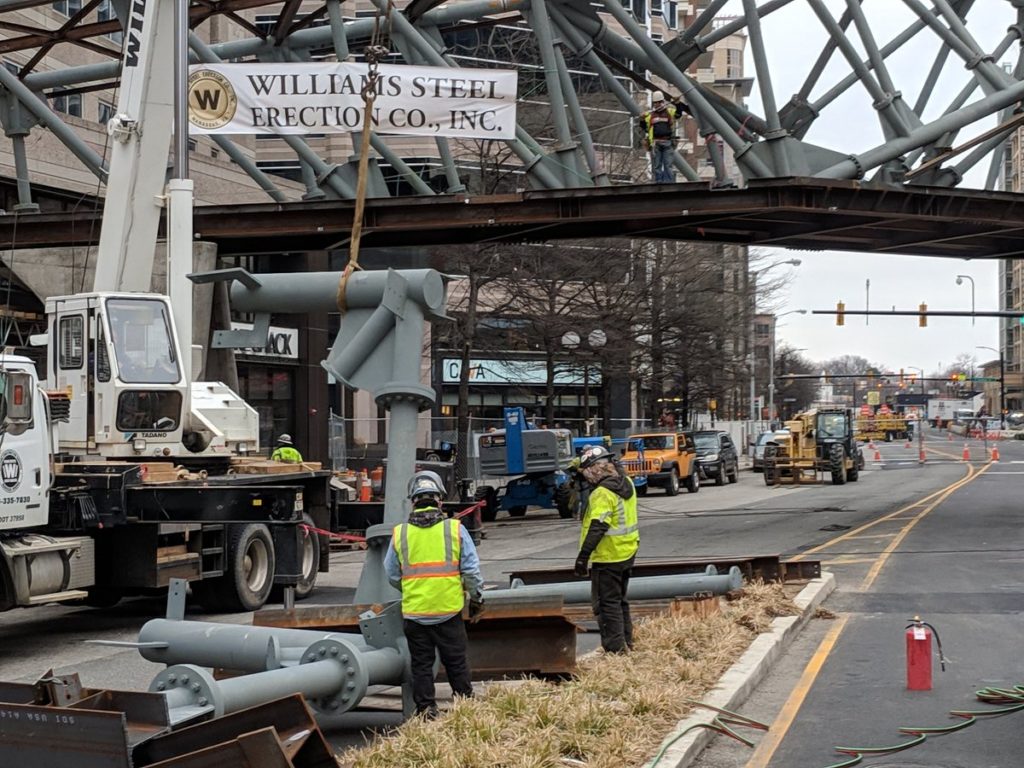
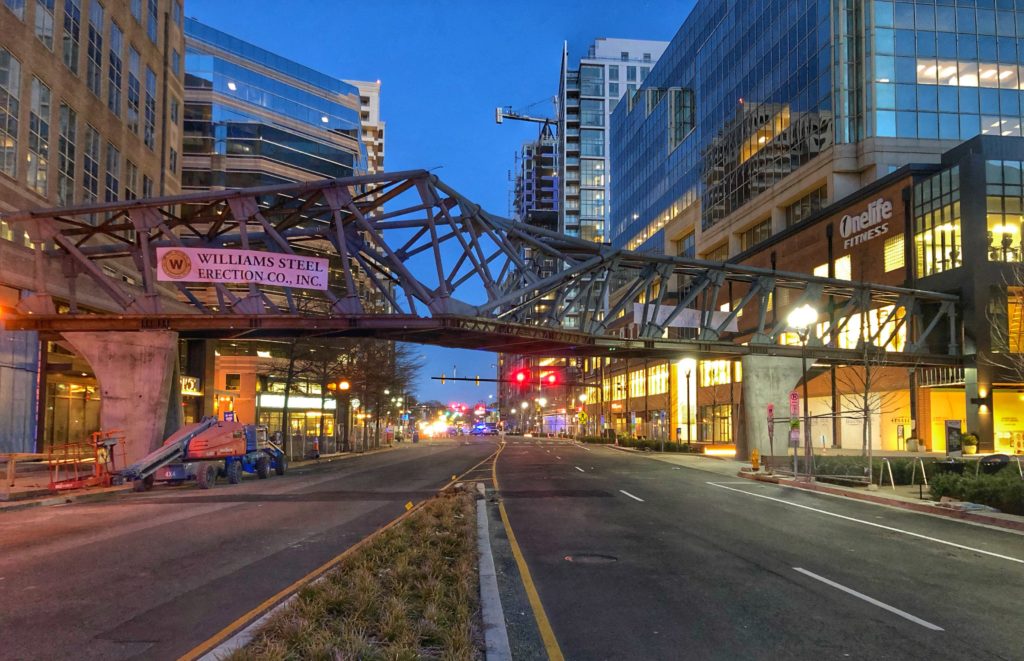
The Ballston Quarter pedestrian bridge under construction in early March (Image via Arlington County)
New Ballston pedestrian bridge being installed (photo courtesy Dennis Dimick)
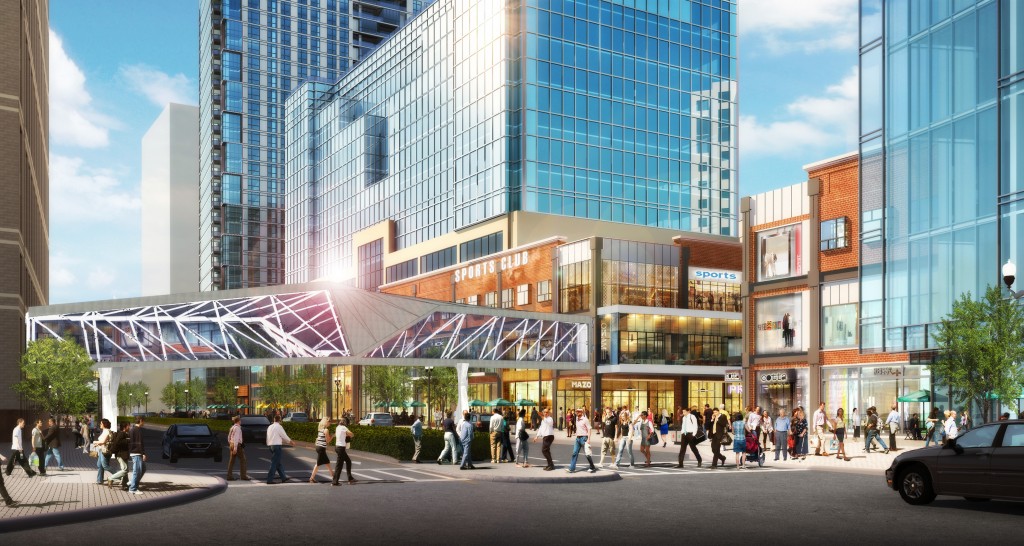
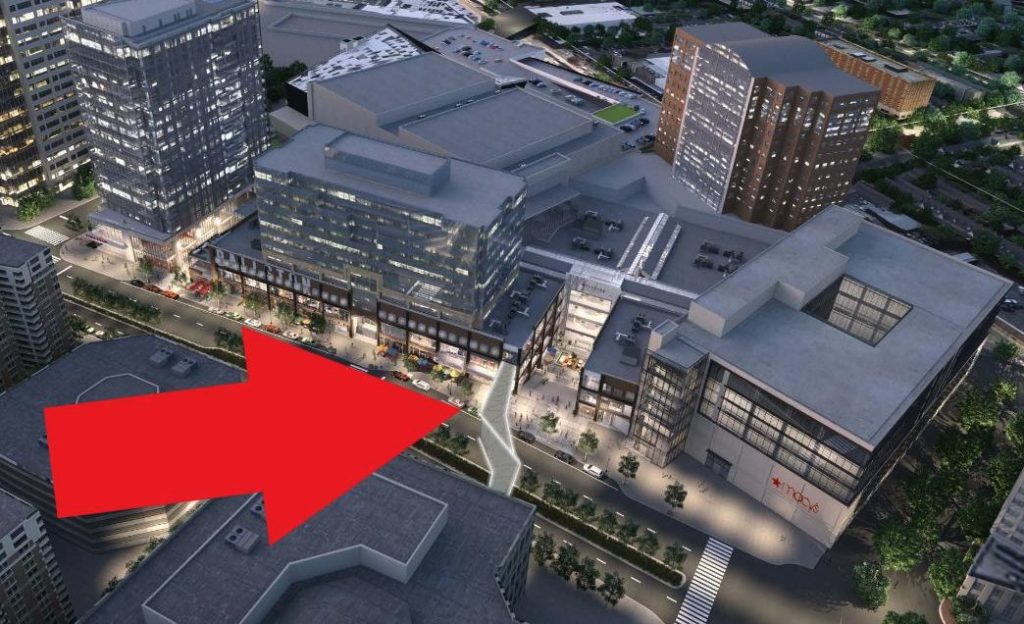
A rendering of the new Ballston pedestrian bridge (via Forest City)
A rendering of the pedestrian bridge to be built at Ballston Quarter (via @ArlingtonDES)
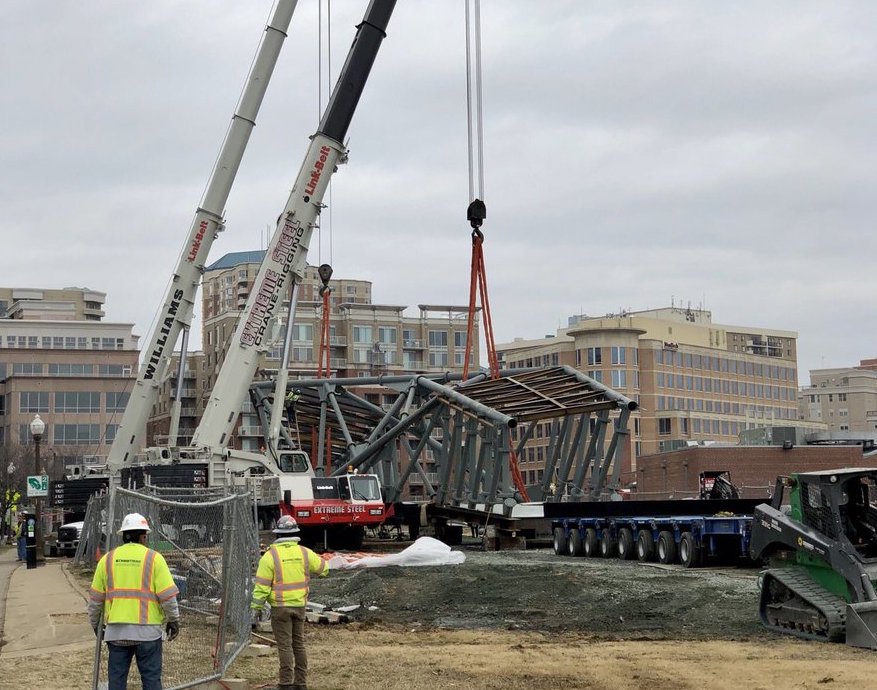
Workers prepare to move a new pedestrian bridge to its permanent home over Wilson Blvd in Ballston (via @btj)
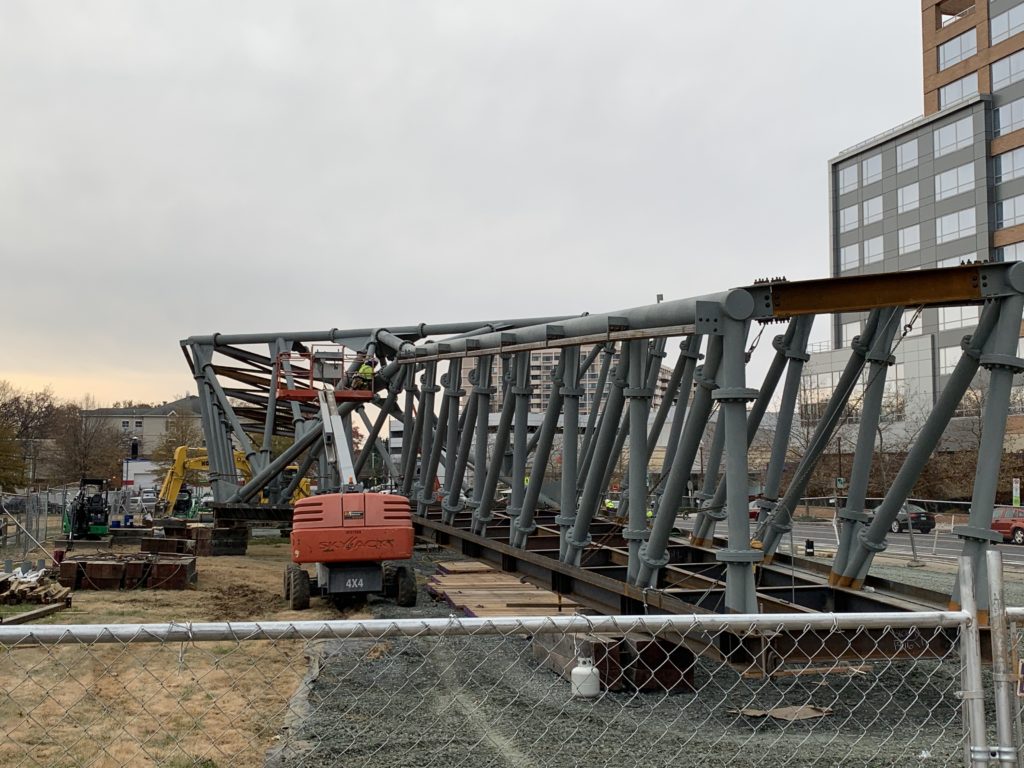
Workers assemble the Ballston Quarter pedestrian bridge in Mosaic Park in December, 2018 (Staff Photo)
Workers might’ve lifted the new Ballston Quarter pedestrian bridge into place over Wilson Blvd, but it won’t be ready for walkers for months yet.
The county announced yesterday (Thursday) that another four months of work are scheduled on the bridge, which is designed to connect the newly revamped Ballston Quarter development with the neighborhood’s Metro station, linked through the Ballston Exchange development at 4201 Wilson Blvd.
That work means that more road closures are underway on a busy Ballston street.
Tonight (Friday), Wilson Blvd will close between N. Randolph and N. Stuart streets starting at 8 p.m. It won’t reopen until Sunday at 6 p.m.
Then, starting Monday (March 4), county officials say they plan to close the eastbound lanes of Wilson Blvd overnight on weekdays for the next eight weeks. The closure will run from 8 p.m. to 6 a.m. each night, and they’re designed to allow time for “glass installation” on the bridge.
Once that wraps up, workers will close the westbound lanes of Wilson overnight for the next eight weeks to allow for the completion of that work.
Eastbound weekday overnight closures will last 8 weeks, followed by 8 weeks of westbound lane weekday overnight closures. Big bridge, lots of glass to install.
— Arlington Department of Environmental Services (@ArlingtonDES) February 28, 2019
Ballston Quarter’s developer, Forest City, also recently secured the County Board’s blessing to continue to use Mosaic Park as a construction staging area through March 22. The developer used the space to assemble the bridge, temporarily delaying planned renovations for the park.
Forest City had hoped to have the bridge ready in time for the development to start opening to customers last fall, but quickly realized it would need more time for the project.
It’s one of many delays for the redevelopment of the old Ballston Common mall — not only has the developer missed its own targets for opening stores to customers, but it’s currently unclear just when its new food court may open for business.