
The Right Note is a weekly opinion column. The views and opinions expressed in the column are those of the author and do not necessarily reflect the views of ARLnow.com.

Delegate Patrick Hope unsuccessfully tried to move a bill through the House of Delegates to change the way Arlingtonians vote for County Board.

Hope’s bill would not have required the County Board to adopt the new voting process, it would have just given them the option. It is not an option they should have.

Hope proposed what’s known as “instant-runoff voting” which would give voters the ability to rank their choices when voting. This process has been used by local Democrats in recent caucus voting.

If no candidate receives more than 50 percent of the votes, the the second choice of the last place candidate is redistributed to the other candidates in the field based on the ranking. The process repeats until someone reaches a majority.

Having come in a fairly close second (for an Arlington Republican anyway) in the most recent County Board special election which resulted in no one receiving 50 percent of the vote, you might think I would be for this change.

However, in a county where the numerical advantage so overwhelmingly favors the Democrats, removing the ability for a non-Democrat to win a plurality vote means the only real practical impact of the proposed change would be to put Independents and Republicans at a further political disadvantage.

The cynic may say the call for instant-runoff voting, much like redistricting reforms, is most often pushed by those who think the change would tilt the political playing field their way. But let’s give Hope and others the benefit of the doubt, that one of the big goals is to find a solution that creates more “civility” in politics. Poll after poll certainly says voters would prefer a better tone during our elections.

In Arlington, general elections are not really acrimonious affairs. Can someone really say that any County Board races have devolved into mudslinging affairs in recent memory? Maybe the problem is just with the tone on the Democratic side in their primary elections?

Another of Hope’s stated goals is to prevent a “fringe candidate” from winning a crowded field with only 25 or 30 percent of the vote. Someone should ask Delegate Hope which “fringe candidate” who failed to receive 50 percent is sitting in office that he thinks fits the bill?

It is understandable that politicians want to be seen as doing something, but changing the system of electing candidates is unlikely to change the current political environment here in Arlington.

If you want more civility overall as a political leader, recruit candidates who will adopt a positive tone in their campaigns. If you want more civility as a voter, do not reward candidates who run scorched earth campaigns with your vote.


Progressive Voice is a weekly opinion column. The views and opinions expressed in the column are those of the individual authors and do not necessarily reflect the views of their organizations or ARLnow.com.

By Takis Karantonis

Four major corridors cut across Arlington — Columbia Pike, Crystal City-Route 1, the Rosslyn-Ballston (R-B) corridor and Lee Highway. “Corridor development” has been at the core of Arlington County’s growth strategy. Our “Main Streets” have merited dedicated policy focus and resources, starting with the development of Metro in the 1970s along the R-B corridor and Crystal City.

But it’s time to look anew at whether these corridors are all meeting their potential and all getting the resources they need. Corridors don’t occur “organically.” They emerge as products of community vision, policy, planning and timely public and private investment decisions.

Attention has been lavished on the corridors close to Metro, and understandably so, since Metro drove their commercial development. But it is time for Columbia Pike and Lee Highway to get the same kind of purposeful attention and long-term investment from the County.

Given the rising challenges in our local and regional economy, it is time to give our corridors a more urgent priority.

Twenty years ago, the Arlington County Board launched the Columbia Pike Initiative, a plan to revitalize Arlington’s most populous non-Metro corridor. A key aspect of that decision was the recognition that:

  • Corridors connect our neighborhoods and business districts, thus forming a county-wide network on which economic activity occurs. Arlington’s potential for a thriving economy will continue eluding us until the pockets of inequality that dot our community are addressed by effectively developing all our corridors.
  • Corridors are business-friendly and economically diverse. This is where small businesses start and often have the best chance for survival and growth. Big businesses prefer to locate here as they are optimally suited to make the most of a dense ecosystem of resources.
  • Corridors provide the environment to address scarcities, such as housing and transportation.

At this year’s 20th anniversary of the Columbia Pike Initiative, we can list accomplishments, such as jumpstarting development after a three-decades-long doldrums and upgrading transit, both of which bring us closer but still not near to our development goals.

Lee Highway has been languishing and despite citizen volunteer work through the Lee Highway Alliance for more than five years, the County-staff-led planning process has been rather slow in delivery.

In the upcoming County budget, let’s show renewed focus and commitment to our corridors.

Let us re-invest fully in our urban partnerships (CPRO, the Clarendon Alliance and the Lee Highway Alliance) in ways that give them actual agency and leverage to act as true partners in advancing already stated stakeholder and community goals.

These organizations are the glue that holds business, neighborhoods, residents and local government together. They have a proven record of steering and aligning, with beneficial and tangible results for public and private interests in their respective areas.

(more…)


Peter’s Take is a weekly opinion column. The views and opinions expressed in this column are those of the author and do not necessarily reflect the views of ARLnow.com.

ARLnow.com reported last Thursday that Arlington County has posted for public comment a 54-page draft “Framework” document that is intended to guide future development of the Four Mile Run Valley (4MRV) area.

Public comments must be posted by tomorrow, Friday, February 16.

Current draft very confusing

The current draft Framework is confusing, redundant and contradictory, making it impossible for an ordinary Arlington resident to know what it means, or which proposed action items might be implemented.

This failure might be welcome if it were clear that the Framework couldn’t be relied upon as justification for proceeding with any of the poorly conceived suggestions that were floated earlier in the 4MRV planning process: for example, adding excessive density, disregarding the community’s preferences for Jennie Dean Park, or creating an arts district.

Unfortunately, the Framework’s substantive ambiguity lends itself to justifying almost any iteration of the often-competing goals and alternatives listed in the Framework, including those noted above.

Excessive density

Appropriately, the draft acknowledges the unsuitability of dense redevelopment for most of the 4MRV area, which lies in a floodway/floodplain. Yet, the Framework lacks any actual plans to reduce runoff by removing hardscape or buildings — instead, planning to add more.

Also discussed are the extensive measures that are needed to remediate decades of environmental damage to the two streams (Four Mile Run and Nauck Branch). However, the majority of the draft discusses how to carve up and develop all this land.

Compared to the earlier versions staff/consultants presented to the 4MRV Working Group, there seem to be fewer/smaller areas to add a lot more density/housing. And, the proposal to retain the existing industrial area for continued industrial use — for which we have great need — would be a plus, if confirmed.

For any particular parcel, however, an ordinary resident cannot determine, in most cases, which potential use the plan will apply to that parcel after the plan’s adoption — or how that use might differ from today’s use.

Prior to the County Board’s final plan adoption, it should direct County staff to provide the community with the numbers of new housing units staff expects will be added with and without this draft plan’s adoption. In addition to these useful metrics (to assess the plan’s likely impact), the public should also receive ratios of added density to added parkland acres within the plan’s boundaries.

Jennie Dean Park

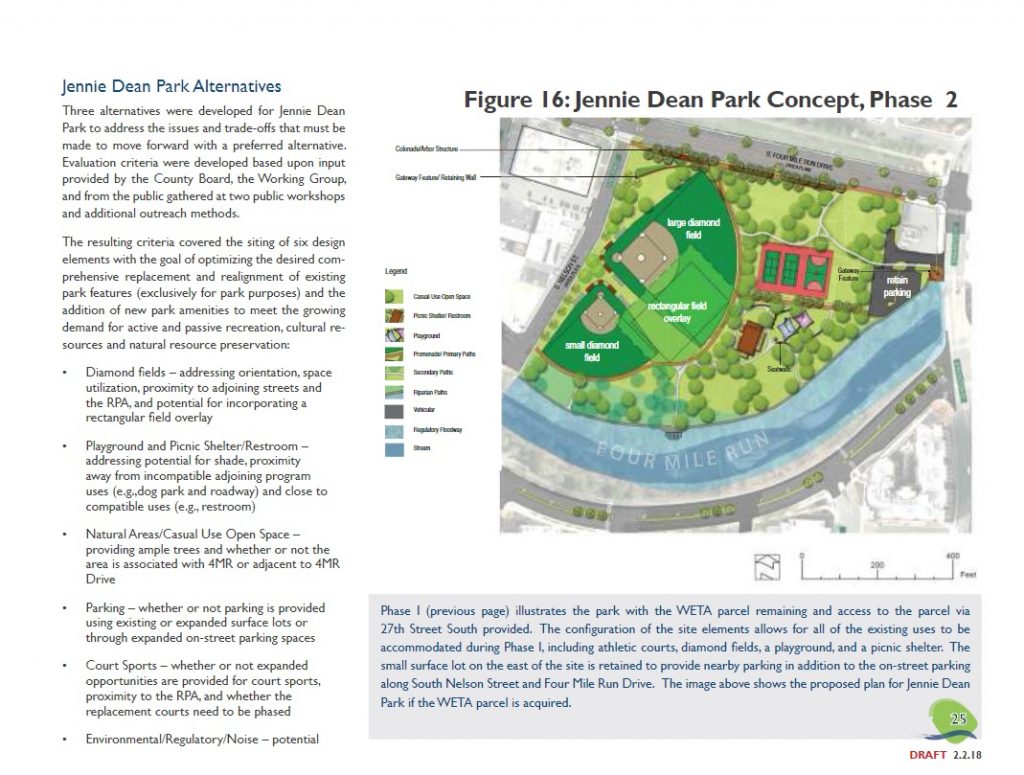
Given the community’s desire that the “portion of the park fronting the neighborhood at Four Mile Run Drive be left open for casual use” and avoid locating fields or courts adjacent to Four Mile Run Drive, the County Board should direct staff to honor those preferences.

Arts district

As I wrote recently, the County Board should adopt a comprehensive, easily understood, 21st century arts policy determining when, where and how Arlington should subsidize the arts before entertaining proposals to create an arts district in the 4MRV area.

Conclusion

Given the current draft Framework’s nebulous state, more work needs to be done to clarify the plan. Residents have a right to know exactly what is and is not being proposed, and to give County Board members meaningful feedback. Only then will Board members be able to make an informed decision as to the likely costs, impacts and desirability of the Framework’s outcomes.


The following Letter to the Editor was submitted by long-time Nauck resident Portia Clark, the current president of the Nauck Civic Association.

My family has lived in Arlington for more than a century. I was raised in Arlington, and my children and grandchildren live here too. Some of my ancestors from the 1800’s are buried in the cemetery next to Lomax A.M.E. Zion Church, which was established in 1866. Lomax falls within the Four Mile Run Valley Study Area.

When I was young, I went to Arlington public schools. Yet, my mother growing up in Nauck, was not allowed to play in most Arlington County parks because of the color of her skin.

The the only park open to her and her siblings was Jennie Dean Park. Arlington County’s then- Department of Recreation noted in its 1949 report that Jennie Dean Park was the county’s “sole recreation area for colored citizens.” In the Park’s historical markers, there are photos of my family members, friends and neighbors.

After decades of waiting, Arlington County is now focused on revitalizing Jennie Dean Park and the surrounding area in Nauck. I have seen the draft plans for Jennie Dean Park put forth by Arlington County staff. The plans are astoundingly tone-deaf.

The Nauck community hasn’t asked for much with regard to Jennie Dean Park, other than to revitalize it and to minimize the impacts on our community. We certainly have ideas for what amenities we would like to see in the Park, but we understand – maybe better than anyone else – that parks should be for the entire community. So, when the County told us that they wanted the same amenities to stay in the park – no more, no less – we understood that everything we discussed at numerous meetings could not go into the park.

We did insist, however, that respect be paid to the Nauck community. This means that the front of Jennie Dean Park, the portion fronting the neighborhood at Four Mile Run Drive, be left open for casual use. We want this area to be a gateway for the community to enter the Park. We want it to be green. We want it to be landscaped. We want it to have flowers and trees and open space.

Instead, the County has drafted plans to place a baseball field in that spot, instead of another part of the Park. A baseball field, especially one with fencing and stadium lights, is not welcoming. The County’s draft plan also hides a playground and shelter area away from the community it would serve. This County plan offers no connection to the neighborhood and its cultural heritage, except for a historical marker with some friendly faces on it. This plan will negatively impact our community in a number of ways.

It doesn’t have to be this way. In fact, the County drew up plans, which it insisted were viable, that accepts the placement we requested and the honor we deserve.

The Nauck Civic Association has already voted – unanimously – that this draft plan from the County on Jennie Dean Park is a non-starter. We hope others will join us in expressing this concern.


With another week over, let’s take a look back before heading into the weekend.

These were our most-read stories of the week:

  1. Ballston Quarter to Be ‘Entertainment Hub’ With Addition of New ‘Experiential’ Tenants
  2. Bada Bing Bemoans Business Bummers, Bureaucratic Blunders; Believes Binghamton Bodes Better
  3. Nude Woman Wanders Into Building Lobby
  4. Police: Woman Robbed in Westover
  5. County Removes Confederate Memorial Near Bluemont Park

Feel free to discuss anything of local interest in the comments. Have ideas on what we should cover? Send tips to [email protected]. Have a great weekend!


The Right Note is a weekly opinion column. The views and opinions expressed in the column are those of the author and do not necessarily reflect the views of ARLnow.com.

Arlington’s independent auditor, Chris Horton, is soliciting suggestions from the public on what to audit. Encouraging ongoing participation from all Arlingtonians is a good thing.

The current work plan for the auditor includes fleet management, public safety overtime, Business Improvement Districts and the Neighborhood Conservation Advisory Commission. It is a good start, but only two of these audits are definitely slated to be completed this fiscal year.

If you look at the what the auditor has identified as the “Audit Horizon,” it is clear that the office should step up the pace. The Audit Horizon includes affordable housing, capital improvement planning, economic development incentive funding, facilities management, the handling of personally identifiable information, procurement and analysis of the county’s financial condition. And that is just a partial list of important items.

The total budget for the auditor in FY 2018 is about $210,000. The County Board should consider a dramatic increase in the budget and staff allocation for the auditor during the current budget cycle discussions to at least $500,000.

There is too much important work to do to spread the audits out over the next decade, or even longer. If the Board is committed to paying more than lip service to this new level of accountability, then it is time to give the office the resources it needs.

The Electoral Board this week announced a competition to design a new “I Voted” sticker. A goal of the project is to help boost turnout in the 2019 election cycle, the historically lowest turnout year in each four-year cycle.

The idea that more voters should take advantage of their constitutional right whenever it is available to them is certainly a noble goal. As we saw this past November, turnout can be dramatically increased over prior years, but it is primarily driven by the circumstances surrounding a given election cycle.

While the holding the competition will draw some additional attention, it is hard to imagine that the stickers would do much. In New York, a city of 8.5 million people, 700 designs were submitted, but only 10,000 people voted on which design they liked best according to the Sun Gazette article. That’s just a little over 1/10th of one percent of the population.


Progressive Voice is a weekly opinion column. The views and opinions expressed in the column are those of the individual authors and do not necessarily reflect the views of their organizations or ARLnow.com.

By Steve Baker

Frederick Douglass said, “The limits of tyrants are prescribed by the endurance of those whom they oppose.” Last year, the Arlington Democrats reached their own limit and in response, sent volunteers beyond Arlington to House of Delegates’ districts around the Commonwealth.

Arlington, which is the smallest county in Virginia in square miles but one of the largest in terms of population, was in the highest Democratic performing congressional district in last November’s election.

Pleased with our own General Assembly delegation but eager to do better for Virginia and send a positive message of hope to the nation, we turned our focus to joining our neighbors and fellow Virginians in the burgeoning and ever more diverse suburbs and exurbs outside the beltway.

It wasn’t the first time we exported volunteers but in 2017 we elevated it to a grander scale, joining with many local groups, like WofA (We of Action), Arlington Indivisible and others. The Beyond Arlington program flourished in response to the confluence of our 2017 delegate races and a record number of 89 democratic candidates, with an enormous outpouring of volunteers due to the current administration in Washington.

The reasons for greater collaboration are clear. We have common goals: a growing need for schools, continued job growth and regional transportation solutions. We share many transit assets–Metro, VRE, our Interstates, toll roads and bike trails. We also have a need to protect the Potomac River watershed and our parks and open spaces.

Progress in these areas has often been difficult as an entrenched conservative General Assembly has, often by party-line votes, rejected progress or serious bipartisanship. Even after last year’s election, the 51% has refused to work with the other 49%, something Alexis de Tocqueville referred to as the “tyranny of the majority.”

This has been the case throughout our history. Conservatives in Virginia have fought federal authority vigorously, most notably over the abolition of slavery, women’s suffrage, school integration, the Civil Rights Act and the Voting Rights Act.

These same conservatives have no qualms exercising far greater authority over our local governments in Virginia through the Dillon Rule and state constitution, denying localities their own decision-making.

We saw this most recently in preventing localities from removing a statue from a local park or renaming stretches of state roads within their jurisdiction. As Governor Northam said last year on the campaign trail, “If we can’t change their minds, we need to change their seats.”

(more…)


Peter’s Take is a weekly opinion column. The views and opinions expressed in this column are those of the author and do not necessarily reflect the views of ARLnow.com.

The 2018 Virginia legislative session again has featured a batch of proposed bills relating to voting rights.

Several of those bills relate to no-excuse absentee voting.

No-excuse absentee voting bills

HB 1072 was co-sponsored by Arlington Delegate Patrick Hope and 15 others. The bill would have erased the current extensive and complicated list limiting the reasons (excuses) entitling a registered voter to vote absentee. But, this bill was sidelined on January 30 by a 4 to 2 vote in a Virginia House of Delegates subcommittee.

Also on January 30, one Virginia Senate no-excuse absentee voting bill, SB 254, was deferred until 2019 by a unanimous vote of a Senate committee. Another Senate bill, SB114, met the same fate.

Virginia should enact a law authorizing no-excuse absentee voting

Like other voting rights issues, Arlington voters can only obtain the right to no-excuse absentee voting if that right is enacted at the state level because Virginia is a Dillon Rule state.

Virginia has developed a series of 16 narrow, but often confusing and overlapping, excuses that entitle registered voters to vote absentee. Unless your reason for wanting to vote absentee fits squarely within one or more of the 16 categories on the authorized list you can’t vote absentee.

Virginia’s current system should be changed. It should be replaced by a system that permits any registered voter to vote absentee without having to provide any excuse.

Reasons to support no-excuse absentee voting

The bedrock reason why the current system should be changed is that experience in other states has demonstrated that no-excuse absentee voting enables more registered voters to vote to choose their elected officials. The broader the base on which our political leadership rests, the more likely that decisions made by our leaders will be respected.

The League of Women Voters of Virginia recently has prepared a helpful checklist of reasons to support no-excuse absentee voting, including these:

  • No voter should have to provide personal unrelated information to cast a ballot
  • Extra personnel are needed to explain the current excuses
  • Voters have found it very confusing to determine what the current excuses mean, and therefore their eligibility to vote before Election Day
  • Local Election Offices have had success in reducing long lines on Election Day by encouraging absentee voting
  • For voting absentee in-person, eliminating the cumbersome process of completing the absentee application would save time as well as the expense of printing the form

Opponents of a no-excuse absentee voting system have argued that it encourages too many more voters to vote too early, thereby foreclosing their opportunity to vote based on late-breaking developments in a political campaign. Weighing this risk against the depression of voter turnout under the current system, the benefits of providing more opportunities to vote outweigh the risks that some voters might regret that they voted too early.

Both Democrats and Republicans should support no-excuse absentee voting

No-excuse absentee voting has been enacted by a majority of U. S. states–both “red states” and “blue states.”

Conclusion

No-excuse absentee voting should be a subject on which Virginia Republicans and Virginia Democrats can agree. No-excuse absentee voting will enable more Virginians to vote.

The current patchwork quilt of 16 authorized excuses should be replaced by: no excuses necessary.


With another week over, let’s take a look back before heading into Super Bowl weekend.

These were our most-read stories of the week:

  1. Freshbikes Has Closed in Ballston
  2. Morning Notes (January 30)
  3. Bluemont Pizza Pupatella Warns Against Online Ordering
  4. Market Common Redevelopment Plan Goes Before County Board Tuesday
  5. ‘Little Community Pantry’ Helps to Feed the Hungry in Ballston

Feel free to discuss anything of local interest in the comments. Have a great weekend!

Flickr pool photo by Michael Coffman


The Right Note is a weekly opinion column. The views and opinions expressed in the column are those of the author and do not necessarily reflect the views of ARLnow.com.

Redistricting has been thrust into the spotlight recently.

Courts are increasingly entertaining legal challenges to electoral maps, even based on challenges that the process is too political. Reformers are also seizing on perceived momentum to push for change.

Politicians who favor redistricting reform often do so because they believe the map has been drawn in a way that drastically favors the other side.

Republican Governor Larry Hogan favors redistricting in Maryland as Democrats there have drawn lines in a way to favor them. Portions of the map, which uses bodies of water to connect various portions of districts, resemble an ink blot test.

Democrats in Virginia favor redrawing Congressional district lines because Republicans currently hold seven of the eleven districts here.

Some backers of reform favor redistricting because they believe less partisan districts will produce less partisan public policy results as politicians will have to be more responsive to the middle or moderate voters. Many believe these new policy outcomes will look more like the things they wish would be accomplished.

Will the proposed reforms really be a silver bullet to address political polarization? Would the type of politician elected really change all that much? Will the base of each party lose influence on public policy to the middle? These are the things I hope to address next week in a Civic Federation panel discussion on redistricting.

Speaking of thawing political polarization, it looks like Democrats are once again split on County Board race. Three Democratic elected officials, all women, are backing Independent John Vihstadt’s re-election.

This is a reflection of his 2014 coalition that defied conventional wisdom by producing a comfortable win in a November election after Democrats claimed the special election was little more than a fluke.

The question is what voters will do without a controversial big ticket item like the Columbia Pike streetcar driving the debate. Most prominent Democrats will end up backing Vihstadt’s opponent of course, but the endorsements are a reminder that every once in a while, political polarization stops at the county line.


Progressive Voice is a weekly opinion column. The views and opinions expressed in the column are those of the individual authors and do not necessarily reflect the views of their organizations or ARLnow.com.

By Janet Kopenhaver

As Arlington County updates our community development plans, the arts need to be emphasized and explicitly promoted in these discussions because of the positive impact they have on the economy and the people of our County.

Residents may be unaware that hundreds of individual artists and arts groups call Arlington County home. Indeed, with more than 6,000 employees, these artists and arts-related businesses represent 5.1 percent of Arlington businesses and 3 percent of the county’s workforce.

Non-profit art groups spend more than $170 million on operational expenses in Arlington County, which in turn generates tax revenue. Last year, arts audiences also spent more than $18 million above the cost of admission for such things as parking, meals, and local ground transportation in the County.

The arts go beyond this impressive economic impact, however, to also play an integral role in helping people. The arts do so by providing therapeutic support for veterans and residents with physical and mental challenges, for example, and also offering inspiration to and support for students.

A positive contribution of the arts is in helping veterans cope with depression, bipolar disorders, schizophrenia and post-traumatic stress disorder (PTSD). One combat medic who served in Vietnam was having difficulty emotionally after he came home to Arlington. After attending several art therapy classes and through working on paintings and collages, he was able to slowly deal with his PTSD.

“I could express the locked-in things that I was afraid to talk about,” he said.

Numerous studies show that art therapy helps veterans like him who are suffering PTSD, especially those who are having trouble talking about their combat experience.

People suffering from neurological disease (such as Parkinson’s disease) experience noticeable benefits from movement or dance classes. Arlington’s Bowen McCauley Dance runs a program for people suffering from Parkinson’s and several clients have asserted how much their lives have improved since starting lessons.

One Arlington resident noted, “My state of mind is vastly improved.” Another wrote, “It benefits my mood and physical capability.”

(more…)


View More Stories