Peter’s Take is a weekly opinion column. The views and opinions expressed in this column are those of the author and do not necessarily reflect the views of ARLnow.com.

A story posted on the Arlington Sun-Gazette website last Friday asked the question, “Could school system go outside Arlington to find space for students?”

The story only addresses whether Virginia law authorizes Arlington to do so. Answer: yes, but only if Arlington does so in one or more adjacent Virginia jurisdictions: Fairfax County or the Cities of Alexandria or Falls Church.

Discussion

Whether it would make sense for APS to go outside Arlington to find space for Arlington students should be addressed only in the context of a new long-term plan that answers these questions:

  • What new schools do we need?
  • When do we need them?
  • Where in Arlington could/should we put them?
  • What will it cost to put them in Arlington?

In 2017, APS Superintendent Patrick Murphy publicly acknowledged that:

  • Arlington County forecasts continued total population and school enrollment growth for many years beyond the 2026 cut-off date in the current Capital Improvement Plan (CIP)
  • Arlington’s total population aged 0-14 will exceed 40,000 by 2030
  • APS needs to develop its own long-term new school construction plans well beyond 2026:

“In his report to School Board members, Murphy said the school system will need an additional 2,200-seat high school, plus up to two middle schools and up to four elementary schools, if enrollment continues to push toward, and beyond, 30,000 students.”

Based on the latest publicly-available data, APS is still on the same trajectory Murphy described a few months ago: pushing toward and well beyond 30,000 students.

In December 2017, in preparation for planning its latest CIP out to 2028, APS posted its latest enrollment projections by school and by year. With the requisite explanatory footnotes, these latest projections show an increase from a Fall 2017 total enrollment of 28,020 to a Fall 2027 total enrollment of 32,666.

This latest set of publicly-available data do not include updated capacity utilization numbers for each school, but those are supposed to be published sometime this month.

So long as these population and enrollment forecasts continue to represent the County’s and APS’ best estimates, they should be employed systematically to make long-term planning decisions for all land use and public infrastructure investments (e.g., schools, parks, roads).

(more…)


With another week over, let’s take a look back before heading into the weekend.

These were our most read stories of the week:

  1. Castle Carved Out of Tree Trunk Outside East Falls Church Home
  2. Police: Three Arrested for Gang-Related Stabbing Along Four Mile Run
  3. Beer Garden BrickHaus Applying to Keep Patio Partly in Sidewalk
  4. DEVELOPING: Track Fire at Pentagon City Metro
  5. Video: A-Town Co-Owner Speaks Out About Imposter

And these received the most comments:

  1. Police Charge Three Teenagers in Four Mile Run Trail Stabbing
  2. UPDATED: Federal Government to Re-Open
  3. Arlington Democrats Join Thousands in Women’s March on Washington
  4. Morning Notes (Thursday, January 25)
  5. Cherrydale Residents Fight for Proper Spelling of Park

Feel free to discuss anything of local interest in the comments. Have a great weekend!

Flickr pool photo by John Sonderman


The Right Note is a weekly opinion column. The views and opinions expressed in the column are those of the author and do not necessarily reflect the views of ARLnow.com.

Arlington homeowners received some bad news last week when the county announced that residential property tax assessments were up over last year while commercial assessments, driven by office buildings, went down.

The news will put a real strain on the County Board guidance to hold the tax rate steady as they chase the mythical budget gap.

Residential assessments are up 3.9 percent over last year, which means the average homeowner will already pay 3.9 percent more in taxes absent a rate cut. A year ago, the County Board raised the tax rate by 1.5 cents on top of the 2.5 percent assessment.

Overall assessments rose by 1.9 percent, instead of the projected 3.2 percent. It is hard to imagine a scenario where the Board doesn’t eventually say they were “forced” into raising the tax rate again this year by another 1 or 1.5 cents.

Lest you think they needed the last rate increase, the Board once again spent millions in extra revenue during the closeout process last fall. It was more than enough to eliminate the need for last year’s rate increase.

Since they do not need the extra revenue another rate increase would bring, let’s take a moment to discuss some of the other go-to talking points when the subject of assessments and rate increases come up.

“Arlington homeowners should be pleased their assessments are going up because it means their homes are worth more.”

Sure, it’s great over the long haul for when you want to sell your home. It is not so good for young professionals trying to buy into the housing market or for retirees trying to age in place. Right now, we have to pay all the taxes out of our income. If your incomes are not rising by 4-5 percent every year, you are not further ahead, you are further behind.

“We use conservative estimates of revenue to determine how much of a rate increase we will need.”

It’s only a conservative estimate if your intention is to give the money back when you consistently estimate the revenue wrong, and in a way that creates a “budget gap” and requires you to raise taxes. And it’s not conservative when your intention is to spend the excess each year in order to raise spending even more the next.

Here’s a challenge to the Board and the County Manager as they continue through the budget process

Step 1 –Continue to write your budget in a way that rates would not to increase under the “conservative” estimates.

Step 2 — At the end of the process, reduce spending by .5 percent across the Board.

Step 3 — Use any closeout revenue available in November of 2018 to cut next year’s tax rate.


Progressive Voice is a weekly opinion column. The views and opinions expressed in the column are those of the individual authors and do not necessarily reflect the views of their organizations or ARLnow.com.

By Larry Roberts

Nearly four years ago, I had the honor of taking on the role of editor of a new ARLnow column titled “Progressive Voice.”

I believed that weekly columns by Mark Kelly and Peter Rousselot, while well written and informative, were not fully representative of views many Arlingtonians had about their County, elected officials, and County government.

I believed that the best answers would not come from a more conservative direction, a desire to keep the status quo, or steady criticism of County government.

In my view, Arlington was going to be affected more and more by what happened at the federal level, in Richmond, and through heightened competition from jurisdictions in Northern Virginia as well as the District and Maryland.

I saw important trends that I believed Arlington needed to acknowledge and respond to in order to remain economically vibrant and competitive.

Some examples – then and now – included: 1) diminishing federal spending in the county and the impact of the Base Realignment and Closing process on Crystal City and Arlington more broadly; 2) the opening of the Silver Line to competitive centers such as Tysons, Reston, and Loudoun County; 3) changing demographics including an influx of millennials; 4) shifting trends in real estate toward mixed-use and transit-oriented development; 5) an increasing office vacancy rate; and 6) losing important tenants such as the National Science Foundation to other jurisdictions (in that case to Alexandria).

At the same time, Arlingtonians continued to want and press for high-quality services and more of them. Moreover, a rising school population required additional resources to maintain a school system regarded as among the best in the nation.

Because of the trends identified above, I believed it important to provide a voice for the proposed Crystal City-Columbia Pike-Baileys Crossroads streetcar system that was vitally important to the County’s competitiveness and maintenance of affordable housing.

I continue to believe that defeating the streetcar project – including turning down $285 million in dedicated funding from the Commonwealth – was a major policy mistake that will set back Arlington for generations to come. However, the voters chose a different path and left local elected officials with little choice but to move on to other items of importance.

The history buff in me wanted to ensure that we honored Arlingtonians living and no longer with us who shaped the County such as Ellen Bozman, Joe Wholey, Talmadge Williams and those who risked much so that Arlington (together with Norfolk) became the first jurisdictions in the Commonwealth to integrate their public schools.

Unlike the “Right Note” and “Peter’s Take” columns, ARLnow wanted the new Progressive Voice column to reflect a range of voices and, particularly, to give voice to women and persons of color. So rather than writing my own weekly column, I became a column editor.

At first, this seemed to put me at a competitive disadvantage, because I had to enlist a group of columnists and — to be expected — each columnist had their own perspective on what issues she or he wanted to address and how to approach those issues.

But I came to value very highly the process of identifying talented columnists and providing a platform to express diverse points of view from varying perspectives and life experiences.

I met or got to know better many outstanding Arlingtonians. I learned, re-learned, or gained valuable insight into a broad range of issues, programs, needs, goals, and services.

And I learned to think more broadly, deeply, and holistically about Arlington County and its place in the Commonwealth, region, and nation.

All of that reaffirmed for me how unique and special a place Arlington is, but also that Arlington must continue to progress – as it has progressed – and not seek to stay in place or shrink from new opportunities. Communities either grow and thrive or they wither and lose what made them great.

I want to thank the Progressive Voice columnists for their outstanding contributions and willingness to produce quality columns under deadline pressure, ARLnow for the opportunity to edit the column, and the new editors who will continue to ensure that a broad range of voices will be heard via the Progressive Voice column.

Finally, I want to thank the readers who gave us reason to write our columns. I can’t say I have enjoyed every online comment received, but it has been a pleasure to hear from so many people over the years that they appreciate the column.

Carry on and move forward!

Larry Roberts was recently named Chief of Staff to Lt. Governor Justin Fairfax. He has long been active in Arlington’s civic life, including serving as Chair of the Arlington Democratic Committee. He chaired five successful statewide campaigns, served as Counselor to Governor Tim Kaine, completed a successful term as Chair of the Board of the Virginia Public Access Project, and was named a 2017 Virginia Leader in the Law by Virginia Lawyers Weekly.



Peter’s Take is a weekly opinion column. The views and opinions expressed in this column are those of the author and do not necessarily reflect the views of ARLnow.com.


Last Friday afternoon, Arlington County issued its annual information on the assessed value of Arlington property as of January 1.

As per that release, the top line numbers are:

  • Overall increase of 1.9 percent (compared to 3.0 percent last year)
  • Average residential property up 3.8 percent
  • Most commercial property values up, but office values down 6.8 percent

Office properties represent about 18 percent of the overall tax base.

Discussion

As the county’s press release acknowledges, last Friday’s news is sobering:

This past fall, County officials projected a 3.2 percent increase in the value of all residential and commercial real estate–and a comparable increase in tax revenues. With actual growth of 1.9 percent, the County will face a greater shortfall as it works to develop a balanced budget.

At the end of 2017, the County Board directed the County Manager to “propose a balanced budget within the existing tax rate” for FY 2019, after having raised the tax rate by 1.5 cents for CY 2017. Within that appropriate framework, the tough budget choices the Board is going to have to make in 2018 are tougher after last Friday’s news.

The good news is that the public already has provided many constructive ideas to help the Board make these tough choices. Late last fall, the Manager asked Bryna Helfer and her Engage Arlington team to solicit the public’s suggestions to help prepare the FY 2019 operating budget. Some of the public’s responses have been compiled and posted on the Engage Arlington website.

For example, check out the public’s suggestions grouped there under these headings:

  • Fiscal problems have roots in poor planning and decision-making
  • Focus on the big $$$ issues, not the micro stuff
  • Smart spending
  • Close-out funds
  • Laundry list of budget-related suggestions

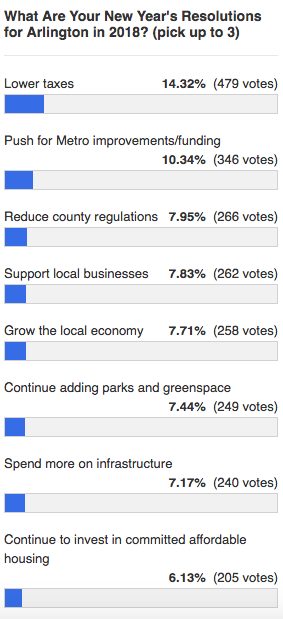
Another interesting indicator of the public’s priorities can be found in an online poll conducted by ARLnow.com beginning January 2. A large number of responses — 3,345 — were recorded.

Here are the top 8 vote-getters from among the 16 options offered in that poll:

With the important caveat that the foregoing results are not derived from a statistically-valid public opinion survey, they are nevertheless useful indicators of the relative priorities of a large number of recorded votes.

As I wrote in December, it’s also important for the County Board and our community to address FY 2019 budgeting tasks in the context of longer-term financial modeling.

The Board should direct the Manager to develop financial projections out to 2040 for both capital and operating budget spending, utilizing at least three assumptions: most likely case; optimistic case(s); pessimistic case(s). The results and assumptions underlying this exercise should be published, and the public should be invited to comment on those results.

Conclusion

Arlington should set its budget priorities:

  • giving careful consideration to the public’s priorities
  • using data-driven information regarding what the County (and APS) are likely to be able to afford in the long term

With another busy news week over, let’s take a quick look back at what happened before we leave for the weekend.

These were our most-read stories this week:

  1. Winter Weather Advisory Issued for Arlington, D.C.
  2. ‘Cajun Seafood and Sushi Lounge’ Coming to Clarendon
  3. UPDATED: Northern Virginia, D.C. on Amazon ‘Top 20’ List for HQ2
  4. Residents Launch Petition to Change Zoning Ordinance After Home Extension Denied
  5. Card Skimmer Found in Clarendon ATM

And these received the most comments:

  1. Lopez Announces Formation of Virginia Latino Caucus in General Assembly
  2. Bill Renaming Gravelly Point for Nancy Reagan Being Debated in House Committee
  3. Morning Notes (January 16)
  4. Arlington’s Congressional Delegation Blames GOP for Possible Government Shutdown
  5. UPDATED: Northern Virginia, D.C. on Amazon ‘Top 20’ List for HQ2

Feel free to discuss anything of local interest in the comments below. Have a great weekend!

Flickr pool photo by Jim Harvard


The Right Note is a weekly opinion column. The views and opinions expressed in the column are those of the author and do not necessarily reflect the views of ARLnow.com.

Riders suffered through another train derailment on Metro this week. Fortunately, no one was hurt.

Metro was already receiving criticism for its “Back2Good” PR campaign and its expenditure on an ad that ran during the college football national championship game last week.

The ad is part of a larger $7 million marketing budget which many critics say should be spent to improve the system instead. Once escalators work and trains run safely and on time, riders will be more likely to come back, they argue.

Metro is also fighting a lawsuit brought by its union over the arbitrations proceedings for 16 track inspectors who were fired for falsifying safety reports. The falsified reports came to light after an investigation of a 2016 derailment.

According to union lawyers, the firings could not take place because they were not done fast enough. Terminations more than six months after the alleged actions took place is an apparent violation of the union contract with Metro. The lawsuit is a reminder that the union contract, and resulting labor costs, is another obstacle to reform.

Of course, the list could go on and on. The question is, at what point will everyone say enough is enough?

There have been many suggestions out there to change the trajectory of the transit agency. They range from essentially declaring bankruptcy and dissolving Metro altogether so we can start over to writing Metro a blank check for billions of dollars.

Northern Virginia Rep. Barbara Comstock (R) introduced a bill in December that represents a middle ground. Metro would receive a 50 percent increase in federal funds to be matched by the other jurisdictions.

Under the proposal, there would be no federal funds available until D.C., Maryland and Virginia agreed to the creation of a new five-member reform board.

Other conditions include reducing the size of the permanent WMATA Board to nine and creating a direct line of accountability to the U.S. Department of Transportation. It also calls for long-term reforms of the union contract, including the employee retirement system for new hires.

Whether everyone agrees with the Comstock approach, or thinks they can improve upon it, it is time for specific action on reform. This is an opportunity for the County Board to show leadership on an issue where we have a clear financial stake.

The Board should adopt a formal position on what reforms they believe need to take place in exchange for ongoing funding of Metro and include that language as part of this year’s budget process.


Progressive Voice is a weekly opinion column. The views and opinions expressed in the column are those of the individual authors and do not necessarily reflect the views of their organizations or ARLnow.com.

By Clara Bridges

If you lived in Arlington during the 2017 Virginia elections, you have probably been visited by canvassers a few times before the November 7 election who wanted to remind you to vote.

In fact, the number of those visits were likely closer to five than to just one. Getting out the vote volunteer numbers increased, in Arlington and beyond, as interest in local, state and federal politics has surged.

After last year’s presidential election, numerous grassroots groups sprung up throughout the country, and Arlington was no different. Whether they grew out of the call to huddle from the Women’s March on Washington, the Indivisible Guide, or a group of friends, these organizations have over the past year become a persistent facet of civic engagement and a steady source of activism.

In just the 8th Congressional District encompassing Arlington, Alexandria, Falls Church and parts of Fairfax County, these groups have members in excess of 7,000 people.

Although there were initial concerns about their expected longevity, most of the groups continue to flourish and improve their operations, focusing on a few items at a time and directing their group members to take action.

Although the primary focus continues to be the on the Trump administration and its appointees, as of mid-2017 most groups also developed a cohort of individuals focused on local politics with a specific target on getting out the vote activities such as calling, texting, and canvassing as well as registering voters.

Individuals in three Arlington groups that I am aware of and participate in — Indivisible Arlington, We of Action (WofA), and HEAR Arlington — “adopted” Virginia House of Delegates candidates not just in Arlington but all over the state.

The adopted candidates had grassroots group members canvassing for them and making calls in their districts to drum up support and ensure a good turnout. We believe these efforts were a key to victories in numerous House districts across the Commonwealth as well as the statewide races for Governor, Lt. Governor and Attorney General.

The 2017 election may be over, but the grassroots activists inspired to work so hard in 2017 show no sign of slowing down now that we are in 2018. Energized by the significant wins in the Virginia House of Delegates and motivated by all that has been learned, groups are mobilizing to watch and promote or oppose legislation being discussed in the 2018 Virginia legislative session.

Indivisible Arlington has hosted training sessions explaining the process by which bills become law and some of the inner workings of the committees and chambers in the General Assembly. VA PLAN (Virginia Progressive Legislative Action Network), a coalition of members from grassroots groups all over Virginia in which WofA plays an important role, has organized a legislative alert network to raise awareness of bills that promote or hurt progressive goals.

One can only assume that groups across Virginia will join those in Arlington to ensure that every bit of legislation passed in this General Assembly session will get the level of scrutiny this highly educated and well trained mass of volunteers can give.

The activism picture in Arlington is certainly a good example of what we are seeing all over the country. Groups formed primarily to fight against what they see as a Presidential Administration without respect for American values have dug their heels in and created coalitions that ensure the ongoing vitality of grassroots activism.

The focus continues to be on keeping the Trump Administration accountable and also fighting against the Administration’s policies that are hurting our County, our state, our country, and the international community.

The grassroots activists, with their electioneering and legislative work, are now on the offensive as well as playing defense. Expect to see Arlington activists pushing for or against legislation in Richmond and helping grassroots groups in other Virginia Congressional Districts with less progressive representation challenge the status quo looking toward the November 2018 elections.

If the elections in Virginia in 2017 have been any indication, this year is gearing up to be an exciting one for Arlington activists.

Clara Bridges is an Arlington resident and a member of multiple local activist groups. She works as a software architect for an Arlington based company.


Peter’s Take is a weekly opinion column. The views and opinions expressed in this column are those of the author and do not necessarily reflect the views of ARLnow.com.

Given the 2017 election results, Virginia’s Democratic legislators are in a much better position than ever before to expand Medicaid under the Affordable Care Act. This is their top 2018 joint legislative priority.

Virginia Democratic legislators can’t do this alone. They lack a majority in both legislative branches.

Virginia Republican legislative leaders still seem cool to the idea. But Senate Majority Leader Tommy Norment (R) has acknowledged: “I do think we’ll see something this year for health care for lower-income Virginians. I’m not saying full Medicaid.”

Discussion

Gov. Ralph Northam (D) and Democratic legislative leaders must negotiate aggressively with Republicans to reach the best possible deal.

Virginia is losing out on $6.6 million a day in federal money by not expanding Medicaid eligibility to roughly 400,000 low-income Virginia adults.

Under the ACA, states can choose whether to expand Medicaid to cover people making up to 138 percent of the federal poverty level, or about $16,640 for an individual. The federal government currently picks up almost all the cost, although that percentage is scheduled to decline to a 90 percent federal share by 2020.

About half of the 31 states that have chosen the Medicaid expansion have Republican governors.

One of those Republican governors is Ohio’s John Kasich. Kasich has forcefully criticized Donald Trump’s failed efforts in 2017 to gut the Medicaid expansion program:

“That is a very, very bad idea, because we cannot turn our back on the most vulnerable,” Kasich said. “We can give them the coverage, reform the program, save some money, and make sure that we live in a country where people are going to say, ‘at least somebody’s looking out for me,'” he said. “It’s not a giveaway program — it’s one that addresses the basic needs of people in our country.”

Michigan’s Republican Governor Rick Snyder agreed, touting “Michigan’s embrace of the Medicaid expansion, which has covered 642,000 people in the state.”

Virginia Republican legislative leaders can pick and choose from among a whole host of Medicaid expansion options pioneered by Republican leaders in other states. Besides Ohio and Michigan, Virginia Republican leaders can look to states like Arkansas or Pennsylvania. From Vox:

Prior to 2018, Virginia Republican leaders offered a variety of excuses for not following the example set by Republican leaders in any of these other states. They argued that Virginia could not afford the 10 percent share of the costs that the federal government ultimately will not cover. But, that particular Republican argument was taken off the table when Virginia’s hospitals offered to cover the state’s share.

Virginia Republicans also argued during most of 2017 that the ACA was going to be repealed. That never happened. And, Republicans like Kasich and Snyder have had the courage to fight successfully for their covered residents. Virginia Republican leaders should emulate them.

Finally, Virginia Republicans have argued that there is fraud and abuse in Virginia’s Medicaid program. While it is true that some fraud and abuse has been identified, there is a detailed roadmap for fixing those problems. There is no reason not to simultaneously implement the identified fraud and abuse safeguards and expand Medicaid.

Conclusion

Virginia Democratic and Republican legislative leaders must work together to reach a bipartisan solution to expand Medicaid. It’s the right thing to do. The benefits substantially outweigh the costs.


Once a year, we poll all of our readers and use the data collected to help set the direction of ARLnow.com for the year to come.

The time has arrived to unveil the 2018 ARLnow reader survey, which is now live and ready for your feedback.

We take reader feedback seriously, so if you have a couple of minutes, we would greatly appreciate if you can answer some or all of the questions below. If you’re on mobile, or if the survey is otherwise not working, click here to open it in a new window.


Before we head out for the long weekend, these were our most-read stories this week:

  1. UPDATED: SWAT Team Arrests Man in Crystal City Parking Lot
  2. In-Home Dog Sitter Closed After Neighbor Complaints
  3. JUST IN: Arlington Public Schools Closing Early
  4. Letter to the Editor: Thank You to the Drafthouse
  5. Clarendon Bakery Leonora Closes Ahead of Move to Falls Church

Discuss anything of local interest in the comments below. If you have story ideas, email us at arlingtonnews@gmail or submit an anonymous tip.

Barring any breaking news, we will resume our regular publishing schedule on Tuesday. Have a great weekend!

Flickr pool photo by John Sonderman


View More Stories