The first full weekend of October starts with excitement for Washington Nationals fans, as the team begins its playoff series against last year’s World Series winners, the Chicago Cubs.

Another big event taking place this weekend is the 33rd annual Army Ten-Miler on Sunday. A number of roads will be closed in Arlington to accommodate the race.

These were our top five most-viewed stories of the week:

  1. Scott Disick to Host Pentagon City Restaurant Grand Opening
  2. Construction Update: Ballston Quarter Mall
  3. Crime Report: Woman Wakes Up to Find Intruder in Home
  4. New Apartment Building With ‘Vintage Americana Aesthetic’ Now Leasing in Ballston
  5. Patio Fire Scorches Freddie’s in Crystal City

Feel free to discuss anything of local interest in the comments below. Have a great weekend!


Autumn might have officially arrived on September 22, but weather in the 80s and 90s since then has had some people still stuck in summer mode. Despite the weather roller coaster, some people are going full steam ahead into fall and embracing fall activities.

A number of events in Arlington over the coming weeks are fall-themed, such as Columbia Pike Fall Fest on Saturday or the Howl O’ Ween Walk to the Rescue on Sunday. But there are plenty of traditional fall activities you might enjoy that aren’t necessarily an organized event, such as looking at the changing colors of fall foliage or picking apples and pumpkins. Or maybe you’re a sports buff and at this time of year you most enjoy watching playoff baseball.

This morning we want to know: What is your favorite fall activity? Let us know in the comments about other fall activities you enjoy that we may not have listed.


The Right Note is a weekly opinion column. The views and opinions expressed in the column are those of the author and do not necessarily reflect the views of ARLnow.com.

In Progressive Voice last week, Delegate Alfonso Lopez expressed the opinion that redistricting reform is the only way Democrats can push their agenda through the Virginia General Assembly. Redistricting reform, he argues, would result in Medicaid expansion, a minimum wage increase and more education funding.

Surely Delegate Lopez knows Hillary Clinton beat Donald Trump in a majority of the House of Delegates districts in November of 2016. Despite the existence of a majority of Clinton districts, Republicans currently hold a 66-34 majority in the House. And, I have noted before, Virginia Senate Democrats drew their own district lines in an attempt to maintain a majority, but voters gave Republicans the majority instead.

In other words, the notion that the placement of the district lines is why Democrats cannot win races across Virginia seems misleading at best.

Lopez bemoans the fact that policies supported by Democrats in Arlington are not embraced by other parts of Virginia. He goes on to claim that more competitive districts would cause Republicans to work with Democrats on the Democrat agenda, like raising taxes to pay for more programs.

As with most liberals, the Lopez definition of bi-partisanship is when Republicans work with Democrats to expand government. Rarely is it the other way around.

Lopez also suggests that voters in rural districts vote against their own self-interest when they elect Republicans now. This is another typical liberal argument that people would be better off if they voted for the government to expand, particularly when it means giving them more of someone else’s money.

What Lopez does not seem to contemplate is that voters have looked at the this Democratic agenda and have rejected it. Or at the very least, maybe Virginia Democrats have done a bad job of explaining their agenda to the voters.

You do have to hand it to Delegate Lopez. He wrote an entire opinion piece on redistricting reform in order to make a gubernatorial endorsement at the end.

Of course Lopez wrote the piece before Ralph Northam released an ad saying he was willing to work with President Trump. This is quite a reversal for Northam who had resorted to calling the president names in his primary ads in order to win over the base in his party. Maybe Northam finally realized that running a campaign aimed at running up the score with the liberal base in Northern Virginia was not a winning strategy in 2017?


Progressive Voice is a weekly opinion column. The views and opinions expressed in the column are those of the individual authors and do not necessarily reflect the views of their organizations or ARLnow.com.

By Michelle Winters

In 2015, the Arlington County Board adopted its first-ever Affordable Housing Master Plan. Two years in, how are we doing?

No Market Let Up – Thousands of market-rate affordable housing units have been lost to rent increases or redevelopment. The County’s most recent accounting shows less than 3,000 units remain affordable to households earning 60% of the area median income — about $45K (single person) and $65K (four-person household).

Worsened Political Environment – Proposed Trump administration budget cuts would devastate the support network for low-and moderate-income people, including affordable housing programs. We were spared the worst for the current fiscal year, but we can expect draconian cuts in each new proposed budget. Moreover, plans for a tax code revamp put at risk the nation’s only real affordable housing program – the Low-Income Housing Tax Credit – that responsible for almost all new or substantially rehabbed affordable rental housing in Arlington.

Local Funding Has Not Kept Up – Even with annual allocations to the Affordable Housing Investment Fund – the County’s revolving loan fund supporting affordable housing development and preservation – resources fall so far short of demand that the County can only partially fund the project selected through the recently enacted Notice of Funding Availability – APAH’s Queens Court development. Any other planned developments in the system will have to wait potentially several years.

This is the context for the County’s next budget planning round. The AHMP’s goal for affordable housing supply is simply to provide housing to match the demographic reality and prevent further loss. Adequate AHIF funding is the most fundamental step the County can take to support this goal. Annual AHIF allocations have increased to $15 million in the current fiscal year, doubling the allocation of just five years ago. However, even this increased annual allocation remains far below the amount needed. Supporting Arlington as a diverse and inclusive community requires support for an even higher AHIF investment.

The County is trying to move forward simultaneously on a number of other non-financial AHMP-related initiatives potentially making the climb toward affordability less steep.

Reduce Costs – This month, County staff plan to advertise a policy change to potentially reduce the amount of structured parking required for residential developments near Metro. At an estimated $45,000-$60,000 cost per space, parking requirements are a key example of local public policy impacting the cost of housing. Given ride sharing trends and overall lower levels of car ownership, this forward-thinking policy change can save thousands of dollars per apartment. This reduction is more justified and meaningful for affordable housing properties, potentially reducing public subsidy needs and producing lower rents or a larger number of affordable units.

Provide Incentives – Arlington and other inner-ring suburbs and cities have been undergoing a purging of non-subsidized affordable housing stock. Even were adequate AHIF loans available, saving this market affordable housing stock would be daunting. Individual property owners make their own decisions about the future of these properties based on what makes the most sense to them, not public policy priorities and needs. Setting up an incentive structure that aligns owners’ and developers’ interests with those of the public could be highly beneficial. Over the past year, County staff have been working toward a proposal, hopefully released very soon, to create a property owner incentive package to encourage preservation or replacement of these affordable units.

Create More Options – Another small-scale solution in the works would not rely upon public subsidies or incentives but could nonetheless provide a new, moderately-priced housing supply. The County’s accessory dwelling ordinance, originally adopted in 2009, has not worked as anticipated. Accessory dwellings are what many people refer to as “granny flats” or “in-law units” – standalone apartments within or on the property of a single-family home. The current AD policy contains so many restrictions that only 20 units have been approved. This year, the policy is getting a much-deserved second look with an eye toward removing many restrictive provisions keeping these units from being created.

Progressive Arlingtonians should support all of these efforts with enthusiasm, even if each is just a small step toward solving a large and daunting housing affordability challenge. After these proposals move ahead – and hopefully each will be successfully adopted by the County Board over the next few months – there are many more examples of similar measures that can and should be taken up promptly to achieve the goals of the Affordable Housing Master Plan. Full speed ahead.

Michelle Winters is the executive director of the Alliance for Housing Solutions in Arlington. AHS is a 501(c)(3) nonprofit organization working to increase the supply of affordable housing in Arlington and Northern Virginia through public education, facilitation and action. Learn more about the Arlington for Everyone campaign at http://www.allianceforhousingsolutions.org/.


Peter’s Take is a weekly opinion column. The views and opinions expressed in this column are those of the author and do not necessarily reflect the views of ARLnow.com.

Last week, County government added an item to the County Board’s agenda for its October 21 meeting.

This item seeks Board approval of a resolution authorizing:

  • an offer to purchase certain properties on Shirlington Road
  • the transmittal of an agreement of sale to the owner
  • the acquisition of the properties for public purposes and by eminent domain, if purchase negotiations are ineffectual or unsuccessful

A subsequent notice from the Joint Facilities Advisory Commission (JFAC) stated that the Shirlington properties “would be used for public transit facilities and related uses.”

Acquiring the Shirlington properties outright is a much better choice than swapping those properties for a portion of the more valuable land at the “Buck” site on N. Quincy Street.

Abandon Arcland’s land swap proposal

For far too long, the County has been considering a proposal from an entity called Arcland to swap properties Arcland owns on Shirlington Road in exchange for a portion of the Buck property. Arcland wants the right to use a portion of the Buck property to build and operate a private, self-storage facility. My June 1 column sharply criticized this proposal.

It has been apparent for months that adopting Arcland’s proposal would severely restrict the County’s potential uses of the Buck property. It would:

  • result in the permanent loss of 38% of the Buck property’s acreage
  • limit short and long-term flexibility in County use of the property
  • diminish the potential to expand adjacent park space

The Buck property’s central location, size and flexibility are too unique and valuable to be compromised by a swap with Arcland for low-lying land that may contain hazardous waste.

Decide how best to use Shirlington Road properties

Arlington should organize an open, transparent public process to identify the best uses for the Shirlington Road parcels to be acquired.

JFAC has received a briefing (pp. 18-19) regarding storage issues related to ART and APS buses. The briefing specifically cited the Shirlington Road properties. However, JFAC must promptly turn its attention to long-term,
countywide facilities planning. The detailed public review of alternative uses of these Shirlington Road properties ought not to be assigned to JFAC.

I understand that County staff previously presented possible development options for these Shirlington Road parcels at a meeting of the Four Mile Run Valley (4MRV) Working Group. Because Arlington has been “temporarily” parking vehicles/buses at Jennie Dean Park, a 4MRV Working Group member suggested using the Shirlington Road land to build a structured parking garage for County vehicles and APS buses. However, staff countered that it would be “too expensive.”

Staff also claimed that there is a federal security prohibition against co-locating buses and certain other uses too close to each other. Staff should be required to document the precise terms of any such prohibition during the public hearing process.

Conclusion

The County Board should declare publicly that it has abandoned the Arcland land swap in favor of acquiring the Shirlington Road properties outright. Hopefully, this acquisition will be the start of a new commitment to close a serious gap in available public land for critical County services.

Any development of the Shirlington properties will be expensive — and the County is already renting space there to park buses. Therefore, the costs vs. benefits of the structured parking garage option should be fully evaluated rather than rejected out of hand.


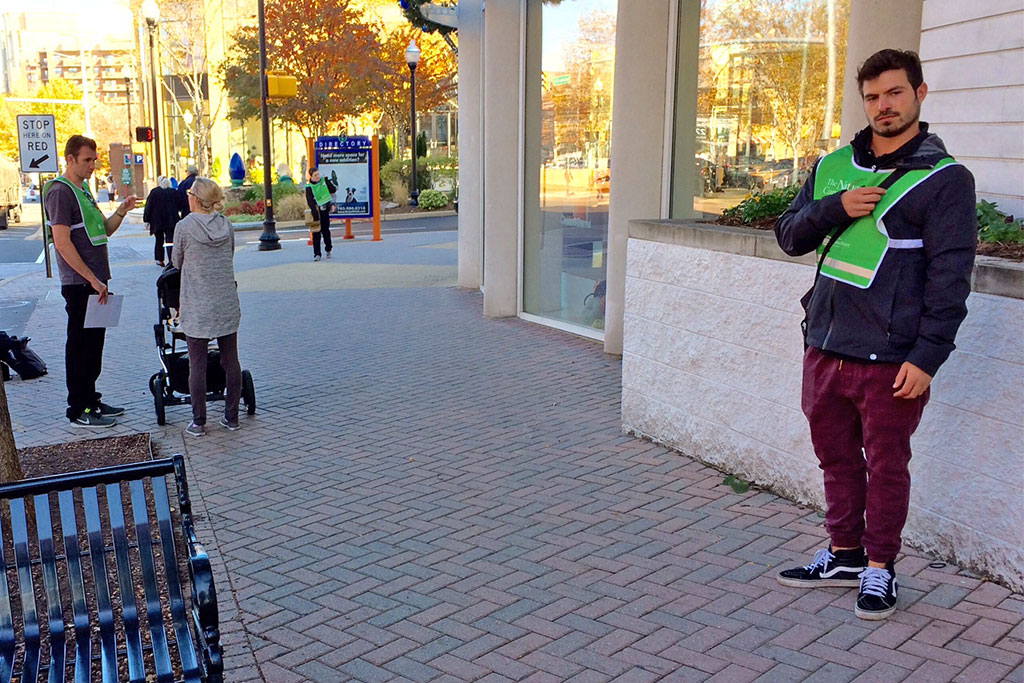
If you frequent Clarendon or other highly-populated Arlington neighborhoods, you’ve likely encountered them: flourescent-vest-wearing young people stopping passersby to solicit support for the environment, civil liberties, or other causes and organizations.

They’re usually friendly, though persistent, working in teams to ensure no one walks by without a pitch. Even intensely looking down at one’s phone and/or wearing headphones does not seem to discourage many from approaching as you walk down the sidewalk gauntlet.

While a majority of Arlington residents may support their causes, the sidewalk signature collectors are seen by some as an annoyance, an obstacle to going about one’s daily business. If you walk around Clarendon often — say, picking up lunch or getting coffee or going to the bank — the forced brush-off routine can get tiresome when practiced multiple times per week.

Canvassing and signature solicitation appears to be perfectly legal in Arlington. One could argue that it’s an example of democracy in action. But should additional restrictions be imposed?


Editor’s Note: Playboy founder Hugh Hefner died last night at the age of 91. Arlington resident Buzz McClain, a writer and communications professional, was a regular contributor to Playboy for two decades. Below, McClain shares a brief recollection of his time at Playboy.

From 1992 to 2012 I did a monthly home entertainment column on the movie pages of Playboy. I would review several B-movies or direct-to-tape (later, direct-to-disc) films, with the occasional A-list movie.

There are few bigger thrills than getting your first paycheck with an embossed “bunny head” on it signed by Hugh Hefner’s daughter, Christie. (Hef led the way in empowering women; his daughter was chairman and CEO of Playboy Enterprises. His considerable philanthropy for women’s rights and free speech is largely unnoticed, and he liked it that way.)

Hef was probably the world’s biggest movie fan, with his every-Wednesday night screenings of new movies at the Mansion for his close friends and buying one of each of just about every film that became available at retail. And he watched them! No pressure on the critics, right?

Only once in 20 years did he change the “bunny head rating” on a review of mine, bumping up “Superbad” (2007) from 3 to 3.5 bunny heads. I’m OK with that.

Somewhere in the house I have an autographed copy of “Hef’s Little Black Book” he sent for my birthday. I was hoping it was his personal phone book (ahem), but it turns out it was his rules for living a full and meaningful life. No doubt that was the better option.


The Right Note is a weekly opinion column. The views and opinions expressed in the column are those of the author and do not necessarily reflect the views of ARLnow.com.

A few weeks ago, Peter Rousselot revisited the issues surrounding launching or expanding a business in Arlington. If you missed it, you should definitely read the story about the business owner who had to install a front door system three times before getting it approved because two inspectors gave them different interpretations of the code.

The conclusion we can draw from the piece is that for years of promoting itself as a world class community, Arlington is still woefully short of offering world class service to businesses who wish to call Arlington home. This is unless you are a big name company who promises two hundred new jobs, in which case, Arlington will probably pay you to locate your business here.

The Board is also quick to jump into a national debate and put out a statement on immigration policy, but cannot provide the County Manager with a directive to streamline these processes. Board members have talked about the need for change, but no one seems to be held accountable.

This is not a question of tight budgets and resource allocation either. For years, I have opined that tens of millions county closeout funds be given back to taxpayers each year instead of being spent. A one-time exception to use unspent budget funds to fix this issue would certainly be appropriate.

At the October meeting, Board members should direct the County Manager to provide a good faith estimate on the cost to implement an online system that integrates applications, payments, approvals and inspections which can be used throughout the process by applicants as well as county staff. The estimate should include the cost of giving mobile devices to inspectors to access and update the system in real time.

The Board should direct the Manager to set aside an amount equal to the estimate in the closeout spending package he proposes. If the County Manager cannot provide such an estimate before the November meeting, then the Board should set aside any consideration of the closeout spending until the estimate is provided.

If you want a real incentive, include in the directive that the Board will refund 100% of the closeout revenue to taxpayers if the process is not complete before the January meeting. I would not hold my breath that three members of the Board would vote for a refund provision, but it would put in place a real incentive for producing the work in a timely fashion.


Progressive Voice is a weekly opinion column. The views and opinions expressed in the column are those of the individual authors and do not necessarily reflect the views of their organizations or ARLnow.com.

By Alfonso Lopez

When Virginians vote this year for Governor, Lt. Governor, Attorney General, and House of Delegates candidates, one key issue should be redistricting and the importance of fair, competitive House districts. We need to elect candidates who will fix the detrimental impact that partisan gerrymandering has had on our country and Commonwealth.

A recent report by the Center for American Progress highlights how partisan gerrymandering and unfair district maps have skewed the legislative process.

When legislators pick their voters instead of the other way around, it creates a culture of divisiveness, partisanship, and lack of accountability that negatively affects every aspect of our democracy.

In Virginia, we’ve created a system where one party holds a 66-34 majority in the House of Delegates despite losing every statewide election for the last five years and when overall House votes cast across the state are roughly 50-50 between the parties.

Over the years Virginia has transitioned from a rural to a much more urban/suburban state. Indeed, our population growth and economy is increasingly driven by areas like Northern Virginia, Metro Richmond, Hampton Roads, Charlottesville, and Roanoke. However, gerrymandering with a software-driven, laser-like scalpel has ensured that rural areas wield outsized influence within the Richmond policy making process.

As a result, policies that are supported by voters in urban/suburban areas like Arlington and Fairfax County are often summarily rejected in the committee process before they ever reach the House of Delegates floor.

A prime example — supported by the majority of Virginians – is Medicaid expansion.

Despite the undeniable benefits expansion would bring to rural hospitals struggling to stay open, legislators representing rural areas have drawn themselves into such partisan districts that supporting anything associated with Obamacare threatens a serious primary challenge. The same is true for legislation to raise the minimum wage and increase K-12 education funding.

The irony is that often the constituents of these rural districts have the most to gain from these policies.

Hospitals in rural areas are struggling with the costs of uncompensated care. Lee County lost its hospital in 2013 and, just two weeks ago, Pioneer Community Hospital in Patrick County announced that it will close.

What company wants to move their operation, manufacturing plant, or call center to a county without a hospital?

The same is true for state K-12 education funding, which makes up a significant portion of public education funding in rural areas.

Northern Virginia can rely on a strong local tax base in building world class public education systems. Unfortunately, rural parts of the state don’t have the same local revenues.

If districts in Virginia were drawn to be more competitive, more legislators in Virginia could buck party dogma in favor of legislative solutions with broad, bipartisan public support such as raising revenue for public education or expanding access to health coverage under the Affordable Care Act.

In times past, partnerships in the General Assembly developed between rural and urban/suburban legislators – merging urban/suburban support for measures to spend resources on core services for rural areas with rural support for economic development and transportation initiatives needed to keep urban/suburban economies moving forward. The result was enhanced revenues for core services across the Commonwealth.

Instead, we have ideological gridlock and stagnation that holds Virginia back.

That is why Virginia needs an independent, nonpartisan Redistricting Commission that takes into consideration natural geographical boundaries, jurisdictional boundaries, communities of interest, and competitiveness when creating district boundaries.

If we want to create reasonable districts that fairly represent the values and priorities of all Virginians, we need to remove politics from the redistricting process.

2017 represents a major turning point in the push for nonpartisan redistricting. The next Governor of Virginia will oversee the 2020-2030 redistricting process and can veto any plan that uses partisan gerrymandering to rig our democracy for the next decade.

The choice could not be clearer.

As the head of the Republican State Leadership Committee in 2010, Ed Gillespie led the Redistricting Majority Project (REDMAP) with the expressed purpose of flipping state legislatures having the largest impact on Congressional redistricting. Gillespie publicly stated that their goal in drawing new lines was to “maximize gains” for Republicans.

In contrast, Lt. Governor Ralph Northam has been a strong advocate for nonpartisan redistricting and even cosponsored nonpartisan redistricting legislation when he was a member of the State Senate.

It’s time to break the cycle of partisan gerrymandering that has skewed our democracy and our legislature’s public policy priorities.

Make your voice heard by voting for Ralph Northam for Governor on November 7.

Alfonso Lopez represents Virginia’s 49th District in the House of Delegates, which includes South Arlington and Eastern Fairfax County. He serves as the Democratic Whip in the Virginia House of Delegates. He and his family are long-time Arlington residents.


Peter RousselotPeter’s Take is a weekly opinion column. The views and opinions expressed in this column are those of the author and do not necessarily reflect the views of ARLnow.com.

In an earlier column, I summarized efforts by Arlington’s civic and elected leaders, including Rep. Don Beyer (D-8) and County Board members Katie Cristol, John Vihstadt and Libby Garvey, to identify solutions to address the problem of increasing aircraft noise in Arlington.

Since 2015, the region has had a growing problem with aircraft noise caused in part by changes to the regional airspace enabled by the FAA’s precise NextGen program.

New Developments

Arlington civic leaders continue to collaborate on this problem. County Board liaisons Vihstadt and Garvey, together with Arlington Civic Association leaders and staff of Representative Beyer, convened at a September 12 meeting chaired by Vihstadt, to discuss these topics:

  • Citizen complaints as the FAA continues to route flights directly over Arlington neighborhoods, with no consensus on remedies within the designated regional noise working group. (Past FAA plans for quieter flights over the Potomac River, were rebuffed by Rosslyn interests, among others.)
  • Senior Maryland officials’ letter to the FAA complaining about noise over Montgomery County neighborhoods, requesting that pre-NextGen flight paths be restored. The FAA rejected this request, and Gov. Larry Hogan has directed his Attorney General to sue the FAA.
  • Phoenix, Ariz. sued the FAA for failing to collaborate with Phoenix before implementing their NextGen flight paths. On August 29, the U.S. Court of Appeals in D.C. ruled for Phoenix. A concurring judge noted that the FAA should avoid historically-designated neighborhoods and parks in determining flight paths. (Potomac Overlook Park in Arlington is directly under the current flight paths.)
  • Georgetown is suing the FAA to push flight paths away from their location, and thus further towards Arlington.
  • Continued efforts by Beyer to successfully hold the line on number and length of flights, while seeking results from a 65dB noise study, which would use actual data from FAA monitors at noise levels below those currently allowed at night at DCA.

Next Steps

The group that convened on September 12 recognized the difficulty of seeking changes at Reagan National Airport (DCA) in view of powerful airline interests that would oppose some of the ideas discussed, but nevertheless advocated that some or all the following ideas be pursued:

  • Increasing the fines paid by airlines violating the current nighttime noise limits at DCA, and indexing the fines to future inflation. The current maximum $5,000 fine was established more than 30 years ago, and the total fines paid in 2016 were an extremely modest $140,000. Fine revenue could be used to compensate Dulles airport for lowering its relatively high fees on any flights from within the DCA perimeter of allowed flight distances, thus encouraging Dulles use and decreasing DCA use — an existing goal of Virginia.
  • Requiring aircraft to fly at higher altitudes on departure and arrival.
  • Allocating the slots at DCA first to the quietest aircraft and last to the noisiest, thus encouraging the earlier adoption of quieter Level 5 engine technology.
  • Seeking a letter comparable to the Maryland letter from our U.S. Senators and Gov. Terry McAuliffe, to complement Rep. Beyer’s efforts. This letter might request that FAA employ more naturally-dispersed flight paths by using precise NextGen navigation.
  • Designating DCA as a model airport to validate the most useful noise abatement concepts for potential adoption in other urbanized areas.

Conclusion

The next meeting of the group that met on September 12 is scheduled to occur in mid-November.


Those enjoying summer’s muggy extended stay in our area are set for a letdown tomorrow.

Hot and humid afternoons and warm evenings will give way to seasonably cooler weather early Thursday, according to the National Weather Service.

Mr. Autumn Man can break out the flannel and sip a maple latte or pumpkin beer on a fall crisp day, rather than sweating over shorts-clad passersby questioning the meteorological appropriateness of said beverages.

Is the return of autumnal weather a good thing or bad thing, in your opinion?


View More Stories