Transformer fire on Lee Highway at N. Culpeper Street (photo courtesy Andrew Pang)

It was a week of warmth and power issues in Arlington. Both are now in the rear view.

Fall has returned after a week-long summer reprise. Today (Saturday) should be breezy, cool and crisp, followed by a bit warmer of a fall day on Sunday.

Our three most-read articles of the week were: 1. Thousands Without Power in North Arlington; 2. County Board Approves Pedestrian-Only Streets in Arlington; and 3. ACPD Investigating More Than Two Dozen Car Break-ins.

Feel free to discuss any of those stories, this week’s podcast with Rep. Don Beyer, or any other issues of local interest in the comments — assuming the comments section is working.

Photo courtesy Andrew Pang


GOP county board candidate Mark KellyThe Right Note is a weekly opinion column. The views and opinions expressed in the column are those of the author and do not necessarily reflect the views of ARLnow.com.

This month County Board Chair Libby Garvey put forward the idea of giving a raise to County Board Members. Garvey suggested the salaries could be raised from the current $51,500 ($56,500 for the Chair) to the median income of Arlington, around $110,000.

Under our form of government in Virginia, the raise cannot occur until after the 2019 election when two seats are up once again which means any raise would not take effect until 2020. Every single member of the Board will have been elected or re-elected at that point, which would give the public plenty of time to speak on the issue.

Board Member John Vihstadt opposed the massive pay raise and said it was valuable for Board Members to hold other jobs. I agree.

There is no compelling evidence that turning the Board into a full-time legislative body would improve the outcomes, making a full-time salary unnecessary. Moreover, having to hold down a real job puts a Board Member on par with the average Arlingtonian who wants to speak on an issue at 9 a.m. on a Saturday after a long week at work.

While Garvey’s suggestion of essentially doubling the salary may set an unrealistic ceiling for the discussion, giving the Board some level of a raise is not something this fiscal conservative would dismiss out-of-hand. While it is public service, Board Members should be compensated fairly — taking into account that a Board Member cannot go out to dinner or even to a neighborhood block party without essentially being “on the job.”

But if a majority the Board really wants the public to be accepting of any raise, they could start by making a case for why they deserve it in this year’s close-out discussions.

The Board should be given credit for creating a close-out process that seeks more public input. However, they did not address essential questions for the public to consider.

Why is there always a revenue windfall? Why is the automatic assumption that the revenue windfall should be spent? Why not consider using the revenue to lower the tax rate for 2017?

Revenue once again came in significantly over projections — $29 million to be exact. And as I have pointed out repeatedly, this underestimation happens every single year. The money is spent at close-out time. Then the County Manager issues a report telling us we have a mythical budget gap requiring taxes to go up next year. And the cycle continues.

They call the revenue estimates the result of “fiscally responsible budgeting.” But the real result has been a bias towards higher and higher spending fueled by more property tax revenue.

If Board Members want public support for a raise in 2020, they should consider giving the taxpayers a “raise.” The Board should vote to give the next four years of excess revenue back to the taxpayers instead of spending it in the close-out process.

Mark Kelly is the chairman of the 8th District Republican Committee, a former Arlington GOP Chairman and two-time Republican candidate for Arlington County Board.


Andrew SchneiderProgressive Voice is a weekly opinion column. The views and opinions expressed in the column are those of the individual authors and do not necessarily reflect the views of their organizations or ARLnow.com.

By Andrew Schneider

Election season is upon us and, thankfully, the end is near. While it is fashionable to tout this election as a uniquely negative one, I still find myself encouraged and enlivened by the citizen activism that this election, like most elections, has engendered in Arlington.

Just this week, as voter registration draws to a close, the Arlington Democratic Party celebrated their efforts to register 19,000 new voters in Arlington. Regardless of party affiliation, I hope we can all be proud that an engaged and informed electorate helps shape our community.

Civic engagement and informed residents are what led me to host a local weekly radio program. For the past six months, I have had the honor of hosting a weekly radio program, Arlington Voices, on WERA-LP — Arlington’s community radio station and an offshoot of Arlington Independent Media.

The show has given me (and hopefully listeners), an opportunity to discuss and learn about the fabric created by our community ties. I have had the chance to talk with thought leaders, non-profit managers, educators, coaches, musicians and academics. Each has had an impact (and been impacted by) life in Arlington.

As this is the political season, in the past two weeks I have interviewed Delegate Rip Sullivan and our Congressman Don Beyer. Soon, I will host Libby Garvey, Chair of the Arlington County Board.

While each interview is different, I see common threads that seem to weave throughout every guest’s journey. They note in their careers and their lives more generally the value of life-long friendships, inclusiveness and yes, progressive values they have found in Arlington.

These values can be found throughout our community fabric and they are one of the reasons that my wife and I chose to raise our family here. As Senator Mary Margaret Whipple recently noted in this column a few weeks ago, Arlington is frequently touted as a best County for many things including places to raise a family and our schools are consistently ranked among the best in the state, and the nation as well.

Arlington’s schools also shed a different light on life in Arlington. Even though Arlington ranks as the sixth richest County in the nation according to U.S. Census data, over 30% of Arlington’s school population (over 7,500 students) are on a free or reduced lunch plan.

Similarly, estimates indicate that over 10% of Arlington’s populations is living in poverty (estimates vary by how the data is analyzed and broken down). Each day, the organization that I work for, Arlington Thrive, helps some of these residents with same-day emergency financial assistance. This assistance is often what helps them avoid eviction, having the power turned off or not having access to important medical assistance.

So while I am disheartened that we live in a community where there are many people living in poverty amidst so much wealth, I am also thankful that we live in a community that supports efforts to reduce poverty with forthrightness. Our policies do mitigate poverty and often provide a blueprint and an inspiration for other communities around the United States.

These are not just County government efforts. For example, Arlington’s 10 Year Plan to End Homelessness is a coalition of government resources, local non-profits like Arlington Thrive, and support from the local business community.

As the election draws to a close I am mindful how the greater conversations taking place across the country have resonance here in Arlington.

Whether it is the populist appeal of candidates as different as Donald Trump and Bernie Sanders, or the release last week of a forward thinking anti-poverty plan by Hillary Clinton and Tim Kaine, the issues of our country are also issues within our community.

My hope is that Arlington will continue to lead the charge on these issues and that, as we do, the people of our community — from those living in poverty to those living in wealth, continue to find Arlington voices — of reason, of hope and of inspiration — that signify a successful and a caring community we can proudly call home.

Andrew Schneider is a lifelong Arlingtonian who is the Executive Director of Arlington Thrive, a non-profit that provides same day emergency financial support to neighbors in need.  His weekly radio interview program, Arlington Voices, can be heard every Friday at 10 am on WERA-LP 96.7 FM. 


peter_rousselot_2014-12-27_for_facebook

Peter’s Take is a weekly opinion column. The views and opinions expressed in this column are those of the author and do not necessarily reflect the views of ARLnow.com.

At its October 15 meeting, the County Board approved a County staff recommendation to advertise draft regulations relating to Airbnb.

Discussion

It’s important for health, safety and other reasons to appropriately regulate Airbnb, similar service providers and Arlington homeowners who use these services. Pursuing a robust public-engagement process with respect to draft regulations can be a constructive way in which to improve a draft.

However, the County staff’s proposed December 10 deadline for the County Board’s final adoption of appropriate regulations is problematic due to:

  • The exclusion of certain related issues either from the draft regulations and/or from public engagement regarding the draft regulations, and
  • Virginia’s ongoing work to enact a state law to cover many of the same areas.

Arlington County staff proposal

The County staff proposal is available here. At its October 15 meeting, the County Board approved this proposal with some amendments.

The staff proposal:

  • Defines a new home occupation use called “accessory homestay,”
  • Establishes standards for this use,
  • Acknowledges that many related areas have been excluded from advertisement of the proposed regulations, citizen engagement and/or final action on December 10.

Among the many areas that have been EXCLUDED are:

  • Requirement of owner-occupancy of the unit,
  • No more than one contract for an overnight stay.

Exclusion of any area in the advertisement means that, no matter what any affected party might say, no changes can be made without re-advertising and providing a new thirty-day review period. But, based on public feedback, re-advertising may be the wisest course.

The staff proposal also:

  • States that staff “does not know what the 2017 General Assembly will do” regarding the state legislation, but
  • Hopes that “implementing regulations in Arlington now could help inform the state’s decision.”

Virginia state legislative status

Legislation regulating Airbnb and similar service providers almost passed in the 2016 Virginia state legislative session. That legislation would have established the Limited Residential Lodging Act (the Act), and would have allowed property owners to rent out their homes or portions thereof for periods of less than 30 consecutive days, or do so through a hosting platform.

The hosting platform could have chosen to register with the Virginia Department of Taxation, in which case the hosting platform would have been responsible for the collection and remittance of all applicable taxes on behalf of the property owner.

Although this legislation did not pass, the Virginia Housing Commission was directed to convene a work group with representation from the hotel industry, hosting platform providers, local governments, state and local tax officials, property owners and other interested parties to explore issues related to expansion of the framework set forth in the draft legislation.

The group was ordered to complete its work by December 1, 2016, with the goal of developing draft legislation for consideration by the 2017 session of the General Assembly.

Because Virginia is a Dillon Rule state, there is a significant risk that state legislation in 2017 could preempt Arlington’s regulations adopted in 2016. If such state preemption were to occur, it could be seriously disruptive because it could significantly change one or more key substantive provisions in Arlington’s regulations.

Conclusion

Arlington should seriously consider deferring final approval of appropriate regulations until after the 2017 state legislative session. Is there a compelling reason why the final regulations must be enacted in December 2016?


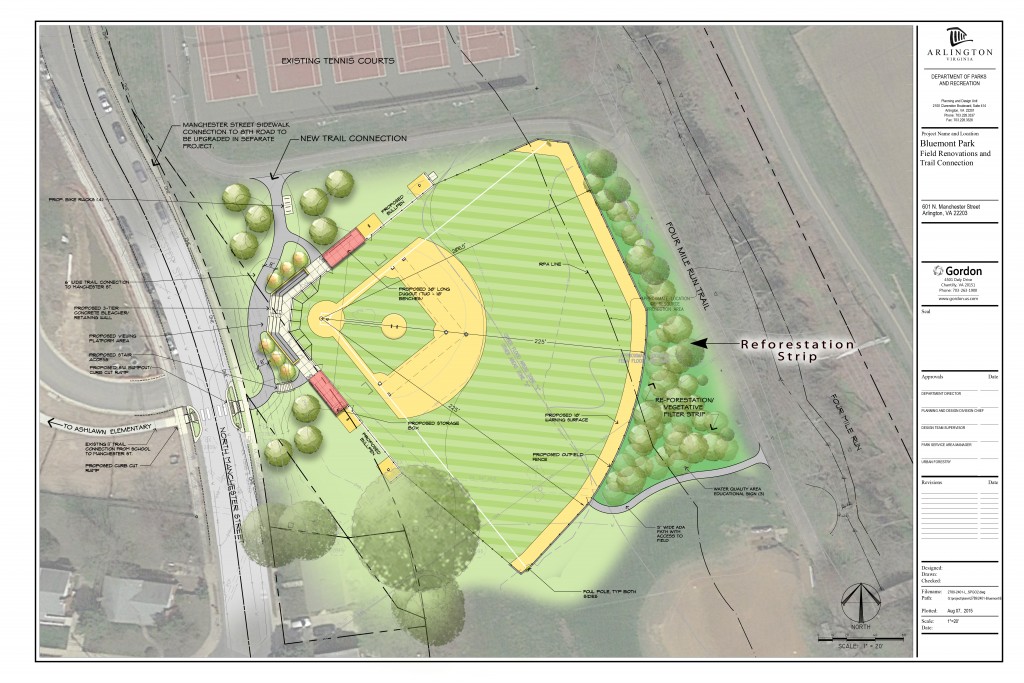
Planned baseball field at Bluemont Park

The following letter to the editor was submitted by John Foti on behalf of Arlington’s youth baseball community. Via letters and outreach at meetings, baseball advocates are pushing back against vocal opposition, among a group of residents, to the renovation of a baseball diamond in Bluemont Park.

A small minority of opponents have dominated the conversation about the planned improvements to the baseball diamond at Bluemont Park. I’d like to speak up for the proponents.

Participation in youth baseball has grown rapidly as the county’s school-age population has grown. There are currently over 3,600 youth baseball participants playing each year, up from about 2,400 participants just 7 years ago. Bluemont field #3 is one of the most heavily-used fields for kids aged 8- to 12-years old.

Bluemont #3 is a field used by more than 1,000 kids for more than 70 games a season and roughly 60 practices per week. Unfortunately, overuse and misuse of the field for non-baseball activities (such as riding bicycles around the diamond) have combined to make it very susceptible to unplayable field conditions. This spring alone, an estimated 60 percent of the scheduled activities on Bluemont #3 were cancelled due to unplayable field conditions – which is significantly higher than any other baseball field in the County

To derail the planned improvements, project opponents have made several assertions that are wrong or misguided.

  • They assert there is surplus of baseball fields, but only half of the 38 fields they identified are actually safe, usable fields. The remaining 50% are poorly maintained and are not usable. Bluemont #3 sits at the bottom of the list of playable fields.
  • They argue that allocating land to youth baseball is inefficient because of “low utilization rates during daylight hours”. Please keep in mind that the kids that use these fields are in school from 8am-4pm. Using this flawed logic is like stating “APS has plenty of classroom space because the schools are empty between 4pm-6am”. It is used every single weekday from 4pm until the sun goes down for either practices or games.
  • They contend that very few county residents benefit from the field, but this conclusion is based on incomplete data. Granted, the field does not serve any of the non-baseball playing residents, but it does serve of the 1,000 KIDS who play baseball.

Opponents are particularly opposed to fencing the field. Fencing helps mark in-play territory, keeps balls from flying out and hitting park users, and extends the life of taxpayer investments. Because the field is not currently fenced, park users routinely wander onto the field of play and interrupt permitted users. This is incredibly unsafe and unfortunate for the kids that are playing. Moreover, fields that have fences elsewhere in the county tend to remain in relatively good shape: They require only routine maintenance during the season and generally last years beyond their expected “useful life”.

The planned renovation of the Bluemont field will restore this much needed field to a condition of playability and safety, while helping to ease diamond field supply/demand issues for families across the County.

There are a few thousand good reasons to restore Bluemont #3, most of them are between ages 8-12 and want a good, safe place to play ball.

John Foti
Arlington Babe Ruth
(on behalf of the Arlington Youth Baseball Community)

ARLnow.com occasionally publishes thoughtful letters to the editor about issues of local interest. To submit a letter to the editor, please email it to [email protected]. Letters may be edited for content and brevity.


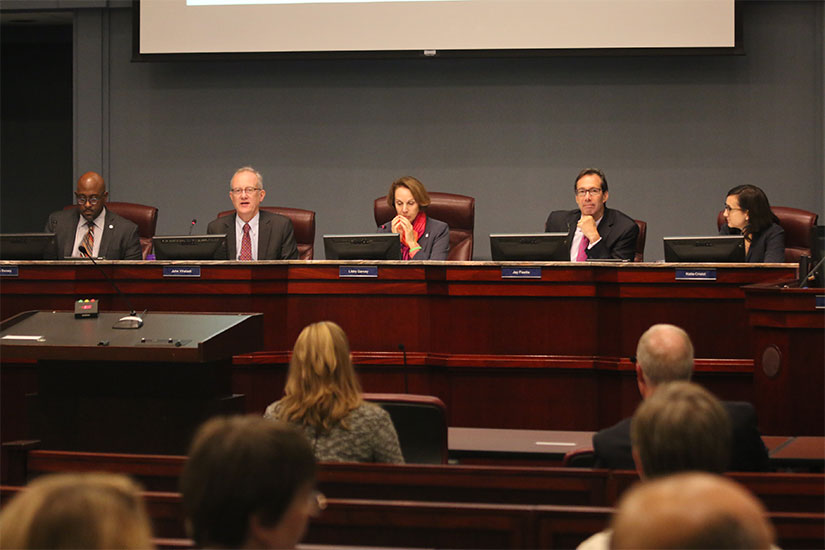
Arlington County Board on 9/27/16Arlington County Board Chair Libby Garvey is floating the idea that Arlington County Board members should be paid better.

Currently, County Board members are paid between about $51,500 and $56,500. The position is considered part-time, and three out of the five current members have other jobs, but in practice Board members end up working full-time hours in service of the county.

As reported by the Washington Post, Garvey wants to start a discussion about raising County Board member pay closer to the county’s median family income of $110,900, which would be more in line with what Fairfax and Montgomery counties pay their elected officials.

Board member John Vihstadt, a partner with a D.C. law firm, says he does not favor a pay raise and thinks it’s better for County Board members to have other jobs.

What do you think?


Mark KellyThe Right Note is a weekly opinion column. The views and opinions expressed in the column are those of the author and do not necessarily reflect the views of ARLnow.com.

For much of the past decade, many community activists along with some political candidates have called for the County Board and School Board to streamline operations and avoid duplication of services. This month, the two Boards held a joint work session and produced a draft charter for a Joint Facilities Advisory Commission.

The new Commission would be made up of no more than 20 members, appointed to two year terms, who would not serve for more than six consecutive years. The members will be charged with long range planning of facility needs.

The draft charge also reads that the Commission should be a “forum where fresh and creative ideas can be discussed freely,” a directive that should be taken to heart. There should be no room for Commission members who are afraid to challenge the status quo or conventional wisdom.

While this is only a draft charge, it is unlikely to see major substantive changes. Here are some recommendations of changes to make before it is finalized:

  1. The Boards should appoint fewer than 20 members (12 may be ideal). In my experience serving on committees, smaller ones are generally more effective, particularly if the members are appointed for their substantive knowledge, not political considerations.
  1. The Boards should agree to charge the Commission with specific projects to consider each year. The current charge contains projects to be evaluated in 2017 (a list that may actually be a little long to cover adequately in just four meetings). Setting specific projects to be considered with a specific deadline for recommendations will keep the Commission focused.
  1. The Commission should be charged with quantifying savings to the overall county budget gained by consolidating a project. This is one of the main reasons people called for this process — to save taxpayers money (and maybe even return it to the taxpayers through lower property taxes). The budget analysis should also include any impacts joint use would have on the current revenue sharing principles.

While fiscal conservatives may hold out little hope our taxes will go down as a result of this process, we still value government that spends our money wisely. So, kudos to the Boards for bringing the idea one step closer to reality.

Mark Kelly is the chairman of the 8th District Republican Committee, a former Arlington GOP Chairman and two-time Republican candidate for Arlington County Board.


Lisa NisensonProgressive Voice is a weekly opinion column. The views and opinions expressed in the column are those of the individual authors and do not necessarily reflect the views of their organizations or ARLnow.com.

By: Lisa Nisenson

Last week, former State Senator and Arlington County Board member Mary Margaret Whipple kicked off Affordable Housing month with a Progressive Voice column advocating more housing options, such as introducing small multi-family dwellings and accessory dwellings (ADs). In making the case, Senator Whipple cited the benefits of housing variety, while acknowledging concerns about how new housing types fit into existing communities.

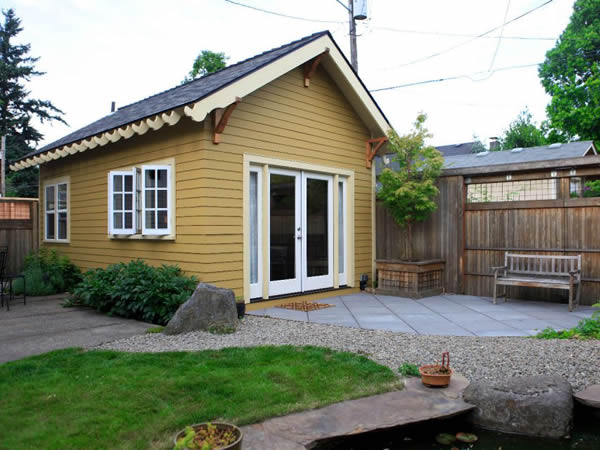
Of the expanded housing options, accessory units such as backyard cottages and in-law suites, have the greatest near-term potential to add lower-cost housing options across the County.

Backyard cottageIn 2008, Arlington updated codes and regulations for accessory units, though homeowners and construction companies still face code barriers that outweigh the benefits of constructing ADs. While safety — such as fire codes — drives many of the requirements, other elements related to parking and design deserve closer scrutiny.

The stated purpose for these elements is largely to lower impacts on surrounding properties, though it is unclear (1) whether the impacts exist to the degree anticipated and (2) whether the required design requirements effectively prevent or reduce impacts. Given the housing pressures on an increasing number of Arlington residents, our entire community needs to come together on a platform of “what works” rather than expansive code written to anticipate and regulate every “what if.”

Fortunately, other cities have adopted — and fine-tuned — programs that offer ideas for shaping policies, programs and design elements for neighborhood-friendly accessory units. Here is a snapshot of how programs are shaping up:

Portland, Oregon: In general, Portland has the most ambitious AD program with lower parking requirements and permit fee reductions. While most cities with ADs require owner occupancy either in the main or accessory unit, Portland eliminated this rule in 1998. Three years ago, the state surveyed homeowners to determine (1) how ADs are used and (2) information on concerns such as parking.

The results? By and large, ADs are rented for out for extra income, typically to a single occupant. For parking, one-third of units report using the street (for the other units, 20% of dwellers do not own a car or homeowners provide off-street parking). Portland also places a high value on design and quality.

Seattle, Washington: Seattle has taken a more incremental and targeted approach to rolling out its AD program. Like Arlington, Seattle manages parking (though based on proximity to transit instead of on-street parking capacity), minimum lot sizes and design standards. Also like Arlington, Seattle’s housing crisis is driving a renewed effort for promoting accessory units through regulatory reform and incentives.

Novato, California: Novato created a new class of units: Junior Accessory Dwelling Units. These units are modified interiors within existing homes to create a separate living space. The city waives requirements for parking and fire codes while making special provisions for building small-scale kitchen facilities.

As it responds to escalating housing costs, Arlington should consider other trends affecting housing. New mobility options, notably bike share, car share such as Car2Go and on-demand ride hailing — such as Uber — are helping drive down car ownership rates and the related need for parking.

Also, an increasing number of retiring baby boomers are finding decreasing options for “aging in place” and “aging in neighborhood.” Yet there are few downsizing options other than apartments, and restrictive rules prevent the use of space in existing homes to provide a downsizing option while giving homeowners income to cover taxes and maintenance.

A big wild card is the availability of short term rentals — like Airbnb — that were barely on the radar in 2008, but are now reshaping parts of the real estate and hospitality industry. Here in Arlington, our County Board is considering the legal and tax framework for short term rentals. The Virginia General Assembly is also expected to revisit statewide legislation that could restrict local governments’ ability to regulate short-term rentals.

Currently, Arlington’s code makes building guest houses for temporary guests easier than building accessory units for long-term, stable renters. Without new rules, the County may be in a position where economic incentives favor “Airbnb cottages” over new, stable housing units.

As Arlington implements the Affordable Housing Master Plan and rules for accessory dwellings, look for discussions on allowing detached dwelling units (as opposed to attached or in-house units currently allowed), fire code requirements, site requirements such as lot coverage and enforcement.

If you are new to the topic of ADs, the website Accesorydwellings.org is an exhaustive resource, with links to a design gallery, research, policies and case studies.

Lisa Nisenson is Founder of the urban planning startup GreaterPlaces, named a “Top 10” resource by the planning authority Planetizen. She holds positions on the American Planning Association’s Sustainable Communities Division and Smart City Task Force. She is a long time Arlington civic advocate from Lyon Park.

Image: Raleigh, N.C.


Peter RousselotPeter’s Take is a weekly opinion column. The views and opinions expressed in this column are those of the author and do not necessarily reflect the views of ARLnow.com.

The School Board has begun the process of revising high school attendance boundaries in order to balance enrollment and better utilize spaces at Arlington’s three comprehensive high schools. These boundary changes will be effective September 2017, apply to current eighth grade students who will be entering high school next fall and to each freshman class in the next three school years.

The final revised high school boundary plan is scheduled to be voted upon at the School Board’s December 1 meeting. Further information is available here.

On October 6, the School Board voted to waive its Policy 25-2.2 on enrollment and transfers for middle and high schools. In waiving the policy, the Board offers parents an individual choice to help reduce over-capacity at Gunston, Swanson, and Williamsburg middle schools and Washington-Lee High School.

The School Board should emphasize socioeconomic status in its boundary decisions

Redistricting is going to be our new reality in Arlington as enrollment growth — and the extensive new school facilities needed — ripples through every level of schooling. With Arlington projecting 75,400 new residents by 2040, the school district of today cannot be a promise for tomorrow.

Although the number of students to be transferred this fall is likely to be relatively small, emphasizing socioeconomic status should be a “guiding principle” not only for the inevitable, greater boundary changes to come, but even for this fall’s revisions.

Decades of research justifies emphasizing socioeconomic status

Decades of research shows that socioeconomic integration is an important component to reducing achievement gaps and improving instructional outcomes for all students. Low family income correlates highly with low achievement. See also: “From All Walks of Life” by Richard D. Kahlenberg; “Integrated Education and Mathematics Outcomes: A Synthesis of Social Science Research” by Roslyn Arlin Mickelson and Martha Bottia; and research briefs from The National Coalition on School Diversity.

Given that research shows that social composition of the student body is the most influential school factor for student achievement, shouldn’t we expect our school system to address this question?

The School Board’s own rules require promotion of demographic diversity

Promoting demographic diversity already is one of the criteria (Policy 30-2.2) that the School Board explicitly must consider in revising school boundaries. While APS could utilize a variety of available data to determine demographic characteristics for purposes of school boundary revisions, one comprehensive measure definitely available is current student participation in the Free or Reduced-Price Meals Program (FARM). As of October 2015, the percentage of students participating in this program at our three comprehensive high schools was:

  • Wakefield (46%)
  • Washington-Lee (31%)
  • Yorktown (14%)

There are much more marked disparities in FARM participation in elementary and middle schools. In 2015, FARM participation at the elementary level ranged from Jamestown (2.46%) to Carlin Springs (81.8%). In middle school, FARM participation ranged from Williamsburg (9.16%) to Kenmore (51.57%). The county-wide average proportion of students who qualified for FARM in 2015 was 30.13%.

Conclusion

The instruction offered at all three of our comprehensive high schools is excellent. The difference lies in the socioeconomic status of their cohorts of students. That difference impacts the student experience and overall achievement. Exposure to people who are different provides a vital opportunity to learn life skills including conflict resolution, resilience and critical thinking.

Peter Rousselot is a former member of the Central Committee of the Democratic Party of Virginia and former chair of the Arlington County Democratic Committee.


Mark KellyThe Right Note is a weekly opinion column. The views and opinions expressed in the column are those of the author and do not necessarily reflect the views of ARLnow.com.

Another week brings yet another damaging news cycle for Metro.

This time, it was a series of scathing reports from the Federal Transit Administration (FTA). FTA found Metro was not operating trains on a clear traffic pattern during SafeTrack surges. FTA officials were denied access for inspections. Metro officials delayed repairs identified by FTA. And earlier this summer, FTA found some Metro inspectors had been inadequately trained.

Despite the best efforts of Metro’s new General Manager to implement a culture of safety, the message has clearly not permeated through the ranks. And the FTA’s findings are just more bad news for the system.

Metro also announced in August ridership was down 11 percent in the preceding quarter. That’s 8 million trips fewer than the same quarter the year before. For the entire fiscal year, ridership was down 6 percent.

And Metro reported only 42 percent of riders viewed the system as reliable. That number would almost certainly be lower if those who had not already abandoned the system were also surveyed.

Some dissatisfied individuals have simply returned to their own vehicles as fares increased while gasoline prices have decreased. Many have turned to services like Uber and Lyft. Uber launched a carpooling service where multiple individuals share rides at a price that is comparable in some cases to riding Metro, in in most cases much more reliable.

The ridership losses accounted for $58 million in lost revenue for the 2016 fiscal year. And, the agency did not actually have an overall budget shortfall for the year. Yet, Board Chairman Evans called for $300 million more from Congress, and $1 billion overall, to bail them out.

The facts continue to point to mismanagement of the system and a broken culture as the primary reasons for its woes. But WMATA Board Chairman Evans continues to say all would be solved with “more money.”

At some point everyone should say enough is enough and demand a total reboot of WMATA. The last thing we should do is give the current leadership an additional $1 billion with no strings attached.


Mary Margaret WhippleProgressive Voice is a weekly opinion column. The views and opinions expressed in the column are those of the individual authors and do not necessarily reflect the views of their organizations or ARLnow.com.

By: Mary Margaret Whipple

Arlington has been making many “best of” lists lately: The Best City to Live in America, the second Best City for Millennials, fourth Best City Parks in the country. We can be proud of these notable achievements.

But Arlington also finds itself on lists that tell another side of the story: we have some of the highest home prices and rents in the D.C. area, and the D.C. area is among the least affordable metro areas in the country. The median price of single-family homes in Arlington increased 140 percent between 2000 and 2013, while the average rent increased by 91 percent.

Rising prices have resulted in a great loss of economic and other types of diversity for our community. Over the last few decades, Arlington’s demographics have become less diverse as many lower and middle-income households either decided to move or were forced to move out of the county. Arlington County was the only place in the D.C. area that lost Hispanic population between the year 2000 and 2012. And although the overall number of households in Arlington grew by only 10 percent during that time, the number of households earning more than $200,000 increased by almost 60 percent.

In the County’s work on housing affordability and in the Affordable Housing Master Plan adopted last year, a lot of attention has been placed on providing affordable housing for low-income families.

For example, most government housing subsidies are focused on meeting the housing needs of those earning below 60 percent of the Washington area’s median income. In the Washington area, this means housing programs serve those making less than around $65,000 per year, and the greatest subsidies are reserved for those earning much less. This makes sense, because the lowest income households are the most burdened by high housing costs and tend to live in the most vulnerable situations. Especially when subsidy dollars are scarce, most of us would agree that they should be focused on those most in need.

But the county’s three-year Affordable Housing Study Working Group process also pointed out that housing affordability concerns have reached the point where households higher and higher on the income scale are affected, particularly when it comes to purchasing a home.

In Arlington, this means that even those earning $80,000-$100,000 or more can find it difficult to buy homes in the County that meet their needs. Due to a lack of diversity in our housing stock, empty nesters and seniors with modest incomes who would like to downsize have limited choices if they want to stay in our area.

Employees of Arlington County government and businesses also struggle with housing costs. Many end up moving farther and farther away from their jobs. The longer commutes mean sacrificing time with their families in order to find an affordable place to live. Extended commutes also affect our area’s employers as well — making it more difficult to attract and retain talent willing to make the commute. And all of us are affected by the traffic and environmental impact caused by increasing numbers of long distance commutes.

Is there anything that can be done to help middle income households find suitable living situations in Arlington?

That’s the question that the Alliance for Housing Solutions is trying to answer in this year’s Thomas P. Leckey Forum addressing the concept of “Missing Middle Housing.” We’ll be talking about how to create housing options that could better meet the needs of middle-income households, including families and seniors.

Could duplexes, four-plexes and stacked townhomes be more affordable for middle income households than what’s currently available to them? Could backyard cottages provide a place for recent college graduates or aging grandparents to live near their family? At present, many of these possibilities are either not allowed in Arlington or become infeasible after layering on current zoning and related requirements.

We recognize that long-time Arlingtonians may be concerned about how well this kind of housing would fit into our community. To help provide some concrete examples and create a community conversation on this issue, AHS is holding two “Missing Middle” Design Galleries on October 15th and October 25th to showcase some examples of this kind of housing. Are you curious? If so, come take a look at the examples and let us know what you think.

Columnist Note: October is Affordable Housing Month in Arlington. Learn more about Affordable Housing Month activities on the County’s website: https://housing.arlingtonva.us/affordable-housing/month/.

Mary Margaret Whipple is president of the Board of Directors for the Alliance for Housing Solutions. She represented the 31st District in the Virginia State Senate from 1996 to 2012, served as a member of the Arlington County Board from 1983-1995, and was appointed to the Arlington County School Board in 1976. AHS is a nonprofit organization founded in 2003 that works to increase the supply of affordable housing in Arlington County through public education, facilitation and action.


View More Stories