


peter_rousselot_2014-12-27_for_facebookPeter’s Take is a weekly opinion column. The views and opinions expressed in this column are those of the author and do not necessarily reflect the views of ARLnow.com.

In last week’s column, I outlined some of Arlington’s self-imposed limitations in utilizing “community benefits” as conditions for approving developer site plan requests for additional density. See also my Sept. 22 column recommending preparation of integrated, project-specific fiscal impact statements.

Critical Reforms

The most critically-necessary community benefits’ reforms include:

Consider fiscal impact statements at each special exception/site plan hearing

Arlington should take advantage of this planning tool routinely utilized for years by other Northern Virginia jurisdictions like Fairfax and Loudoun. Both use project-specific fiscal impact statements as part of their review processes. Even though those jurisdictions use a proffer system rather than Arlington’s special exception/site-plan system, the advantages to policy-makers and the public of utilizing this tool are common to all of our jurisdictions.

Falls Church has utilized fiscal impact statements since 2003.

Arlington should expedite the adoption of its own fiscal impact model to be considered at each special exception/site plan hearing. Any impacts and equitably allocated offsetting community benefits need to be measured from the applicable base by-right zoning.

Assess the impact on schools of incremental enrollment

The fiscal impact model Arlington ultimately adopts should explicitly consider incremental school enrollment impacts.

In Falls Church, voluntary school capital contributions have been a staple of past agreements with developers of mixed-use projects.

The Fairfax fiscal impact model has explicitly considered school impacts since 2003.

Fairfax determines a per-student generation factor by housing type, and estimates how many students are anticipated from the particular mix of housing units in each proposed development. Fairfax then computes a per-student cost for each project, which when multiplied times the number of students anticipated from the project, yields the total incremental enrollment cost that forms the basis for negotiations with the developer.

Important updates to the Fairfax model (effective July 1, 2016) are discussed below.

Assess the impact on parks of incremental usage

Under the updated Fairfax impact model, benefits for incremental school or park usage negotiated with a developer do NOT have to be limited to creation of, or refurbishments to, a school or park within the boundaries of the site of the proposed project — so long as those benefits are “reasonable” in amount and address impacts that are “specifically attributable” to the “residential use component” of the project.

Parks include “playgrounds and other recreational facilities.” Such off-site benefits must provide a “direct and material benefit” to residents of the proposed project. Both on-site and off-site benefits for schools or parks can include cash.

Allow citizens to speak publicly at SPRC site plan meetings

By the time a Site Plan Review Committee (SPRC) site plan meeting is scheduled with respect to any particular developer proposal to obtain additional density, the principal features of such a proposal, including any corresponding community benefits, have already been negotiated in private between the developer and the county. To provide a fair balance at site plan meetings, the SPRC process should be revised to specifically permit individual citizens and citizen groups to speak publicly at the meetings.

Conclusion

Although the pace of site plan proposals declined after the Great Recession, that pace is now increasing rapidly. The County Board should initiate an appropriate public process to consider the reforms discussed here and others, with a direction to report back in six months.
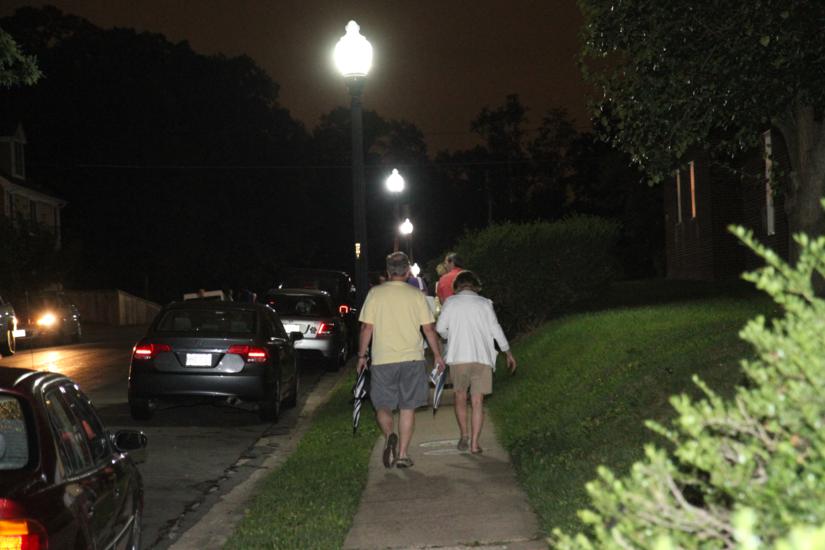
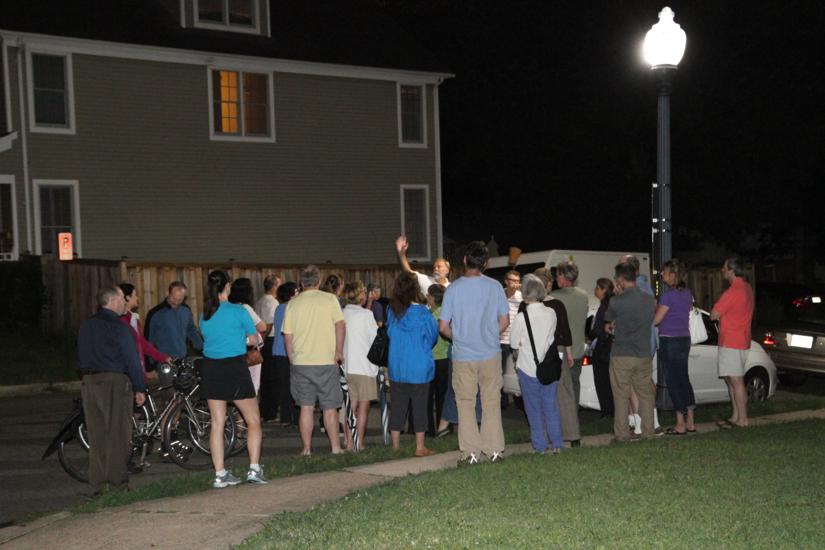
“Some cities are taking another look at LED lighting after AMA warning.”

That was the headline from a Washington Post article last Sunday, discussing the pushback against modern Light Emitting Diode streetlights in local communities. While the new streetlights are more energy efficient, last longer and save money compared to older sodium lights, some say they are too bright or cast to harsh of a light.

The American Medical Association warns that excessive blue light from certain LED streetlights could “disturb sleep rhythms and possibly increase the risk of serious health conditions,” according to the Post. Localities, however, say LED streetlights are not only more economical and more ecological, but are safer for drivers as well, helping to improve visibility on streets.

In Arlington, 85 percent of the more than 7,000 county-owned streetlights are now LED, according to Arlington Dept. of Environmental Services spokeswoman Katie O’Brien. Arlington’s streetlights operate at 5500 Kelvin, she said, casting a bluer tint than the warmer 3000K color temperature recommended by the AMA. The blue tint has been compared to that cast by natural moonlight.

When LED streetlights were first rolled out in Arlington neighborhoods, there were loud complaints from some groups of residents. Since then, O’Brien said, many of the complaints about lighting technology — more than 50 formal complaints between 2013 and 2016 — have been addressed.

“The County has installed shields on county-owned LED streetlights to help better direct the light towards the sidewalk and street,” she said. “Most LED streetlights are also on a dimming schedule to decrease in brightness throughout the course of the night, dimmed as low as 25% of full brightness.”

Nonetheless, the county is studying the AMA report.

“Arlington County streetlights meet current federal standards,” O’Brien said. “The County is studying AMA’s report that LED lights may have negative health and environmental impacts. We are researching this issue and will consider this report, industry standards, and other factors in making a final decision around LED streetlight temperature as part of the County’s Street Light Management Plan that will be completed in 2017. Additionally, our staff will work closely with Arlington’s Public Health Division throughout this process.”

LED streetlights are 75 percent more energy efficient than older models. Arlington expects to save $1 million annually once all county streetlights are converted to LED technology.

What do you think about LED streetlights in Arlington?


Mark KellyThe Right Note is a weekly opinion column. The views and opinions expressed in the column are those of the author and do not necessarily reflect the views of ARLnow.com.

The idea of a “Blue Ribbon Panel” charged with bringing independent thinking to Arlington’s strategic planning process left me cautiously optimistic. A temporary group empowered to break out of a status quo mindset and provide truly independent analysis could have been a good source of insight for Arlington’s leaders.

After initially moving the independent panel forward with the support of all but one of her colleagues, Garvey blinked in the face of pressure from a relatively small group of powerful insiders. And this week, the County Board officially surrendered to those who are afraid of what an independent group might recommend. Instead, the Board charged the County Manager with forming a staff team to review county priorities.

While I appreciate Board Chair Garvey’s desire to reach a compromise that advanced even the smallest of reforms, it seems like even calling it a small step forward is optimistic. This group may very well produce a new idea or two, but not from a fresh perspective. The County Manager will continue to control the process of how existing staff will provide advice to the Board.

Why isn’t the County Manager doing this type of ongoing review already?

And, if it so hard for the Board to agree to an independent panel to make reform recommendations, how hard would it be for them to vote for any real reforms?

Garvey is finding out about the biggest headaches of sitting in the center seat and holding the gavel: Arlington’s Board Chair only serves a one year term and really has only limited power in setting the Board’s agenda. If three of the other Board Members do not like an initiative, they can simply find ways to run out the clock.

This one-and-done tradition is long engrained in Arlington, and may very well prevent as many bad ideas from moving forward as good ones. But often it simply lends itself to allowing “the way we’ve always done it” to march on with little change for the better.


peter_rousselot_2014-12-27_for_facebookPeter’s Take is a weekly opinion column. The views and opinions expressed in this column are those of the author and do not necessarily reflect the views of ARLnow.com.

This is the first of two columns.

Today, I’ll discuss some of Arlington County’s self-imposed limitations on site plan conditions for “community benefits.” These are benefits that Arlington receives in exchange for granting developers additional density and other zoning changes.

Next week, I’ll recommend appropriate planning and policy reforms.

Discussion

Arlington lists the County’s standard site plan conditions, noting that they are designed to:

Ameliorate a project’s impacts on surrounding property, as well as any additional height and/or density or other bonuses that may be approved or modifications to Zoning Ordinance standards proposed by a developer… Increased density, height or other modifications can have an impact on the surrounding community and site plan conditions help to mitigate these impacts.

Arlington’s administrative regulation also enumerates (pp. 63-64) “standard site plan conditions” that are “typically necessary,” while acknowledging that other conditions (not enumerated) might be appropriate for individual projects.

The County’s community benefits’ conditions have failed to adequately address the impact of development

Increased student enrollments and crowded parks are two important impacts of many development projects. There is no state law or County ordinance that prohibits the County from requesting a reasonable cash or in-kind contribution from a developer as a condition to address these particular kinds of impacts on schools or parks. Yet, the County has:

  • failed entirely to request cash or in-kind schools’ contribution conditions, and
  • asked only occasionally for contribution conditions relating to parkland and open space.

Efforts to discuss development’s impact have been hamstrung by lack of awareness of other jurisdictions that routinely assess those impacts (including on schools and parks), and perform related cost/benefit analyses. George Rovder, a Bluemont Civic Association past President, provided me with this first-person account of what transpired during the course of the Site Plan Review Committee’s (SPRC) recent consideration of site plan conditions for 491 new housing units to be constructed on the former Mazda Ballston site:

The applicant (developer) stated how much more tax revenue the proposed project would bring in vs. the amount currently being collected (from the Mazda dealership and the small strip of retail stores), stressing that this increased tax revenue was a key reason the community should support the project. I asked that the applicant or staff also provide figures for the costs associated with schools and other community services and infrastructure. I was advised by the SPRC Chair that there “are no costs” associated with these projects, as we already have water and sewer and the like in place. The Chair further observed that neither staff nor the applicant could possibly calculate the infrastructure and community services costs associated with the project.

The County has further failed to adequately track, monitor and enforce community benefits’ conditions

Citizens, the Arlington County Civic Federation, and at least one County commission have complained about County staff’s failure to track, monitor and enforce community benefits’ conditions.

Their strong complaints led Arlington’s independent auditor to place this issue at the top of the independent audit priority list. However, the Board’s new independent auditor has since resigned, leaving this audit in limbo.

Conclusion

Properly reformed and enforced, community benefits’ conditions included in site plans can materially improve the fiscal and functional sustainability of new development. Next week, I’ll propose planning and policy reforms needed to better fulfill those goals.


Mark KellyThe Right Note is a weekly opinion column. The views and opinions expressed in the column are those of the author and do not necessarily reflect the views of ARLnow.com.

Promise to ban homework: through middle school or at least at the elementary school level.

Nothing causes more stress on an ongoing basis in our house then ensuring homework is completed during the school year. Turns out academic studies continue to show it may just be a lot of stress for no (or virtually no) academic benefit in return, particularly in elementary school and quite possibly all the way through high school.

Worse, at the elementary school level, studies have found it has a negative impact on children’s attitudes toward school. And it’s certainly no picnic for parents who often find themselves at a kitchen table 30 minutes past bedtime forcing their child to complete an assignment.

If it’s not providing real benefits to our children, if it threatens to turn our children off to a love of learning and if it decreases quality of life at home, why do we continue to require it?

I have engaged in conversations with other adults about my belief in ending homework. Some were aghast at the suggestion. When I pointed to several academic studies on the topic, they had no real objective arguments in response other than something along the lines of, “well, it’s good for them,” or “it teaches them responsibility,” or “it’s good practice.”

A recent poll asked the following question:

A Massachusetts school system has now ended all homework and extended the school day two hours in hopes of improving student performance. Do you favor or oppose a no-homework policy coupled with a longer school day in your community?

After my informal survey, I’m not surprised that 51 percent of people polled oppose a policy to ban homework in exchange for a longer school day while 33 percent approved.

I cannot tell you whether people are more opposed to banning homework or to forcing kids to be in school longer every day. My best guess is it’s a little bit of both. But I would also venture a guess that a majority of those polled have no idea what the academic research on the topic actually says.

Arlington is among the most educated counties in the country. That should mean we are open to what the research says on the topic of homework. It is certainly worthy of a public debate, and could just be a vote-getter.


Joseph Leitmann-Santa CruzProgressive Voice is a weekly opinion column. The views and opinions expressed in the column are those of the individual authors and do not necessarily reflect the views of their organizations or ARLnow.com.

By: Joseph Leitmann-Santa Cruz

As previously expressed in this column, my wife and I are proud to call ourselves Arlingtonians. One reason for this pride is that we believe our community recognizes the importance of creating opportunities for all to succeed. Ours is a community that gets involved proactively and effects positive change.

Understanding and celebrating the many benefits diversity has brought to Arlington is a core element of what makes Arlington unique in the commonwealth.

On Sept. 23, you are invited to attend a multifaceted program — combining performing and visual arts, history, and public dialogue — that will explore the past, present and future of immigration in Arlington. This event will place a special focus on immigrant experiences and milestones of the past 40 years.

Arlington’s reputation as a welcoming environment is owed to years of immigration policy and outreach, but the cultural fabric of Arlington is complex and in its making are immigration stories of freedom, pain, and opportunity.

We Are All Arlington! seeks understanding and appreciation of the diverse narratives that connect our past to the present and to our common future. We hope you will join us at Wakefield High School (1325 S. Dinwiddie Street) from 6 p.m. to 9 p.m. for an engaging program that will explore the legacy of immigration in Arlington — and what opportunities and challenges it presents for individuals and as a community today.

Over the past five decades Arlington has been transformed from a suburban, largely racially segregated environment to a mixed urban and suburban one with racial and ethnic diversity.

According to a late 2015 urban studies report from the Wilson Center, Arlington “is at the forefront of demographic processes changing the face of American communities as well as the United States in its entirety.” Furthermore, the recent “The Changing Face of America” report describes Arlington as “being at the leading edge of a diversity explosion sweeping the USA.”

However, this rapid growth of diversity has come with consequences, such as at the economic, educational and housing levels.

The overall economic well-being of Arlington is very strong. At 6 percent, we have one of the lowest income poverty rates in the nation — less than half of the nationwide income poverty rate for families.

Yet African Americans and Latinos face a different income situation in Arlington. Their poverty rates are 14.7 percent and 15.4 percent, respectively.

Another indicator of the socio-economic well-being of a community is its residents’ ability to deal with adverse personal financial events. According to a new data analysis from the Family Assets Count Project, 23 percent of Arlingtonians are financially vulnerable.

Communities of color in Arlington fare even worse: 50 percent of African American families and 58 percent of Latino families are poor in terms of liquid assets. This means that one in every two African American and Latino families does not have enough savings to live above the poverty line for just three months if they face loss of a job, a medical crisis or a similar substantial income disruption.

Because we understand and celebrate diversity, we can recognize that as a community there is much we can do to create conditions whereby success is achieved more broadly. The success of today’s diverse communities will fuel the future growth and strength of our county and our country — much as what we consider American success and cultural achievement today comes directly from earlier immigration experiences.

One significant step in building equity in Arlington is how for the past 40 years, Arlington has been a gateway community for thousands of immigrants settling not only to the commonwealth but across the United States. Immigrants from nearly 120 countries have settled in Arlington, creating vibrancy, opportunity and a multicultural legacy that has changed what it means to be an Arlingtonian.

The Sept. 23 event is organized by the We Are All Arlington! Committee and is sponsored by Dream Project Inc. and Arlington Public Schools in partnership with Arlington Libraries, Arlington Historical Society, StudioPAUSE, REEP, ECDC, Comité ProBolivia, John Marshall Bank and The Urban Alternatives Foundation.

We can be a stronger community and a more stable and equitable community by recognizing vulnerability and sharing more broadly the tools for success for all Arlingtonians, regardless of race, ethnicity and/or country of origin.

I look forward to having our community further build bridges and tear down walls among the multiple racial, ethnic and national groups that make up Arlington. How about you?

Joseph Leitmann-Santa Cruz works for an asset-building and financial capability organization in Washington, D.C., and is a member of the Board of Directors of the Arlington-based non-profit organization Dream Project.


peter_rousselot_2014-12-27_for_facebookPeter’s Take is a weekly opinion column. The views and opinions expressed in this column are those of the author and do not necessarily reflect the views of ARLnow.com.

The Community Facilities Study Group’s (CFSG) Final Report contained this recommendation:

Add an economic and fiscal impact section to private development (special exception/site plan and Form Based Code) project staff reports to provide information on the costs (e.g. the projected service demands and other costs to the community) and benefits (e.g. the taxes and other economic benefits) likely to be generated by a proposed project.

Discussion

As I wrote in June, Arlington must continuously plan and explain to the public how it expects to pay for the new public infrastructure and services required to serve the 75,400 people Arlington currently projects to add by 2040. But, the county government has yet to do so.

Why are project-specific impact assessments important?

Quantifying incremental county services and infrastructure that a proposed special exception/site plan project necessitates will inject vital, objective input into the county’s short- and long-term planning and budgeting processes (e.g., budgeting for and implementing additional required school capacity, open space, public safety resources). Collecting this data for each project will, in turn, enable the county to more accurately determine geographically specific, cumulative impacts and time-specific scheduling based on project completion.

Project-specific impact analyses–as recommended by the CFSG — should be prepared for each development project in a timely manner because they provide critical facts needed to determine in advance whether we can afford to approve a project, must add conditions, or should deny the request.

What kinds of project-specific impact analyses should Arlington perform?

The county should perform an integrated fiscal impact analysis for each special exception/site plan development project. Each analysis should compare by-right development for the site with the developer’s site-plan proposal that includes any changes to the General Land Use Plan (GLUP), up zoning and/or bonus density. The goal is to determine the degree to which a developer’s cash contributions and other specific community benefits will offset the county’s cost to provide additional services and infrastructure over the life of the development.

More accurate and reliable forecasting is particularly vital now that large commercial tracts of land without any students on them are being replaced with dense, multifamily housing. Independent, third-party studies have concluded that residential projects almost always generate more net costs than benefits.

Other Virginia jurisdictions routinely utilize impact analyses.

Neighboring Northern Virginia jurisdictions like Fairfax and Loudoun counties use some form of project-specific impact assessments as part of their review processes. Even though these jurisdictions use a proffer system rather than a special exception/site-plan system, the benefits to policy-makers and the public of having project-specific impact assessments are common to all.

Falls Church City has utilized fiscal impact analyses for years. See a detailed description of its model here.

Caveats: Other jurisdictions’ models often don’t include capital costs or assess environmental impacts or quantify a value for natural space. A new branch of economics — environmental economics — provides new models that help to establish a monetary value for open space and the natural infrastructure.

Conclusion

Arlington County should adopt and implement CFSG recommendation 12. Arlington should expedite a public examination and discussion of alternative fiscal impact models to select one that will result in greater objectivity, better informed decision-making and enhanced planning to meet the infrastructure and service needs of our rapidly-growing population.


Pumpkin beer in the Clarendon Whole FoodsPools might close after Labor Day but summer has been very much still in effect over the past couple of weeks.

With high temps in the 80s and 90s, one does not exactly get the twigs and acorns crunching pleasurably beneath one’s boots feeling that traditionally prompts a craving for fall-related items — you know, the ever-popular pumpkin spice latte or a malty Oktoberfest beer.

Starbucks has been offering the “PSL” since the end of August (McDonald’s now has a version, too) and Oktoberfests and pumpkin beers started hitting local store shelves even earlier than that.

We know that such seasonal beverages are popular choices when the air gets crisp and the days shorter. But are they popular now before the official start of fall? (The autumnal equinox is Thursday.)

Given the proliferation of Starbucks and the crowds at our fall beer tasting event over the weekend, it seems like the answer might be yes. But let’s see whether actual consumption so far this season actually bears that out.


Mark KellyThe Right Note is a weekly opinion column. The views and opinions expressed in the column are those of the author and do not necessarily reflect the views of ARLnow.com.

Recently, Arlington Democrats unanimously backed $316 million in new borrowing proposals. I was not at the meeting, but I would venture a guess that no one asked how much of this money should be paid for out of the regular budget, including road paving, park maintenance, facilities maintenance, landscaping, and street lights?

It is not to say that all of the spending in the bond proposals is without merit. And, the Board deserves credit for publishing a more detailed explanation of the bonds. However, the ongoing practice of pushing what should be annual budget items into bonds should come to an end.

And how much debt do we currently have?

For FY 2017, our total debt burden is $951 million. This round of bonds will push us over $1 billion. By 2021, our total debt will be $1.23 billion — an increase of 29% over current levels.

Currently, the per capita debt is $4,317. In 2021, every man, woman and child will owe $5,270.

For FY 2017, our total annual debt service budget cost is $109.7 million between the schools and general government. It is slated to grow to $143 million over the next five years. And our debt service to expenditure ratio is projected to rise and hover just under the 10% cap credit ratings agencies look to for maintaining our AAA rating.

These bonds will almost certainly pass because Arlington voters have proven time and again to be OK with the borrow, spend and tax philosophy. The voters continue to support the notion that maintaining a never-ending level of “manageable” debt is desirable.

But continuing to max out our credit card is a dangerous game. The current run of historically low interest rates combined with county revenue that has outpaced inflation has fueled this borrowing boom. What happens if there is a spike in interest rates? Or what if Arlington experienced the type of economic recession which makes it impossible for revenue to continue to rise?

Unfortunately, Arlington Republicans have failed to field a candidate for either the County Board or the School Board. Sure, it’s a presidential election year which presses the Democrat advantage to the maximum level in the county. However, without Republican candidates making a case of how to apply our principles to the issues facing the county, voters do not even have an opportunity to hear an alternative vision.


Paul HollandProgressive Voice is a weekly opinion column. The views and opinions expressed in the column are those of the individual authors and do not necessarily reflect the views of their organizations or ARLnow.com.

Arlington can, and sometimes does, play an outsized role in the politics and governance of our Commonwealth and nation – given the number of people in high levels of government and politics who live here. Yet many in our state and around the country live far different lives than we do. And the despair and anger they feel cannot and should not be ignored.

In that regard, J.D Vance, a former Marine and graduate of Yale Law School, has written an essential book on America’s political culture in 2016. “Hillbilly Elegy: A Memoir of Family and a Culture in Crisis” is an autobiographical account of growing up in the Rust Belt. The book has spent the last six weeks on the New York Times Best Sellers list. It has garnered acclaim across the political spectrum: Fareed Zakaria of CNN and The Washington Post, David Brooks of The New York Times and PBS, and American Conservative‘s Rod Dreher have all praised Vance’s writing and perspective on this moment in our history.   

Mr. Vance self identifies as a hillbilly and does so proudly. He recounts his story, from fighting to defend his family’s honor as a 6-year old, to countless father figures entering and exiting his life, to a mother trapped in a cycle of drug addiction and dependency. But Vance also praises the foundations that led to his success, including the powerful and stabilizing influence of his grandmother (Mamaw) and his service in the Marine Corps.

Perhaps the most impressive aspect of Vance’s writing is his honesty. He bluntly captures the despair of his community. Many of the people Vance grew up with no longer believe in the opportunity for positive change and upward mobility. They believe the American Dream has passed their part of the country by, migrating permanently to the Acela Corridor and West Coast. 

Vance also views the core fabric of American society as fractured. His culture has no heroes — certainly not in politics, but not even in the military. He laments the loss of common purpose that followed World War II and recounts how “after seventy years, filled with marriage, children, grandchildren, death, poverty and triumph, the thing about which Mamaw was unquestionably the proudest and most excited was that she and her family did their part during World War II.”    

Vance found his way out of the cycle of despair when he enlisted in the Marine Corps two years after Sept. 11. His four-year tour included a deployment to Iraq and an assignment working in Public Affairs at Marine Corps Air Station Cherry Point.

Both were important and formative experiences, but it was his experience at Cherry Point which stands out in the memoir. As a young Marine, he was assigned the significant responsibility of serving as the media relations officer for one of the largest Marine Corps bases on the East Coast. He started slowly, but quickly learned to do the job very well. Eventually he earned a commendation medal for his efforts and built the foundation of confidence necessary for his future successes. 

The issues facing Vance’s self-described, hillbilly demographic are real. From economic stagnation to opioid addiction, these issues require effective action by our elected leaders and public officials at all levels of government. Across the political spectrum, these issues deserve attention, not dismissal or condescension. If we want to move our country forward, we must acknowledge the diversity of perspectives and ideas we hold as individuals – not just based on race, ethnicity, gender, sexual orientation, faith, and national origin, but also by geography and economic circumstance.   

Hillbilly Elegy is a story of our divided politics. It is a book that is both honest and sympathetic, with the goal of educating both liberals and conservatives about topics that have not received sufficient attention from the political establishment and require creative and sensible solutions rather than appeals to darker and more desperate instincts.

Will reading this book solve the serious issues facing Vance’s hometown and the people who live in other Rust Belt communities? No, it will not. But it is a story that people across the political spectrum would be wise to hear, and will hopefully be one that starts many conversations in Arlington and beyond.

Paul Holland is a lifelong Arlingtonian who lives in Waverly Hills with his wife and two children. He has long been active in Arlington civic life and currently serves as Vice Chair of the Fiscal Affairs Advisory Commission.


peter_rousselot_2014-12-27_for_facebookPeter’s Take is a weekly opinion column. The views and opinions expressed in this column are those of the author and do not necessarily reflect the views of ARLnow.com.

As my fellow columnist Mark Kelly and I both have previously advocated, it’s time to overhaul the seriously-flawed process Arlington County government has been using to allocate any surplus funds left over at the close of the County’s fiscal year.

Discussion

Both Arlington County and Arlington Public Schools (APS) have fiscal years that end on June 30. Both the County and APS are required by law to adopt a balanced budget. In many years, Arlington County has closed its fiscal year with substantial surpluses. Since APS receives the lion’s share of its revenues from the County under a revenue-sharing arrangement, APS automatically receives its defined pro-rata share of any locally-generated Arlington County revenue surpluses.

However, in past years, each Board has utilized sharply-contrasting processes for deciding what to do with any such surpluses.

School Board’s Current Close-out Process

The School Board first receives, posts on its website, and discusses in a public meeting its staff’s recommendations regarding how to allocate any surplus funds. But, the School Board does not vote on its staff’s proposal until the following month. This process allows the School Board to:

  • discuss the initial APS staff recommendations at a public meeting, and
  • receive a public report from the APS Budget Advisory Committee, and
  • wait a month to get further input from the general public, before finally
  • adopting the final allocation of any APS surplus funds.

County Board’s Current Close-out Process

The County Board’s current close-out process is seriously flawed because it fails to provide the extra month for input from the general public that the School Board’s process provides. For example, last November, the County Board approved $21.8 million in new spending from surplus funds without providing that extra 30-day public review and comment period.

In 2015, the general public was denied a reasonable opportunity to discuss and comment about the Acting County Manager’s recommendation that this was the very best way to allocate last year’s $21.8 million revenue surplus:

  • $1 million for economic development, including incentives to attract new businesses to Arlington
  • $7.8 million for land purchases and other capital investment, including schools
  • $0.8 million for a “larger than anticipated” class of fire recruits
  • $11.2 million to maintain investments in the Affordable Housing Investment Fund and housing grants
  • $1 million for any unexpected needs or issues that may arise next year

Many activists allege that County staff deliberately overestimate expenses and underestimate revenues in the operating budget the County adopts each spring. These activists claim that staff does this so that during the following fall’s fiscal year close-out, the County government can take advantage of a public review and comment period that bears little resemblance to the far more lengthy spring review and comment period that the full operating budget annually receives.

County staff have indignantly countered that any such suggestions are false because the County’s spring budgeting approach simply demonstrates prudent financial planning for which the staff should be praised not criticized.

It isn’t necessary to resolve this continued annual debate over motive, because there is a far better process available to guard against the possibility that the staff’s motives might be suspect.

Conclusion

Starting this fall, the County Board should adopt a new fiscal year close-out process similar to the process long utilized by the School Board.


View More Stories