Mark KellyThe Right Note is a weekly opinion column. The views and opinions expressed in the column are those of the author and do not necessarily reflect the views of ARLnow.com.

Upon first hearing that some wanted to run gondolas across the Potomac between Rosslyn and Georgetown, my first thought was to dismiss it out-of-hand. But when the backers commissioned an initial $215,000 feasibility study back in April, the project landed on my radar.

The long running battle over the Arlington streetcar seems like a distant memory. One thing I do remember is that streetcar proponents always cited Portland as an example of why we should implement the system in Arlington.

Never mind the fact that Portland’s streetcar construction, expansion and ongoing operations consistently cost more than projected when presented to the taxpayers. Auditors have raised questions about costs, ridership numbers and transparency in general. And of course nearly every city has had similar problems with their streetcar lines: Washington, Atlanta, Charlotte, Virginia Beach, Milwaukee, etc.

The first public meeting was held on the proposed gondola project in July. The meeting brought out many concerns from the public. Is there a need? Who will pay? Where will the stations be located? What will the connections be to Metro? Is it much faster than walking over the bridge?

As I reviewed the public meeting presentation, I was not surprised to learn that one of two city gondola projects currently operating in the U.S. was in Portland.

What happened when Portland constructed a gondola? According to news reports, the Portland Aerial Tram construction cost of $57 million was nearly four times the initial estimate of $15 million. Operating costs are nearly twice the original projections. And the fee charged to paying customers ended up coming in closer to three times the initial estimate as well.

The problems do not seem to stop Portland residents from coming back for more taxes and spending. In May, Portland voters approved a 10 cent per gallon gas tax to put toward transportation improvements. The Portland gas tax is projected to raise $64 million over the next four years. Here’s a guess, the revenue projection won’t hit the mark. Savvy consumers, particularly the 48.4% of the voters who voted against it, will remember to fill up outside the city limits whenever possible to avoid the tax.

When Arlingtonians are pointed toward Portland as an example, they should keep the full Portland experience with these projects in mind. However, like residents in Portland, a majority of Arlingtonians seem relatively immune from the argument that our tax rate, or debt, is too high or that shiny object projects often fail to meet expectations.



Max BurnsProgressive Voice is a weekly opinion column. The views and opinions expressed in the column are those of the individual authors and do not necessarily reflect the views of their organizations or ARLnow.com.

By: Max Burns

A little over a month since its blockbuster launch, Arlingtonians have probably seen the massive crowds of people engaging in the latest summer trend — Pokémon Go.

Now the most popular mobile game in history, Pokémon Go encourages players and their friends to venture into community parks and open spaces to capture the 151 Pokémon that became a global craze in the mid-1990s.

There’s a massive thread on Reddit’s Northern Virginia board sharing the best locations for catching Pokémon, battling other players in “gyms”, and meeting up for conversations and Happy Hours. It’s difficult to visit a local park — or even walk Wilson Boulevard — without encountering hundreds of eager players striving to be the very best.

But Pokémon Go may be more than just a mobile game. It’s also an opportunity for Arlington County officials to engage a tough-to-reach demographic on an issue that is often not at the forefront of their attention: community parks.

Look around a County Board meeting or any meeting of parks advocates and you likely won’t see many Millennials. Discussions about projects like the Long Bridge Park Aquatic Center largely target other demographics. But with the surge in youth utilization of parks after Pokémon Go’s release, younger Arlingtonians may be primed to think about parks as their concern.

There’s evidence that Arlington’s Pokémon Go players are increasingly conscious of the greenspace and public land that makes up the game’s field of play. I reached out to several players hunting Pokémon in stop-rich Clarendon and along Columbia Pike for their experiences playing in Arlington.

“It’s brilliant seeing parks that used to have three or four people and their dogs now have four or five times as many Pokémon fans using them,” a level 33 player who goes by Fulliautomatix, said. “The game has spurred a greater connection — a real connection — between folks in the neighborhood and the parks in the community.”

There’s merit to Fulliautomatix’s sentiment. A casual tour of Pokémon gyms and stops in Arlington shows a diverse collection of ages, races and genders swapping stories from the hunt and commending the accessibility and safety of Arlington parks. Nationally, Pokémon Go also received commendations for bringing players with Asperger’s and other social disorders into their communities.

Pokémon Go has mobilized a broad demographic of players who previously paid little attention to dry debates about Arlington parks. It’s a unique opportunity for the Arlington County Board, Parks and Recreation Commission, and County staff to develop and promote entertaining and educational events and programming targeting an often overlooked audience of young Arlingtonians who during this time are much more aware of and more likely to use community greenspace.

They wouldn’t be alone in such a response. Nationally, the National Parks Service has leaned into the Pokémon Go craze by urging rangers to engage tourists visiting national forests and monuments. Last month, Fairfax County hosted a community “Pokethon” that combined neighborhood walks with discussions of safety and the importance of maintaining community spaces. Hundreds turned out.

“I don’t know if I cared about parks around here as much before Pokémon Go,” level 24 player LiteraryCritic said between captures at Windy Run Park last weekend. “I went on the Parks and Rec website to find good spots, and actually found a lot of things I’d get involved with.”

Pokémon Go may be a summer trend destined to fade. But its growth shows no signs of slowing, and the enthusiasm of its players shouldn’t be overlooked by County officials. Engaging even a fraction of active players in Arlington County would represent an incredible change in the community audience engaged on greenspace issues.

And it’s the kind of tech-forward experiment in civic engagement that could encourage more Millennials to participate in County processes and make a long-term commitment to involvement in their community. We’ve already heard multiple County Board members — including new members Katie Cristol and Christian Dorsey — urge innovation in County outreach to Millennials. Here’s a tailor-made opportunity. Piggybacking discussions of community greenspace onto a mobile game may seem like an unorthodox method to start public policy conversations, but if creating new support for parks and park resources are a priority for Arlington County, it’s an attempt worth pursuing.

Max Burns is the Chair of the Democratic Party of Virginia Technology Working Group. He is also a former President of the Arlington Young Democrats.


peter_rousselot_2014-12-27_for_facebookPeter’s Take is a weekly opinion column. The views and opinions expressed in this column are those of the author and do not necessarily reflect the views of ARLnow.com.

Last week, Virginia Governor Terry McAuliffe announced that the state of Virginia is in “very serious negotiations” with the Washington Redskins to help the team build a new stadium in Virginia.

Governor McAuliffe explained how he plans to negotiate:

“What I always say is it’s got to make sense for the taxpayers of Virginia. We’ve got to negotiate a deal — my job as governor is to get economic activity — but you’ve also got to protect the taxpayer dollars. And we’ve got to be creative with this thing, so we’re protecting the taxpayers, it’s in the taxpayers’ best interests, and it’s a win-win for the Redskins.”

Discussion

The evidence is overwhelming that subsidizing the construction of a proposed new Redskins stadium will never be in the best interests of Virginia taxpayers.

Sports stadiums do not spur significant economic growth

Independent experts (like Roger Noll, a Stanford professor emeritus of economics and specialist on sports economics) repeatedly have concluded that sports stadiums do not spur significant economic growth:

“By comparison, other billion dollar facilities–like a major shopping center or large manufacturing plant–will employ many more people and generate substantially more revenue and taxes.”

These conclusions by independent experts contradict the rosy publicity bankrolled by self-interested owners or any government partners they can recruit.

The direct costs far outweigh the benefits

A very extensive study by the Federal Reserve Bank of Kansas City found that a typical stadium costs taxpayers more than four times more than any long-term benefits from jobs and tax revenues. Or, as this study diplomatically put it:

“Proponents of using public funds to finance stadium construction argue that the benefits from increased economic activity and increased tax revenue collection exceed the public outlays. But independent economic studies universally find such benefits to be much smaller than claimed.”

The opportunity costs further tilt the balance against taxpayer funding

The costs of a new Virginia stadium for the Redskins are even higher when you factor in the opportunity costs. Money spent on such a stadium is money that could have been spent:

  • on a new dedicated funding stream for Metro’s capital replacement program, or
  • to redress some of the critical deficiencies in Virginia’s mental health facilities, or
  • for additional job retraining in areas of persistently high Virginia unemployment.

And, these are only three of hundreds of far more deserving uses of our Virginia taxpayer funds.

Dan Snyder doesn’t need the money

Redskins’ owner Dan Snyder is a billionaire who doesn’t need a public hand out. Public subsidies for a new Redskins stadium in Virginia will go directly into Dan Snyder’s pockets and into the pockets of already highly-compensated Redskins football players. A 2003 study by a member of the University of Texas economics department documented that a new stadium increases:

  • team profits by an average of $13 million annually,
  • payroll salaries by $14 million annually, and
  • team book value by $90 million.

All these numbers are likely to be much higher in 2016 and into the future.

Conclusion

I admire Governor McAuliffe tremendously for all of the excellent work he has done to promote Virginia as a place to do business. In this particular case, he should hand the ball back to Dan Snyder.


It’s August 10 and already the shelves of Whole Foods, Trader Joe’s and other Arlington stores are being stocked with fall beers.

Pumpkin beers, Oktoberfest beers — the kind of brews that make you think of crisp, cool weather and fallen leaves crunching under your feet. Yet, we’re still a month and a half away from the first day of autumn, the leaves are still green and another sweltering heat wave is about to get underway.

How do you feel about this practice of starting fall early in the beer aisle? Do you appreciate being able to stock up on your pumpkin beers early, or do you wish retailers would save the Oktoberfests until closer to October?

Regardless of your answer, if you’re a fan of fall beer, be sure to mark your calendars for the seasonally-appropriate date of Sunday, Sept. 18, for a free ARLnow-sponsored “Mega Fall Beer Tasting Event” at Arrowine, featuring a whole bunch of great breweries, some rare brews for sale and grub from local food trucks.

Space is limited, and email subscribers will get first dibs; keep an eye out for an invite.

Hat tip to Peter G.


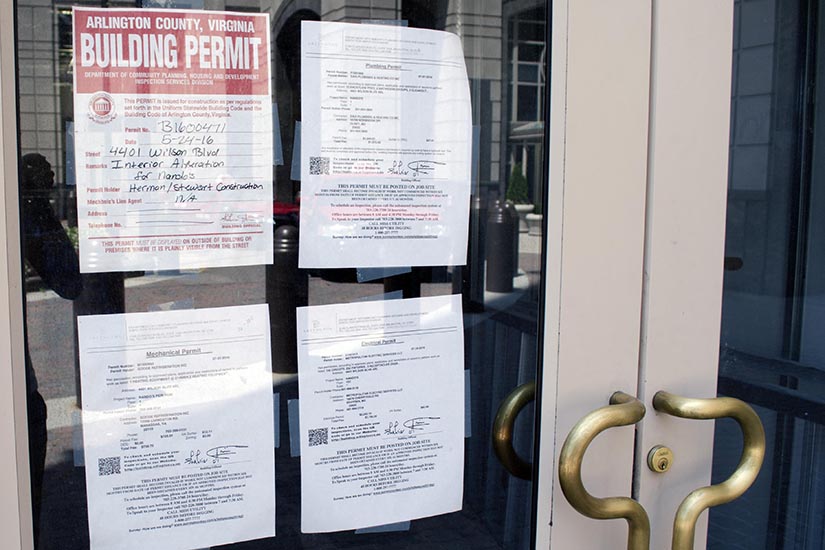
Building Permits at Nando's Peri-Peri in BallstonAs we’ve been reporting, this has been an active summer for local restaurants.

A number of prominent Arlington eateries have closed or are closing, while some highly-anticipated restaurants are nearing an opening.

Here are some of the restaurants expected to open later this year:

Of those, which are you most looking forward to?


The Right Note is a weekly opinion column. The views and opinions expressed in the column are those of the author and do not necessarily reflect the views of ARLnow.com.

Mark Kelly

This week, Arlington announced its economic development successes for the past fiscal year. The tally: 53 “deals,” 2 million square feet of office space and 4,200 jobs that were “created or retained.” County Manager Schwartz says it’s his top priority.

The release does not indicate how many were created and how many were retained, something that would be good to know in measuring success. Just as when President Obama tried to count jobs he “created or saved,” we should be very leery of an announcement that contains such a qualifier. Maybe the county will provide a breakdown of created versus retained. But it is hard to argue the success of economic development if we are not adding to the job base.

Also, in evaluating jobs that were retained, it would be good to know an answer to the question of why were they going to leave? Were they just making a threat to get a better deal?

Moreover, if we are making special deals to make businesses stay, what about all the businesses who are staying here without getting a government deal? Where is their “piece of the action?”

At any level of government, there is a very real danger to the taxpayer when a handful of government officials get behind closed doors with a business and make a deal. Even with the best of intentions, there is the very real danger that a business will profit and the taxpayers will lose. Look at “deals” like the one Solyndra received from the federal government and what Governor McAuliffe’s GreenTech Automotive did to Mississippi (after they couldn’t get a good enough deal from Virginia).

This leads to the question of why do you have to make deals to lure employers to our community at all?

Sure, some would argue that every state and community serious about landing big employers are offering special deals. But as my dad used to say, just because everyone else is doing it, doesn’t make it right.

Why not make our policies so friendly to job creators that they want to come here? If our tax policies, zoning, permitting are reformed, and if we improve their experiences in even little things like submitting online applications and payments, then we can attract and retain businesses without cutting deals.

Creating a more business-friendly environment both attracts new business we want to locate here, but also benefits the ones who have been providing jobs in our community for years. That should be the goal.


Emma Violand-SanchezProgressive Voice is a weekly opinion column. The views and opinions expressed in the column are those of the individual authors and do not necessarily reflect the views of their organizations or ARLnow.com.

By: Emma Violand-Sanchez

The following is an adaptation of an end of school year address:

Good morning! Buenos Dias! It has been a privilege to serve as School Board Chair for the 2015-16 school year. I am proud of our world-class school system and our top priorities of student achievement and meeting the needs of the whole child.

I am also proud of APS’ recent accomplishments. All 31 schools are accredited by the Virginia Department of Education. The 2015 Washington Post Challenge Index listed all APS high schools in the top 3 percent in the U.S. This is the seventh year in a row all APS high schools made this list. In 2014 and 2015, almost 92 percent of all student graduated on time. The dropout rate has declined by two-thirds since 2010. These statistics show that our students are thriving and taking advantage of multiple options provided to help them succeed academically.

This year the School Board supported our students with initiatives such as the Arlington Tiered System of Support and enhanced opportunities for our students to succeed in a global economy.

We have set a goal to have our students be proficient in more than one language. Bilingualism is a social, economic and educational asset.

In that regard, we reached our objective to offer foreign language at all elementary schools. New language courses have been added at the middle school level. The number of students enrolled in world language courses – including sign language — is steadily increasing. This year, over 550 students received the Board of Education Seal of Biliteracy certifying that they graduated high school proficient in one or more world languages.

To help Arlington students prepare for a successful future in the 21st century — including the importance of technology and innovation — our schools have partnered with universities as well as non-profit organizations such as The Dream Project. Dual enrollment between our high schools and Northern Virginia Community College has increased by 20 %. Over 50% of the students in Grades 2-12 have received computer or IPad devices to enhance personalized learning.

The opening of Arlington Tech provides additional progressive educational opportunities for our students. This program will provide our students with integrated hands-on, project based learning, ultimately preparing our students for different paths toward success after high school.

As a school system, we wholeheartedly believe in supporting the whole child. Our Whole Child Working Group developed a framework to ensure that each child is healthy, safe, supported, academically engaged and challenged.

The local historic designation of Stratford School is another proud accomplishment. It was an honor for me to help celebrate the courage of those who helped APS play the historic role of being the first school system in Virginia to integrate its schools on February 2, 1959.

Without a doubt, the struggle and bravery shown by the young African-American students attending Stratford that day and the ongoing efforts of Black and White supporters of school desegregation laid the foundation for greater educational opportunities for all students, not only in Arlington but across our nation.

With all of the accomplishments of our schools, the Board recognizes the challenges presented by our growing enrollment — especially at the high school level.  This year we worked hard on an adopted budget that continues a commitment to excellence. We designated funds to invest in instructional support, infrastructure, and staff and benefit compensation.

Another important way to address the challenges was our approval in June of the FY 2017-26 Capital Improvement Plan. The plan focuses on providing seats for students in the areas of most critical need in light of the continued, sustained growth in student enrollment. Our commitment to investment in APS facilities this year included opening Discovery Elementary School and investing in maintenance of APS facilities to provide optimal learning environments.

I am thankful to staff  and citizens who are always willing to step in and help us with our work, such as the South Arlington Working Group, Arlington Facilities Planning Council, and Building Level Planning Committees for projects at Stratford, Wilson, Abingdon, McKinley, and the new elementary school in South Arlington.

It has been an honor to serve our community on the School Board and our community. Thank you for your support. Arlington’s school system is a reflection of our commitment to success in our culturally, linguistically, and racially inclusive school community.

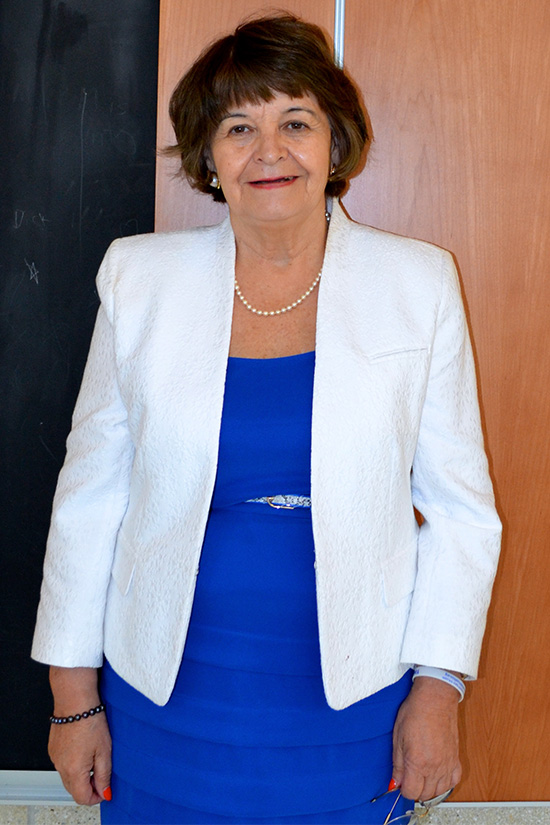
Emma Violand-Sanchez will complete her service on the Arlington County School Board in December after serving as Chair during the 2015-16 school year. Emma joined the Board in January 2009 and previously served as Chair during the 2012-13 school year. She is a career educator and has lived in Arlington since 1978.


peter_rousselot_2014-12-27_for_facebookPeter’s Take is a weekly opinion column. The views and opinions expressed in this column are those of the author and do not necessarily reflect the views of ARLnow.com.

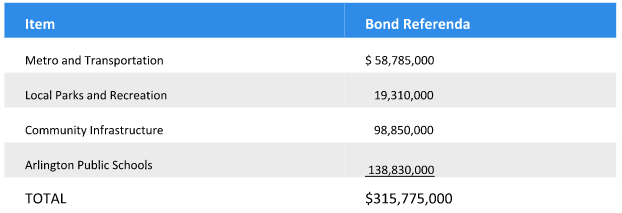
Last month, the Arlington County Board unanimously voted to approve the wording of four bond referenda totaling $315.7 million.

These four referenda will be on the November 8, 2016 general election ballot:

Peters Take Aug 4 Table

Taking into account factors such as the large sums of money involved, the number and complexity of the projects in each category, the opportunities for public comment on all of the projects, and the opportunities for comment on this year’s entire 10-year capital improvement plan (CIP) , the County Board arrived at a fair and reasonable determination regarding the degree of specificity of the ballot wording of each of these four categories.

Discussion

Under Virginia state law, any time a local government proposes to use general obligation bond financing to pay for capital projects, such proposals must be submitted to the voters for approval. The law grants the County Board the right to determine the wording and dollar amounts of such bond proposals.

This year’s wording represents a substantial improvement over recent prior practice. For example:

While in 2014 a typical ballot question sought $105.8 million in bonds to “fund the design and construction of various school facility projects including new elementary schools, building additions for additional classroom space and maintenance capital projects,” a question on the ballot this fall for $138.8 million in school construction will spell out five specific schools or projects, with costs attached to each.

This year’s push to provide more ballot detail also is a welcome response by current County Board members to a 2012 County Board decision regarding a Parks bond proposal. In that earlier case, the ballot wording of a $50.5 million Parks bond failed to disclose that 80% of the funds were earmarked for the construction of the original grandiose design of the proposed Aquatics Center at Long Bridge Park. Voters in 2012 easily could have thought they were voting simply to acquire critically necessary new parkland.

Criticism of the vagueness of the wording of the 2012 Parks bond was a major issue properly raised by independent John Vihstadt in his successful 2014 campaign for County Board. The wording of that bond also led to passage of a 2015 resolution by the Arlington County Republican Committee urging that any individual capital project involving general obligation bond spending of more than $25 million be listed separately on the general election ballot–rather than aggregated into a broader generic category.

The Arlington GOP’s resolution raises reasonable issues for continuing community discussion. The resolution poses legitimate questions regarding:

Singling out a large project for a separate vote (how expensive should it be to deserve separate treatment?), and

Bundling proposed capital expenditures into larger generic categories (how many generic categories should be chosen?).

Conclusion

During the period of public comment on the merits of future capital projects involving general obligation bond financing, it could become clear that the dollar amount of any particular project is so large, or the community is so divided on the project’s merits, that the project deserves a separate line item on the ballot. None of this year’s individual projects deserved such separate treatment.


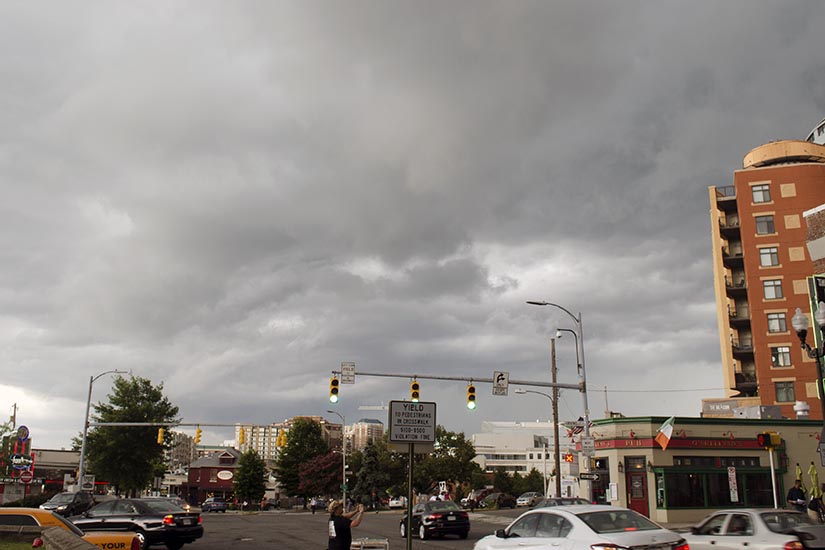
Storm Clouds in Clarendon on July 18, 2016

The weekend is finally here and so is the relief from the heat.

Temperatures will be in the low to high 80s with chances of thunderstorms.

Even if the storms roll through, it won’t put a damper on our ARLBBQ event at the Bartlett in Pentagon City, which our email subscribers were invited to a couple of weeks ago. It’s a free event and we ran out of tickets in 3 hours — apparently people like the idea of enjoying beer and Whole Foods-catered barbecue in a fun indoor/outdoor space with games, TVs, music and a view.

For those attending, good news: you’re getting more free stuff. We’ll have gift bags with Bartlett sunglasses, ARLnow t-shirts and other goodies for you. Supplies, however, will be limited.

Feel free to discuss the weather, your weekend plans or any other topic of local interest in the comments.


The Right Note is a weekly opinion column. The views and opinions expressed in the column are those of the author and do not necessarily reflect the views of ARLnow.com.

Mark Kelly

Last fall, I wrote about the possibility of another Tax Increment Financing District in Arlington. This time for the redevelopment of the Ballston Mall.

This is what I wrote then:

“The argument for TIFs is that the development being paid for by the TIFs will increase revenue to the County above what we would have otherwise received. Therefore, despite setting aside a portion of that revenue to subsidize development, it is still a net benefit to the taxpayer.

However, if a private developer cannot secure financing for a project in one of the most attractive real estate markets in the country, why should taxpayers agree to make up the difference?”

My questions about TIFs then are my questions today. Should Arlingtonians continue subsidizing development with debt? And is it worth setting aside future tax revenue to the detriment of other county needs?

Last week, the County Board took a slightly different approach. For the first time, they are forming a Community Development Authority (CDA). The CDA could receive up to $46 million from bonds. The County is also kicking in another $9 million for transportation needs.

The bonds would still be financed by tax increment financing. This financing sets aside a portion of future tax revenue to finance the bonds. None of those funds will be available for schools or other county-wide obligations.

While a CDA sounds like a separate entity, the board members will be made up solely of County Board members, according to the county press release. If that’s the case, why set up a separate entity at all?

Also in the county press release was this statement, “the bonds issued are not on the County’s balance sheet and thus do not affect the County’s debt capacity or debt rating.”

Who pays if the tax increment funds do not meet the debt service requirements? Best guess is the Arlington taxpayers would still end up on the hook. The honest way to do the accounting is to recognize the bond for what it is, an obligation Arlington must pay.

Whether you call it a CDA or TIF, it is little more than a new way to borrow money.


Elizabeth Jones ValderramaProgressive Voice is a weekly opinion column. The views and opinions expressed in this column are those of the individual author and do not necessarily reflect the views of their organization or ARLnow.com.

By: Elizabeth Jones Valderrama

At a time of increasing partisanship, we see people from across the political spectrum coming together to promote the re-entry of individuals into society after incarceration. Assisting individuals to re-enter society after their release from incarceration in a responsible way reduces recidivism and thereby makes us all safer.

Our organization, Offender Aid and Restoration of Arlington County, Inc. (OAR), was established in 1974 by a group of Arlington women who volunteered in jails and saw a need for ongoing support of individuals incarcerated and being released who remained largely ignored and forgotten by society.

Today, OAR serves Arlington County and the Cities of Alexandria and Falls Church. We serve those currently incarcerated by offering life skills courses and case management in local correctional facilities, as well as offering emergency services, case management, and employment services to individuals recently released. OAR also manages the court-mandated Community Service function for Arlington and Falls Church courts.

We hope to remove needless obstacles to the success of individuals impacted by the criminal justice system.

Did you know, for example, that when individuals return home from incarceration they are unable to get back their driver’s license until they pay all court fines, costs and restitution in full, or establish a payment plan with the court? That means that many individuals in Arlington are trying to put their lives back on track, including finding a job, without having a driver’s license.

Hundreds of the participants coming to OAR owe thousands of dollars in court fees and fines. Every time they have gone to court, they are assessed a fee. It is not unusual for a participant to owe $10,000 or more. With a job, they could approach the Court and create a payment plan. However, getting a job without a driver’s license makes coming home and staying out of trouble that much more difficult.

While inside jail and prison, the unpaid fines and costs accrue at an interest rate of 6% a year, which continues accruing until paid. If a person owes fines and costs to multiple courts (not unusual in Northern Virginia), each Court’s judgment must be satisfied or each Court must agree to the establishment of a payment plan.

In fiscal year 2012, 401,504 suspension orders were issued by the Virginia Department of Motor Vehicles. Of those, approximately 37% (over one-third) were for unpaid fines and costs, which constitutes the single largest cause of license suspensions.

The Supreme Court of Virginia reports that in fiscal year 2012 over $352 million in fines and costs were assessed but that over $164 million were uncollected. This suggests that the use of license suspension as a collection method may in fact adversely affect the ability to collect unpaid fines and costs; as such suspensions may limit a person’s ability to obtain or retain employment and, therefore, the ability to pay.

One OAR participant came out of the Virginia prison system three years ago with every possible certification in horticulture. When no one would hire her in spite of outstanding credentials, she started her own landscaping business.

However, with no driver’s license, she had to take Metro and the bus, with her tools, to get to job sites. She was able to buy a scooter and started looking for a trailer she could pull with the scooter. Finally, the judge agreed to give her a driver’s license limited to use on the job.

Today, while working full-time and continuing her landscaping business part-time, she is not only paying back the fines, she is hiring others with similar backgrounds who are able to pay their fines as well as taxes.

Think of those living in rural areas and even areas in Arlington with limited public transportation. Their chances of securing employment are reduced considerably when they cannot be at work at odd hours or on-call because they have no transportation.

The recent report from the Governor’s Commission on Parole Review recommended a change in the state law to allow individuals to have their driver’s licenses reinstated prior to completing all payments of court fines and court costs. The Commission members understood that there is no need to make it harder for those coming home to find employment, pay their fines, contribute their gifts to the community, and get on with their lives.

We hope that Arlingtonians will feel inspired to encourage the General Assembly to adopt this vitally important change in law.

Elizabeth Jones Valderrama is the Executive Director of Offender Aid and Restoration (OAR), serving Arlington County and the Cities of Alexandria and Falls Church, and has been on the OAR team for over 11 years.  Born in Costa Rica, she relocated to Arlington in 1989. Elizabeth holds a BA in Spanish and Latin American Studies from the University of Virginia and has a Master’s Degree in Organizational Management. She is a 2009 graduate of Leadership Arlington and was honored as one of its 40 under 40 Emerging Leaders inaugural class.


View More Stories