

peter_rousselot_2014-12-27_for_facebookPeter’s Take is a weekly opinion column. The views and opinions expressed in this column are those of the author and do not necessarily reflect the views of ARLnow.com.

The dust-up at last week’s County Board meeting at which the Board voted (4 to 1) to purchase an art truck highlighted the importance of answering more basic questions:

  • Why is Arlington County taking so long to develop a new strategic plan for the arts?
  • What are some of the critical issues such a plan ought to address?

Opinions expressed by opponents and supporters of the art truck were based on diametrically opposed assumptions about Arlington County’s proper role in supporting the arts. Just among supporters, there were fundamental differences about the proper scope of that role. The absence of an up-to-date strategic plan for the arts was painfully evident.

A sampling of comments on the initial ARLnow.com art truck story illustrates the point:

  • “How many musical instruments for our schools could this $70k to $100k get us?”
  • “When will all the speed bumps, gateway speed reducers, and painted-faux-brick crosswalks receive basic maintenance so that these traffic calming objects are functional again?”
  • “The County is spending a small amount of arts money that it already has, albeit in a new and innovative way.”
  • “How about they spend the money on one of the already established arts organizations the county bankrolls, perhaps you can name a few? I know I can.”
  • “This is actually a common, and inexpensive, thing that many local governments have.”
  • “It’s not necessarily a bad idea, but if they let the people who ran Artisphere be in charge of it (and most of them now work for Cultural Affairs), I don’t give it much of a chance of being either good or successful.”

Against this background of conflicting opinions, County Board member John Vihstadt asked County staff to answer the following questions prior to the Board vote on the art truck:

Summarize the “ongoing Cultural Affairs Strategic Planning Process” that informed this proposal and provide a window into the overall status and timing of such process more broadly across Cultural Affairs. Will this process result in a formal report to the County Board and, if so, when? Are there any tentative outcomes that staff is comfortable sharing at this time?

Regrettably, Deputy County Manager Carol Mitten was unable to answer Vihstadt’s questions. Mitten explained that she couldn’t provide any predictions on timing because of “difficulties in getting everyone together,” and warned the Board that “we are going to need guidance from you.”

Arlington’s current arts policy was approved in 1990. Among other reasons, it was the lack of a clear arts policy that doomed the Artisphere.

To avoid more fiascos like the Artisphere and the Signature Theatre bailout, we need a new strategy for public support for the arts.

Conclusion

The County Board, Manager and staff all need to develop a greater sense of urgency regarding adoption of a 21st century arts strategy. There are models and other external resources available to help them. For example, Boulder, San Francisco and Boston have plans that our government should examine. Those plans provide strategies and ideas regarding many of the challenges that an Arlington strategic plan for the arts should address.

It’s time to speed up development of a strategic plan for public support for the arts in Arlington.
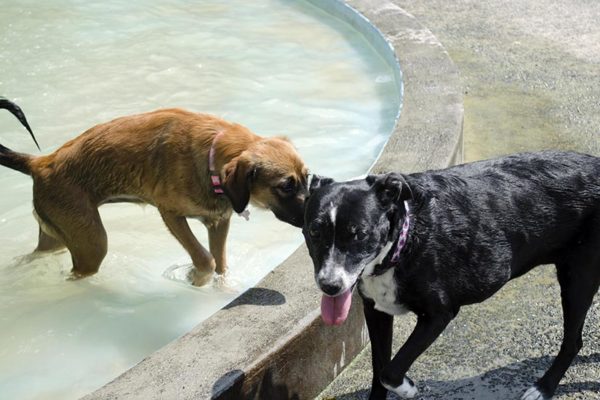


Dogs cool off at the James Hunter Dog Park

The weekend is here and so are the scorching temperatures.

Temperatures could reach the high 90s throughout the weekend, according to the National Weather Service. So make sure to take extra precautions and stay cool and hydrated this weekend.

There will be some outdoor activities this weekend in and around Arlington such as the Crystal Twilighter 5K and a bike ride along George Washington Memorial Parkway. See our event calendar for more listings. Or, if you’d rather stay inside and keep cool, check out some of the open houses happening Saturday and Sunday afternoon.

Feel free to discuss the heat wave or any other topic of local interest in the comments.


The Right Note is a weekly opinion column. The views and opinions expressed in the column are those of the author and do not necessarily reflect the views of ARLnow.com.

Mark Kelly

The Virginia Supreme Court will now make a decision on Governor McAuliffe’s order to restore voting rights to over 200,000 felons who served their time.

Previous governors have agreed with legal advice that the right to restore rights was not a blanket one through the clemency powers. Instead, they were supposed to set up a review of each case.

Both Governors Kaine and McDonnell worked to make that review easier. And McAuliffe’s predecessors were applauded from across the political spectrum for doing so.

McAuliffe has fought to keep the list secret, and multiple mistakes have been uncovered — leading to ever-growing criticism.

The case should ultimately rest on one important question:  Did Governor McAuliffe violate the Virginia Constitution with his order? The Court is expected to decide in time for the general election in November.

But the Solicitor General asked that the case be thrown out because the legislators could not prove they were harmed by the Governor’s order. He said allowing the case to go forward could amount to a situation where “any voter is going to be able to challenge virtually any election law.” And there was a good deal of discussion on this question during the arguments.

The Supreme Court did agree to hear this case in an expedited fashion. That seems to indicate the justices are concerned there could in fact be harm if the General Election is allowed to proceed under the order.

However, high courts often make decisions based on procedural questions like this rather than creating a precedent on the merits. If the Supreme Court rules in favor of McAuliffe, they will almost certainly hang their hat, or robes, on this question.

The harm of the order does appear to be to anyone who is a valid voter in Virginia, including our elected officials. If the Governor’s order resulted in individuals having their voting rights restored in error and those individuals register and vote, it dilutes the votes of everyone else. Your vote and my vote would not have as much strength as they should have in the electoral process because of the actions of the government.

Our default position should be that any time the impact of an election law weakens our voting rights, a voter should be able to challenge it. The Solicitor General should stand ready to defend our election laws. And we can let the courts decide.


Emma Violand-SanchezProgressive Voice is a weekly opinion column. The views and opinions expressed in this column are those of the individual author and do not necessarily reflect the views of their organization or ARLnow.com.

By: Emma Violand-Sanchez

Arlington takes pride in its outstanding public school system whose top priority is student achievement and meeting the needs of the whole child. We support great schools with our tax dollars, our time, and our attention.

Our public schools are first and foremost a place to educate our children. Yet they benefit many other people. Home buyers and sellers pay close attention to school quality. As a result, strong schools enhance property values. Arlington’s economic development officials know that the quality of our schools is a key factor in where businesses choose to locate. School facilities serve as the home of many community programs as well.

There are many factors that contribute to the success of our schools. One of those factors is having sufficient classroom capacity. I am pleased that during my time as School Board Chair we have worked cooperatively with the County Board to address our capacity challenges.

Another key to school success is creating an atmosphere conducive to learning. We have outstanding teachers and principals who make that possible in Arlington. We work hard to recruit and retain top notch educators. Where schools are of high quality, students and parents value stability – there is pleasure in seeing familiar faces as a new school year begins.

As Board Chair, I looked at ways to enhance our ability to attract and retain talented educators. Considering my own personal experiences as a mother who has worked all of my adult life as well as conversations I have had over the course of my career as an educator, I chose paid parental leave as an important initiative. I am pleased that APS now offers two weeks of paid parental leave.

As a school administrator, I saw the stress involved for educators – women and men – who are getting ready to welcome a new child into their home, whether by birth or by adoption. Knowing that they have some paid parental leave once they have a child reduces stress levels and helps maintain focus on the educational mission during the time leading up to childbirth or adoption.

The vast majority of our employees want to return to their school, but the early weeks welcoming a new child are incredibly important ones. Parents want to be sure that their child is healthy. They want to establish an early bond with their child. And it takes some time to develop new routines that accommodate having a new child.

Many of our employees are from two-income families and having time to make adjustments in schedules and finding childcare solutions are very important to facilitating a return to work.

Moreover, studies show that early childhood development is important to the brain development and life success of a child. And we all benefit from maximizing the number of children who develop the tools and character for life success. Through paid parental leave, vacation, and other unpaid leave options, a new parent can maximize their ability to provide a strong start for her or his child.

As a start, we are providing two weeks of paid parental leave. I hope that my successors on the School Board are able to do more. I know, for example, that the District of Columbia schools provide up to eight weeks of paid parental leave. In many other countries, they have made a decision to support longer parental leave to support mothers or fathers who are able to guide their children through the very important early months of development.

We are blessed in Arlington with the quality of our school employees. I am hopeful that our paid parental leave initiative will give them support as they do their work on behalf of our children, an additional reason to continue their service as successful educators, and help them raise their children in ways that increase the prospects of life success.

Emma Violand-Sanchez will complete her service on the Arlington County School Board in December after serving as Chair during the 2015-16 school year. Emma joined the Board in January 2009 and previously served as Chair during the 2012-13 school year. She is a career educator and has lived in Arlington since 1978.


peter_rousselot_2014-12-27_for_facebookPeter’s Take is a weekly opinion column. The views and opinions expressed in this column are those of the author and do not necessarily reflect the views of ARLnow.com.

On July 19, the County Board approved another extension of the Neighborhood Conservation Program (NC Program). But, this program no longer can function effectively.

Arlington’s NC Program had a noble objective:

When the program was created in 1964, the goal was to empower residents by having them come together to discuss and share ideas for improving their neighborhoods.

Though nothing could sound more idyllic or representative of the “Arlington Way,” the way NC actually works in practice undermines its lofty goals. NC has problems in three key areas: equity, timeliness and cost.

Discussion

Equity. NC’s principal inequity — a crippling one — arises because tens of thousands of Arlington residents are being denied timely neighborhood infrastructure improvements since they live in areas lacking a properly functioning civic association. (Belonging to a civic association is an NC requirement.)

Many civic associations have modest memberships, representing just a fraction of the community’s population. Most are operated by a handful of volunteers. Quite a few lack functioning, updated websites, and still fewer are capable of producing anything approaching a newsletter. Newsletters distributed to the highest possible percentage of community members are the surest means of effective communication.

Simply put, too few civic associations are truly functional. Many are run by a few people with little knowledge of or consent from those living within the association’s boundaries. Arlington County cannot mandate that every civic association function properly.

Residents without a fully functioning civic association are barred from tapping the NC Program’s roughly $12 million annual budget.

Timeliness. The NC program’s labor-intensive requirements, which include monthly meeting attendance–often for years–to gain “funding points,” and repeated outreach and notification efforts, mean the complete NC “process” can take anywhere from 5 to 10 years. If an association’s NC rep fails to attend meetings, a project can lose its place in the funding line.

Project engineering, always in short supply, further delays project funding. The current status report for funded NC projects shows only 4 completed projects, with 36 still in process.

Cost. Typically, delays make projects more expensive. Earlier this decade, the cap for NC projects was $250,000. Then, it grew to $500,000. In the most recent funding round, improvements to Nelly Custis Park clocked in at almost $800,000.

NC rules also add to costs. For example, NC street projects must contain curb, gutter and sidewalk components, whether or not a sidewalk is needed or desired. With flexible spending caps, expensive add-ons like lighting are common–even though Dominion will install new lights at no charge.

It’s time to provide a more equitable, timely and cost-effective way to provide critical infrastructure to neighborhoods. Back in 2007-2008, County staff began assembling Neighborhood Infrastructure Plans (NIPs) to identify missing critical infrastructure: curb, gutter and sidewalk, storm drains, etc. County staff has the tools needed to prioritize critical infrastructure projects and rotate among neighborhoods to allow greater and fairer access to funding.

Conclusion

Over the next two years, the County Board should direct staff to phase out the NC Program entirely and re-allocate current NC Program funds.

The Neighborhood Complete Streets Program is one alternative funding recipient. A more flexible Missing Links Program could be another.

The goal should be to fund critical infrastructure equitably, efficiently and in a way far superior to what is possible under the NC Program.


The sun during the heat advisory on Thursday, July 14, 2016

The weekend has arrived and so has the heat and humidity.

Throughout the weekend, temperatures will be in the low 90’s and humidity levels will be in the 60% range. So be sure to find fun ways to cool off.

There will be some outdoor activities this weekend in and around Arlington, such as the Junior/Parent Golf Open in the Falls Church area, for those who can brave the heat. See our event calendar for more listings. Or, if home shopping is your thing, check out some of the open houses happening Sunday afternoon.

Feel free to discuss the heat wave or any other topic of local interest in the comments.


The Right Note is a weekly opinion column. The views and opinions expressed in the column are those of the author and do not necessarily reflect the views of ARLnow.com.

Mark KellyNext Tuesday, the County Board will consider the 2016 Bond Referenda to be placed in front of the voters in November. It is reported that this year will include $320 million in new debt for the county. Nearly $140 million on school projects alone.

As of the writing of this column, the County Manager’s report was unavailable online. In the past, the language of the ballot questions has been vague. And voters often rubber stamp them as necessary spending for “parks,” “schools,” “roads,” and “public safety.”

Once again it seems that the County Manager is rejecting a call by Arlington Republicans that every project with a price tag of $25 million or more to be taken up in a separate bond referenda.

Taking on debt for big ticket items should rise or fall on its own merits. On the flip side of that argument, many of the smaller ticket items pushed into these larger packages should be paid for out of the annual budget process.

Along with the slush fund spending in the annual close out process, the bond process should be subject to closer scrutiny and better accountability. Hopefully we’ll hear comments to that effect from more than one County Board member next week.

In September, the County Board will be asked to approve two new polling locations for Arlington.

For a few of the 13 hours polls are open every four years on the first Tuesday in November when voters choose a president, there are moderate length lines to vote on Election Day. Every other election it seems has virtually no line to speak of at any polling location throughout the county.

With all due respect to the good people of the Electoral Board, the reason for the additional polling locations is not readily apparent.

And in a story that surprises no one, taxi trips are down in Arlington as a result of Uber and Lyft.

I have little need for on-call transportation and was not one of the first to join one of these two services. Calling a taxi was going to be just fine for me and my occasional trip to the airport.

Then came the time a cab was 30 minutes late to pick me up to get to my flight. The next time, I tried to order a cab the night before for an early morning flight and could not due to some glitch in the company’s system.

When I went to pick up the phone for my next trip to the airport, I decided to download the ride sharing software instead. For me, it is infinitely more convenient, particularly when it comes to never having to exchange money at my destination.

If taxi companies want to regain market share, then they need to offer a competitive product people want to use.


Larry RobertsProgressive Voice is a weekly opinion column. The views and opinions expressed in the column are those of the individual authors and do not necessarily reflect the views of their organizations or ARLnow.com.

The tragic deaths last week in Baton Rouge, Falcon Heights, and Dallas, which followed the recent horrific killing of 50 in Orlando, shook the nation.

In Orlando, it was the scale of the killings and the targeting of LGBT community members. In Dallas, it was seeing law enforcement officers targeted for death based on the color of their skin. In Baton Rouge and St. Paul, it was the sight of two more African-American men killed by law enforcement officers for — based on eyewitness and video evidence — no discernible reason.

For a brief time, it appeared that these latest killings would lead to a discussion more fundamental than whether or how gun laws should be changed. There was a sense that we needed to bridge divisions in our society that were taking a dangerous turn.

Columnists, political analysts and other commentators wrote about an inflection point in our recent history – where there was room for unity, acknowledging the complexity of our problems, and a need for more listening, more humility, and less hostility and angry rhetoric.

Close to home, ARLnow was part of that trend, stating that “[t]imes like these remind us of the darker side of humanity — but should inspire us to counter that with kindness and respect for our fellow humans. Here in our little 25.98 square mile Arlington bubble, we hope that that extends to our comment section.”

Our two most recent Presidents sought to convey the message as well. President George W. Bush, at the memorial service in Dallas for the five fallen police officers cautioned that “[t]oo often we judge other groups by their worst examples, while judging ourselves by our best intentions.”

President Obama expanded on this theme: “[W]ith an open heart, we can learn to stand in each other’s shoes and look at the world through each other’s eyes … With an open heart, we can abandon the overheated rhetoric and the oversimplification that reduces whole categories of our fellow Americans not just to opponents, but to enemies.”

Yet even in the midst of these words, in a country in need of healing, the public discourse devolved yet again. Instead of encouraging the hard work that will be needed to resolve problems faced by our communities and our nation, we were presented with division, rancor, finger pointing, and the notion that there are only two sides to every debate, that people must choose which side they are on, that those who would choose the other side are enemies, and that only by defeating those enemies will we restore peace, order, and greatness.

The reality is that we live in complicated times that demand from our citizenry a sober minded reflection on how Americans can come together to address those challenges and move our country forward.

This will take hard work, resources, listening to and respecting one another, and seeking solutions that bind us together and elevate our society and ourselves.

In times past, we may have looked to great leaders for guidance.

Speaking of toleration, George Washington said that “the Government of the United States, which gives to bigotry no sanction, to persecution no assistance, requires only that they who live under its protection should demean themselves as good citizens…”.

Lincoln sought to bring together a nation that had devolved into civil war not by triumphalism, but through humility and understanding: “With malice toward none, with charity for all, with firmness in the right as God gives us to see the right, let us strive on to finish the work we are in, to bind up the nation’s wounds…”.

Roosevelt, at a time when the nation faced economic devastation, asserted his “firm belief that the only thing we have to fear is fear itself … In every dark hour of our national life a leadership of frankness and vigor has met with that understanding and support of the people themselves which is essential to victory.”

Today we live in a time where leadership is viewed with skepticism, where institutions face a lack of trust, and individuals are free to assert their views widely and without filter.

In such a time, it will take asking ourselves how we can take individual actions to restore a sense of unity, purpose and advancement.

Respecting the views of others, watching the tone of our own discourse, countering division and ideologies, and supporting the hard work needed to address our problems, are building blocks needed for recovery and for success.

Larry Roberts has been active in civic and political life in Arlington for nearly 30 years and is an attorney in private practice. He has been active in County civic life. He also chaired two successful statewide campaigns, served as Counselor to the Governor in Richmond, and served as Chief of Staff to the Chairman of the Democratic National Committee.


peter_rousselot_2014-12-27_for_facebookPeter’s Take is a weekly opinion column. The views and opinions expressed in this column are those of the author and do not necessarily reflect the views of ARLnow.com.

Last week, my fellow ARLnow.com columnist, Mark Kelly, posted a column that said that living with aircraft and helicopter noise in Arlington was the price we pay for the economic benefits generated by National Airport (DCA) and the Pentagon. In response, Chris Slatt posted this most up-voted comment:

One can fully support the airport and the Pentagon as necessary and integral parts of Arlington while simultaneously questioning whether reasonable measures are being taken to minimize their impact on quality of life.

Chris is right to question whether reasonable measures are being taken. Many measures are.

How the FAA has contributed to increased noise

The increased noise results both from increased numbers of flights at DCA and changes to flight paths.

Last year was DCA’s sixth straight year of record-high passenger traffic. DCA now serves more passengers than Dulles–an airport 14 times its size.

The changes to flight paths are a result of NextGen – the FAA’s modernization initiative for the U.S. air traffic system designed to maximize efficiency.

Congressman Don Beyer has spearheaded initiatives to address DCA aircraft noise

Congressman Beyer:

  • Is an original co-sponsor of HR 3965, the FAA Community Accountability Act. This bill would require FAA to take into account negative impacts on the human environment near airports when considering flight path changes related to NextGen. Currently, FAA is required primarily to consider only safety and efficiency;
  • Sent a May 5, 2015 letter from the Virginia and DC Congressional delegations to Transportation Committee members stating their opposition to changes to DCA slot and perimeter rules;
  • Encouraged FAA to include the DC region in a multiyear study of the relationship between aircraft noise exposure and its effects on communities around airports.

Congressman Beyer also has spearheaded initiatives to address helicopter noise

Congressman Beyer’s office has received complaints related to military helicopter noise since he joined the Congress. These complaints overwhelmingly have related to frequent overflights from the V-22 Osprey, an 85-foot-wide tiltrotor aircraft.

Beyer successfully added an amendment to the FY 2017 National Defense Authorization Act requiring the DOD to work with the FAA to study noise mitigation solutions to military helicopter noise.  He spearheaded a National Capital Region letter to DOD Secretary Ash Carter and the FAA Administrator offering to facilitate DOD/FAA outreach to communities impacted by military helicopter noise.

Beyer’s initiatives have not attempted to seek an outright ban on military helicopter flights, but he believes it is irresponsible to ignore his constituents and not seek some mitigation solutions. Beyer has not succumbed to the reasoning in Mark Kelly’s column that nothing can be done simply because the “Pentagon was here first.” Instead, Beyer has proceeded on the premise that homeowners in Arlington and elsewhere should not be forced to anticipate the Department of Defense developing and then routinely flying an Osprey over their homes.

Conclusion

Noise mitigation measures may include federal legislative or regulatory actions that actually will lower the aircraft noise levels we are experiencing today. At least with respect to DCA air traffic growth, it is hard to envision how this will be realistically possible unless the DCA air traffic share is lowered and the Dulles share is raised.

Preferably, DOD and FAA will adhere to good neighbor policies that will quiet the skies.


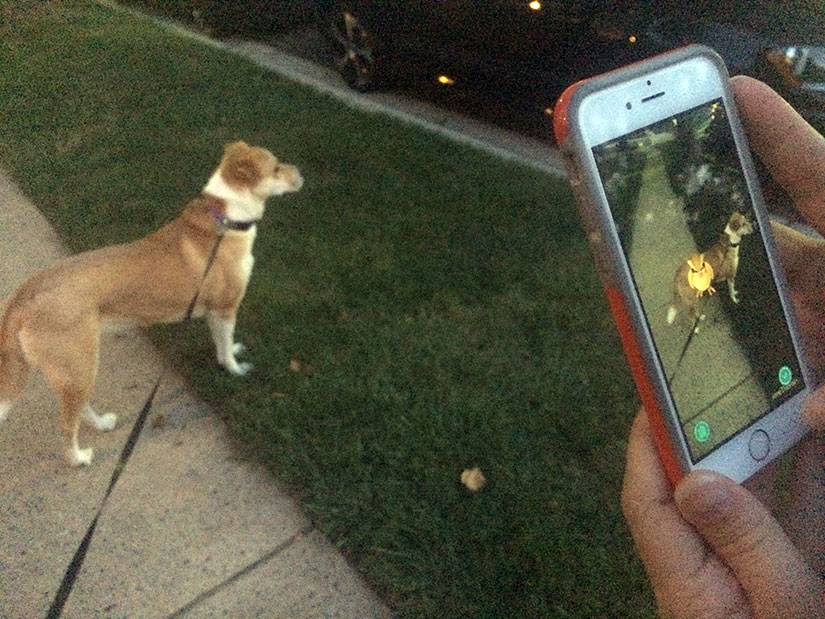
An iPhone user playing Pokemon Go in Fairlington, with a dog oblivious to the nearby virtual PokemonIf you have no idea what the headline of this article means, you’re not alone but you’re part of a rapidly dwindling group.

Late last week and into the weekend, the smartphone-based game Pokemon Go exploded in popularity and has become a pop culture phenomenon. That’s especially remarkable if you consider that the game was only officially released on Wednesday.

Walk around any given Arlington neighborhood last night and you were likely to see people loitering about, glued to their phone — more so than usual, at least. The game takes place on local streets and gathering places across the world, in augmented reality.

Pokemon creatures may appear on the sidewalk in front of you. A park or a community center may be a Pokemon gym (there’s even a Pokemon gym inside the Pentagon). A local business may make a payment in the game to attract Pokemon — and thus attract Pokemon-playing potential customers.

Given the game’s popularity, we were interested in knowing which team local players were joining. Let us know in the poll below.


A man carries kegs away from the now-closed Hard Times Cafe in Clarendon

For a shortened holiday week, there sure has been plenty of bad news. It’s enough to make someone look forward to a relaxing weekend with friends, family and cold beer.

In Arlington, a little girl suffered very serious injuries in a crash that remains under police investigation.

Nationally, the ongoing presidential election circus didn’t inspire much confidence in the next occupant of 1600 Pennsylvania Avenue, although it did at least bring affable actor Tony Goldwyn to Clarendon.

And of course, the series of shootings involving police, culminating of last night’s rampage in Dallas, has broken hearts in Arlington and around the country.

Times like these remind us of the darker side of humanity — but should inspire us to counter that with kindness and respect for our fellow humans. Here in our little 25.98 square mile Arlington bubble, we hope that that extends to our comment section.

The comments have taken a bit of a turn in the wrong as of late, which isn’t exactly surprising given what has been in the news. Nonetheless, we’re taking action to keep discussions productive and out of the gutter.

Those who repeatedly troll with political topics on non-political news articles (think: bringing up immigration on an article just because the subject has a Hispanic last name); repeatedly try to get around moderation when it occurs or harass our staff about it; or have no history of commenting on the site and begin by generally being a jerk — you will be banned. Basically that’s the golden rule: don’t be a jerk. Those who post thoughtful comments, who add to the discussion, who make an effort to be part of the community, who can post opposing opinions without going nuclear — you are welcome here.

We know that there are plenty more of the latter than the former here, thus if you are banned you can save yourself some time and skip sending the angry email explaining how we’re going to regret no longer having you as a reader/commenter/etc.

With that, we hope you have a nice weekend. Feel free to discuss any topic of interest in the comments.


View More Stories