Larry RobertsProgressive Voice is a weekly opinion column. The views and opinions expressed in the column are those of the individual authors and do not necessarily reflect the views of their organizations or ARLnow.com.

By Lawrence Roberts

I was pleased to join fellow ARLnow columnists Mark Kelly and Peter Rousselot on a panel discussion at “ARLnow Presents: Hot Topics on Columbia Pike.” We had a spirited discussion of County issues and I hope you’ll watch the video when it appears on Arlington Independent Media and ARLnow.

While I don’t often agree with ARLnow’s “The Right Note” column, I was pleased that Mark identified Metro as the County’s highest transit priority.

Metro is vital to Arlington’s economy, serving tourists and providing the impetus for a commercial tax base carrying half of Arlington’s real estate tax burden – a substantially higher percentage than other area jurisdictions.

Metro is also vital to Arlington’s mobility – for commuters to and from Arlington as well as people using public transportation to get around the region without driving. Metro (and other transit options) helps Arlington avoid massive traffic gridlock in its urban corridors and along residential streets.

Today’s federal government could not function without Metro and the ripple effect of reduced federal activity without Metro would be highly detrimental to Arlington companies and workers intersecting with the federal sector.

So what are we to make of this week’s National Transportation Safety Board’s report on the L’Enfant Plaza accident in January 2015 that led to NTSB’s heavy criticism of Metro and, in particular its lack of a safety culture?

I believe that Arlington’s first reaction should be to acknowledge that Metro is essential to Arlington’s economy, its desirability as a place to live, its mobility, and the health of a commercial tax base that supports the many public services that Arlingtonians want and expect, including schools, public safety, parks and social services.

For that reason, Arlington government officials and residents should be at the forefront of efforts to support and encourage Metro as it undergoes necessary changes.

Second, Arlington should be working with our federal delegation and regional partners to demand dedicated funding streams for Metro – as most urban transit systems have.

Essentially, the federal government takes the position that it heavily funded Metro’s construction and that its obligations largely stopped there without ensuring an adequate dedicated funding stream for operations and maintenance.

While federal warnings about safety are important, it is easy to lay blame on Metro management and employees without acknowledging that the federal government has not been a reliable partner in solving the chronic and well known problem of deferred maintenance due to lack of funding.

Metro’s importance to the federal workforce and travelers from across the country who come to the Nation’s Capital warrant strong federal financial support.

Third, we should not fall prey to the convenient and simplistic assertion that if only Metro management had been more disciplined about spending there would be no safety problem. Metro management could squeeze every ounce of waste, fraud and abuse out of the system without making a dent in the structural deficiencies in Metro funding.

Fourth, it is important not to jump on the bandwagon of finding fault with Metro at every turn. I had occasion to review the Washington Post’s 2015 stories about Metro. They constituted a steady drumbeat of identifying one problem after another that would lead one to conclude that no one is able to commute effectively or safely by Metro.


(more…)


peter_rousselot_2014-12-27_for_facebookPeter’s Take is a weekly opinion column. The views and opinions expressed in this column are those of the author and do not necessarily reflect the views of ARLnow.com.

On April 27, the U.S. Supreme Court held an oral argument on former Virginia Governor Bob McDonnell’s appeal of his federal criminal corruption conviction. Press reports on the oral argument suggest that the Supreme Court might end up overturning McDonnell’s conviction.

If the Supreme Court does rule in McDonnell’s favor, the average citizen should be justifiably outraged that what McDonnell did isn’t illegal. It reminds me of these lyrics.

Well there oughta be a law against what he’s done
Stole my heart and away he run
Didn’t leave me a thing but misery
And there oughta be a law against the way he’s hurtin’ me

What did Bob McDonnell do?

Bob McDonnell and his wife, Maureen, accepted multiple expensive gifts from Jonnie R. Williams Sr., the boss of a dietary supplement manufacturer known as Star Scientific.

These gifts included several expensive vacations, a Rolex watch, a $20,000 shopping spree, $15,000 in catering expenses for a daughter’s wedding, joy rides in Williams’ Ferrari and tens of thousands of dollars in private loans. McDonnell promoted a Star Scientific product known as Anatabloc, hosted an event at the Governor’s mansion for the product, passed out samples, and encouraged research about the product by Virginia universities. In one case, McDonnell emailed Williams asking about a $50,000 loan, and six minutes later sent another email to his staff asking for an update on Anatabloc scientific research.

Discussion

In 2014, a federal jury convicted McDonnell and his wife on multiple counts of extortion under the Hobbs Act, a federal criminal statute prohibiting political corruption, and of “honest-services” fraud. The jury concluded that there was sufficient evidence of a connection between the actions the Governor took and the gifts and the other favors Williams provided.

The oral argument before the Supreme Court suggested that several Justices were skeptical that the jury should even have been allowed to reach these conclusions. As Dalia Lithwick, a veteran Supreme Court watcher, observed:

It will be an amazing thing if — in a year when voters across the spectrum are infuriated and sickened by the influence of money in politics — the Supreme Court decides that poor Bob McDonnell should be let off the hook because he only did what every politician does every day: Take a lot of money to open doors for a rich guy. But maybe the line between money and influence is too fuzzy and ubiquitous to even be said in words anymore. 

What about Virginia law?

At the time Bob McDonnell did what he did, there is a general legal consensus that no Virginia criminal statute would have prohibited his conduct. Moreover, at that time, there were no limits on the dollar amount of gifts that could be given by a donor to members of the executive branch or their families.

Conclusion

Only the stupidest gift giver or public official is likely to prepare a written record documenting that the donor of a Rolex watch is providing it to a public official in exchange for favorable government action by the public official. That should not be the only circumstance enabling a successful criminal prosecution:

Well there oughta be a law…
And there oughta be a law against the way he’s hurtin’ me.

Peter Rousselot is a former member of the Central Committee of the Democratic Party of Virginia and former chair of the Arlington County Democratic Committee.


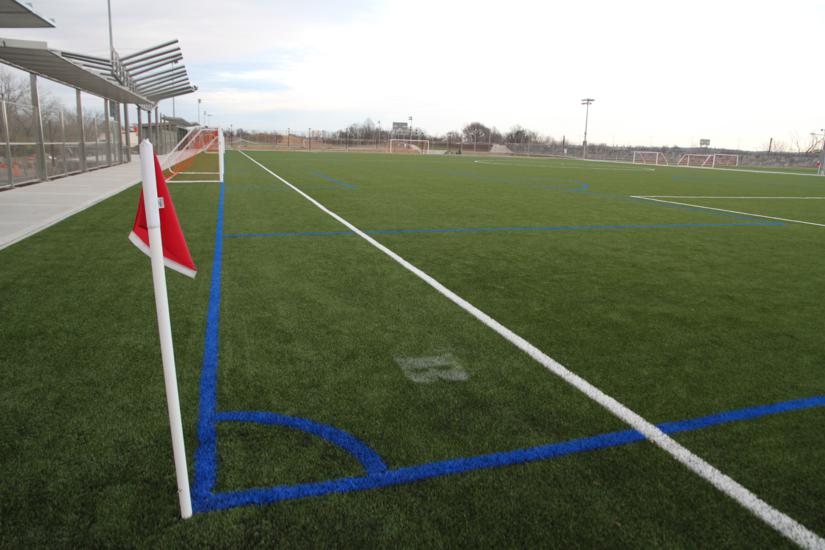
Athletic field at Long Bridge Park

The following op-ed was written by Michael Peterson, a board-certified toxicologist at Gradient, an environmental and risk sciences consulting firm. He serves as scientific adviser to the Recycled Rubber Council

Given some concerns that have been raised over recycled rubber infill in artificial turf fields by your publication (“Time To Re-Examine Artificial Turf Fields,” 4/21/16), I wanted to lend a scientific perspective to the conversation to clear up some misconceptions.

Recycled rubber is the most commonly used infill — the shock absorbing layer — in artificial turf fields, and as the author states, recent reports have suggested it poses significant health risks. The actual science performed on the issue, however, shows that such fears are unfounded.

Based on the lack of citations, it is unclear if the evidence the author points to has been peer-reviewed by other scientists, a critical component in establishing scientific credibility.  The linked Change.org petition generally only cites news reports, and not reputable scientific journals or regulatory reports.  On the other hand, there have been more than 90 peer-reviewed studies, reports, and evaluations from academics, state health departments, and third-parties that have concluded that the best available evidence support that chemical exposures associated with recycled rubber are below levels associated with health effects.

So while it is certainly true the EPA (and two other federal agencies) are doing a comprehensive study of recycled rubber, many local and state governments have already weighed in, and among them, the Connecticut Department of Public Health in 2015 found “no scientific support for a finding of elevated cancer risk from inhalation or ingestion of chemicals derived from recycled tires used on artificial turf fields.” In short, the author’s suggestion that the federal government will conclude otherwise lacks any scientific basis — in particular since EPA’s preliminary study in 2008 did not find that chemical exposures were of concern.

Children’s safety should be placed above all else, but when making decisions about Arlington County’s fields, unsubstantiated fears shouldn’t undermine science. The best available science indicates recycled rubber does not pose health concerns.

ARLnow.com occasionally publishes thoughtful letters to the editor about issues of local interest. To submit a letter to the editor, please email it to [email protected]. Letters may be edited for content and brevity.


Rainy February commute (Flickr pool photo by Kevin Wolf)

There is a good chance of rain or storms each day of this week, through Friday.

Normally May is one of the more pleasantly sunny and warm months of the year in the D.C. area. Except for a brief period of warmth today, high temperatures this week will struggle to break out of the 60s.

How do you plan to cope with the cool, rainy, overcast weather this week?

Flickr pool photo by Kevin Wolf


Washington Capitals logoIt’s looking like a pretty dreary weekend, weather wise. The good news: it won’t be a total washout, and there’s a lot to do this weekend, both indoors and outdoors.

And that’s not to mention the Washington Capitals playoff game Saturday night or, for a certain set, the excitement around the White House Correspondent’s Dinner.

Feel free to discuss the Caps or any other local issues of interest in the comments.


Mark KellyThe Right Note is a weekly opinion column. The views and opinions expressed in the column are those of the author and do not necessarily reflect the views of ARLnow.com.

All five members of the Arlington County Board were on hand last night for the ARLnow event at the Celtic House on Columbia Pike. It was a pleasure to share the forum with fellow columnists Peter Rousselot and Larry Roberts to discuss issues facing the county.

If you missed it, here are a few of the points I made to the questions our panel received:

  • The decision to stop the streetcar project is still a good one. It would have done nothing to improve traffic on the Pike at a massive cost to the taxpayers.
  • Using the influence of our seat on the WMATA Board to fundamentally reform Metro should be our highest transit priority.
  • Parents and teachers need to stop buying into the notion that increasing class sizes by just 1-2 pupils will somehow destroy their children’s education. It is a step that may be required to get through the short-term as we address the capacity crunch in the county.
  • Without dramatic increases in taxpayer subsidies or dramatic increases in density, the county will always be fighting a losing battle to make housing more affordable. Arlington has a limited amount of prime real estate available, and the laws of supply and demand will continue to prevail.
  • Few people, especially those with children, are going to walk to a new Long Bridge aquatics center. Supporters should eliminate it from their talking points in support of the project.

I did miss an opportunity during the aquatics center discussion to make a pitch for reforming the way bonds voted on in Arlington. Big projects like the aquatics center should be voted on as stand alone questions, not tucked into other bond projects.

As you might imagine, because of the time constraints, we did not get to all of the possible topics suggested to us by the staff at ARLnow.

What should the County Board have done on taxes? After the average out-of-pocket costs for taxpayers has increased $1,113 the past five years, the County Board should have taken a more aggressive approach to reducing the tax rate than just a half-cent reduction. The excess revenue spent every year during the closeout process proves there is room to provide tax relief without cutting any fat, let alone muscle in the budget. A two cent reduction in the rate this year would have simply reduced the funds available at closeout time this year by about $10.5 million over what the Board approved.

Does Arlington have a crime problem? No. But public safety is one of the big three in terms of core services along with education and infrastructure (includes transportation). It should always be treated as one of our highest priorities and given the resources law enforcement needs.

How should Arlington plan to handle infrastructure needs for an increased population over the long term? From potholes to sewer lines, investing in ongoing maintenance of and improvements to our existing infrastructure should always trump new “shiny object” projects.


Eric HaroldProgressive Voice is a weekly opinion column. The views and opinions expressed in the column are those of the individual authors and do not necessarily reflect the views of their organizations or ARLnow.com.

By Eric Harold

It’s ironic that ARLnow’s April 22 article said “Gutshall attempted to re-litigate the streetcar…” at the first County Board candidate debate held on April 20.

Nothing could be further from the truth. Along the Pike and in Crystal City we know that “streetcar” is no longer on our menu of transit choices. We understand that neither Erik Gutshall nor Libby Garvey is in favor of bringing the streetcar back, and both further agree that Arlington needs to move forward with alternative plans to address Columbia Pike.

The real difference between the candidates is that only one has, for well over a year, been in a position to act yet hasn’t.

Residents of Columbia Pike and Crystal City waited in vain throughout 2015 to hear more specifics from longtime BRT proponents Libby Garvey and John Vihstadt. While we attended meetings and filled out on-line surveys, these leaders offered no new ideas for us to consider – even though they had assured us that easily implemented alternatives were readily available.

Arlingtonians for Sensible Transit (AST) folded its tent, too, leaving us to wonder about its true purpose. AST’s Peter Rousselot, a very vocal opponent of the streetcar, has been thunderingly silent in advocating for any transit alternative. In fact, everyone involved with the “BRT movement of 2013-2014” disappeared completely from publicly advocating for improved transit services that met our well-articulated vision and needs.

The staff-led Transit Development Plan (TDP) process somehow became a reason NOT to provide active leadership for the Pike and Crystal City.

We thought that perhaps we would see the Board’s BRT proponents’ commitment to us in the recently adopted FY17 budget. After all, the draft TDP identified improvements in connectivity between the Pike and Ballston as well as enhancements in the Crystal City area as funding priorities in FY17. In fact, only one new route was funded in the FY17 budget — the ART 55 — a northside bus replacing a Metro bus route.

Unfortunately, our elected BRT leaders’ silence continues. The draft TDP contains nothing new or creative here for 22202 and 22204 to rely on. The TDP says our mode is “BUS and only BUS” and as proposed will do a great job of moving people OUT of Arlington but very little to help people move AROUND Arlington, and especially on the Pike.

Yes, some service is more frequent; and some commuters will get service during rush hour with fewer stops; but for those of us who were hoping to ditch our cars to do most of our regular errands off-peak there isn’t enough here to make leaving our cars behind practical.

Arlington’s success has been built in large part on long-term vision and strategic public investment in solutions that provide mobility beyond the car for those of us who live here — especially in our densest neighborhoods. Making sure this continues to happen on the Pike and in Crystal City is critical to Arlington’s long-term success. We can’t do baby steps or we will strangle our economic recovery.

The streetcar — vilified as it was by some — was a transformational option developed over ten years with significant public input. We’ve removed it, but the problem still remains. Now, we need even more ongoing focused creativity to ensure that the Pike achieves its adopted vision and Crystal City becomes a great place to live as well as work.

In her New Year’s Day remarks, Ms. Garvey stated that “…we have all been frustrated at how long it seems to be taking to design a substitute [for the streetcar].” That is an understatement for residents of the Pike and Crystal City.

We are still waiting for leadership from the County Board — most particularly from Ms. Garvey, who worked so hard to kill the streetcar and advocated so loudly for buses. It is clearly easier to “just say no” and to criticize than to constructively develop and implement positive solutions.

Eric Harold has lived in the Barcroft neighborhood of Arlington since 1998. He has served twice as president of the Barcroft School & Civic League (the Barcroft civic association) and for twelve years until 2013 on the County’s Environment and Energy Conservation Commission (E2C2). He currently serves on the APS Advisory Commission on Facilities and Capital Construction (FAC).


peter_rousselot_2014-12-27_for_facebookPeter’s Take is a weekly opinion column. The views and opinions expressed in this column are those of the author and do not necessarily reflect the views of ARLnow.com.

On Friday, April 22, Virginia Governor Terry McAuliffe issued an executive order restoring the voting rights of approximately 200,000 Virginia ex-felons. Governor McAuliffe made the right decision.

Background

“Virginia is part of a national trend toward restoring voter rights to felons … Over the last two decades about 20 states have acted to ease their restrictions, according to the Brennan Center for Justice at New York University,” reports the New York Times.

According to Myrna Pérez, director of the Voting Rights and Election Project at the Brennan Center, “what this will do is move Virginia, which was among the worst of the worst in terms of disenfranchising people, to a much more middle-of-the-road policy.”

Discussion: Why enfranchising ex-felons is the right thing to do

Conservative columnist David Brooks has been among the most eloquent voices supporting the restoration of voting rights for ex-felons. In a 2010 column, Brooks summarized the case in favor of their enfranchisement:

There is no good reason to deny former prisoners the vote. Once they are back in the community — paying taxes, working, raising families — they have the same concerns as other voters, and they should have the same say in who represents them. Disenfranchisement laws also work against efforts to help released prisoners turn their lives around. Denying the vote to ex-offenders, who have paid their debt, continues to brand them as criminals, setting them apart from the society they should be rejoining.

Last Friday, Brooks re-affirmed his position when asked specifically about Governor McAuliffe’s action in Virginia: “One of the weird things in our whole criminal justice system is, we have got people who are 50, and 60, well past what they call criminal menopause, and they’re perfectly upstanding citizens, and they’re not the person they were at 19, and yet we continue to punish them.”

The historical context in which Virginia disenfranchised ex-felons

Virginia’s record as one of the “worst of the worst” in disenfranchising ex-felons is inextricably tied to its Confederate past. Virginia ex-felons are disproportionately black. As a 2015 article from the Weldon Cooper Center at the University of Virginia documents, Virginia’s record is long, sordid, and explicitly racist. In advising Governor McAuliffe about his April 22 executive order, researchers turned up a 1906 report:

that quoted Carter Glass, a Virginia state senator, as saying [disenfranchisement] would “eliminate the darkey as a political factor in this State in less than five years, so that in no single county of the Commonwealth will there be the least concern felt for the complete supremacy of the white race in the affairs of government.”

Legal Issues

A.E. Dick Howard, the legal scholar who is credited as the principal author of Virginia’s current constitution, advised Governor McAuliffe that he had the legal authority to act unilaterally via executive order. Action by the Virginia legislature was unnecessary. Other lawyers disagree, claiming that Governor McAuliffe’s executive order violates the Virginia constitution. Lawsuits and efforts at legislative repeal or amending Virginia’s constitution might happen.

Conclusion

For the last 150 years, first Democrats and now Republicans in the Virginia legislature have compiled a dismal record blocking the restoration of ex-felons’ voting rights. Based on Howard’s legal advice, Governor McAuliffe acted appropriately in by-passing the legislature.


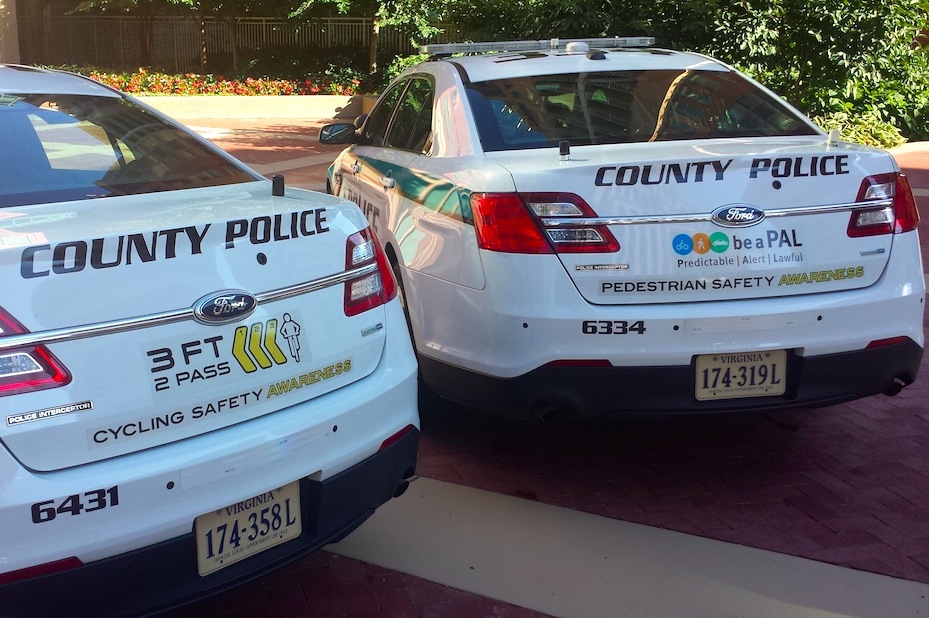
New decals on police cars remind drivers, pedestrians and cyclists to be Predictable, Alert, Lawful, or PAL (photo via Arlington County)

(Updated at 1:40 p.m.) This week, the Arlington County Police Department is holding its annual Spring Pedestrian & Bicycle Safety Awareness campaign.

This morning and for part of the day Thursday, police will be conducting targeted, high-visibility traffic safety enforcement and public education in Clarendon and Crystal City.

https://twitter.com/ArlingtonVaPD/status/724958170754506754

But is that enough to truly improve safety for pedestrians and cyclists in Arlington? In just the past week alone, two young people have been struck and seriously injured — while crossing in marked crosswalks along the pedestrian-heavy Rosslyn-Ballston corridor.

In both instances, nearby residents complained that drivers were chronically ignoring crossing pedestrians, driving too fast and driving while distracted — and that police enforcement is virtually non-existent.

Those two incidents aside, local drivers will tell you that pedestrians in Arlington make a habit of darting out into the road mid-block and crossing against traffic lights, often oblivious to oncoming traffic.

So what should be done about this, to improve safety for all? Should the Arlington County Police Department issue more tickets to drivers and pedestrians in an effort to curb serious accidents and bad behavior on both sides?

(Note: this poll and discussion concerns drivers and pedestrians only. Say what you want about cyclists — and the drivers who sometimes cut them off — but the most pressing issue here is about what to do specifically about pedestrian and vehicle conflicts.)


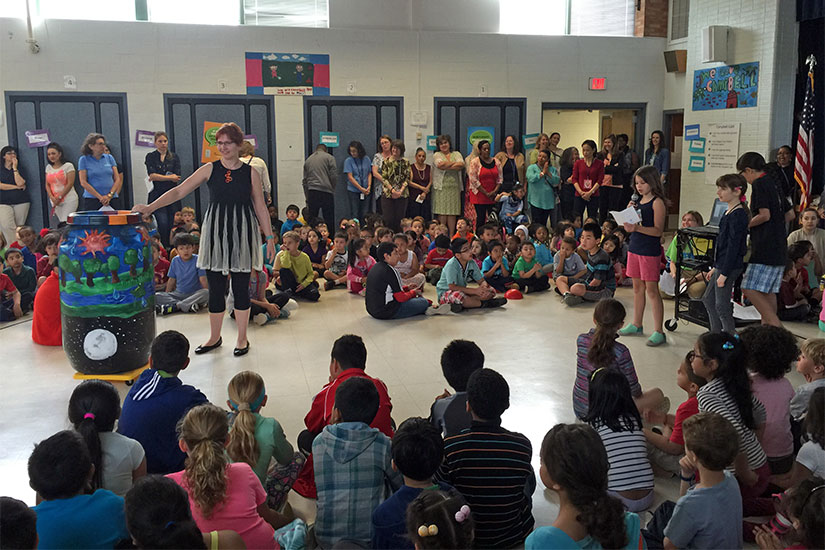
Students learn about a rain barrel at Campbell Elementary School on Earth Day (photo courtesy Virginia Energy Sense)

Today was Earth Day. Here in Arlington, there were a variety of events and announcements in connection with the annual environmental celebration.

Among them was the announcement that the county was launching the nation’s first Energy Lending Library. And, at Campbell Elementary School this morning, students got a demonstration about how a rain barrel works and learned how to be good stewards of the earth, as pictured above.

Speaking of events, next week we’ll be holding our ARLnow Presents: Hot Topics on the Pike event. It’s taking place on Wednesday from 6:30 to 8 p.m. at Celtic House (2500 Columbia Pike). Tickets are only $5 and benefit Doorways for Women and Families.

There will be two panel discussions as part of the event. First, our opinion columnists — Peter Rousselot, Mark Kelly and Larry Roberts — will debate the hottest countywide topics, from blue ribbon panels to aquatics centers. Then, we’ve assembled our own blue ribbon panel to discuss the present and future of Columbia Pike. That panel includes:

Our host for the evening will be Amanda Fischer, a Columbia Pike resident, Arlington Chamber of Commerce board member and owner of Grade A Marketing. We hope to see you there!

With that, feel free to discuss the Earth Day, the Pike or any other topics of local interest in the comments.

Photo courtesy Virginia Energy Sense


The following letter to the editor was submitted by Jef Dolan, an Arlington resident, Marymount University professor and mother of Olympic gold medalist swimmer Tom Dolan

As a long time swimming resident of Arlington, I would like to refute some of the points that Peter made in his March 31 column referring to the proposed aquatics center at Long Bridge Park.

Many early mornings I would have to take my two time Olympic Gold Medalist son Tom to 50 meter pools either in the District, Fairfax or Montgomery County to train or swim in local and regional meets. I resented seeing these facilities getting revenues from food concessions, t-shirts and pool fees.

Why couldn’t Arlington share in this revenue?

The aquatics center at Long Bridge Park gives us this opportunity.

Will Arlington need additional indoor and outdoor recreational facilities in the future?

Existing county recreational facilities are not adequate to meet the full range of current and future community recreational, fitness and aquatics needs of the growing youth, adult and senior populations. A report by the University of Virginia’s Weldon Cooper Center for Public Service Demographic Research Group showed that Arlington County’s population grew by 9.4 percent from the 2010 Census through July 2013 alone. By 2040, Arlington’s overall population is expected to grow by over 65,000 people.

Many of the aquatic classes I try to enroll in as a 55+ citizen in the high school pools through the parks and recreation department are closed due to over enrollment. As much of the Arlington population ages, we seek affordable places to recreate to continue productive lives in the county.

As a mom who has sat in pools all over the country, I have seen the benefits of a multi-purpose training facility.

Existing county recreational facilities are not adequate to meet the full range of current and future community recreational, fitness and aquatics needs of the growing youth, adult and senior populations. We need to have an Oak-Mar Fairfax facility in our community.

Sixty-three percent of our citizens responded favorably to this in a recent survey posted on ARLnow.com.

The money is there. Let’s coalesce as a community to build this facility.

I look forward to seeing many youth teams and swim for safety programs delight in this amenity in Arlington County.

ARLnow.com occasionally publishes thoughtful letters to the editor about issues of local interest. To submit a letter to the editor, please email it to [email protected]. Letters may be edited for content and brevity.


View More Stories