Mark KellyThe Right Note is a weekly opinion column. The views and opinions expressed in the column are those of the author and do not necessarily reflect the views of ARLnow.com.

Thumbs Up to Republican Voters

On Tuesday news broke that some Arlington precincts were running out of pre-printed Republican ballots. Only time will tell if Tuesday’s primary results in Arlington mean Democrat enthusiasm is down and Republican enthusiasm is up, or that Democrats crossed over to vote for the candidate they most wanted to run against their likely nominee — Hillary Clinton. We do know that statewide Virginia Republican Primary results smashed previous records.

Thumbs Up to Revisiting New Day-Care Regulations

County officials acknowledged that new day-care regulations in the works at the Department of Human Services were being met with significant opposition from parents and day-care providers. Beyond basic health and safety regulations, it is always a dangerous path to go down to tell parents what their child must do at day-care, particularly since parents are paying the bill.

Thumbs Down to the Advertised Tax Rate

The Arlington County Board’s decision to advertise a flat tax rate is not bad news, but it should not be celebrated either. The County Manager’s budget made it clear that revenues were going to meet budget needs, and he proposed a small rate cut to reflect that reality. Of course, in either scenario, you will be paying more. The average single family home assessment is up 2.8%. Even with a half-cent rate cut proposed by the Manager, that means your taxes will go up 2.3% or $133 annually — $163 with no rate cut. Last year, the average homeowner saw a $270 increase.

Thumbs Up to Hearings Changes

Board Chairman Libby Garvey announced changes to the upcoming budget and tax rate hearings. The tax rate hearing has been sparsely attended in recent years, so moving it to the front end of the two budget hearings makes a lot of sense. Lower tax advocates who do choose to speak will also now have an audience, albeit not necessarily a friendly one, as higher spending advocates will already be filling the room.

Tourism Tax Back

John Vihstadt proved he could have some influence in Richmond with Republican legislators. Unfortunately, it was to get them to approve a tax increase that will be used to fund additional tourism promotion. I’m not sure who the real winner is here as tourism is a given for Arlington due to its close proximity to our nation’s capitol. It does signal there may be an end to an icy era with Richmond created in large part due to a tussle with the Board Member Vihstadt replaced, and that is a good thing to be sure.



Mary RouleauProgressive Voice is a weekly opinion column. The views and opinions expressed in the column are those of the individual authors and do not necessarily reflect the views of their organizations or ARLnow.com.

By Mary Rouleau

We have seen mounting evidence and substantial reporting about the growing income and wealth (net worth) gaps nationally. These gaps have become a key theme in this year’s Presidential election. They have also been picked up more and more in local coverage.

Less reported — and perhaps less understood – are the opportunities for economic mobility in our society and the factors that influence such mobility. Economic mobility measures movement up or down the income ladder throughout a person’s life (intragenerational mobility) or relative to their parents (intergenerational mobility).

Income inequality and the wealth gap have both grown. The opportunities for intragenerational and intergenerational mobility have not improved – which may be one of the reasons for growing income and wealth gaps. While upper incomes grow, people with lower incomes find themselves stuck on the same rung of the economic ladder.

To reverse the income and wealth gaps, we will need to generate opportunities for economic mobility.

What can be done on the local level to create and sustain economic mobility?

It starts with housing, which is the primary portal to education, jobs, and transit — or, in other words, to opportunity.

The Urban Institute conducted a recent review of how housing policy has an impact on economic mobility.

The review noted that “housing policy can play an important role in improving the economic well-being of low income households….” Yet, “housing policy can also impede progress when families do not have access to affordable, safe and stable housing and when economic and racial segregation leave some communities with reduced financial, social and human capital….”

At its core, stable affordable housing enables children to have better cognitive development and improved learning. This success, in turn, reduces parents’ stress, allows families to maintain relationships, and helps build social connections. Through these relationships and connections, it is easier to identify and access resources for training, education and enrichment.

By contrast, when policies trap people in unstable housing, poor schools, few jobs, and a lack of community assets and social institutions we see individuals being unable to ascend the next rung of the economic ladder. This serves to “perpetuate the cycle of poverty for the next generation.”

The type of poverty and opportunity gaps that are generally the focus of study are found in large areas of concentrated poverty in cities and rural areas. Unstable housing, poor schools, few jobs and a lack of assets doesn’t sound like Arlington.

(more…)


peter_rousselot_2014-12-27_for_facebookPeter’s Take is a weekly opinion column. The views and opinions expressed in this column are those of the author and do not necessarily reflect the views of ARLnow.com.

If enacted into law, a bill that now has passed both houses of the Virginia legislature would enable Richmond politicians and bureaucrats to censor APS teachers’ decisions regarding what books to assign in APS classrooms.

Background

Under HB 516, the Virginia state Department of Education would be required to establish a uniform, statewide policy that would require every local public school district in Virginia to:

  1. Notify the parent of any student whose teacher reasonably expects to provide instructional material that includes sexually explicit content. Such notification shall (i) directly identify the specific instructional material and sexually explicit content contained in such material and (ii) set forth the parent’s options pursuant to subdivisions 2 and 3;
  2. Permit the parent of any student to review instructional material that includes sexually explicit content upon request; and
  3. Provide, as an alternative to instructional material and related academic activities that include sexually explicit content, nonexplicit instructional material and related academic activities to any student whose parent so requests.

As a recent Washington Post story explained, this proposed state legislation “all started with Laura Murphy, a Fairfax County woman who said she was horrified to discover that one of her sons, a high school senior, had been assigned to read Toni Morrison’s 1988 Pulitzer Prize-winning novel ‘Beloved.'”

Under HB 516, the state Board of Education would get to define for every local school district what does and does not constitute “sexually explicit content.”

Discussion

An English teacher posted this comment to the recent Washington Post story:

I assure you that if this insane plan becomes law that we English teachers will have to give a heads up about sex, graphic language, and violence for such works … as “The Canterbury Tales,” “Romeo and Juliet,” “Hamlet,” “MacBeth,” “1984,” “Catcher in the Rye,” “Huck Finn,” “Night,” as well as a good percentage of the recommended readings for both AP Literature and Composition and IB courses. … [S]tudents can be given alternative readings and teachers have learned to do this without the students feeling singled out or traumatized! 

Another Post commenter convincingly warned:

This is not about “a parent being able to opt their child out of a reading assignment.” If this bill passes, I guarantee there is already a group ready to complain en-masse, and make a big enough stink that a given book will be rejected by a teacher or school system wanting to avoid the controversy. Thus, they will get to determine what is “appropriate” for everyone’s kids.

About half of Virginia’s local school districts already require teachers to give parents advanced warning of “potentially sensitive or controversial materials in the classroom.” APS itself has adopted guidelines in this area. Under current Virginia law, any other local school district can choose to do so as well.

Conclusion

HB 516 raises serious censorship issues under the First Amendment to the U.S. Constitution. This bill is an ill-conceived and foolish effort by state legislators to set statewide standards regarding a set of issues that should be decided locally by APS and each other local school district in Virginia. Governor McAuliffe should veto this bill.


peter_rousselot_2014-12-27_for_facebookPeter’s Take is a weekly opinion column. The views and opinions expressed in this column are those of the author and do not necessarily reflect the views of ARLnow.com. 

Donald Trump is the clear favorite in Virginia’s March 1 Republican Presidential primary. His candidacy seriously undermines Republican prospects to carry Virginia in the fall.

Background

In a July column, I concluded:

The longer Trump stays in the race, the longer his views are publicized and associated with the Republican brand, the more damage he will do to Republican prospects–particularly in a purple state like Virginia.

Based on the results of the South Carolina primary and the Nevada caucuses, the damage inflicted by Trump’s candidacy on the Virginia Republican brand has grown substantially since July.

What South Carolina and Nevada say about Virginia

Trump won the South Carolina primary decisively, and the anti-Republican-establishment candidates (Trump, Cruz & Carson) won a combined 62% of the South Carolina vote. The Republican- establishment candidates (Rubio, Bush & Kasich) won only 38%.

The Nevada results were even more decisive. The anti-Republican-establishment candidates won 72%, leaving the Republican-establishment candidates with only 28%.

Therefore, the anti-Republican-establishment “lane” in Virginia will be plenty large enough to do lasting damage.

The right profile for a Republican to win a Virginia general election

  • Ideology

Mainstream, conservative establishment Republican Bob McDonnell easily won the 2009 gubernatorial election. Extreme, right-wing Republican Ken Cuccinelli lost the 2013 gubernatorial election. As shown in the table below, two other mainstream Republican conservatives almost won recent statewide elections:


Attorney General     2013 Mark Herring (D)  1,103,777 Mark Obenshain (R)    1,103,612
U.S. Senate               2014 Mark Warner (D) 1,073,667 Ed Gillespie (R)           1,055,940


  • Temperament

Virginia general election voters have a history of supporting candidates whom they perceive as sensible and pragmatic. Large numbers of voters found McDonnell, Obenshain and Gillespie to be sensible and pragmatic. Donald Trump simply does not have the personality profile of recent highly competitive Republican statewide candidates like McDonnell in 2009, Obenshain in 2013 or Gillespie in 2014. Instead, Trump looks a lot more like a recent brash, outspoken, statewide LOSER: Cuccinelli in 2013.

Here’s what Shaun Kenney, the respected former Executive Director of the Republican Party of Virginia, recently declared he would do if Donald Trump is the Republican presidential nominee:

I will work actively against him to ensure his defeat in the general election should he obtain the Republican nomination. In this, I am not alone. Millions of Americans will not pull the lever for Trump. Millions more are absolutely sickened by the jackbooted tactics of a militated few.

This is an uncommonly blunt declaration for a prominent party operative to make about his own party’s likely Presidential nominee. He wouldn’t have made it if it didn’t reflect what he is hearing privately from many other Virginia Republican leaders.

Conclusion

It looks very likely that Donald Trump will be the Republican Presidential nominee. But, even if the Republican establishment finds a way to deny Trump the nomination, Republicans are unlikely to carry Virginia for that alternative nominee. Why? There are already too many angry, energized Virginia Trump and Cruz supporters who either would stay home or force that alternative nominee too far to the right to carry Virginia.

Either way, Republicans in Virginia are trumped.

Peter Rousselot is a former member of the Central Committee of the Democratic Party of Virginia and former chair of the Arlington County Democratic Committee.


 Mark KellyThe Right Note is a weekly opinion column. The views and opinions expressed in the column are those of the author and do not necessarily reflect the views of ARLnow.com.

The Virginia General Assembly is considering a bill to grant police and sheriff’s departments virtually unlimited latitude to refuse to release the names of its officers via Freedom of Information Act requests.

Senate Bill 552 passed the Senate on a 25-15, bi-partisan vote. It would classify all officers names as personnel records, exempting them from mandatory disclosure. By all accounts, it is the most sweeping measure of its kind in the country.

Governor McAuliffe has thus far been silent on the bill. The House of Delegates is holding hearings today.

Supporters claim the bill is necessary to protect our law enforcement officers from the threat of deadly retaliation. Opponents, both on the left and right, warn it goes far beyond safety and essentially would create “secret police” in Virginia.

The bill is being heavily scrutinized as it should be. Any time an agency that exercises the police powers of our government wants to become in any way less transparent and less accountable, it warrants the most intense public scrutiny.

Clearly, the safety of our law enforcement officers is critical. No one would argue, for example, that an undercover officer should have his or her identity revealed while they are in harm’s way.

However, this bill appears to have come about because a news organization was interested in whether officers with disciplinary problems in one department were finding work in departments elsewhere. If so, Virginians are right to be concerned about its origin along with its potential implications.

Our law enforcement officers deserve our respect and deserve to do their dangerous jobs in the safest manner possible. At the same time, the public deserves the strongest levels of accountability from those who can deprive them of their liberty. In fact, the bill’s supporters should be concerned such secrecy could erode public trust with law enforcement.

The bottom line is, there are serious questions about whether this legislation is warranted, and the Members of the General Assembly and the Governor must carefully consider all of its implications.

Mark Kelly is a former Arlington GOP Chairman and two-time Republican candidate for Arlington County Board.


Alan Howze headshotProgressive Voice is a weekly opinion column. The views and opinions expressed in the column are those of the individual authors and do not necessarily reflect the views of their organizations or ARLnow.com.

By: Alan Howze

Last night, the County government and Arlington Public Schools held a joint community forum on how to improve snow removal. No doubt, there was a wide range of suggestions, and with global warming contributing to more frequent mega-snows it is good to see that County leadership recognizes that its approach to snow removal needs to adapt.

How well did the County respond to the blizzard? Let’s look at the numbers:

376      Lane miles maintained by Arlington (excludes VDOT and federal)

4          Days to complete first pass of all Arlington roads

254      # of vehicles – county and contractor – involved in the cleanup

That amounts to 81 feet of roadway cleared per vehicle per hour.

In the spirit of yesterday’s forum, I offer suggestions for how the County and APS can get the community up and running more quickly.

1 – Use data. Many cities and state transportation departments have implemented GPS systems that track vehicles – including snow plows. Real-time information is made available to emergency managers and residents. County government and APS should implement a unified GPS system for their respective fleets – and work with contractors to improve data collection.

Better data, made publicly available, would speed snow removal and lower costs, and the benefits would extend beyond the snow season, providing year-round information to improve county services. The benefits of better data for snow clearing include:

  1. Real-time snow clearing information for residents, emergency managers, and fire / EMS
  1. Information to improve operations – for example, it would allow for analysis of driver behavior, time spent plowing, filling up with salt, refueling, shift switches, towing out other trucks and more
  1. Data upon which to make route adjustments – during the storm cleanup and for future planning
  1. More efficient application of de-icing material with less duplication of street coverage
  1. Faster clearing by allowing plows to be deployed where needed – with less duplication

2 – Set targets. The County uses a four-phase approach to snow removal – but a process is not a goal. What is missing are explicit service level targets. How about 24 hours to clear roads and reopen schools in snows of 8 inches or less – and 48 hours for larger storms? Or a target to clear 120 feet of roadway per vehicle work hour.

With a clear target, County and APS staff can engineer an approach to hit the mark. Clear expectations would also improve accountability by setting benchmarks for measuring performance.

To budget for infrequent but significant snowfall, money could be set aside in a “rainy day” fund that rolls-over from year-to-year. In years without snow the account accrues and then is drawn down when big storms hit.

3 – Integrate County and APS efforts. As with the County, APS should have clear targets for how quickly after storms it will clear its properties, and then work with the County to develop a joint approach to re-open schools quickly.

Arlington students missed an entire week after the storm. A number of APS schools didn’t see a plow until late Tuesday, a full three (sunny) days after the storm had stopped. And on many streets, County crews dumped giant snow piles onto already cleared sidewalks – forcing pedestrians, including children, to walk in the streets to reach bus stops, metro or schools – and further delaying school reopening.

The community facility study conducted last year identified a number of opportunities for County/APS cooperation, and snow removal is another area where joint efforts could benefit the entire community.

There was much that Arlington did well in the storm. The County made a real effort to provide better information to residents – albeit with mixed results. Staff and contractors worked incredibly hard and should be commended for their effort.

By working smarter – using data, setting explicit targets and coordinating County and APS efforts – our community can recover from the next storm faster, with less disruption, and for lower cost.

Alan Howze lives in the Overlee Knolls neighborhood and has been active in Arlington civic life, including a prior bid for County Board. He is the father of three Tuckahoe Elementary Turtles and a management consultant by day.


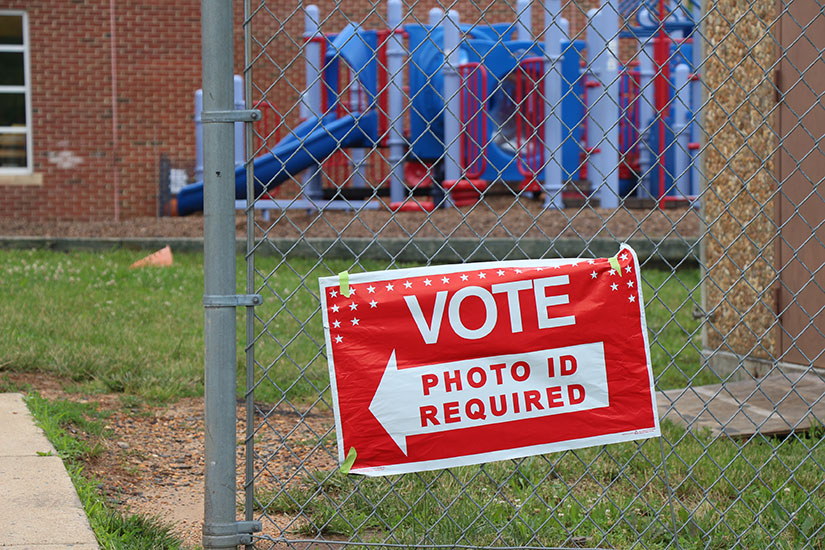
"Photo ID required" voting signIn the eyes of some, Arlington Public Schools students have already had enough days off school this year. Still, there are some murmurs that Arlington should follow the lead of other school systems and give students an off day on March 1 — the Super Tuesday primary election in Virginia.

Fairfax, Prince William and Stafford counties have all decided to close schools on March 1 while voters go to the polls in the contentious presidential primary.

Arlington has no such plans.

“March 1 is still a school day for students,” said APS spokesman Frank Bellavia.

Those who support students getting the day off typically say that the flood of voters could disrupt the normal school day and could pose security concerns. Those who want school to go on as usual say the election could be a backdrop for a hands-on civics lesson.

What do you think?


Alfonso LopezProgressive Voice is a weekly opinion column. The views and opinions expressed in the column are those of the individual authors and do not necessarily reflect the views of their organizations or ARLnow.com.

By: Delegate Alfonso Lopez 

Over the past several years, Democrats have won every Virginia statewide elected office.

In presidential elections, the Commonwealth has become a bellwether state. The competitive nature of Virginia’s statewide political campaigns is, however, largely absent in the Virginia House of Delegates, where, with 66 Republicans and 34 Democratic legislators, political gerrymandering has created a body that is anything but representative of the Commonwealth.

The consequences of a House that is unrepresentative of the Commonwealth as a whole is ideologically-driven legislation that is harmful to Virginia.

Just this week, the House passed HB773 with the Orwellian title – “The Government Nondiscrimination Act.” This bill actually does just the opposite. It allows non-government entities to discriminate against others based upon that entity’s religious beliefs as they relate to same-sex marriage, the transgender community, and even sex outside of marriage.

Under this bill, private companies, universities, and non-profits could refuse to work with individuals based on their sexual orientation or gender identity without any repercussions to state contracts, funding, accreditation, or licensure. Simply put, the state would not be allowed to stop discrimination.

The bill passed on a 56-41 vote.

You read that correctly. In 2016, a sizable House majority still wants to embrace and enshrine discrimination in the Code of Virginia.

It is the will of the House to require the Commonwealth to continue providing contracts, tax exemptions and state funding to support discrimination. Accredited private universities could deny admission or degrees to Virginians based on their sexual orientation.

While Governor McAuliffe has issued an executive order banning workplace discrimination on the basis of sexual orientation and gender identity, he would become powerless to prevent the Commonwealth from supporting entities that discriminate on this basis in Virginia.

This is not the message we should be sending as a Commonwealth. Instead of protecting Virginians from discrimination, their state would be required to support it.

It appears that the real reason supporters pushed this bill through the House is so that social conservatives can send a message to their base during a Presidential election year and prior to the March 1 Super Tuesday primaries.

They think little of how this type of legislation makes Virginia appear unwelcoming and hostile to people and businesses who might be considering relocating here.

If we want to make sure that Virginia is open for business and to create a new Virginia economy less dependent on federal spending, do we really want to fall into the traps that other states have fallen into when they pursued similar legislation?

General Electric, Apple, Salesforce.com, Eli Lilly, Lyft, Twitter, WalMart, and AirBnB are examples of companies that have spoken out against similar bills in other states.

(more…)


peter_rousselot_2014-12-27_for_facebookPeter’s Take is a weekly opinion column. The views and opinions expressed in this column are those of the author and do not necessarily reflect the views of ARLnow.com. 

While most members of the general public are not paying attention, Virginia legislators are trying to restore the old ways of doing business. Senate Bill 692 passed by the Virginia Senate on February 15 would water down even the overly-modest government ethics reforms enacted in 2015.

What Virginia did in 2015

Last year, begrudgingly, Virginia enacted modest government ethics reform legislation. The highlight of the law passed last year was placing a $100 annual limit on gifts to public officials from lobbyists and some others. Last year, current Senate Majority Leader Tommy Norment (R-James City) was quoted as saying that the only reason that the legislation was considered in the first place was because “the media is on our backs.”

Undermining 2015’s reforms

Norment is leading the effort this year to water down last year’s work.

Among the new loopholes incorporated into SB 692:

  • A suggestion by Sen. Richard H. Black (R-Loudoun) that would exempt “food and beverages” from the definition of gifts that must be disclosed and counted toward the $100 annual aggregate gift amount. Black told fellow senators that last year’s legislation had “unintended consequences” that have been “demeaning to us as legislators,” because of “the very notion that if somebody gives me a prime rib as opposed to a hamburger I’m going to change my vote.” Meals accounted for nearly half of the gifts lawmakers disclosed last year, according to the Virginia Public Access Project.
  • A suggestion by Sen. Stephen D. Newman (R-Lynchburg) that would prohibit lobbyists from disclosing the name of any “legislative or executive official, or a member of his family” if any of those people pay their own way to attend an event that is subject to being reported because the event itself is paid for by a lobbyist.
  • The Joint Rules Committee could exempt any 501(c)(3) organization from the gift rules for gifts to any legislator. The same gift to a member of the executive branch or a local official would still be a gift.

Last year, the legislature enacted modest ethics reforms primarily due to relentless prodding from Democratic Governor Terry McAuliffe. Unfortunately, this year, Governor McAuliffe’s own administration is caught up in a controversy over whether certain members of the administration, including Virginia Commerce Secretary Maurice Jones, failed to disclose gifts of Redskins skybox tickets valued at more than $100.

What Virginia should do in 2016

The House of Delegates should reject all of the proposed new loopholes embodied in SB 692. Governor McAuliffe should veto any legislation that embodies any of these loopholes.

In addition, Virginia should create a new, independent Ethics Review Commission with teeth, including subpoena and enforcement power. A large majority of other states, including Massachusetts, South Carolina, and Pennsylvania have permanent ethics commissions. In Massachusetts, for example, its Ethics Commission can impose the following penalties:

  • A civil penalty of up to $10,000 for each violation of the conflict of interest law or the financial disclosure law, and
  • A maximum civil penalty of $25,000 for bribery.

Our legislators should be able to find a model for Virginia that combines effective enforcement power with safeguards against partisan abuse.


View More Stories