
Mark KellyThe Right Note is a weekly opinion column. The views and opinions expressed in the column are those of the author and do not necessarily reflect the views of ARLnow.com.

The Arlington County Board today heard a presentation from County Manager Mark Schwartz on his proposed budget. (As of Wednesday night, when this column was written, the details had not been posted online.) It will be the first look at where the Board may be headed for FY 2017. And if history is any guide, it will not be without at least a few minor controversies.

The County Board’s guidance late last year directed staff to prepare a budget that did not raise tax rates. However, it has been the practice of the Board in the past to advertise a tax rate increase even with such guidance.

Some have argued that ongoing concern about the taxes we pay is overblown or somehow anti-government. But longtime homeowners here in Arlington know that our out-of-pocket property taxes over time have increased at a rate much faster than the rate of inflation.

Many ask, as they should, are they getting a good return on their tax dollar? Are potholes being adequately prioritized over gondolas? Is public safety adequately addressed before theater bailouts? And, what exactly is the plan to meet school enrollment increases?

Some may argue it prudent to advertise a higher rate and give the Board options in case revenue estimates fall dramatically over the next two months. The Board will almost certainly call it giving themselves “flexibility.” Flexibility usually means a reason to ignore their guidance and spend more later.

Here are three reasons the Board should advertise a flat tax rate for fiscal year 2017 and entertain the possibility of a rate cut:

1. The Board just added a new audit function as a nod to fiscal responsibility. Why not give the new office a year to make recommendations on changes the Board can make before even entertaining a rate increase?

2. The average homeowner’s taxes are going up even with a flat rate simply because of increased assessments.

3. If the last decade plus of history is any indication, revenues will comfortably exceed estimates – again. The “worst” thing that will happen is the Board will have a few million less on hand to spend at the end of the year in the closeout process.

Kate RocheThe following op-ed was written by Kate Roche, President and CEO of the Arlington Chamber of Commerce.

In 2014, Arlington had 6 million visitors who spent nearly $3 billion in the County, making Arlington the number one county for economic impact of tourism in Virginia.

This is a substantial boost to our local economy. In just tax dollars alone, tourism revenue generates approximately $81 million in County taxes and $108 million in state taxes per year. Without these revenues, each Arlington household would pay an average of $1,800 each year in taxes to receive the same services.

Tourism also accounts for about 25,000 jobs in Arlington. As the President & CEO of the Chamber, I’ve had the pleasure of working with many in our hospitality industry who work hard every day and reflect positively on our community to those who visit.

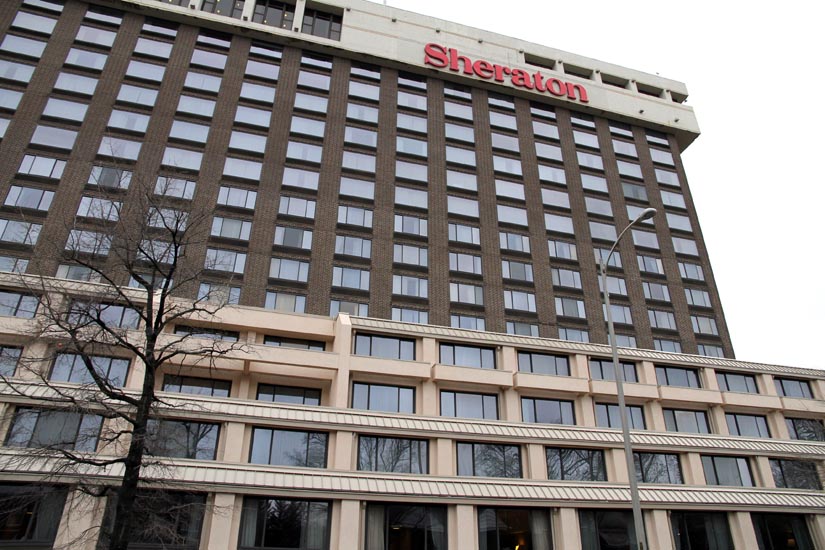
Sheraton National Hotel in Foxcroft HeightsEvery year the Chamber hosts our Hospitality Awards which recognizes individuals in the industry who go above and beyond. These awards are not for managers or properties, but for the front-line individuals who make a difference – whether it’s the concierge who takes off his own tie and irons it for a guest who spilled mustard on his, or the parking attendant who rescues a guest during a blizzard. These are the people who make Arlington’s first impression on visitors and keep them coming back to our great county.

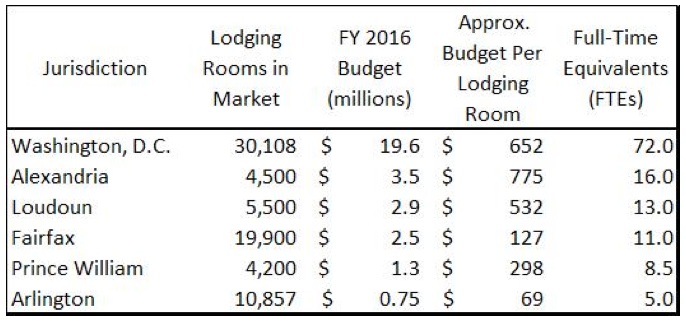
While our hospitality industry is thriving, its potential to grow has been significantly limited by budget constraints. As the chart below shows, the Arlington Convention and Visitors Service’s budget pales in comparison to our neighboring jurisdictions’ tourism budgets. While the ACVS staff is effective with the resources available, they are severely financially constrained.

More than twenty years ago, the Chamber successfully lobbied the General Assembly for an additional 0.25% Transient Occupancy Tax (TOT) surcharge on hotel rooms in Arlington with all revenues to fund tourism. The Chamber has an active Hotel General Managers Committee who were, and continue to be, fully supportive of this. Even with this tax, our hotel room tax rates are extremely competitive, particularly compared to DC. This is a surcharge that pays for itself in additional revenue generated.

Regional tourism statistics

The TOT surcharge had a three year sunset clause and was renewed consecutively until 2011 when it lapsed. That lapse had nothing to do with tourism, but with the political climate in Virginia and some legislators’ view of Arlington.

The Chamber is working hard to make sure that politics don’t get in the way of what is not only good for Arlington County, but also good for Northern Virginia and the entire Commonwealth. Reinstating the additional TOT has been the Chamber’s top legislative priority this session. We have worked closely with the entire Arlington delegation to the General Assembly on this issue, with Senator Janet Howell introducing SB160 and Delegate Patrick Hope introducing HB 1147. I, along with our Chair Todd Yeatts and a number of Chamber members, have gone down to Richmond several times for these hearings. At this time SB160 has passed the Senate and HB 1147 passed the House of Delegates just last week.

The Arlington Chamber is hopeful this legislation will be signed into law by Governor McAuliffe and is incredibly optimistic about the impact these additional tourism funds will have not only on Arlington business, but the larger community.


Valentine's Day heart candy by Chris Rief

A three-day weekend is here. And it’s going to be freezing cold all weekend. Sounds like a great opportunity to stay inside and watch some Netflix with your valentine, your roommates or anyone else who happens to be nearby.

Alternatively, if you want to head out and brave the cold, there’s an abundance of Valentine’s Day events and even an anti-Valentine’s-Day event to choose from in town. See our Arlington Agenda post and our full event calendar for event listings and details.

Barring breaking news we’ll be off on Monday, so feel free to use this post to discuss any issue of local interest.

Flickr pool photo by Chris Rief


Mark KellyThe Right Note is a weekly opinion column. The views and opinions expressed in the column are those of the author and do not necessarily reflect the views of ARLnow.com.

Thumbs up to new County Manager Mark Schwartz for seeking out public input at a forum February 24th on how to better respond to and recover from major snow events. I know one burning question for many parents is, should it really have taken an entire week after a major snow event to return to school?

Let’s face it though, we do not have major snow events inside the beltway on a regular basis.

There is no need for the county to spend millions on heavy snow removal equipment like they may have in many places to our north. However, improvements to the contingency planning for such events may be in order.

County officials and the Virginia Department of Transportation should focus on how can we avoid the rush hour disasters of 2-4 inches of snow that fall just as millions in the area are heading home from work. Regional officials, most certainly looking ahead to “Snowzilla,” essentially ignored the snow forecast two days before the blizzard which resulted in hours of gridlock.

It is not the first time a smaller snow event timed with the commute home wrecked havoc on the region. It certainly seems like a more pressing problem than figuring out how to move 20-30″ of snow off county streets once every few years.

For both the major and more minor snow events, hopefully the forum is worthwhile in fostering practical solutions for the future.

A big thumbs up to all the police officers, firefighters, health care professionals, and County emergency personnel that worked during the storm. As we hunker down in our homes, we can forget about the people who are working to make sure we are as safe as possible.

Thumbs up to good neighbors. I don’t know about your street in Arlington, but I find a storm often brings out the best in a neighborhood. Neighbors spend time helping neighbors. Children of all ages play together. Long conversations replace quick hellos. Not to wish blizzard conditions on the county all the time, but it’s not so bad every once in awhile.


peter_rousselot_2014-12-27_for_facebookPeter’s Take is a weekly opinion column. The views and opinions expressed in this column are those of the author and do not necessarily reflect the views of ARLnow.com.

Over the next few months, APS will develop a new version of its 10-year Capital Improvement Plan (CIP). The CIP identifies capital improvement projects, estimates their cost, and proposes how to finance them. The School Board will adopt this CIP as student enrollment continues to grow at all levels of instruction. If the latest projections are right, APS enrollment will reach levels last seen in the mid-1960’s.

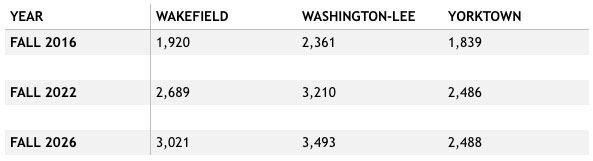
The table below displays the latest projections for Arlington’s current three comprehensive high schools:

School chart

These data–which exclude high school students who will attend HB Woodlawn and other alternative programs–present a strong case for beginning to plan now for a fourth comprehensive high school to open by 2022.

Arlington should cap enrollment at somewhere between 2,000 to 2,500 at each of its comprehensive high schools

There is an extensive body of educational research concluding that ideal high school enrollment is in a range from 600 to 900 students. That ideal goal obviously is not practical for comprehensive high schools in Arlington. However, that same body of educational research also concludes that there is a significant adverse impact on learning in those high schools that enroll more than 2,100 students.

Finally, the research demonstrates that the significant adverse educational impacts at the high schools that enroll more than 2,100 students fall disproportionately on those students of low socio-economic or minority status.

Specialized program high schools, like Arlington Tech, are not adequate substitutes for a fourth comprehensive high school

Whether because it underestimated the degree of high school enrollment growth in the last CIP, or because it did not choose to confront the challenges of siting and constructing a fourth comprehensive high school then, APS is two years behind schedule in planning for a fourth comprehensive high school. Over the long term, Arlington Tech is not the answer to Arlington’s projected high school enrollment surge.

Other considerations in planning for a fourth comprehensive high school

It is essential for APS to conduct a thorough and transparent process to choose a site for a fourth comprehensive high school in this CIP cycle.

One possible option is to turn Kenmore into a high school, and to build a new middle school at the Carlin Springs hospital site. Despite clear traffic issues, this location for the fourth comprehensive high school would enable substantial enrollment reductions at both Wakefield and Washington-Lee.

Conclusion

Even after the new elementary school opens at the Thomas Jefferson site, and the new middle school opens at the Stratford site (following HB Woodlawn’s relocation to the Wilson School site), Arlington will need to add thousands more seats at all grade levels. In addition to a fourth comprehensive high school, this probably means adding at least two more elementary schools and another middle school over the next 10-12 years.

A comprehensive public high school education lies at the core of APS’ mission because APS should assign priority to providing that opportunity before providing narrower program options.

A fourth comprehensive Arlington high school should be up and running within 5-6 years.


Max BurnsProgressive Voice is a weekly opinion column. The views and opinions expressed in the column are those of the individual authors and do not necessarily reflect the views of their organizations or ARLnow.com.

By Max Burns

(Updated at 11:35 p.m.) When you think of an Arlingtonian on food assistance, what image comes to mind? The stereotypes are ready-made: the single mother trying to stretch a dozen eggs across two weeks. The low-income minority without sound employment options. The homeless.

We make assumptions about these individuals every day because their circumstances prevent them from engaging in civic life. We don’t see them at political meetings or bar crawling with the khaki crowd in Clarendon. They exist separate from us, if they exist to us at all.

But those stereotypes aren’t supported by the data. I reached out to Arlington County for demographic information on residents below the poverty line and received an instructive but dusty 2011 survey on poverty in Arlington County published by the Department of Community Planning, Housing and Development. As sparse and dated as the research may be, what it shows shatters our preconceptions.

Nearly 40% of residents living below the poverty line are 18-34 — by far the largest subset of Arlingtonians. Their faces look like mine. They are “Millennials,” that much-maligned term. They came to Arlington to work, and many are gainfully employed. They don’t live lavishly. Many have multiple roommates. They aren’t bar crawlers.

Even with jobs and housing, their income just isn’t enough to handle the rising cost of living in Arlington County – north or south. That’s a systemic problem.

These young people came to Arlington to pursue their careers because of our promise as a community, but more and more end up at the door of the Arlington Food Assistance Center, which provides food support to community members in need. Now, those who help need help in turn.

An AFAC staffer told me it used to be easy to tell who visited AFAC to volunteer and who turned up for food assistance. That isn’t the case anymore. With demand for food assistance rising countywide, especially among the newest generation of residents, it’s imperative we take two immediate steps to address what is both a pressing public health crisis and a moral one.

First, Arlington County must get serious about producing updated statistics on poverty and hunger in our community. AFAC took the first step with a 2012-2013 Food Insecurity Survey that showed over 7% of Arlington suffers from chronic food insecurity. This requires those who have the means to make their voices heard on behalf of those who do not.

Second, and most immediate, we need to re-engage as a community with AFAC and organizations that support these marginalized groups. That means giving our time, expertise and, yes, contributions. It’s a logistical challenge to distribute 4.3 million pounds of food a year. Your hands and checkbooks make a direct, meaningful impact. This is what community really means.

I’ve met countless Democrats, Republicans and politically unaffiliated people who give their time and money to help alleviate the suffering of their fellow Arlingtonians. But they can’t do it alone. If Arlington is to remain a magnet for new residents, if we are going to reduce the need for other, more expensive social services for those in poverty, the County Board must make addressing food insecurity a priority.

We must find a way as a community to engage with those we don’t see. It’s time to put our values – progressive or otherwise – to the test for those we call neighbors and friends.

Max Burns is a member of the 8th Congressional District Democratic Committee and former President of the Arlington Young Democrats.


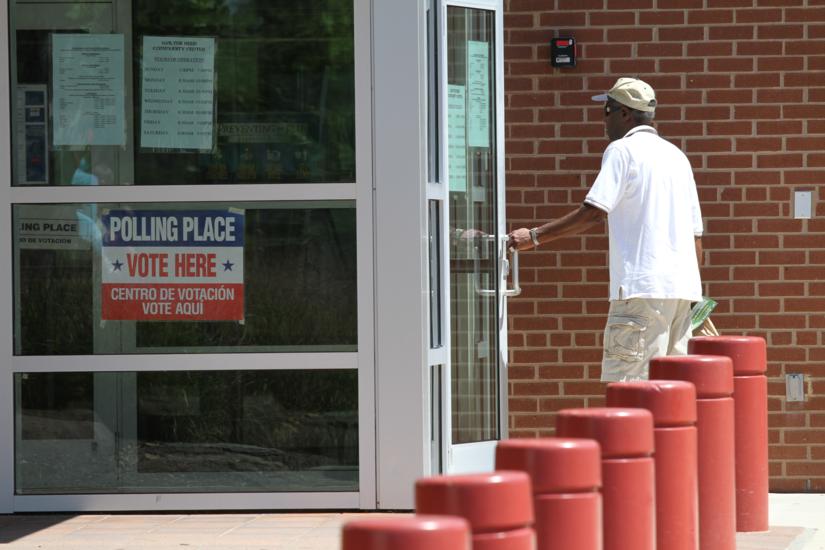
Voting at the Walter Reed Recreation Center (file photo)Update at 10:30 a.m. — Jeb Bush’s name was accidentally left off the GOP poll for about 20 minutes after publication. It has since been added. ARLnow.com regrets the omission. 

Donald Trump and Bernie Sanders were the big winners in yesterday’s New Hampshire primary.

How will “outsider” candidates Trump and Sanders fare in Arlington, when the Virginia presidential primary takes place on Super Tuesday, March 1? Let’s find out.

The following polls reflect the Virginia presidential ballot as approved in December. If you’re planning to vote, let us know who you’re planning to vote for on March 1.


Larry RobertsProgressive Voice is a weekly opinion column. The views and opinions expressed in the column are those of the individual authors and do not necessarily reflect the views of their organizations or ARLnow.com.

By Lawrence Roberts

57 years ago this week, Arlington was at the epicenter of a quake that shook the foundations of the conservative, segregationist establishment in Virginia that was devoted to “Massive Resistance” against school integration.

On the morning of February 2, 1959, four young African-American students enrolled for classes at Stratford Junior High School (now home of the H-B Woodlawn and Stratford programs). They did so after January 1959 state and federal courts rulings that struck down key Massive Resistance laws as unconstitutional.

The integration of Stratford – together with 17 African-American students in Norfolk entering previously all-white schools – marked the first time that any of Virginia’s K-12 schools were integrated, nearly five years after the U.S. Supreme Court had ordered the end of segregated schools in Brown v. Board of Education.

It would be many more years before integration became a reality across the Commonwealth. The death knell for segregation in Virginia occurred in 1970 when Governor Linwood Holton became the first Virginia Governor to support integration by using his inaugural speech to call for an end to racial discrimination in Virginia.

Later that year, Holton escorted his daughter to begin classes at the nearly all-black John F. Kennedy High School in August 1971. A photo of that event was seen across the country and appeared on the front page of the New York Times.

Gov. Holton’s actions had the intended effect of providing opportunities for service by African Americans at high levels of government in Virginia and also to make Virginia part of a “New South” movement to make the region more competitive for economic development, entrepreneurs, tourists and top students from around the country and the world.

All of Virginia’s progress on integration and greater educational opportunity over the ensuing decades was possible because of the brave actions of Arlingtonians who helped bring about the integration of Stratford in February 1959.

The bravery was most evident on the part of the four students – Ronald Deskins, Michael Jones, Lance Newman and Gloria Thompson. But many others – parents, teachers, administrators, School Board members, lawyers, judges, law enforcement officers, and community leaders – both black and white – were integral to the many years of effort that led to making that moment a reality.

Stories about this bravery were kept alive over time through the efforts of parents and community leaders who had been involved.

Broader recognition of the events of February 1959 was spurred by Arlington Educational Television’s 2001 production of a documentary “It’s Just Me: The Integration of the Arlington Public Schools.”

On the 50th anniversary in February 2009, then Governor (now U.S. Senator) Tim Kaine and First Lady Anne Holton (daughter of Linwood Holton and now Virginia’s Secretary of Education) joined the Arlington community in remembering Stratford’s historic significance.

And this week, Arlington County, Arlington Public Schools, NAACP-Arlington Branch and the Black Heritage Museum of Arlington invited the community to an event honoring those who fought for school integration and made history at Stratford.

The hundreds in attendance heard from our County and School Board Chairs (Libby Garvey and Emma Violand-Sanchez), the presidents of the local NAACP and Black Heritage Museum (Karen Nightengale and Craig Syphax), and a panel that included among others three of the four African-American students who enrolled at Stratford in February 1959 and a 104 year old former Stratford teacher who welcomed two of the four students to her classroom that day.

If you would like additional information about this proud moment in Arlington history, good places to start are the APS website and the Arlington Public Library website. The 2001 documentary is available on YouTube.

Larry Roberts is a 30-year resident of Arlington and an attorney in private practice. He chaired two successful statewide campaigns and is a former Chair of the Arlington County Democratic Committee.


peter_rousselot_2014-12-27_for_facebookPeter’s Take is a weekly opinion column. The views and opinions expressed in this column are those of the author and do not necessarily reflect the views of ARLnow.com. 

The Arlington County Board should adopt a formal numerical target of adding a minimum annual average of 3 acres of County parkland for the next 10 years. A recent paper produced by the Arlington County Civic Federation’s (ACCF’s) Parks & Recreation Committee presents a compelling case to support the adoption of this numerical target.

Parks are a critical core service

Public parks and recreational facilities are a core government service. Parks are critical to the quality of life and health of Arlington’s residents and to environmental sustainability.

As I noted in an earlier column  , parks reinforce our social fabric, providing opportunities to socialize and exercise. Trees, shrubs and grass reduce air pollution, decrease storm-water runoff, and ameliorate the urban heat-island effect with shade and cooling.

Acquiring more parkland is vital

More County parkland represents an investment in Arlington’s future. Current demand for parks and recreational facilities far exceeds supply because land acquisition has lagged behind population growth.

The County projects adding over 75,000 new residents by 2040. Nearly all new households will be located in multifamily buildings with little open/green space of their own–meaning demand for open, green, and recreational spaces will become even more acute.

We can’t rely solely on sharing community facilities to solve our present and projected parkland shortfall. The 2015 Arlington Community Facilities Study noted the following on p. 56: “Although there are success stories from sharing facility resources, the open space system has been pressured by recent and forecasted population growth.”

In 1995, Arlington County had 10.8 acres of parkland per 1,000 residents. By 2014, the parkland-to-population ratio declined to 7.9 acres per 1,000 residents. However, in high-density corridors like the R-B corridor, parkland acreage per 1,000 residents is considerably lower than these averages.

Our neighbors are doing much better: DC has 13.2 acres of parkland per 1,000 residents; Fairfax County has over 20 acres of parkland per 1,000 residents and is planning to purchase an additional 2,015 acres for parks. Nationally, compared to other high-density communities, Arlington falls behind Los Angeles, Seattle, Minneapolis, the District of Columbia and Oakland. [Source: TPL’s 2015 City Park Facts, p. 10]

Why 3 acres per year?

Over a 20-year period, Arlington County acquired an annual average of 3.8 acres of new public parkland. The most recent trend has been lower–just 0.63 acres were purchased in 2015. Whereas a higher acreage figure could be justified given the 20-year average, current unmet demand and projected population increases, ACCF’s Parks & Recreation Committee settled on the 3-acre target because it represents a practical, reasonable goal that helps correct the recent downward trend.

Conclusion

On February 2, with only one dissenting vote out of over 60 cast, the ACCF approved a resolution that the County Board should add a minimum annual average of 3 acres of County parkland for the next 10 years. The County Board should do so.


Mark KellyThe Right Note is a weekly opinion column. The views and opinions expressed in the column are those of the author and do not necessarily reflect the views of ARLnow.com.

In every press release, Arlington refers to itself as a “world-class residential, business and tourist location”. It ends the standard paragraph with “Arlington stands out as one of America’s preeminent places to live, visit and do business.” It is easy to find support for that statement and fault with it, depending on who you talk to in Arlington.

Our main economic engine, the federal government, is not going out of business any time soon. The question is, will Arlington put itself in a position to maximize the health of our economy to withstand any BRAC-like changes in the future? And, will it do it by empowering businesses to grow rather than by taxpayer-funded shiny objects like streetcars, swimming pools and gondolas?

Now that Mark Schwartz* is our County Manager, I hope he will accept the challenge to look at every aspect of Arlington’s budget and ongoing day-to-day operations. If he takes a reform-minded approach rather than embracing the status quo, we will all be better off for it.

Over the next two weeks Schwartz and his team will put the finishing touches on the Manager’s proposed budget.

If you read the Budget Guidance from the County Board, it does represent a fairly fiscally responsible path forward. No tax rate increase. Consider tax rate cuts if revenues exceed 2.4% in growth. Present options for program reductions or eliminations as well as for the elimination of duplication and inefficiencies, including partnerships with the school system.

The Board has been known to ignore its own guidance before, and could very well do it again, but this is a good place to start.

The Manager should also put in the FY 2017 budget proposal parameters for closeout spending. What projects does he support spending extra revenue on or would he support giving that money back to the taxpayers? By doing so, the closeout process would be subject to the same scrutiny in public budget hearings as every other line item in the budget.

Finally, the Manager should also give a detailed report on the revenue estimating process. As noted in this column multiple times, revenues in recent history have without fail been underestimated when the budget is passed. This is what gives the Board the opportunity to spend tens of millions each year in the closeout process.

Speaking of the Budget, A Word on Bikes

When it comes to the Bikeshare program in the region, it seems few people care deeply about it as an issue. But the ones who do have extremely strong opinions on it, on both sides. Whether you’re for it or against it, one thing is for sure, eventually it’s cheaper to buy every Bikeshare member their own bike and lock.

*Last week I failed to properly proofread my column and referred to Mark Schwartz as “Michael”. For those who missed the correction, my apologies again for the error.


Snow plow on Jan. 24, 2016The blizzard of 2016 is long gone, but reminders of it are still piled high on the side of local roads and parking lots.

Life has largely returned to normal — students went back to school today for the first time since Wednesday, Jan. 20 — though there are scattered reports of continued mail delivery issues.

It was a Herculean task to clear two feet of snow from local roads. Though major arteries were plowed and made passable pretty quickly, as usually happens with large snow storms in Arlington the residential streets remained snow-covered and treacherous for days, prompting complaints.

Overall, how would you grade Arlington’s snow removal effort?


View More Stories