Progressive Voice is a weekly opinion column. The views and opinions expressed in this column are those of the individual author and do not necessarily reflect the views of ARLnow.com.
Andrew Schneider(Updated at 2:50 p.m.) The week of Nov. 17 was a busy one in Arlington.

On Monday, the County Board voted to cancel further work on the Arlington/Fairfax streetcar project after more than a decade of community planning and involvement. This decision, like the streetcar itself, has proven to be controversial — for some in terms of outcome and for others in terms of process. Both streetcar supporters and advocates for alternatives saw reasons to be disappointed.

Most people, whatever their streetcar views, were caught by surprise. Many wondered about a clear path forward to address congestion on Columbia Pike and grow our commercial tax base to support services that remain a reason so many people find Arlington an attractive place to live. The element of surprise suggests we still need to be aware of ways in which county leaders and Arlington residents can be better connected.

The evening after the streetcar announcement, over 100 Arlington residents from four Civic Associations gathered for nearly two hours at the Langston Brown Community Center to discuss their views on the future of Lee Highway. In my four years as Yorktown Civic Association President attending many meetings, this was one of the most positive representations of civic engagement I’ve seen.

How to reconcile these events? The streetcar announcement suggests a major change in direction for our county. The community meeting indicates that the “Arlington Way” — shorthand for deliberative community involvement and inclusion — is alive and well. Having talked with many leaders of all types and vantage points across the county, I hear from many that the process is broken and from many others that the process is alive and well. My conclusion is that we have entered a new era that will take time to sift through.

I believe that Arlington is alive and well. Our schools are strong, our economy is still bolstered by proximity to Washington and forethought of Arlington’s leaders in previous generations. We have an active and engaged citizenry. Yet, something has changed and we are at a pivot point.

Schools consume half of the county’s budget, yet too many residents question whether we have the efficiency, transparency and consistency we should expect from a $500 million entity.

Our commercial sector has historically high vacancy rates and faces competitive pressures not seen recently. With the downsizing of the federal government and competition from Tysons, Reston, Alexandria and other locations, Arlington is facing questions about how we can better attract businesses and make sure they stay in Arlington once they are here.

This is important because nearly 50 percent of real estate property taxes are commercial and nearly 60 percent of the county’s operating budgets come from real estate taxes.

These challenges come when there are questions about how different communities and “regions” of Arlington relate to one another and there are significantly different perceptions about what our county needs or should look like — even though we need greater county unity to meet the challenges we face.

How best to succeed in such an environment? I have recently been reading a book titled “Citizenville” by California Lt. Gov. (and former San Francisco Mayor) Gavin Newsom. Newsom addresses how governments can better connect with residents through innovation and technology. Newsome would likely applaud how much Arlington has done right — embracing and using technology and innovation in ways that most communities would envy and be wise to emulate. (more…)

Progressive Voice is a weekly opinion column. The views and opinions expressed in this column are those of the individual author and do not necessarily reflect the views of ARLnow.com.

Krysta JonesArlington is grappling with issues common to communities with urban areas. We can remain inclusive and value diversity as we progress and seek to remain competitive, but we must consider the importance of affordable housing as part of that competitive edge.

The need for affordable housing evokes different images — providing shelter for families in need; allowing lower-income workers to live closer to their jobs and to transit, promoting economic activity without adding to congestion; encouraging greater diversity and inclusion; aging in place without having to give up one’s home as real estate prices rise; strengthening and stabilizing communities; and, for some, housing “projects” and crime.

Arlington has attempted to maintain affordable housing as the cost of living has increased. In 1975, AHC, Inc., began working as a nonprofit affordable housing developer. In 1989, the Arlington Partnership for Affordable Housing was founded to develop and preserve quality rental communities for individuals and families earning approximately $20,000-$60,000 per year.

Housing is considered affordable when rent or mortgage, plus utilities, is no more than 30 percent of a household’s gross income. Across the nation, an estimated 12 million renter and homeowner households pay more than 50 percent of their annual incomes for housing. In 2012, average rents in Arlington increased to $1,999.

One must make generally make 60 percent or less of the area median income to qualify for affordable housing, which in Arlington is $45,180 for a single person.

Arlington County provides affordable housing by expanding the supply of Committed Affordable Units (CAFs) for low-income residents, and offering Market-Rate Affordable Units which are owned by the private market and tend to have higher monthly rents.

According to a 2011 literature review by the Center for Housing Policy, “the development of affordable housing increases spending and employment in the surrounding economy, acts as an important source of revenue for local governments, and reduces the likelihood of foreclosure and its associated costs.”

In 2012 the County commissioned a three-year task force to create a shared community affordable housing vision, but not everyone is happy with the direction of affordable housing in Arlington.

  • Although it ultimately failed, in 2013 the Arlington Green Party (AGP) spearheaded a ballot initiative to create a low income housing authority. In a 2013 Washington Post article, AGP chairman Steve Davis noted, “…a housing authority would raise funds more easily, lower administrative costs, and provide more affordable rental units.”
  • The County offered developers more density for their projects if they preserved 6,200 units of affordable housing on Columbia Pike as a part of the Columbia Pike Revitalization Plan. It is unclear whether developers will still be interested in building and preserving affordable units in light of the recent streetcar project cancellation.
  • Under the Public Land for Public Good program, the county identified three to five publicly owned sites with the greatest potential for affordable housing development in the next 10 years. Yet, the Long Range Planning Committee of the county Planning Commission recommended that the program be “set aside” and the Arlington County Civic Federation is asking the County to start over — both citing a need for more public input.
  • Additionally, Columbia Heights West, the civic association that encompasses the new Arlington Mill Residences, is an advocate for more affordable housing in Arlington, but questions the high concentration of affordable housing in some neighborhoods. Early drafts of the Affordable Housing Working Group study included a provision to ensure more affordable housing throughout the county, but it was deleted by the Long Range Planning Committee.

(more…)


Peter’s Take is a weekly opinion column. The views and opinions expressed in this column are those of the author and do not necessarily reflect the views of ARLnow.com.

Peter RousselotIn a Nov. 13 column, I urged Arlington Public Schools and the Arlington County government to collaborate in thinking way outside the box in selecting sites for new school facilities.

Today, I urge them to be similarly creative and flexible in designing those new facilities.

Our neighbor, Fairfax County, has provided an example of such creativity and flexibility with the September opening of a new elementary school in vacant office space at Bailey’s crossroads. “As we continue to be a fast-growing school system and property becomes harder to come by, we will have to think differently” about school design, said Superintendent Karen Garza. “Vertical buildings will be part of our plan throughout the county.”

With roughly one-tenth the land area of Fairfax, Arlington must place even greater emphasis on vertical facilities. There are many obstacles to overcome, but we must come together as a community to overcome them.

Arlington need not re-invent the wheel on this issue. For example, several years ago, the state of Maryland prepared a study on vertical public school design. In a 14-page report, the Maryland study team summarized:

  • its methodology
  • the problems and issues it encountered, and
  • a series of possible solutions

The Maryland study team included public and private sector representatives from across the state. Many other localities in the U.S. (e.g., Los Angeles) and all over the world are planning vertical schools. Via AECOM:

Vertical schools are already being successfully designed and delivered…, including the Hampden Gurney primary school in London. … [T]his school [is] to be constructed over 6 levels on a space-restricted site. Incorporating a playground on the roof with play decks on intermediate floors, schools like this are set to inform the design process for similar schools in Australia.

So what’s driving the growth of these schools as opposed to more conventionally designed ones? … Population growth is seeing young families settle in high-density areas, attracted by associated lifestyle benefits that also make the “traditional” school design model harder to achieve.

Sound familiar?

Vertical schools are just one example of the kind of flexibility and creativity Arlington needs in order to address the design issues presented by the school capacity crisis. A whole host of other issues need to be on the table, for example: how existing space within current school facilities could be re-designed in order to be more effectively utilized.

Since incremental funds to address the school capacity crisis deserve the highest priority in our County budget, a portion of our community resources should be devoted to innovative school facility design.

Peter Rousselot is a former member of the Central Committee of the Democratic Party of Virginia and former chair of the Arlington County Democratic Committee.


The Right Note is a weekly opinion column. The views and opinions expressed in the column are those of the author and do not necessarily reflect the views of ARLnow.com.

Mark Kelly

Earlier this week, a story appeared here on ARLnow posing a question of whether the County Board should require developers to make a contribution to schools as one of the community benefits required for additional density.

Though the exact number varies from year to year, roughly 46 cents of every tax dollar in Arlington goes to the school system per a loosely defined revenue sharing agreement. One could argue developers could do more for schools, but for each additional tax dollar generated by new development, the schools already receive a significant ongoing, rather than one-time, benefit.

This ongoing property tax revenue benefit works this way except for the two areas operating under a Tax Increment Financing District (TIF). Arlington currently has two TIFs in Crystal City and along Columbia Pike — not coincidentally in the areas that would have been impacted by the now-cancelled streetcar system.

When there is a TIF in place, a percentage of future tax revenue is set aside to be used in the areas covered by the TIF. In other words, those tax revenues are no longer shared with the schools, or the rest of the general budget, in the same way as they are throughout the rest of the county.

For the Crystal City TIF, 33 percent of additional revenue moving forward from January 2011 will stay in Crystal City to pay for infrastructure. Along Columbia Pike, 25 percent of additional revenue will be used for affordable housing on the Pike.

By taking these revenues off the table for decades into the future, it builds in an automatic squeeze on the schools budget, in addition to reducing money available for roads, parks, public safety and other services. And, if past history is any indicator, the solution will be for the County Board to come to the taxpayers throughout the county and tell us they have no choice but to raise all of our taxes again.

Now that the streetcar project has been tabled, it is time for the County Board to revisit the the two TIFs. The Board should eliminate them altogether and fund any needs through the regular budget and bonding processes. A less desirable option is to debate a reduction in the percentages that were originally calculated with the streetcar in mind.

Mark Kelly is a former Arlington GOP Chairman and two-time Republican candidate for Arlington County Board.


ARLnow.com is considering options for building a dedicated mobile app in 2015.

While we believe the experience of visiting ARLnow on a mobile browser is adequate for most users’ needs, there are certain enhancements that a mobile app could bring. For instance, features could include:

  • Breaking news alerts
  • Event calendar optimized for mobile
  • Local-specific weather, traffic and/or transit info
  • Instant deals/coupons at local businesses

If we built such an app, would you use it? Also, tell us in the comments if there are any other features you’d like to see.


Thanksgiving place settings

ARLnow.com is taking a day off for the holiday, but we wanted to wish you and yours a very Happy Thanksgiving.

Thanks in part to the status of “Black Friday” as the most prominent shopping day of the year, Thanksgiving seems to be getting ever more commercialized. At its heart, however the holiday is about recognizing and giving thanks for the blessings of our lives.

If you’re taking a break between cooking dinner, watching parades and football, and reminiscing with friends and family, tell us what you’re thankful for this year, in the comments.


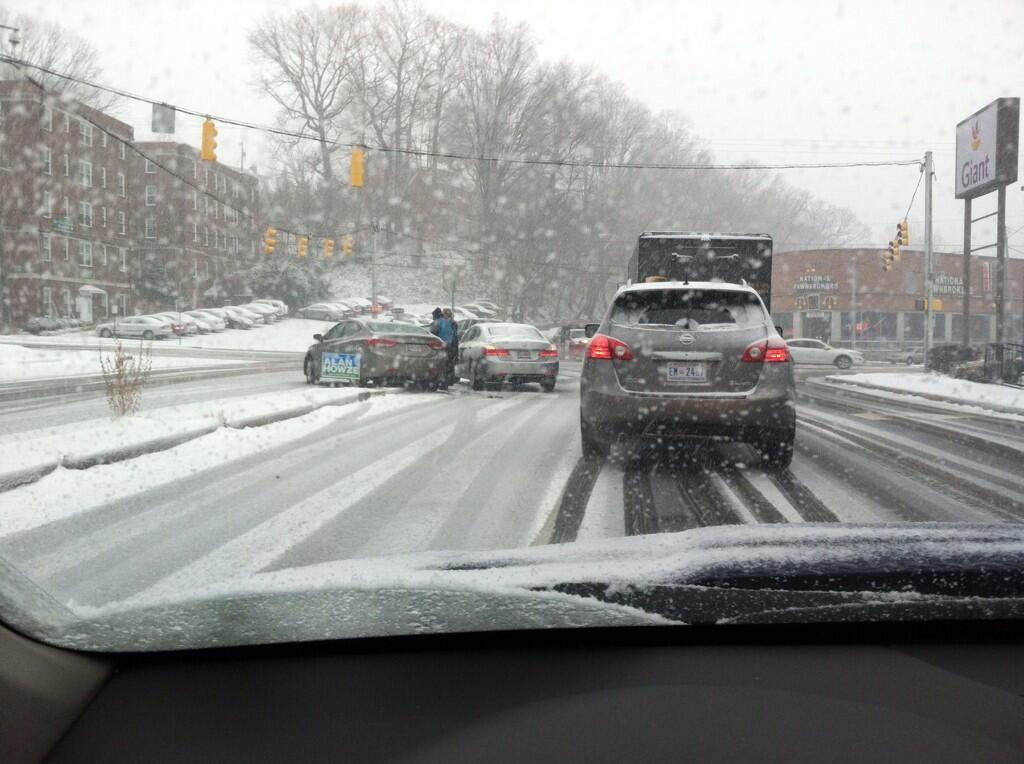
Snowstorm hits Arlington 1/21/14 (Photo courtesy @albers_eric)An east coast storm could bring some sloppy snow and rain to Arlington and up to a half foot of snow accumulation to the outer northern and western parts of the D.C. region tomorrow.

Forecasters say above-freezing temperatures should preclude more than an inch or so of accumulation locally. Still, the storm has the potential to have a major impact on Thanksgiving travel from Washington to Boston on Wednesday.

If you’re planning to travel for the holiday, is the storm affecting your travel plans?


The following letter to the editor was submitted by Columbia Pike resident Nicholas Evans.

I’m not a pro-streetcar zealot. However, living a few blocks from Columbia Pike, I was generally supportive of the streetcar as the best available option to spur growth and alleviate congestion. There was also an element of needing to keep a promise that had been made to developers and local business owners. Nevertheless, I heard and understood the passionate arguments made by many friends of mine in opposition. There are no perfect answers.

With the decision made, we face some new realities. The Columbia Pike area is now a much less attractive place to buy a home or locate a business. More broadly, Arlington has sent a signal to potential residents, businesses and other local governments that it cannot be counted on to hold up its end of the bargain. Governor McAuliffe has been told, “No thanks. Don’t spend transportation money here.” Those are not political statements, but facts. Major policy decisions have consequences.

I take our County Board members at their word that work will continue to develop new transportation options. However, for people who are celebrating, your work is unfinished. Here are your assignments:

  • County Board Member Vihstadt: Congratulations. You successfully provided a channel within the system to defeat the streetcar. Throughout your campaigns, you opposed the streetcar because you wanted to do more for “core services”–education and affordable housing. There is no more streetcar to fight so let’s see you keep your promises. I expect results and, no, you are not allowed to pass the buck on the school overcrowding issue. Education is as core as it gets. Time to get to work.
  • To County Board Member Garvey: You have repeatedly suggested that “money is money” and that there truly wasn’t dedicated money for the streetcar. This was a very effective argument–should we be building this when we have so many other needs? Although I might be disappointed about the streetcar, I am very excited that we now have more money to spend in other areas requiring investment. I would imagine you have some bold and potentially expensive proposals that are ready to go. I look forward to evaluating them.
  • To Neighbors in South Arlington Opposed to the Streetcar: No whining. If development continues along the Pike, you can’t complain about vehicles parked in front of your house and the Pike itself turning into a parking lot choked with all those new drivers. On the flip side, if development stagnates or regresses, no complaining about the lack of restaurants, unsafe streets or crumbling infrastructure.
  • To Neighbors in North Arlington Opposed to the Streetcar: Same as your South Arlington allies. No whining. I’m assuming that the inflammatory stuff I’ve read about North Arlington taxpayers not wanting to spend money in South Arlington is fiction. I have many good friends north of 50 who have opposed this project and I know that’s not their view. Regardless, North Arlington residents won’t feel the same congestion impact except for periodic trips to Dick’s to buy a new set of cleats for their kids. However, if development along the Pike stalls, the tax base won’t broaden. This will be exacerbated as it becomes harder to lure businesses to any part of Arlington–most people won’t locate in a jurisdiction that can’t be trusted to keep its word. As a result, you all will be on the hook to fund an even greater share of the proposals coming from Board Members Vihstadt and Garvey. No whining about any tax hikes.

Finally, there is one team project for everyone identified above. You will continue to be vigilant about spending countywide. There have been plenty of “vanity projects” in my 13 years here and many of you were silent on all of them. I assume at a minimum that you all strongly oppose the proposal to establish a second Metro line through North Arlington. From your perspective, it would seem to be an enormous expense that we cannot afford. I’ll look forward to seeing strong resistance should that project gain momentum. More broadly, I trust that you will be consistent rather than selective in how high you set the bar for all county spending.

ARLnow.com occasionally publishes letters to the editor about local issues. To submit a letter to the editor, please email it to [email protected]. Letters to the editor may be edited for content and brevity.


The Right Note is a weekly opinion column. The views and opinions expressed in the column are those of the author and do not necessarily reflect the views of ARLnow.com.

Mark KellyThe Arlington streetcar is no more. It came just one year after the father of the project, Chris Zimmerman, announced he was resigning. Even the most hopeful of opponents found themselves surprised at the announcement on Tuesday.

Over the course of nearly a decade, a small vocal minority became a silent majority, which became a voting majority against the project. After losing two elections in a row, two of the Board members finally acknowledged public sentiment. Walter Tejada ignored the election results and voted to keep moving forward on the project.

The streetcar project was emblematic of the way the County Board has made decisions in recent memory. When you only talk to people who largely agree with you, you get a feedback loop that too often ignores public sentiment. See also the Artisphere and aquatics center.

Arlingtonians are generally willing to pay more than their fair share of taxes, but now the Board knows they have their limits. Arlingtonians should turn their attention to smaller ticket items in the budget and should hold the Board to account for how they make spending decisions in general. As we dig in further, I think we will find that too often, our elected officials chase a shiny object rather than focus on core services.

So, while defeating a half-a-billion dollar project is good for taxpayers, it is time to get that independent audit function up and running to find savings elsewhere in the budget. We certainly should not be buying the argument that times are tight when Arlington’s per capita spending is $4,623 — or $461 more than our similarly situated neighbor — Alexandria.

On Tuesday, the County Board completed the annual closeout process where they made over $240 million in spending decisions. Included in that process was approval to spend an additional $28.5 million in underestimated real estate tax revenue and $4.2 million in extra personal property tax revenue.

Once again, the revenue estimates on which County Board members based annual budget decisions were way off. Real estate taxes ran 4.7 percent ahead of initial estimates, even with the rate decrease we received in April.

So, it is of little consolation when the Board offered budget guidance Tuesday that would hold tax rates steady. If not a tax rate cut, maybe it is time for a County Board member to call for an annual rebate process. For instance, if real estate revenues ran more than 1 percent ahead of budget, the excess would automatically be rebated to taxpayers rather than spent.

If we start to limit the revenue the Board has available to spend, it will force them to make better budget decisions. A rebate may be a bold proposal for Arlington, but now is the time for bold.

Mark Kelly is a former Arlington GOP Chairman and two-time Republican candidate for Arlington County Board.


Progressive Voice is a weekly opinion column. The views and opinions expressed in this column are those of the individual author and do not necessarily reflect the views of ARLnow.com.

Ginger BrownAs Arlington faces challenges that are not easy to resolve, it is important to take note of a recent success story about Arlingtonians working together to build consensus around a dynamic vision for the future of a neighborhood.

During a two-year process driven by resident input and feedback, the Waverly Hills Civic Association (WHCA) developed the Waverly Hills Neighborhood Conservation Plan (NCP) — a document that fosters a more closely knit community, identifies citizen-driven capital improvement projects, and lays out a dynamic vision for the future of our neighborhood.

Last Saturday, the WHCA’s hard work resulted in a unanimous vote by the Arlington County Board to approve the NCP. The WHCA members’ consensus building efforts are a testament to the power of grassroots, citizen-led planning and to the trust placed by the County in the NCP process as a way to improve neighborhoods and help them thrive.

The creation of the WHCA’s NCP was an exercise in community building. Different generations with varying needs came together to forge an updated vision for Waverly Hills. All of us who participated received an education about the neighborhood’s rich history, its connections to Lee Highway, and its perceived strengths and weaknesses. Long-time residents listened to the concerns of newcomers, and vice versa. Neighborhood residents built shared understanding and trust through well-attended brunches, bake sales, and happy hours.

Through its process, the WHCA identified several capital improvement projects that would be beneficial to the neighborhood and around which consensus had developed, focused principally on Woodstock Park and pedestrian safety.

Woodstock Park — like most parks in Arlington — is a valuable resource. WHCA reached a consensus that the park should be more than just a children’s play area; it should be place for all ages to enjoy. A section of the park was identified as a top-priority capital improvement project, which will result in the addition of recreational uses primarily for adults such as a formal garden area for reading, chess tables, and a place for yoga classes.

The WHCA NCP also included spending recommendations for sidewalks and other pedestrian safety projects. Waverly Hills is within walking distance of Lee Highway and Ballston, both of which are major transportation and shopping hubs. We are also proximate to three schools — Glebe Elementary, Washington-Lee High School and the H-B Woodlawn Secondary Program — that are experiencing the capacity challenges that come with increased enrollment. Because sidewalks are expensive, the WHCA prioritized projects that connect residents to transit, shopping, schools, and parks.

The WHCA NCP also addresses critical issues confronting seniors in our community. Seventy percent of Waverly Hills’ residents expect to retire in the neighborhood. This has prompted a community goal of creating a comprehensive aging-in-place strategy, including supporting the “Villages” concept, expanding senior housing options so that seniors can stay in the neighborhood, and ensuring that the local hospital has the capacity to keep up with the coming wave of healthcare demands.

This vision for Waverly Hills is ambitious, but it is also workable and affordable. Hopefully, the successful implementation of the NCP will help create bonds within the neighborhood and restore faith in the ability of Arlingtonians to work together in a fiscally responsible manner to enhance the quality of life for our residents and to improve a neighborhood that is rich in history and tradition.

Ginger Brown is the immediate past president of the Waverly Hills Civic Association. She is a co-founder of the Lee Highway Alliance and currently serves on the Arlington County Planning Commission.


Peter’s Take is a weekly opinion column. The views and opinions expressed in this column are those of the author and do not necessarily reflect the views of ARLnow.com.

Peter RousselotOn Nov. 18, four members of the Arlington County Board (Jay Fisette, Mary Hynes, Libby Garvey and John Vihstadt) voted to cancel Arlington’s $500 million+ streetcar projects. I commend Jay Fisette and Mary Hynes for this statesman-like vote.

For all of the reasons outlined on the website www.sensibletransit.org of Arlingtonians for Sensible Transit (AST), the vote to cancel Arlington’s streetcar projects also was the right decision as a matter of transportation policy — as Garvey and Vihstadt recognized previously.

On Nov. 18, the County Board also issued guidance to the County Manager to prepare the County’s FY 2016 operating budget.

Although a majority of the Board now has voted to cancel Arlington’s streetcar projects, the Board’s new budget guidance continues to reflect many other flawed priorities of County Board members Fisette, Hynes, and Tejada. Fisette, Hynes and Tejada still have the votes on our five-member Board to pass budget guidance that incorporates priorities that are wrong for Arlington.

Here are some examples of alternative budget guidance that our County Board should have given the County Manager, but failed to give:

  • our highest priority is to fund Arlington Public Schools (including incremental funds to address the school capacity crisis);
  • the School Board has asked the County Board to increase its transfer to APS to cover the cost of enrollment growth, a step increase for its employees and to eliminate early release days at the four remaining schools that still provide early release. The County’s actual budget guidance will leave APS with a shortfall of $23.8 million; that $23.8 million shortfall should be restored;
  • redirect funding toward other core services such as basic infrastructure maintenance (roads, water mains, sewers), sensible transit, and public safety; finance this redirection of funds by comparable cuts in other programs and operations;
  • working collaboratively with Fairfax and Alexandria, retain truly independent transportation experts to prepare an operating plan for a robust regional BRT system serving the Columbia Pike, Route 1/Crystal City, and other appropriate transit corridors;
  • provide alternative plans for use of the $80+ million currently set aside for the capital costs of the Aquatics Center because we have decided to cancel this project as it is currently designed; Arlington cannot afford to pay the currently estimated $4 million per year to operate such a facility.
  • provide a cut in the property tax rate of no less than 1 cent.

Conclusion

Like every other community in America, Arlington must set priorities for how it spends its money. If everything is a priority, nothing truly can be a priority. Leadership involves explaining why some programs and projects must be cut in order to fully fund other programs and projects that have a higher priority.

Many of Arlington’s priorities are right. Certain of Arlington’s priorities are wrong. Arlington should continue to change those of its priorities that are wrong.

Peter Rousselot is a former member of the Central Committee of the Democratic Party of Virginia and former chair of the Arlington County Democratic Committee.


View More Stories